Quite a bit of it, in fact. Also for breakfast. I was planning on spending the weekend reading a pile of articles, but life intervened. Since I’m going to be traveling so much, there were a bunch of things I just had to get taken care of before Tuesday morning. And I did need a little down time.
For one thing, I had a thawed goose I had to deal with. The meat became a very nice stew with apples & gooseberries ( and a bit of apple brandy) and the carcase made some nice goose stock. The bones are now reposing in the qanitchaq (arctic entryway) to become a lab exercise.
Then we had to put the slipcover back on the sofa. What a job! But it does look a lot nicer after being washed. Got caught up with the laundry, figured out what I need to pack for the next trip, started some no-knead bread, watered the flowers (the big ones need it several times a day) and then got started on the reading.
This morning I was contacted by folks from Ilisaġvik who were trying to finalize the catalog for spring. Assuming there are enough students (courses taught by adjuncts don’t go unless there are at least 5), I’ll be doing a Fundamentals of Archaeology and a Lab Methods course. The idea is to do them as distance-delivered, with a lab that is in-person for the lab course. People in Barrow can take the lab during the semester, and it can also be offered as a summer camp for those who are outside of Barrow. Today it became clear the lab needed to be a separate course to fit into the catalog format, so I had to hurry up and do a course description for the lab and a new one for the course leaving out the lab components. Then the bread had to be baked & now back to reading articles.
On Friday afternoon we headed to Point Barrow. I’d gotten KTUU set up with Aarigaa Tours, who picked them up in town at Top of the World Hotel, and then picked me up at my house at NARL on the way out to the point. I’d run home from work to change into my warm gear. A good thing, too, as will become clear later.
We’d been having a pretty strong blow from the NNW, and waves had actually been coming up onto the road. The road to the point had actually been closed right by Piġniq (Birnirk), because the waves had been breaking over the road and had done some significant damage. We were in a van equipped for off-road travel, so we were OK, but we had to detour through the cabin area. Once past there, the road was still in pretty good shape, but we could see water seeping in under the gravel berm. Once we got out a bit farther we could see a number of vessels & barges that had come into Elson Lagoon to anchor up and wait out the rough weather.
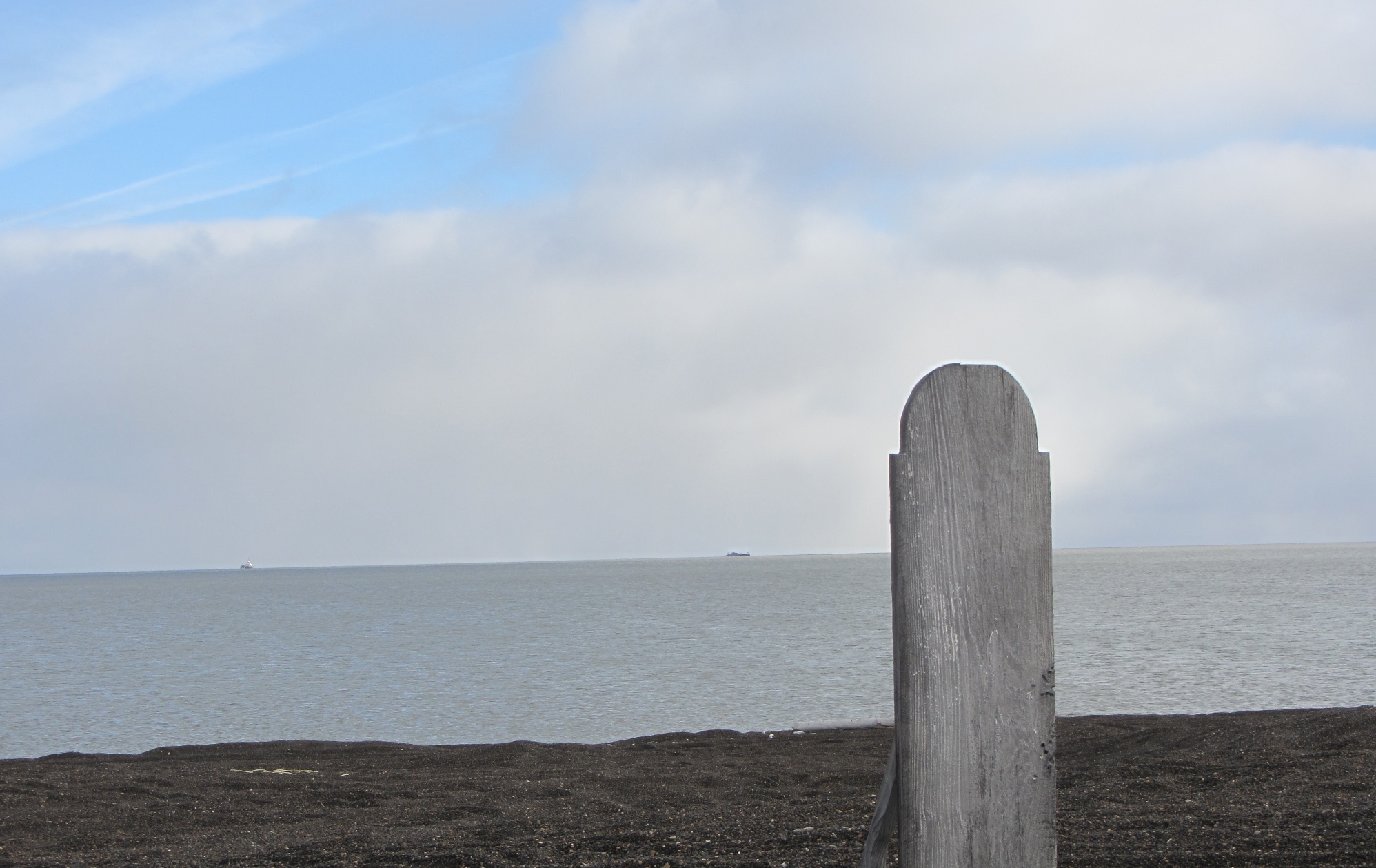
Barges in Elson Lagoon, seen from the trail by the marked graves.
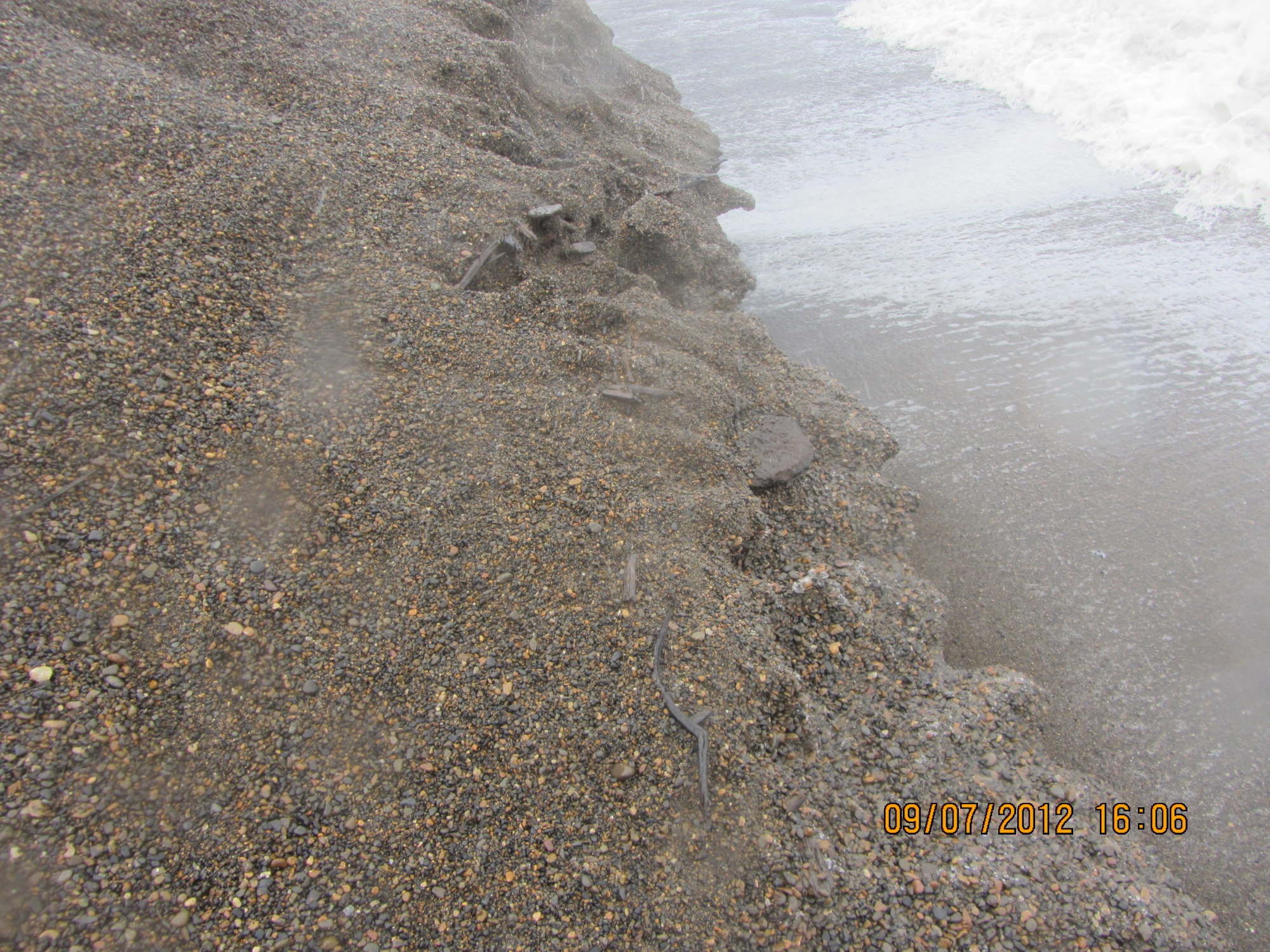
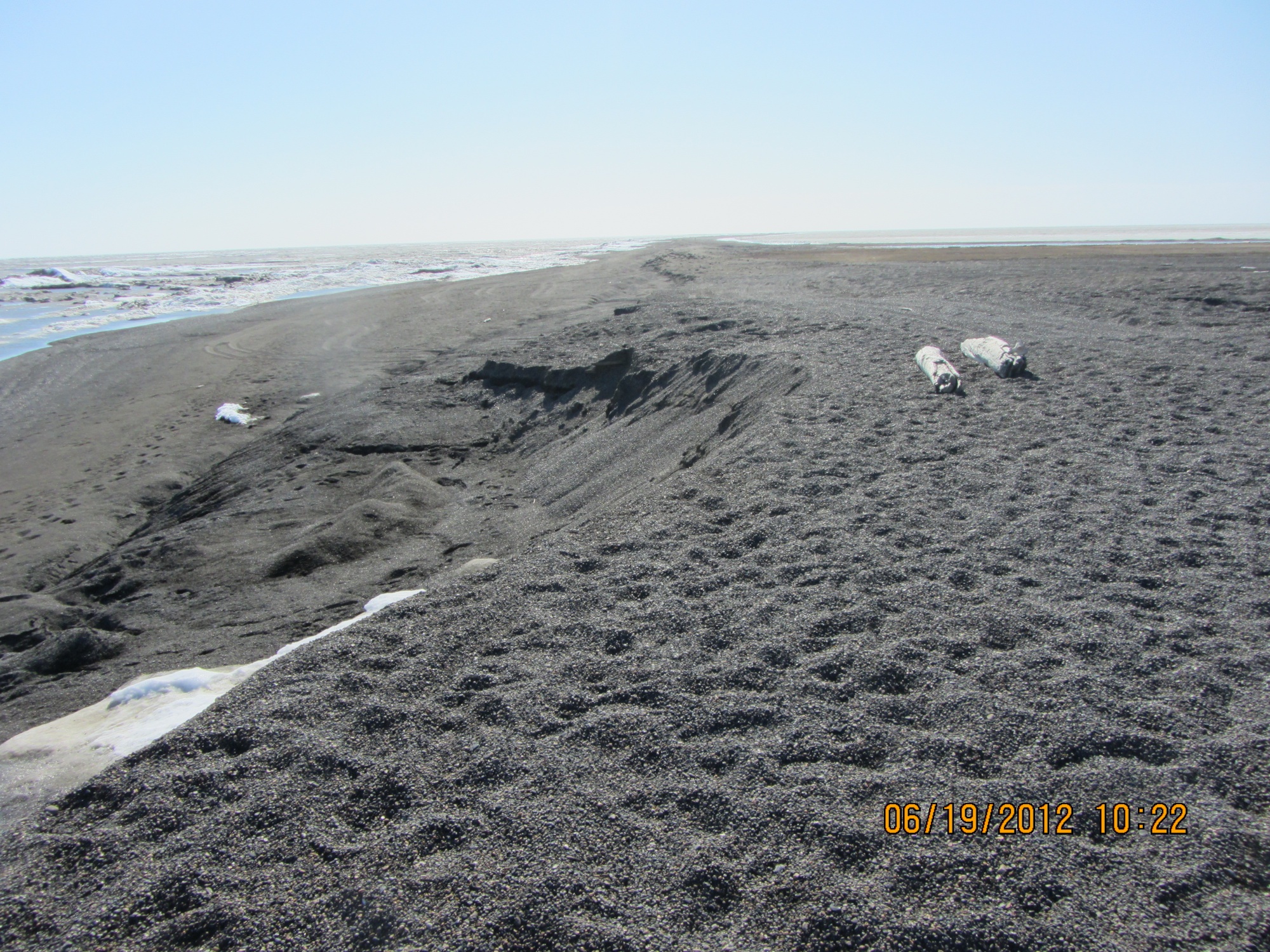
Once we got to Nuvuk and got a look at the site, it was a bit depressing. However, it made a perfect example of coastal erosion in action, and made it really easy to illustrate how information about the past, which could have application to understanding what directions to take to have a sustainable future, is being lost. At least 10 feet (3 m) of the site had been lost to the ocean since couple weeks ago. The gravel slump that had been protecting the face was gone, and thawing permafrost was sticking out and undercut.
Exposed thawing Ipiutak level at Nuvuk.
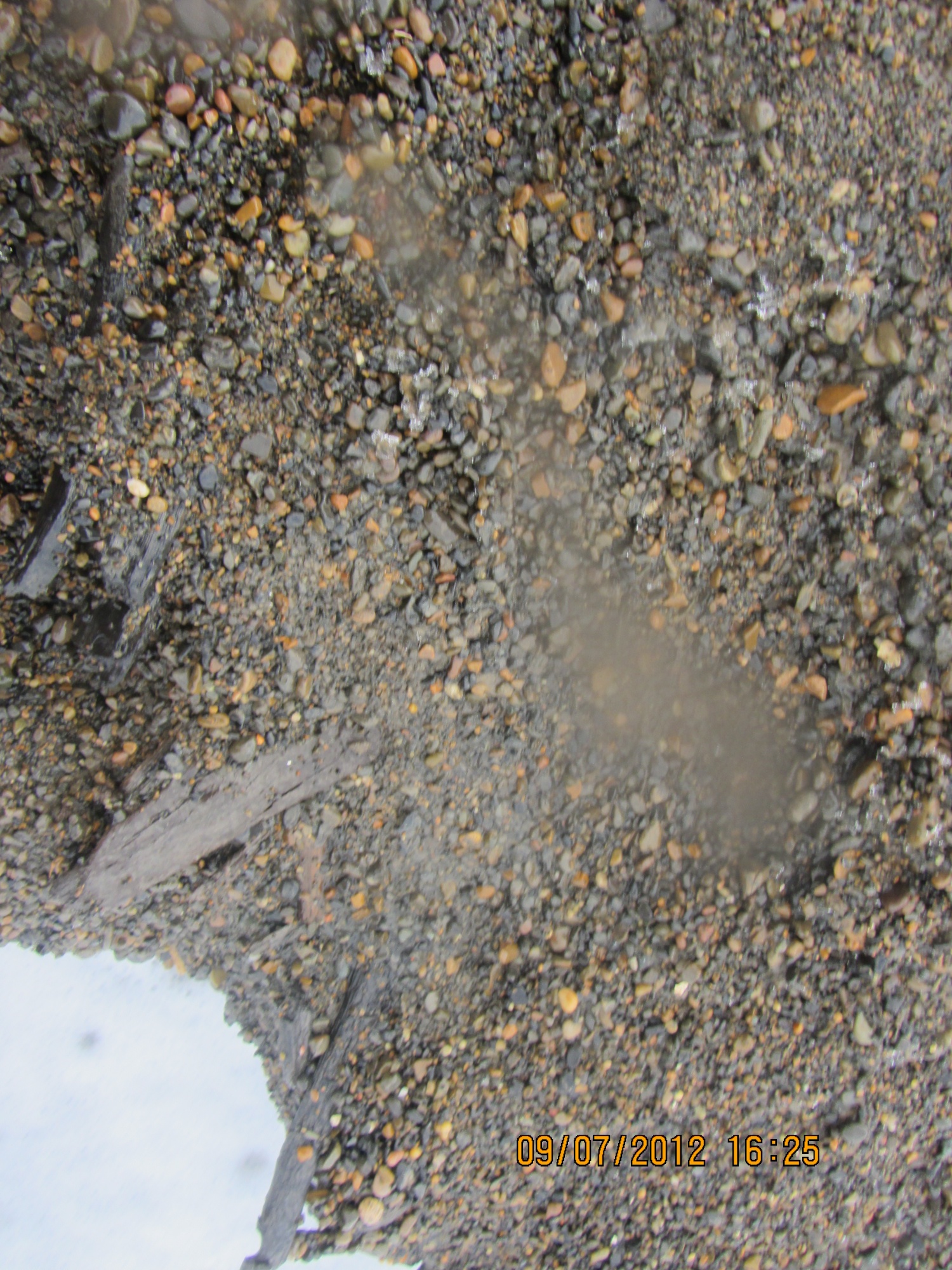
And in that permafrost was the same strandline debris that has proven to be a marker for the Ipiutak occupation. There was a large patch of what looked like fur or peat (which often seems to be found on the floors of Ipiutak structures) and an area where the wood seemed to be far more aligned and level than is normal for a strandline, but would be quite typical for an Ipiutak floor. I tried to get decent pictures, but in the end decided I needed to try to get a sample. I tried walking down on the permafrost, but it was angled, and I couldn’t get close enough without falling off. There were big waves, and the bluff was undercut. If a really big one came at the wrong time, it could wash me off my feet.
Finally, I asked Ricky Bodfish, who was driving the tour van & giving the tour except for the archaeology part, if they had a rope. He did, so he dangled it down the bluff by me, we waited until right after big waves when it looked like a lull and I went down to check it out and try to get close-ups and a sample.
Sampled peat in Ipiutak layer. My finger for scale.
The patch of material turned out to be peat, which I was able to sample, and will send out for dating. My camera got some spray on it, but there was not way or time to clean the lens, so I just kept shooting. Unfortunately a pretty big wave came and dumped gravel on the surfaces just before I got a shot off of the wood, (I managed to turn so I caught it on the side where KTUU’s microphone pack wasn’t) and I could hear the next one was even louder. I ran, and made it into an area above the waves before the big one broke.
Edge of eroding Ipiutak layer showing some of the aligned wood. The white is the foam on the wave that is going under this layer into the bluff.
Fortunately, nothing soaked through the Carhartts so I just took them off for the rest of the trip.
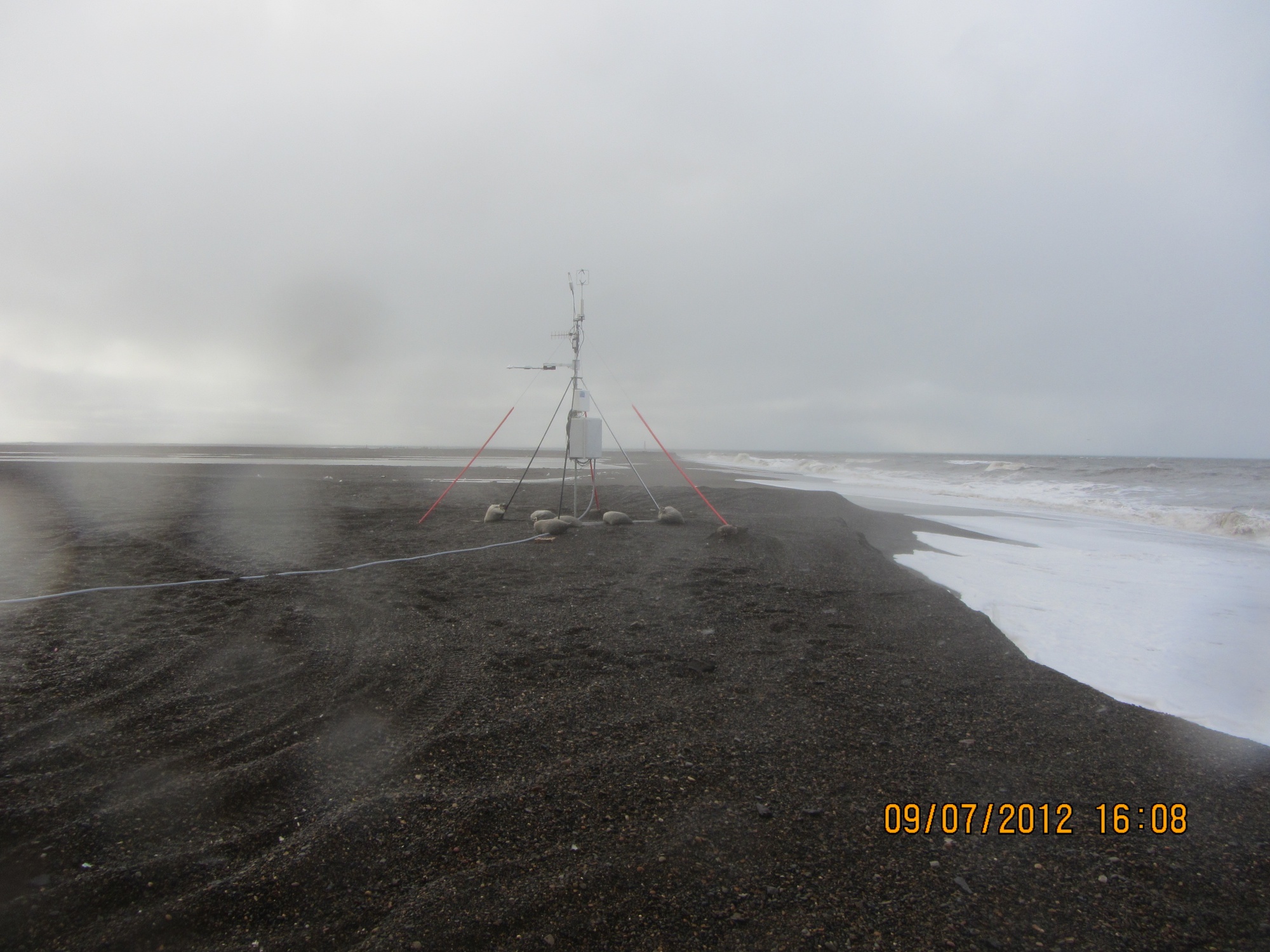
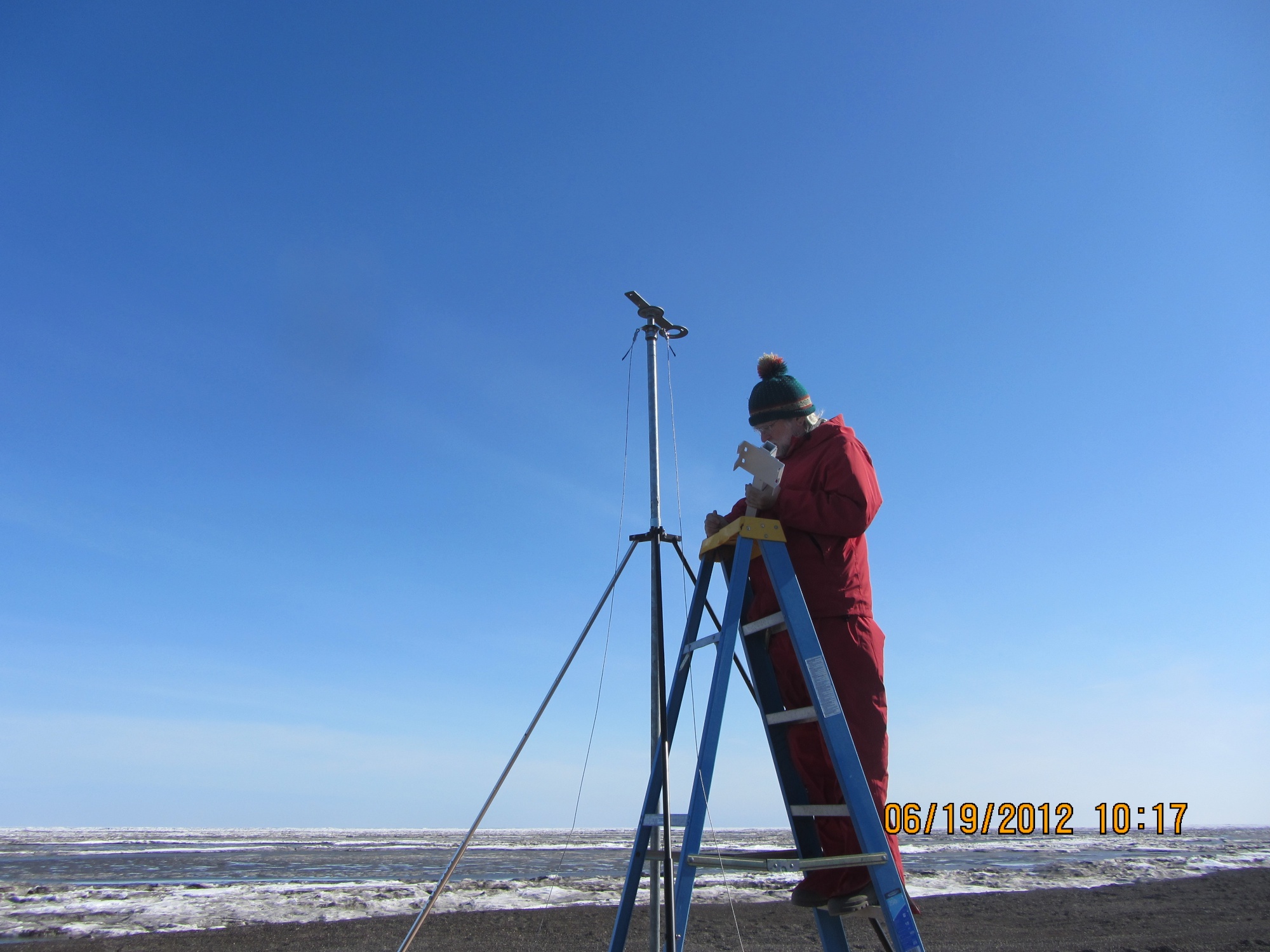
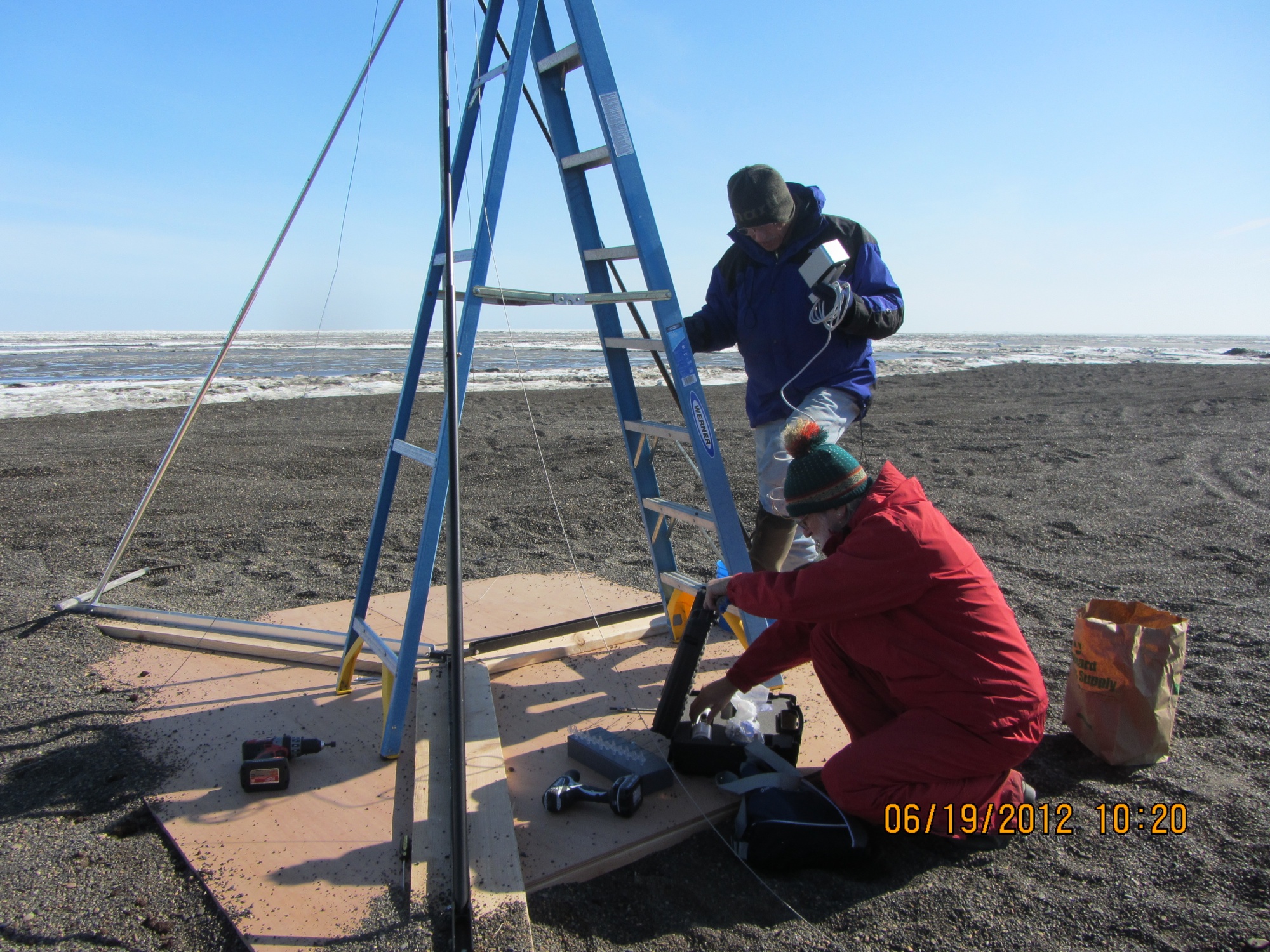
We had been monitoring the tower we’d put out in June, and just a few days earlier had thought it would be fine. However, the storm had taken out a lot of the bluff, and I wound up calling & texting the guys who work on the ARM project for UICS. They wound up going out later that evening and hauling the whole thing about 50 feet (15m) farther back from the edge. Just in time, since by the time they got out there, they figured it was 2-3 feet (< 1m) from the edge.
Getting close to the edge.
After that, the KTUU fellow wanted to see the farthest North point and go to the bone pile to see if there were any bears. We set off, and almost immediately had to detour. The trail we normally use to get to the site, which is always dry, had water all over it from the storm surge.
Trail covered by storm surge.
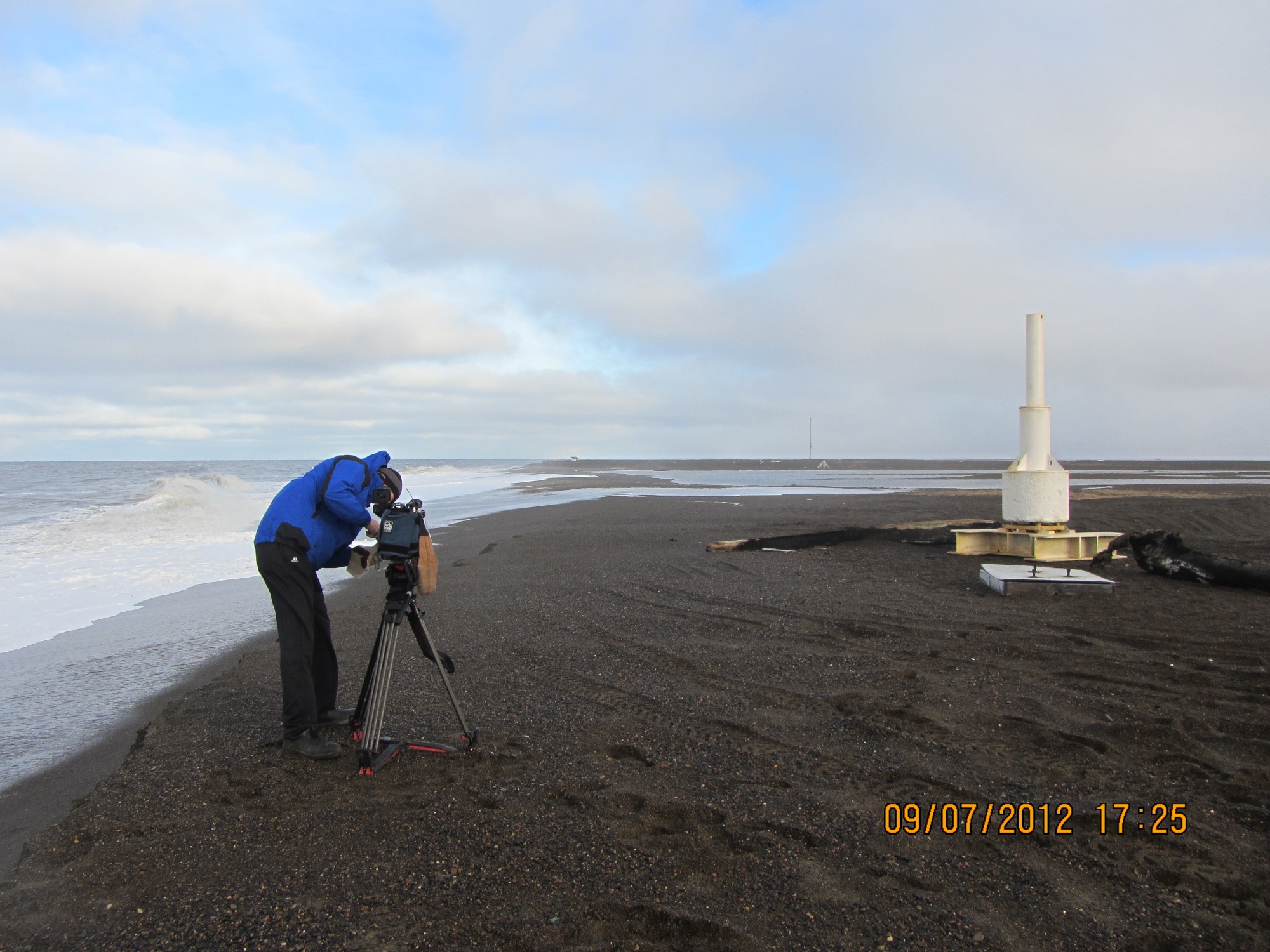
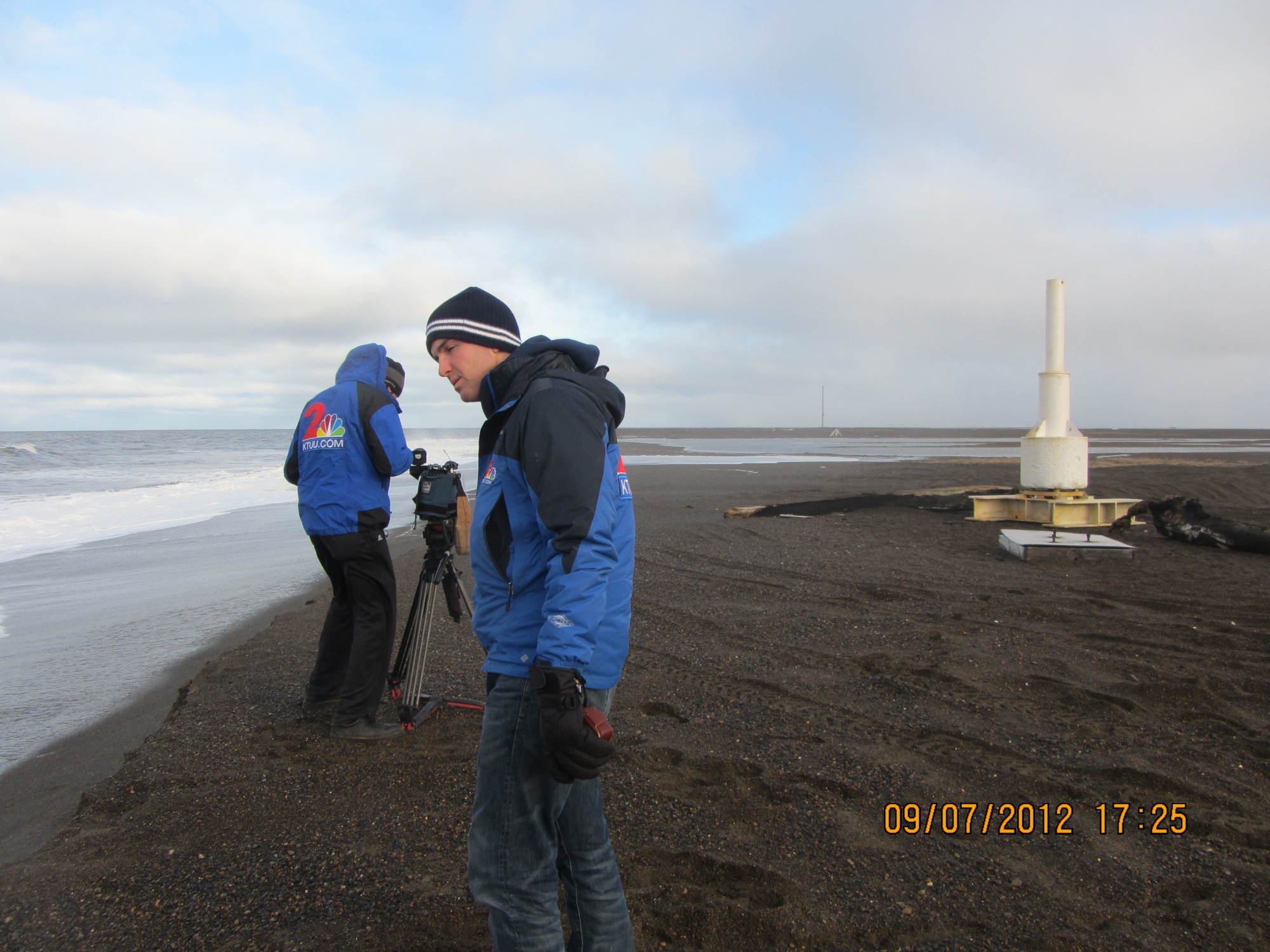
We made it to the farthest North point, which was a bit less far North than previously. The storm surge had made it to the tip of one of the whale jawbones, and about 10 feet was missing here too. However, we did get some nice light, and the KTUU guys got busy.
Crew and van near Farthest North PointDan Carpenter gets ready to shoot at the Farthest North Point.
KTUU crew at Farthest North Point.
Unfortunately, the trip to the bone pile did not come off. The storm surge had caused it to nearly become an island. Ricky was not sure how solid the ground was, and we did not want to get stuck there, so we gave it a miss. On the way back to the road, it was really clear how much of the Chukchi side of the Point Barrow spit had been eaten. The ocean was almost up to the berm along the road, and there used to be a fairly wide strip of gravel there.
The important but not overly exciting routine of proposal preparation & writing on my part, and cataloging on Coby’s part was broken on Friday. KTUU TV, the Anchorage NBS affiliate, sent a crew to Barrow for a few days. They were covering the football team, and wanted to get some practice footage, but that left them with lots of free time, so they had to get as many other stories as possible, and they decided to go for science stories.
I know they did an interview with George Divoky, who had just made it in off Cooper Island (the weather has been really awful–not boating weather at all). They also shot some footage about Nuvuk and coastal erosion.
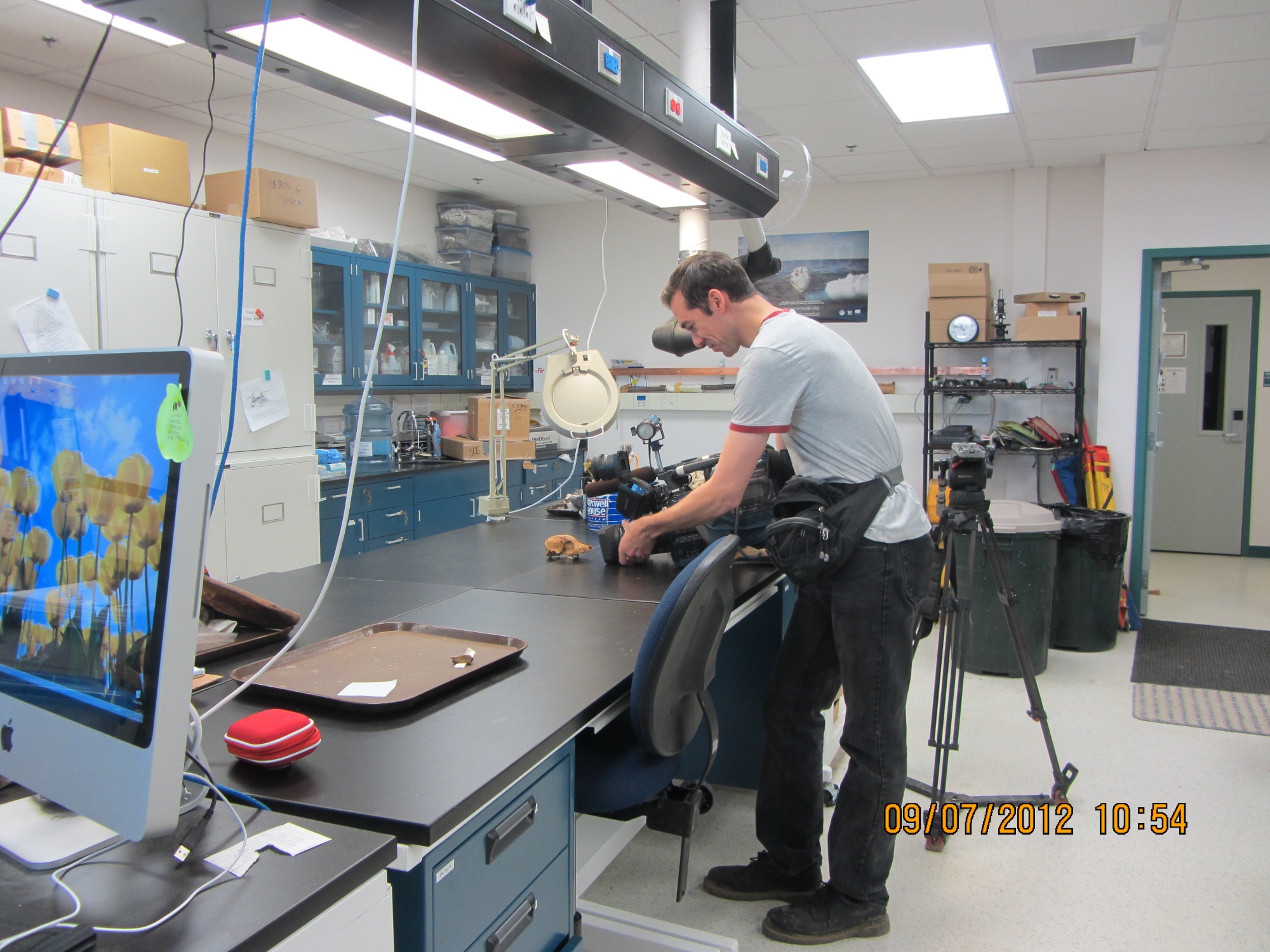
First they stopped into my lab for an hour or so. They shot a fair bit of footage of Coby Hatcher (who is going to HS on-line and therefore was working in the lab when they were there) doing various things one does in an archaeology lab, including re-bagging cataloged artifacts and entering storage locations for artifacts in the catalog database so they can be found again.
Coby updating storage locations in the catalog
With a big collection, this is pretty important, since otherwise it can be very hard to retrieve things. It actually came up because I was trying to find the bird bone from the Ipiutaq levels that had been used to make needle blanks. A number of folks think it looks like it is an albatross bone, which is interesting if true, since there aren’t many albatross around here. One of them is involved in a project which is doing ancient DNA work, and offered to run some of this bone to see if it really is albatross. There was no storage location in the catalog, so we had to look a bit. We found it and I’ll mail it out, and Coby put updates in the catalog.
Then they shot some footage of me showing some of the artifacts, and some of me doing an interview about the project and what one can learn through archaeology. That lead into what gets lots when sites are lost to coastal erosion and/or warming and permafrost thawing.
Dan Carpenter shooting video. He really liked this fox skull.Dan Carpenter, KTUU, interviewing me in the lab. Photo by Coby Hatcher.
After that, they headed off to do something else. In the late afternoon, we headed out to Point Barrow for them to get some shots of the site and, as it turned out, coastal erosion in action. That’s a story in itself, so that will be the next post.
I’m afraid I’ve been pretty silent here. It was not a case of writer’s block exactly; I was writing quite a lot. It’s just that I had a lot of papers and proposals that were due (or overdue–sorry ’bout that, editor people) and was really trying to get them done. Between feeling guilty about writing anything that wasn’t the late chapters/papers/proposal sections and actually writing some much that my hands were sore and my brain was protesting, something had to give.
At this point, one article is published electronically (unfortunately behind a pay wall :-), there are three chapters of books (one mine, two co-authored with Glenn Sheehan) off for review, I’ve got most of what I need in to the PIs for two proposals due soon, and I’ve just got one chapter and two shortish encyclopedia entries to write and a proposal to rewrite, an abstract to submit for the Society for American Archaeology meetings next spring (in Hawaii, so yes I’m going), and posters (or maybe a talk) for the AGU meeting in San Francisco in December. Oh, and the annual budget process is starting.
Things are pretty quite in the lab with most of the students graduated. There is one home school student who is still working away, since he has more flexible hours. I hope to start getting something done in there myself once the writing frenzy is over.
I’ve been busily writing away at a couple of overdue papers, and the students have been going great guns processing and cataloging artifacts in the lab. While all this work is important, it doesn’t make for the most exciting blog posts, so I’ve been focusing on the papers.
Last week I wound up doing a couple of outreach events. The first was a public talk at the Murie Science and Learning Center at Denali National Park. Since I don’t live anywhere near Denali NP, this was no small undertaking. I flew to Anchorage, rented a car and went to the Apple store to pick up some video adapters for my Mac Air on Sunday, picked up my daughter Justine on Monday morning, and we made some sandwiches and set out. It is a 240 mile (more or less) north out of Anchorage, up the Parks Highway to the Park and the MSLC. I was speaking at 7 PM, but wanted to get there a bit early to make sure I found the place and my computer worked with their projector & so forth.
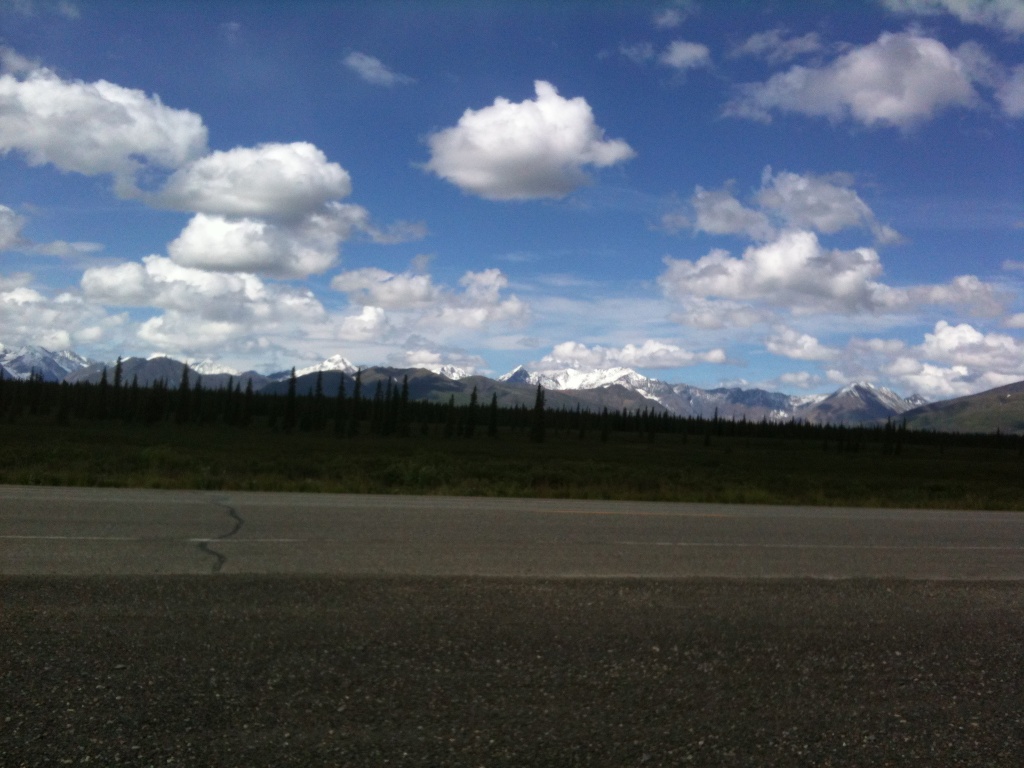
We had a pretty nice drive. The weather was sunny, but since I was driving north that was no problem. The drive is beautiful, although there were clouds around Denali (the mountain some call Mt. McKinley) so it wasn’t out.We stopped at a couple of viewing areas, but no luck. There are actually mountains between Denali and the Parks Highway, but Denali is so big it would have been visible anyway except for the clouds.
Alaska Range from Parks Highway
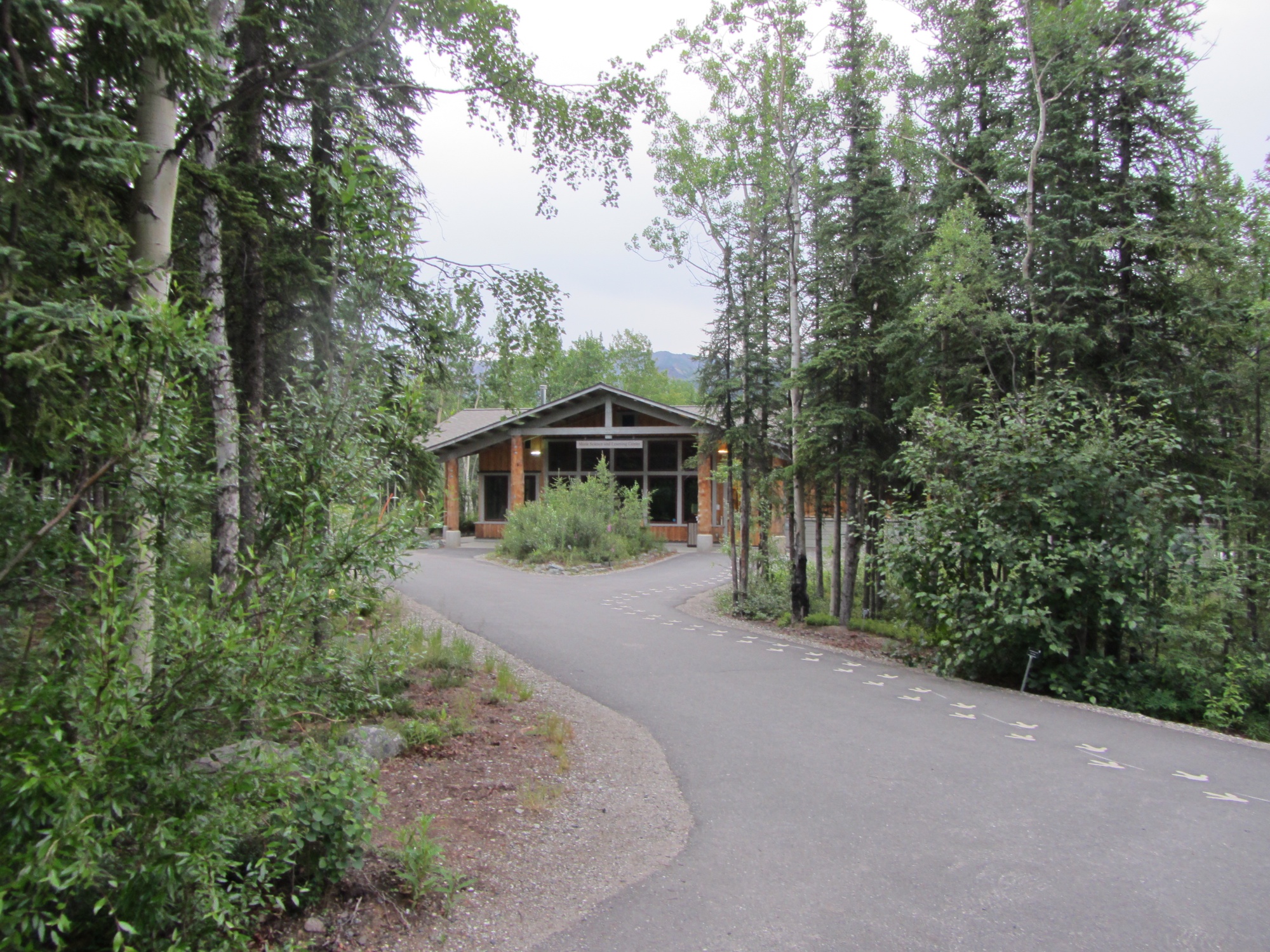
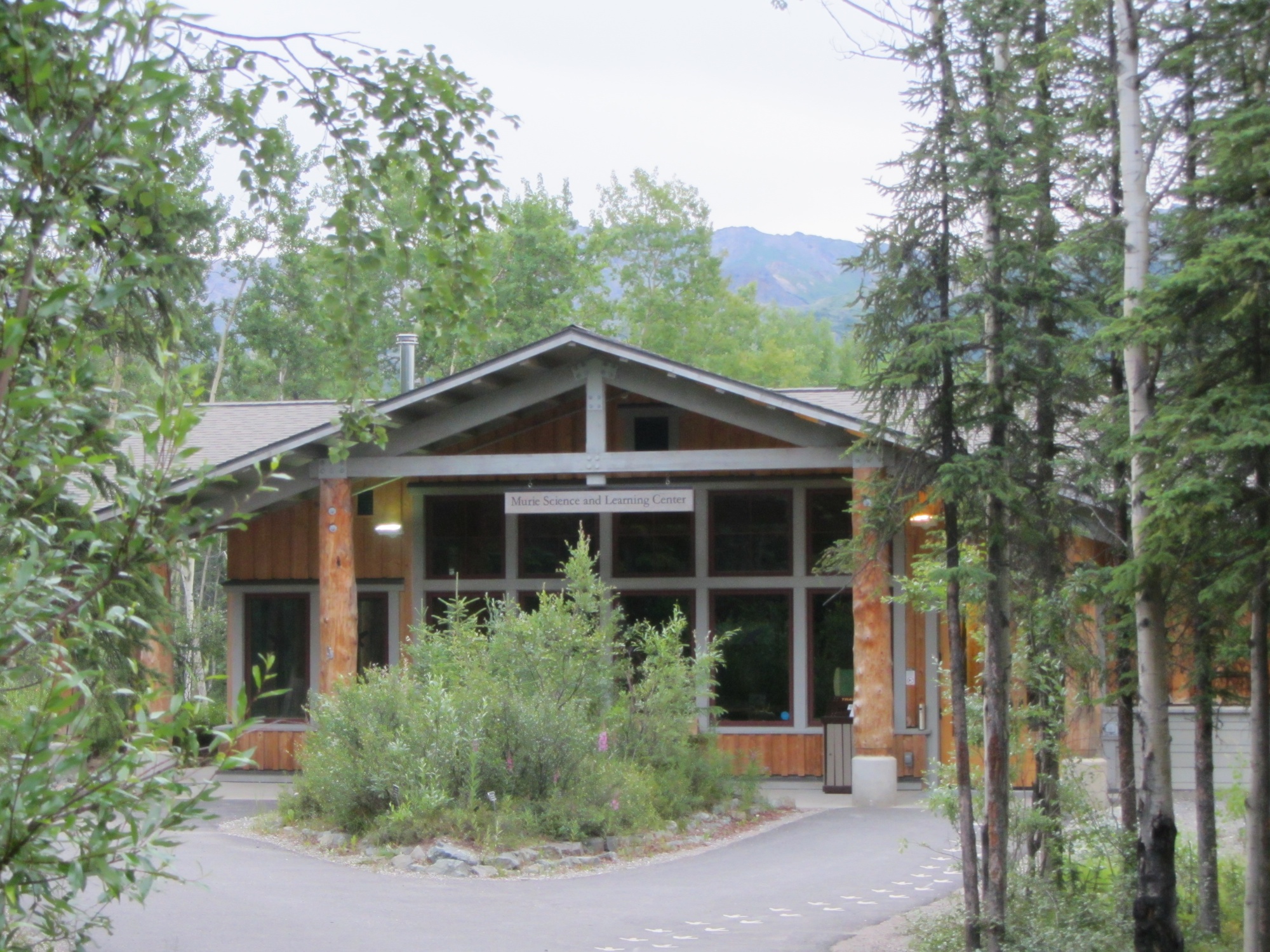
We made good time to Denali. It is very beautiful country, to my way of thinking, and gets prettier as you climb away from sea level and taiga forests with tundra on the mountains. It took a bit of doing to find the MSLC, but we succeeded.
Pathway to Murie Science and Learning Center. The white dinosaur footprints lead to the MSLC from the Denali NP Visitors’ Center.
Closer view of MSLC.
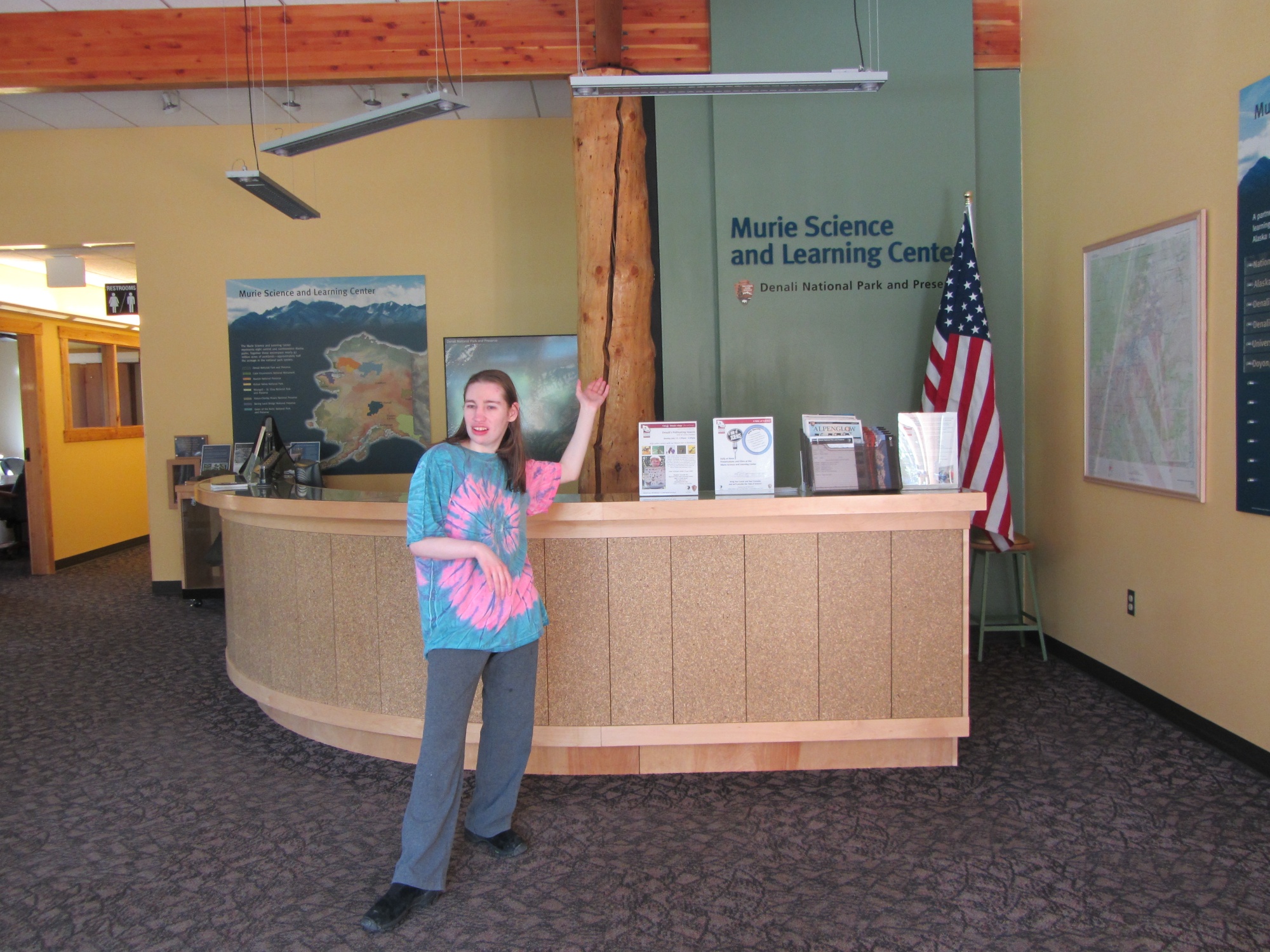
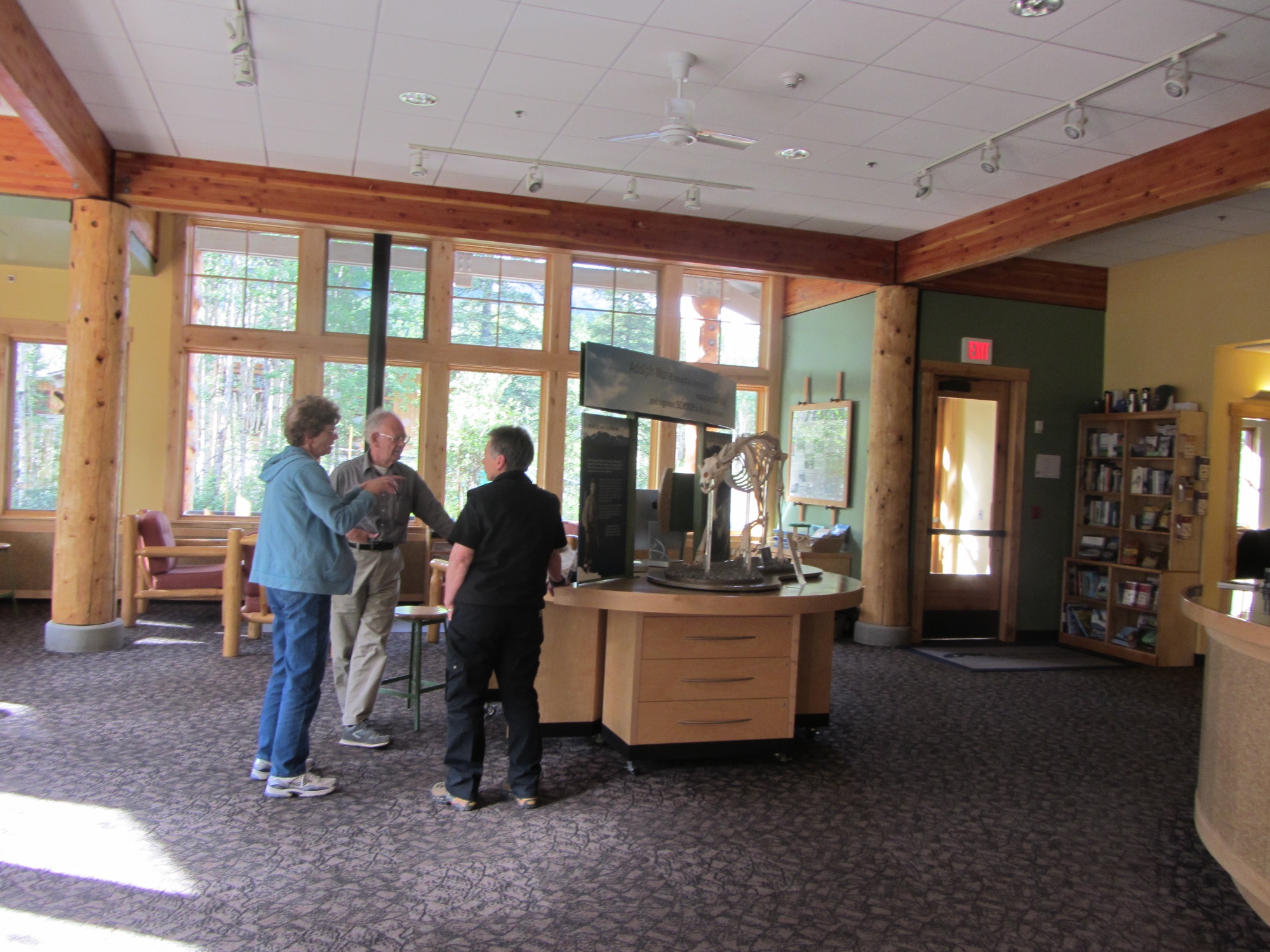
Justine indicating where we are for the photographic record of the trip.Main room of the MSLC, with a couple of park visitors and an interpreter.
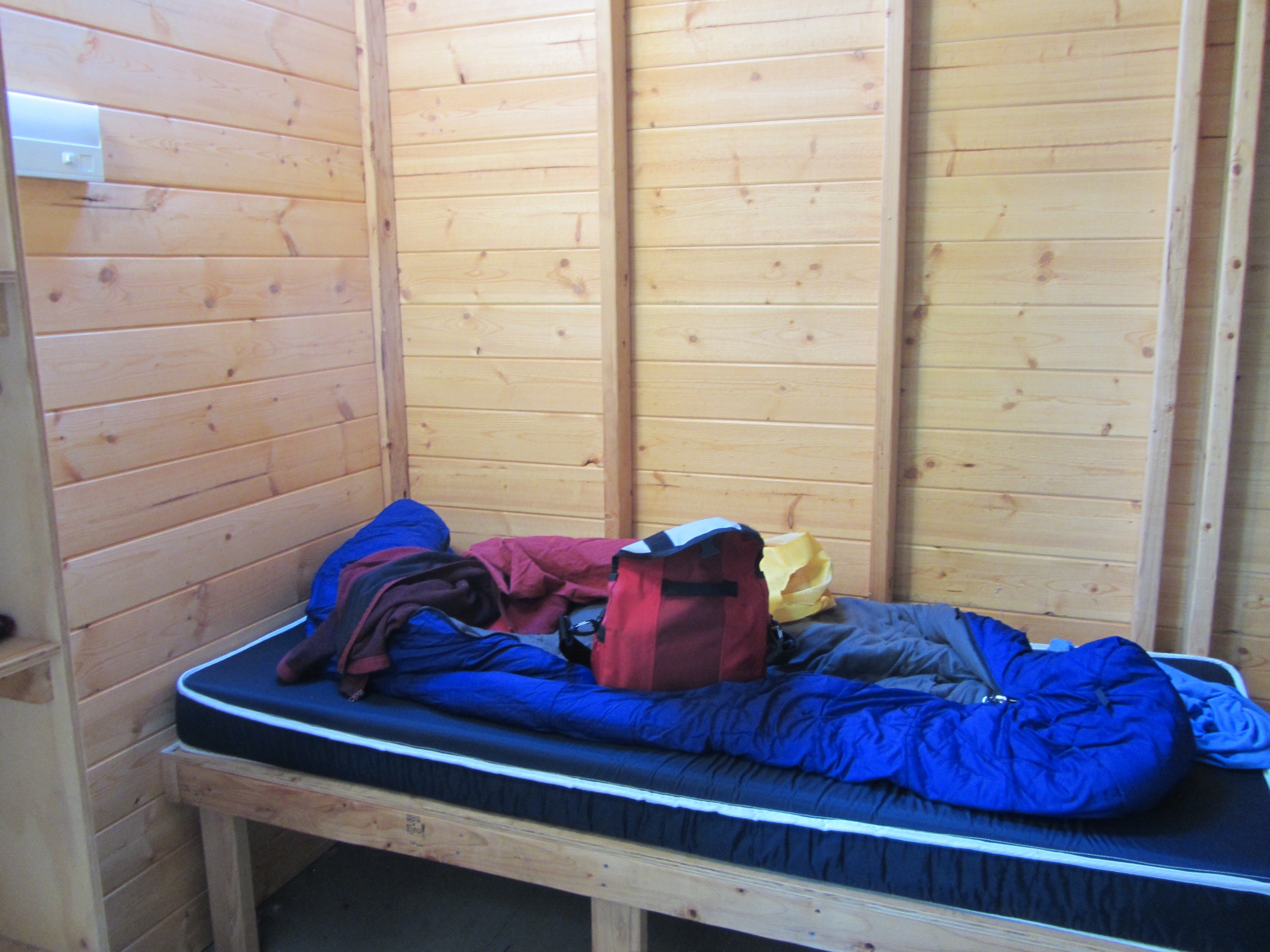
We got in touch with NJ Gates, who runs the speakers’ program and she got us settled. I made sure my computer worked with their projector. Although this was not a paying gig, they were kind enough to put us up in a yurt that they have for visiting researchers. Since there weren’t many around, we each got our own room. I had brought down sleeping bags & a Thermarest (since we thought one of us would be sleeping on the floor) from Barrow. The Park has wagons, and we used one to pull our gear to the yurt. I somehow didn’t manage to get a picture of the outside or the bear-proof box into which all food and toiletries went. The interior was divided into 3 rooms, 2 of which shared an entryway. We got those two.
Bed in yurt, strewn with gear.Interior view of yurt & skylight.
After we got settled, we went to the grill at the visitors’ center for a quick dinner, and headed back to give the talk. We got a decent crowd for a Monday night, I thought. It went well, except for the earthquake in the middle of it. It was big enough to really shake the screen, and given that the MSLC is a heavy timber-frame building, I waited a few seconds to see if it would get bigger. It didn’t, so on we went. Some folks had a lot of questions, but we were all done, and in bed in the yurt by about 9:30.
This was important, because Justine had a doctor’s appointment in Anchorage at 11AM the next day. We got up at 4:15, grabbed a couple of sandwiches & a drink and were on the road a little after 5AM. The weather wants quite as nice, but it didn’t rain until we were nearly to Wasilla (yeah, that Wasilla), but stopped quickly a little later. Still no sight of Denali, but the drive was beautiful.
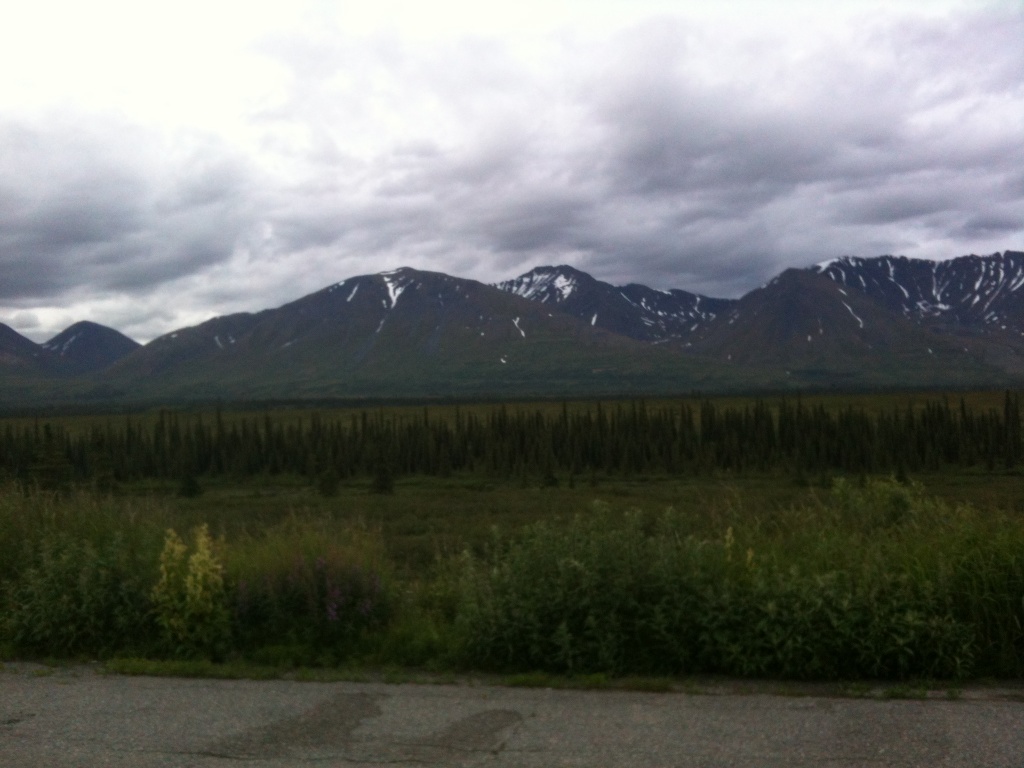
Mountains along the Parks Highway.
We made it to the doctor’s office around 10AM, I dropped Justine off, met my husband for lunch (he was in Anchorage on his way back from Ketchikan to Barrow), and caught a plane back to Barrow on Tuesday night.
Wednesday, we got ready for a visit by kids from the City of Barrow summer program. More about that in the next post.
I got out to Nuvuk today for the first time today. The ARM project that we support want to put a flux tower at the Point to measure flux off the ocean during the open water season. The thing is that the ideal spot for the tower is on the ridge where the Nuvuk site is.
In the past, other folks wanted to put flux towers there, but there simply wasn’t room for a tower in an area where we had already tested and recovered all the burials, and we didn’t want to chance disturbance to a burial. Now we’ve gotten a good way ahead of the erosion, so it seemed that it might be possible. However, I didn’t want the tower to be on top of the possible Ipiutaq structures, just in case funding for their excavation is available. Since the tower installation involved moving a little gravel, it was important for me to be there just in case something showed up.
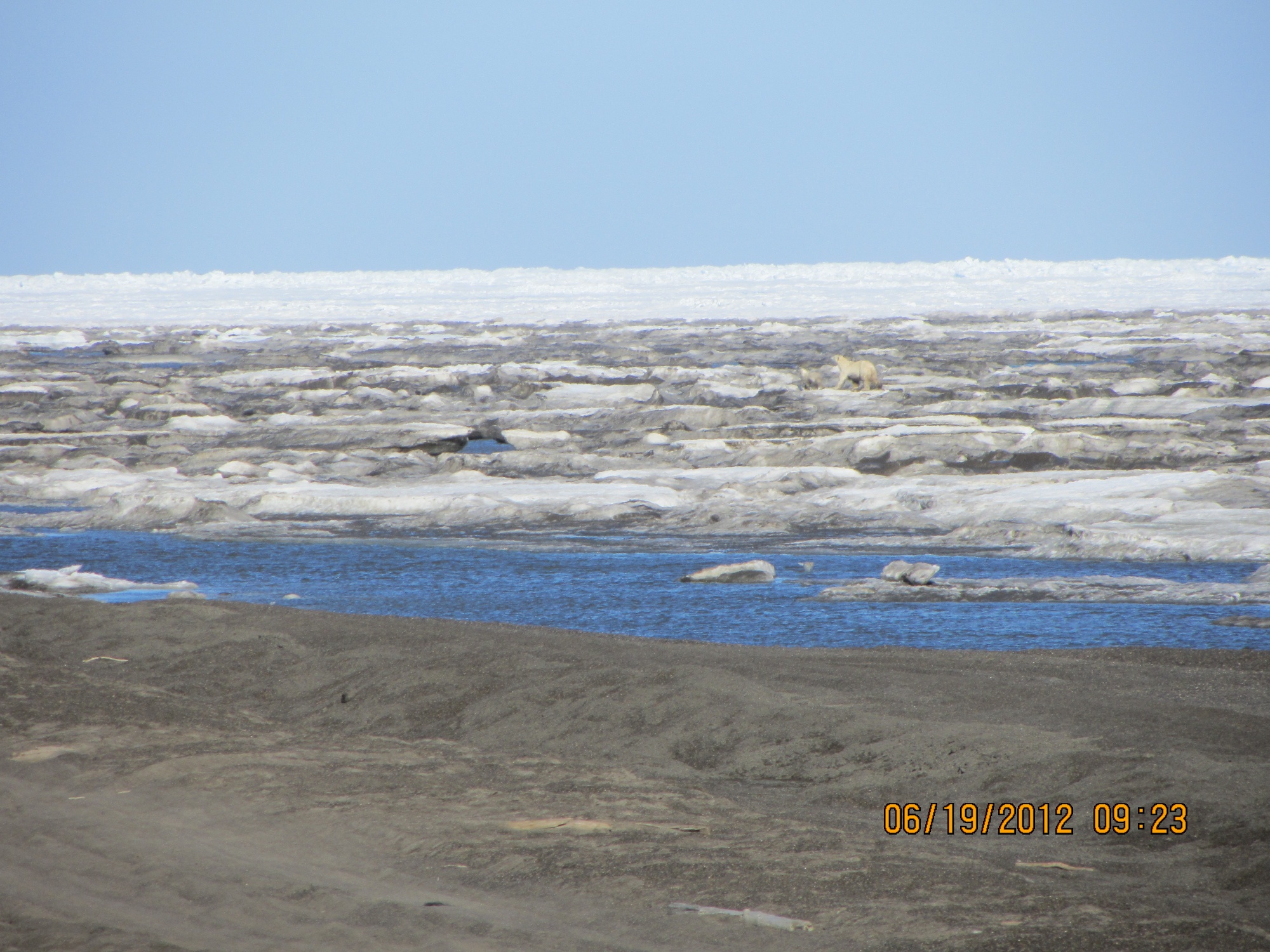
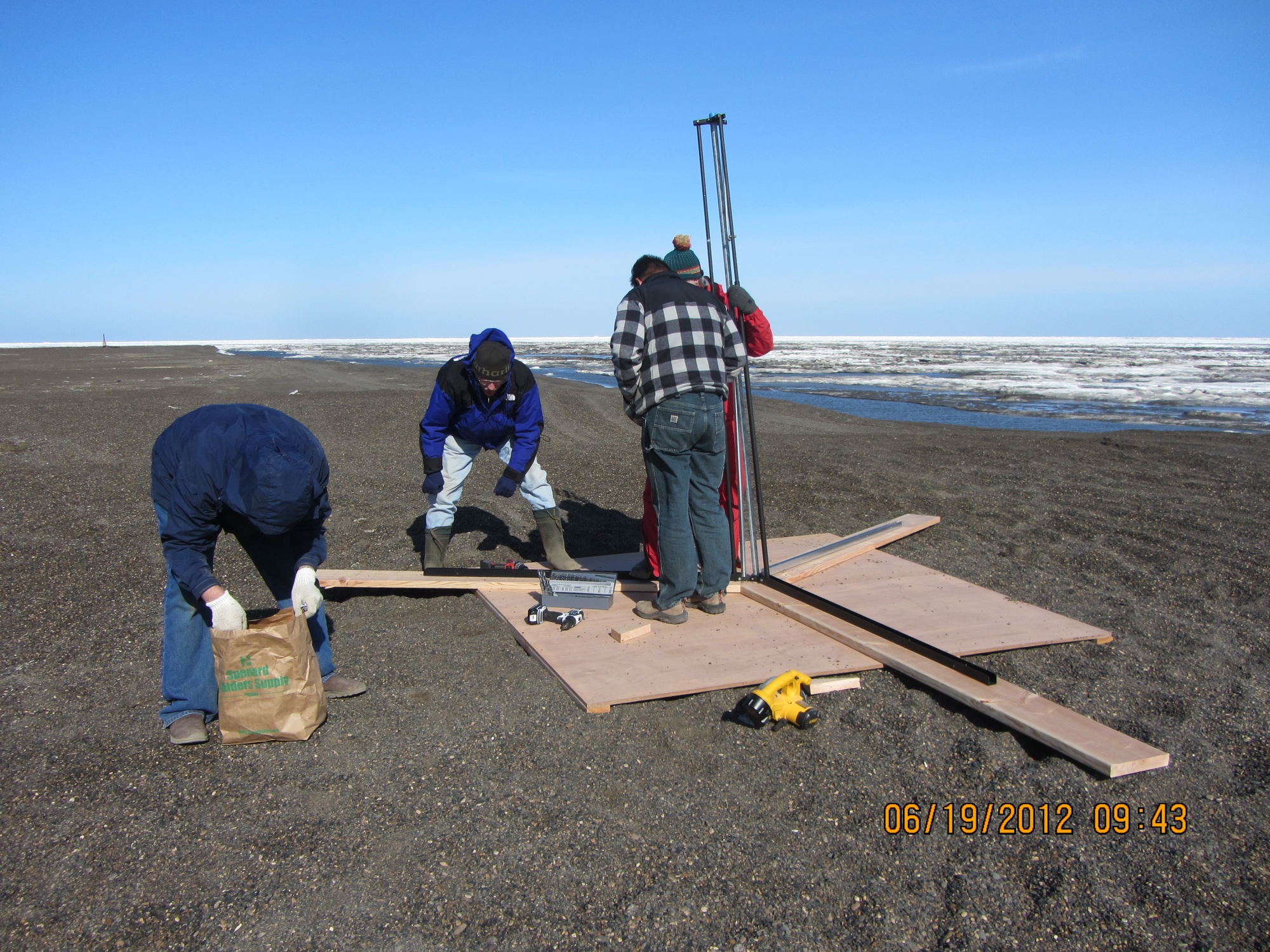
It took a while to get out there, since the ARM Kubota is on tracks and can only go about 15 miles an hour. We quickly got a spot picked for the tower. After that, I spent most of my time looking around for bears while the others started putting the tower together. I spotted 2, a mom and a cub, who were heading to the bone pile.
Polar bears heading for a meal.Assembling the base for the tower.Putting the tower together.Putting the instruments on the tower.
We decided to use sandbags for the guy-wires and then added some more on top the tracks on the base plate. To minimize disturbance to the site, we decided fill the “sand”bags with beach gravel, and bring them up with a four-wheeler.
“Sand”bags on the Honda.
After the tower was assembled and the instruments were on, the instruments needed to be wired up. That took a while, but I had to sick around since one of them needed to look down are gravel, so we needed to cover the plywood base plate, which meant more digging.
That gave me time to check out the area where we salvaged the Ipiutak structure last fall. Good thing we did that last fall, because that area is gone. There is a big notch in the bluff there, and that’s it. It would have been a pity to lose that, because we found some very interesting things in the field and in the lab.
Where the Ipiutak structure was…
While I was getting to play, the crew was working away in the lab. They have finished floating and sorting the materials from the fall salvage, and are moving on. Over the winter, we’ve had several sets of visitors on short notice, which required some materials to be cleaned off benches fairly quickly. As a result, there were a lot of miscellaneous boxes around the lab. The crew has reorganized several cabinets and gotten most of the boxes emptied. There is plenty of bench space, so we are moving on to cataloging and marking.
Part of the hard-working lab crew (l. to r. Victoria, Trina & Trace) working on faunal remains.
Dennis O’Rourke and Geoff Hayes are scheduled to give a talk at the Iñupiat Heritage Center tonight as part of the BASC Saturday Schoolyard series. They are giving a report to the community on the results of the GeANS (Genetics of the Alaskan North Slope) project, involving both modern and ancient (mostly from Nuvuk) DNA. It should be really interesting.
Dennis is scheduled to arrive on the evening Alaska Airlines flight, and then head over to the IHC to start the talk at 8PM. I think Geoff may either be here or is coming in from a village. I just hope the AK Airlines flight isn’t as late as the one I was on yesterday; I didn’t get here until almost 9PM.
For some reason, two of the archaeology blogs I follow had recent posts which were perfect summaries of information for people considering getting into archaeology. Although the topics were quite different, neither was the sort of thing covered in most classes or textbooks.
On the practical side, GraecoMuse did a nice summation of what an archaeologist needs in the way of personal field equipment. I’d add a clipboard desk for forms, and certainly most US and Canadian archaeologists would substitute Marshalltown trowels for WHS.
On the other end of the spectrum, what appears to be a new blog gives an extended quote from an L. S. Klijn article in Acta Archaeologica listing 25 Commandments for archaeological researchers. I tend to think that not all archaeologists are quite as individualistic and cutthroat as #5 might imply, and would offer such highly successful collaboratives as NABO and GHEA as counterexamples. The list is a clear description of some very important principles of archaeological logic and epistemology. Many of the “commandments” are applicable to all scientific endeavor, no matter the discipline.
I’ve noticed I’ve been getting more hits on search terms relating to those whales, probably since the movie “Big Miracle” just was released. So, since I’m kinda busy with the Super Bowl, I thought I’d put up a few links to the real story.
1) Bill Hess’s blog, where he is doing a series on the whole event. Bill took what were probably the first professional pictures of the whales, including some may probably recognize. This features a lot of Bill’s really fine photographs.
2) An article in the Fairbanks New-Miner which has interviews with many of the folks in Barrow who were involved in the original event, including biologist Geoff Carroll.
3) An article in the Anchorage Daily News by Richard Mauer, who covered the original story and hauled out his notes to write this one.











 Out of Ice and Time