It rained all night, and is still very windy. The oceanographers decided that they’d rather wait until it wasn’t pouring to go out to Nuvuk. We looked at the weather, and small craft advisories are extended to at least Sunday night, but the forecast for Monday suggested they will be extended as soon as we hit the right window in time. The rain is supposed to let up, though, so tomorrow and Monday are looking much more promising.
I spent some time at the BARC, listening to the Saturday Schoolyard talk and working on the Nuvuk plotting. It was fun to see the gas field project coming together after working on the cultural resources surveys for the last three years! They have the drill rig set up in the East Barrow Gas Fields (you can see it from Nuvuk) and are supposed to spud in the well today.
I also looked at the plots from the DWF for this year, to check how the various levels had related to each other. I hope this will be helpful in trying to recover the rest of the structure.
Now to catch up with laundry, bills, etc. Hard to keep all that on track if you are working 6 days a week.
We got to the field yesterday. Bryan Thomas and Scott Oyagak (bear guard) from BASC, and Courtney Hammond, the new BASC intern, were joined by dental extern Audrey Navarro. We got the site uncovered, removing all the trash bags that had been pinned in place to help protect the actual surface. It had suffered some damage, so we laid out a gird of 1/4 m square units, took surface elevations, and started slowly removing and bagging the entire matrix of the first 1/4 meter in, in 5 cm levels. This was the most disturbed, and I could not find the floor level. If I couldn’t, it’s not surprising that the volunteers, two of whom were excavating for the first time, couldn’t do it. Bryan was mostly running the transit, since he’s done that a bit and is fine with the program (just needs more practice aiming the theodolite to get really fast–it’s harder for him since he’s a lefty and it is totally built for right-handed people). By the end of the day, there were a couple of hints of where the floor was, although one was much higher than the other.
There were hints of two levels of floor earlier this summer as we moved away from the hearth, perhaps due to a renovation of the structure which involved adding gravel to the floor/bench, so that might be what is showing up. It certainly doesn’t make figuring out where the floor is from a profile (I use the term very loosely, since we are talking about unconsolidated gravel here).
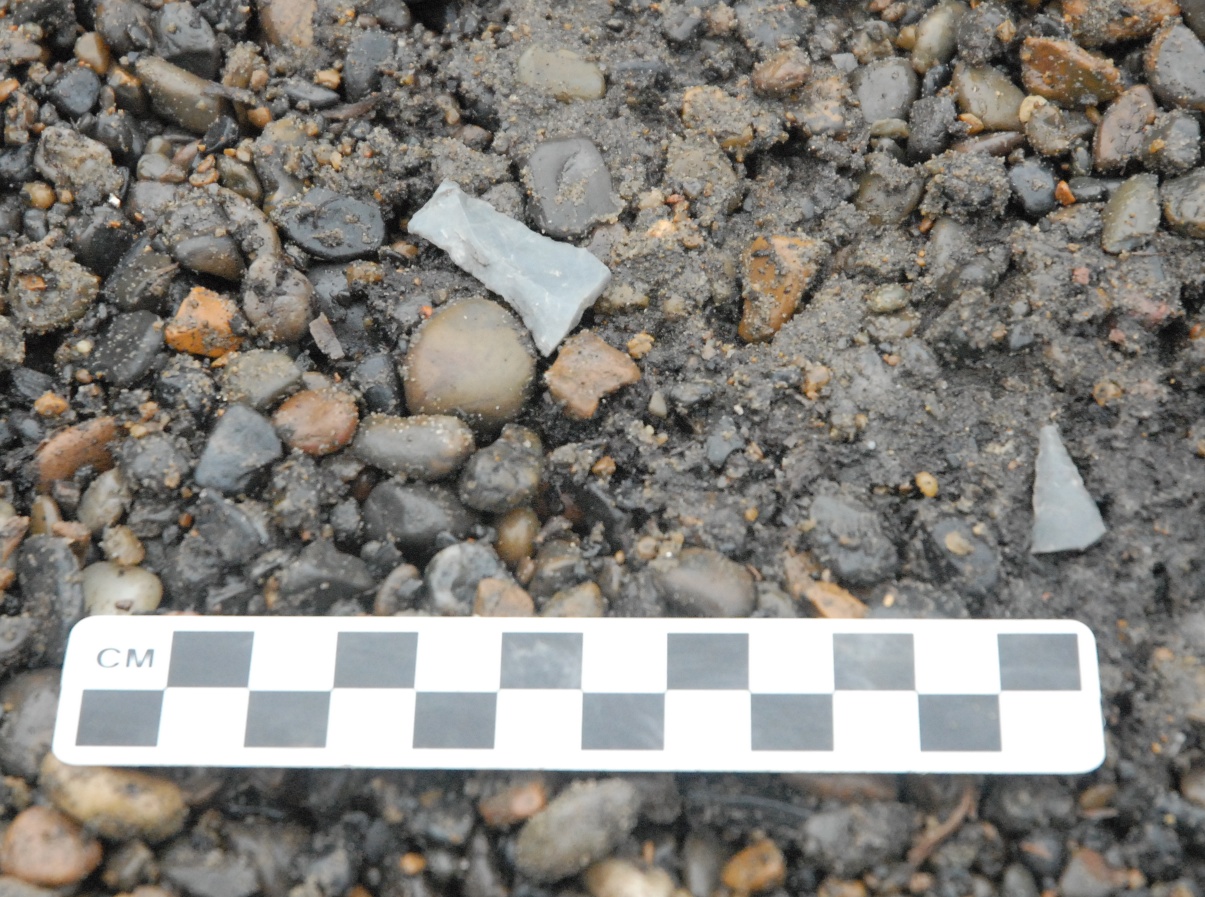
Today, I went out with Glenn Sheehan, from BASC, who is also an archaeologist by profession (also my husband), since I really needed someone else who could dig without direct supervision if I needed to run the transit, and Bryan and Scott. As it turned out, Glenn was able to find a small chert flake and then an ivory flake and follow out a level from there. Pieces of wood are turning up as well. Mike and Patsy Aamodt stopped by after checking their net and we chatted for a bit. They just came back from their cabin, where they had both nanuqs (polar bears) and brown bears hanging around. Amazingly, we’ve seen none yet this season, which is a first.
Tomorrow the weather is supposed to be very windy, and we were having trouble getting local volunteers since it is the Homecoming game for the Whalers football team. However, Nok Acker from BASC arrived to spell Scott so he could get home in time for his babysitter to go home, and had heard that a team of oceanographers who are in town want to go out tomorrow (probably because there is a small craft advisory so they can’t go boating 🙂 ), so we may go out anyway. Rain/snow/30 knot winds may mean a short day, but so be it. There is a bit of gravel that can be moved even if it’s too windy to excavate (or even expose the surface).
Anyway, now that we have the surface, we can follow it, record visible artifacts, and bring the matrix back for screening & flotation in the lab. Given the macro-fossil stuff and the micro-flakes, it’s the only way to get the structure excavated enough to find the edge before it gets wiped out by a storm.
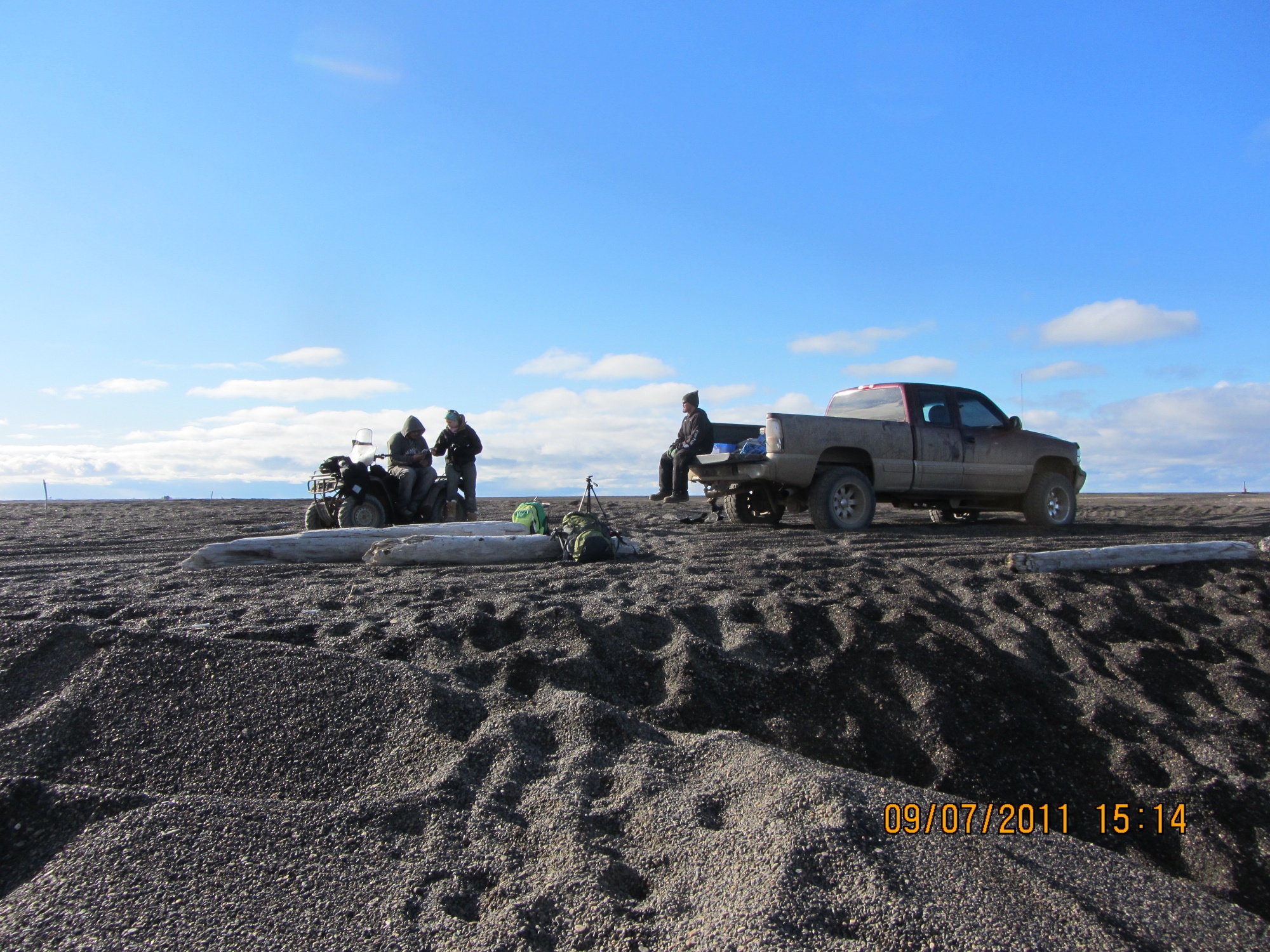
The possible large labor force to shovel off the gravel didn’t pan out due to scheduling difficulties, so we went out after lunch to do it ourselves. We = Michael Donovan, Scott Oyagak, Courtney Hammond (all from BASC) and me. Mike rode out on an ATV, and the rest of us rode in style in Scott’s truck. It was a beautiful day, perfect for shoveling.
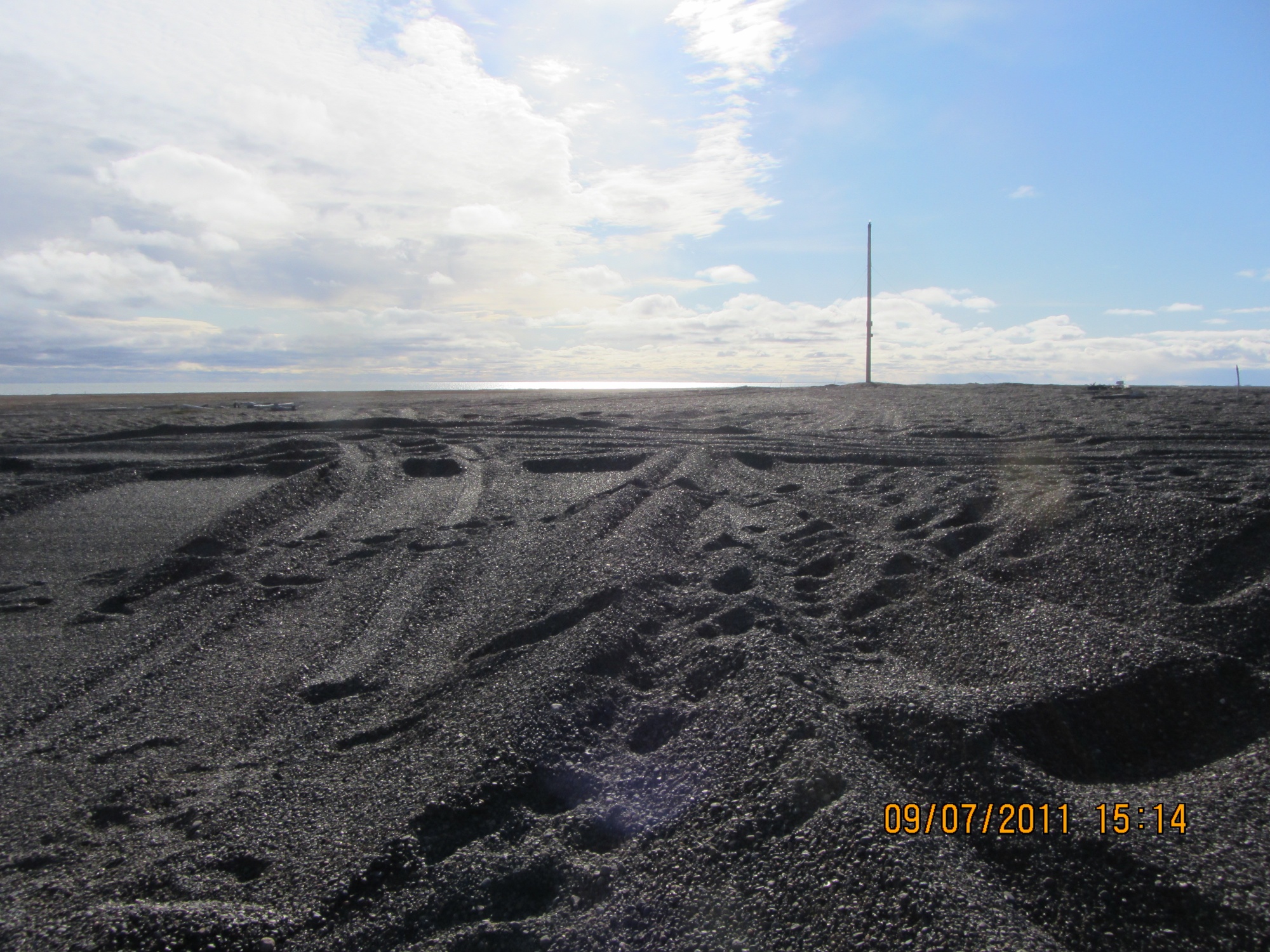
Out at Nuvuk on a bluebird dayBeautiful day at Nuvuk
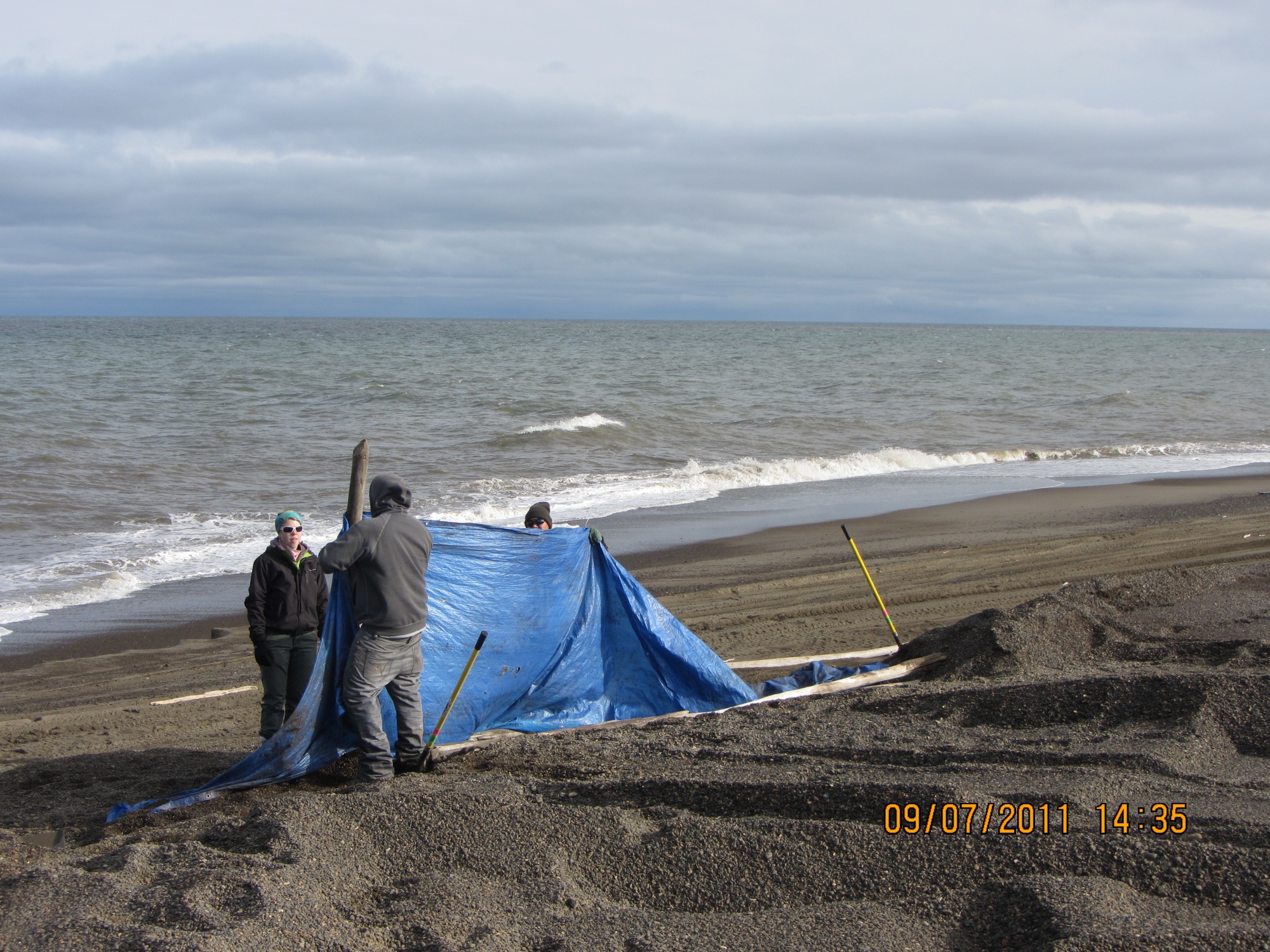
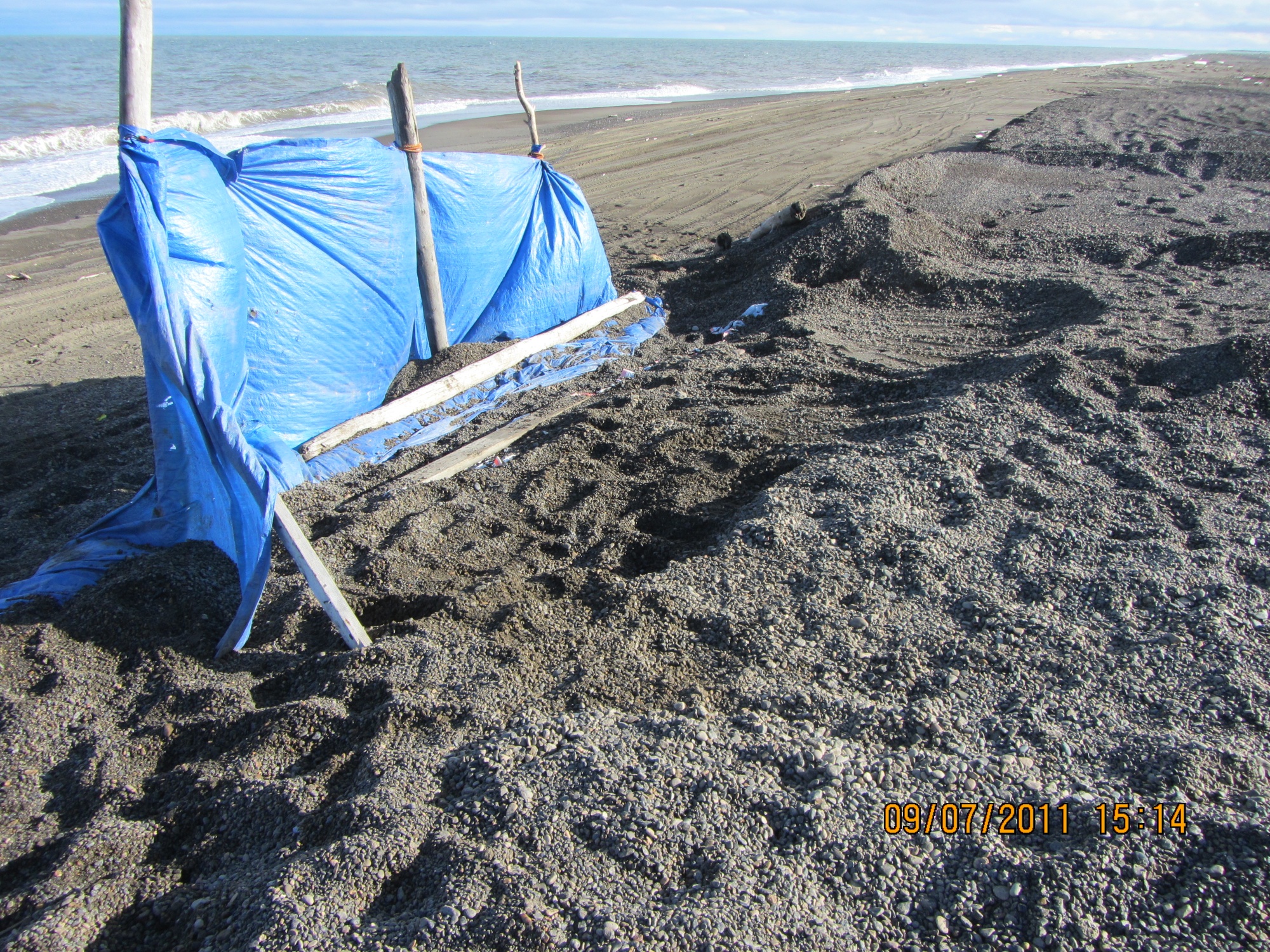
We used flat shovels to uncover the blue tarp and driftwood that had been buried to try to protect the structure (remember, we didn’t know if we would get funding to do this) and then to get about another foot (30 cm) of gravel off the surface we want to get to. The surface had been covered with trash bags to protect it, and we didn’t quite go down to that level, although they could be seen.
Putting up the windbreak
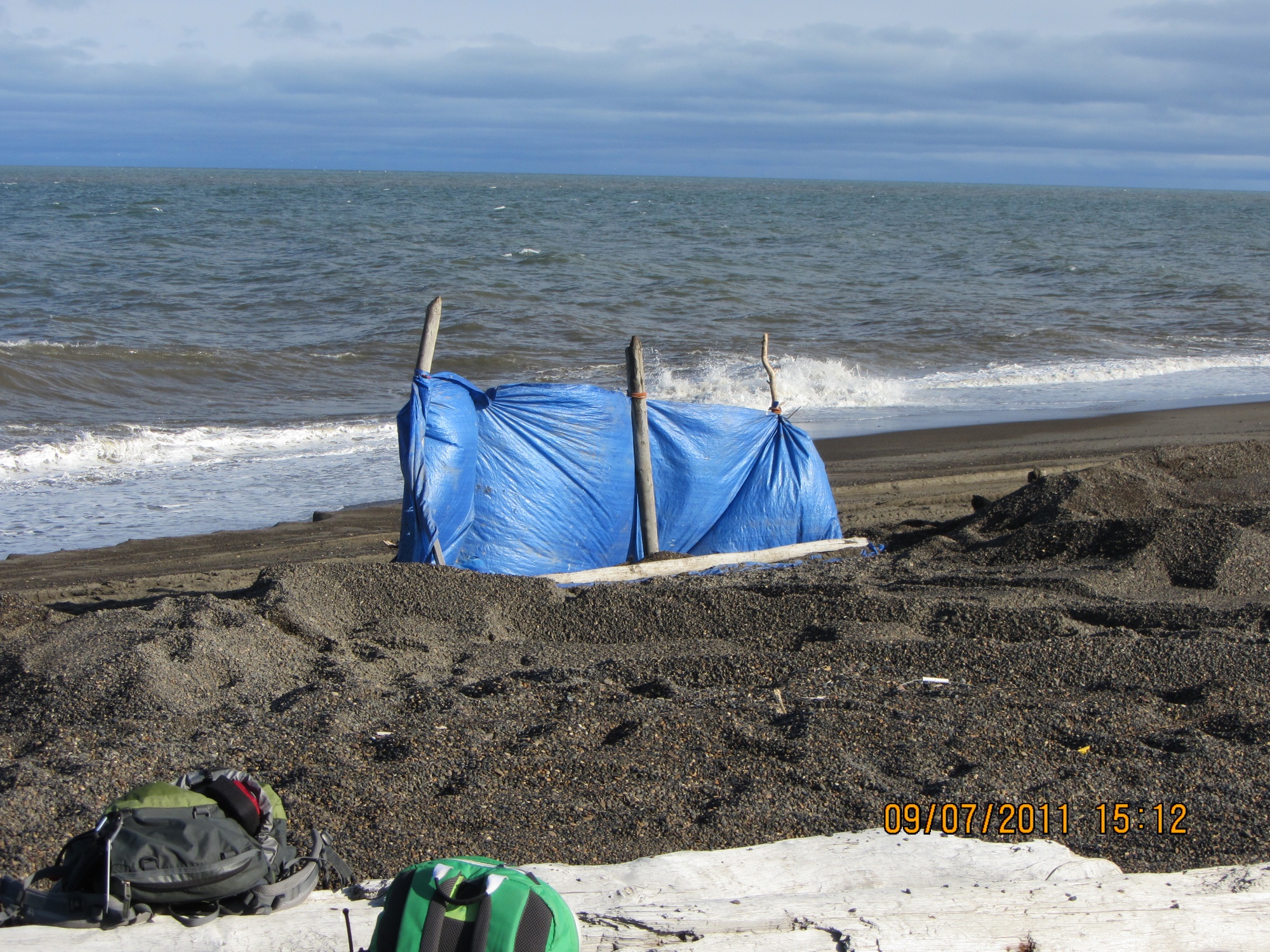
Then we set up the windbreak. It is long enough to shield the entire area we want to work in, and has small wings on either end, so it should be good for a variety of wind directions. We added a couple of supports to the front, so it should be OK unless we get a huge storm, which it doesn’t look like we will for a couple of days, if the NWS isn’t lying. We may need to add props to the ocean side on Friday, though.
Finished windbreak.Area to be excavated
Tomorrow four of us will head out to start the actual excavation.
We didn’t actually start the fieldwork today. A possibility for lots of help shoveling off the overburden exists, so it didn’t make sense to start that until we know if it will pan out tomorrow. Whether it does or not, we start tomorrow. At the moment forecast doesn’t call for snow until the weekend, but who knows…
In the meantime, I got one report to the client, have the final figure for another back to the GIS guy in draft format (I was having some problem getting my base image to display–it seemed to import OK, and acted like it was there, I just couldn’t see anything when the layer was turned on). So the final image just needs to be inserted and that report can be PDFd and sent off tomorrow.
It looks like Ilisagvik College is going to be able to help us out. So tomorrow we should be able to get the giant mound of gravel off the house. And then the fun begins.
The weather is supposed to be in the low 40s with not too much wind, so that should be good. Not so good for getting rid of the fog and not having flights canceled into Barrow, but for what we’re trying to it, it’ll be fine.
When I got the information from the AHRS files, one of the two sites listed was Maudheim. I recognized the name, but had connected it with a Norwegian-British-Swedish station in Antarctica. Obviously that wasn’t it. It turned out the Maudheim near Wainwright was a station that had been built by Roald Amundsen, the Norwegian explorer, in 1921 or 22 in connection with his planned flight over the North Pole. It was meant as an overwintering base, although it seems that Amundsen actually spent the winter in Nome, leaving his pilot Oskar Omdal to take care of Maudheim and the plane.
After the expedition was over, Maudheim was apparently acquired by the Midnight Sun Trading Company, which seems to have dealt in coal from small mines near Wainwright as well as other standard items. There may have been some additions to the building. Although the trading post seems to have gone out of business quite some time ago, the building survived for many years. According to Tim, he was told it was torn down a few years ago since it was not being maintained (no real owner) and people in Wainwright were afraid it was becoming a hazard for kids.
Footprint of a building, probably Maudheim.Ice cellar near Maudheim site.
Once we finished with the original reason for the trip, we headed back to town for lunch. The Olgoonik Hotel does have a very tasty grilled cheese sandwich, and they make their own soups.
Since there was time left, I decided it would be a good idea to go back to the general area where the possible road would go, since between the TLUI and the AHRS there were a number of nearby sites. Given that many of them were not located by GPS (in some cases the only location data was something like “3 miles from Wainwright” it seemed like it would help my clients to know a bit more about the situation prior to actually trying to design a road.
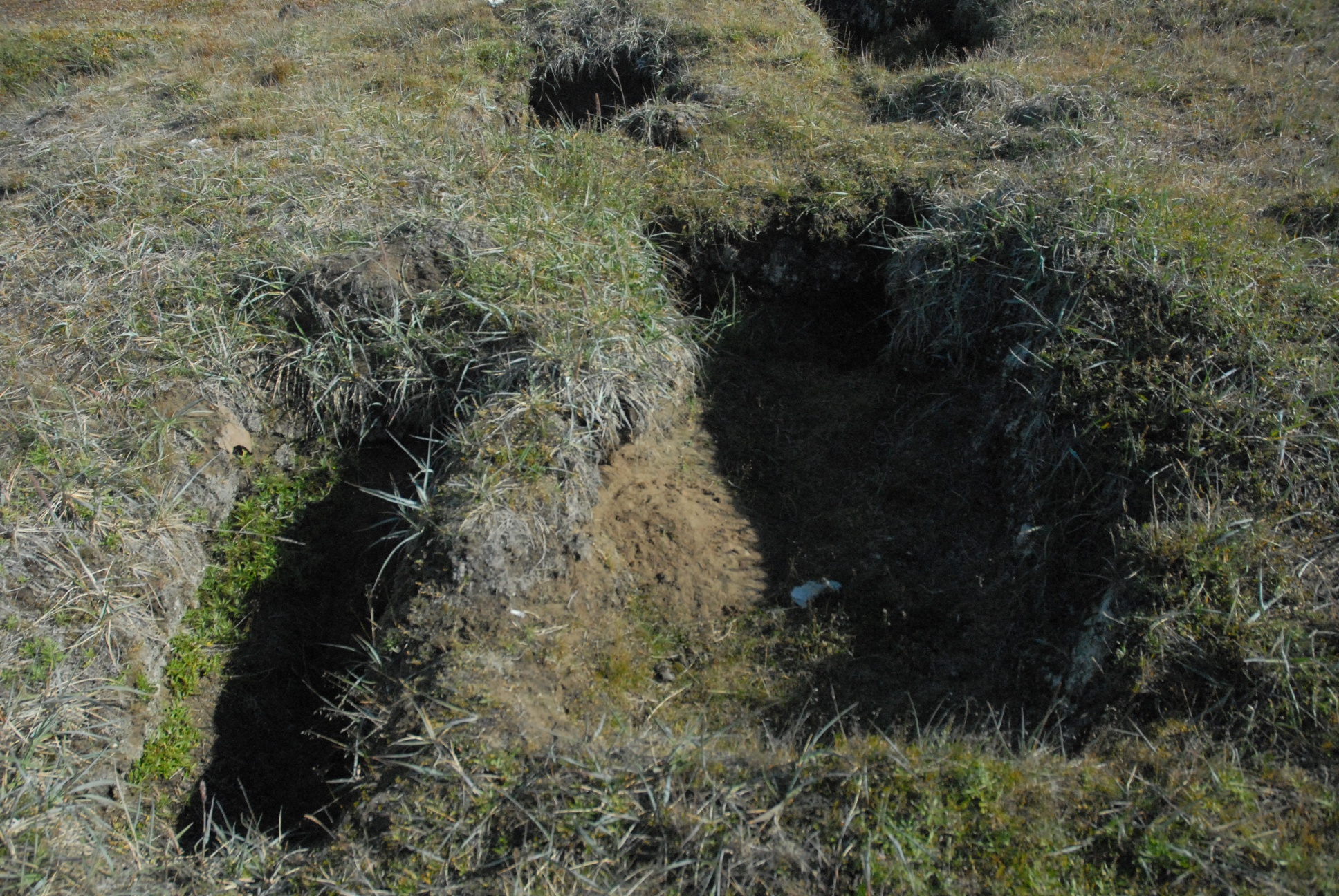
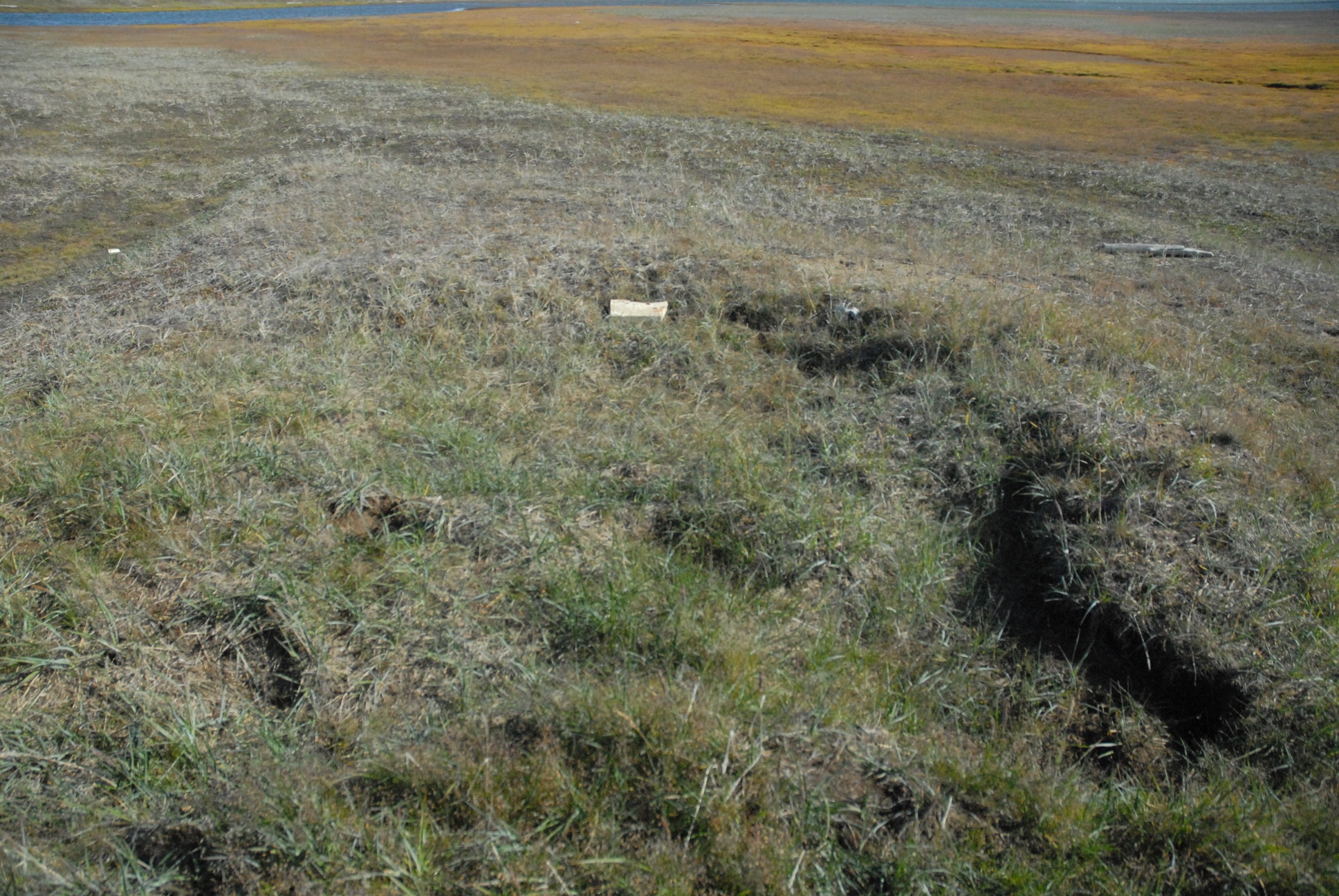
The TLUI showed an area whose name translates as “a place to tent” very close to the find. There was a fairly flat area between the river and a lagoon which looked likely (especially in the past, when sea level was a wee bit lower) so we went there. There was some evidence of tenting, and a lot more of butchering, mostly of larger marine mammals, including beluga and maybe a porpoise (they are found around there, and the skull didn’t look right for a beluga, of which there were multiple examples). But what there was also evidence of was archaeology. And lots of it! There were a veritable plethora of trenches, very overgrown, so this had all happened some time ago.
Old 1m x 1m unitTwo units separated by a baulkYet more excavations, at a slightly higher elevation.
Tim was fascinated, and wanted to clean a wall, so I headed off to get my trowel. He’d started with a bone he found, and discovered that under the lichen the wall in question was very hard. I started to clean it and immediately recognized oil-indurated sand. It became clear that there were overlapping patches of oil induration at various levels, and that the area had been used to process marine mammals for some time. It was a sunny day, and after a while the smell of marine mammal oil permeated the pit. It’s the smell of archaeology in the north, and I love it. Others may think differently.
This was very interesting, as one would expect that this much excavation would only happen if the archaeologists were finding things. If one put several sterile trenches in, one would probably go elsewhere. Yet, there is no site recorded in the AHRS at that location, and I’m not sure who did this. There are a couple of hints in Waldo Bodfish’s autobiography with Bill Schneider, but there is still a mystery to solve there.
As I mentioned a couple of days ago, I had to make a quick trip to Wainwright. It was way quicker than I liked, because I didn’t have time to get in touch with folks before going, and really just had to do what I came to do and jump back on a plane. A human skull had shown up during a survey, and the client wanted to know if it was an isolated find or not.
So I flew to Wainwright on Thursday night. Tim Van Sickle from Olgoonik, the Wainwright village corporation met me and took me over to the Olgoonik Hotel. We got some dinner and made plans for the next day.
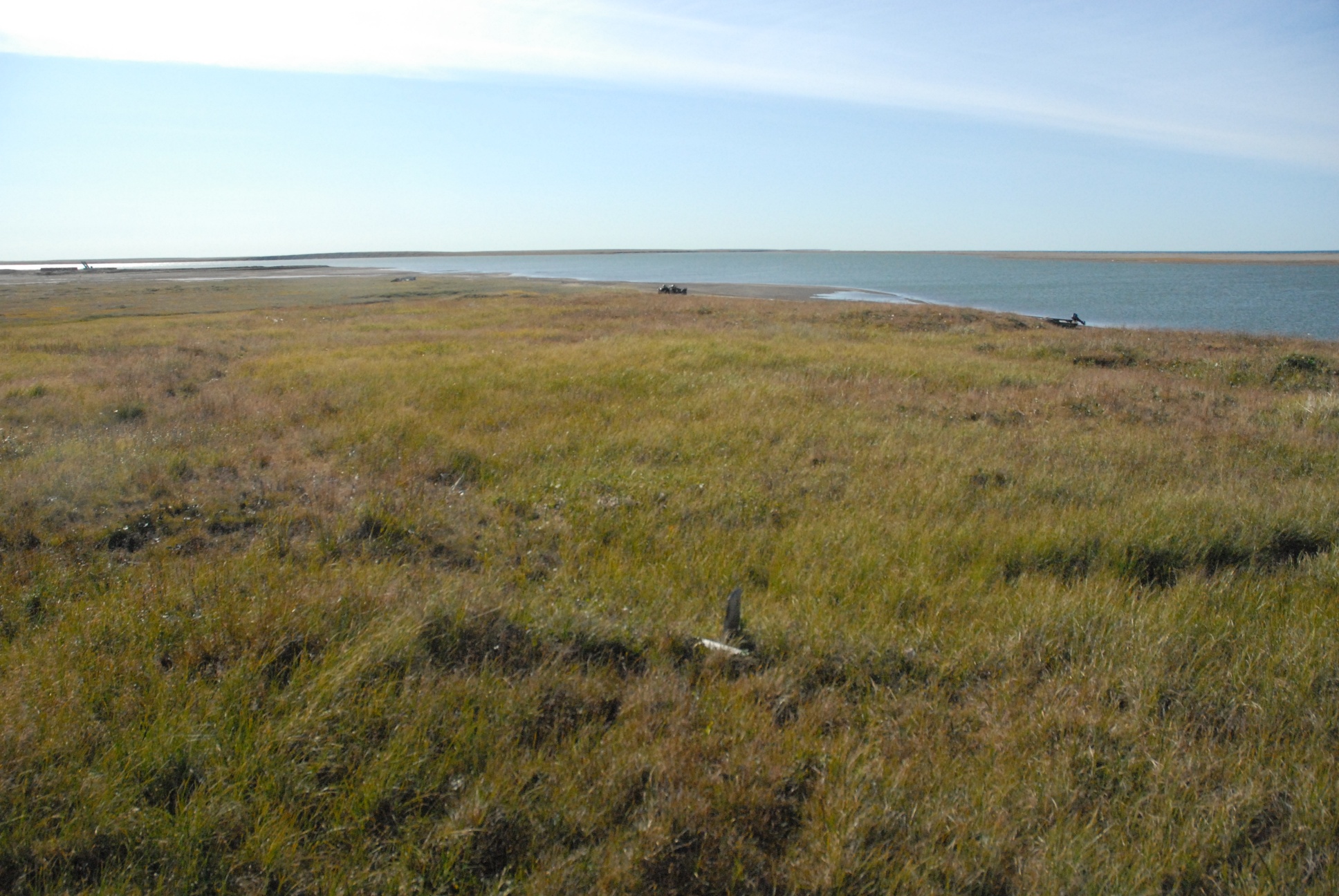
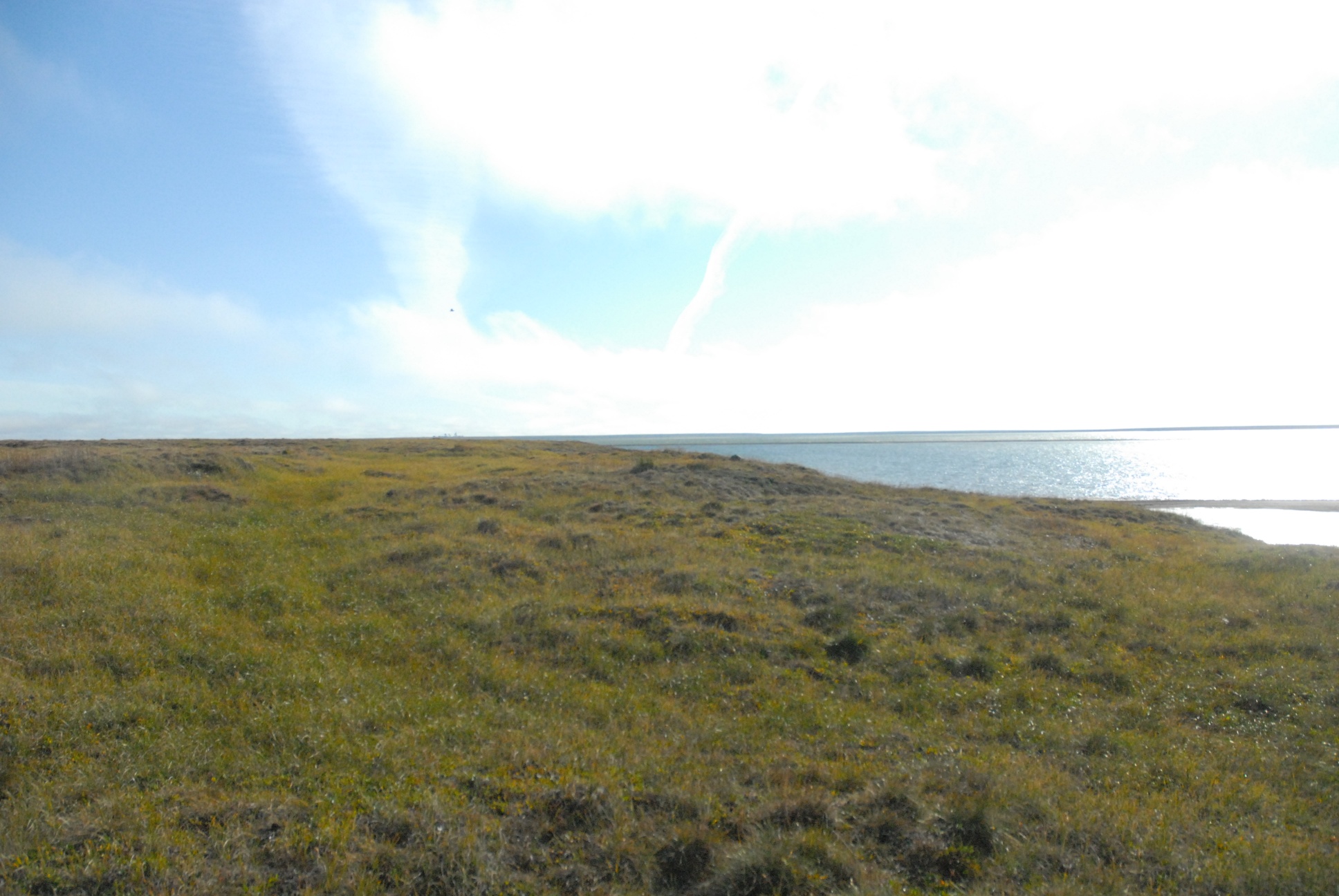
After breakfast, we caught up with the son of the landowner, who was handling access arrangements. After discussing it with him, we headed to the GPS location given by the surveyors, taking four-wheelers along the lagoon. As usual, the LCMF surveyors GPS and my not nearly as fancy unit agreed, and it put me within .5m of the spot. It was up on some high ground overlooking the Kuk River (kind of redundant name, if poorly spelled–kuuk means river) and lagoon. The view was great.
Wainwright lagoon and small lake
Indeed, the surveyors were correct. I examined the area, and discovered, that there were additional remains. Interestingly, although the skull had been were it was found for quite a while (no plants growing under it) it had previously been about a meter away, where the lower jaw was embedded in the tundra, and a now-well vegetated depression into which the skull fit still existed!
Where the skull has been for a while
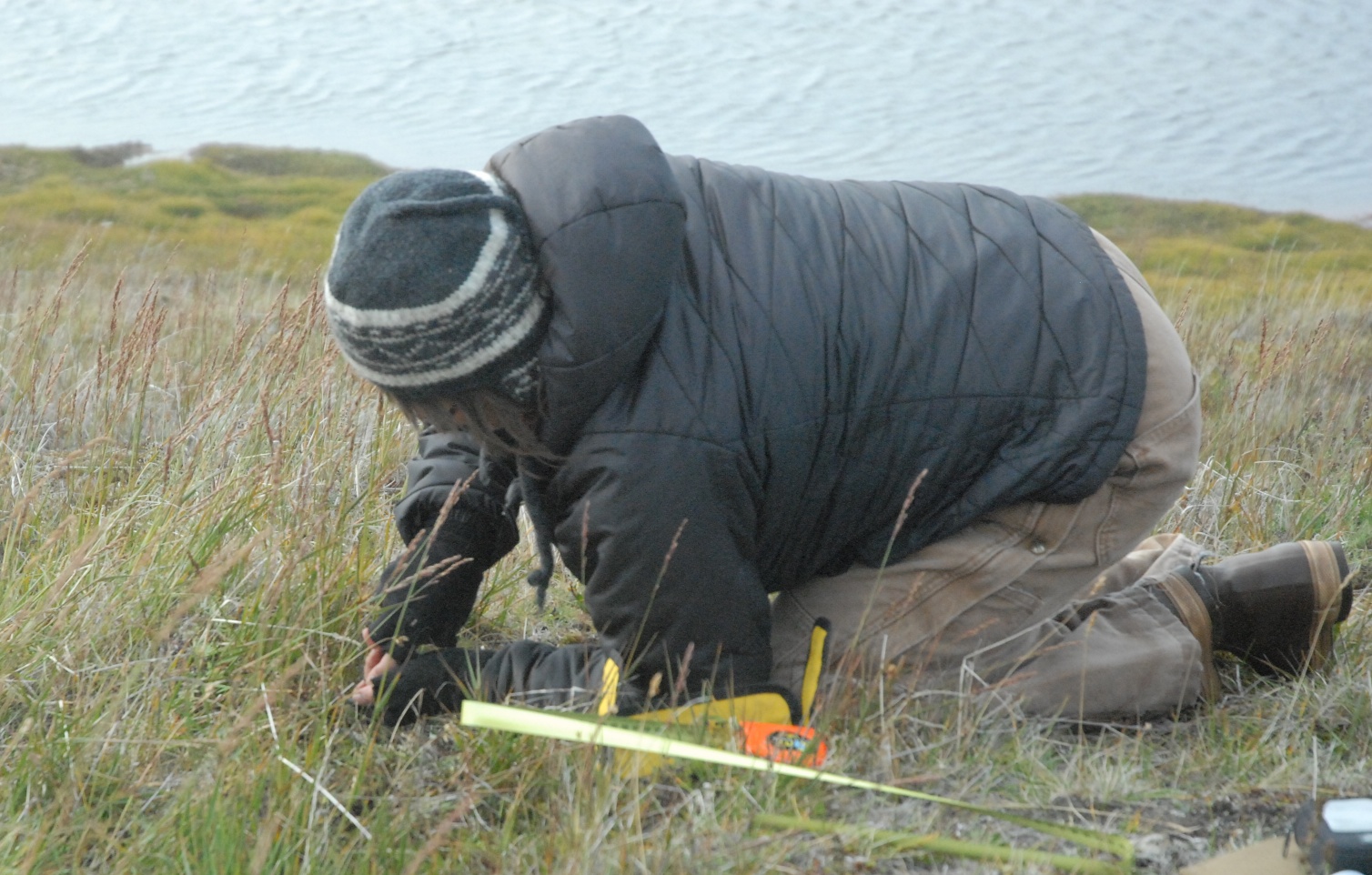
There was some indication that there might have been a grave, but there was also a frost crack and a bone partially covered with vegetation visible on the surface. I gently removed some of the vegetation to let me see if the surface bone was human, and then tested where the jaw suggested the rest of the skeleton should be if it had been a burial. Although we had a shovel with us, I opted to use only a trowel, to avoid any damage if there was anything buried. Tim took pictures of me actually working, and I’ve included a couple which don’t show any human remains. As he said, people always tell him he’s got great pictures of Alaska, but he’s never in any of them, so he volunteered to take some of me. Many thanks!
Removing vegetation to identify bone. Photo: Tim Van SickleCutting sod with a trowel. Photo: Tim Van SickleTaking notes. Photo: Tim Van Sickle
In the end, it looks like the person, most likely a woman, probably was laid to rest on the surface, which was the practice in this area when Euroamericans arrived. Exactly when the switch from actual burial, as at Nuvuk, to “surface burial” took place is not clear yet. Since there is no actual project yet, and it is possible there never will be, or it will be located at a considerable distance (more likely due to this find), we placed some stakes so that people on four-wheelers or snowmachines would be less likely to run the remains over, and left them where they had been laid to rest. If things change, time enough to move them then. They are in a nice place, with lots of salmonberries nearby.
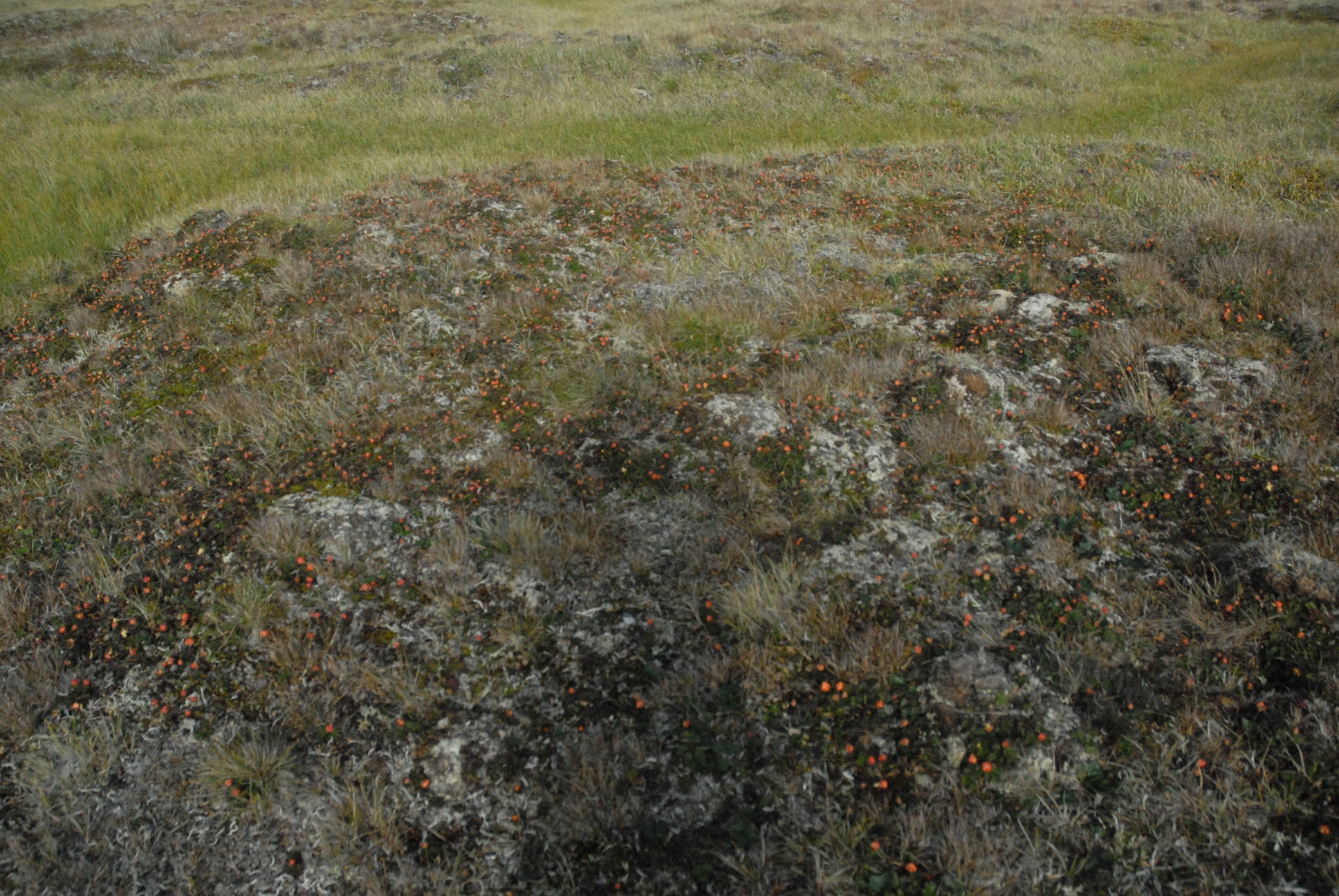
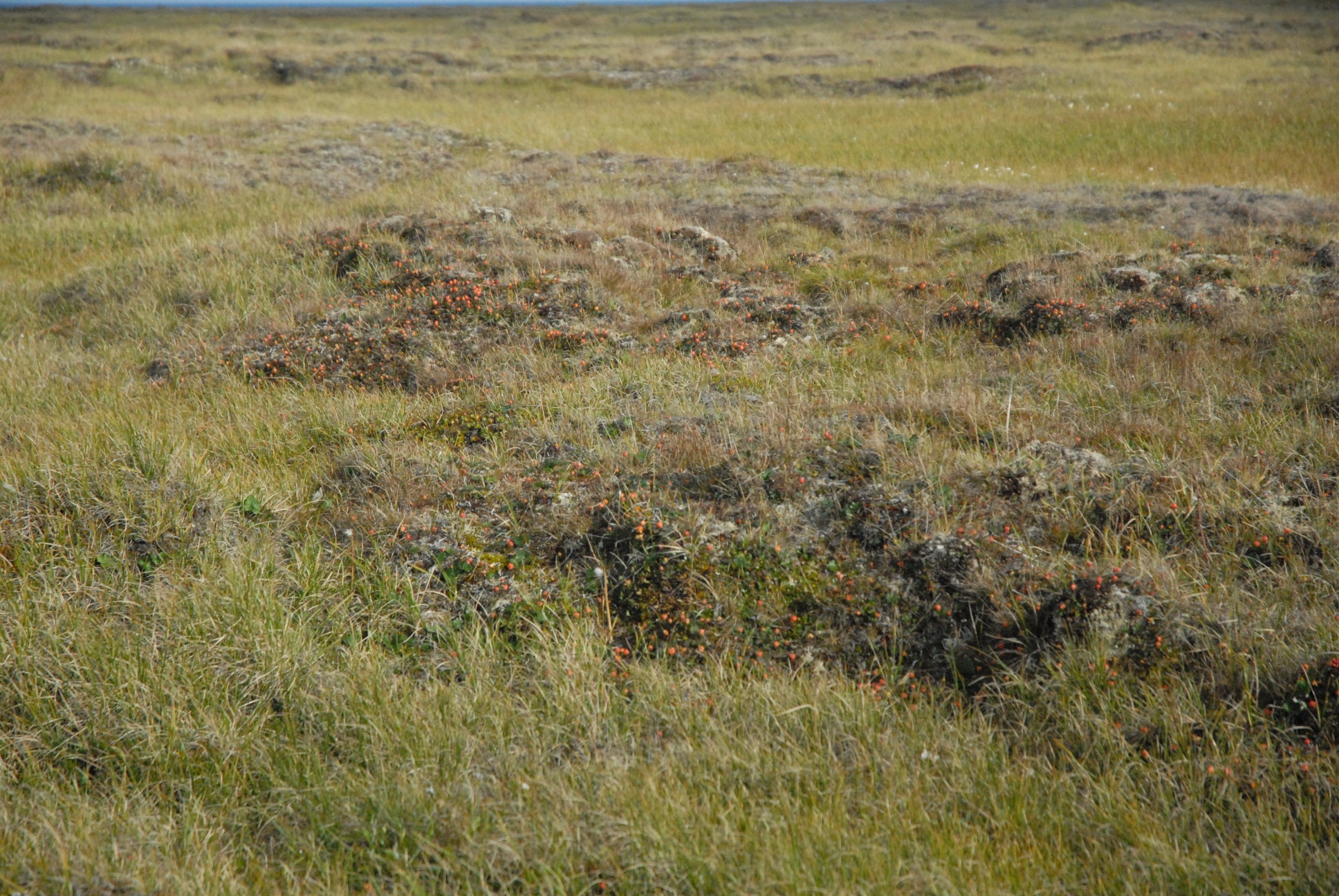
Salmonberries!More salmonberries!
Sadly for us, the patches had been picked pretty recently, so we only found a handful of ripe berries :-(.
The good folks at the NSB (thanks Tommy and Qaiyaan) had provided me with maps of the area to take along showing locations of TLUI (Traditional Land Use Inventory) sites and AHRS sites plotted along with the GPS of the remains. Several of them were very close, so after we had confirmed the existence of the remains, we went to look for evidence and more precise locations of those sites. That way I can give that data back to them so they can improve their database.








 Out of Ice and Time