Back in town

We made it back into town just over two weeks ago.  The field season went well, despite a few challenges from sea ice, snow drifts on the beach and general cold weather.  There was  a huge amount of catching up to do (nearly 4000 emails), three projects which needed various forms filed, an MOA which had to be done for this project, some radiocarbon calibrations to write up for another project, lots of equipment which needed to be cleaned, dried, put away or returned, and many artifacts and samples which needed processing.  Although I had lots of help, I’ve been working 16 hour days since before we went into the field, and something had to give.

Unfortunately, we didn’t have good connectivity in the field, so the only updates I could send were from my deLorme InReach.  At 160 characters per message, it really isn’t up to blog posts.  That means I’m sort of going to have to do some catch-up posts.  I head to Deering for a monitoring project on Saturday, and it’s not clear how good the connectivity will be there either, so there may be another gap.

And we’re off!

The wind changed, we can boat down, and so we’re going!  More when we can or when we get back.

Looking for scrap lumber

We’re in need of a bit of scrap lumber (1x2s and 2x4s), to complete construction of a water screening device.  Alas, Barrow no longer has a lumberyard, so it is a real problem when it turns out you need a bit more lumber.  If anyone has some excess lumber they would be willing to contribute to the Walakpa salvage effort, please let me know.

Getting closer

Time is flying before the field season.  It has been insanely busy trying to get some projects to a point that they can be left for a few weeks while we’re in the field, while at the same time getting set to actually go to the field.  We have been ordering things, and waiting for them to get here so we can build things, or pack things or prep meals or…   And of course, this being the Arctic, shipping delays abound.  However, we have gotten the replacement cover for a Weatherport, all the recalled transit batteries, extra new batteries for the handheld radios, Rite in the Rain paper for field forms, the refurbished iPads, the nice new big First Aid kits, chaining pins, Sharpies (lots of Sharpies) and a bunch of other goodies.  I got my new tent stuff sack (the original lasted one trip, and all the duct tape in the world isn’t enough to hold what’s left together if I actually put the tent in it) and my InReach.  We are still waiting on the parts for a water screening station, and the dry goods.

The lab looks a mess, because everything is still out from the inventory, and needs to be packed, but some of the things to pack it in are part of the freight.  Not optimal, but it will sort itself out.

The freeze and chill food got in, and Kaare will be working with the volunteers to prep a lot of meals to freeze before we head down.  That is, once there are enough volunteers here.

The first of the volunteers were to get in Tuesday night, but the plane couldn’t land, so they all wound up heading back to Anchorage, getting in quite late.  One got on the early flight today on standby, but the rest are now coming tomorrow morning.  I figured maybe 2 nights in Anchorage would be a student budget-buster (having slept under some stairs once when stranded in England for a week on the way home from the field–Laker had raised ticket prices over the summer and I didn’t have a credit card), so I posted on a couple of northern archaeology Facebook groups, and had 5 offers of places to stay from folks in Anchorage within a couple of hours.  In the end, folks couldn’t get refunds for the nights they paid for (a downside of online booking, I guess), but if anyone else gets stranded overnight on the way in or out, at least I’ve got a bunch of phone numbers and we should be able to help out.  Gotta love Alaskan archaeologists.

Kaare made it to Walakpa, although there is still snow on the beach.  There has been a good bit more slumping, but it looks like the overhanging block that was making access so dangerous has fallen, which is a good thing indeed.  The plan is to try to take some of the heavy stuff down tomorrow, although that may change depending on if the freight makes it in.

We’ve also got a survey to finish before we go (only got the go-ahead a week ago) and maybe a desktop study as well, depending on their timeframe (just got the go-ahead today).  Oh, and a proposal, which was just requested yesterday.

And I need to finish making sense of a bunch of dates which I have calibrated for the WALRUS project.  It looks like we have decent ranges for many of the sites based on the caribou dates.  There are a couple of sites that are confusing (possible reverse stratigraphy in big mounds) and I haven’t been able to get copies of the field notes or talk to the excavators yet.  I’ve calibrated the walrus dates using the marine curve, and it is clear there is not a standard offset from the terrestrial dates.  I’m redoing it using the best available local delta R, but I know the one for Barrow is off by several hundred years (if you use it there are a lot of bones from archaeological sites that it indicates will be dying in a couple of centuries!) and there is one site in the walrus study where one pair of dates on associated caribou and walrus is several hundred years farther apart that the other pair.  Since walrus move around, some probably more than others,  it may not make sense until we figure out where the individuals were feeding.

A hundred and one (roughly) moving pieces

There are a lot of things that go into a successful project.  We’ve been inventorying field gear and project supplies, getting emergency contact forms filled out, finalizing safety protocols and on and on.  Kaare Erickson is up from Anchorage for a week or so to help get the gear organized for the Walakpa season, plus another project we’re doing right after that.  He’s heading back down next weekend and will do some serious shopping (& screen building) before he comes back up for the field season.

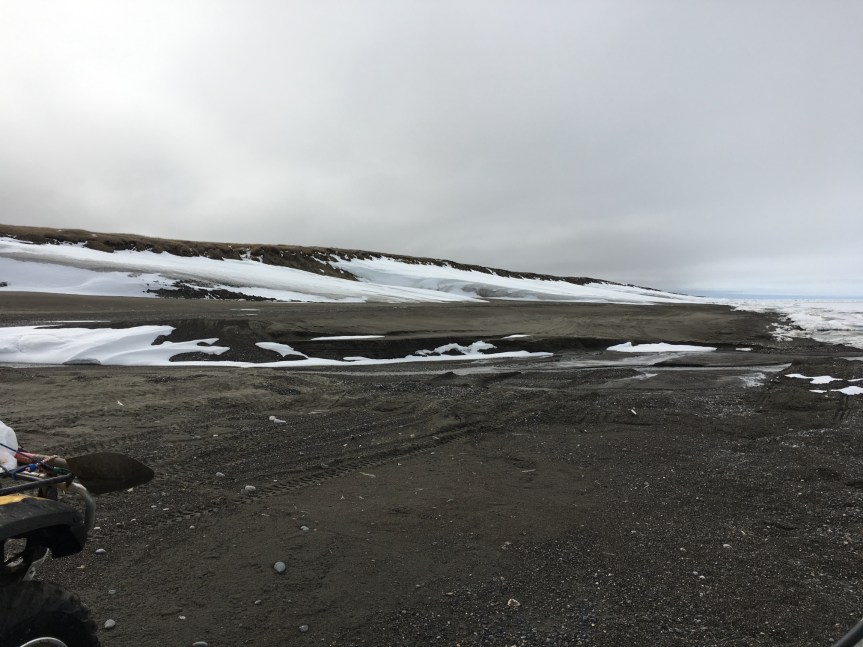
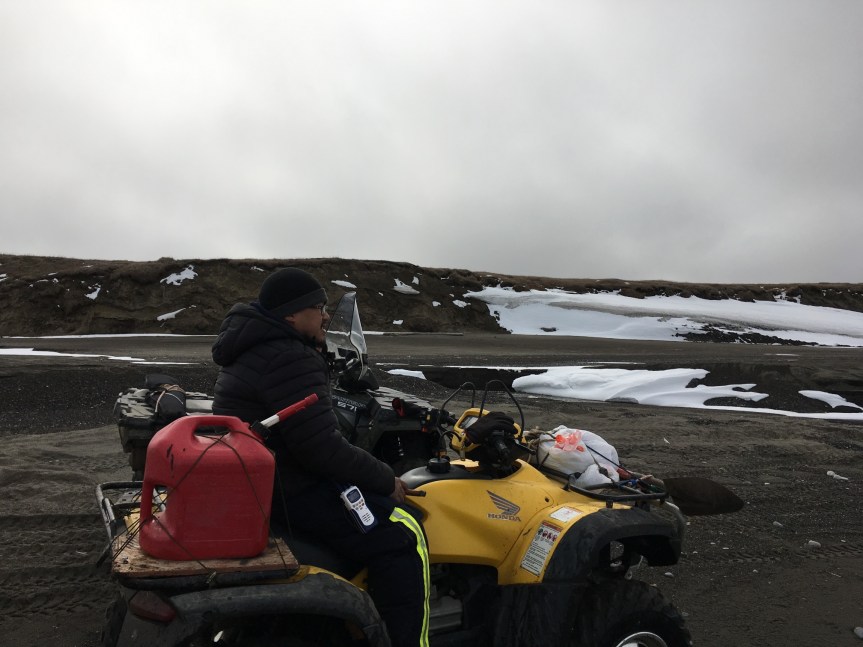
Today we decided to try to get down to Walakpa to see how the site was.  Some folks have made it down (including someone in a truck, supposedly.  Sean Gunnells, who worked at Walakpa in 2013 came along, and we headed down on ATVs.  Alas, yesterday’s snow was not helpful, and the Honda kept bogging down, since it had less ground clearance than the Polarises.  We kept having to go up on the tundra, which made for slow riding.  We made it to Hollywood, which was probably about nine miles, or a little over halfway there, before we decided that the game wasn’t worth the candle. It would have taken all day, and we had lots of other things to get done.  It’s supposed to be warm (in the 40s) for several days, so we hope that a lot of the snow will melt and make for easier traveling.

IMG_3080
Beach just south of Hollywood.  We got as far as the snow in the distance.

While we were on the beach, we looked for tracks.  We didn’t see any, even near a couple of areas where animals had been butchered.  All we saw was an old walrus carcass that must have been dragged up the beach by a bear, but no tracks around it.

However, we had packed lunches, so we went ahead and ate on the beach.  A little ring seal popped up in the shore lead and looked at us.

IMG_3081.jpg
Sean looking down the beach.


Gear list posted

I just put up a new page with the gear list that I’m sending to the folks who are volunteering to help with the archaeological salvage at Walakpa this summer.  I thought it might be interesting to people.

If you have experience camping up here and notice anything you think is missing, please drop me a line :-).

UPDATE 5/29/16:  I added something to the list, thanks to a good suggestion from Randall O.

Archaeology at Disney World. Seriously.

I am writing this from Disney World, where I have gone to talk about archaeology, particularly global change threats to the archaeological and paleoecological records.  The Society for American Archaeology is having its 81st Annual Meeting here, so I am sitting on the 11th floor of a hotel with a view across a lot of fairly low lying land.  It might be high enough to survive several meters of sea level rise, but by 20m, the Orlando airport looks like it gets iffy.

I organized a session on, surprise, global change threats to the archaeological and paleoecological records.  It should be good, with people presenting on various aspects of the problem in various part of the world (mostly the North), and some possible solutions being tried as well.  The session is Saturday morning, and we’ve got Ben Fitzhugh from UW as discussant, as well as a 15 minute discussion slot.  I hope we get good attendance, because this is a critical issue for the future of the discipline (and maybe of people in general).  Of course, in their infinite wisdom, the schedulers put us directly opposite the session in honor of Lou Giddings, which deals with coastal Alaska.  I actually have to read a paper for someone because the primary author couldn’t travel and the second author is giving a paper in the Giddings session at the same time!  Meanwhile, I’d already gone to most of the papers I want to see today by 10:30 AM.

Last night I went to the President’s Forum, which was on Climate Change and Archaeology.  Dan Sandweiss had organized a nice set of speakers.  One of them was Paul Mayewski,who specializes in ice cores and their analysis. He talked about some new software they have, and then he described a new instrument they have which can sample cores in tiny increments, so they can actually see individual storms thousands of years ago in the right type of core!  I introduced myself afterwards, and asked if it might work on ice wedges, following up on a suggestion Vlad Romanovsky had made during ASSW.  He thought so, and offered to pay to ship a trial wedge sample to his lab so they could try it.  Now I just have to get a good sample.  Hopefully it works, but either way it will be interesting.

IMG_2929

I’ve got a meeting later today (and another on Saturday for those who can’t make today’s) for folks who want to help with 2016 Walakpa Archaeological Salvage (WASP 2016).  Today we meet at 5PM at registration, and anyone who is interested is free to come along.  Now I have to run off and find the meeting of the newest SAA committee, Climate Change Strategies and Archaeological Resources (CCSAR).

Yet More Erosion

There is a very large storm, with winds up to 50 mph and big waves from the west battering the Chukchi coastline from Barrow south.  It has created a major storm surge, with big waves and coastal erosion.  An emergency has been declared in Barrow due to flooding and road damage.

I flew back from Wainwright yesterday evening, and even through the storm was just building, the waves were already hitting Walakpa.  I couldn’t get pictures but it did not look good.

Today was much worse.  Late this afternoon, I got a series of calls about something washing out at Ukkuqsi, where the little frozen girl Aġnaiyaaq was found.  Aqamak Okpik from IHLC got things organized, with Morrie Lemen coming out to NARL in a bigger truck than mine to take me in to take a look.  The North Slope Borough Fire Department came over, and two firefighters suited up and tied a rope onto me so I could go down and take a look.

View of Ukkuqsi from the north side.

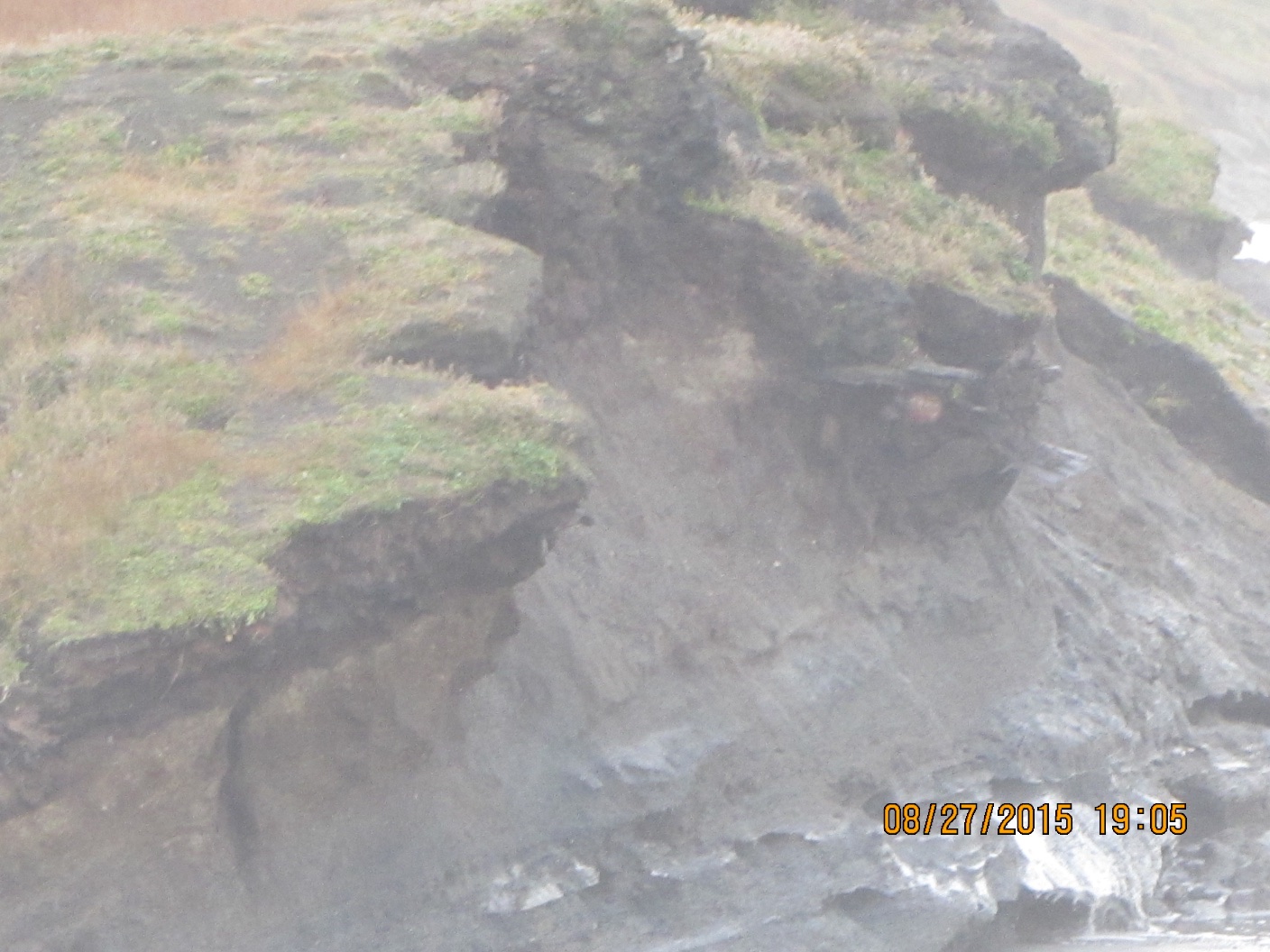
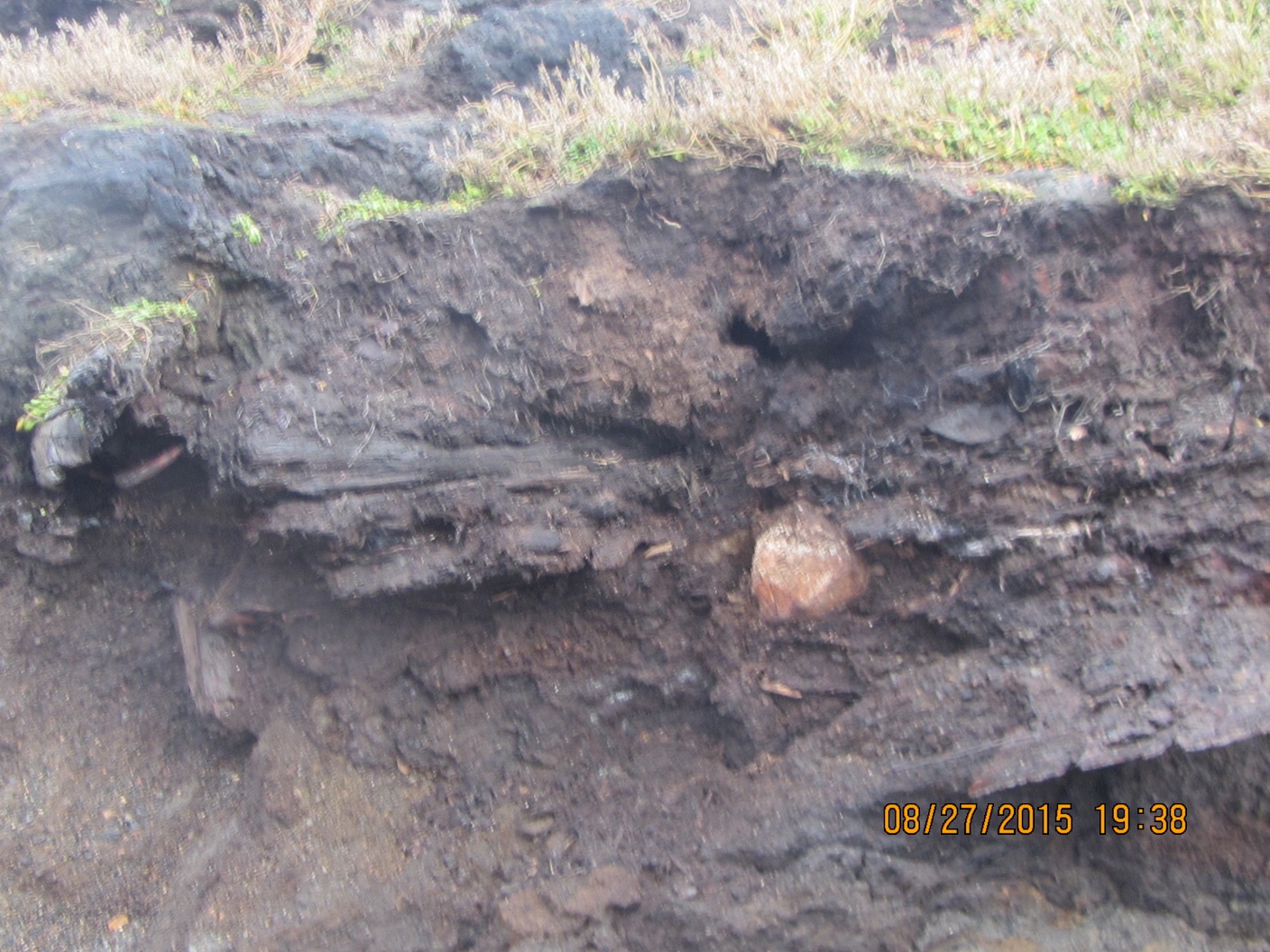
The big concern was that a burial was eroding out, since there have been several in that area.  In the end, it looked like part of a house (maybe two superimposed) with a whalebone and a baleen toboggan.  We retrieved a few bones and a piece of structural wood that were going to fall in any minute, and hope to be able to get a radiocarbon date or two.  I only got hit by one big wave.

Closeup of eroding structure from the beach.

Hope to get some video or at least frame grabs available soon.

Walakpa, July 30, 2015

We got up with the goal of getting packed up.  It wasn’t clear if the UICS logistics staff would be able to come and get us today, but we decided to finish all the field work, and pack up as much as possible.  We got right on the screening, and recording of the edges of the midden and the units on the Pipe Monument mound.  Owen went to work on a detailed profile of CS 2.

CS 2 after excavation and preparation for detailed profiling.

Once that was well in hand, it still wasn’t clear if we would be able to get home.  I needed to go in to Barrow to make sure everything was progressing with the other project, so we decided I could take trailer load of field gear, samples and some of my gear back to town.  That way, we would need less help getting back, and if the pickup wasn’t going to happen until tomorrow, I could bring back my sleeping bag and sleep in the mess tent.

Once I got to town, I unloaded and did some more work on the other project.  It turned out that some logistics folks were available, so I went back down with them, and we managed to get everything back to town, and into the UICS yellow building.   Everybody got to sleep in a real bed.