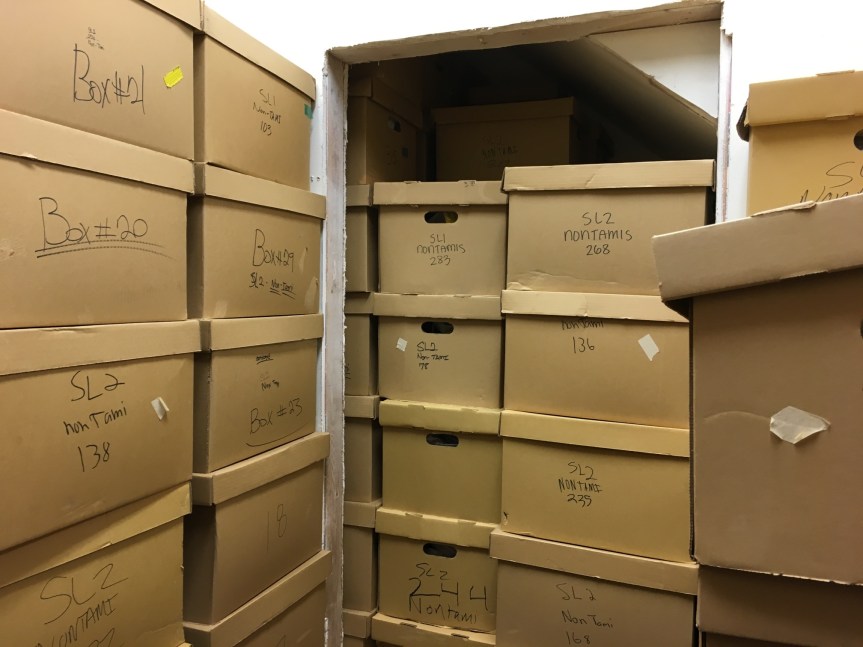
Tony and I spent the day going through boxes containing animal bones from the 1990s excavations at Pingusugruk. Tony made a list of boxes that contained the sample bags we wanted, which we then had to find in the warehouse.
There were over 300 boxes from that site, so it was a long day. We didn’t have to open all the boxes, thank goodness, but we had to move most of them. I suspect I’ll be sore tomorrow. Not really in full fieldwork shape yet, unfortunately.
Tomorrow, we’ll do a bit of modeling, before Tony leaves on the evening plane.
So far it has been pretty busy with Tony here. He’d picked out a number of possible samples in advance, and we’ve been finding them. I’ve also been going through the column samples we took last year at Walakpa, and finding contexts that have 2-3 datable samples of both land and marine animal bone. That way, there will be multiple terrestrial dates to give us both a date on the level and information to use to develop correction factors for marine mammal bones. Marine mammal bones tend to give radiocarbon dates that are too old, but sometimes they are the only thing available to date. People generally don’t run dates in those circumstances, but if there were decent correction factors available it would be possible.
We went over to the Inupiat Heritage Center this morning to look at the material they have from Utkiagvik. It looks like there is enough for a whole project there, although the location of the 1981 field notes was unknown for the moment. Some of the staff came out to the lab later and looked at a couple of sewn objects. The mystery one is made out of gut which has been stitched to form a sort of pointed tube, although it is pretty crumpled up. If we get a conservator to visit, it would be great if they were able to rehydrate it a bit and straighten it out.
Tomorrow we are going to be going through boxes of faunal material from Pingusugruk to find suitable samples. There are hundreds of boxes, so Tony is trying to select some contexts to pull, and then I have to ID appropriate bones. I am really hoping that the intern shows up for work.
On the Walakpa front, I’ve been talking with the UIC Science logistics folks, working on how to handle temporary housing for those transiting in and out of the field, and starting to work on travel arrangements.
I have been really busy the last month, trying to finish several reports and papers, plan for the summer, and get ready for a research visit from Tony Krus of SUERC, who was a member of the 2008 Nuvuk field crew before he headed off to grad school. He is now Dr. Krus, and was able to get a grant to come over and work on Bayesian modeling for Barrow area dates, as well as attempting to improve the value for DeltaR (a correction factor used with radiocarbon dates on marine organisms to compensate for the excess older carbon found in the oceans). Between the massive amount of writing I was doing and smashing a finger getting luggage out of the overhead coming back from a trip, I’ve not been blogging.
I hope to catch up with things a bit; there’s been considerable activity on the DONOP/global change threats to cultural and natural heritage front, as well as planning for Walakpa.
I spent most of the day talking about climate change threats to cultural heritage and archaeological resources. I started off at a fairly conventional session about archaeology at various sites in Alaska and the Pacific Northwest, which had a number of interesting papers, many based on analysis of well-preserved faunal remains.
I then went on to the first formal meeting of the newest SAA committee, on Climate Change Strategies and Archaeological Response (CCSAR). Dan Sandweiss, who is the SAA board liaison, as well as being one of the earlier people to call attention to the importance of archaeological sites as archives of paleoenvironmental data, as well as the obvious archaeological data. It seems to be a really great group of people,working in a lot of different places, all of which are having some climate issues. Most of them are interested not only in saving data, but in what that data can tell us about past climates, and about how people adapted to changes in them. As one person said, “We really don’t have much data about the Archaic, the last time people lived sustainably in North America.” This may be a bit of an exaggeration, especially for Alaska, but basically the idea is correct.
After that, I had to go to an appointment in the book room. We will see what comes of that in due time.
Then there was another interesting session on Heritage Tools for Tackling Climate Change. This included a variety of talks on ways people are dealing with the effects of climate change. One had to do with melting ice patches in Glacier National Park, and how the Park Service had dealt with material coming out, in consultation with the local Native American community, as well as studies they were doing so they could be proactive. Another paper included information on the California Cultural Resource Management (CRM) community’s efforts to get public lands on the coast surveyed completely.
There was some discussion about whether the US ban on revealing any site location data helps or hurts. Most other countries will reveal that data, although they may wait until very valuable materials have been properly excavated in some cases. They have found that it decreases looting, if anything. It also helps people avoid inadvertent damage that happens when people don’t know a site is there, and lets them report on changes in site conditions. So instead of a few archaeologists, lots of people can keep an eye on the sites. Here they can’t do that. I suspect, as do many others, that the people who are serious looters already know where the sites are, and have a pretty good idea where to prospect for more. On the other hand, when the US government shut down for a couple of weeks in 2013, looting exploded in the National Parks.
Tomorrow morning the session I organized on Global Change Threats to the Archaeological and Paleoecological Record (not snappy, but lots of buzzwords for search engines) happens.
I am writing this from Disney World, where I have gone to talk about archaeology, particularly global change threats to the archaeological and paleoecological records. The Society for American Archaeology is having its 81st Annual Meeting here, so I am sitting on the 11th floor of a hotel with a view across a lot of fairly low lying land. It might be high enough to survive several meters of sea level rise, but by 20m, the Orlando airport looks like it gets iffy.
I organized a session on, surprise, global change threats to the archaeological and paleoecological records. It should be good, with people presenting on various aspects of the problem in various part of the world (mostly the North), and some possible solutions being tried as well. The session is Saturday morning, and we’ve got Ben Fitzhugh from UW as discussant, as well as a 15 minute discussion slot. I hope we get good attendance, because this is a critical issue for the future of the discipline (and maybe of people in general). Of course, in their infinite wisdom, the schedulers put us directly opposite the session in honor of Lou Giddings, which deals with coastal Alaska. I actually have to read a paper for someone because the primary author couldn’t travel and the second author is giving a paper in the Giddings session at the same time! Meanwhile, I’d already gone to most of the papers I want to see today by 10:30 AM.
Last night I went to the President’s Forum, which was on Climate Change and Archaeology. Dan Sandweiss had organized a nice set of speakers. One of them was Paul Mayewski,who specializes in ice cores and their analysis. He talked about some new software they have, and then he described a new instrument they have which can sample cores in tiny increments, so they can actually see individual storms thousands of years ago in the right type of core! I introduced myself afterwards, and asked if it might work on ice wedges, following up on a suggestion Vlad Romanovsky had made during ASSW. He thought so, and offered to pay to ship a trial wedge sample to his lab so they could try it. Now I just have to get a good sample. Hopefully it works, but either way it will be interesting.
I’ve got a meeting later today (and another on Saturday for those who can’t make today’s) for folks who want to help with 2016 Walakpa Archaeological Salvage (WASP 2016). Today we meet at 5PM at registration, and anyone who is interested is free to come along. Now I have to run off and find the meeting of the newest SAA committee, Climate Change Strategies and Archaeological Resources (CCSAR).
Folks who have been reading this blog are aware that erosion of archaeological sites due to global change effects (warming, sea level rise, etc.) is a huge problem where I live and work. Rapid decay of the exquisitely preserved organic contents of the sites is also a huge problem. But a blog only reaches so many people and actually dealing with the sites and otherwise doing my day job means that I can’t spend endless time on outreach. So when a member of the media is interested, I take the time to talk to them. Sometimes something comes of it, other times not.
Last summer Eli Kintisch, who writes for a number of scientific publications came up and spent a few days in Barrow. He managed to spend a day at Walakpa, although his schedule meant he couldn’t be there for the whole thing. He’s been working on it since, and I think the result is pretty engaging. The resulting article was just published by Hakai Magazine here and simultaneously by the Smithsonian website here. Hakai focuses on coastal issues and just recently published an article on Tom Dawson and SCAPE’s work in Scotland dealing with similar problems (minus the permafrost thawing and sea ice retreat).
It’s a big problem, and one that will take a considerable input of human and financial resources to deal with. We’ve only got a few decades (less in many cases) before all the cultural heritage and paleoenvironmental information in these sites is gone for good.
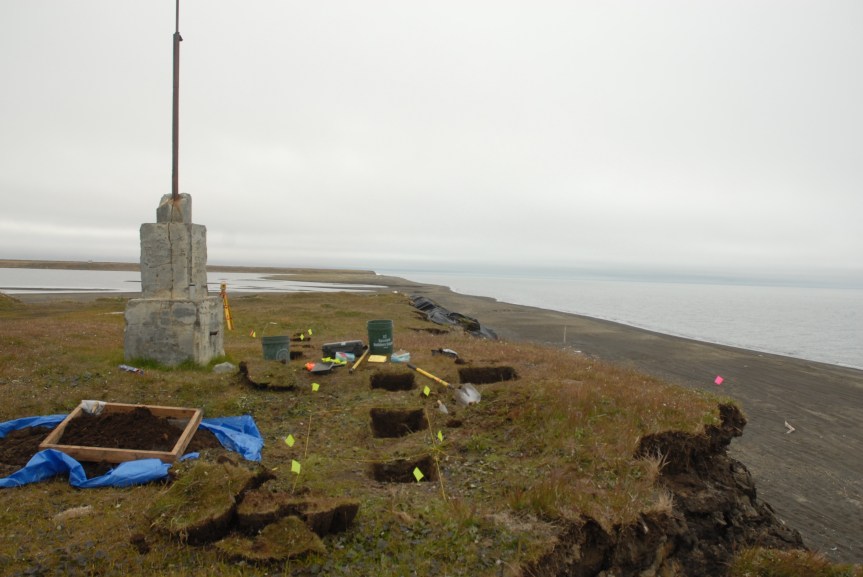
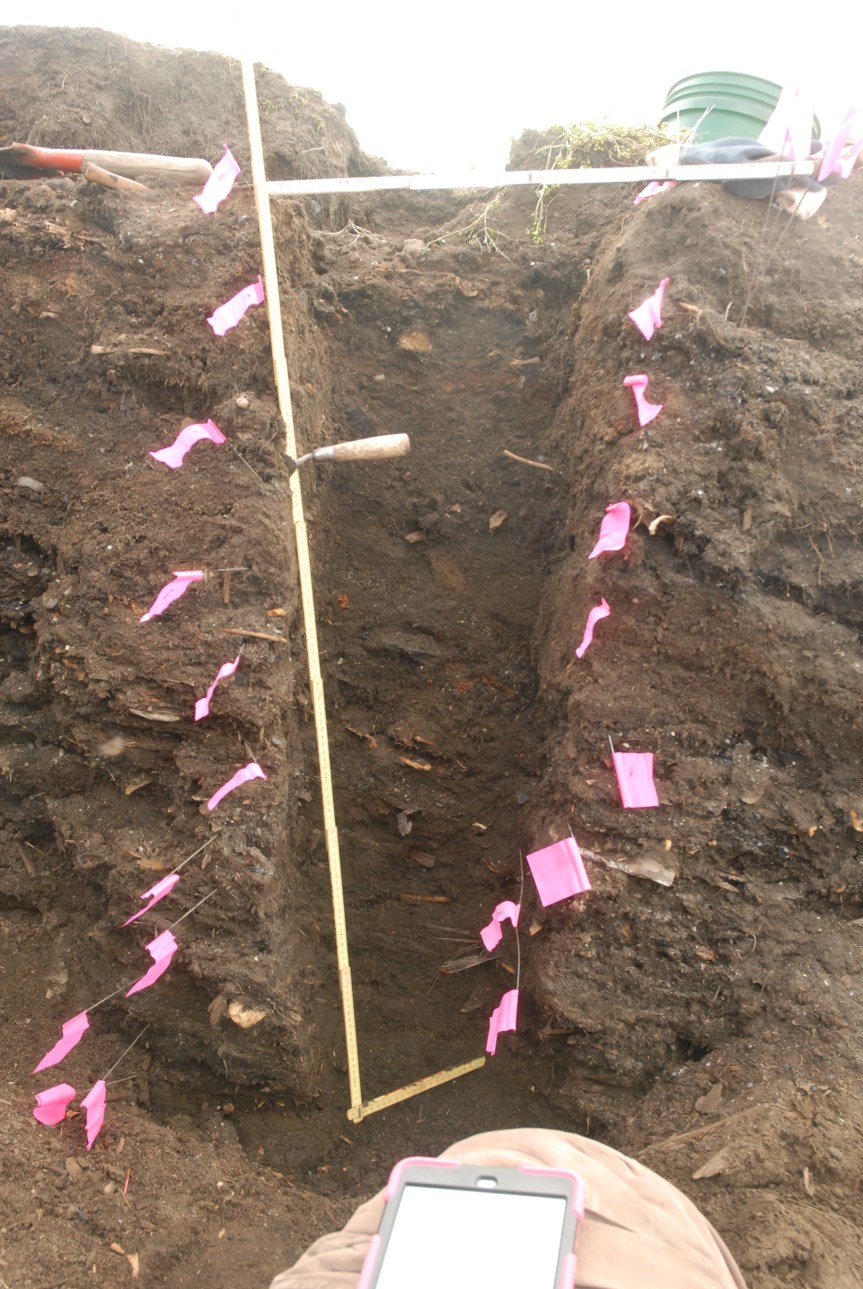
Tests in a midden at Walakpa. A new date shows it is Late Western Thule, between 300-500 years old.Column sample at Walakpa, Summer 2015.
I spent most of the week in Seattle at the Arctic Observing Open Science meeting. Ben Fitzhugh and I were the point persons for the broader GHEA/IHOPE Emerging Knowledge Hub on Global Environmental Change Threats to Heritage and Long Term Observing Networks of the Past. This is a long and fancy way of talking about the threats that sea level rise, ice retreat, and permafrost warming pose for archaeological sites in the North. Since this was not an archaeological meeting, most of the folks were either natural scientists or resource managers. We focused on the kind of data that archaeological sites contain that are more than relevant to answering the kinds of questions they are asking, while pointing out that the data is vanishing quickly. The library is on fire!
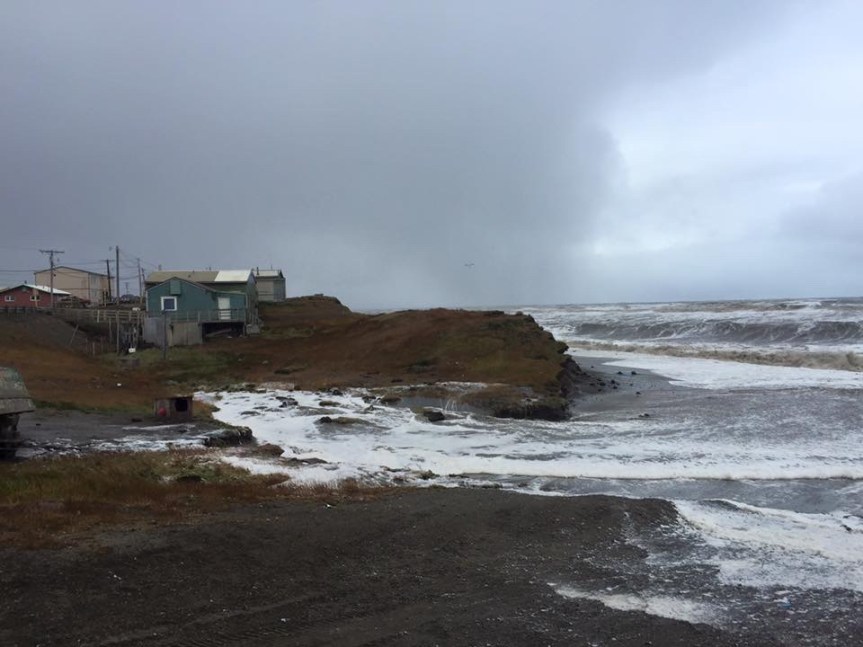
Waves eat at the Utqiaġvik bluffs.
Ben and I each were the lead on a talk (both massively multi-authored), and we also did a poster, with a similarly large number of contributors. Ben’s talk was in the Marine Ecosystems session. It seemed like it interested the audience, which was primarily oceanographers, and related agency and funding folks.
Mine was in the Human Dimensions session, since the Coastal Processes session we had aimed for apparently didn’t get enough papers. I followed a paper on frozen heritage (primarily ice patches and the preliminary stages of development of site evaluation schema) by Martin Callanan and Shelby Anderson, so the issues were thoroughly driven home. The audience included a number of natural scientists (!), and the discussions included the relevance of archaeology to both other fields of research and to developing toolkits for sustainability.
Our hope is we woke some of our colleagues up to both the potential of archaeological sites to provide data, and the need to find a way to get that data that doesn’t rely entirely on Arctic Social Science funding.
My talk and the poster are up on both my Academia.edu and ResearchGate pages, if you would like to see them.
I’ve spent the last month writing almost non-stop. However, none of it was posts on here. We had done a number of CRM projects this summer, and the results had to be written up. Five reports later, that is more or less done, pending a couple of possible new illustrations.
I’m working on a couple of projects for a client who is in the early stages of planning some big infrastructure projects. Instead of waiting until the design and site selection is nearly complete and then considering cultural resources, which often leads to unfortunate surprises, unnecessary expenses and project delays (which are then blamed on archaeology instead of poor project planning), they are actually trying to get a handle on what cultural resources might be located in the possible Area of Potential Effect (APE) and what dealing with them appropriately might entail. This seems like a way better approach and should be a win-win.
This weekend, I’m working on a paper and a poster for the Arctic Observing Open Science Meeting in Seattle in 2 weeks. I had hoped to give the paper in a proposed Coastal session, but apparently there weren’t that many coastal papers, so it looks like I’ll be in the Human Dimensions session. Sort of ironic, given that I’m talking about the paleoenvironmental data that Arctic sites can contain, and how that data is at imminent risk of being destroyed by global change effects, and pretty much taking the human dimension information potential as a given. That’s pretty much been the basic premise of archaeology since the days of CJ Thomsen & JJA Worsaae. I’m spending a part of next week in Anchorage, so I want to get it more or less done before I go.
From Glasgow, we went on to Vienna and CHAGS (the Conference on Hunting and Gathering Societies), by way of Düsseldorf. The Düsseldorf airport is not high on my list of airports in Europe.
In Vienna, we stayed in Hotel-Pension Bleckmann, a nice family-run hotel near the University, where all the conference sessions were being held. The hotel had great breakfasts, and the staff was really nice and very helpful. They recommended a restaurant that had great food and a local clientele, so it was more reasonable than the more touristy places.
Glenn having dinner at D’Landsknect, Porzellengasse.
The conference was very interesting. Both Glenn & I were giving papers in a session on Aboriginal Whaling in the 21st Century. I talked about the archaeological evidence for whaling in Alaska, and Glenn talked about the late pre-contact/protohistoric whaling-centric system in North Alaska. There were a number of other northern papers in the session, including papers on Central and Eastern Canadian whaling archaeology from Jim Savelle and Peter Whitridge, as well as papers on whaling in places like Korea & Bequia. There were 51 other sessions, all having to do with hunting and gathering groups. Of course there were a lot of northern papers, but some of the other papers were very interesting as well. The organizing committee and the students really made an effort to have a green conference, including the food and drinks served at breaks, and all in all it was quite fun.
We ran into a couple of hooded crows in one of the courtyards on campus. Oddly, we’d seen one at the University of Glasgow as well.
Hooded crows.
The campus has all sort of restaurants and beer gardens more or less on or next to it. It was very convenient after sessions. Several times we wound up at Steigel-Ambulanz. This was a restaurant/beer garden right across a walkway from the area where the sessions were concentrated. It featured seriously large portions, but the food was very good. We also had a dinner at Universitätsbräuhaus, which was more or less across the quad.
Seriously large (and very carefully arranged) caprese salad).Claire Alix about to enjoy that salad.
The conference banquet was held in a banquet hall in the Wiener Rathauskeller. That literally means the cellar of the city hall, and that’s exactly where it is, in the basement of Vienna City Hall. It is set up for banquets (and also as a restaurant). The food was great, and Richard Lee (of Man the Hunter fame) was honored for his contributions. He was just back from something like his 50th field season!
Conference banquet in Wiener Rathauskeller.
Vienna had more places that only took cash than do most cities these days. We wound up having to wake quite a way to find a bank that exchanged money, since we needed more Euros than we had exchanged in the first place. On the way, we stopped by the Spanish Riding School (home of the Lipizzaner stallions), and booked a stable tour for the next afternoon, when there weren’t any sessions we simply needed to hear. The building the Riding School is in had a stratified archaeological site under the plaza in front of it, and portions had been preserved with a wall around it.
Archaeological site in Michaelerplatz. There are portions of a Roman road, Roman fortifications, and even 18th century apartments and drains exposed. The entrance to the Winter Riding School is in the background.
The next day we went for the stable tour. It was pretty interesting, and the stables were very nice, although we weren’t allowed to take pictures in the actual stables. Much like the Royal Stables in Denmark, the horses were all in box stalls, but you could see they had been converted from tie stalls at some point in the past.
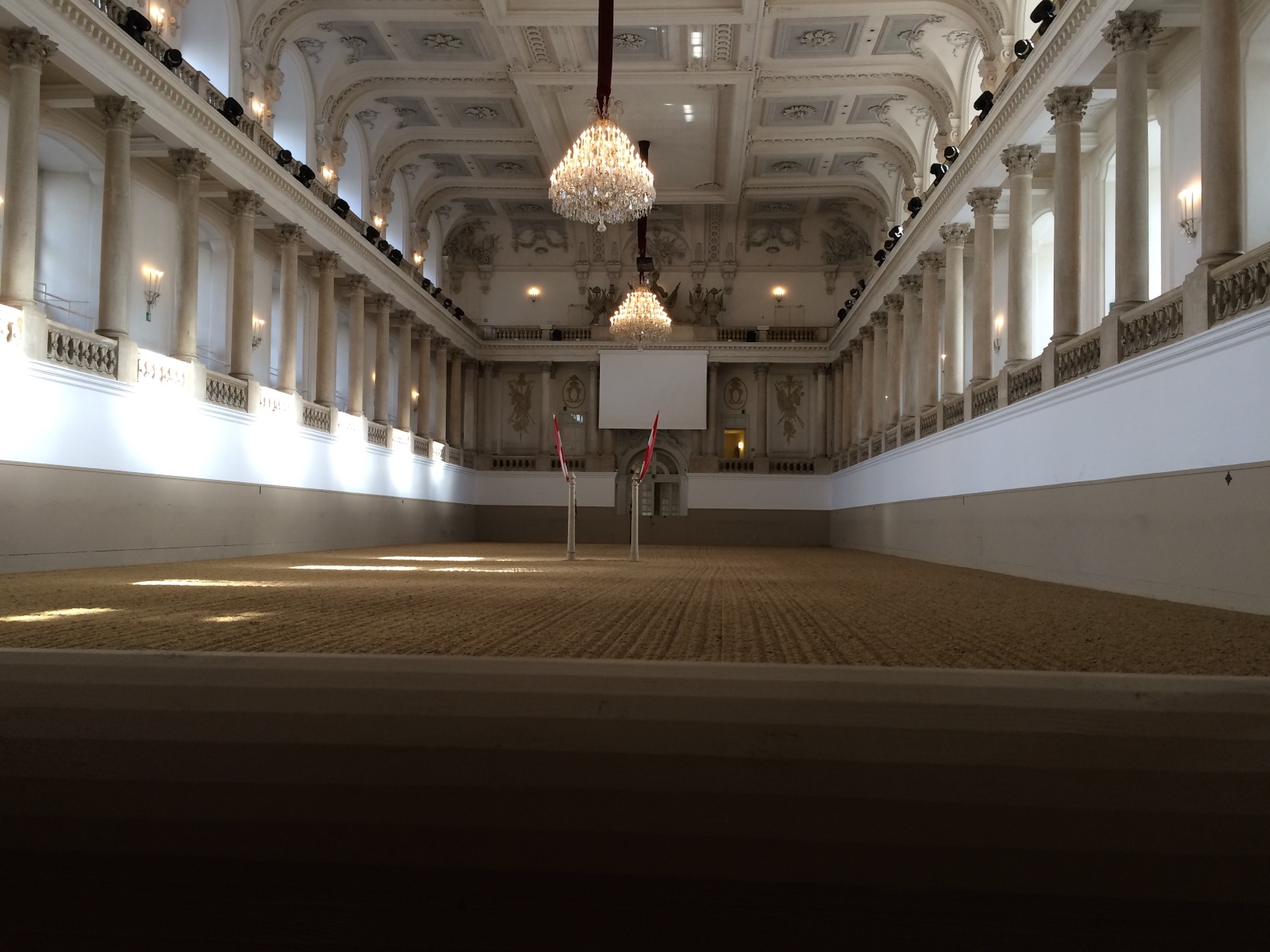
Entrance to the Hofburg from Michaelerplatz. The Riding School is on the left of the main archway.Largest walker in the world.Saddles in the tack room at the Spanish Riding School.The Winter Riding School.
Chandelier at the Winter Riding School.
Believe it or not, when it was built, the Winter Riding School hall was considered very simple in design, the better to show off the horses!
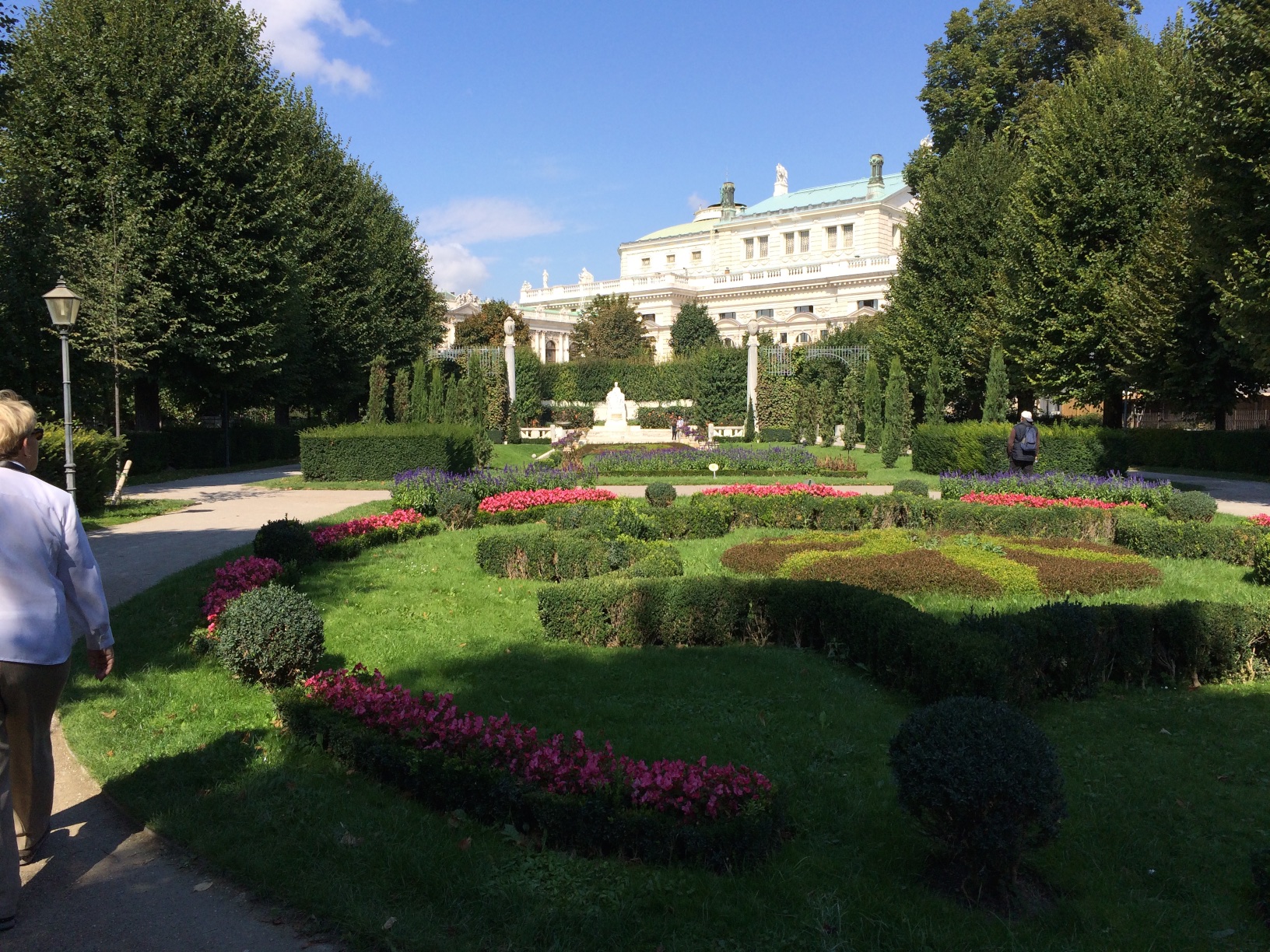
We walked back to our hotel through the Hofburg grounds. Being in Vienna really brings home that until pretty recently, it was the seat of a major empire.
Gardens in Vienna.Display rose garden. It seemed to have one bush of each variety of rose, clearly labeled.
Another garden.
I couldn’t resist adding this. The German for ice cream is “eis” and this is an ice cream shop.







 Out of Ice and Time