Things get a bit exciting…

As is traditional at the end of a field season, things started getting a bit exciting.  The possible burial we found in STPs yesterday proved to be the real thing this morning, and the feature we worked on on Monday also turned out to be a burial. It is the deepest burial I’ve seen at Nuvuk in the fifteen years I’ve worked there.  It appears to contain two children, covered in fur.  We hope to finish it tomorrow.

I had hoped to be done with the DWF today, but fish bones kept coming, along with an arrowpoint, a worked walrus humerus, some worked bird bone, what look like a broken needle, and more lithics.  Recording all that with the transit took time.  We still had the windbreak up, but there wasn’t much wind, and since it was the second warm day in a row, the mosquitos were swarming.  Thank goodness I always have bug dope in my pack, or I don’t think much would have gotten done.

In other good new, the replacement for the Nikon Coolpix S9100 which I had for a week before it stopped working arrived, so I will have a pocket camera for snapshots.  More pictures for here without lugging the D200 home to download the card every night.


Plenty of fish

Excavation of the hearth & surroundings continued.  When we first found fish bones we were pretty excited.   We just keep finding more in and near the hearth and I must admit the thrill is rapidly fading 🙂 . We’re finding some other bone too, not all of which has been burnt past the point of recognition.

The egg was successfully extracted and packaged, and has made it back to the lab, I hope more or less intact.  We shall see when we start processing things.  If we can’t figure out what it was, Dennis said they’ll take a crack at IDing it through DNA.

Two neat finds

We started investigating the last GPR hit and came down on a jumble of wood.  The excavators were not optimistic, but I kept pushing to go a little further.  Eventually, this appeared:

Feature detected with GPR

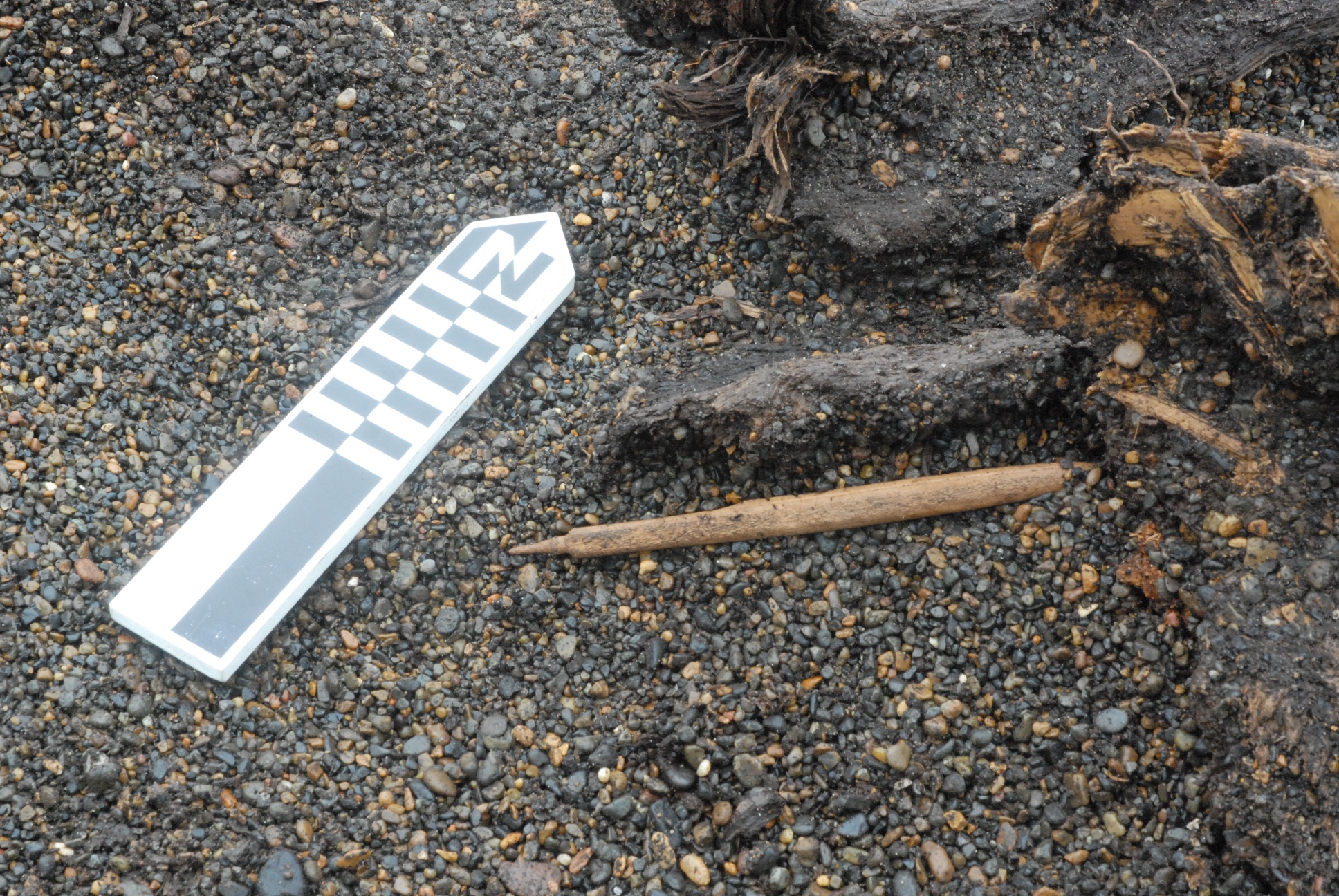
The feature (I’m not calling it a burial until there is evidence of human remains) was jumbled because at some time after it was constructed, someone dug a hole in the middle of it.  And right beside where the hole had punched into the feature was this:

Antler arrowpoint

The hole just missed it.

The DWF (Ipiutak) levels had their own surprises.  We found a good bit of fish bone, some lithics (nothing diagnostic) and a lot of broken bone, but the really cool thing, which I found on the edge of the hearth, was a flattened but apparently complete egg!

The remains of the egg

Looks like it’s a hearth

We were a small crew today since the high school students weren’t working, so we concentrated on the Ipiutak area. It was fairly tricky to excavate, since there is unconsolidated gravel under the Wood/sand/gravel layer that covers the Ipiutak surface, and a large pile of unconsolidated gravel uphill from the features.  Plus the hearth ash is covered with a mushy skin of peat, and both the hearth surface and the peat undulate.  Despite that, we recovered 2 fin rays, some burnt bone, a pot-lidded flake (probably rhyolite), a grey chert flake, and a black biface fragment from the hearth.  We also got some large ungulate (species in dispute at the moment–probably caribou) bone, and a small fragment of decorated ivory, plus several interesting pieces of wood, which appear to be worked.

It was quite cold.  Even though we had a windbreak, the levels are just thawing, and the ground is cold and wet.  My hands are still stiff, so more will have to wait until tomorrow.

Much gravel is moved

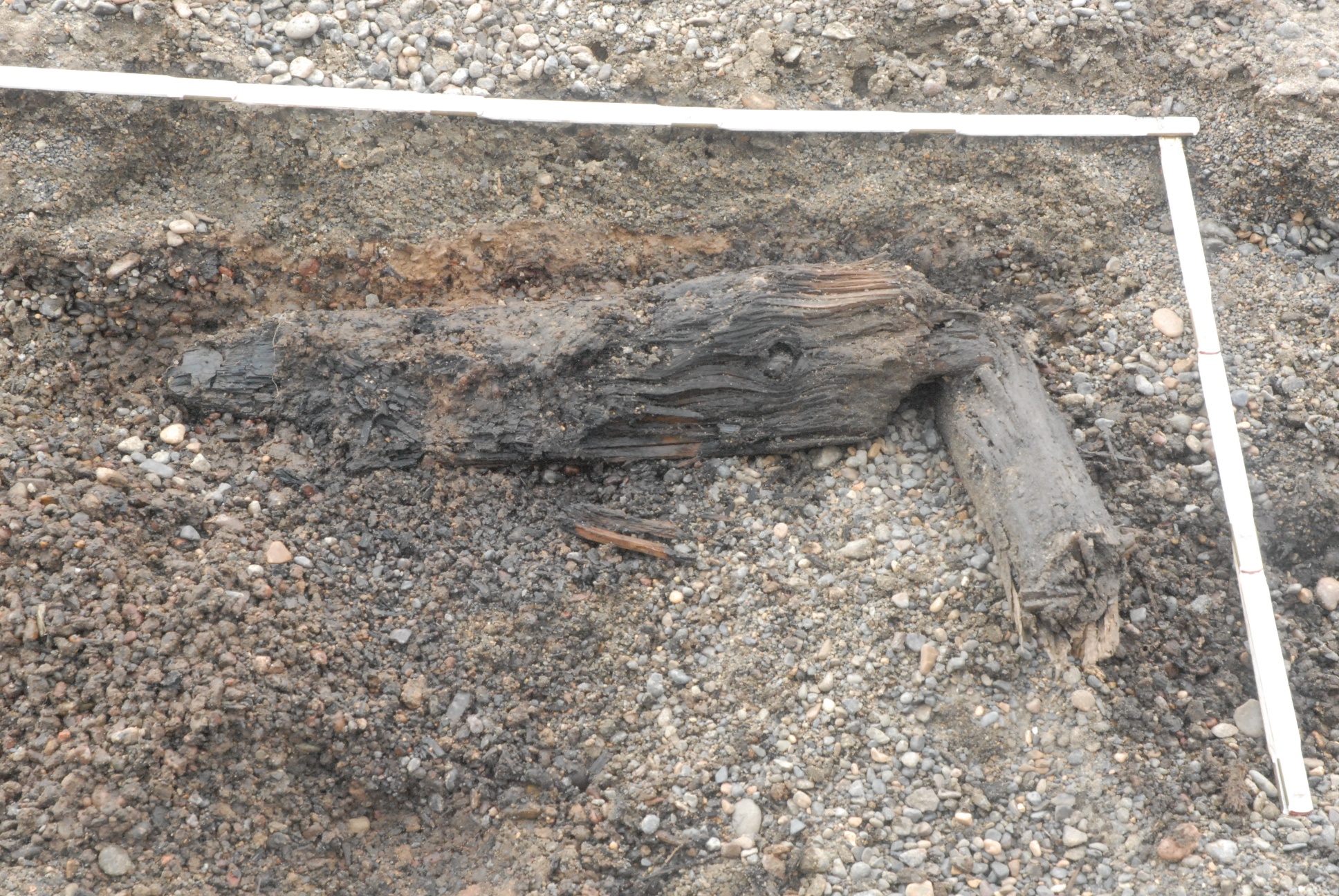
We spent most of the day with shovel testing, shooting in pits and moving gravel.  The gravel moving was in aid of getting a better look at the worked wood protruding from the erosion face at what appears to be the Ipiutak level.  So far, there seems to have been a fire and a lot of ash in association with one of the wood features, and it’s not clear if it was a hearth or a structure that burned accidentally.  Opening it up a bit more would help, but it is under a lot of gravel.

Structural timbers with possible hearth in Ipiutak level

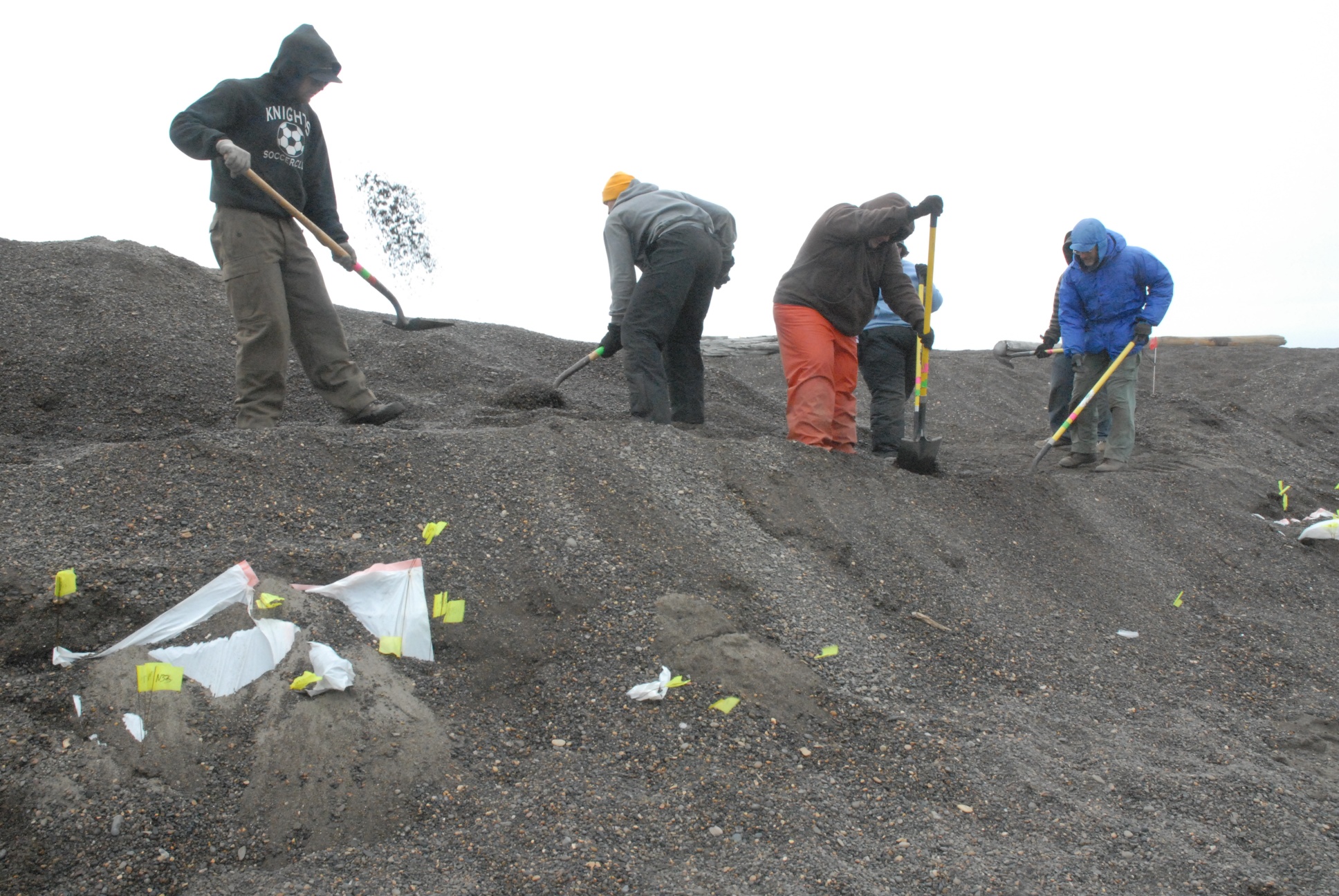
The crew did yeoman work, and much gravel was moved, so we can get a look tomorrow.  There is actually a frozen layer under where most of them are standing, which will have thawed by tomorrow if we are lucky.

Flying gravel! L to R: Adam, Trace, Laura, Candace, Dennis, Tom

Sunshine & blue skies…

…and a full crew.  We started work on the burial under the plank.  It took quite a while, as the plank was complex to define.  It was all one piece, in some places up to 9 cm thick, and had obviously required a great deal of work and skill to make.  The top surface looked like the outer surface of the tree.  The bottom surface showed evidence of burning, in some areas completely charcoal.  It should be good for C14 dating.

The remains are those of a large male.  Preservation is a bit variable, but it looks like there might be some ribs that could yield aDNA.  In any event, he will be safely out of the trail.

Many on the crew did STPs.  So far nothing has shown up.  It is beginning to look as if there is a gap in the burials (or at least a much thinner distribution).  I’ve begun to wonder if this could be the result of a village move due to erosion, which brought the village close to the cemetery and made them skip a bit of ground to put the new cemetery at a proper distance from their residences.

At least it was a beautiful day.

First rainy day of the summer…

…which is pretty amazing if you know Barrow.  It was still somewhat windy and actually raining quite hard at times in the morning.  I decided we’d stick to STPs for the day, since drawing and photography would be sort of problematic.  Rhett and Jared were scheduled to be in the lab processing data, and Dennis decided to stay in too.  Several of the students were sick.

There was a half-hour delay due to confusion over who was going out as bear guards, and where they were to get rain gear.  UMIAQ even asked us.  We do have some spare rain gear, but it stays in the field in case someone’s gets wrecked or a student forgets theirs, so that really was no help.  They finally had to go home and get their own.  Then on the way out an ATV, which had been acting up for several days, “failed to proceed”  just past the end of the road, so another half hour delay for me, one of the bear guards and Candace, who was riding the dead machine.  UMIAQ brought another out and we continued.  No huge deal since we were just doing STPs, but if we’d been planning to excavate, everything would have been on hold until the transit and the excavation equipment in the trailer being towed by the dead machine could get to the site.

The crew that was there got a good number of STPs done, although nothing showed up.  At least it doesn’t seem like the GPR is missing anything, although some areas have been driven over so much and have so much refuse in them that nothing short of a whale skull would stick out from the background noise.

Blustery day

It really was, and chilly besides.  Winds were probably over 30 knots at Nuvuk, so we didn’t even try to excavate.  The day went with shovel testing, shooting in various things with the transit, and checking out the wood projecting from the erosion face that appears to be in the Ipiutak layer.  It’s looking pretty interesting, but hard to get at.

It was a long cold day, and I had a lot of paperwork to do, as well as homework for a course I am taking online, so…  More tomorrow.

Back at it…

After a day off, we were back in the field today.  The GPR hits we tested were mostly concentrations of water, and buried whale bones (not part of graves, unless it was a whale grave).  However, we also looked at two other areas that had turned up in the trails on the first day’s walkover.  One proved to be nothing but a concentration of refuse.  The other wasn’t looking much more promising, with peat and a little wood, but we took it down to expose all the wood, and low and behold, a very large piece of wood indeed, which is a burial cover.  We will have to excavate that tomorrow.  There will also be a new set of GPR results to test.

The burial cover exposed. That is one piece of wood! The dustpan is covering what may be a bone, so the photo can be used for the public.

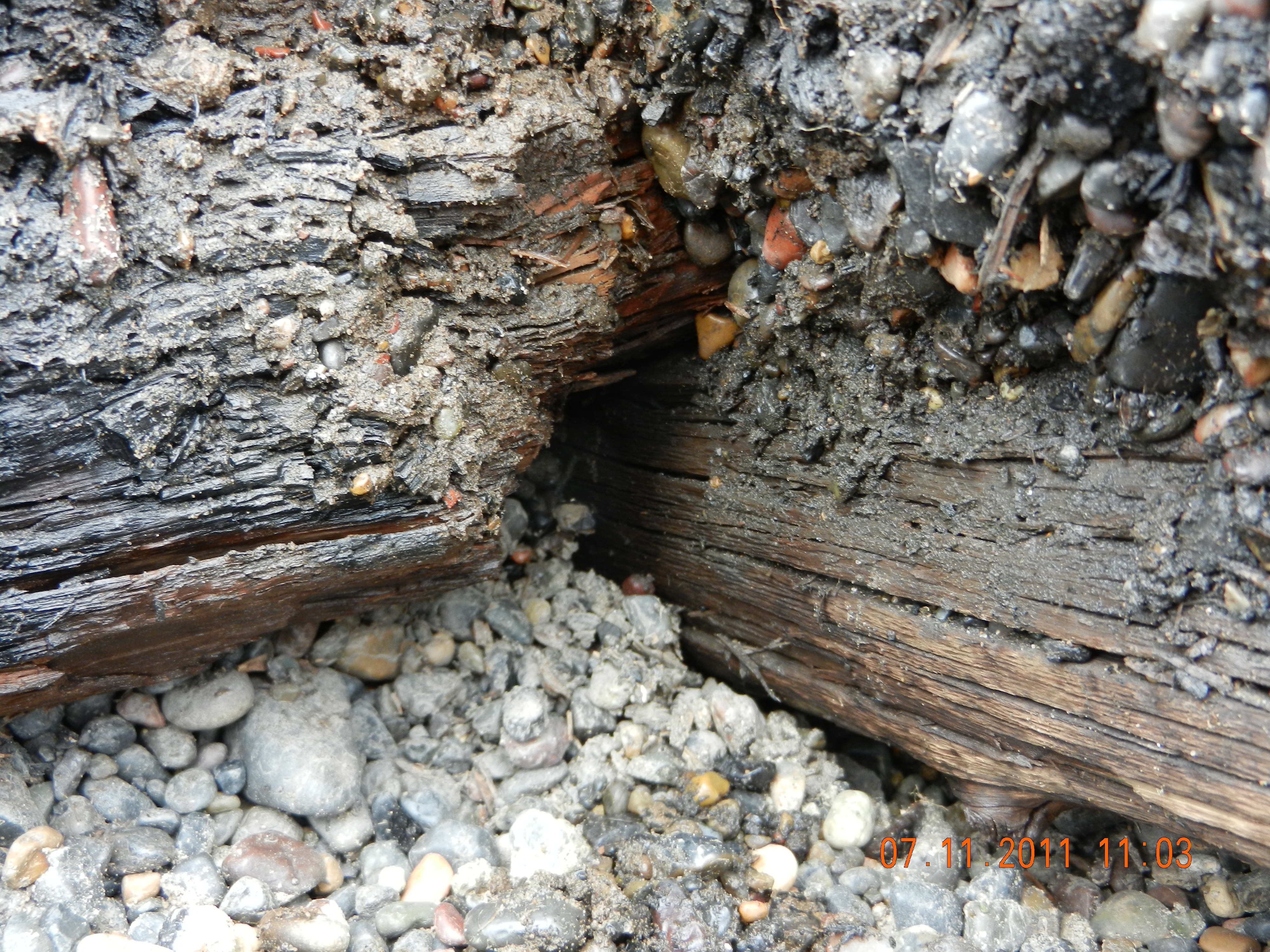
There is also some wood exposed on the erosion face at what looks like the Ipiutak level, including something that looks like architecture.

Notched log resting on another log. Ipiutak?