It took a while to get everything in place, but we are ready to start taking applications for summer internships in archaeology through Ilisaġvik College! They will involve learning about laboratory work and participating in some interesting and important research on walrus in the past. It will help prepare you to participate in some fieldwork that we hope to have coming up this summer and/or next, and you can also earn college credit.
I’ll be in Fairbanks working at the University of Alaska Museum on selecting samples from the collections there for the next two weeks. In the meantime, you can get an application packet from Susie Stine (852-0921). I’ll be interviewing the week of May 25 (not on Memorial Day) so get your applications in.
This is probably best for people who live in Barrow, since there is no housing with this internship.
When we first started archaeological work at Nuvuk, it took a while to find a physical anthropologist who was willing to work with the human remains here in Barrow. Dennis O’ Rourke and his team were willing to do that. Dennis came up to Barrow to speak to the community and the Elders to get their permission. His lab works with genetic studies as well as skeletal material, and he asked if they would be interested in allowing ancient DNA studies on the remains from Nuvuk. The Elders were not only interested in those studies, they suggested that the group undertake a program of modern DNA studies across the North Slope as well. They developed a proposal to do just that, and once it was funded, research got underway, with resident of all seven North Slope communities contributing samples.
The analysis took a while. The team traveled to all the villages to collect the data and returned to present the results to North Slope residents before they were published. Finally, thefirst paper based on the project is published! It is based on looking at mitochondrial DNA, which is inherited only from your mother. It is present in many more copies than the more familiar (to most people) nuclear DNA, and therefore is often studied in archaeological situations, since all the extra copies make it more likely that some of it will survive.
The short version is that the modern DNA results support the North Slope as the source for the populations that migrated to the eastern Arctic, both the Neoeskimo (ancestors of today’s Inuit/Inupiat people) and the earlier Paleoeskimo. This fits well with the picture from the archaeological data.
Jennifer Raff is senior author, with Margarita Rzhetskaya, Justin Tackney and Geoff Hayes as co-authors.
This paper has gotten picked up by a number of science news sources.
Edit: 4/30/15 Fixed a link that WP had put an ellipsis in the middle of the link. It should work now.
I’ve been very busy for the last months, although primarily it has been administrative things, many of them connected to moving my grants to a different institution. It was very necessary, but also very time-consuming, depressing and annoying, and didn’t really make for worthwhile reading. That’s more or less taken care of now, so back to “regularly scheduled programming” we go.
I’m currently in San Francisco to attend the Society for American Archaeology (SAA) 80th Annual Meeting. I’m giving a paper in a very interesting Arctic session on Saturday morning. The paper is on global environmental change threats to North Slope sites, and the urgent situation this creates with regard to the imminent loss of the archaeological and paleoecological information they contain. Even some archaeologists who either haven’t worked in the Far North or haven’t been in the field there in the last 10-15 years don’t realize that things have changed drastically and this is a crisis.
Of course, this session is opposite a very cool IHOPE session into which it would have fit equally as well. Sigh. Someday someone will invent a meeting scheduling software that will minimize such conflicts.
Well, off to see if I can locate the early registration…
I spent much of Friday in the lab, selecting items from Walakpa to send off for radiocarbon dating. We had a reasonable set of samples from 2013 and funds to run the dates, but given that that entire area is gone, I wanted to get some idea of how old some of what was exposed this fall is. That meant I had to make some choices about what got sent and what didn’t.
We had managed to collect several caribou bones, but most of them were ex situ (not in their original location). There are also several samples of plant material from known locations which are much more likely to be informative. Everything had been frozen as soon as it came in from the field due to the aggressive mold we had had to deal with last year. For carbon dating, the lab needs to have a certain minimum weight to work with (varies by each type of material), which means that the samples had to be thawed enough to allow them to be split, cleaned, and dried enough to make sure that the weights were accurate.
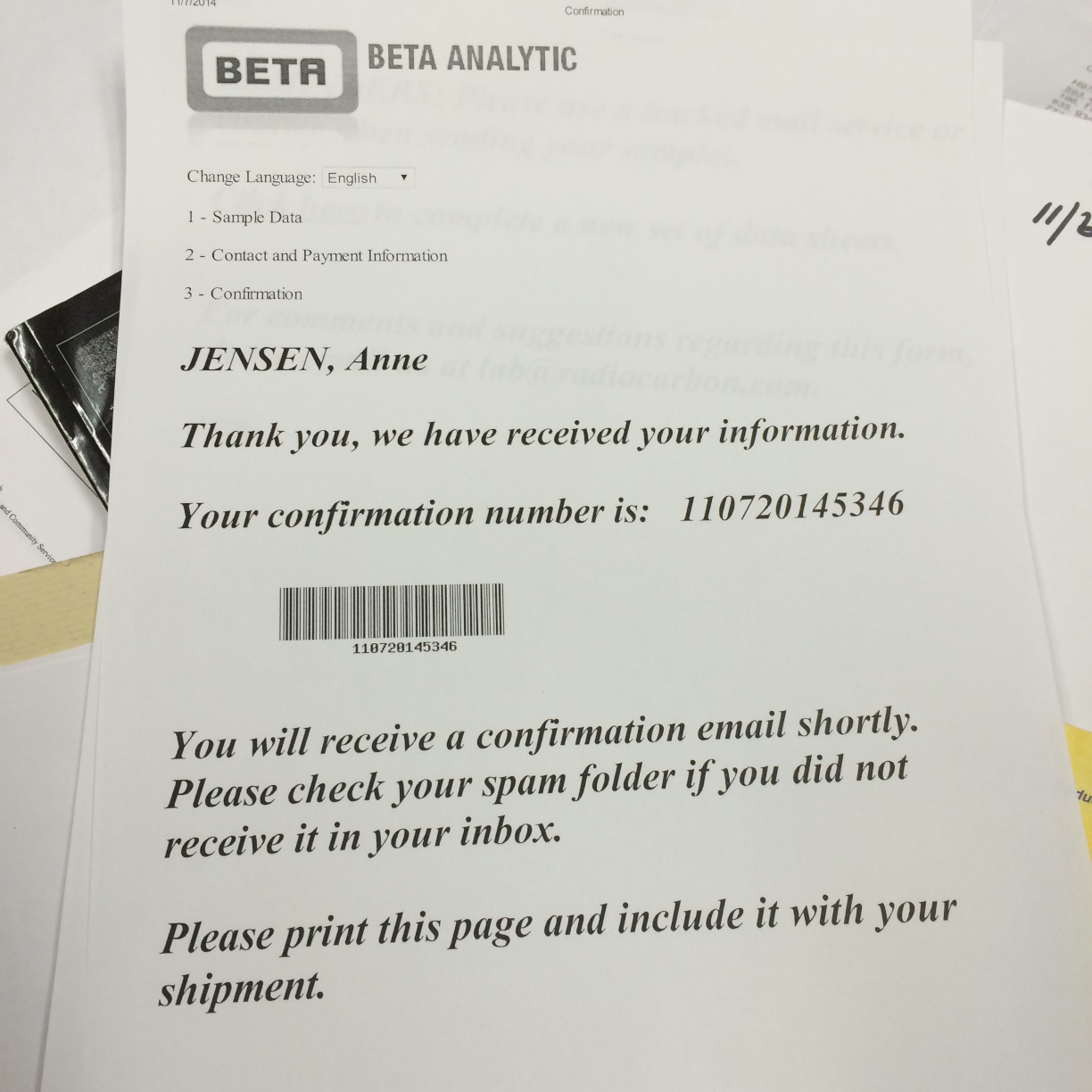
Beta Analytic has got a slick new sample submission interface that I had never used before. It has a few quirks, which meant that I had to quadruple check the submissions to fix things. I got better at it, so . In the end, it prints out a barcoded form that you put in the package with the samples.
By the time I finished, it was too late to mail the samples on Friday. The US Post Office in Barrow doesn’t have any counter service on Saturdays, so they’ll get mailed on Monday.
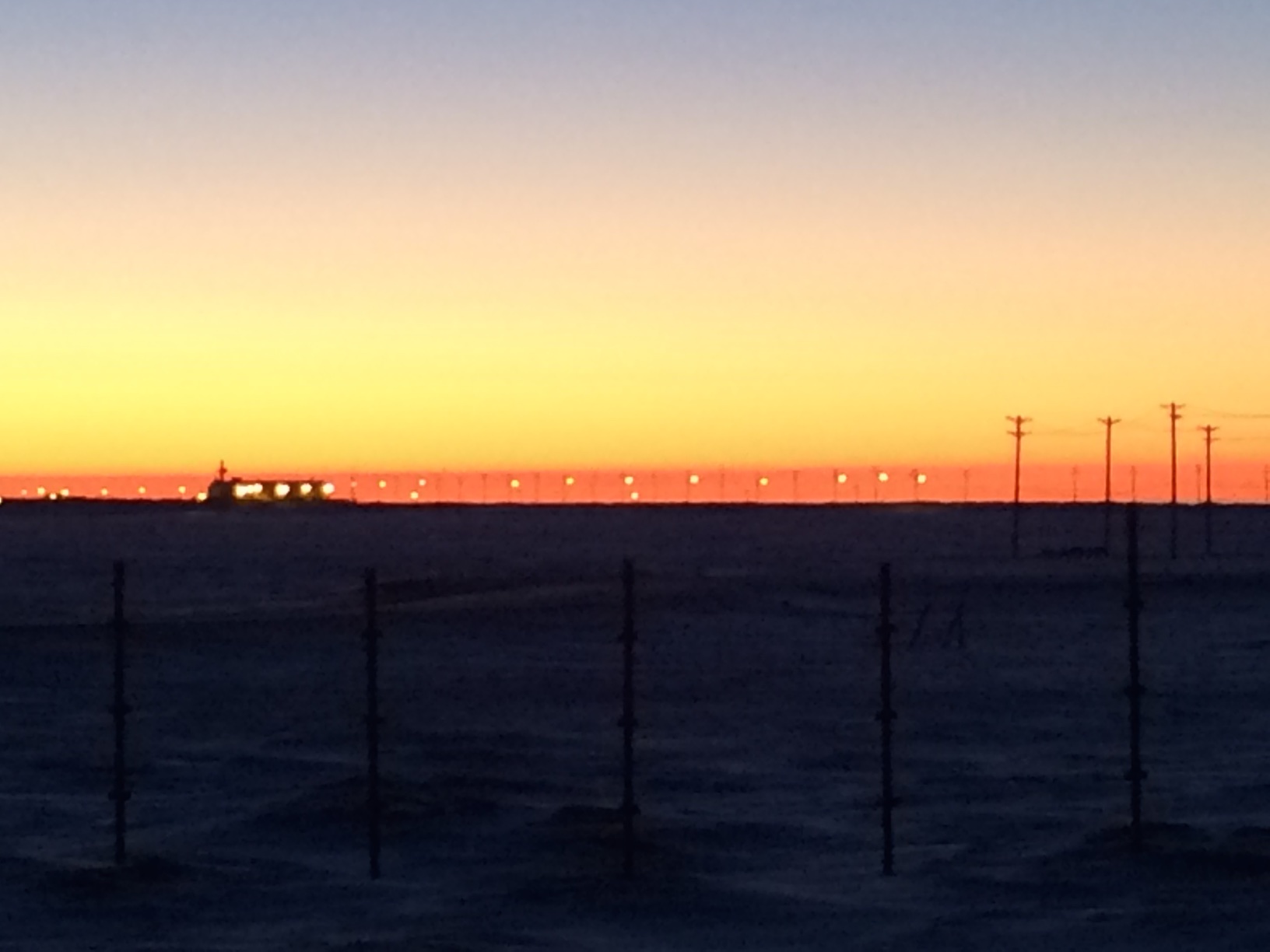
As a result, I didn’t get to see much of the sun that day. It is almost time for it to go down for the winter, and we’ve had so much cloudy weather this year, it was a pity to miss a rare sunny day. By the time I had finished, the sun was down, and this was the view from the BARC.
It’s that time again. I edit a column in the Alaska Journal of Anthropology which covers recent research. I’ve sent copies of the call for contributions to several email lists, but it’s a very busy time of year and they seem to be a bit backlogged, so I thought I’d put it up here as well.
If you did something interesting this summer, please let your colleagues know. You don’t have to have results yet. If there are reasons that you can’t be very specific about where you were working, that’s fine. It will still be helpful to others to know that work was done in an area if they are thinking of doing something there at a future date. If nothing else, they will know who to contact for logistics advice 🙂
This summer was unexpectedly quite on the archaeology front. The non-profit through which my grants were run had some problems, which meant that work had to stop and I had to move my grants. This turned into a rather long drawn-out process, with many fits and starts. In the end, I was appointed as a Research Associate in the Department of Anthropology at Bryn Mawr College and the three grants on which I am PI (Principal Investigator) were moved. We are still finalizing moving the purchase orders to allow for work to proceed on the WALRUS grant, but hope to get it done this coming week.
We had hoped to be doing some work at Walakpa, which had survived the winter unscathed, but despite the North Slope Borough asking for UIC Science’s Certificate of Insurance, which usually happens when a contract is about to be awarded (good thing, the insurance company charges to issue those things), nothing was issued. Then came the first week in September.
I was in Point Hope monitoring the drilling of a geotechnical test hole for a possible fiber project. It took an extra day to get there from Kotzebue, because the weather was so stormy that planes couldn’t land in Point Hope. We didn’t find anything during the drilling, but the extra day gave me a chance to visit with Molly Odell and some other colleagues who had been working in Kotzebue and look at some of what they had recovered during their field season. That was fun, but unfortunately the same storm really did some damage at Walakpa.
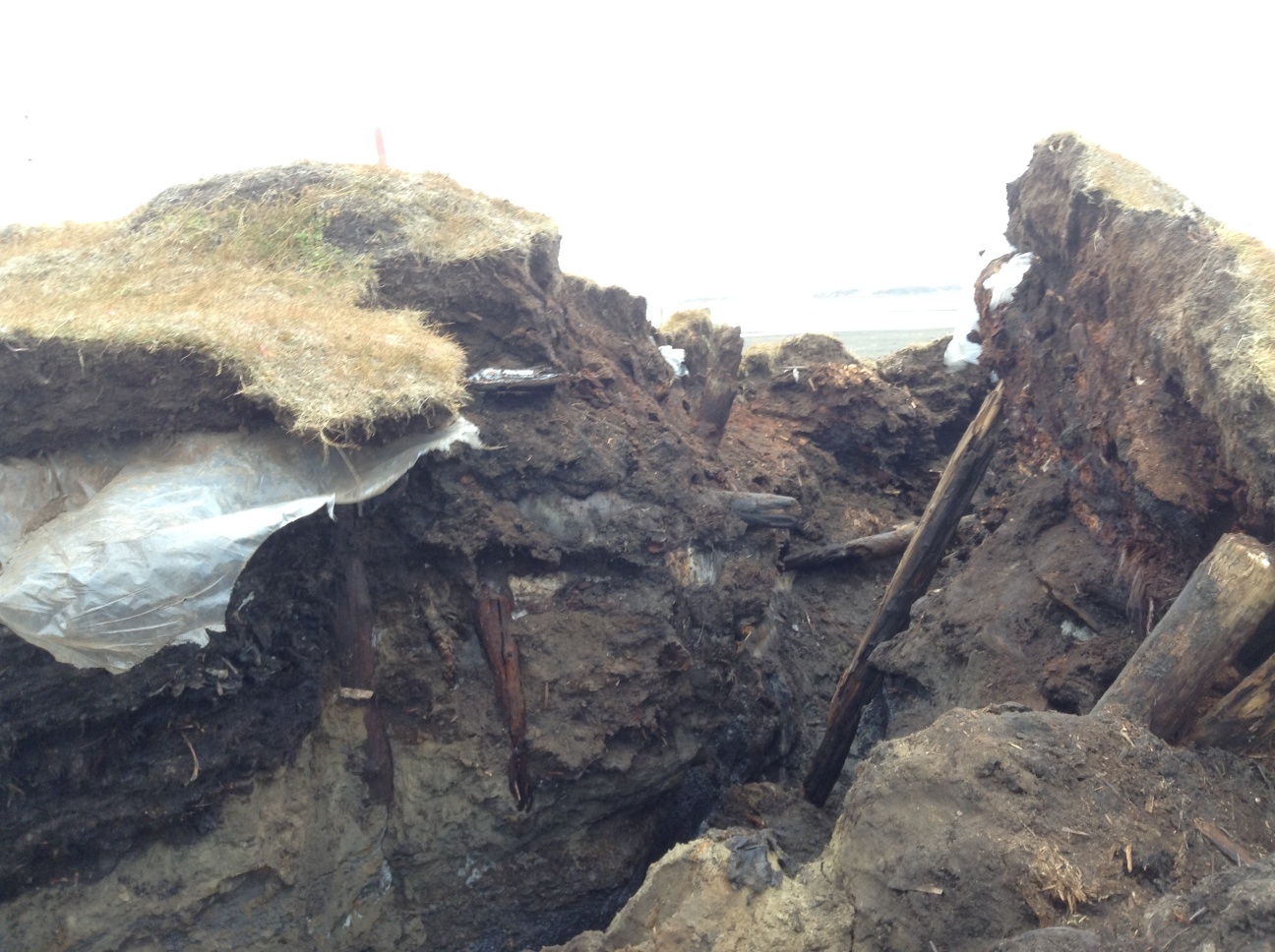
The site was undermined by high surf. Mark Ahsoak Jr. kept me posted (Taikuu Mark) via Facebook message, and it was pretty depressing. In the end, the house we were working on last year seem to have been entirely obliterated. A big slump block broke off and is resting on the beach.
Slump block on the right, intact strata on the left. Notice the Visqueen on both sides.
I went down with a crew from UIC Science Logistics to evaluate it. We found that there had been a lot more Visqueen under the surface than we had thought. The stratigraphy is very complex, with a very large feature containing solidified marine mammal oil, some artifacts and what appears to be maqtaq at the landward edge of the slump block.
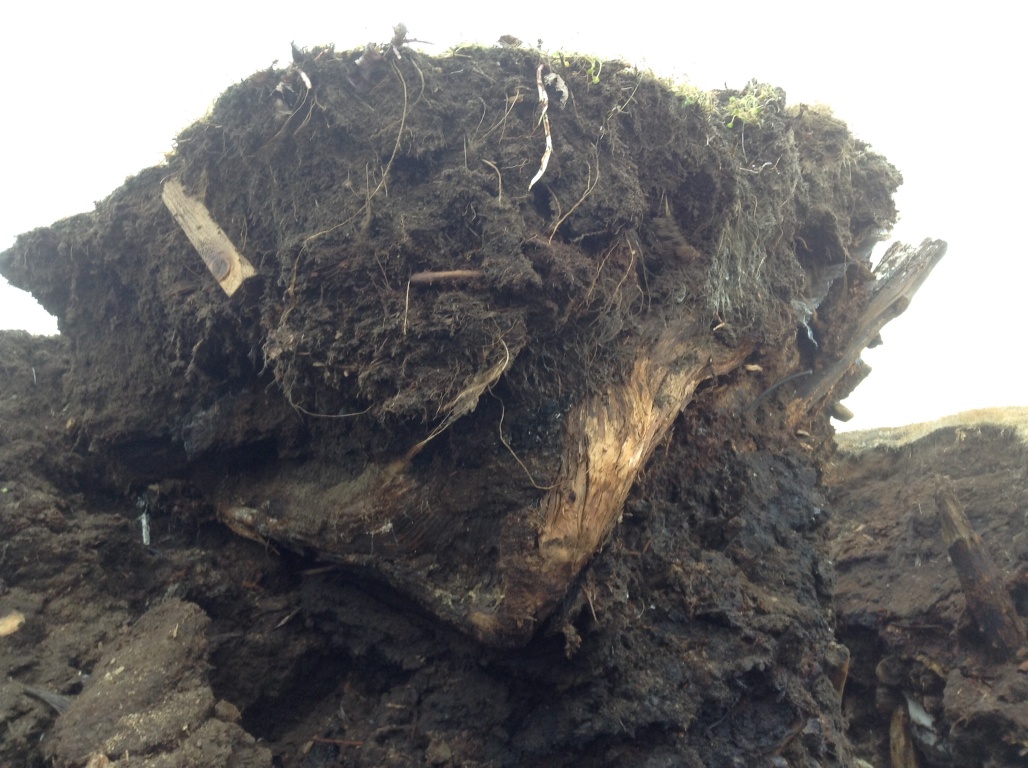
Marine mammal oil feature.
Unfortunately, the marine mammal oil feature is starting to break loose from the main slump block and tip back into the crack between the block and the intact site. We put driftwood props under it, and then stopped all work under the overhang, since it could easily kill someone.
Side view of overhanging block of marine mammal oil. Note crack on the left.
We didn’t find any loose artifacts, although there were a number of visible artifacts that were frozen in. Some folks had been collecting them and turning them in, which is great. I’d really like to thank everyone who has been helping in this way. Unfortunately, some other people have just been collecting them. Several of the artifacts that we saw the first day were gone by the time we returned.
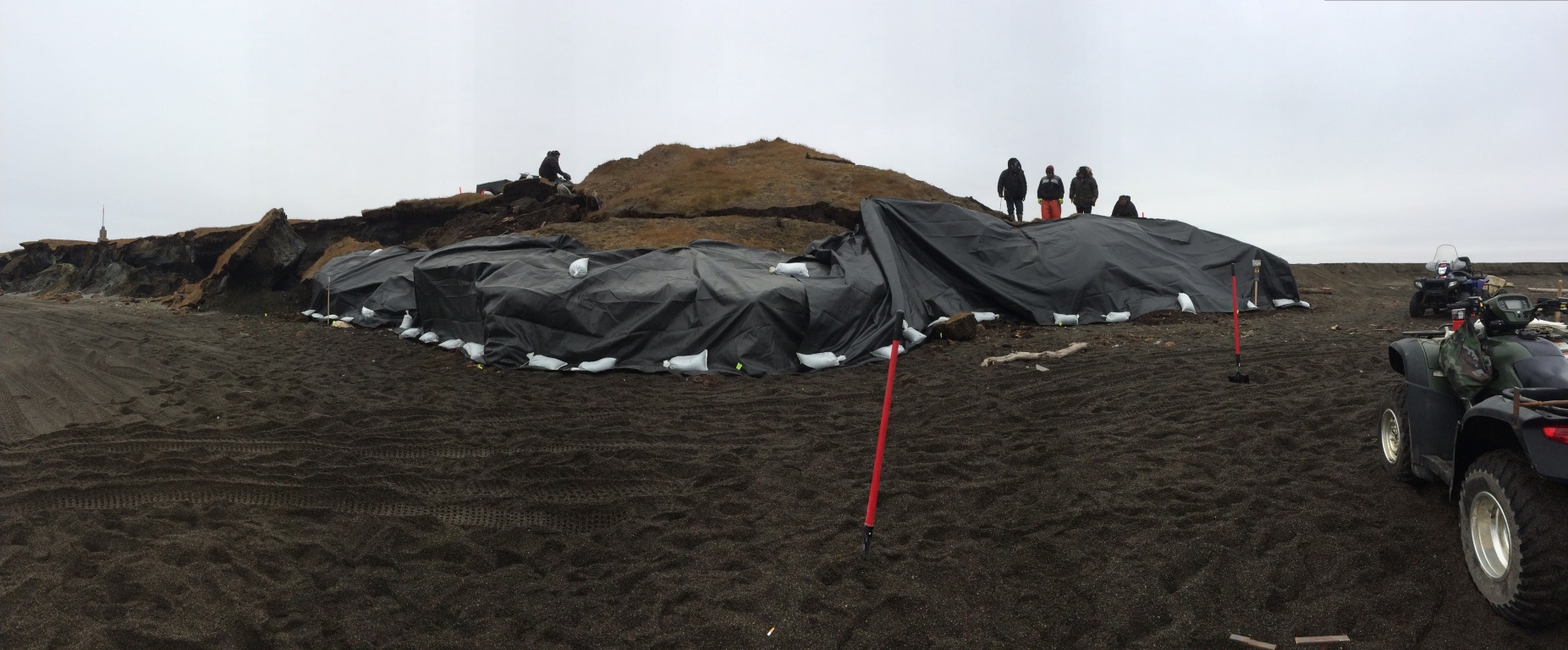
After we headed home, the next day was spent in getting a crew and material to do some stabilization. Several of the Barrow-based UIC subsidiaries pitched in with materials, crew and transport, and we went back to put some temporary protection on the site. We were able to cover almost all the eroding surfaces with geotextile fabric , secured with some cutdown metal support fasteners and sandbags.
Panorama of the site after the initial covering.
We made another trip down with the theodolite to map the new boundaries of the site. This let us document the loss of over 33 feet (11+ m) in that storm alone. We also put a lot more sandbags on the site, and so far it has resisted the weather.
This is the first long trip since I came home from back surgery. It involved connections in Anchorage and Seattle. I was lucky enough to score upgrades from Anchorages all the way to Austin, but I still arrived in less than ideal shape, although the trouble seemed to be my hip, not my back. I went to sleep with an ice pack, and everything seems fine except my right big toe, which really hurts. With my luck, it’s probably gout…
Anyway, the GHEA RCN steering committee, of which I am part, is having a meeting about a mile from the Hilton. I suspect it may take me a bit longer than Google maps thinks to walk it, so I am heading out now. My paper is tomorrow afternoon, so we’ll see how that goes.
NB: Barrow is a very expensive place to find lodging and buy food. We currently do not have project funds to help with this, nor support for travel to Barrow. This summer’s work is probably best suited for people who will be in Barrow anyway, or who can get some support for this from another source.
WALRUS – Walrus Adaptability and Long-term Responses; Using multi-proxy data to project Sustainability
——————-
We are seeking students (high school or college) to work in the archaeological laboratory on artifacts as part of several NSF-funded research projects. The lab crew will be working on processing artifacts excavated at Nuvuk, Walakpa and other North Slope sites.
This will involve cleaning (gently), sorting, marking, cataloging and preparing some items for transfer to a long-term repository. We will also be going through and sorting some frozen organic samples from an earlier project in Barrow that have been sent back from New York State.
We also will be attempting to find walrus bones in these collections for analysis at UAF. There is a possibility for student travel in connection with that project.
You do not need any prior experience; we can train you. Many archaeology crew members start as high school students. Once you learn how to do the work, scheduling can be very flexible. If you have skills in drawing, photography, or data entry, we can really use your help as well! Starting wages will depend on experience and qualifications.
To apply, send a resume and cover letter to Anne Jensen, anne.jensen@uicscience.org as soon as possible. You can use the contact form below for questions.




 Out of Ice and Time