Barrow took 3 whales today; a great finish to a series of minor catastrophes

The last couple days have been interesting, in the Chinese curse sense of that word.  I’ve got two reports that the clients need ASAP.  That’s normal for this time of year.  Neither is very complicated, and neither project has anything in the way of what they want to do.

It’s the other stuff that’s been a bit over the top.  For one thing, my admin assistant is on an extended leave, and getting a temporary replacement is proving hard, so I’m having to try to get her work done too.  The person who usually fills in for her had to go out for some medical stuff, and the person who was going to fill in for her had his girlfriend medevaced the evening before he was supposed to start, and the doctors don’t want her flying so close to delivery, so he had to stay with her.  Everyone is OK, thank goodness, which is the main thing, but it doesn’t get the office work done.

On top of that, I’ve had 3 abstracts for meeting papers due, only one of which is in yet, travel to arrange for a meeting in Munich (which the organizers want done ASAP so they know how much they’ve got left after paying for a ticket from Barrow to Munich), vacation travel to arrange to Hawaii and upstate New York (which needs to happen ASAP so we can afford the tickets and don’t have to go by way of Phoenix or Atlanta), two separate people who need the list of UIC Science phones & emails (which I update at least monthly, to no effect, since the updates appear to get lost and ancient lists resurface with phones that have been disconnected for two years), a new company budget process, credit cards to reconcile & approve (and a clunky new system to do it with), some checks to print, possibly a proposal to work on with a colleague in the Lower 48, the DMV had apparently lost paperwork regarding insurance on a company truck that was involved in a fender-bender, and a bunch more stuff I’ve forgotten.

You’ll have noticed most of this needs connectivity. Tuesday evening, in the middle of this I got a call from my staff saying the power was messed up in a building that houses the offices of the ARM project.  The guys got a small generator to provide clean power to the servers, which needed a midnight refueling and we got the landlord to get the power company, but no luck.  The next day they came back out, and decided all power would need to be shut off to change a transformer that feeds all of NARL.  This required shutting down all servers, so no connectivity.  No email, no Web, no Skype, no VOIP phones.  At least the BARC had power from the generator, so I could write.

In the middle of that, a fellow who works with my husband had a propane explosion on his boat while out whaling.  Amazingly, the boat did not sink, only one guy had to go to the hospital in an ambulance (although they all got checked out) and everything went about as well as it could have gone.  The windows were all blown out, some of the guys had glass embedded in their coats, I’ve heard, but no serious cuts.  Pretty much a miracle.

We scrambled around getting our Herman Nelson heater back from a fellow who had borrowed it to deal with the aftermath of a winter house fire, so that we would be able to keep the pipes from freezing if it got really cold.  The power came on at the end of the day, only to find out that the ARM building still had bad power, so into a second night of refueling.  It proved really complicated to take the servers down, and the guy handling the job is really sick at the moment, so it was decided not to bring them back up until we were sure there wouldn’t be an abrupt power cut.  They started this morning, but it took until early afternoon until everything was mostly back to normal.  Then the queued email flood began.  My husband was on the way to Anchorage this evening, and we had to get BASC checks printed so he could sign them (the other check signers are busy with whaling right now) before he left.

The power guys got the ARM building back on-line in the afternoon, the checks got done, and I actually was able to email some of the stuff people needed to them.

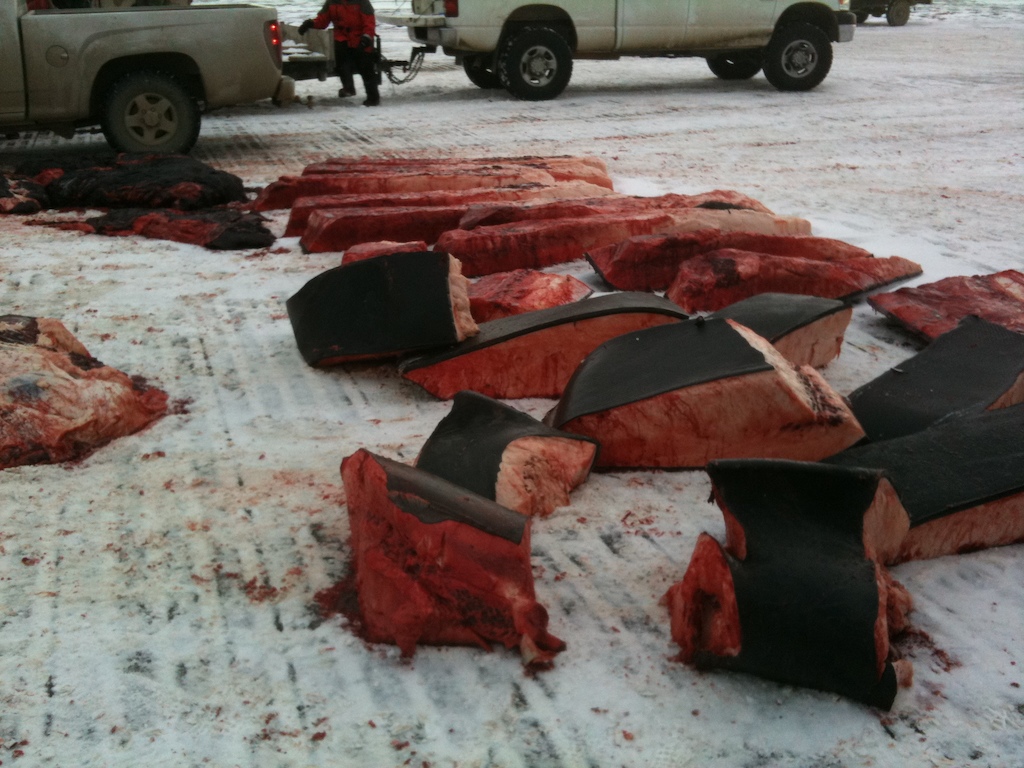
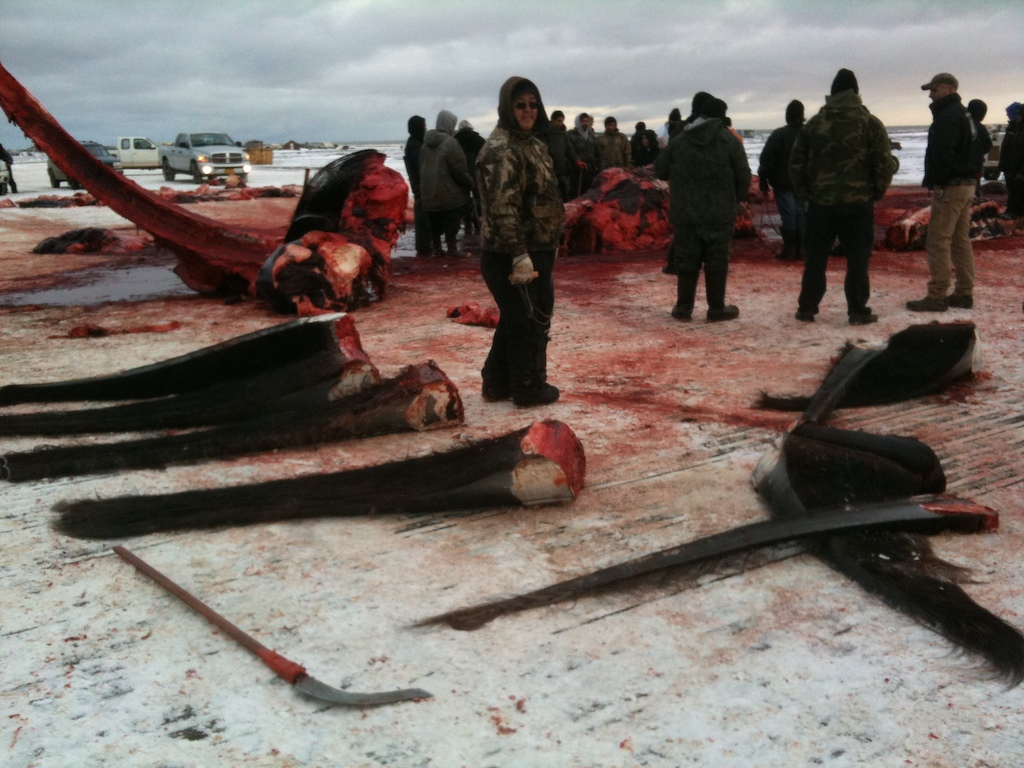
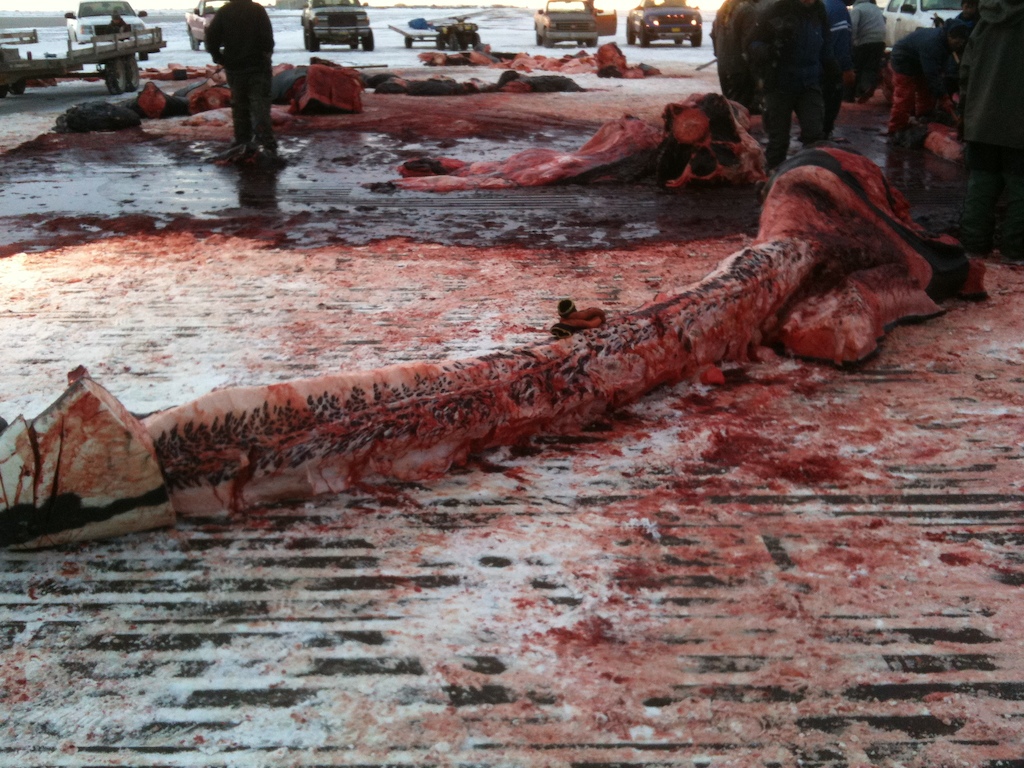
But the best thing was after work, after I dropped Glenn off at the airport, I got to go out to the old NARL runway.  Barrow caught three whales today (Savik, Saavgaq and Panigeo crews); one was already butchered when I got there, and many happy people were working on the other two.  I talked to Maasak Brower, who had a huge smile on his face, and the first thing he said to me was it was a good day.  It’s a fine thing to have a whale give itself and help you feed the community.


Savik whale being butchered.


Maktak and flipper from Savik crew's whale.


Baleen from Savik crew's whale


Mandible (jawbone) of Panigeo crew's whale in foreground. Some of the whale still being butchered is in the upper right, and in the background are some of the shares that will go to many people in the community of Barrow and beyond.


The meat and maktak is distributed according to set rules.  Shares go to the captain, to the boat (or its owner, since the boats don’t eat maktak), various crew members, other boats that helped tow the whale in, and to anyone who turned up and helped with the butchering.  In turn, those shares will be passed on to family members and friends across the North Slope and Alaska and down to the Lower 48.  It takes about 3-4 hours to completely cut up a 30 foot (~10 m) whale, which weighs about 30 tons.  Then shares are distributed and people bring them home.  There has been a constant stream of vehicles, some with trailers piled with maktak, past my house, coming back from the runway.  Guys went out in really small boats on a very cold ocean, about 1000 miles from the nearest Coast Guard help, and had leviathans give themselves to them, and towed them home, and got a lot of food for people, as their ancestors have for many centuries.  Tomorrow, weather permitting, people will try again.
Adventures with journalists; or, I never said anything about 45,000 yr. old Eskimos

Obviously, I think that archaeology is interesting. In my experience, so do most non-archaeologists I meet. People ask lots of questions, and it’s amazing how many of them say they always wanted to be archaeologists (hey, we take volunteers!).

So, I imagine that there’s a reasonable audience for journalism (print, broadcast or Web) that covers it. The Arctic, as the canary in the climatic coal mine and home to endangered charismatic megafauna (AKA polar bears), also seems to be a hot journalistic topic. Given that Barrow is served by at least two jet flights a day and has decent connectivity, we get our fair share of journalists, and a fair number of them want to talk to me.

The public pays for most archaeology (and other science) so I think they deserve to hear what they’re paying for us to learn, especially since most people are interested in other people and their doings, as opposed to, say, permafrost or midge hatches, for which the interested audience may be smaller. So I take the time to talk to journalists. I also try to find out a bit about the journalist in question. If I get the sense that they are not very experienced with science or research, I’ll offer to at least check dates and spellings in their story before it goes to print, pointing out that that’s less embarrassing than having to issue corrections of errors later. Some take me up; some don’t.

I also take the time to attend panels on working with the media at scientific meetings. They are usually composed of a variety of people who are public information officers for scientific organizations or institutions and science journalists, often quite well-known ones who write for national science magazines or newspapers. They are all very earnest and full of good advice. They are usually amazed at the questions asked by the audience, and horrified by those of us who want to see stories prior to publication. They seem bewildered that the archaeologists making up the audience don’t all see journalists as friends and a great help.

Of course, if all journalists were like the ones on the panels, we probably would see them that way. I’ve worked with some great folks. Angelika Franz, a German writer who has done several pieces about Nuvuk, actually has a doctorate in archaeology, so she’s been great to work with, knowing what sorts of information are critical to get right, and understanding technical terms so we can concentrate on the interesting parts of the story. She has done pieces for Spiegel Online Wissenschaft, a magazine called Epoc and now she’s got a book coming out with a number of pieces she’s done.

I had great fun being interviewed (in Danish) by some Danish journalists who were retracing Knud Rasmussen’s travels across Arctic America. The story wound up mostly being about the fact that I have a complete set of the 5th Thule Report, in Barrow. We also had a nice trip to Nuvuk in the local tour van, which resulted in some good polar bear pictures for them.

Most of the others have been reasonably competent, and haven’t garbled the stories too much, although they haven’t written stories that answer the sorts of questions people ask me.

And then there are the others. There was a group of filmmakers working on video for a major producer of science programming. They had decided to focus on an ice scientist and his (cute female) grad student. It was spring, so there was not much to see at Nuvuk, but they wanted to go there anyway. They wanted to film them pulling up on snow machines. The tracks aren’t the best thing for the site, but we had already excavated the area near the bluffs, so I said that would be OK there. Of course, they didn’t like the shot, or the light, and wanted to have them coming from a different angle, and retake it, and I kept having to tell them to stay in the cleared area. Then they decided that the scientists/protagonists should start scraping away gravel from logs (actually a NARL-era sled shed base) projecting from the bluff, with their mittens. Since this is precisely what we want the public to avoid, it didn’t’ seem like a good idea to show them SCIENTISTS doing it on a reputable science TV series. I pointed that out, to no avail. So I told them I couldn’t be party to that, on film or off, and since they seemed bent on damaging the site, which belonged to my employer, I was going to have to ask them to leave.

Better yet was a Barrow reporter for the local newspaper, the Arctic Sounder. The Sounder is not a bad paper given the area it covers and the budget it has. However, I doubt that the editor considers this fellow one of his better hires. He was an odd duck. He once asked me to help him set up the Mac that the paper had given him so that he could file electronically. I got everything set up, and then went to plug the modem into the phone line (this was some years ago). He would not let me. I suggested that we could test it, and then he could plug it in to file and unplug it. No dice. He also thought there was a hole at the North Pole. He interviewed me about some work I had been doing, and in the course of the interview asked me how long people had been in the Barrow area. I said it was hard to be sure, since sea levels had risen and between that and erosion the earliest evidence was probably gone, but that there was some Arctic Small Tool Tradition (ASTt) material there, which was probably “4 to 5 thousand years old”.

Imagine my surprise at being quoted (in quotation marks, no less) as having said that there were “45,000-year-old Eskimos” in the Barrow area! I got calls from folks as far away as Pennsylvania (Tiger Burch for one) who basically wanted to know if I was off my rocker. When I suggested to the reporter that perhaps a correction was in order, he refused on the grounds that “someday they’ll find 45,000-year-old sites here, and then you’ll have been the first to say it in print.” I have heard, although I can’t confirm, that he was removed from town in a straitjacket.

And they wonder why archaeologists view journalists with a somewhat jaundiced eye…

Coastal Flood Watch Remains in Effect

I woke up and turned on the radio this morning in time to hear the morning fellow recommend paying attention to the weather.  Since most folks here do that anyway, it was obvious that something a bit unusual was coming.

…COASTAL FLOOD WATCH REMAINS IN EFFECT FROM 2 AM AKDT SATURDAY THROUGH LATE SATURDAY NIGHT…

A COASTAL FLOOD WATCH REMAINS IN EFFECT FROM 2 AM AKDT SATURDAY THROUGH LATE SATURDAY NIGHT. LOW PRESSURE 400 MILES NORTH OF BARROW EARLY THIS AFTERNOON WILL STRENGTHEN TONIGHT AS THE LOW MOVES SOUTH. BY SATURDAY MORNING THE LOW IS EXPECTED TO BE ABOUT 250 MILES NORTH OF BARROW. STRONG NORTHWEST WINDS WILL DEVELOP ALONG THE BACKSIDE OF THE LOW. WIND SPEEDS OF AROUND 25 KNOTS ARE EXPECTED IN BARROW LATE TONIGHT THROUGH SATURDAY NIGHT WITH WINDS TO 35 KNOTS OFFSHORE.

THE SEA ICE IS NOW NEAR SEASONAL MINIMUMS AND THERE IS OPEN WATER SEVERAL HUNDRED MILES TO THE NORTHWEST OF BARROW. THIS WILL CAUSE SEAS NEAR SHORE TO BUILD TO 9 TO 13 FEET ON SATURDAY. THE SEAS ARE EXPECTED TO BREAK ALONG OR NEAR SHORE. IN ADDITION TO THE HIGH SEAS A STORM SURGE OF UP TO 2 FEET IS POSSIBLE AROUND THE TIMES OF HIGH TIDE SATURDAY AND SATURDAY NIGHT. SIGNIFICANT BEACH EROSION IS EXPECTED WITH MINOR COASTAL FLOODING POSSIBLE AROUND THE TIMES OF HIGH TIDE. THE AREA AROUND STEVENSON STREET NEAR THE BOAT LAUNCH BY THE CITY PLAYGROUND IS PARTICULARLY VULNERABLE TO FLOODING. OTHER LOW SPOTS ON DOWN THE BEACH WILL ALSO HAVE THE POTENTIAL FOR MINOR FLOODING.

ADDITIONALLY…SIGNIFICANT EROSION TO THE BLUFFS ARE LIKELY AS WELL.

PRECAUTIONARY/PREPAREDNESS ACTIONS

… A COASTAL FLOOD WATCH MEANS THAT CONDITIONS FAVORABLE FOR FLOODING ARE EXPECTED TO DEVELOP. COASTAL RESIDENTS SHOULD BE ALERT FOR LATER STATEMENTS OR WARNINGS…AND TAKE ACTION TO PROTECT PROPERTY. NOW IS THE TIME TO MAKE PREPARATIONS AND MOVE ALL PROPERTY WELL AWAY FROM THE BEACH.

Not what I needed to hear…   Turns out it’s the first big fall storm.  With the ice so far out, that means lots of room for the wind to put energy into the water, which means big waves and a storm surge.  That means beach erosion for sure, and maybe coastal flooding.  Our weather forecasts here are a bit less accurate than those most other places, because there are no observing stations where the weather is coming from.  It’s sort of like trying to predict weather in Pennsylvania using data from nothing but a weather station in Chicago.

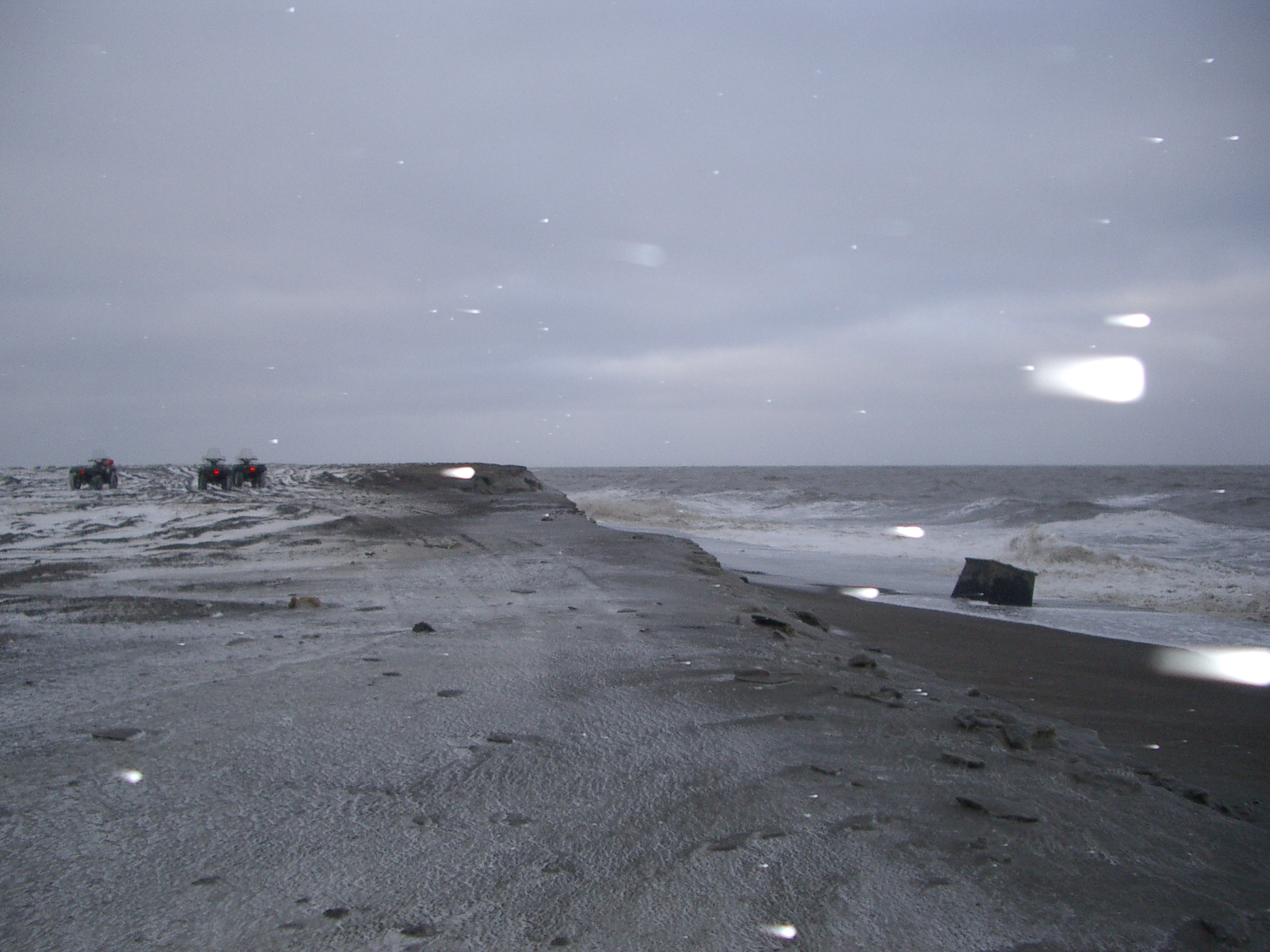
I don’t like fall storms and coastal erosion.  Aside from the dangers associated with flooding (the house I live in floated in 1963, and if it does it again we might wind up in a sewage lagoon), erosion is the most immediate threat to coastal archaeological sites.  I spend my summers trying to organize things so that we got well ahead of erosion at Nuvuk and now are trying to stay that way.

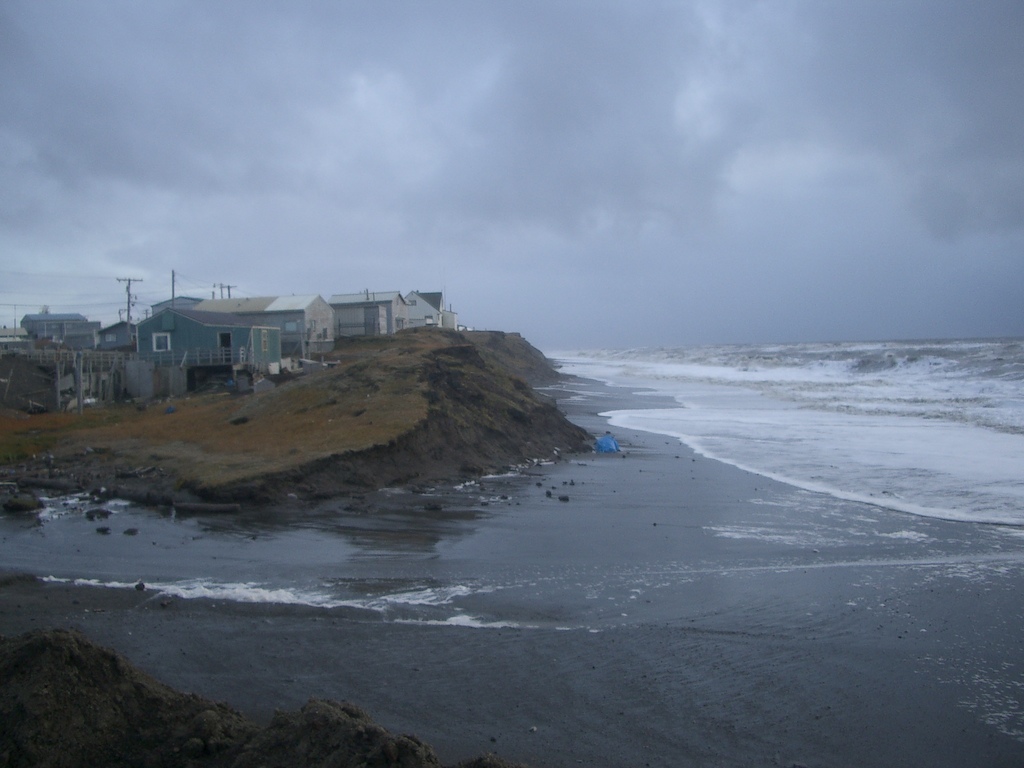
2004 fall storm erodes Nuvuk
Nuvuk bluff slumps from effects of surf

The thing is, Nuvuk, where “the houses are all gone under the sea” to borrow T.S. Elliot’s phrase, is just one of many important sites.  Utqiagvik, Nunagiak, Ipiutak, Tikigak (Point Hope), and so on down the coast.  Most of the sites on the Beaufort coast from Point Barrow east to the Mackenzie River Delta in Canada have already washed away and out of the archaeological record.

Fairbanks, finally

I finally made it to Fairbanks and to my hotel. The flight was delayed, and the rental car reservation was missing, but all worked out in the end. In the morning, I’m going to see Dave Norton, who has already gotten to work on the marine inverts, and then off to the museum at UAF.

Taking the temperature of permafrost and archaeology

Today the Saturday Schoolyard talk was about warming permafrost.  The speaker was Dr. Vladimir Romanovsky, head of the Permafrost Laboratory at the Geophysical Institute at UAF.  He gave a really good talk, explaining what permafrost is (permanently frozen ground, basically), why it matters if it melts, and how permafrost researchers go about taking its temperature (with thermistor (temperature sensor) strings down boreholes, mostly).  He then went on to show how permafrost temperatures had changed through time as the atmospheric temperature had changed.

After that, he moved to predictive modeling based on climatic models.  Using even a fairly middle-of-the-road climate model, it doesn’t look too good for permafrost in Alaska by the end of the century.  He also showed active layer (the soil layer at the top that freezes and thaws every year) modeling done on a similar basis some years ago, and pointed out that over the 10 years since the model was run it had been spot on in its predictions.  The active layer is clearly going to be a lot deeper if the predictions hold.

This is not good news for Arctic archaeology.  Compared to most of the rest of the world, where archaeologists are left to puzzle out what people were doing from a few stone tools, waste flakes and potsherds, we get really good organic preservation here, which makes it possible to look at questions that can’t be addressed elsewhere for lack of relevant data.  The reason the preservation is so good is in large part permafrost, and permanently frozen sites.  Last week, when Claire was here, we were getting a lot of well-preserved 1600-1700 year old marine invertebrates from the samples.  They exist because the layer was frozen for most, if not all, of that time.

I’m been thinking a lot about site destruction, and how to determine which areas are at highest risk, in order to prioritize field efforts.  Perhaps because coastal erosion is the big and immediate threat at Nuvuk (and all the other coastal sites I’ve worked at except for Ipuitak, where the immediate threat was the seawall being built to prevent coastal erosion), I’ve tended to focus on that, as well as eroding river banks for sites along rivers.  The melting of exposed ice wedges, which then leads to collapse of the overlying ground is also something I’ve been concerned about.  And these are major threats, which can tumble entire houses upside down on the beach for the waves to destroy.

Undercutting by waves caused the gravel to slump from underneath this grave at Nuvuk.
Storm-driven surf tears into the mound at Ukkuqsi in Barrow.
Tunnel remnants after the storm. The house was to the left, where only thin air can be seen.
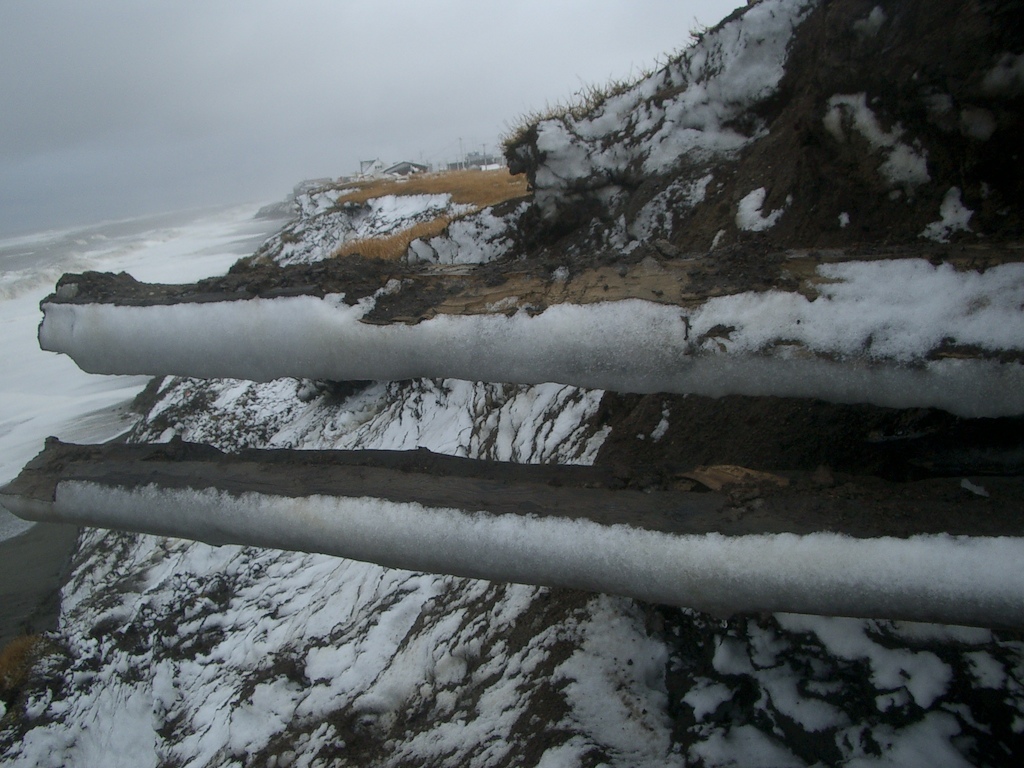
Ice wedge in bluffs near Barrow. They can be much larger.
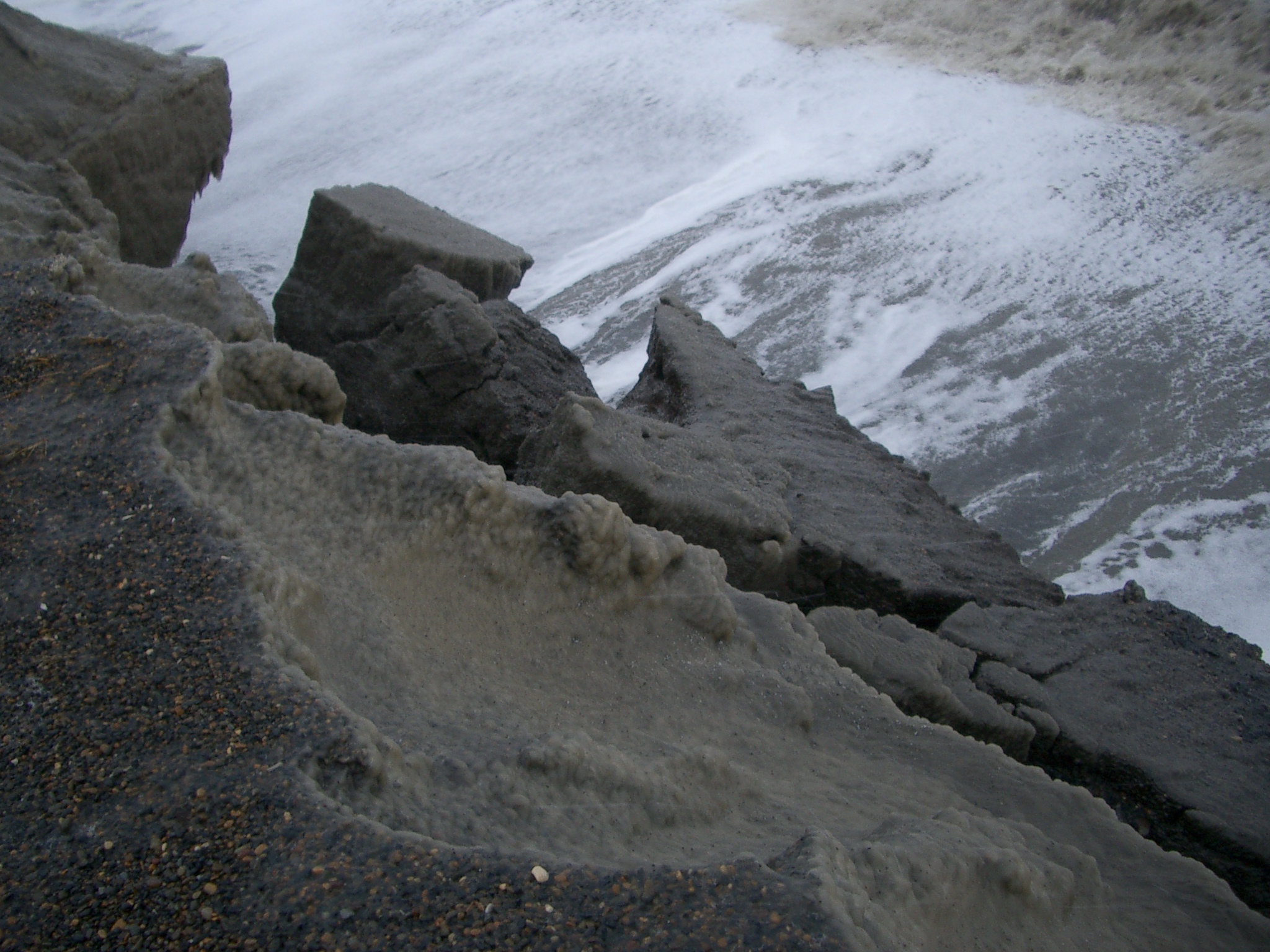
Slump block on beach at Barrow after a storm.
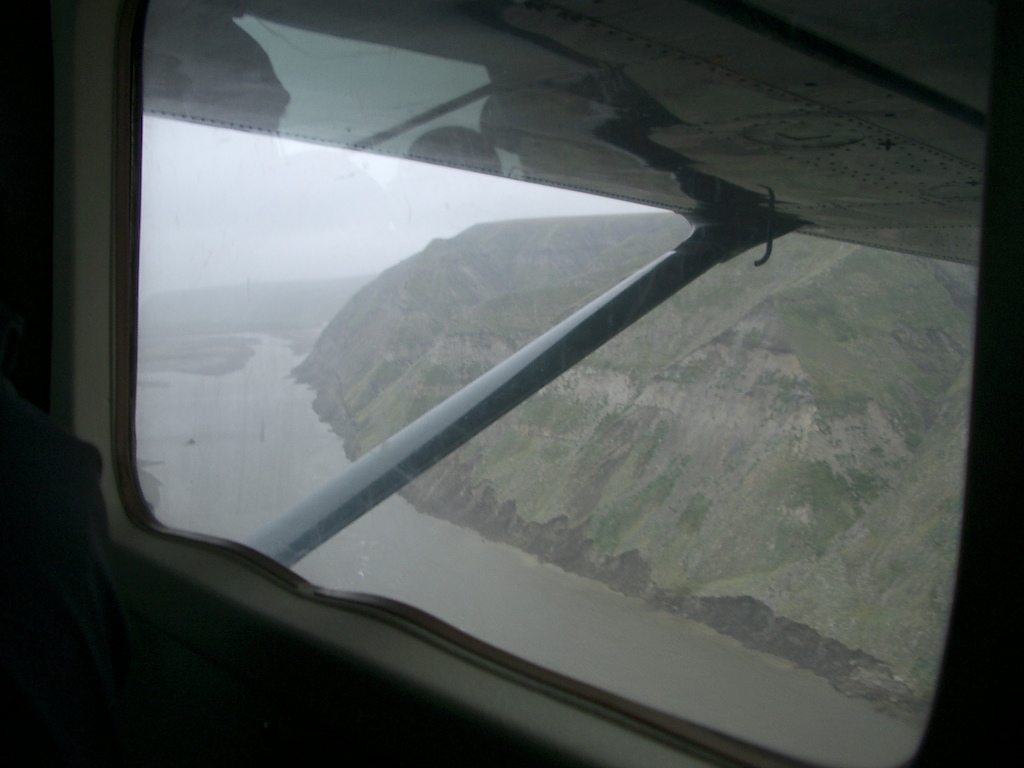
Slumps from thawing ground along a Colville River cut bank.
A Colville River cut bank from the air. Notice the earlier slump that has stabilized and even grown over, and the fresh cut at the bottom from the river's current.

I hadn’t thought much at all about the risks to Arctic archaeology from a significant deepening of the active layer, which will mean that artifacts and ecofacts (animal bones, insects, etc.) will freeze and thaw every year (which is hard on things to begin with, often causing rocks and bones to split) and while they are thawed, they will be decaying.  Even now, really old sites don’t have much organic preservation.  Even sites that are in no danger of eroding are threatened with the gradual invisible loss of a great deal of the information they now contain.

Obviously, if we are going to develop a “threat matrix” for Arctic archaeological sites, this has to be part of it.  I talked to Vlad a bit after the talk, and he thought he had students who could be put to work on this problem, perhaps by combining what we know about site locations in Alaska (by no means a complete listing) and the existing models for permafrost change.  He also said that one could do active layer modeling for a specific site with a year’s worth of soil and air temperatures, so that’s something we definitely need to get started on.

A mystery tooth

One of the fun parts of the job is that people find all sorts of things around Barrow.  Often, they show them to me, or at least send me pictures.  In a lot of cases I can ID them, but I’m not expert on extinct fauna, and the printed/online resources available are not as good as those for modern critters.

I usually send pictures to some folks at UAF (University of Alaska Fairbanks), since they actually have a pretty good collection.  Unfortunately their current curator of mammals flatly denies any knowledge (!) of extinct animals, and doesn’t seem inclined to rural residents of the state that pays his salary by taking a peek in the collections to try to make an ID.  So I’m broadening the search.

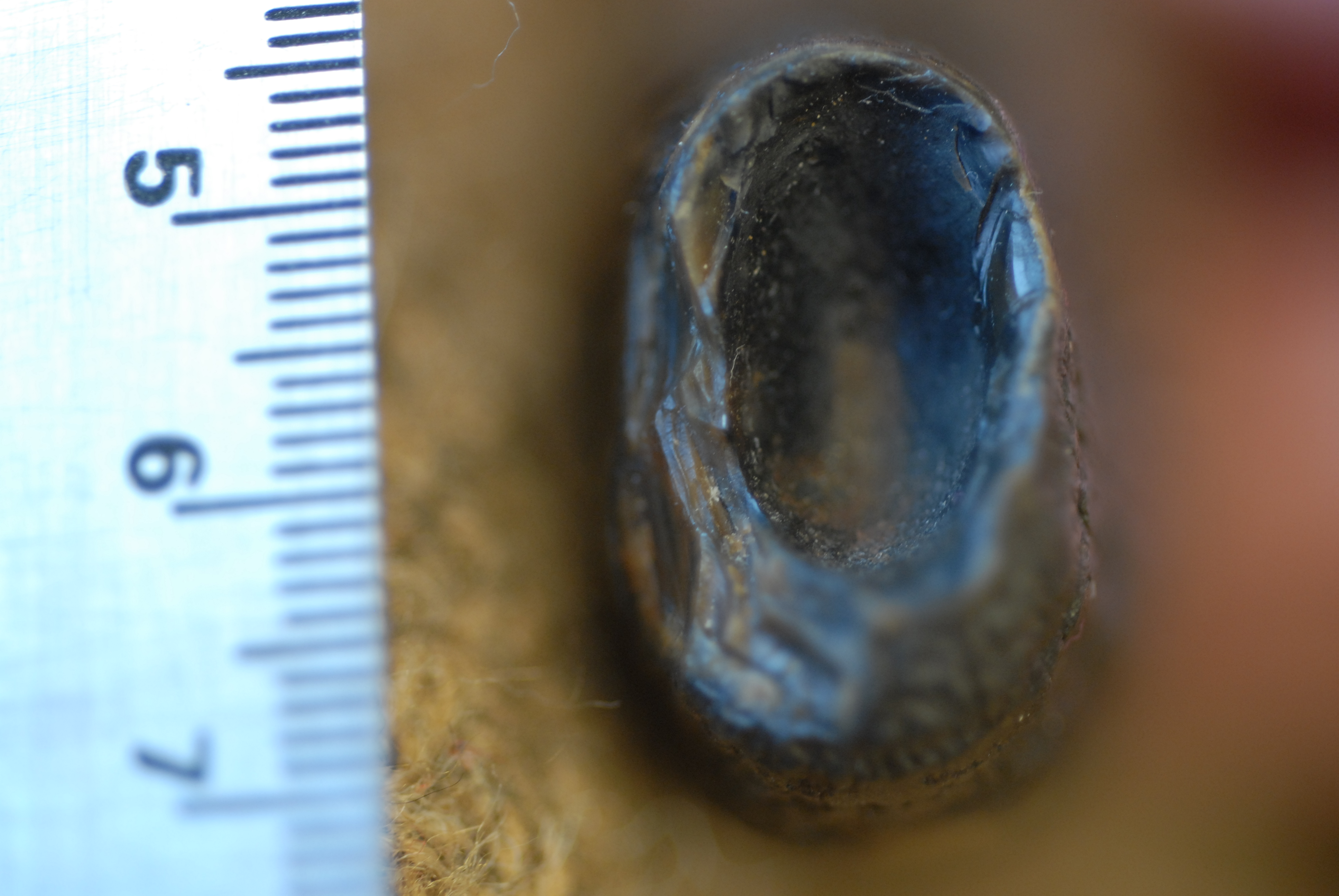
This particular tooth was given to the current owner.  Matu believes it was found in a gravel operation near Barrow, AK.  He’s really anxious to know what it is.  If you have any ideas what it might be from, please let me know.  If you have any colleagues who might be able to ID it, we’d appreciate it if you’d give them the URL for this post and ask them to take a look if they have time.

The following pictures aren’t great.  I didn’t have a tripod or photo stand, or decent lighting.  If you think you know what it might be, but need better pictures (not hard to imagine) or a particular angle, let me know and I’ll see if I can have him bring it to the lab for a better-lit portrait.

Mystery tooth from near Barrow, AK.
Root of mystery tooth.
Close-up of mystery tooth. Any comments on traces at photo center?

Mysterious sea Creatures

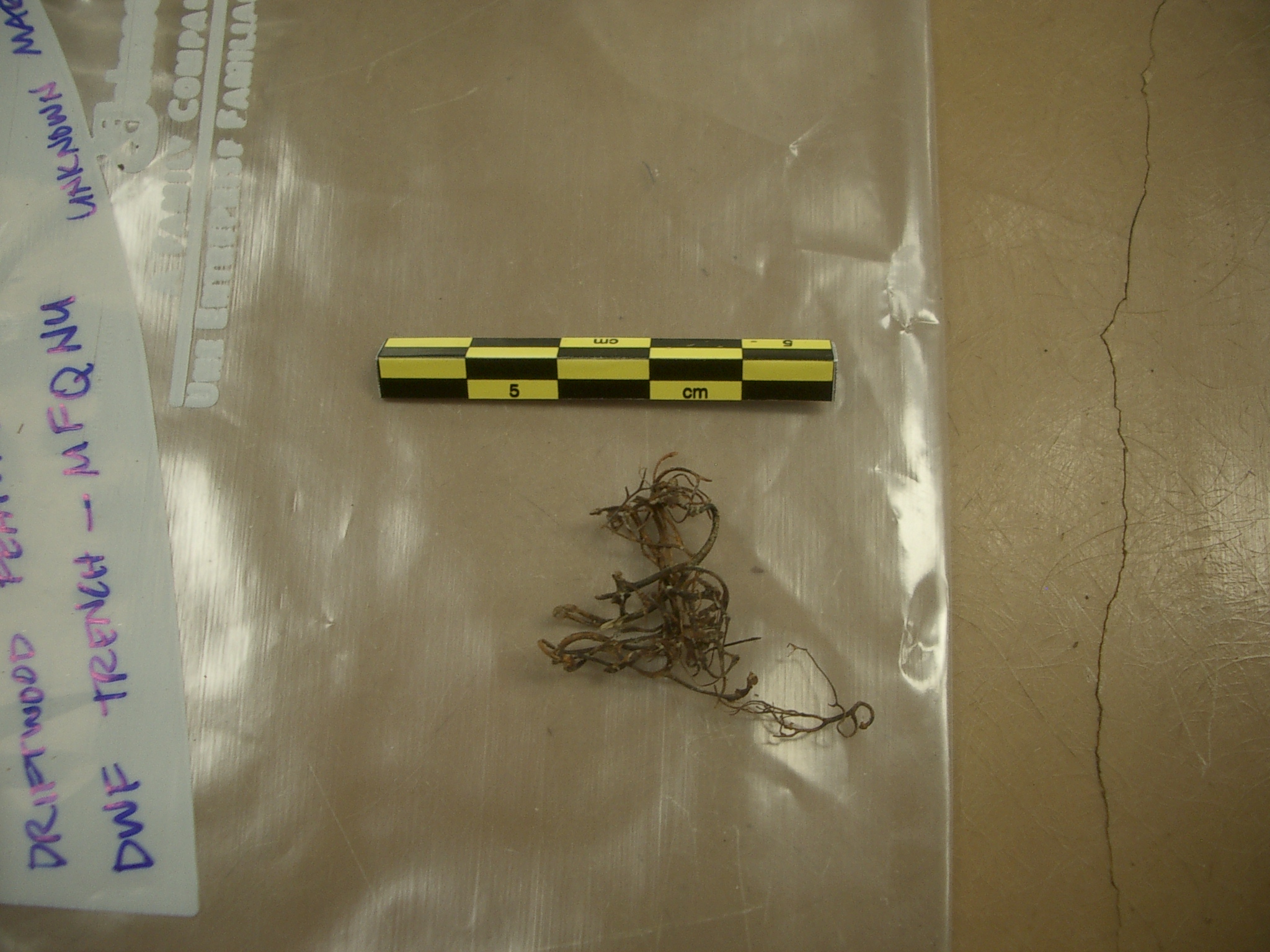
One of the things we collected a lot of from the strand lines was a variety of sea creatures.  There are a lot of pieces of what we thought (in the field) was gut, which is a useful raw material.  Now that we’ve gotten them into the lab, we think most of it is some sort of marine worms.  There are also a variety of other small marine creatures (plants or invertebrates–they have lost their orignal colors) and mollusks.

Marine worm? from 300-400 AD
Another sort of sea creature
Some sort of seaweed?
Maybe some type of sponge-like creature?

Obviously, I know a lot more about mammal bones & teeth than these things.  So we’ve sorted out a bunch, and Claire will take a couple of each type to Fairbanks, along with the shells. With any luck, we can get some IDs.  If we’re really lucky, the species in question will turn out to have fairly narrow habitat requirements, and we’ll know something about what the ocean was like near Barrow when the big storm happened between 300 & 400 AD.

If you happen to recognize any of these, please let me know what you think they are.  If you know anyone who might be interested in these creatures, send them my way.  The “worms” are very well-preserved, and still flexible.  It occurs to me that it might be possible to extract DNA from them (and maybe some of the other creatures as well), which would be a pretty rare opportunity.

Piles of Wood

One of the great things about doing archaeology in the Arctic is that the preservation can be spectacular.  Artifacts often froze the winter after they were abandoned, and only thawed when they were excavated.  This means we get to find a lot of the bone, wood ivory and leather items that were undoubtedly part of most precontact people’s tool kits.  We don’t have to guess at what people were using or extrapolate from a few stone tools that did manage to be preserved; we can see it firsthand.

This is not always an unmixed blessing.  Arctic archaeology  sometimes suffers from an embarrassment of riches.

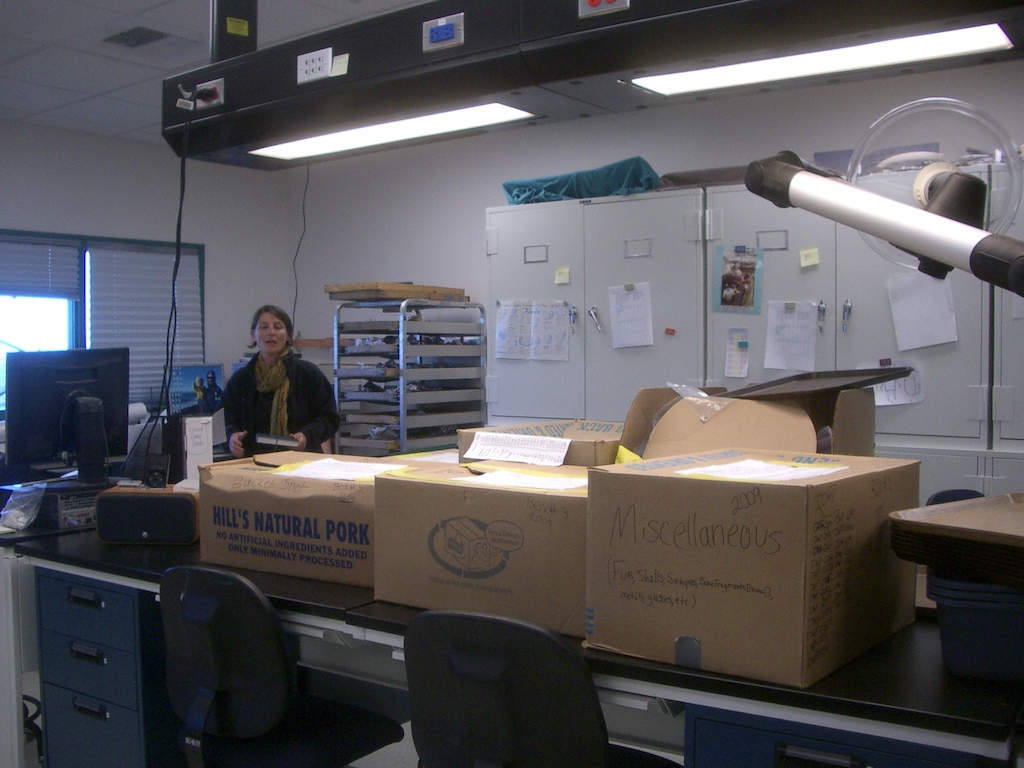
Boxes with wood from the Driftwood Feature (DWF).

In the past, archaeologists generally only saved the artifacts from a site.  Animal bones and soil were pretty much ignored, or at best documented in the field (there are a lot of excavated houses in the Arctic where the animal bones are still piled at the edge of the excavation where they were left decades ago).  As archaeological science advanced (radiocarbon dating began about 60 years ago) and people began to do more things with faunal (animal) remains and soil samples, people began to collect a lot more, and to bring it back to museums to save, on the assumption that one day someone would be able to do something informative with it.  The idea is still a good one in theory, but it is bumping up against various realities.  For one thing, in most areas these sorts of things require storage in climate controlled conditions or they will deteriorate and become useless.  They are often quite bulky compared to just the artifacts.  Most museums simply don’t have any place to put all this stuff!  Some of the better-funded places, like the Smithsonian Institution, have built large off-site storage facilities in areas where real estate is a bit less expensive, just to keep all this stuff.  But such places require operational funds and new staff, and that costs money too.  Most places can’t really afford that.  Some institutions have started charging for putting collections there, but there are problems with that as well.

So part of the new reality for archaeology is that we can’t keep everything.  The question is how to decide what to keep and what not to keep.  In general, the artifacts are kept.  No problem there.  The issue is how to deal with the other things.

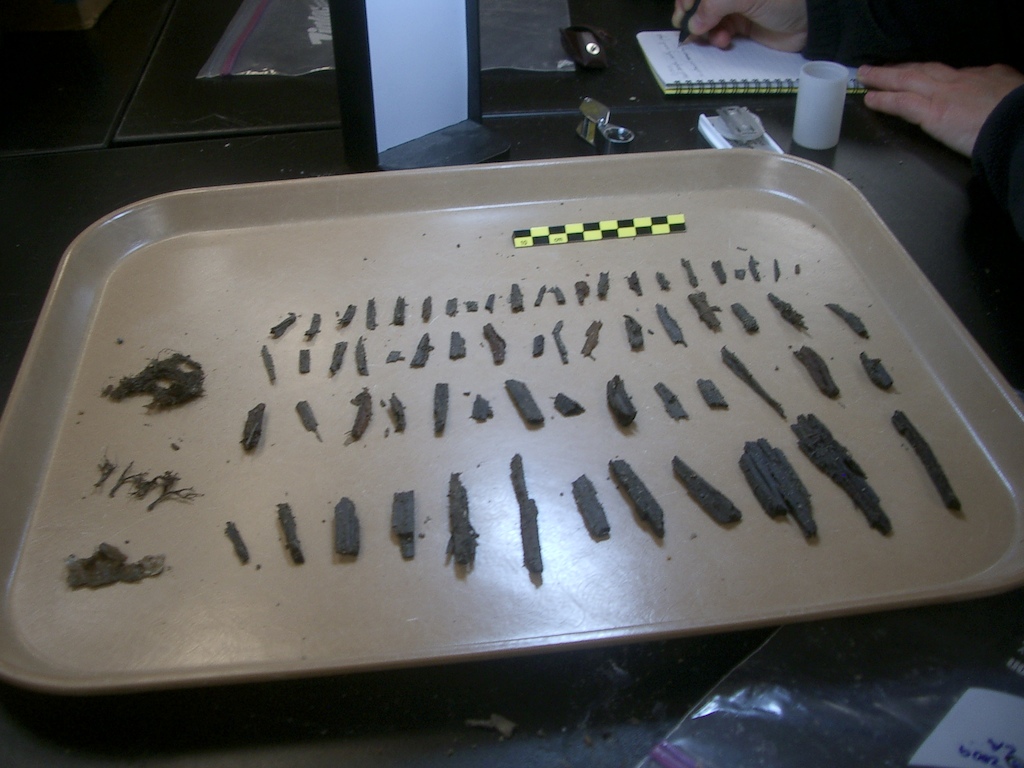
It’s even more complicated for the Nuvuk project.  We have had several areas where massive amounts of organic material, with some artifacts and faunal remains mixed in, were encountered.  While one might normally choose to excavate this all in the field, in a couple of cases the areas were right at the erosion face, and could literally have vanished overnight.  Combine that with a very cold field situation, where mild hypothermia can dull excavators’ thought processes, it didn’t seem like that was the best plan, since it risked data in a variety of ways.  I decided to take tightly-provenienced (with very accurate information on where they were from) bulk samples, which can then be processed in the lab, where it is warm and we have good lighting, magnifying lenses and water to wash the dirt and gravel off so we can get a good look at everything.  If excavators recognize an artifact in the field, it gets recorded there, but the idea is that we’ll find the less obvious ones in the lab.

Contents of one bucket shot laid out on a tray.
A closer look

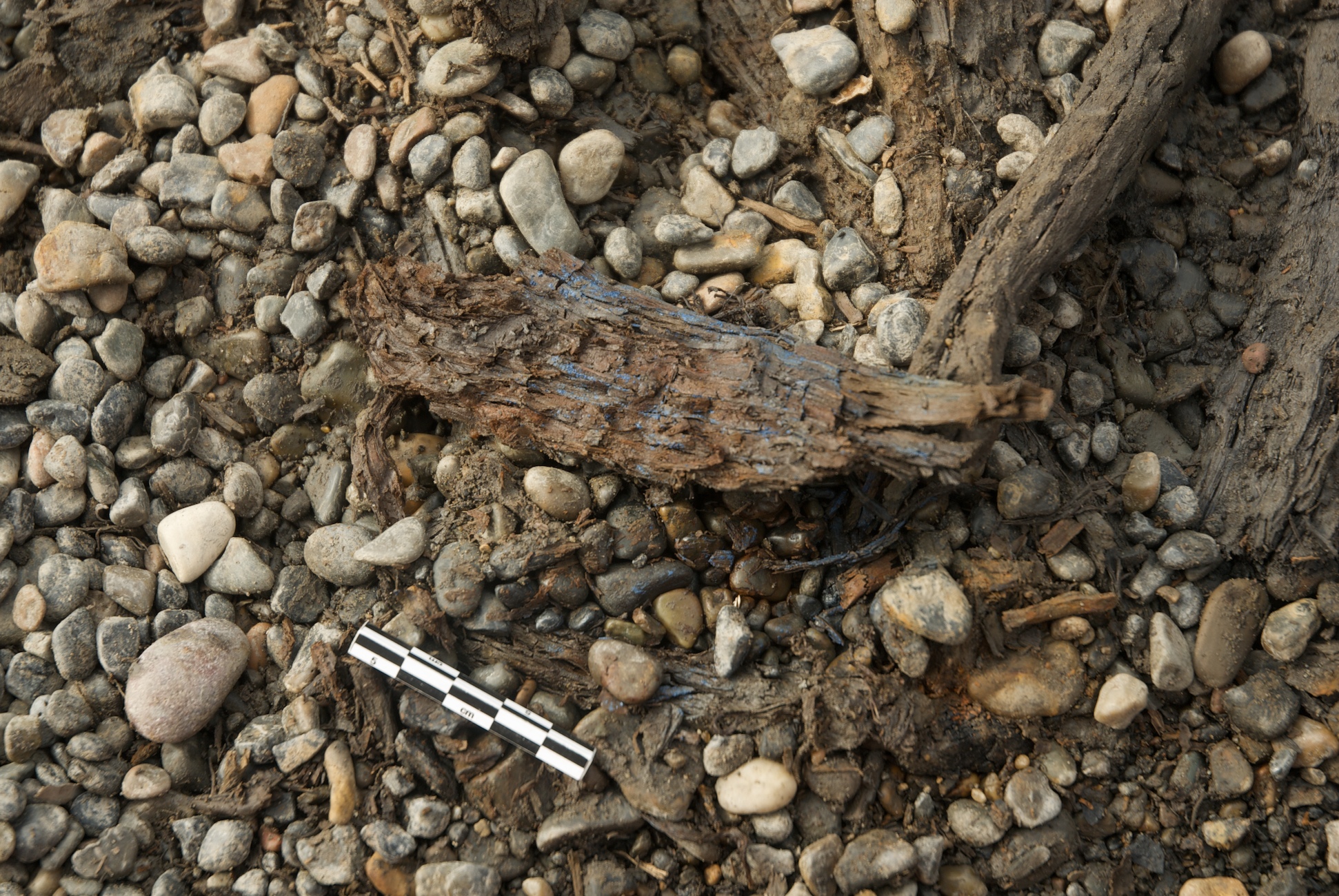
One of the areas with a massive amount of organic material was what we called the Driftwood Feature.  This level is about 1 meter (39 inches) below the Thule graves.  It was actually permanently frozen, and therefore everything organic was in great shape.   It looks like there was an Ipuitak dwelling (maybe there were more that had already eroded–we don’t know) on a ridge near the ocean.  Sometime between 300-400 AD there was a huge storm, which washed all sorts of things (driftwood, bark, marine invertebrates, shellfish, peat, etc.) up onto the beach, all the way up to where the people were living.  It left what is called a strand-line.  It looks like they either left in a hurry and didn’t come back, or didn’t survive, since a number of artifacts were still there. The strand-line continued along what had been the beach ridge, and we wanted to see if there was any evidence of more human activity besides the one dwelling.  Because there was so much wood, and a number of the artifacts at the dwelling had been wood, we had a needle in a haystack problem, with the haystack about to fall into the ocean (which it did the next winter).  So we bulk sampled.

Close-up of the Ipiutak layer at DWF. We excavated many square meters of this!

Now we are going through some of the bulk samples.  I’ve been very lucky to have Dr. Claire Alix, a French scholar who specializes in Arctic driftwood and its use by humans, involved with the project since the very early days.  She was based in Fairbanks, Alaska, for many years, but has recently gotten a teaching and research position at the Sorbonne in Paris.  This is wonderful, since Claire is a great person & really deserves it, but it certainly complicates the logistics of her research on this wood!

Dr. Claire Alix in the Nuvuk Lab

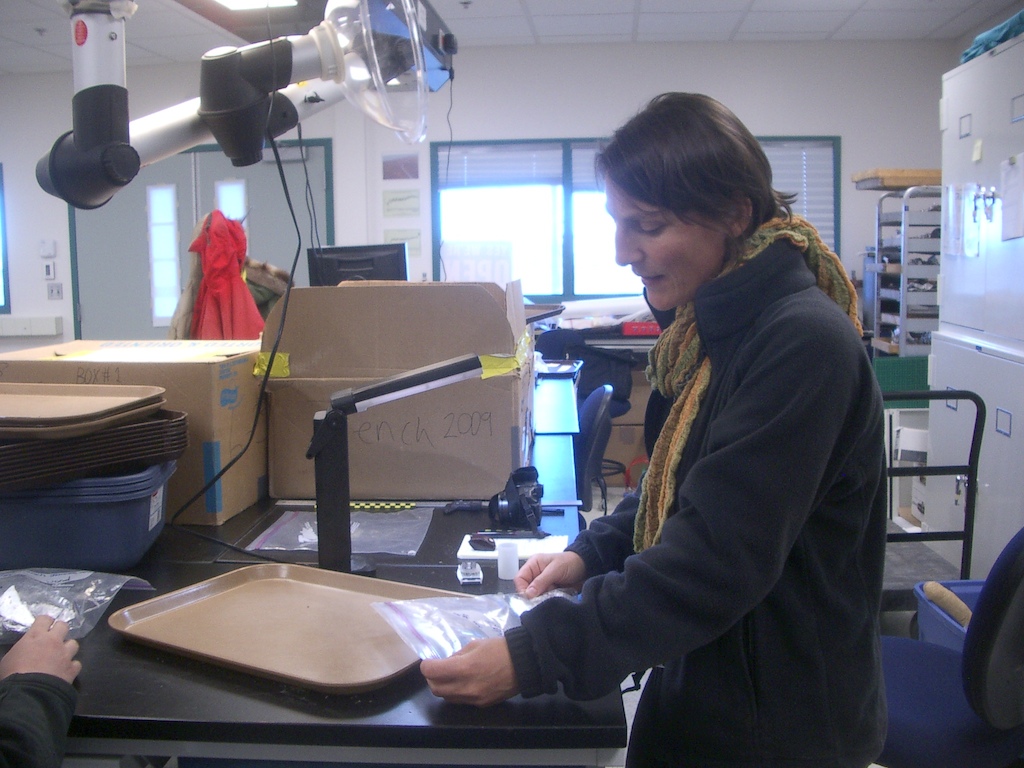
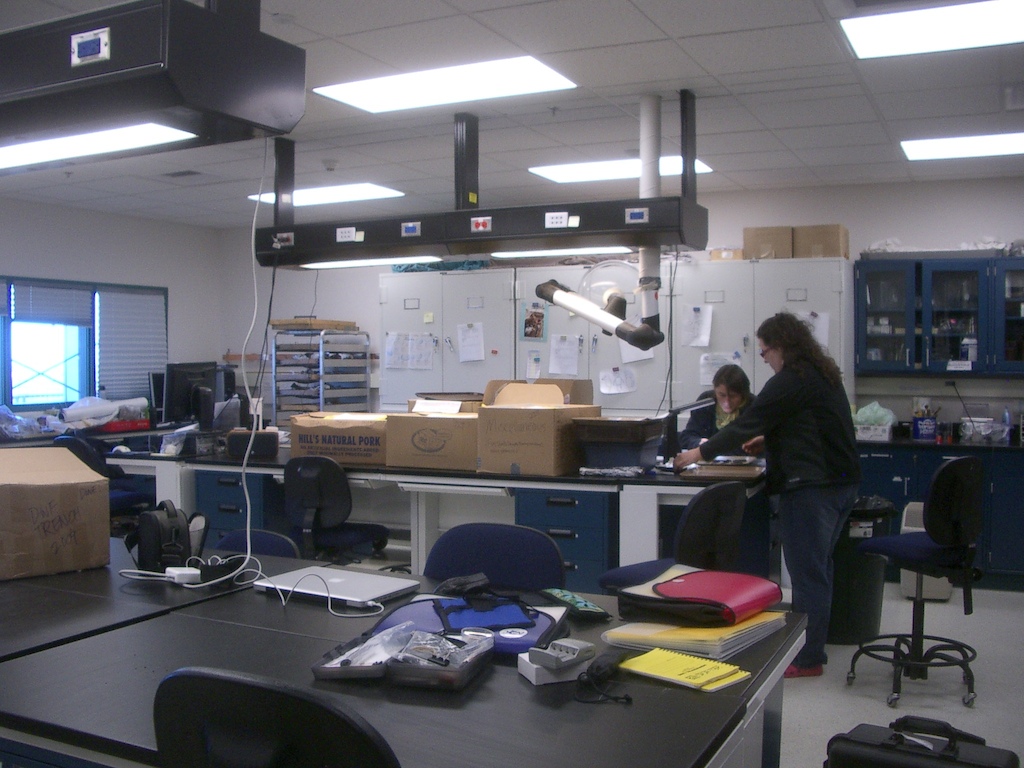
Claire arrived on this morning’s plane, and is already hard at work going through samples from 2009 which were excavated after she left the field.  She is looking for all worked (altered by people) items, picking out things that we can’t yet identify for further examination, and recording amounts & types of wood, bark, and other identifiable organics.  The non-worked identified material is then being lab discarded.  I’ve got the computer map up and color-coded so Claire can look at it when she needs to, Laura is unwrapping the samples, and I’ll probably end up doing the data entry in the catalog.  She leaves again on Wednesday night, and won’t be back in the US until sometime after January, so we’ve got a lot to do, and not much time to do it.

Claire and Laura hard at work.
Lab discards--on closer examination they turned out not to be cultural.

Later this fall we are going to start going through soil samples and so forth.  We hope to be able to reduce the volume they take up.  Some of that will be done by separating the actual sample material of interest from the gravel matrix.  Where that isn’t possible (for example with large logs or whalebone) we will have to sub-sample, retaining only a portion of the total sample volume.  Otherwise, we’re going to run out of room.

Back Home Again–Finally

The conference wound up on Saturday with a really interesting circumpolar archaeozoology session, organized by Max Friesen of the University of Toronto.  I’ll do another post about the papers; this one is about coming home.  A bunch of us went out to dinner at a restaurant on a little square up Rue Lacépéde from Rue Monge.

The next day I started home.  My flight was late in the day, so I had a while to hang around Charles De Gaulle (the airport), which resulted in spending money at the duty-free shops on chocolates (for Glenn) and perfume (for me).  The Air France flight had really good food, and was even a bit early into JFK.  Passport control and US customs were the usual slow lines winding around like snakes, but eventually I made my way (by train) to the place where the hotel shuttles stop and got to the room.  A few glitches with the card keys (apparently their machine is on its last legs and only one of 3 worked) and I was able to sleep.

I had to get up quite early Monday, which wasn’t such a chore since I was still on Paris time, since my flight was at 7AM.  While checking in, I discovered that what had appeared as a JFK-ANC flight actually stopped in Salt Lake City.  And that’s where the trouble started.

We arrived in a perfectly good plane, a bit early, and were told that we were going to change planes.  They re-boarded us an hour or so later on the new plane, closed the doors, and discovered that an engine light was on.  They replaced a part, took the jet-way away, tested the engine, put the jet-way back, did something else, took the jet-way away, tested the engine, put the jet-way back, went looking for some other parts, found them, started replacing them, decided that they should deplane us because one of the parts was hard to get at and it would take a while  (they didn’t know that until they started doing the work?  what kind of mechanics are these?),  but we could leave larger luggage on board to speed re-boarding.  They handed us $6 meal vouchers and told us not to leave the boarding area (where there was only one place to get food for 100+ people).  Several hours later, it was clear that I would not be making my connection in ANC to go to Barrow.

When I went up to get re-booked, they were not able to find me a seat from ANC to Barrow until Wednesday.  I had them book it anyway, so I didn’t wind up having to wait even longer.  Eventually, they had us go on the plane five at a time to get the stuff we’d left there, and then sent us to another gate with another plane.  We finally made it to ANC about 4.5 hours late.  A few of us were stuck overnight, but at least the large contingent of senior citizens from the Midwest heading for a cruise ship didn’t miss their sailing.

It took them quite a while working on my ticket, and in the end they took my email and emailed me the itinerary later.  I did wind up standing around so long that when it was time for hotel vouchers, I’d checked the room availability, and was able to get them to put me in the Millennium, which has a decent restaurant and a gift shop that sells T-shirts (which I needed since I didn’t want to do laundry), instead of the Puffin Inn.  I think the problem was that they managed to book me on a Tuesday flight to Fairbanks, with a layover until the Barrow flight arrived, but hadn’t canceled the Wednesday reservation, so the prices weren’t coming out right, and the poor fellow didn’t have a calculator and was having to do all the math by hand.  They handed me more meal vouchers (which didn’t go that far in ANC in the summer) and off I went to catch the shuttle.

The flights on Tuesday went smoothly, Glenn was there to meet the plane, and my bag was one of the first out, so it was only about a 45 minute wait.  We then went over to the library where there was a BASC-sponsored talk going on, to hear the rest of the program, and pick up our daughter and an archaeologist friend, Rick Reanier, who is in Barrow getting ready to do some survey for Shell Oil down the coast.

Naturally, the first couple of days back have been a zoo.  One client has a procedure where they need to get letters estimating how much you are likely to charge them until the end of the fiscal year (September 30) so they can move money around.  The person who does that is going on vacation, so they needed this done ASAP.  So I made those letters, only to have them discover they didn’t have enough money in the projects to do that, and they didn’t have time before the woman left to move the money.  So I had to rewrite the letters to fit their budget!  I really don’t know why they don’t just do it themselves…  That took most of the last 2 days.

In between rewrites, I had a group of Secretary Salazar’s staffers (he’s in Barrow holding a public hearing) tour my lab while touring the building.  Fortunately, they were busy so the tour was brief.  Then I had a regular teleconference with clients, which I got called out of to go and photograph a very large tooth for a local man, Matu.   We think it may be a saber-tooth cat.  Photos have been forwarded to various paleontologists & mammologists, and we await the verdict.