Mysterious sea Creatures

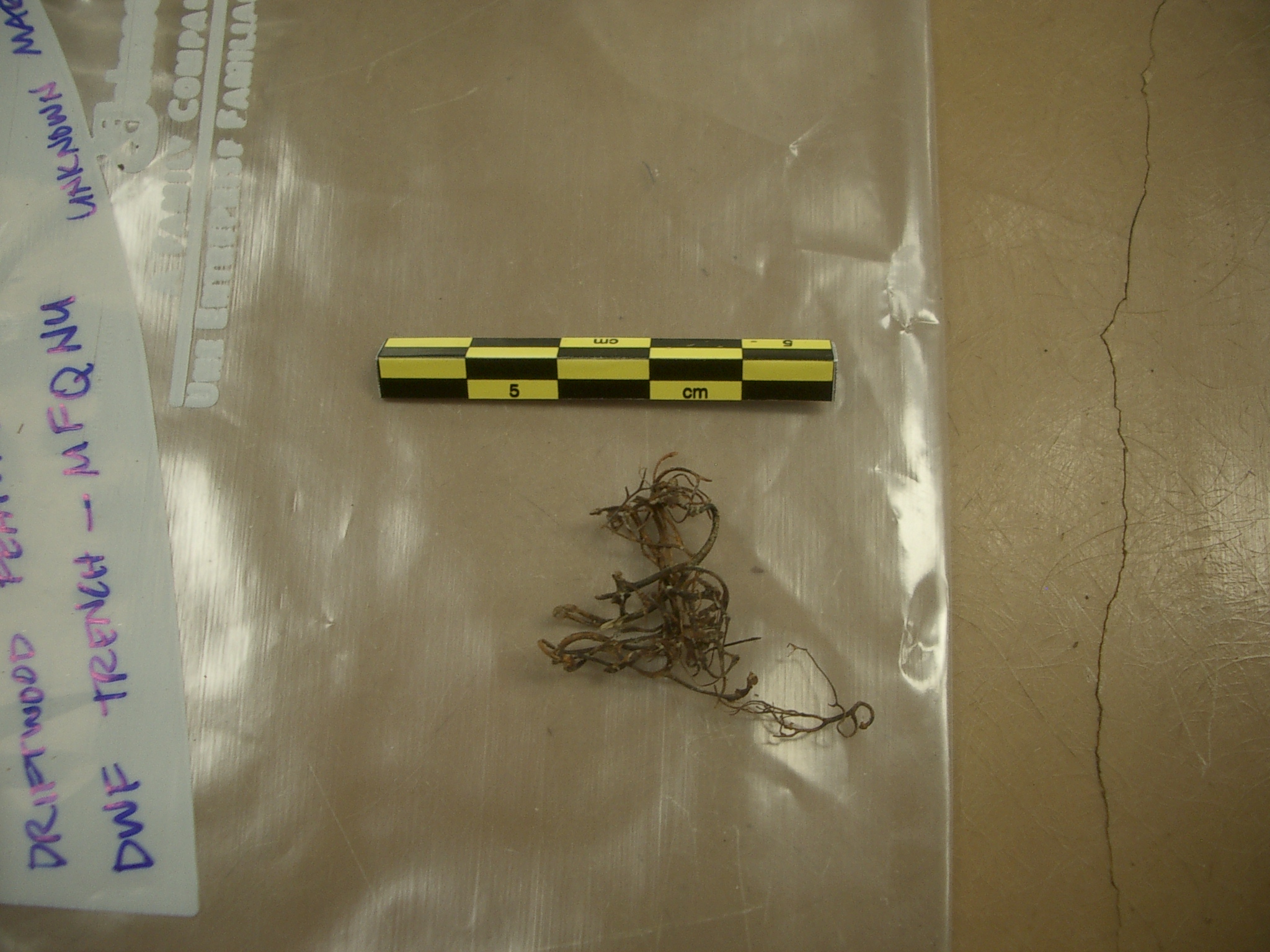
One of the things we collected a lot of from the strand lines was a variety of sea creatures.  There are a lot of pieces of what we thought (in the field) was gut, which is a useful raw material.  Now that we’ve gotten them into the lab, we think most of it is some sort of marine worms.  There are also a variety of other small marine creatures (plants or invertebrates–they have lost their orignal colors) and mollusks.

Marine worm? from 300-400 AD
Another sort of sea creature
Some sort of seaweed?
Maybe some type of sponge-like creature?

Obviously, I know a lot more about mammal bones & teeth than these things.  So we’ve sorted out a bunch, and Claire will take a couple of each type to Fairbanks, along with the shells. With any luck, we can get some IDs.  If we’re really lucky, the species in question will turn out to have fairly narrow habitat requirements, and we’ll know something about what the ocean was like near Barrow when the big storm happened between 300 & 400 AD.

If you happen to recognize any of these, please let me know what you think they are.  If you know anyone who might be interested in these creatures, send them my way.  The “worms” are very well-preserved, and still flexible.  It occurs to me that it might be possible to extract DNA from them (and maybe some of the other creatures as well), which would be a pretty rare opportunity.

A couple of needles (maybe…)

The processing of the large bulk samples is proceeding.  It’s slow going, but we are reducing the overall volume.  We have found a few things that are noteworthy.

Claire has found some well-preserved wood that she was able to take samples of for species identification and possible tree-ring dating.

We also found one piece of coal with one flat, highly polished side.  The rest of it looks like it broke naturally and got smoothed by being rolled in the water, but the one side looks different.  It’s a maybe, but a pretty good one, although we’ll probably never know what it was or was going to be…

There are also a variety of marine worms, shells and what we think are marine plants.  I just spoke to a friend of mine, “retired” biologist, Dr. Dave Norton, who used to live in Barrow and is fairly familiar with the contents of modern strand lines here.  Claire is going to take the oddities we are sorting out down to Fairbanks (where he lives) tomorrow night, and he will look at the specimens and try to connect with the appropriate curators at the UAF Museum of the North.  I’m going to Fairbanks (for shotgun refresher qualifications for a non-archaeology project I manage for Sandia National Labs) the week after next, and will go visiting the curators with him, in hopes of getting good IDs.

Some interesting papers so far

I’ve heard a number of interesting papers so far.  A bunch of them were in a session on digital archaeozoology.  I find this interesting in part because I live and work in a remote area with limited research resources on hand, although for the size of the place they are truly exceptional. A number of highlights from the session below:

1)  A paper by Matt Law on zooarch on the Internet.  He’d done a survey of on-line arch data archives. People often use them heavily, but so far are not good contributors. People still see on-line publication as less prestigious (which is a problem if they are working toward tenure), but most would still be willing to participate if the process were straightforward enough.

2)  A paper by Isabelle Baly & others about a big national database (INPN) the French are building of data on plants and animals from archaeological sites. Much of the data they are including comes from salvage and compliance excavations, which often don’t get published. This is a huge amount of work to pull together (especially with the staff of three that they have!), but it lets people do analyses which they could never afford to do otherwise. It seems to be available through a public website, which will let students and members of the public see and use the data themselves, which is pretty cool.

3)  A paper by Jill Weber and Evan Malone about a set (30+) of skeletons of equine hybrids between donkey and onager, which are currently a unique sample. These are thought to be the Syrian Royal Ass, the Kunga, which was actually the Animal of the Year in Syria a few years ago. The problem was how to be able to preserve & share these bones, and study them without damage to the originals. Answer–3D laser scanning & “printing” them.  3D printing actually makes a replica of the item, and is very cool technology.   Depending on the budget, the replicas can be very good.  The scanned models in the computer are actually even better for doing measurements on ( something we do a lot in zooarchaeology) than real bones in some cases.

4)  A paper by Katherine Spielmann and Keith Kintigh on the Digital Archaeological Record (tDAR).  TDAR is a large-scale data archiving and integration tool, developed at Arizona State University.  The impetus was that a lot of archaeologists there had data  that they were interested in comparing, in order to look at things across a broader area than any of them had studied individually, but were stymied by differences in the way that their data was stored.  They are trying to develop an integration tool and data warehouse.  I haven’t tried it, but it seems interesting.

5)  A paper by Matt Betts, and a number of others about the Virtual Zooarchaeology of the Arctic Project (VZAP) –very cool 3D models of Arctic (and subarctic, since ISU has been working in the Aleutians/Lower Alaska Peninsula area under Herb Maschner for years, and that’s what they see most of) fauna.  The bones are accessed through a very neat visual database interface, which lets you look for bones by species or by skeletal element (part of the body), which is the most common way to find things when identifying unknown bones.  Often you can see you have a femur (thighbone) for example, but aren’t sure what animal it’s from.  The best physical comparative collections of bones actually have a set of femurs you can look at, rather than having to go to a bunch of skeletons and find the femur.  I’ve used this one, and it’s handy.  As more species get added, it will only become more useful.

Off to a conference of archaeozoologists

… or zooarchaeologists or faunal analysts (people who study animal remains from archaeological sites), in Paris. The trip over was a two-day affair, involving not one, but two red-eyes. We had a good tail wind, so the Salt Lake City flight was about an hour and a half shorter than expected, which made up for a late departure due to bad weather.

The conference is feeding us lunch every day, and it’s pretty impressive for a university cafeteria. One starter, one main course, one cheese, one desert and one drink. The folks I ate with didn’t see it, but there are rumors that wine was available. The coffee breaks have great pastries and fresh fruit.

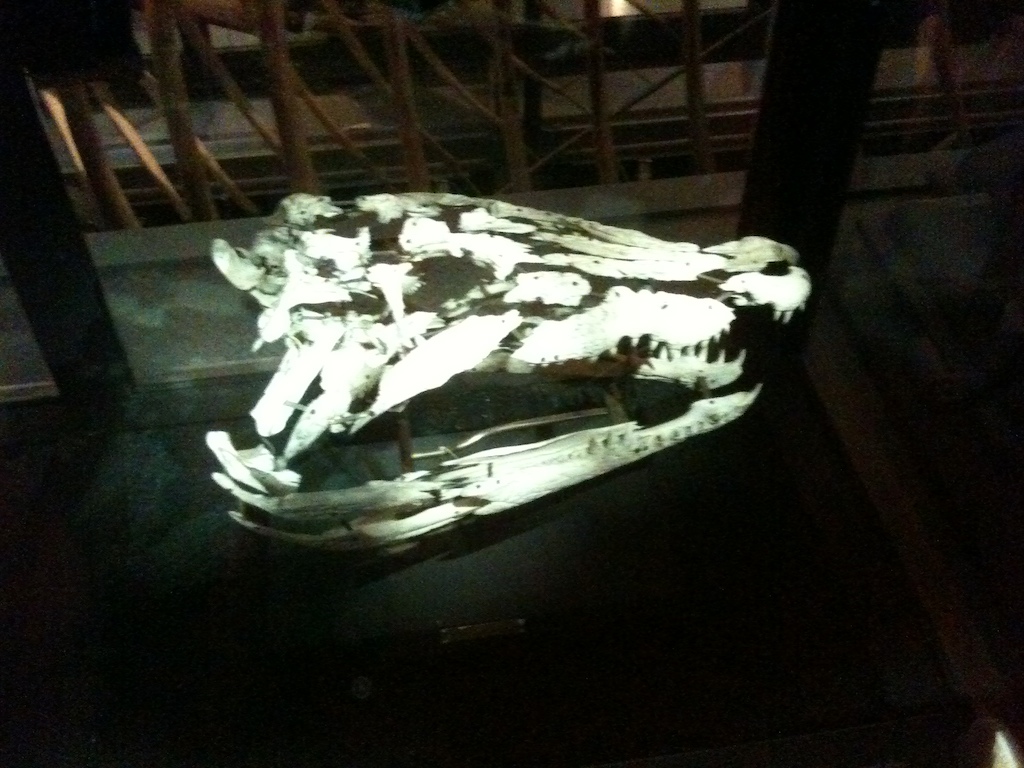
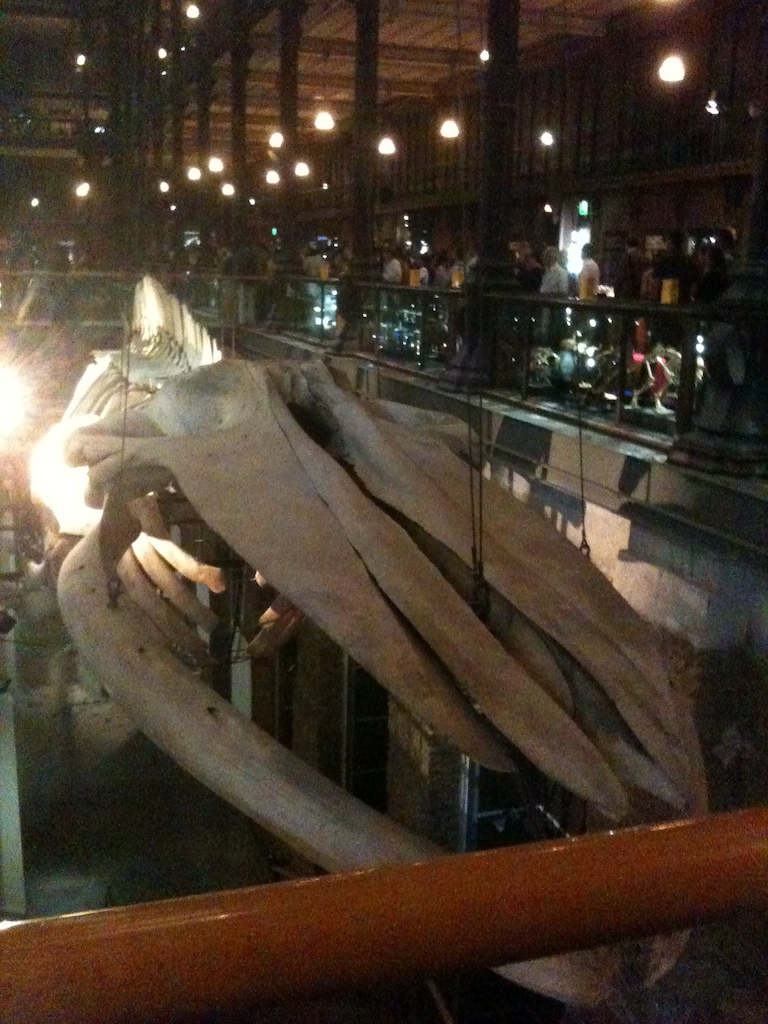
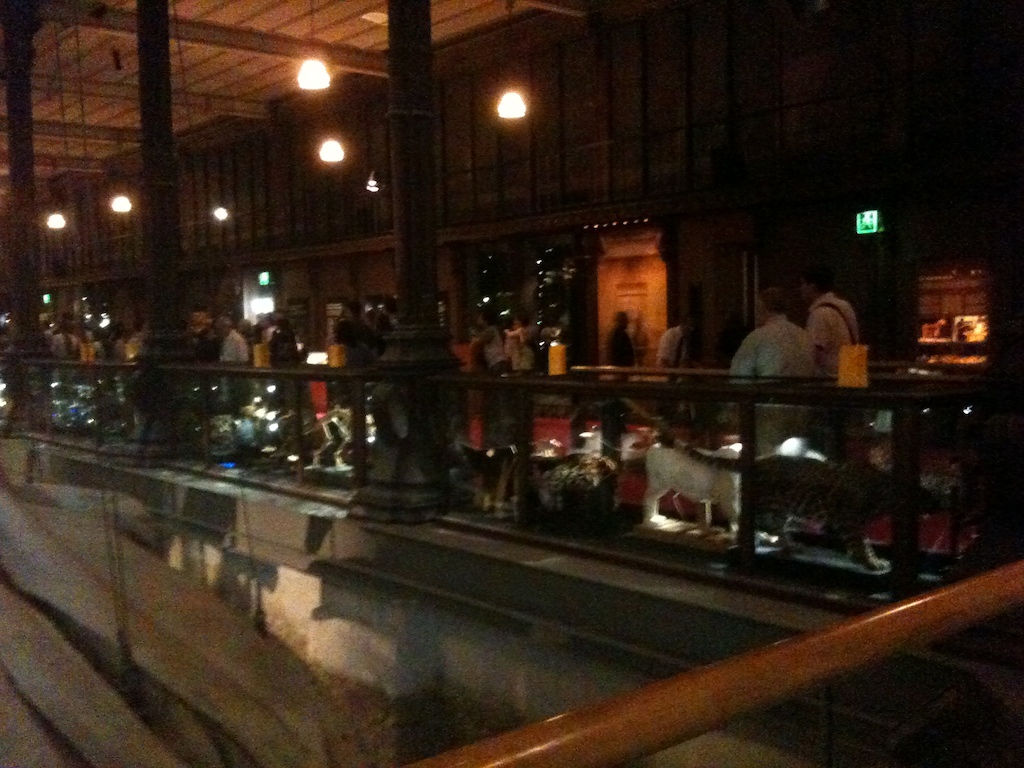
The opening reception was amazing, and they didn’t run out of food, frequent problem at such events. They held it in the Grande Galerie de l’Evolution (Great Hall of Evolution) of the National Museum of Natural History, which is just amazing. A few pictures from there follow. I took them with my phone, so the quality is not the best.

Skull of Nile crocodile
Blue whale skeleton
Southern right whale skeleton
Arctic or Pacific loon, probably Pacific. They look alike, and the ranges overlap.
A small portion of the assembled multitude.

There are also some neat older mounts.  The one of the tiger on the elephant is because a French duke was hunting on elephant back in India, and a tiger leaped onto his elephant.  He was only saved because she was so heavy she broke the basket he was riding in.  She was shot, and that’s the tiger in the mount, which he had made and donated.  It didn’t say if it’s the same elephant.

A hippopotamus, closer-up than you'd want to get in real life.
Tiger and elephant, with howdah (the basket).