What a day!

The weather was not pleasant.  It rained all day, and was pretty cold.  My fingers are swollen up like sausages.  The rain also took out the track pad on the computer for the transit, so we couldn’t back up the files in the field.  We were able to use a mouse in the lab, and got the files backed up and transferred to the other laptop, so if the track pad doesn’t perk up, we’re OK.  My Nikon Coolpix S9100, which I just got last night to replace one that failed after a week, died the same way today.  Nikon won’t issue a refund for 15 days, which is truly ridiculous under the circumstances.  I’ve been committed to Nikon, loved all the SLRs I’ve had (FM, 4 FEs, 4 N70s, D200) and liked everything about this camera, too, except it won’t work.  Epic fail.  So don’t buy one!

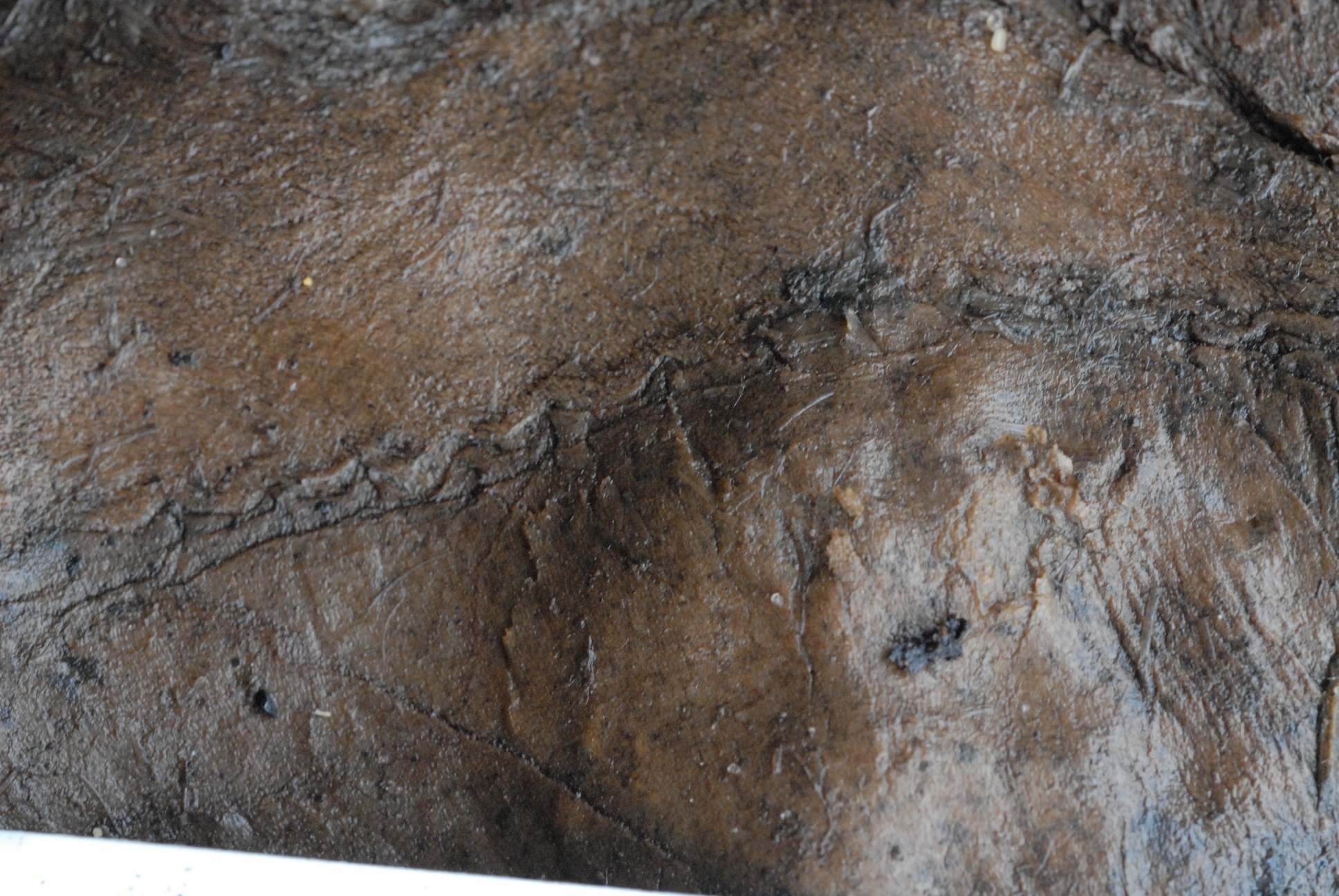
On the plus side, the very deep burial turned out to be a person wearing a fur parka and wrapped in hide!  You can even see traces of the stitching.  We aren’t sure how well-preserved the person is (we found a few finger bones and a nail inside the cuff).  We decided to take it out en bloc (complete) and take it back to the lab to excavate in controlled conditions so we can document the garment better, since it is very fragile.  We had some plywood brought out and managed to slide it through the gravel under the entire burial and lift the whole thing.  This required the digging of a very large hole, which we’ll now need to backfill.  Many thanks to Brower Frantz and his crew for bringing out the plywood and transporting the individual back to the lab while we kept on in the field.
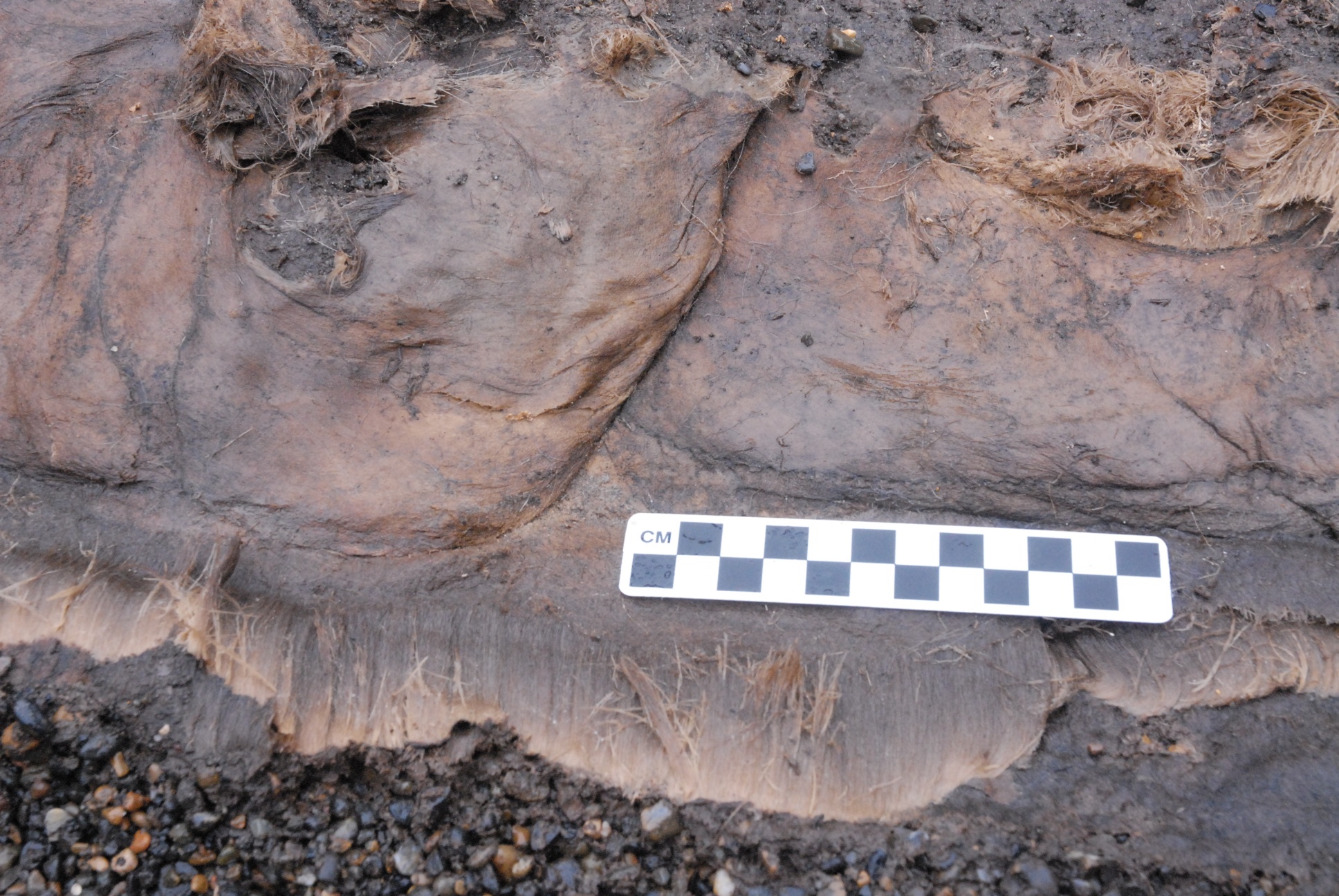
Right arm and side of the fur parka, lying on a hide.
Close-up of stitching on parka

The DWF keeps yielding more artifacts, some of which are quite nice.  We’re trying to get to a reasonable stopping point and figure out a way to protect the exposed feature in case we can get funds to work on it in September.
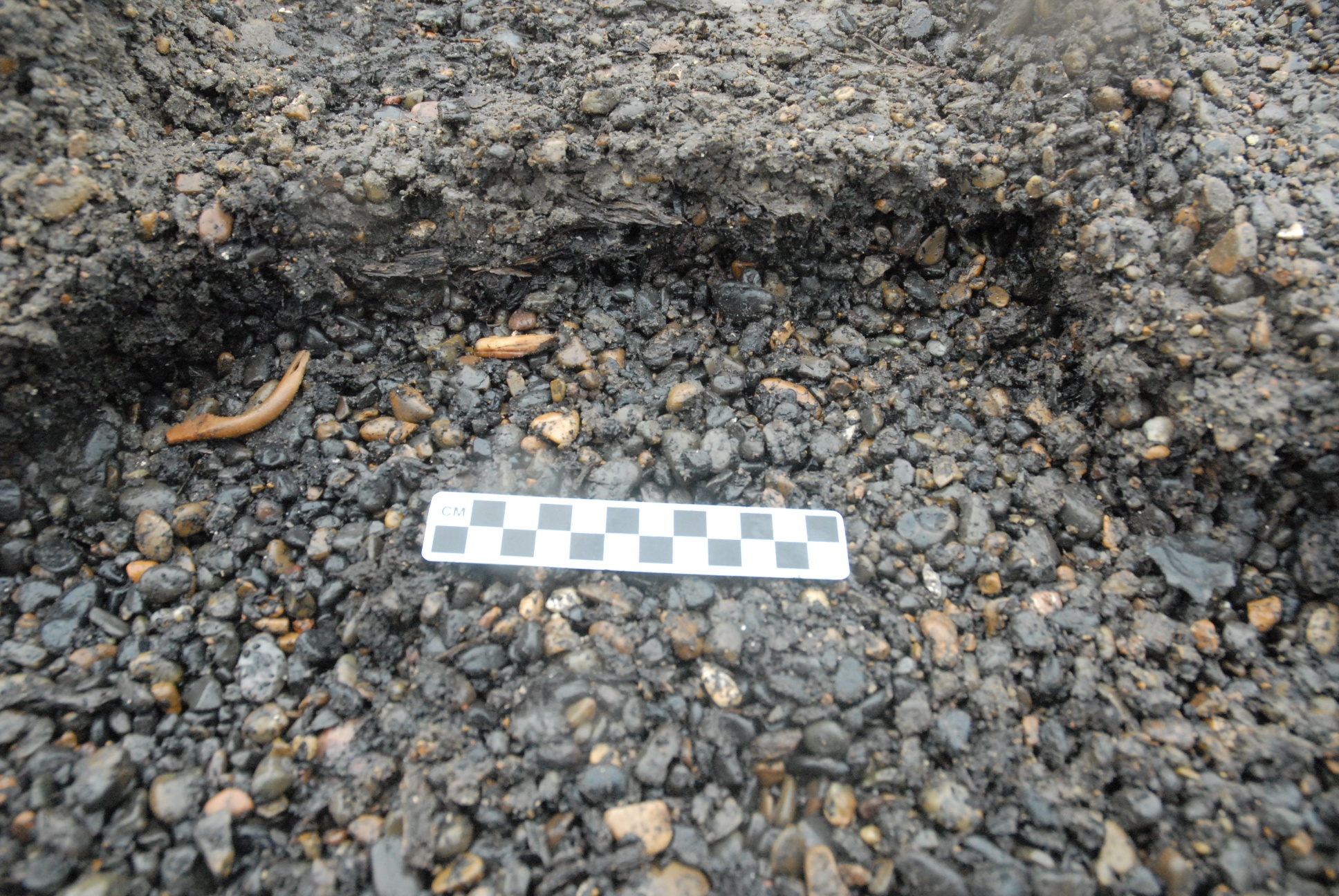
Artifacts from DWF.

Things get a bit exciting…

As is traditional at the end of a field season, things started getting a bit exciting.  The possible burial we found in STPs yesterday proved to be the real thing this morning, and the feature we worked on on Monday also turned out to be a burial. It is the deepest burial I’ve seen at Nuvuk in the fifteen years I’ve worked there.  It appears to contain two children, covered in fur.  We hope to finish it tomorrow.

I had hoped to be done with the DWF today, but fish bones kept coming, along with an arrowpoint, a worked walrus humerus, some worked bird bone, what look like a broken needle, and more lithics.  Recording all that with the transit took time.  We still had the windbreak up, but there wasn’t much wind, and since it was the second warm day in a row, the mosquitos were swarming.  Thank goodness I always have bug dope in my pack, or I don’t think much would have gotten done.

In other good new, the replacement for the Nikon Coolpix S9100 which I had for a week before it stopped working arrived, so I will have a pocket camera for snapshots.  More pictures for here without lugging the D200 home to download the card every night.


Plenty of fish

Excavation of the hearth & surroundings continued.  When we first found fish bones we were pretty excited.   We just keep finding more in and near the hearth and I must admit the thrill is rapidly fading 🙂 . We’re finding some other bone too, not all of which has been burnt past the point of recognition.

The egg was successfully extracted and packaged, and has made it back to the lab, I hope more or less intact.  We shall see when we start processing things.  If we can’t figure out what it was, Dennis said they’ll take a crack at IDing it through DNA.

Two neat finds

We started investigating the last GPR hit and came down on a jumble of wood.  The excavators were not optimistic, but I kept pushing to go a little further.  Eventually, this appeared:

Feature detected with GPR

The feature (I’m not calling it a burial until there is evidence of human remains) was jumbled because at some time after it was constructed, someone dug a hole in the middle of it.  And right beside where the hole had punched into the feature was this:

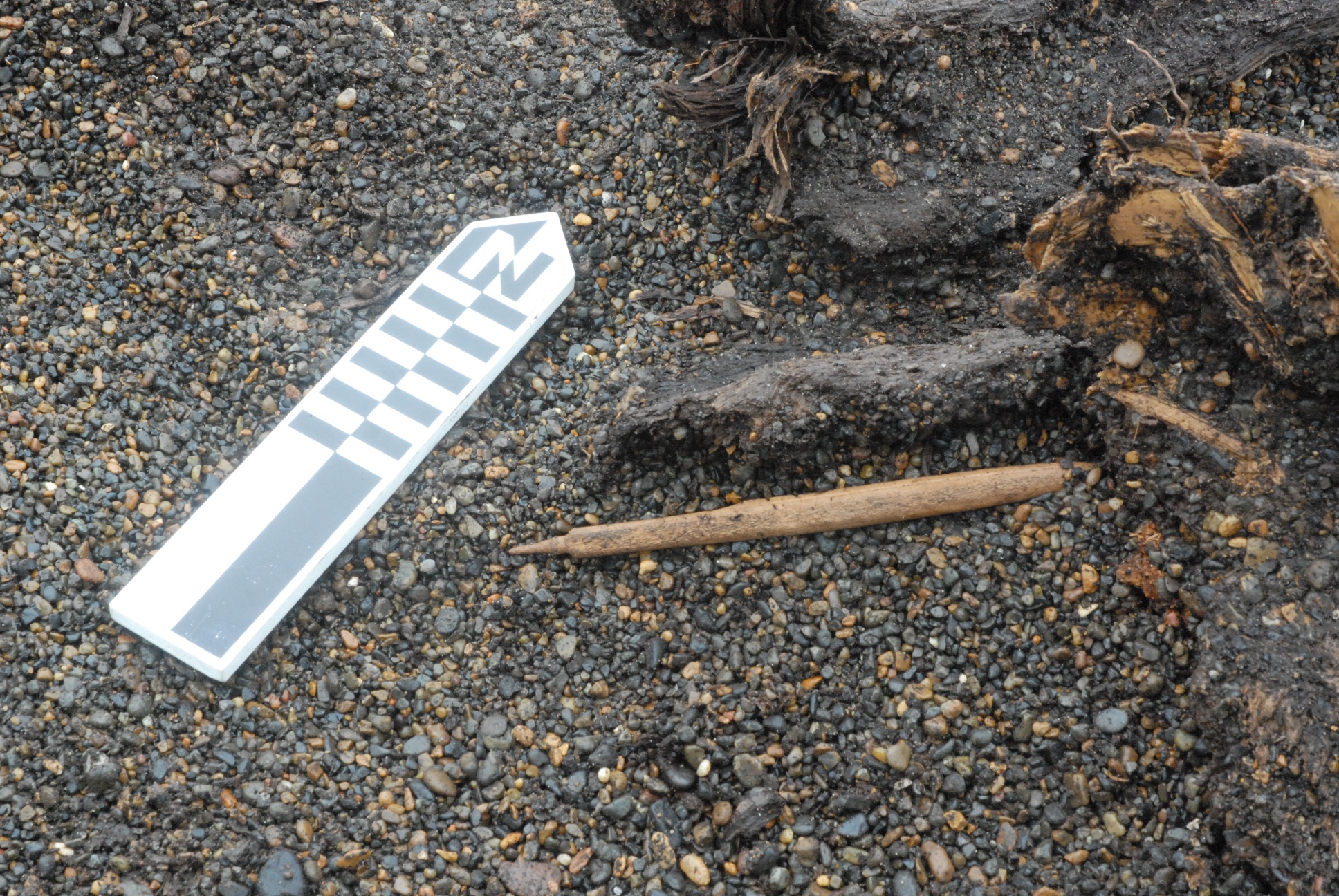
Antler arrowpoint

The hole just missed it.

The DWF (Ipiutak) levels had their own surprises.  We found a good bit of fish bone, some lithics (nothing diagnostic) and a lot of broken bone, but the really cool thing, which I found on the edge of the hearth, was a flattened but apparently complete egg!

The remains of the egg

Looks like it’s a hearth

We were a small crew today since the high school students weren’t working, so we concentrated on the Ipiutak area. It was fairly tricky to excavate, since there is unconsolidated gravel under the Wood/sand/gravel layer that covers the Ipiutak surface, and a large pile of unconsolidated gravel uphill from the features.  Plus the hearth ash is covered with a mushy skin of peat, and both the hearth surface and the peat undulate.  Despite that, we recovered 2 fin rays, some burnt bone, a pot-lidded flake (probably rhyolite), a grey chert flake, and a black biface fragment from the hearth.  We also got some large ungulate (species in dispute at the moment–probably caribou) bone, and a small fragment of decorated ivory, plus several interesting pieces of wood, which appear to be worked.

It was quite cold.  Even though we had a windbreak, the levels are just thawing, and the ground is cold and wet.  My hands are still stiff, so more will have to wait until tomorrow.

Much gravel is moved

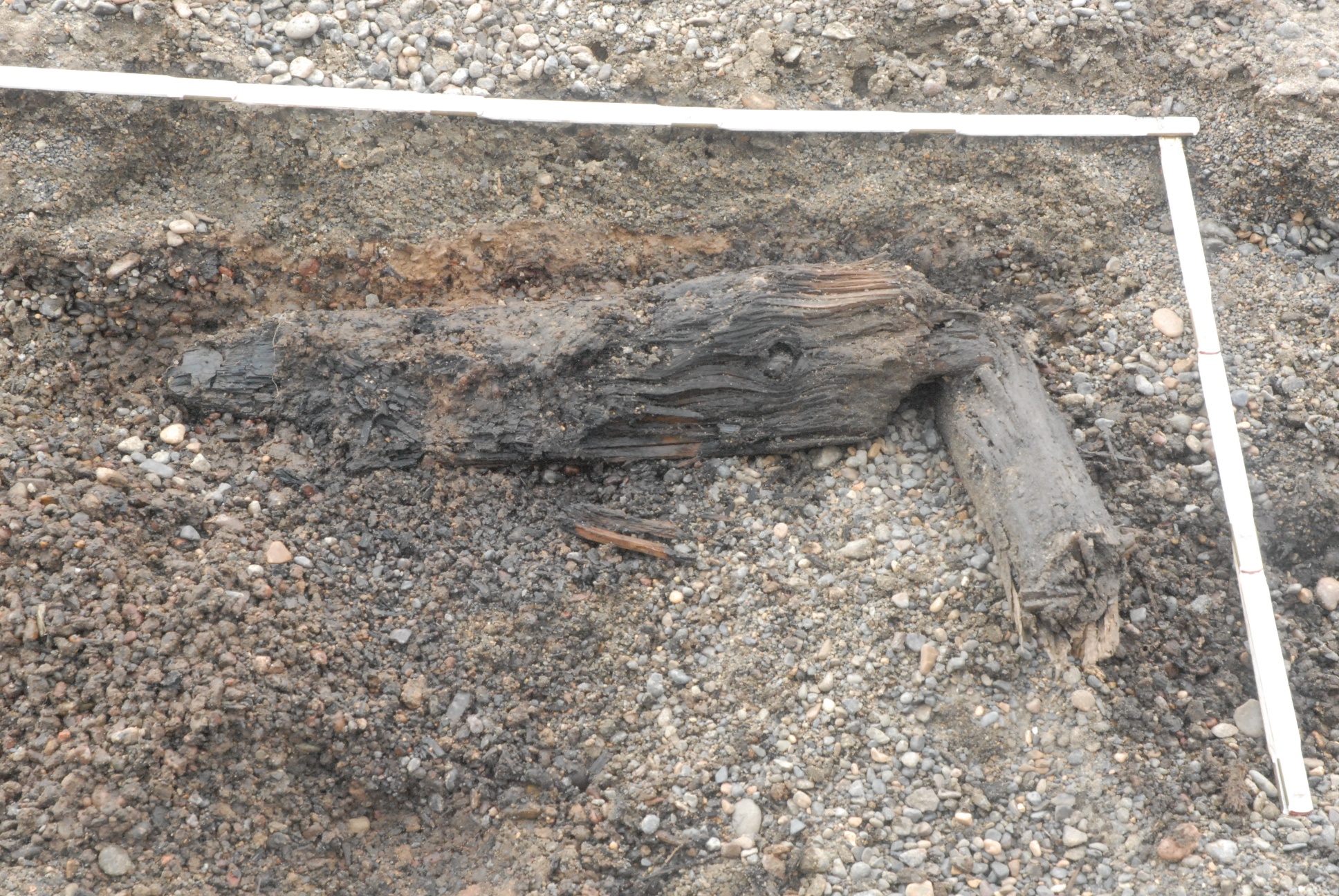
We spent most of the day with shovel testing, shooting in pits and moving gravel.  The gravel moving was in aid of getting a better look at the worked wood protruding from the erosion face at what appears to be the Ipiutak level.  So far, there seems to have been a fire and a lot of ash in association with one of the wood features, and it’s not clear if it was a hearth or a structure that burned accidentally.  Opening it up a bit more would help, but it is under a lot of gravel.

Structural timbers with possible hearth in Ipiutak level

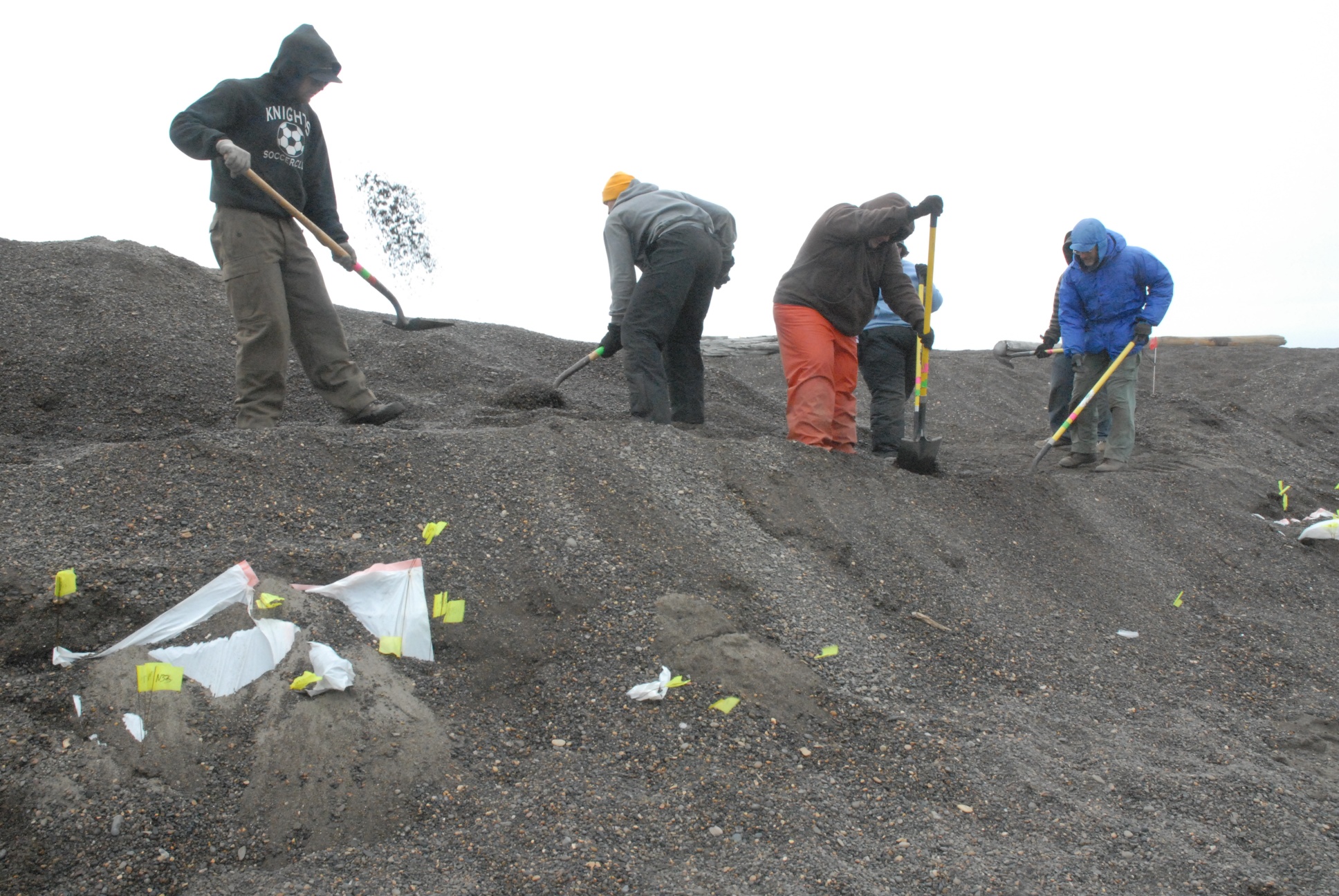
The crew did yeoman work, and much gravel was moved, so we can get a look tomorrow.  There is actually a frozen layer under where most of them are standing, which will have thawed by tomorrow if we are lucky.

Flying gravel! L to R: Adam, Trace, Laura, Candace, Dennis, Tom

Blustery day

It really was, and chilly besides.  Winds were probably over 30 knots at Nuvuk, so we didn’t even try to excavate.  The day went with shovel testing, shooting in various things with the transit, and checking out the wood projecting from the erosion face that appears to be in the Ipiutak layer.  It’s looking pretty interesting, but hard to get at.

It was a long cold day, and I had a lot of paperwork to do, as well as homework for a course I am taking online, so…  More tomorrow.

Back at it…

After a day off, we were back in the field today.  The GPR hits we tested were mostly concentrations of water, and buried whale bones (not part of graves, unless it was a whale grave).  However, we also looked at two other areas that had turned up in the trails on the first day’s walkover.  One proved to be nothing but a concentration of refuse.  The other wasn’t looking much more promising, with peat and a little wood, but we took it down to expose all the wood, and low and behold, a very large piece of wood indeed, which is a burial cover.  We will have to excavate that tomorrow.  There will also be a new set of GPR results to test.

The burial cover exposed. That is one piece of wood! The dustpan is covering what may be a bone, so the photo can be used for the public.

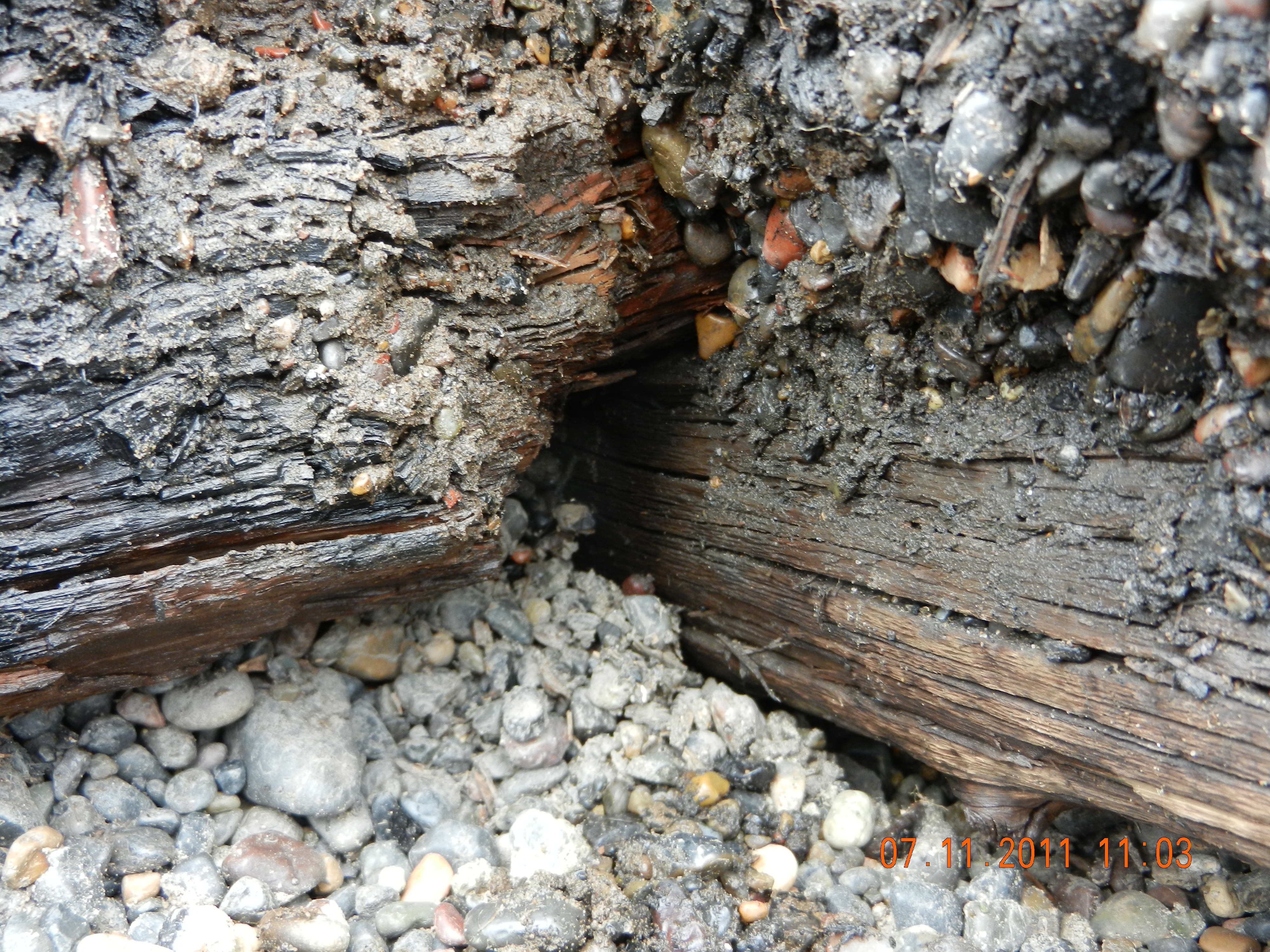
There is also some wood exposed on the erosion face at what looks like the Ipiutak level, including something that looks like architecture.

Notched log resting on another log. Ipiutak?

Working on Wood (as opposed to woodworking)

Claire Alix, who is probably the world expert on precontact wood use in Alaska, is in Barrow for a 10-day stint of analyzing wood from Nuvuk.  She is working on wood from the Driftwood Feature (DWF), because there is so much of it and we need to figure out what needs to be kept.

The DWF was a storm strand line which was washed up onto and mixed with an Ipiutak settlement.  Not just any Ipiutak settlement, but the farthest north Ipiutak settlement by about 500 km.  The result was a mass of wood, bark and marine invertebrates, with a number of clearly identifiable artifacts included.  There was so much wood that we called the level “Wood/Sand/Gravel” because it seemed like there was more wood than matrix.  However, some of the smaller pieces of wood and bark were also worked, but it seems that the storm picked up smaller floatable artifacts and mixed them with driftwood.  Given the field situation, it was impossible to examine each small piece of wood in detail, so we erred on the side of caution and brought back a lot of things that probably aren’t artifacts, so they could be examined in a nice warm lab.

Chert artifact stands out in the middle of huge numbers of small pieces of wood, some worked and some not.
Wood level in the DWF.

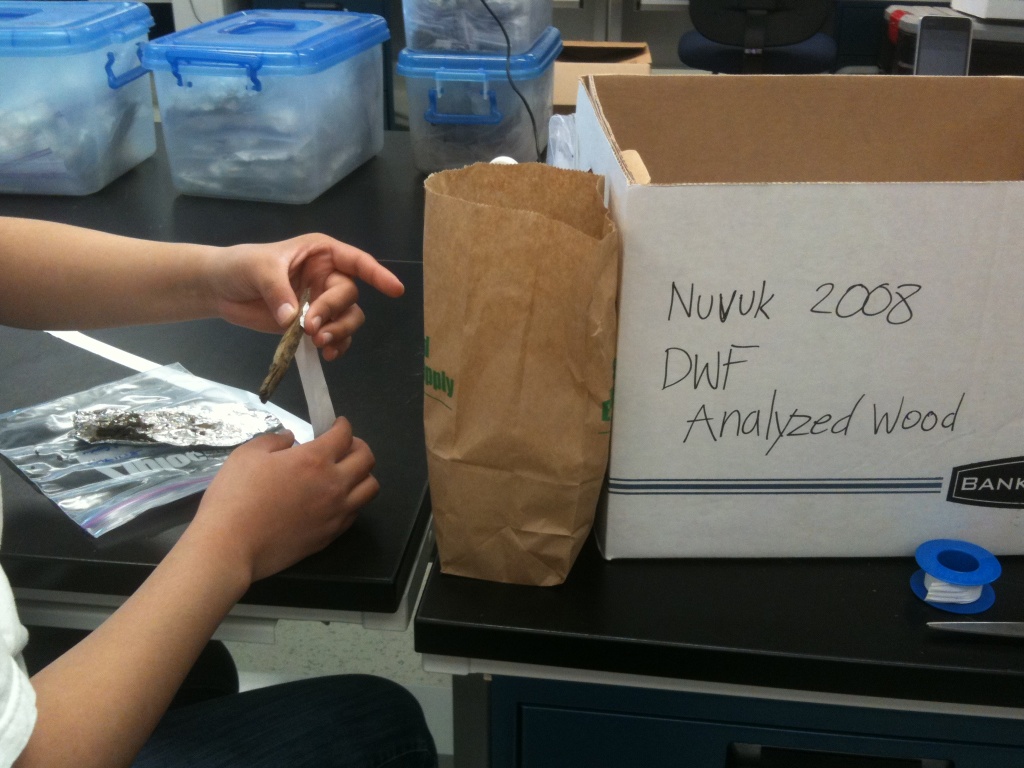
The DWF was actually frozen, and had been for centuries, so we didn’t just want to bring the wood into a warm lab and let it thaw.  That generally leads to wood that looked really well-preserved “exploding.”  We have a nice walk-in refrigerator at the Barrow Arctic Research Center (BARC) just down the hall from my lab, so we have been holding the wood there, thawing slowly and keeping it cool to retard mold growth.  The large and important artifacts started the conservation process very quickly, but there are boxes of smaller things which need to be inspected to separate the worked wood and bark from the rest.  The wood that is just driftwood will be lab discarded, with that being recorded in the catalog so it will be clear in the future that artifacts haven’t been lost.  The artifacts will get analyzed and better information will be recorded.  This also lets us identify things for the conservator to work on when she next can come to Barrow.  Small artifacts are being brought out for gradual drying.  Wrapping wood in teflon tape to hold it together during slow drying has worked fairly well, so we’re doing that to move more out of the walk-in

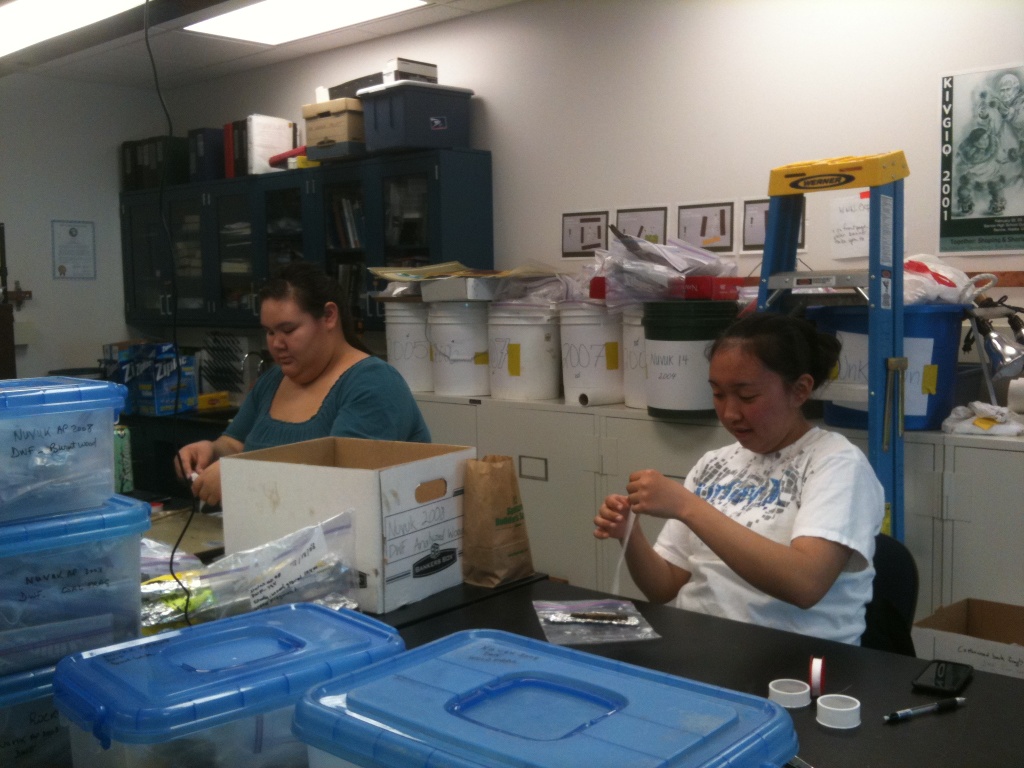
All this is pretty laborious.  Claire has to do the analysis and wood IDs, but with her schedule we needed to find a way to speed things up.  The initial sorting of bags of wood and the wrapping of the wood are two of the most time-consuming aspects of the process.  So, last week Heather Hopson came in to do some data entry and initial sorting, and this week Trina Brower is joining Heather.  They are doing the initial  sorts, wrapping with Teflon tape & data entry, so Claire can keep looking at wood.

Heather & Trina hard at work in the lab.

Wrapping the delicate pieces of small wood is definitely fiddly work.  It certainly helps having someone to work with & talk to while working.

Wrapping an artifact to keep it together while it dries.

And when all else fails….

A most essential piece of lab equipment