For some reason, this year there has been quite a bit of media interest in Barrow and archaeology. To begin with, there were several film crews in Barrow while we were working at Walakpa, two of which actually came out to the site and filmed as well as filming in the lab. Only one of them has anything out yet. PBS filmed for several both in the field and in the lab, and a little bit of it made it into this piece, and a shot in the slideshow that they put up on the web in conjunction with the series on sea ice change. It was a very buggy day in the field, and it was quite the challenge not to be swatting mosquitoes all the time.
Oh, and the buoy experiment that Ignatius Rigor is working on in the film clip is supported by UIC Science staff (not that they have to do much, the idea is to see how the buoys do with no servicing). Their data can be compared to data from ARM’s established serviced meteorological instruments. That way, when scientists get buoy data, they have an idea how reliable it is, and if there are any special considerations in interpretation (becoming uncalibrated over time, etc.)
We’ve also gotten interest from the press. Abra Stolte-Patkotak, one of our volunteers writes for the Arctic Sounder, and did a piece on the Walakpa excavations, which is on-line here. For some reason, they don’t have the picture that was published up on-line, but I will ask Abra if I can put it up here & add it if so.
I am currently working with a free-lancer who has interviewed me and asked me to fact check the article before he goes further. A very good idea, as many years ago I was interviewed by a reporter who mis-heard my answer to the question of how far back in time human occupation of the Barrow area was archaeologically demonstrated to extend. I said “maybe 4 to 5 thousand years” which was what people thought reasonable for Denbigh at the time. He refused fact-checking help, and published an article in which I was directly quoted as saying “45,000 years”. Although Glenn & I could never get the Arctic Sounder to mail our subscription to us in Pennsylvania, apparently Tiger Burch could. I got a very puzzled email from him after the article came out, in which I believe he was politely trying to ask me if I’d lost my mind. Fortunately, he had enough experience with the press that he believed the explanation.
Things got rather busy around here, since I hadn’t actually been planning to be in the field, and had several other things going at work that required some time and attention. Combined with rather chilly weather and a commute that did my no-longer-fused spine no favors, I wound up putting sleep ahead of updating the blog. Now that the fieldwork is done & I’m getting everything else caught up, time for an update on what happened before the season ended.
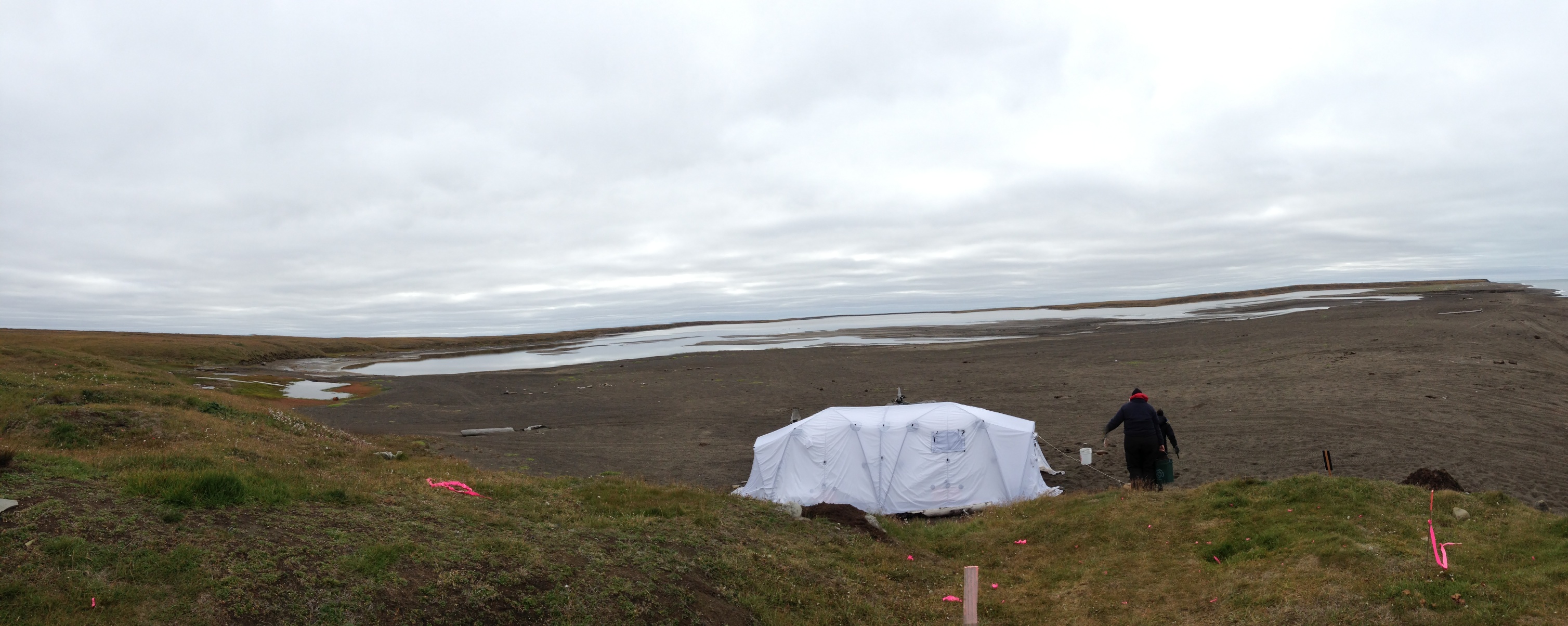
We managed to get quite a bit accomplished before the weather stopped us. Fortunately, the entrances to the lagoons closed up, and we generally had less trouble getting to the site in September, thank goodness! In the end, we had just hit frozen ground at the back corner of the excavation when everything started freezing up. This is good, since that means everything behind/below that should still be in great shape if erosion doesn’t get to it before we can. We actually had some really lovely days. And enough wind so no bugs!
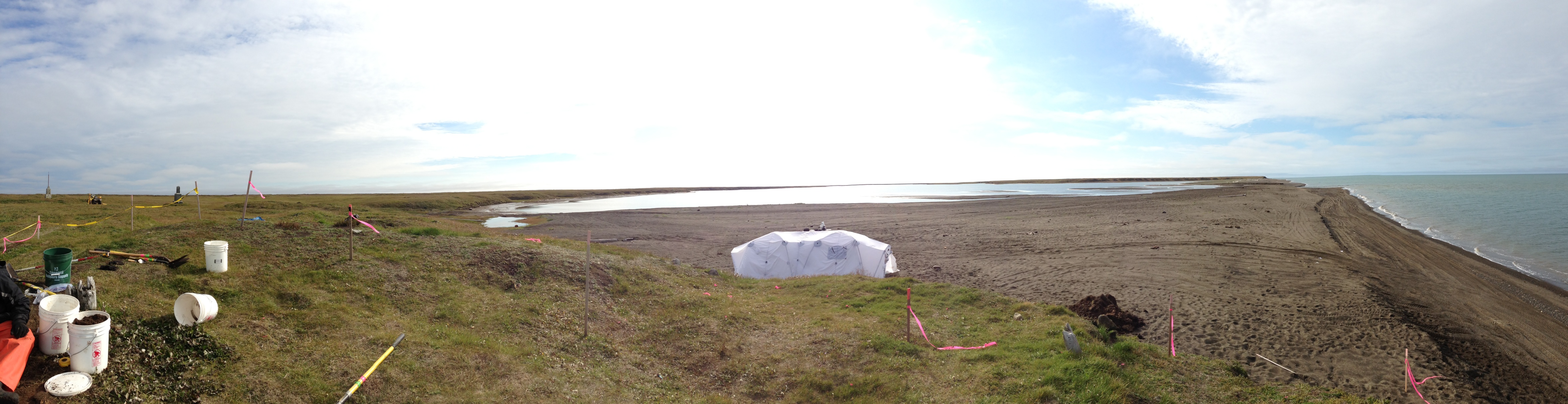
Lagoon and tent on a nice day, as seen from the excavation.
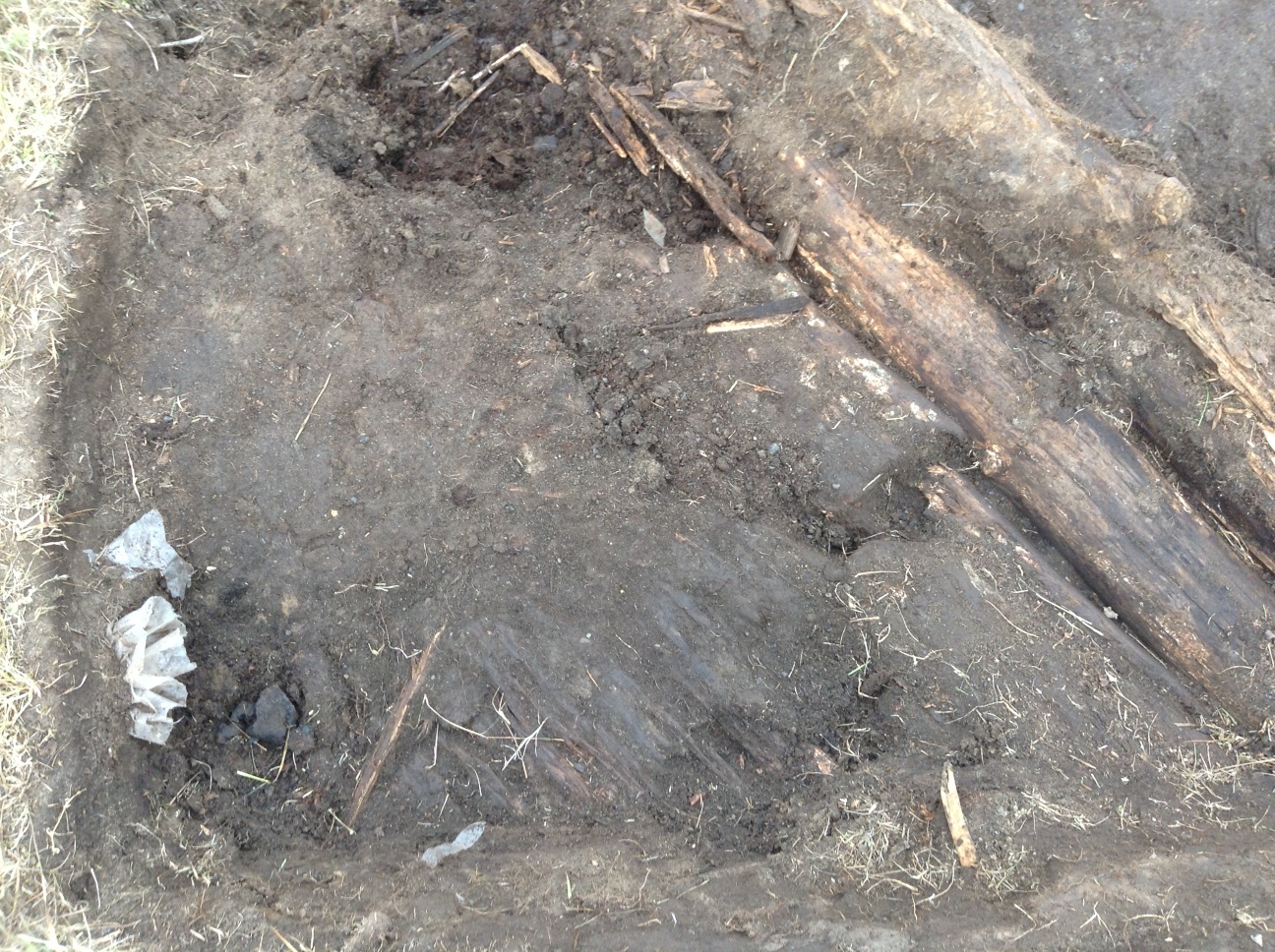
The floor that we had encountered in the south end of the trench cleaned up nicely. There had been a pot in the corner, but all that was left was a pile of smashed sherds. The digging of the pit that someone had put in above it had probably smashed what was left. Near where the arrow shafts were found was an area of floor so soaked with marine mammal oil that you could actually wipe it off of one patch of floor. It seems most likely that this was a tent floor, since there was no evidence of structure otherwise, and it was not far enough below the surface for a semi-subterranean house.
Probable tent floor after cleaning. Pot was located in the lower left corner, left of the stick. The oil patch surrounds the North arrow.
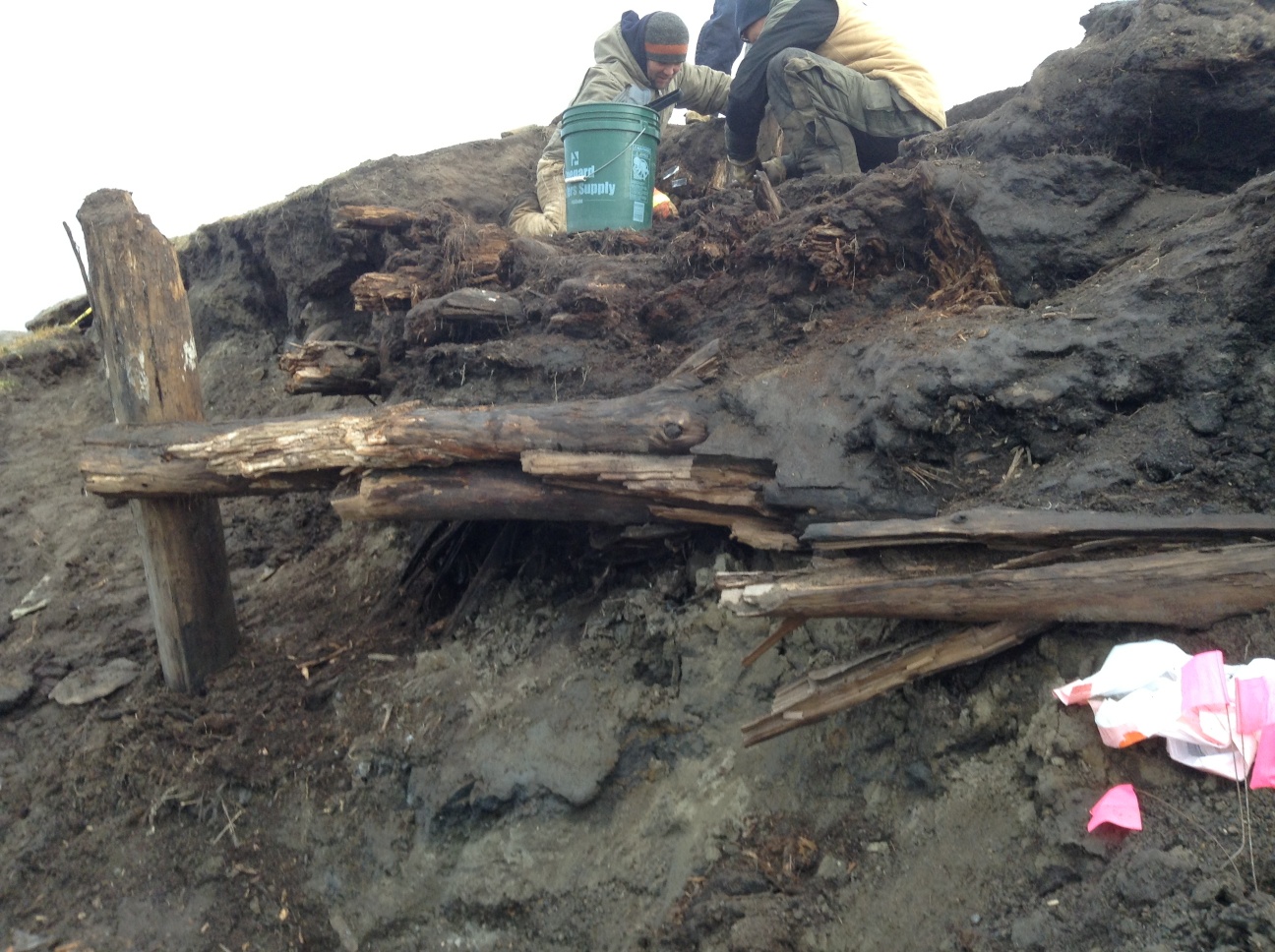
The house (at least I think it was a house) proved very complex. The small area we were able to open was not big enough to let me see what was going on well enough to be definite. However, there seem to have been several floors. We were not able to get down to them before freeze up, but we determined that there were several layers of midden (trash deposit) on them, so it would appear that the house must have been abandoned and reused, rather than just rebuilt.
View from the side showing several layers of floor logs above the sill logs & below the green bucket.
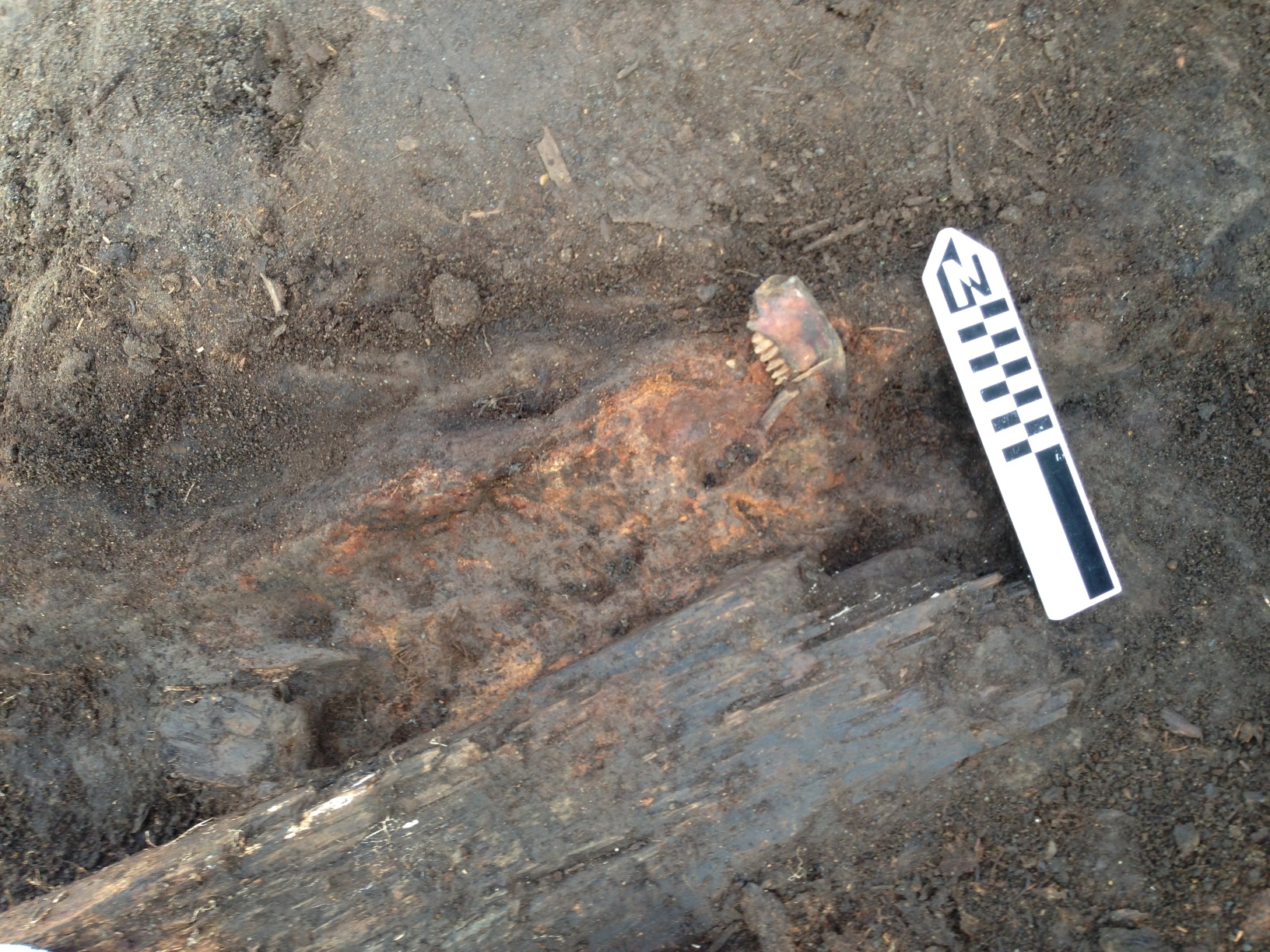
At some point in the sequence, it looks like the structure may have had a meat cache pit (sort of the forerunner of today’s ice cellars) in it. There was a distinct line of hardened red marine mammal oil
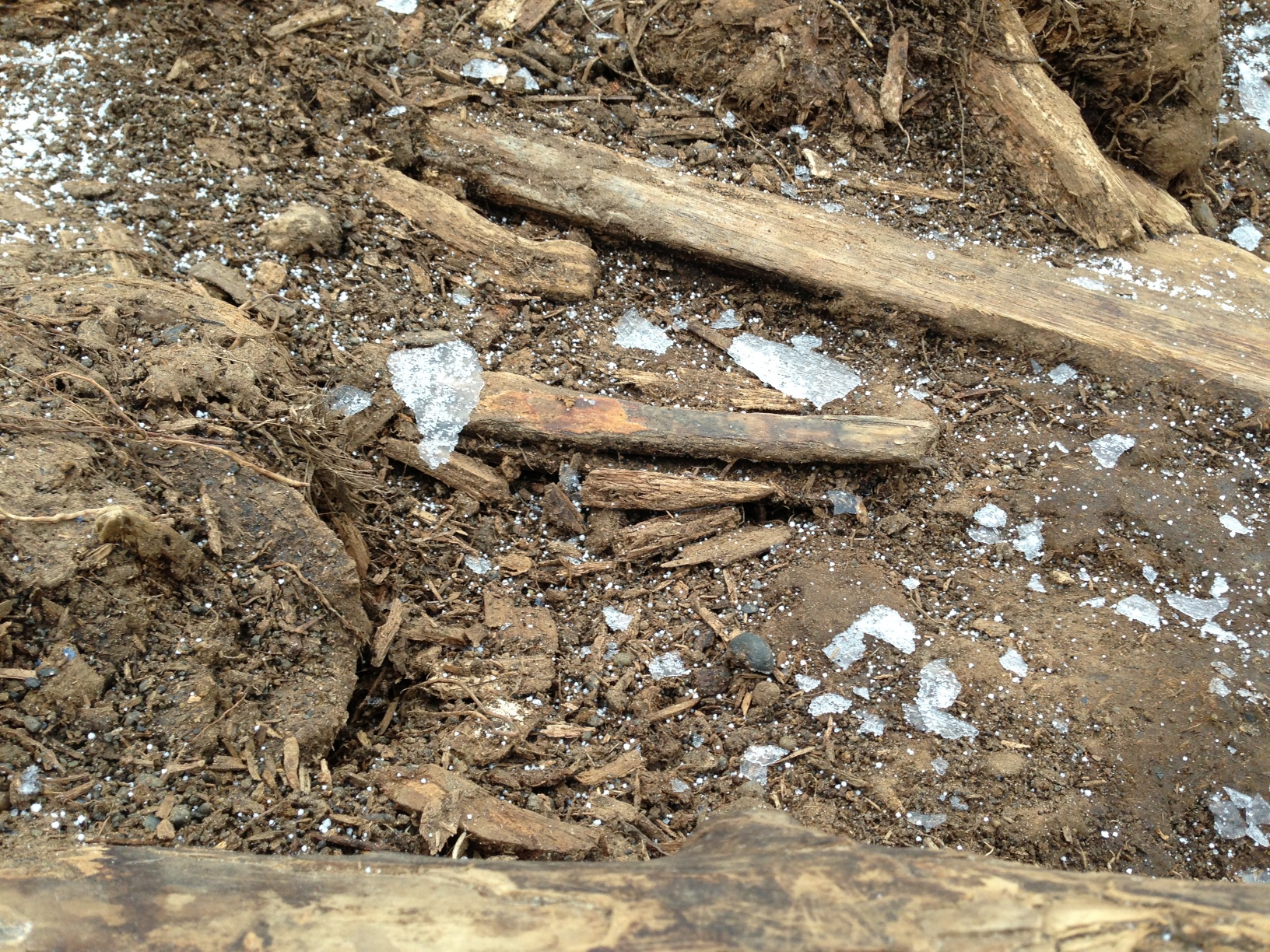
North edge of the meat pit. Caribou jaw lying along the sloping side just to the left of the North arrow. The red oil layer continued under the plank. The north logs were above the edge of the pit, but there was a layer of midden in between, so they were not associated.Another view of the red oil level underneath some logs (possibly 2 separate floors). Notice the seal scapula used as a chock under the plank on the right.Another view of the red oil layer showing it sloping up to the right. Note that the apparent sill logs for the main structure are below what is visible in the picture.
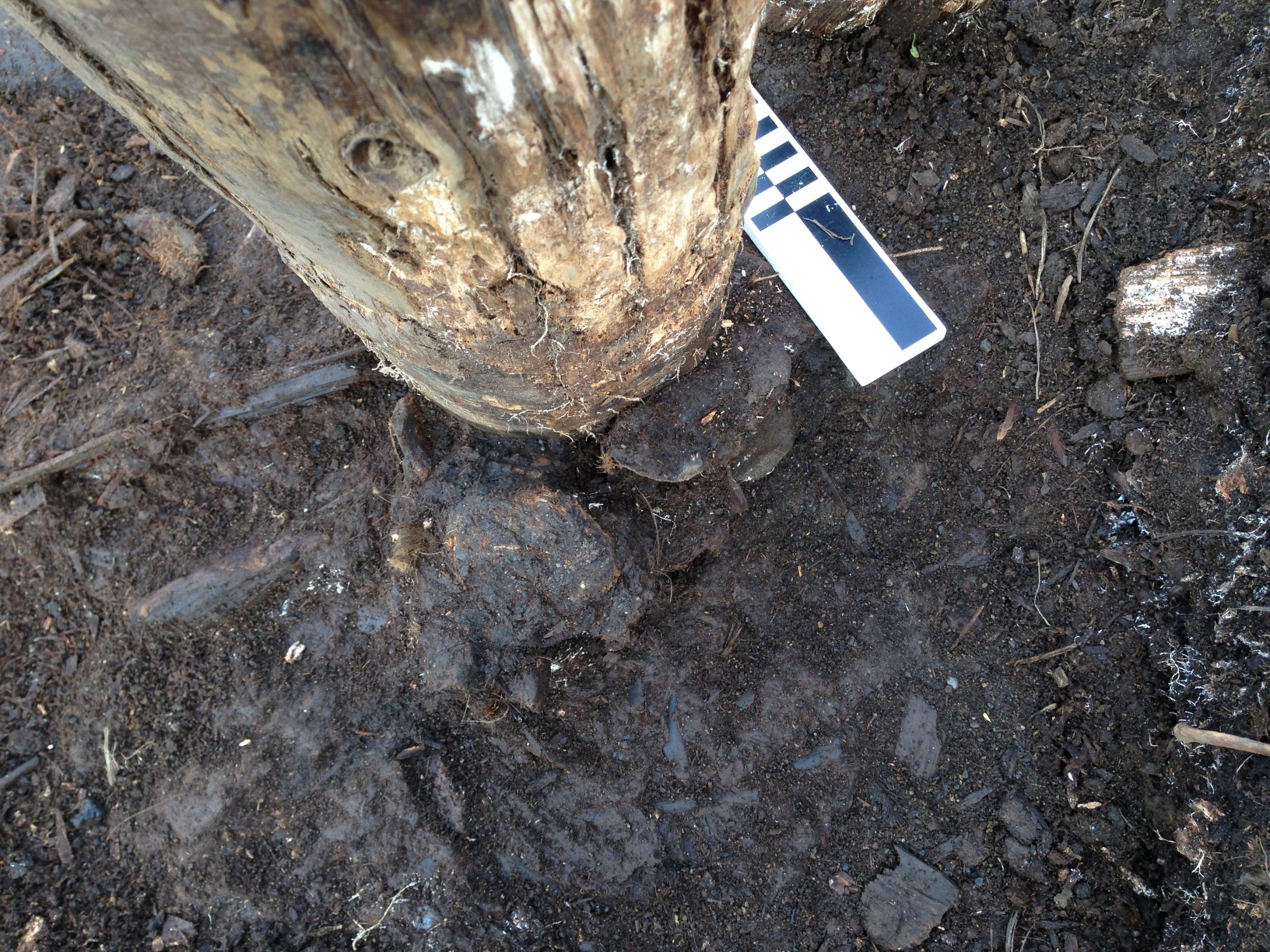
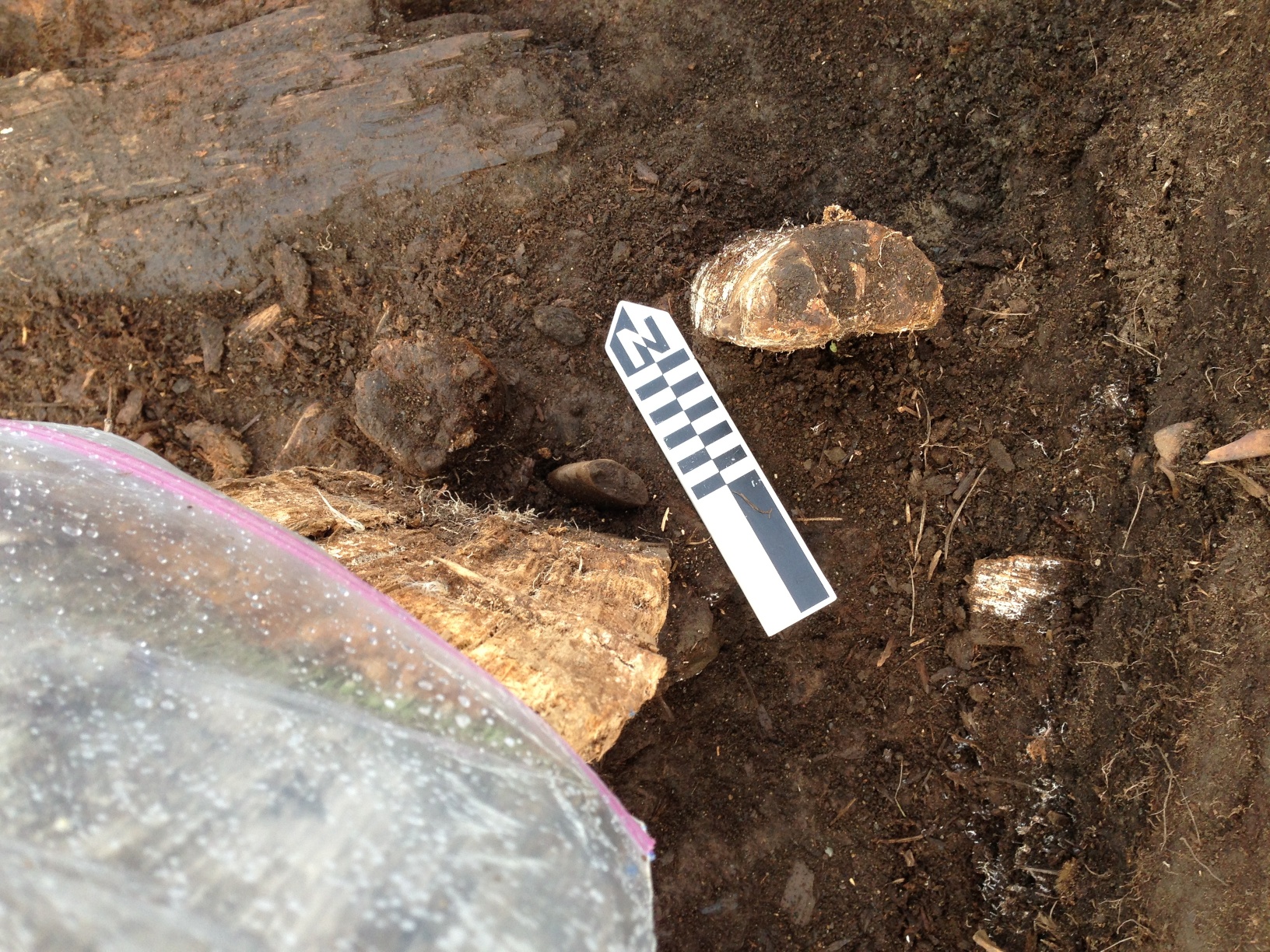
We got all the way to the bottom of the large post in the northern half of the trench. It turned out to be a later addition, dug into an existing midden, and chocked with a seal sacrum, a walrus vertebra and a broken pick head. There were two smaller (and apparently earlier) posts very close to it, one of which had a deposit of shell next to it. That will be interesting if we can ID any of them.
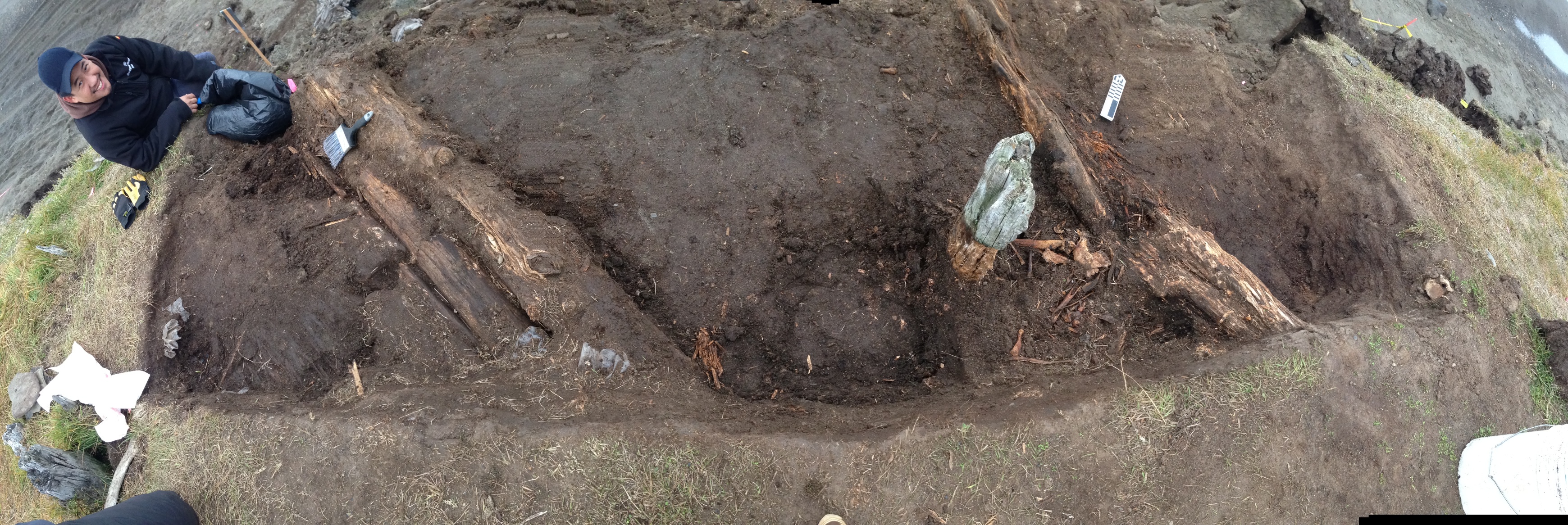
Post, showing sacrum and vertebra used as chocks.Post with pick used as chock at base to left of North arrow.A view of the excavation before the post and north logs came out. NO, the wall was not curved; this is a raw iPhone panorama shot, & that happens. Our walls are straighter than that!
We had been working as fast as we could on the structures at Walakpa. Given how far north we are, “Winter is coming!” pretty much applies as soon as it starts thawing in spring. We had a fair bit of windy weather, so it wasn’t pleasant working conditions, but the ambient temperature was generally above freezing, so the ground remained soft, and we were able to continue excavation.
The batteries on the transit were not happy, and we pretty much needed to have one charging at all times, or risk shut-down until we could charge a battery. The batteries are a bit old, and need to be re-celled or replaced, but since I hadn’t expected to be excavating this summer, that was scheduled to happen over the coming winter, which left us a bit handicapped.
But then, last Monday, there was a dusting of snow on the ground in the morning, and it didn’t melt. Further south in Alaska, snow on the tops of the mountains is often called “Termination Dust” since its appearance signals the beginning of the end of the summer season. And so it was here.
I had started accumulating materials to protect the site over the weekend. UIC Construction had some surplus damaged materials in their yard which would otherwise have just gone to the dump, and they were kind enough to donate them to the cause. Monday, we started hauling them down to Walakpa.
A dusting of snow on the site & the beach in the morningShards of ice from the tarp after the site was uncovered.
We kept digging, since the ground wasn’t frozen. The next morning, there was a lot more snow on the beach, and the ground was really stiff although we did manage to dig a bit more and screen all but two buckets.
We met a polar bear on the way down to the site. It was tired, resting on the beach, but was so wary that it got up and moved before we could detour around it so it could rest.
More snow on the beach. And a tired polar bear, who was none too happy when we showed up on ATVs.
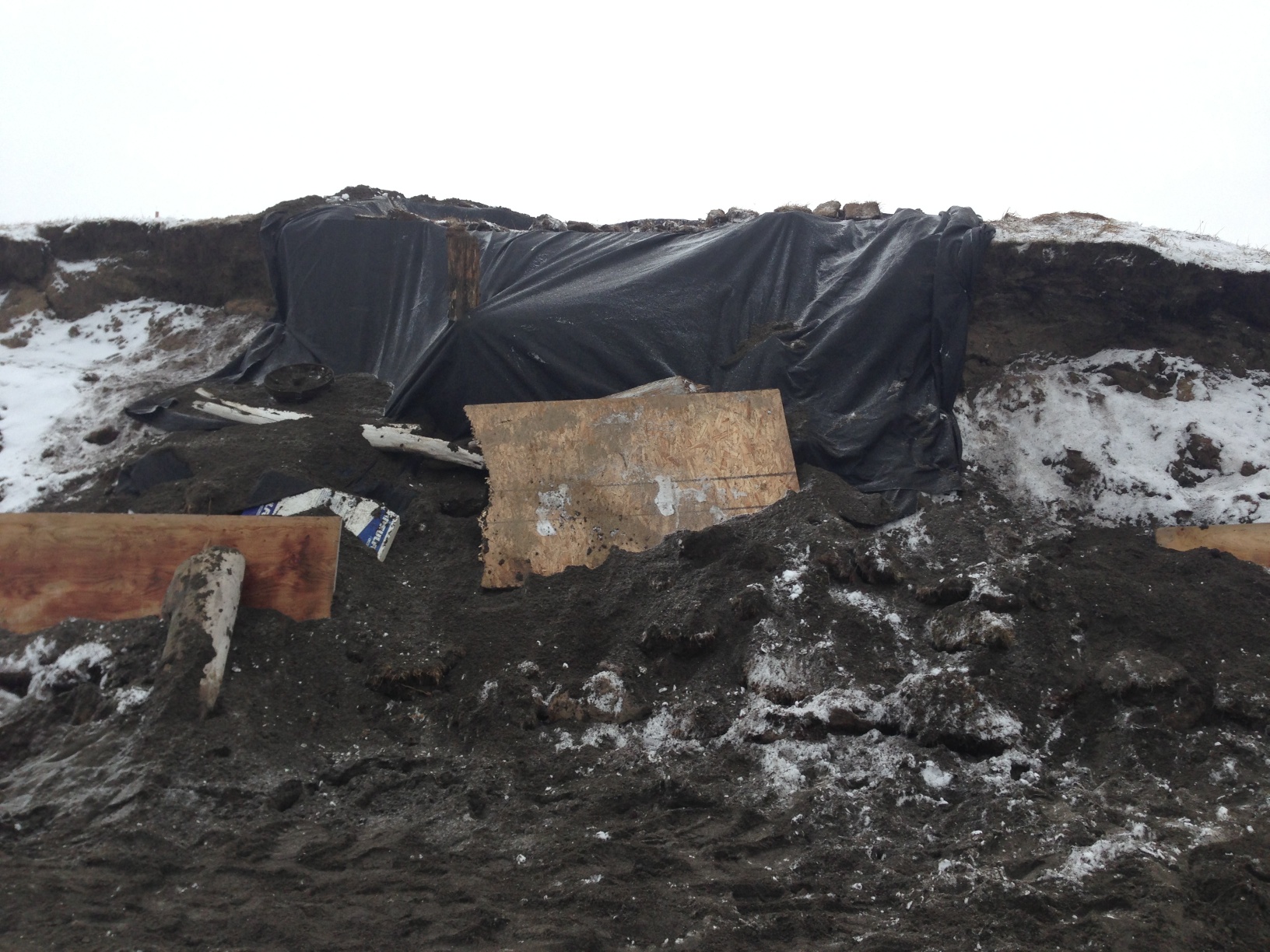
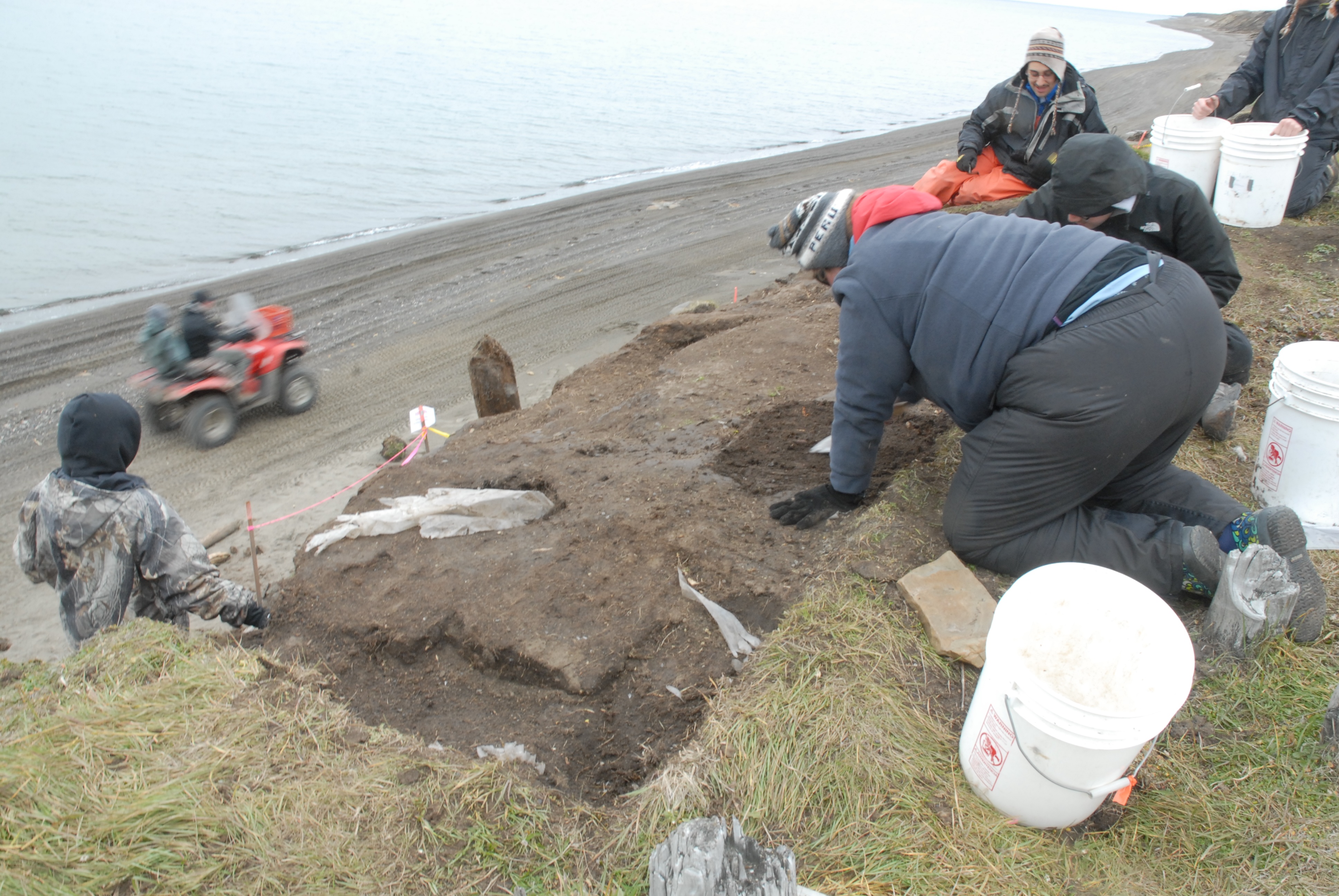
We put particle board along the erosion face of the site, and gathered sods from the beach to stack up to hold them in place. We also used upright driftwood to help hold this in place. By the end of the day, I concluded that things were freezing to the point where only a pickax would move dirt, which would sort of defeat the purpose of archaeological excavation, so we started hauling gear back to town that night.
We allowed the site to freeze more the next day, and Thursday we went down to put the site to bed & take down the tent.
We put a layer of whiteboard insulation on the top and front of the site, and then covered it with geotextile fabric, fastened in place with spikes. Then we covered that with the original sods which had been saved.
Excavation surface covered by whiteboard.Protecting the site with particle board, geotextile, sod and driftwood.Sod back on the site.
Once we had that taken care of, the gear had to be packed up and the tent taken down. We spray painted the hubs of the Arctic Oven frame so the next folks who set it up will have an easier time of it than we did doing it without instructions.
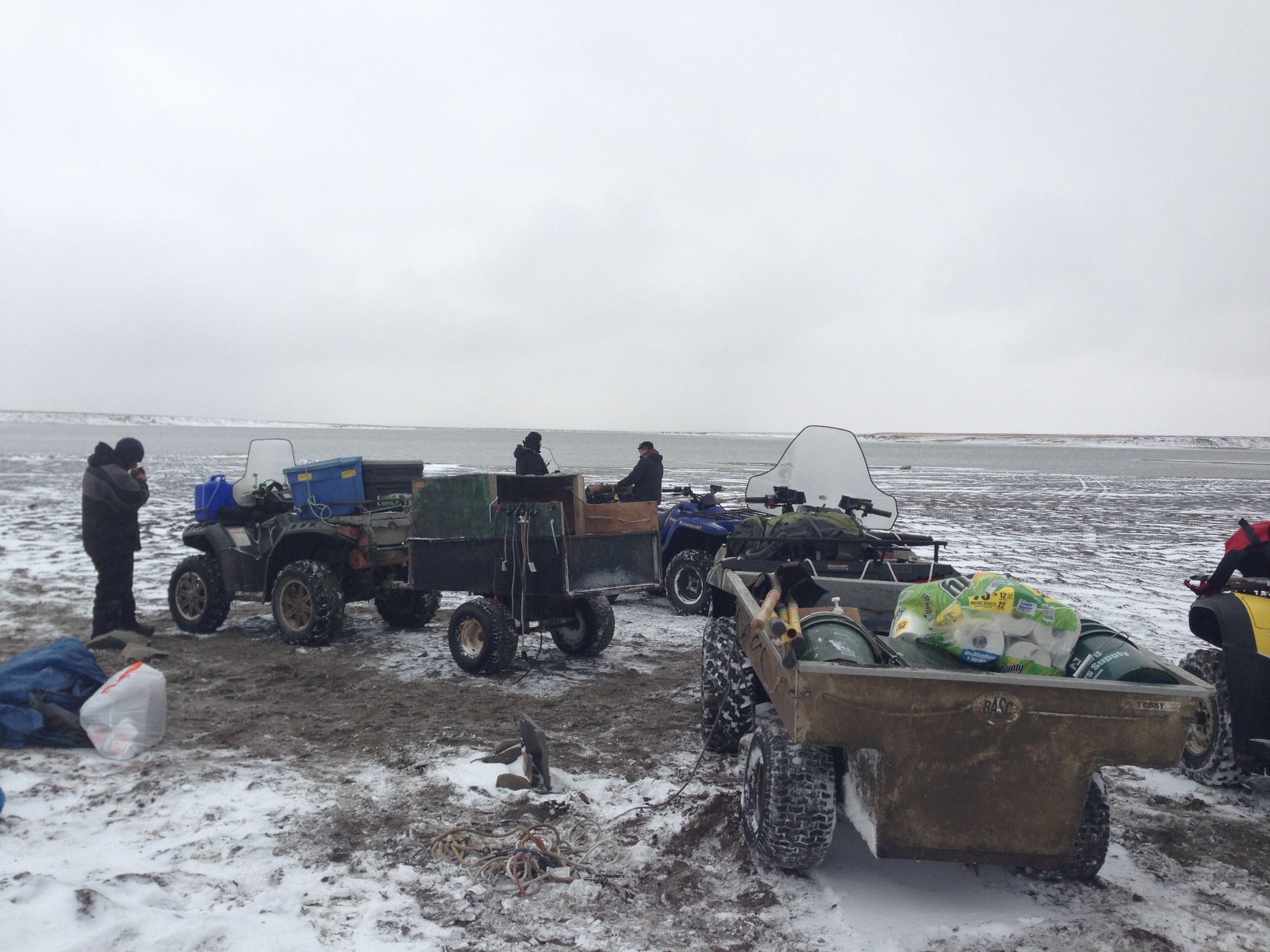
Tent & fly are packed and Jason Thomas is disassembling the frame.Packing the trailers. Riley Kalayauk brought his trailer down too, so we had 2.Happy hard-working crew ready to head home.
Now all we can do is hope and pray that there are no storms before the ocean freezes up that generate waves big enough to reach the site, and if there are, that they don’t last long enough to destroy the protection that we built. If we are fortunate, it will still be there next year, and we can learn more.
The water was a bit higher than yesterday on the way down, and we had to winch a couple of the 4-wheelers out of deeper mud, but we got to the site with not too much trouble. We put a stick in a the high water mark so we could see what the ocean was doing and went to work on the structure.
Yesterday, the strong winds made water screening where we have to do it a pretty sure ticket to hypothermia, so we tried just dry screening on the beach in the shelter of the bluffs, and it worked well.
Dry screening on the beach.
We made pretty good progress on the excavation. More logs were exposed in both of the parallel log features (fallen walls?). The area between the logs is getting soft, and seems to contain a lot of animal bones, many of which are lying in a way suggesting they were tossed into a depression. South of the southern logs, we uncovered what appears to be part of a plank floor, maybe for a tent, since it doesn’t seem deep enough for a house. Next to, but apparently not on it, there was a cluster of ceramic sherds, including a large rim sherd. This was right under an old looters pit, and their activity may have broken the pot.
Panorama of the excavation.Ceramic sherds at lower left (with Visqueen sticking out of the wall above them), plank floor in lower center, south logs at right, and arrow shafts at top center.
Beside the logs, but again not on the plank floor, we found two arrow shafts, apparently associated with a strip of baleen, and a fragment of bird hide. A couple of pieces of hide, one sewn, had been found just above this. This could be the remains of a quiver, or possibly a work bag, since there was a ground slate knife blade fragment and a worked piece of chert nearby. We’ll continue there tomorrow.
We didn’t stay out as long as we might have, since the waves seemed to be coming higher up the beach. It turned out to be a good thing. Going back to town was a bit of an adventure for us, although only one of us got stuck, but even more so for a man & his son we met on the way. They were trying to head out towing a trailer, and had gotten really stuck in a deep soft spot. It looked like they had been there a while trying to get out. We were able to get one of the 4-wheelers with a winch to where we could pull them out, and then waited until they got turned around and back on the town side.
We made pretty good progress at Walakpa this week. This, despite a few challenges.
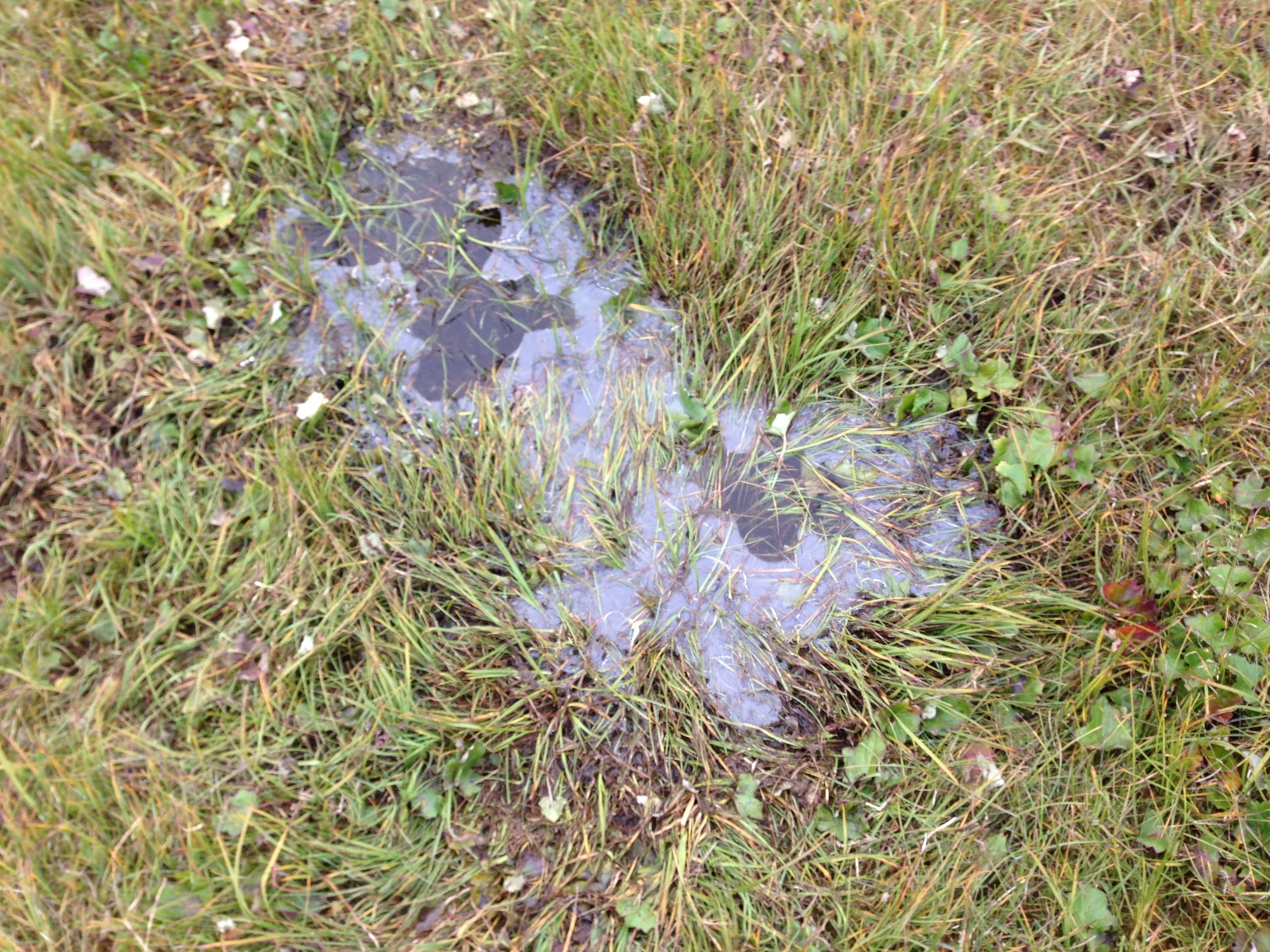
On Tuesday, we had a really small crew, due to a variety of circumstances. Only Trina, Mary Beth & I made it out. It was quite a cold day, with ice on the puddles when we got to Walakpa (or Monument).
Ice on a tundra pond.
We decided to leave the screening for another day and just excavate. It was cold enough that we actually took advantage of the removable floor in the Arctic Oven tent on site and used the Coleman stove inside, but on the ground.
The Arctic Oven on a cold day
The next morning, we had a bigger crew, but there was snow on the ground when we set off.
Snow on the tundra, seen across Middle Salt Lagoon.
We were not expecting to have a great day, but in fact it was warmer than the day before (no ice), and we started getting down to what seems to be structural wood from the house roof, so that was fairly satisfying. We got a lot of water screening done, as well. The beach had really stabilized, so we were able to go the whole way on hard sand, and even most of the lagoons had closed up, with sandbars across the entrances that we could just drive across. The commute to the site was much quicker.
Thursday did not go well. We headed out, only to find that for some reason, the waves were really coming up the beach and running into the lagoons, so that we were not able to get across the stream by the gravel pit. We went around and through the gravel pit, but then could not get across the stream by Nunavak. We did see a polar bear in the water near a dead walrus). I decided we should try to go around, since it was otherwise a nice day & I hated to lose it, but we didn’t have any extra gas along, and by the time we were half-way around, even cutting across country rather than following the shoreline, it was clear that some of the Polaris’s are sort of gas hogs. So back we went to the road, with only one minor mishap when the Tubby trailer bounced into a very wet low-centered polygon and dragged the ATV half-way in. I got my feet wet getting it unstuck, but we still went back down to the beach so that David Pettibone could get a picture of the bear, still in the water, from a safe distance.
Today, despite no major change in wind strength or direction, was very different. The beach was back to Wednesday’s shape, and we got to the site easily. It was quite sunny in the morning, and we got right to work. We had six people, so we started with 4 excavating and 2 screening.
View from the south end of the trench, where I was digging. Pretty well maxed out. L to R: Mary Beth Timm, JoAnn Akootchook and Michael Berger.
I played around with my iPad mini for taking pictures to supplement field notes & drawings. I don’t draw all that well, and used to take Polaroids and draw on them, but that technology is gone and wasn’t that stable anyway. I’ve use a couple of programs to annotate lab photos, but this was the first time I tried it in the field. I used iAnnotate PDF, which lets you put sound files on the image, associated with notes or drawings. They open fine in Acrobat. This will be quite handy.
Seventy-eight years ago, it was a foggy day at Walakpa. The Okpeaha family was camping there. A floatplane descended out of the fog, and two men asked how to get to Barrow, since they had lost their bearings in the fog. Getting directions, the got back in the plane and took off. The engine failed, and the nose-heavy aircraft crashed into the lagoon and flipped. Unable to reach the plane to help the men, Clare Okpeaha ran all the way to Brower’s Trading Post in Barrow, over 12 miles of very rough going, to get help. When boats got back to Walakpa & they got to the plane, it became clear the men had been killed instantly. They were Will Rogers, a noted humorist and political commentator, who was traveling around Alaska to get stories for the newspapers, and Wiley Post, probably the most famous American aviator of the time after Charles Lindbergh.
The crash was national news at the time, and a few years later a monument was erected near the site, followed some time later by another one. These are the monuments that show up in some of the pictures of the site. For some reason, these are on the National Register of Historic Places, but the archaeological site isn’t.
The first monument , looking out over the lagoon where the crash occurred.
Today was a much better day at Walakpa. We headed down with 7 volunteers, including David Pettibone, Michael Berger, dental extern Temurkin Cucukov, and the entire Von Duyke family, plus Marybeth Timm from the Inupiat Heritage Center. The stream was running high and fast at Nunavak, but we got across, although not before I got my boot wet. With that many people, it seemed worth getting the water screening going, so we did, using a small pump to take water out of the lagoon. Alan & Scott Kerner happened by on an ATV ride and pitched in for a while as well.
Wet screeners in action by the lagoon.
The rest of us continued with taking down the rather disturbed level under the sod. It would be a lot easier if we could just shovel it out, but the bluff doesn’t seem that stable & we’re afraid we’ll knock the whole thing down if we shovel, especially since there are still a lot of roots holding things together at this level.
Excavating the disturbed layer. Note the Visqueen.
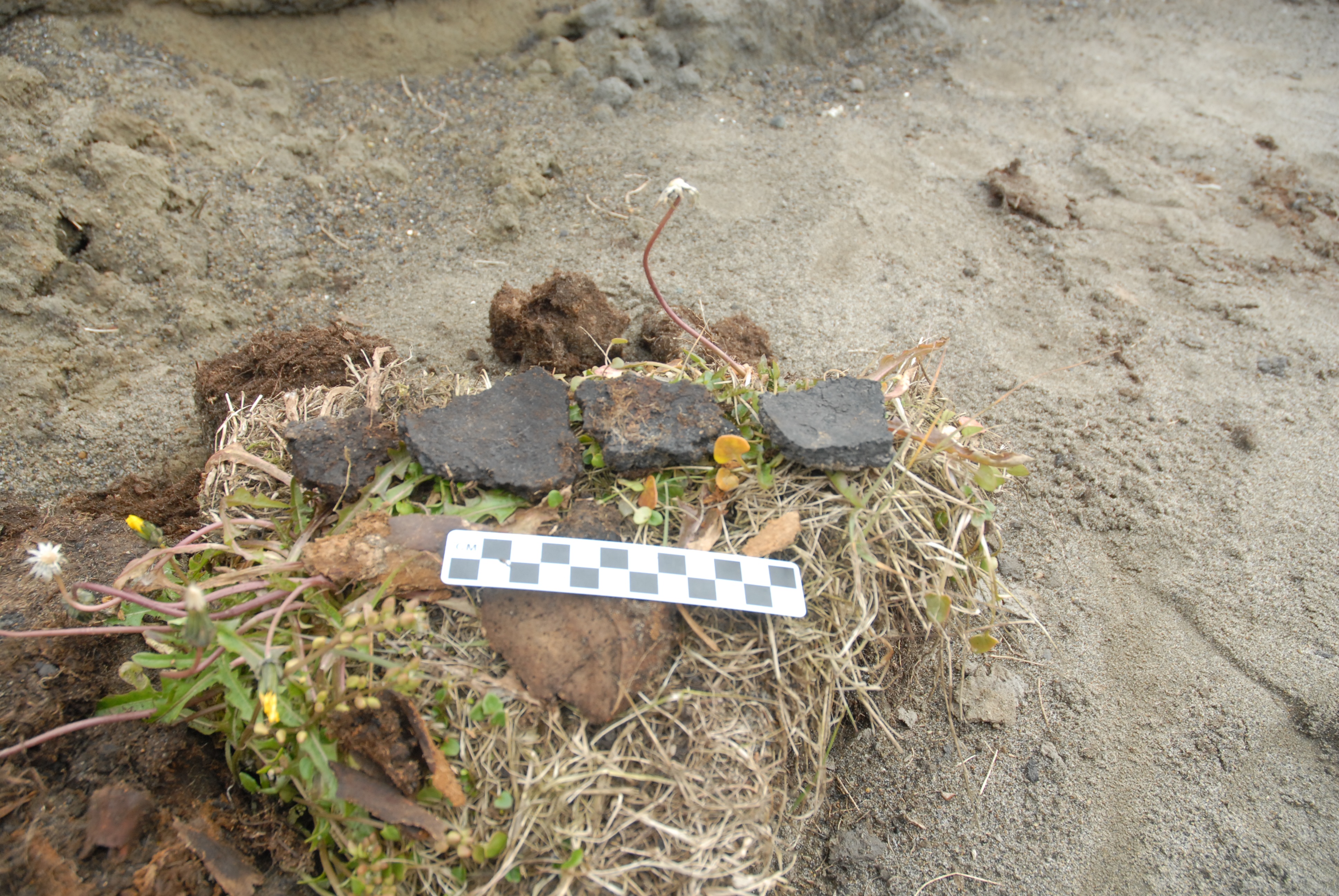
A while after we got there, a boat pulled in, and Jeff Rasic from the National Park Service (in town for a meeting at the Inupiat Heritage Center) Patuk Glenn (IHC) and Kunneak Nageak (IHLC) appeared. They got a good tour, and spent a bit of time wandering around. Jeff found a big sod with a lot of artifacts in it, including several very nice potsherds, one with residue, which we collected.
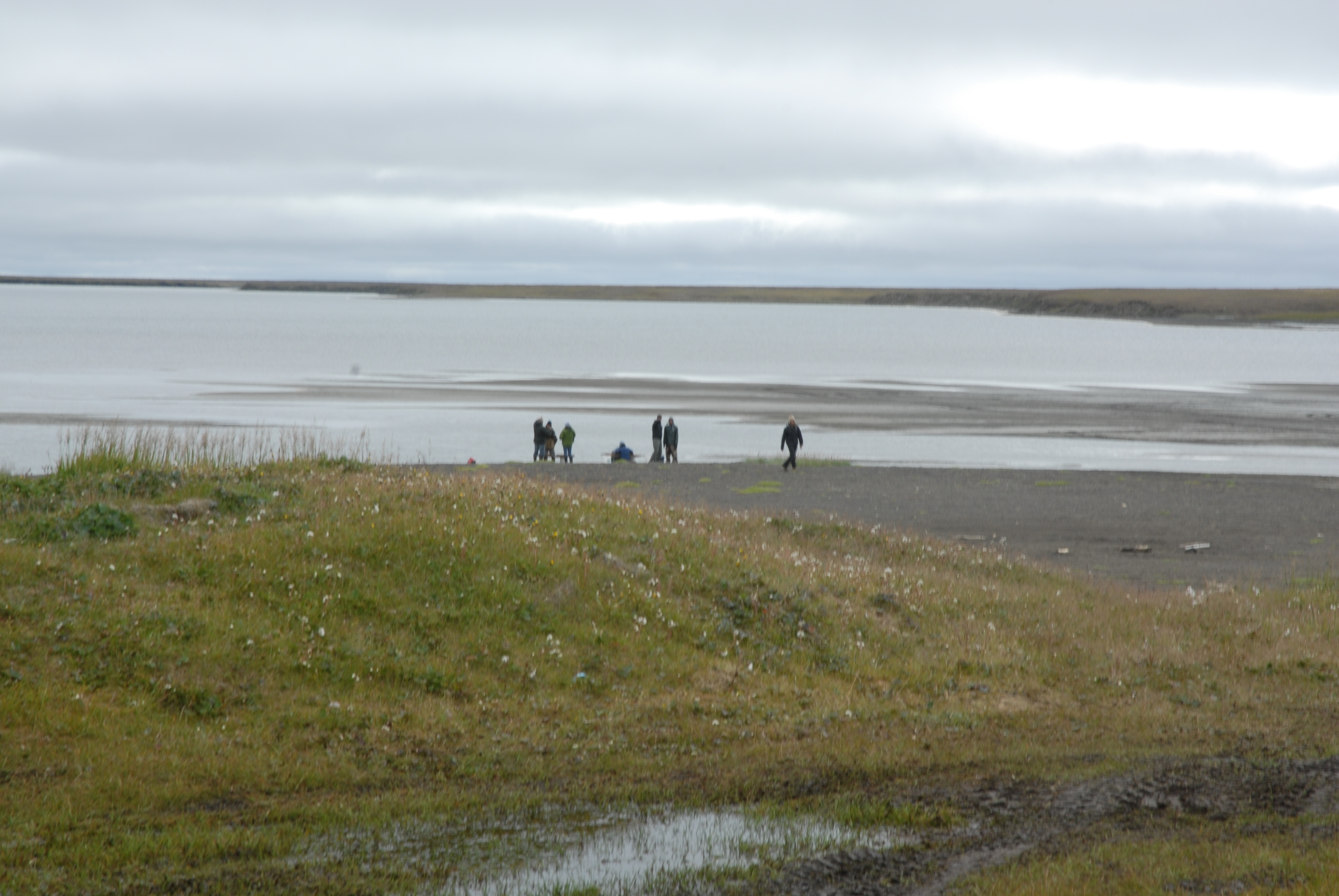
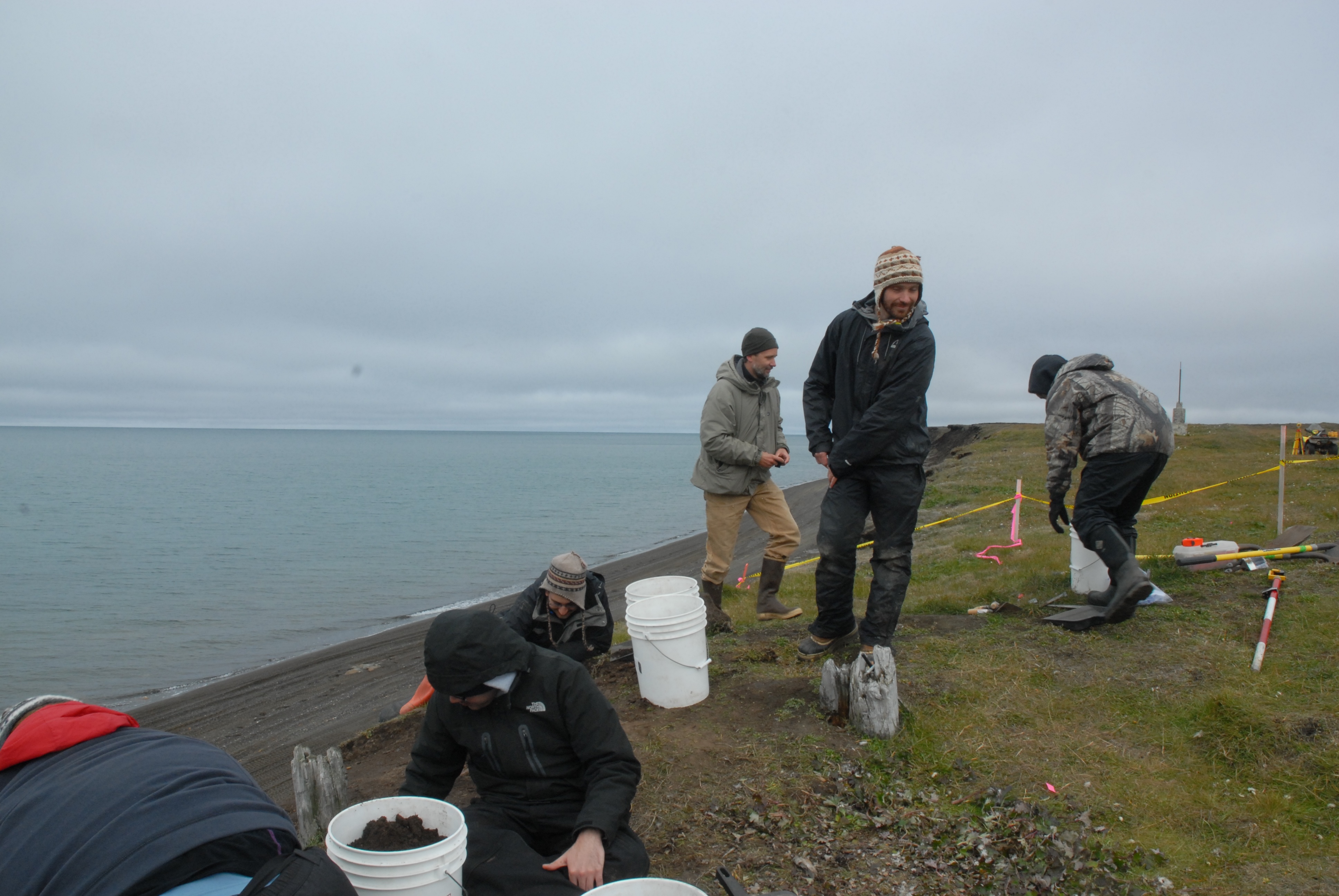
Excavation at Walakpa. L. to R. Marybeth Timm, Temerkin Cucukov, Michael Berger, Jeff Rasic, David Pettibone & Trina Brower.
Potsherds.
The ride home was even more exciting. Nunavak wasn’t too bad, but they were unloading a barge on the beach, so we took the old Nunavak “road” back to town. It has pretty much disappeared back into the tundra on the middle section the last few years, and it was a very muddy ride!
We went to Walakpa today. I’d heard that Nunavak might be running too hard to cross, so we were sort of preparing for having to ride around on the tundra, which would be time-consuming and bone-rattling. When we got there, we were able to find a couple of ways across, so no worries.
We made good progress on removing the sod & an underlying level of disturbed soil. Aside from the fact that it contains random fragments of bone, charcoal, rocks, lumps of clay, etc, the fact that it is on top of Visqueen in a lot of places is a strong hint.
Excavating at Walakpa.
The last bits of the overhang are gone. One fell, and the rest we cut off where it was cracking. It looks like the ground squirrels had a tunnel where the crack was, so there really wasn’t much holding it. Some of what came off looked like a sod wall, but it had part of a plastic eyeglasses frame in it, so it can’t be very old, or associated with the house. We are almost at the point where we should be able to excavate normally.
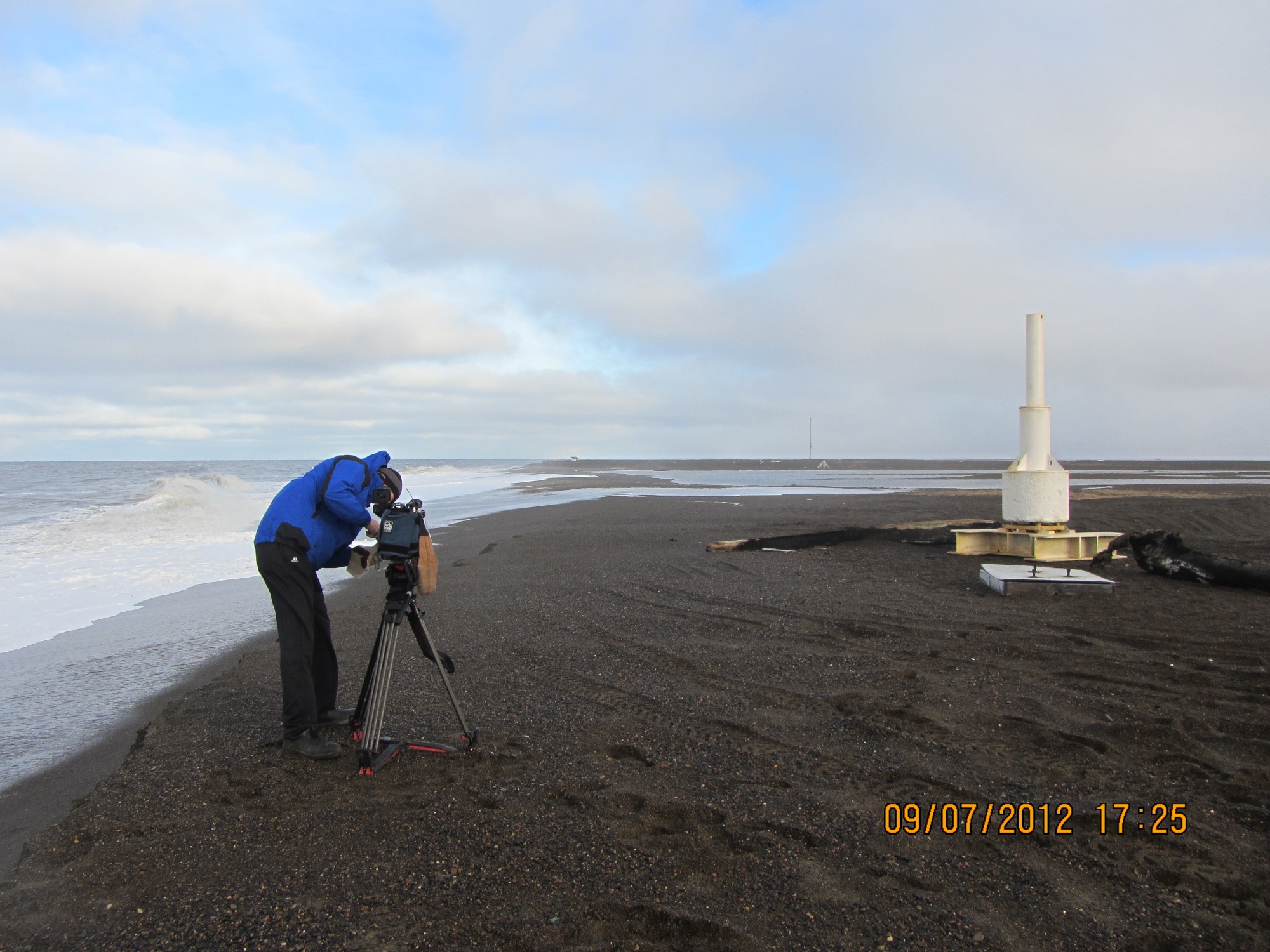
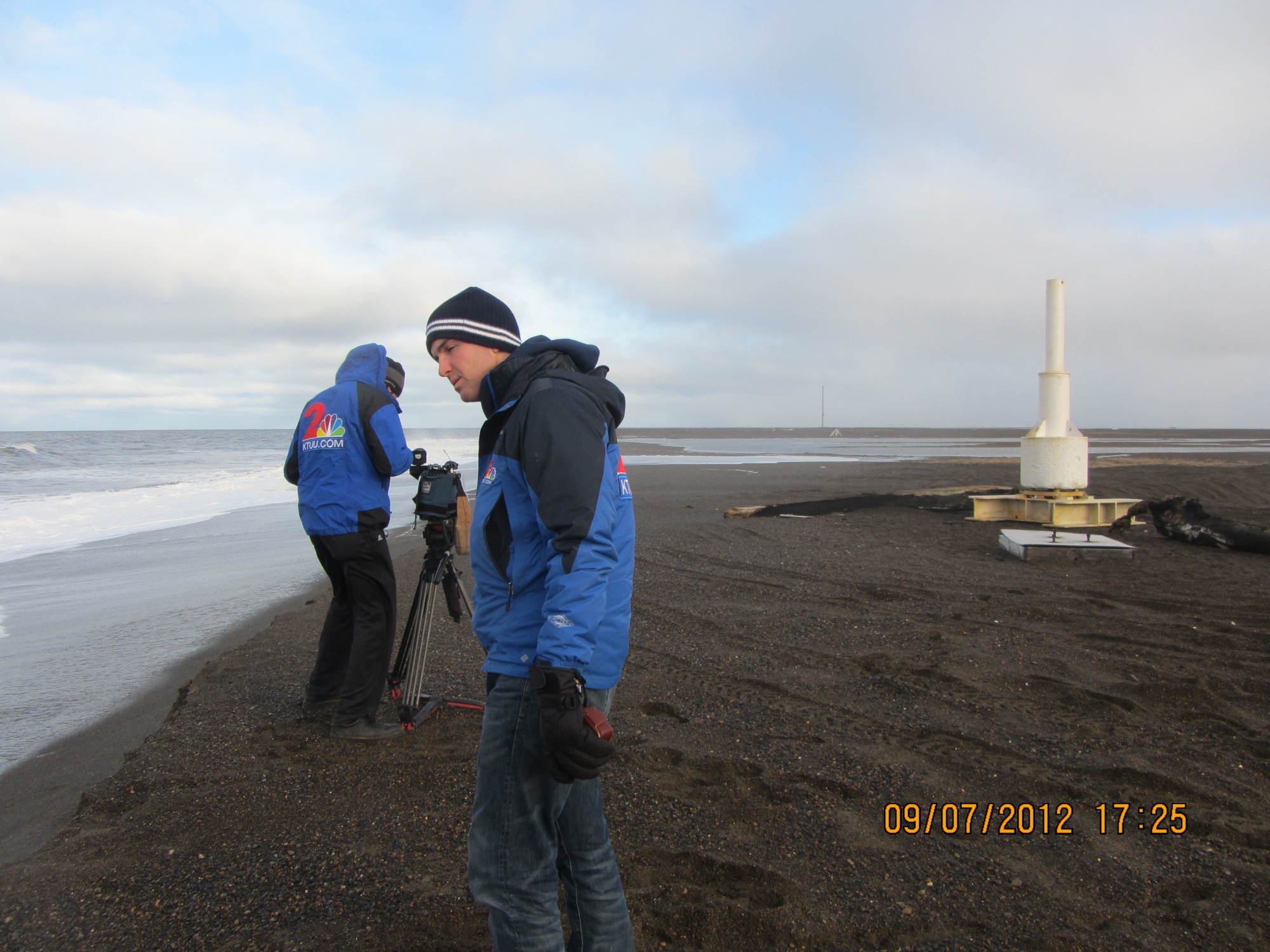
On Friday afternoon we headed to Point Barrow. I’d gotten KTUU set up with Aarigaa Tours, who picked them up in town at Top of the World Hotel, and then picked me up at my house at NARL on the way out to the point. I’d run home from work to change into my warm gear. A good thing, too, as will become clear later.
We’d been having a pretty strong blow from the NNW, and waves had actually been coming up onto the road. The road to the point had actually been closed right by Piġniq (Birnirk), because the waves had been breaking over the road and had done some significant damage. We were in a van equipped for off-road travel, so we were OK, but we had to detour through the cabin area. Once past there, the road was still in pretty good shape, but we could see water seeping in under the gravel berm. Once we got out a bit farther we could see a number of vessels & barges that had come into Elson Lagoon to anchor up and wait out the rough weather.
Barges in Elson Lagoon, seen from the trail by the marked graves.
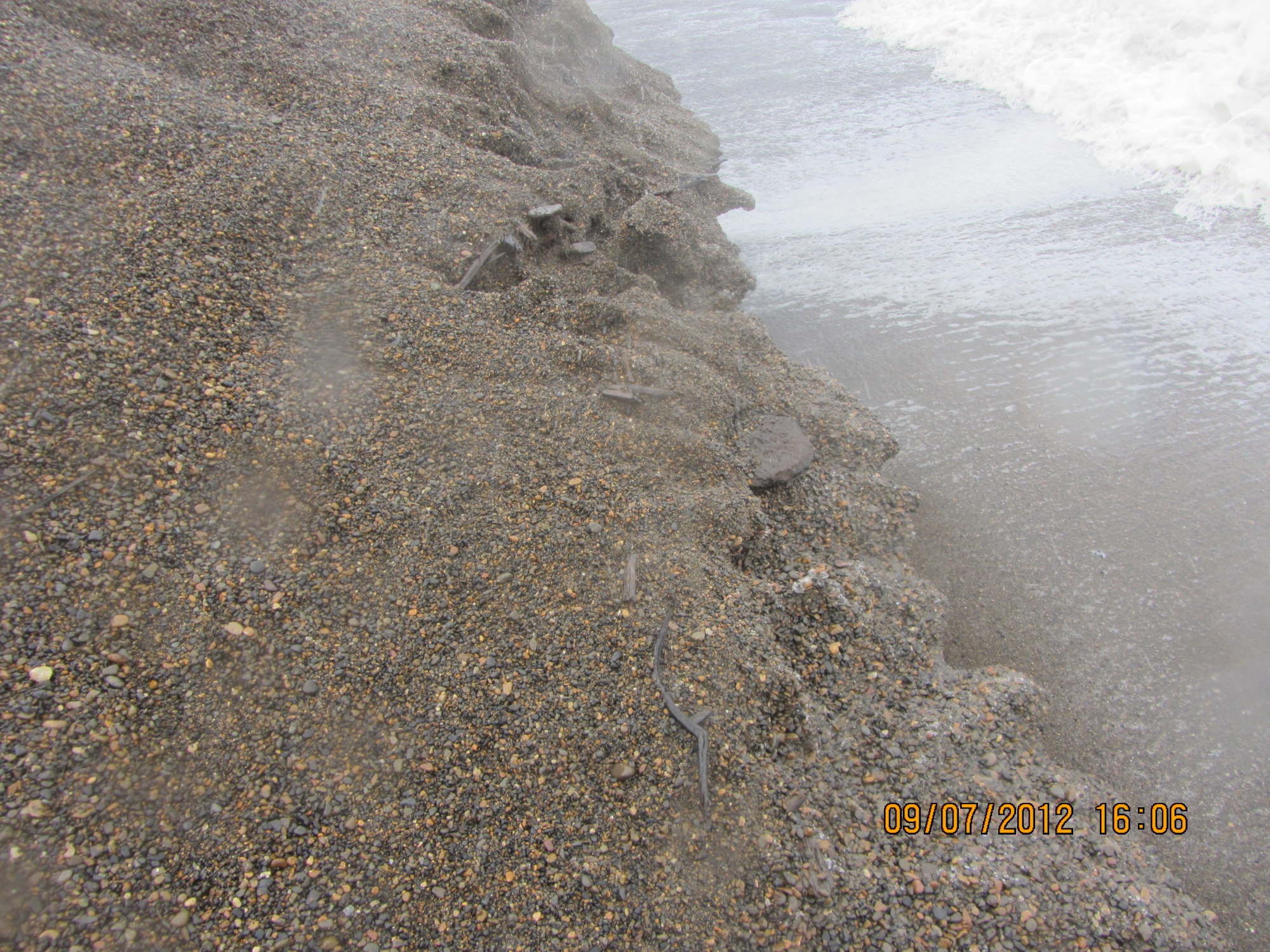
Once we got to Nuvuk and got a look at the site, it was a bit depressing. However, it made a perfect example of coastal erosion in action, and made it really easy to illustrate how information about the past, which could have application to understanding what directions to take to have a sustainable future, is being lost. At least 10 feet (3 m) of the site had been lost to the ocean since couple weeks ago. The gravel slump that had been protecting the face was gone, and thawing permafrost was sticking out and undercut.
Exposed thawing Ipiutak level at Nuvuk.
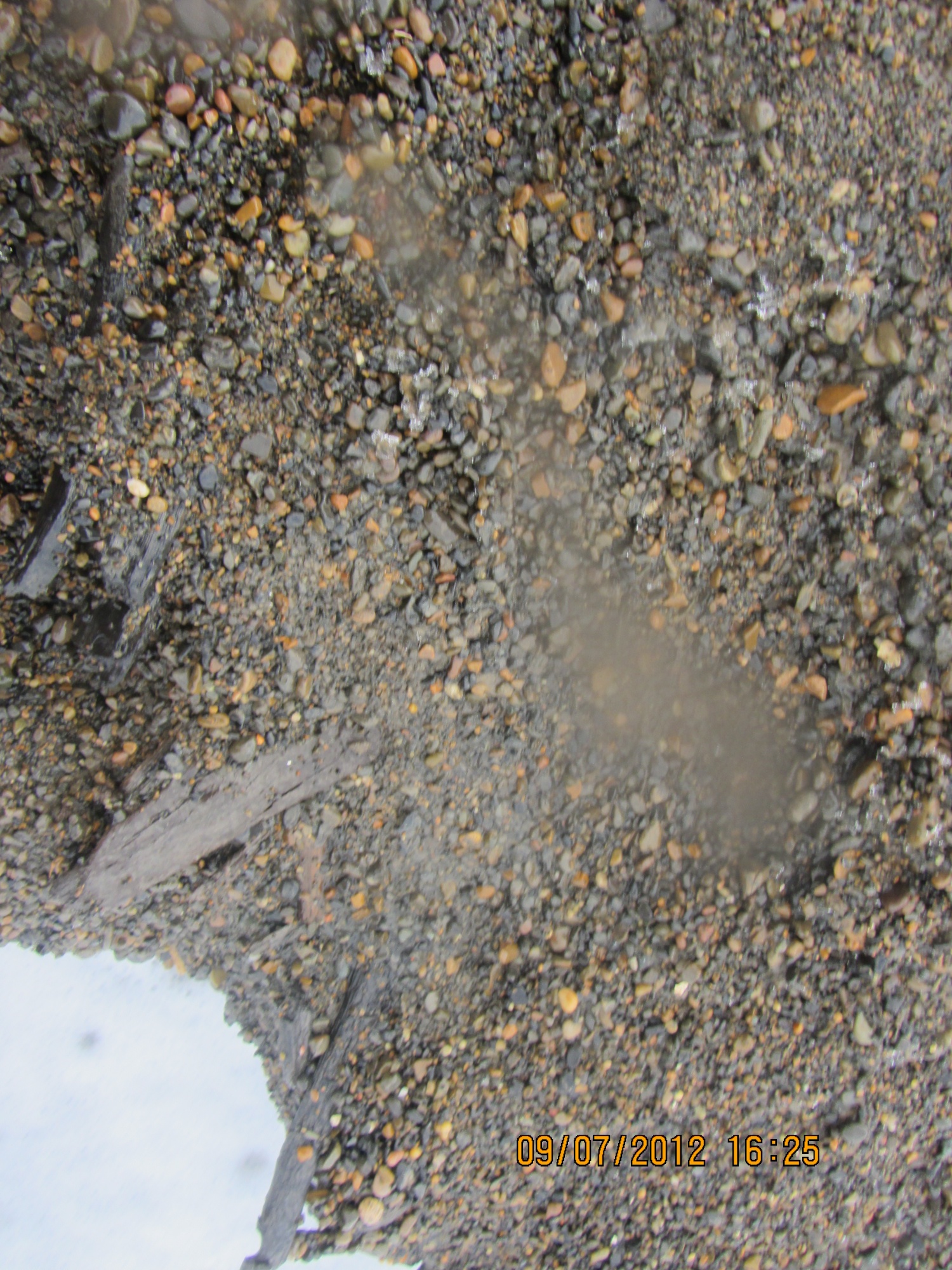
And in that permafrost was the same strandline debris that has proven to be a marker for the Ipiutak occupation. There was a large patch of what looked like fur or peat (which often seems to be found on the floors of Ipiutak structures) and an area where the wood seemed to be far more aligned and level than is normal for a strandline, but would be quite typical for an Ipiutak floor. I tried to get decent pictures, but in the end decided I needed to try to get a sample. I tried walking down on the permafrost, but it was angled, and I couldn’t get close enough without falling off. There were big waves, and the bluff was undercut. If a really big one came at the wrong time, it could wash me off my feet.
Finally, I asked Ricky Bodfish, who was driving the tour van & giving the tour except for the archaeology part, if they had a rope. He did, so he dangled it down the bluff by me, we waited until right after big waves when it looked like a lull and I went down to check it out and try to get close-ups and a sample.
Sampled peat in Ipiutak layer. My finger for scale.
The patch of material turned out to be peat, which I was able to sample, and will send out for dating. My camera got some spray on it, but there was not way or time to clean the lens, so I just kept shooting. Unfortunately a pretty big wave came and dumped gravel on the surfaces just before I got a shot off of the wood, (I managed to turn so I caught it on the side where KTUU’s microphone pack wasn’t) and I could hear the next one was even louder. I ran, and made it into an area above the waves before the big one broke.
Edge of eroding Ipiutak layer showing some of the aligned wood. The white is the foam on the wave that is going under this layer into the bluff.
Fortunately, nothing soaked through the Carhartts so I just took them off for the rest of the trip.
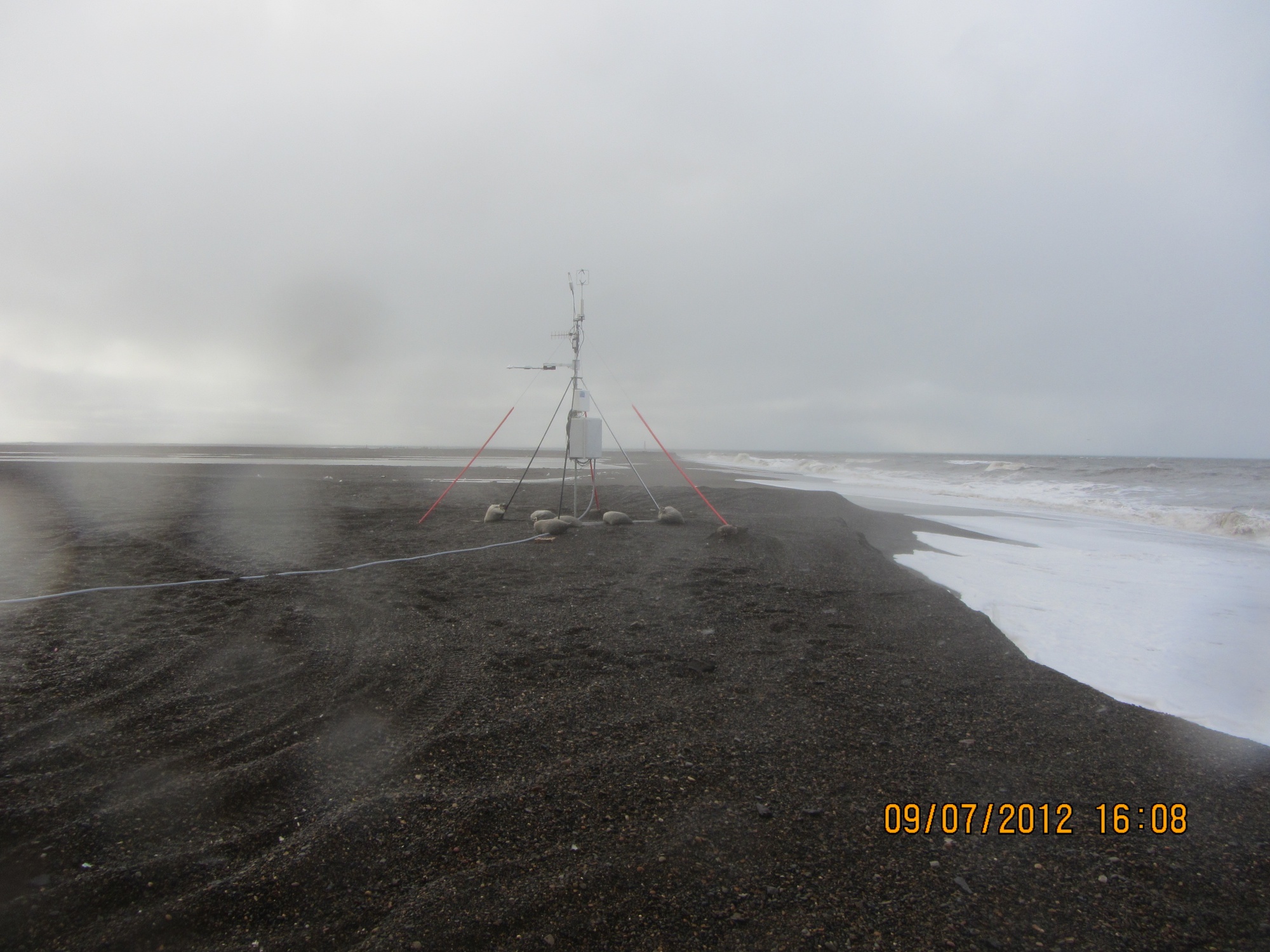
We had been monitoring the tower we’d put out in June, and just a few days earlier had thought it would be fine. However, the storm had taken out a lot of the bluff, and I wound up calling & texting the guys who work on the ARM project for UICS. They wound up going out later that evening and hauling the whole thing about 50 feet (15m) farther back from the edge. Just in time, since by the time they got out there, they figured it was 2-3 feet (< 1m) from the edge.
Getting close to the edge.
After that, the KTUU fellow wanted to see the farthest North point and go to the bone pile to see if there were any bears. We set off, and almost immediately had to detour. The trail we normally use to get to the site, which is always dry, had water all over it from the storm surge.
Trail covered by storm surge.
We made it to the farthest North point, which was a bit less far North than previously. The storm surge had made it to the tip of one of the whale jawbones, and about 10 feet was missing here too. However, we did get some nice light, and the KTUU guys got busy.
Crew and van near Farthest North PointDan Carpenter gets ready to shoot at the Farthest North Point.
KTUU crew at Farthest North Point.
Unfortunately, the trip to the bone pile did not come off. The storm surge had caused it to nearly become an island. Ricky was not sure how solid the ground was, and we did not want to get stuck there, so we gave it a miss. On the way back to the road, it was really clear how much of the Chukchi side of the Point Barrow spit had been eaten. The ocean was almost up to the berm along the road, and there used to be a fairly wide strip of gravel there.
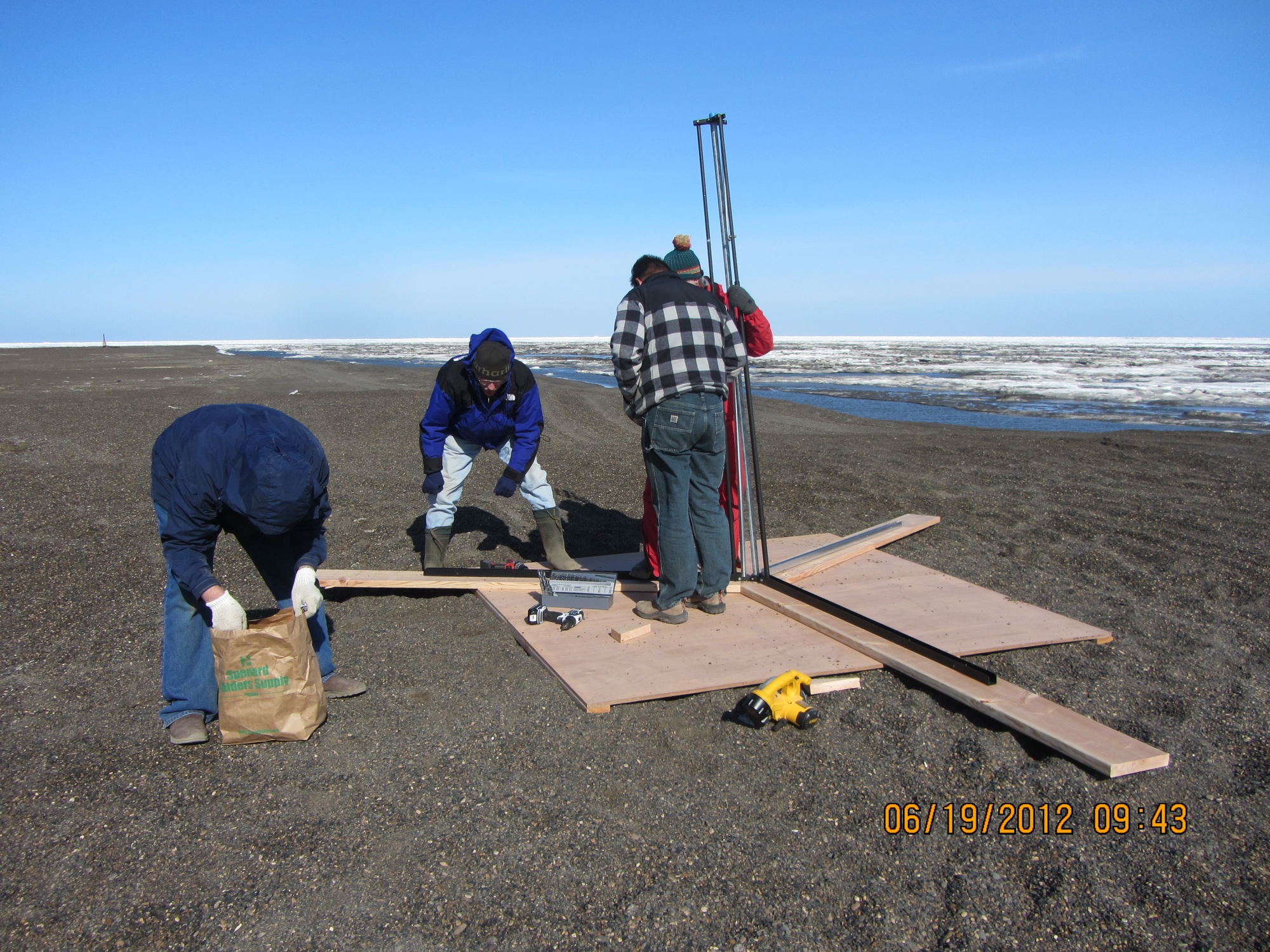
I got out to Nuvuk today for the first time today. The ARM project that we support want to put a flux tower at the Point to measure flux off the ocean during the open water season. The thing is that the ideal spot for the tower is on the ridge where the Nuvuk site is.
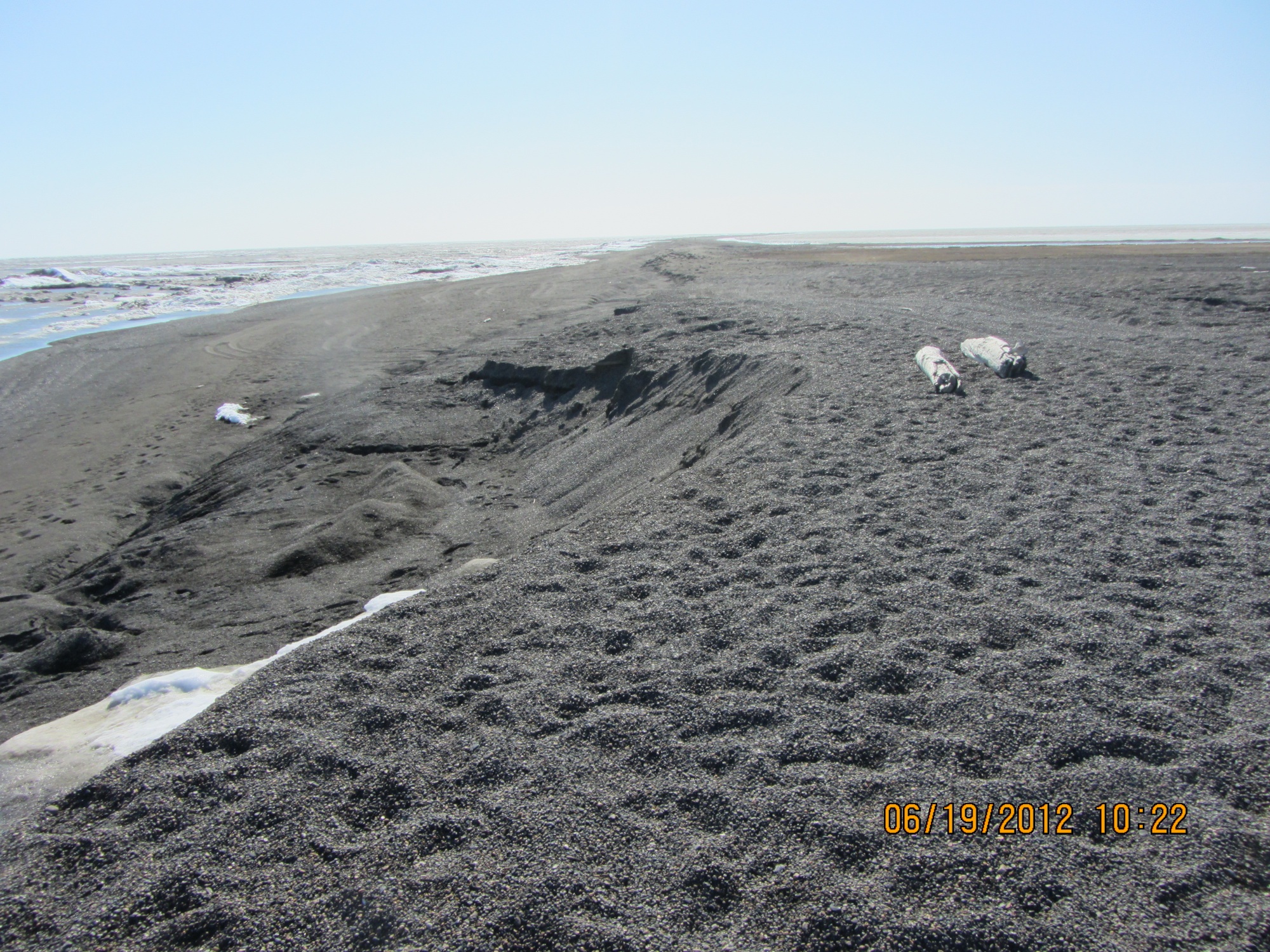
In the past, other folks wanted to put flux towers there, but there simply wasn’t room for a tower in an area where we had already tested and recovered all the burials, and we didn’t want to chance disturbance to a burial. Now we’ve gotten a good way ahead of the erosion, so it seemed that it might be possible. However, I didn’t want the tower to be on top of the possible Ipiutaq structures, just in case funding for their excavation is available. Since the tower installation involved moving a little gravel, it was important for me to be there just in case something showed up.
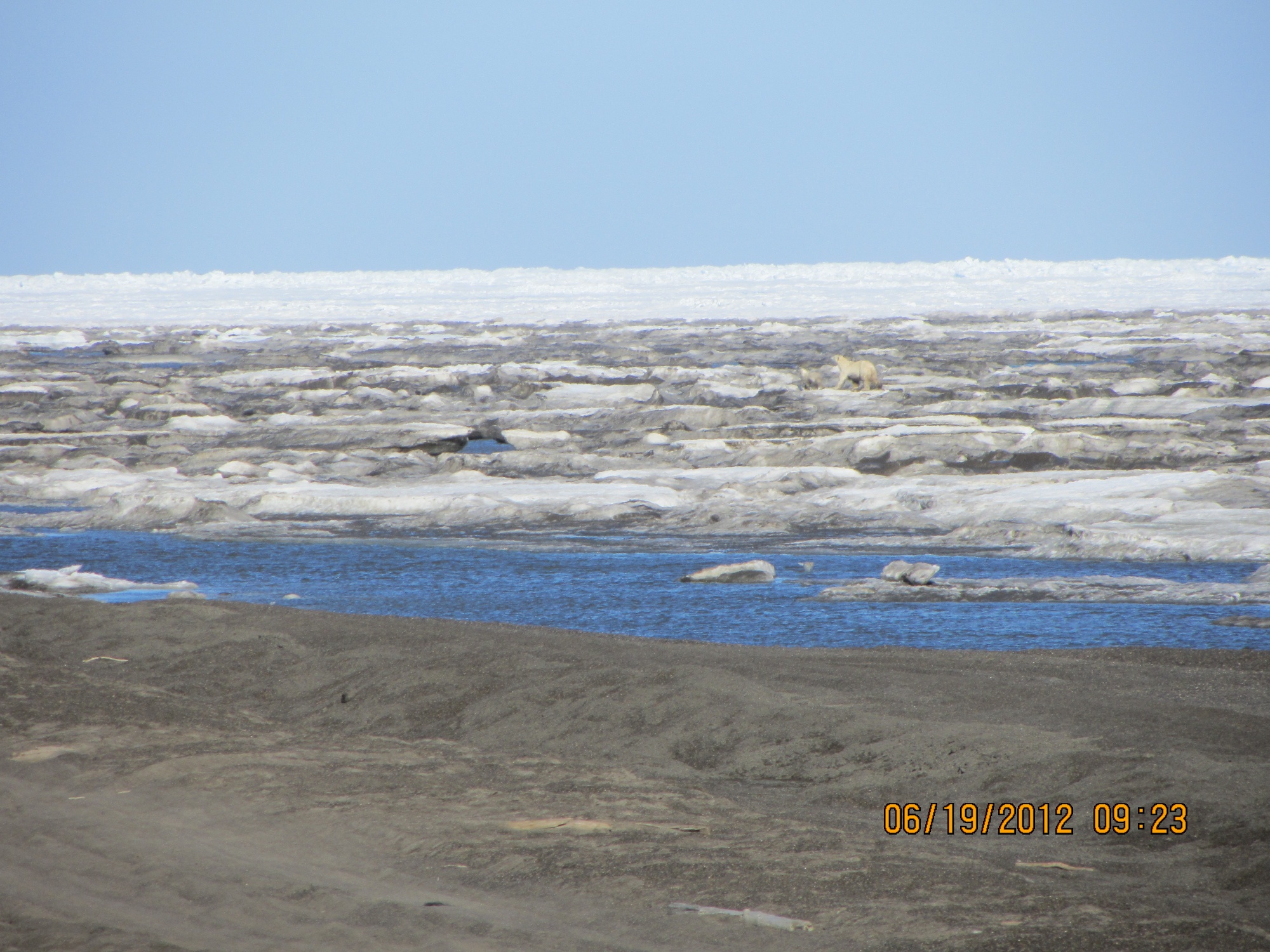
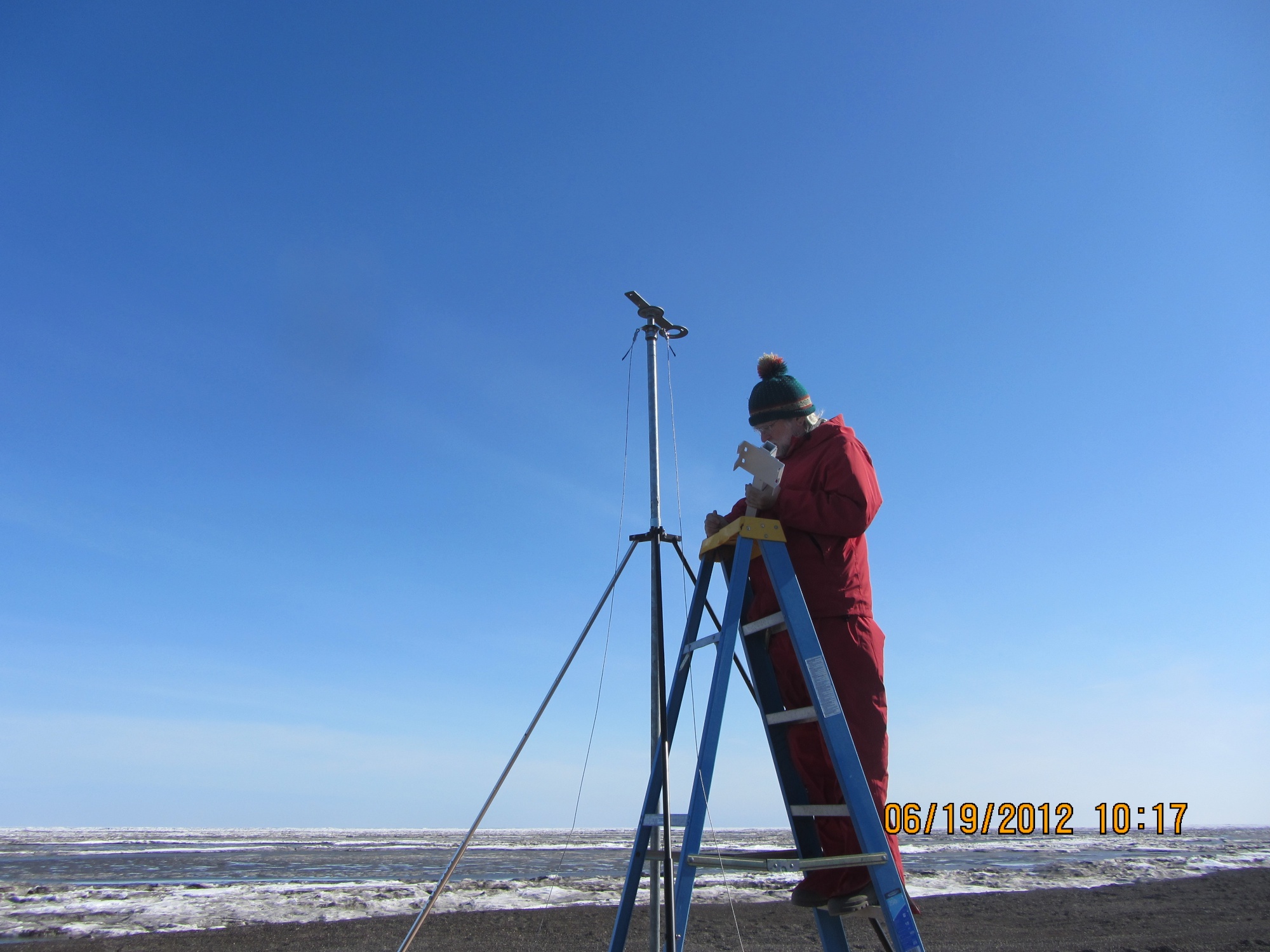
It took a while to get out there, since the ARM Kubota is on tracks and can only go about 15 miles an hour. We quickly got a spot picked for the tower. After that, I spent most of my time looking around for bears while the others started putting the tower together. I spotted 2, a mom and a cub, who were heading to the bone pile.
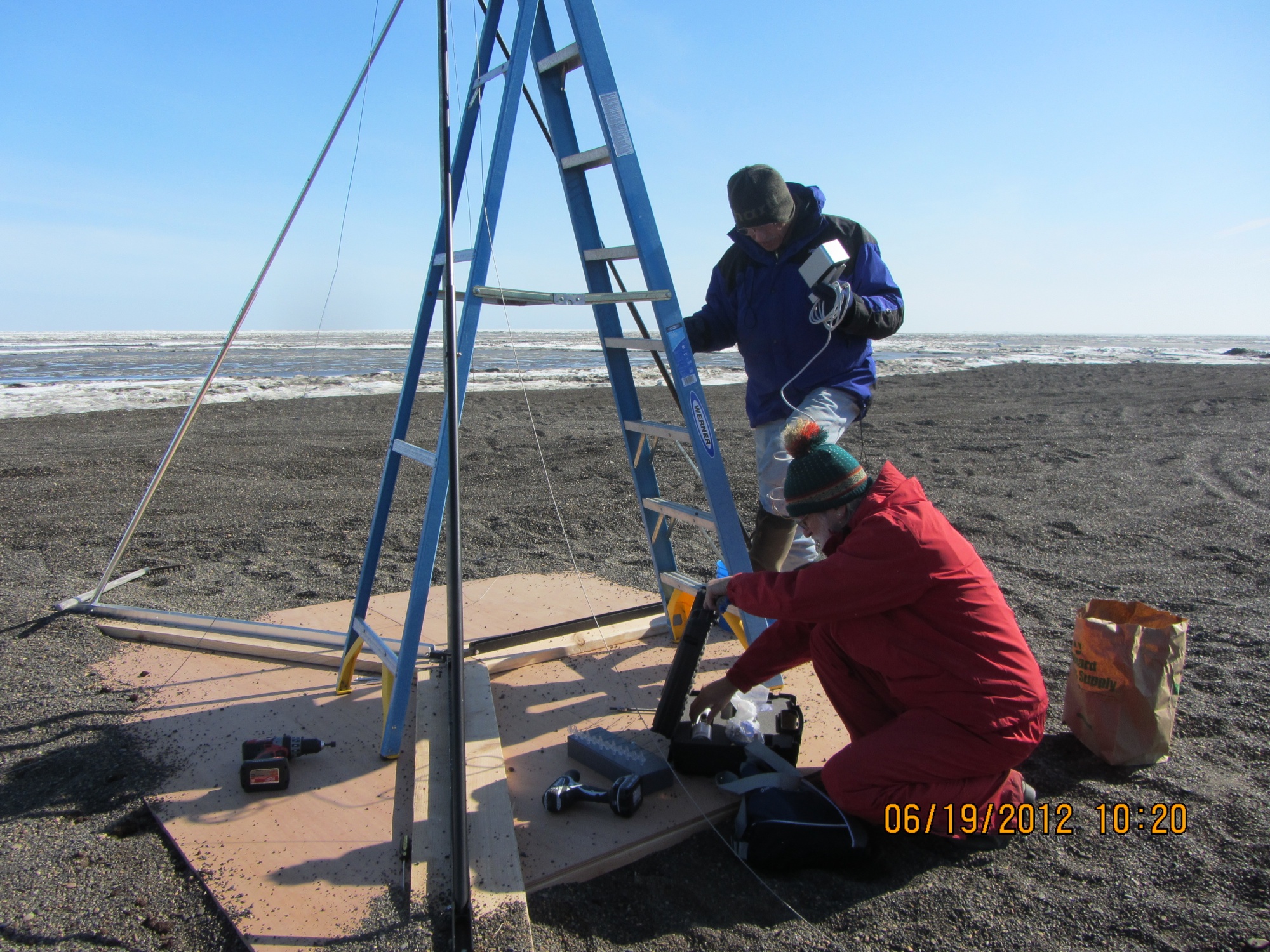
Polar bears heading for a meal.Assembling the base for the tower.Putting the tower together.Putting the instruments on the tower.
We decided to use sandbags for the guy-wires and then added some more on top the tracks on the base plate. To minimize disturbance to the site, we decided fill the “sand”bags with beach gravel, and bring them up with a four-wheeler.
“Sand”bags on the Honda.
After the tower was assembled and the instruments were on, the instruments needed to be wired up. That took a while, but I had to sick around since one of them needed to look down are gravel, so we needed to cover the plywood base plate, which meant more digging.
That gave me time to check out the area where we salvaged the Ipiutak structure last fall. Good thing we did that last fall, because that area is gone. There is a big notch in the bluff there, and that’s it. It would have been a pity to lose that, because we found some very interesting things in the field and in the lab.
Where the Ipiutak structure was…
While I was getting to play, the crew was working away in the lab. They have finished floating and sorting the materials from the fall salvage, and are moving on. Over the winter, we’ve had several sets of visitors on short notice, which required some materials to be cleaned off benches fairly quickly. As a result, there were a lot of miscellaneous boxes around the lab. The crew has reorganized several cabinets and gotten most of the boxes emptied. There is plenty of bench space, so we are moving on to cataloging and marking.
Part of the hard-working lab crew (l. to r. Victoria, Trina & Trace) working on faunal remains.





















 Out of Ice and Time