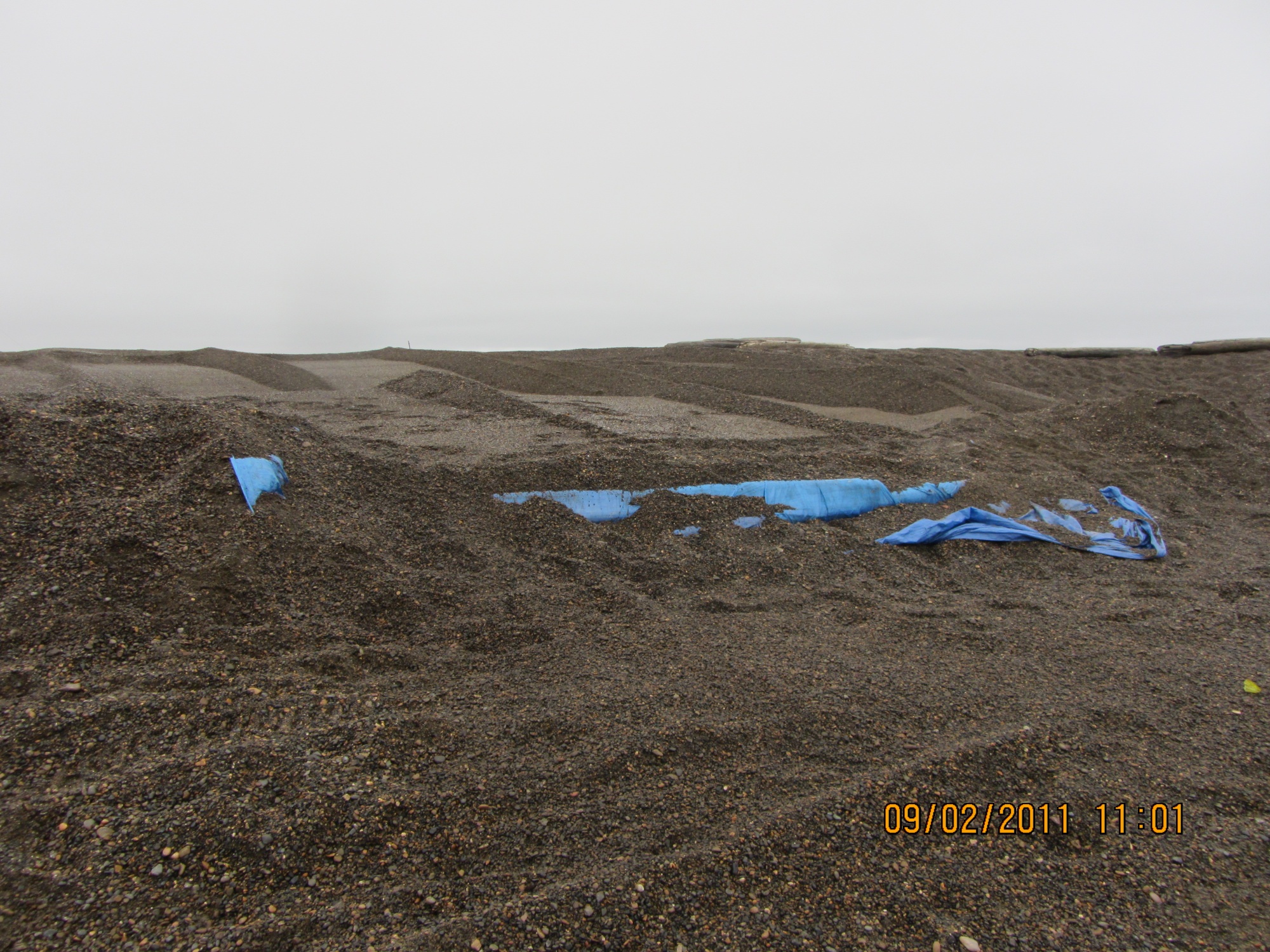
Friday we got the gravel moved. If you remember, the site looked like this:
Gravel pile on the Ipiutak structure
Not exactly conducive to a quick recovery excavation, especially since it’s mostly going to be volunteer labor, the students being back at school and all. It had been looking pretty grim on the heavy equipment front, but Ilisaġvik College came through with a reasonable rental on their new Case loader, and Walter Brower & I headed out around 9AM.
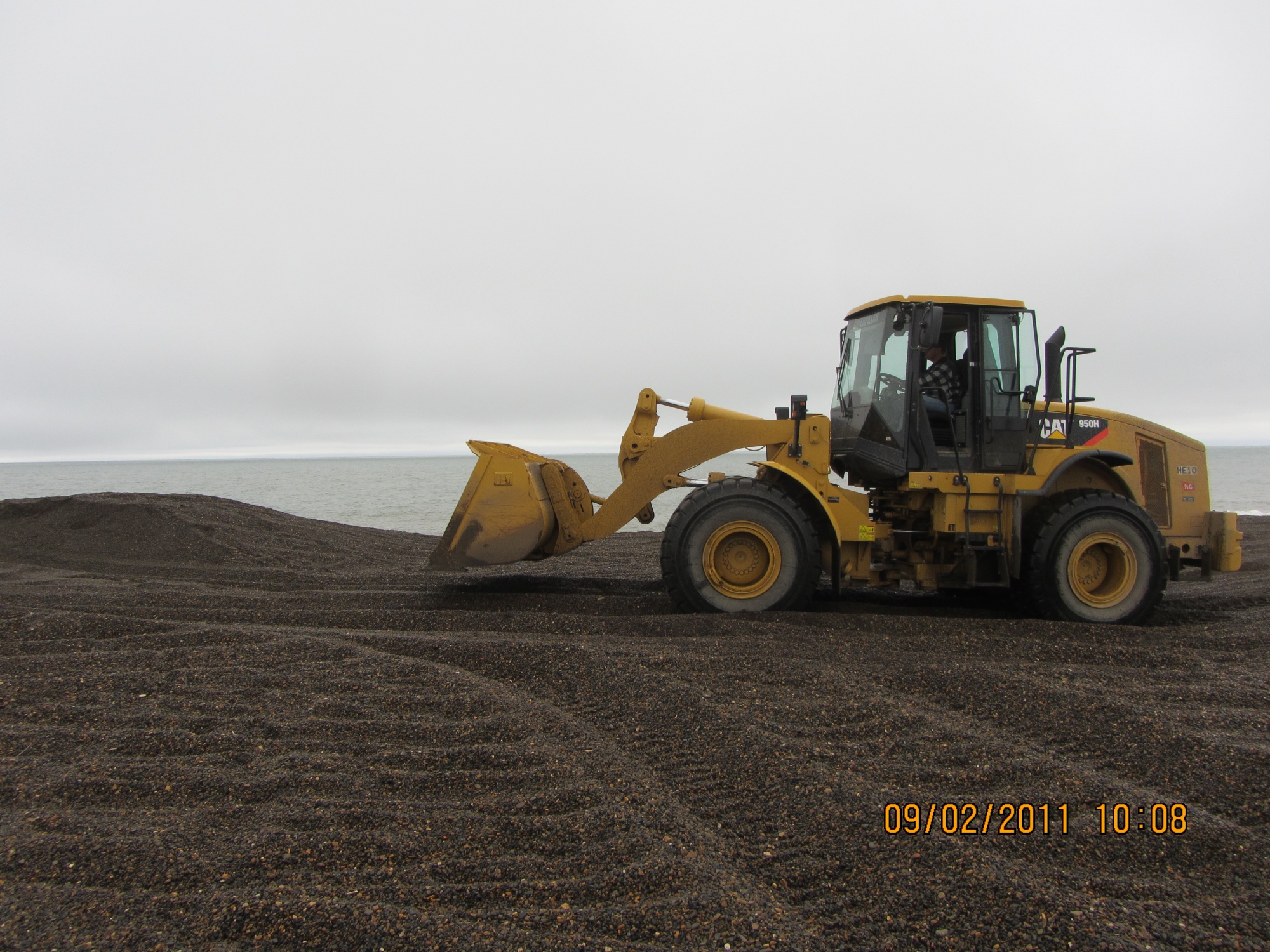
Getting there took a while, but shortly after 10 we were at work. The loader has extra wide tires, and reputedly is not very good in snow, but it did fine in the gravel.
Starting work
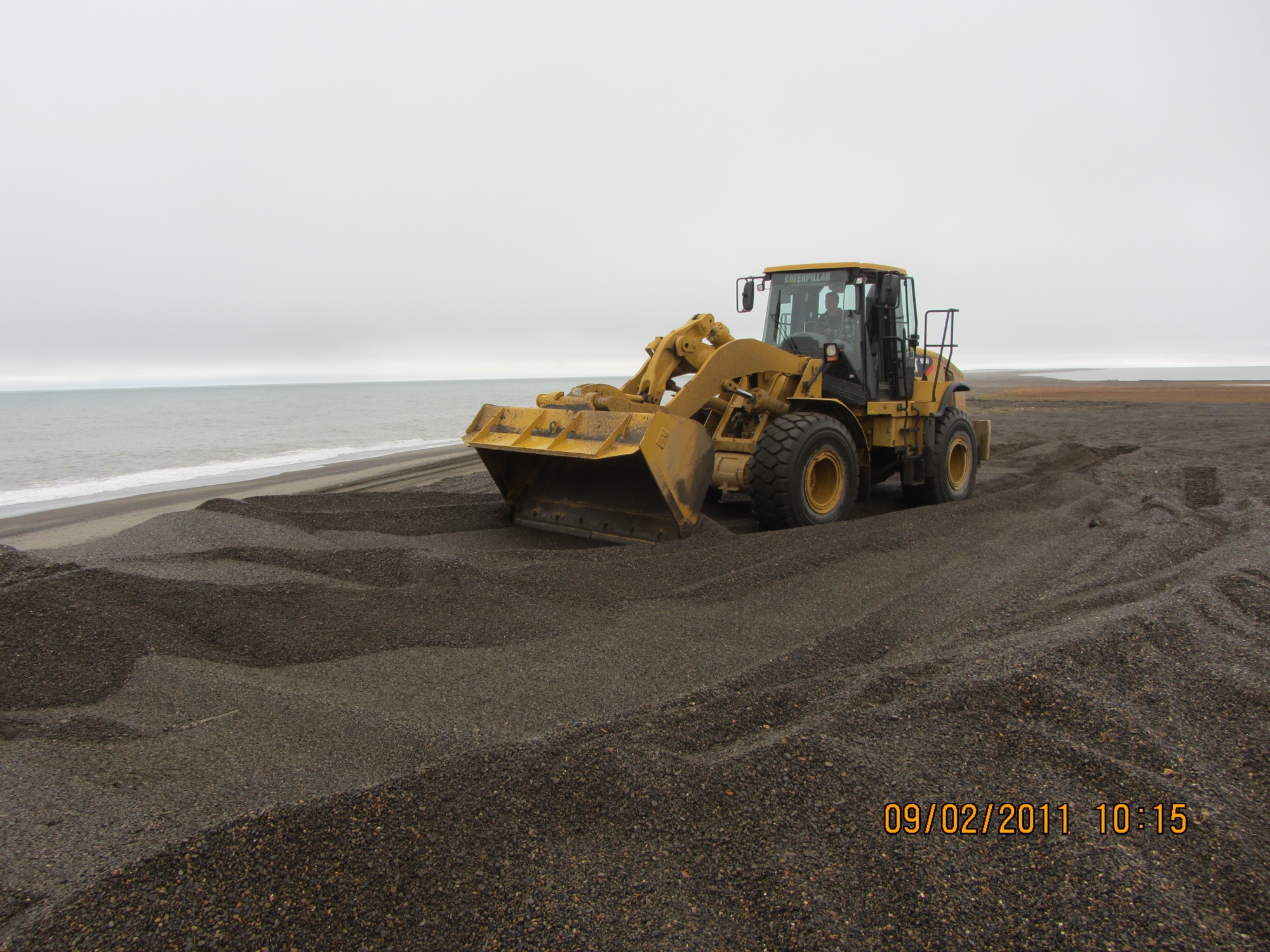
Backdragging.
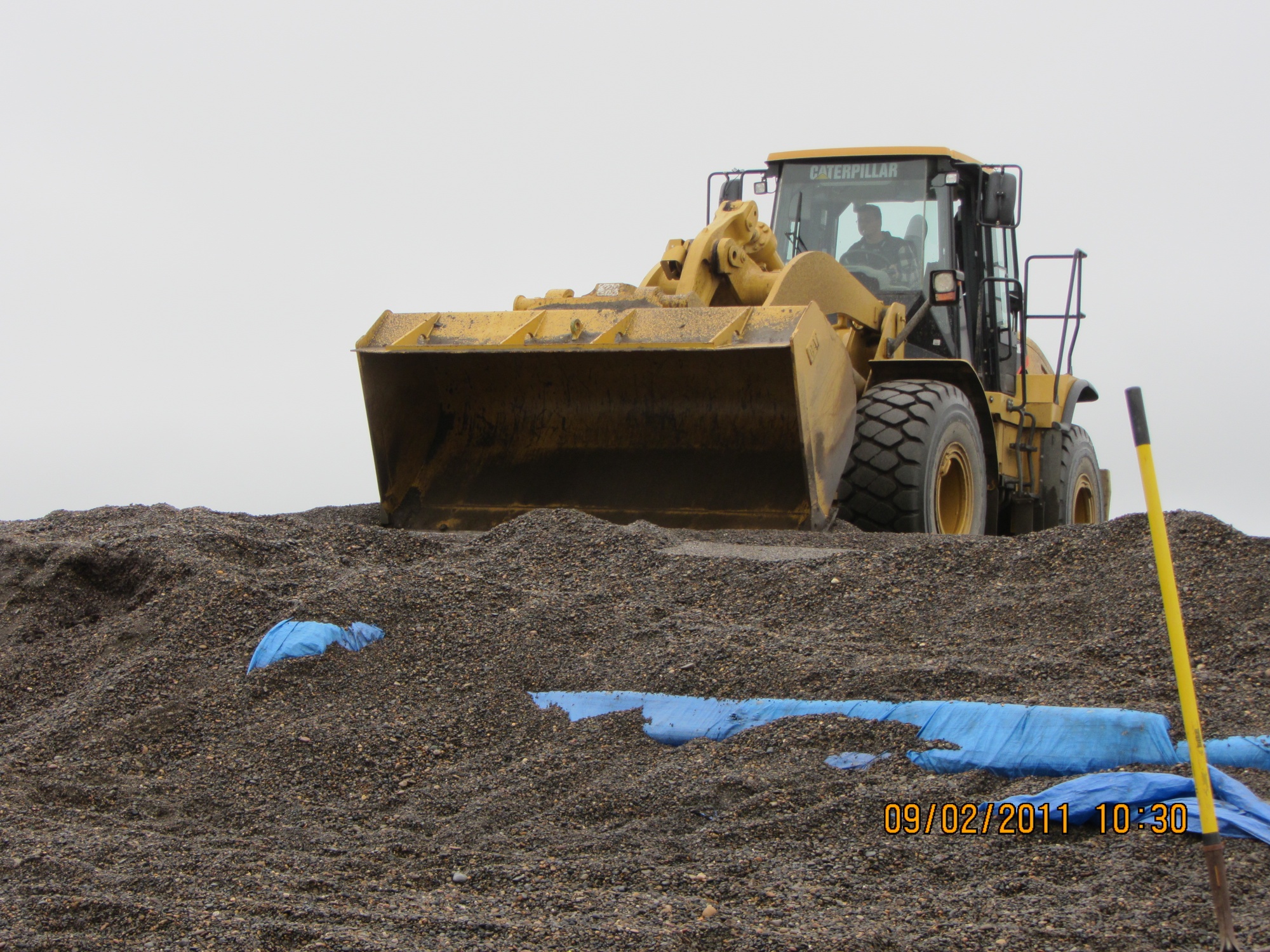
Backdragging proved effective and minimized the need to drive on top of the feature. We were able to take it down to less than 1 foot above the surface, so it will be a lot less work this week & next weekend.
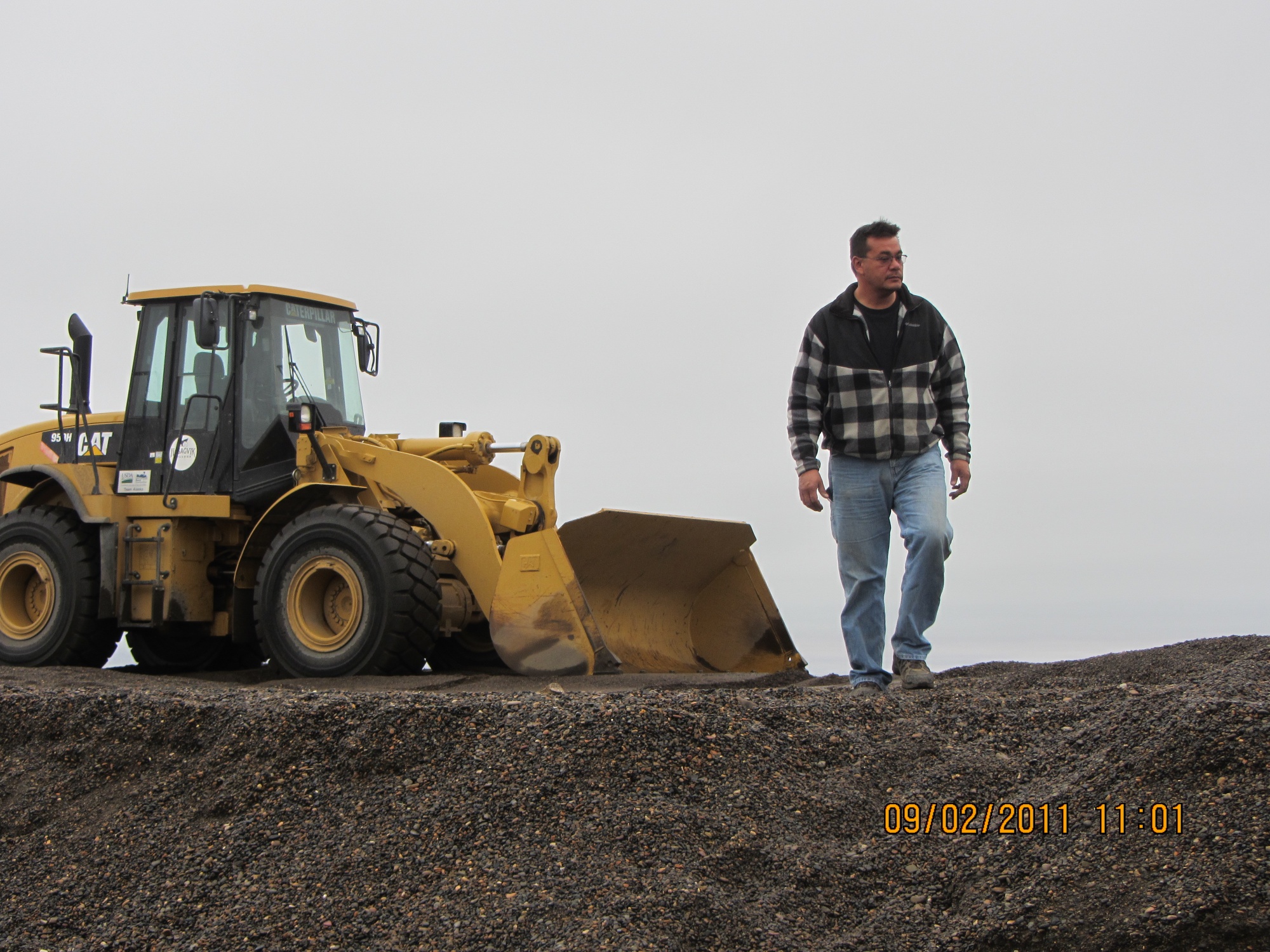
Finishing touches.Walter checking the results.Final result--a great improvement.
All in all, a great improvement.
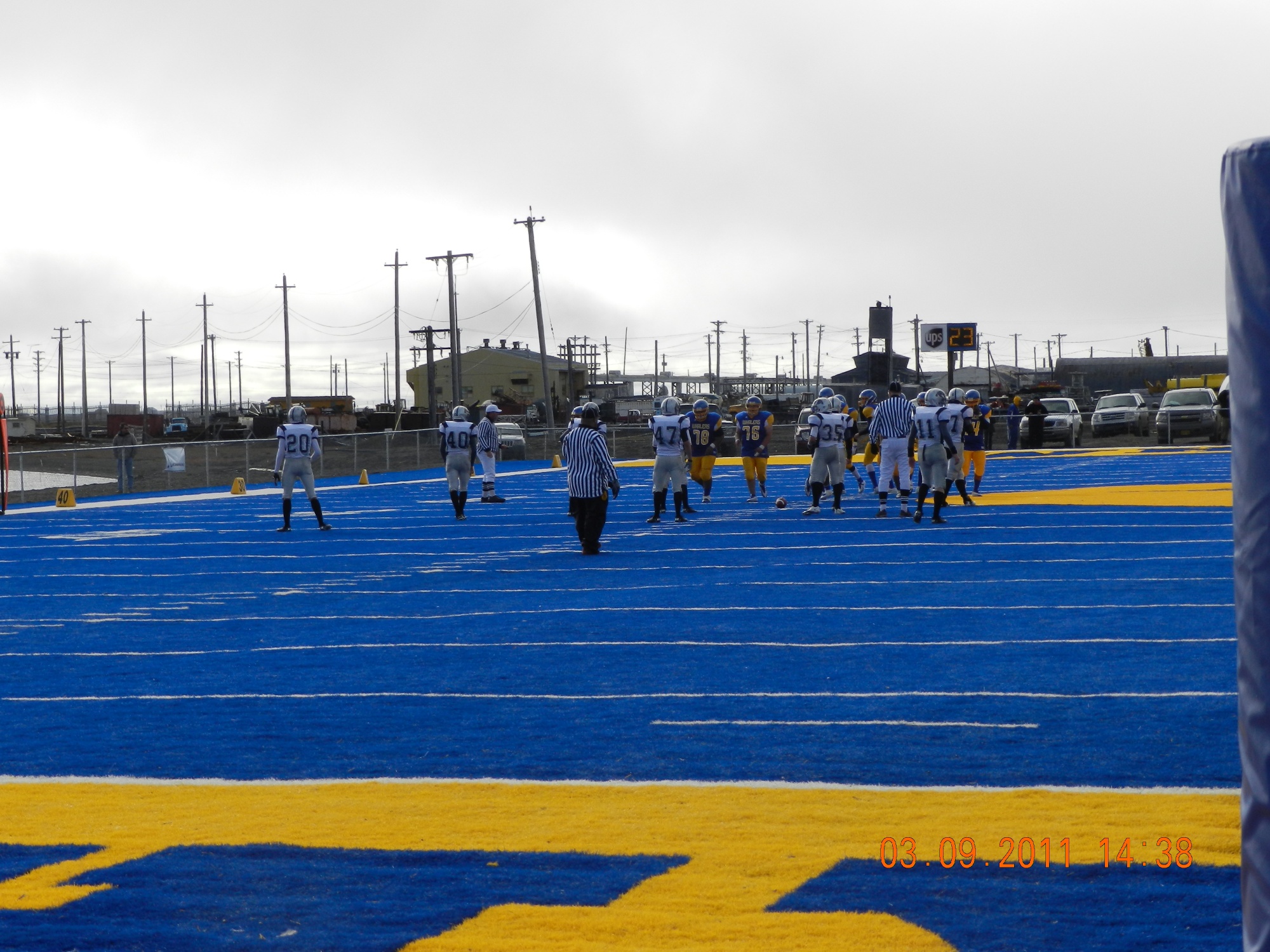
The next day Barrow played Nikiski in football. Both schools are in the Greatland Conference, and Nikiski is a perennial football powerhouse. Barrow had never beaten them.
Cathy Parker FieldFootball beside the Arctic Ocean. Whalers #24 (in motion to the left of the frame) is Trace Hudson, who works on the Nuvuk Project when he's not playing football.
Barrow fixed that.
Final score. No, I have no idea why there is 3:24 on the clock; the game was over.
It looks like Ilisagvik College is going to be able to help us out. So tomorrow we should be able to get the giant mound of gravel off the house. And then the fun begins.
The weather is supposed to be in the low 40s with not too much wind, so that should be good. Not so good for getting rid of the fog and not having flights canceled into Barrow, but for what we’re trying to it, it’ll be fine.
We had a really great finish to the official field season. We excavated a last burial which turned out to be that of a very muscular person, who seems to have been buried in or on bird skin (maybe a bird parka). A possible burial (a human bone showed up in a test pit) turned out to be an isolated find, so we don’t have an unexcavated burial undone. There was a complete egg in the dark organic soil by the bone, which looks like something a fox might do to hide a stolen egg, so maybe the fox brought the bone there from somewhere else. The DWF continued to have a number of interesting artifacts (nice lithics, ground slate, composite labret). I’ll try to get pictures up in the next few days.
We were able to backfill all the big holes, record all surface finds, cover the DWF in hopes of being able to come back later this year, and still get the students home at a reasonable hour.
Some of us are going out again in the morning with an NSF-funded Mexican/North Slope student exchange group of about 25 or so. We’ve worked with them before, but not after the season ends, so it’s a bit challenging to find something to teach them that doesn’t risk disturbing something we haven’t got the time or crew to deal with.
I only got 4 hours of sleep last night, so off to bed.
We started investigating the last GPR hit and came down on a jumble of wood. The excavators were not optimistic, but I kept pushing to go a little further. Eventually, this appeared:
Feature detected with GPR
The feature (I’m not calling it a burial until there is evidence of human remains) was jumbled because at some time after it was constructed, someone dug a hole in the middle of it. And right beside where the hole had punched into the feature was this:
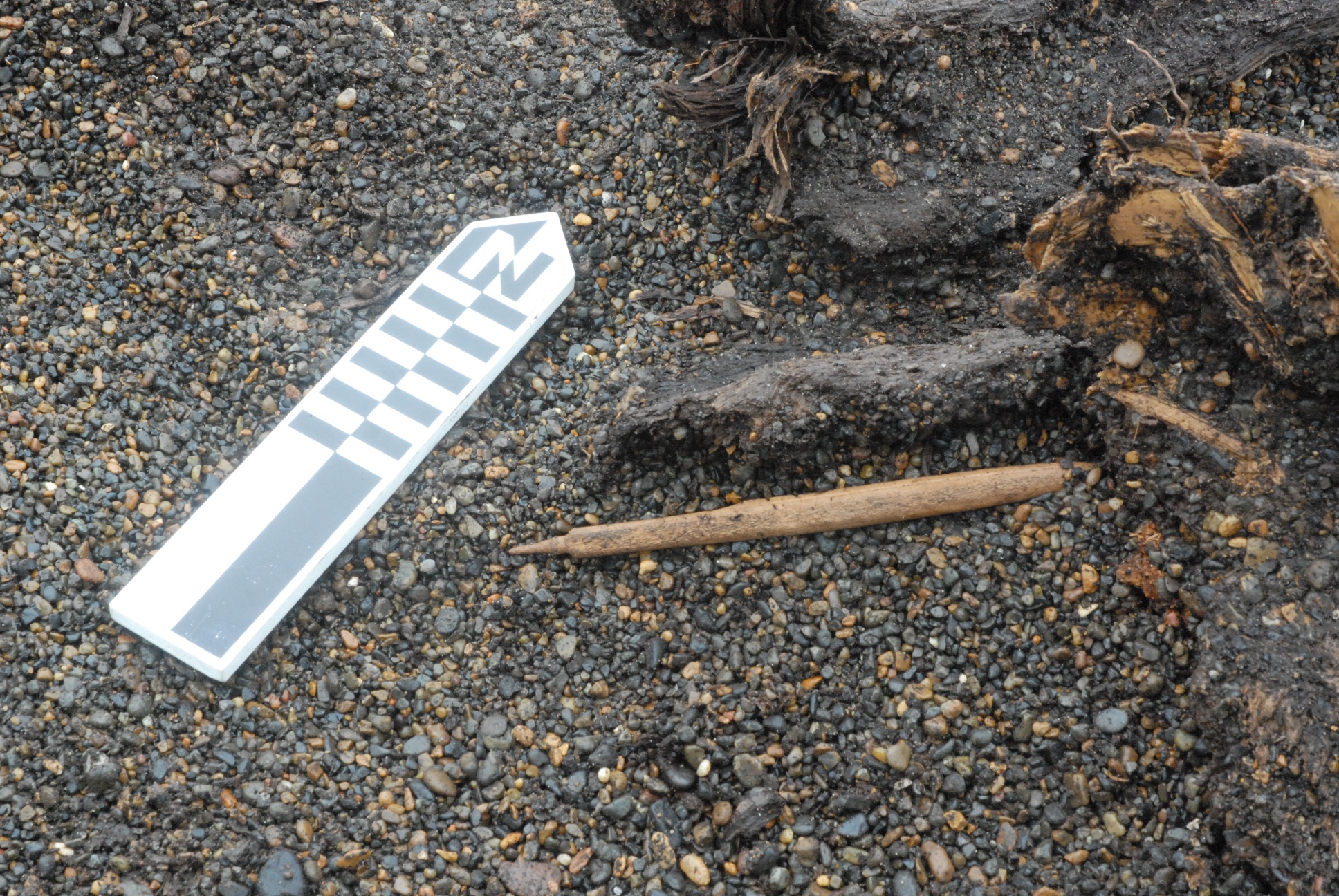
Antler arrowpoint
The hole just missed it.
The DWF (Ipiutak) levels had their own surprises. We found a good bit of fish bone, some lithics (nothing diagnostic) and a lot of broken bone, but the really cool thing, which I found on the edge of the hearth, was a flattened but apparently complete egg!
It was fairly windy today, which made it a bit colder. The GPR sleds are working much better, and even what they got yesterday looks promising without elevation correction. They used a backpack Trimble GPS unit to get accurate elevations, and will use that to correct the GPR images.
The burial is becoming more complicated. There are indeed 2 primary individuals, the most recent (a woman, we think) one whose grave cross-cut another smaller person’s grave. The woman had a couple of leg bones from a smaller person in her “box”, which may or may not come from the smaller person whose grave was cross-cut. There were also a few cranial fragments from a small child in the box, and a few elements from a sub-adult (but not the small child) turned up today. There is also a pelvis from a large man, which makes at least 5 individuals. If the leg bones don’t come from the second grave, it could be six.
We have expanded a bit and aren’t seeing much sign of any grave structures, so we are beginning to wonder if some of these individuals aren’t buried some meters away, with a few parts having been moved by vehicular traffic. This may wind up being a case for the GPR.
The past week has been crazy. All of the crew except the GPR people and Dennis O’Rourke are here. We’ve gotten all of the training out of the way except for ATV driving. We spent a while on Thursday afternoon as scheduled, but the logistics provider still didn’t have all the ATVs (or even know what they would be) so we weren’t able to make sure everyone knew how to ride what they’d be driving. Since they may be renting a bunch of manual shift models (and a number of people have never driven anything with a manual shift), it seemed safest to let people learn that before taking them off-road, so the start for the field will be delayed :-(.
We have all the gear piled in the Theater, where we’ll be staging, except for the electronics. They are still in the lab, where they are being charged. Laura and a rotating crew person will get them and bring them to the Theater each morning, and return them for recharging at the end of the day. We also have a generator, but we’d really rather not run it.
On Friday, I had to do a survey of a very small area where a surface current radar is being installed on Point Barrow. We went out a while ago and picked some spots, and after calculations back at the lab, Hank Statscewich picked a spot. I was supposed to meet up with the logistics providers out there, to show them where the tent was to go, but alas, something came up. I ran into one of them at the gas station while getting gas for the 4-wheeler (turned out to be more complex than expected because I filled my 5 gallon can only to find out it leaked and had to run next door to the NAPA to buy 2 new 2.5 cans to transfer the gas into), and we arranged to go the next morning. I did the survey and went home. The weather alternated between spooky fog and quite nice.
Foggy day on Point Barrow
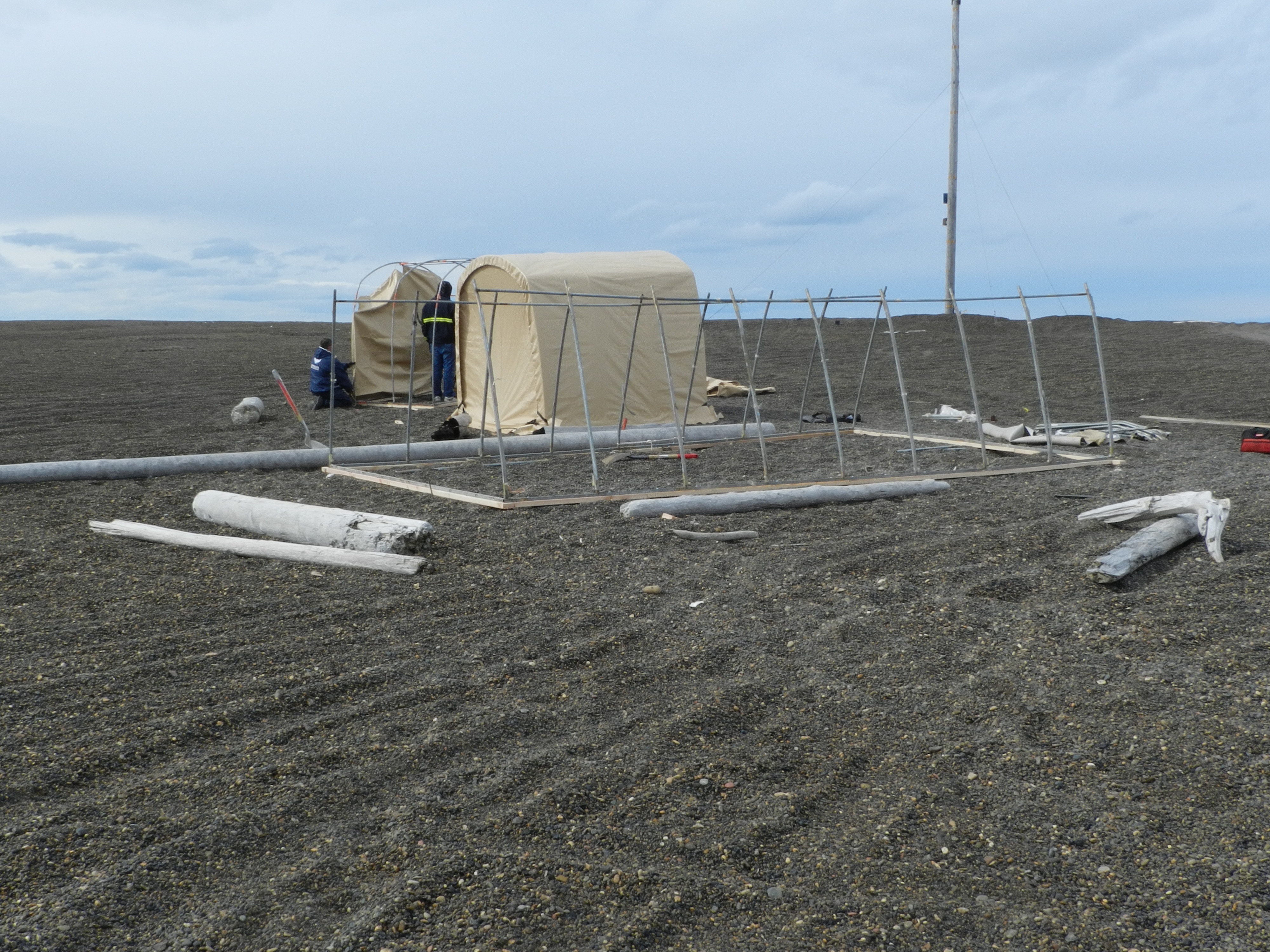
The next day I met up with the logistics providers and headed back to the Point for what was supposed to be a 2-hour activity. I was just going to show them where the tents should go and head back in, but it became clear that might not be the best plan. I made it home 7 hours later. The tents are all up and in place. There are a few issues, mostly relating to them not having actually set up the whole tent prior to shipping, but they were going out today to fix most of them, so we hope to find things in working order tomorrow… At least the weather was nice except when it rained a little bit.
Weatherports going up
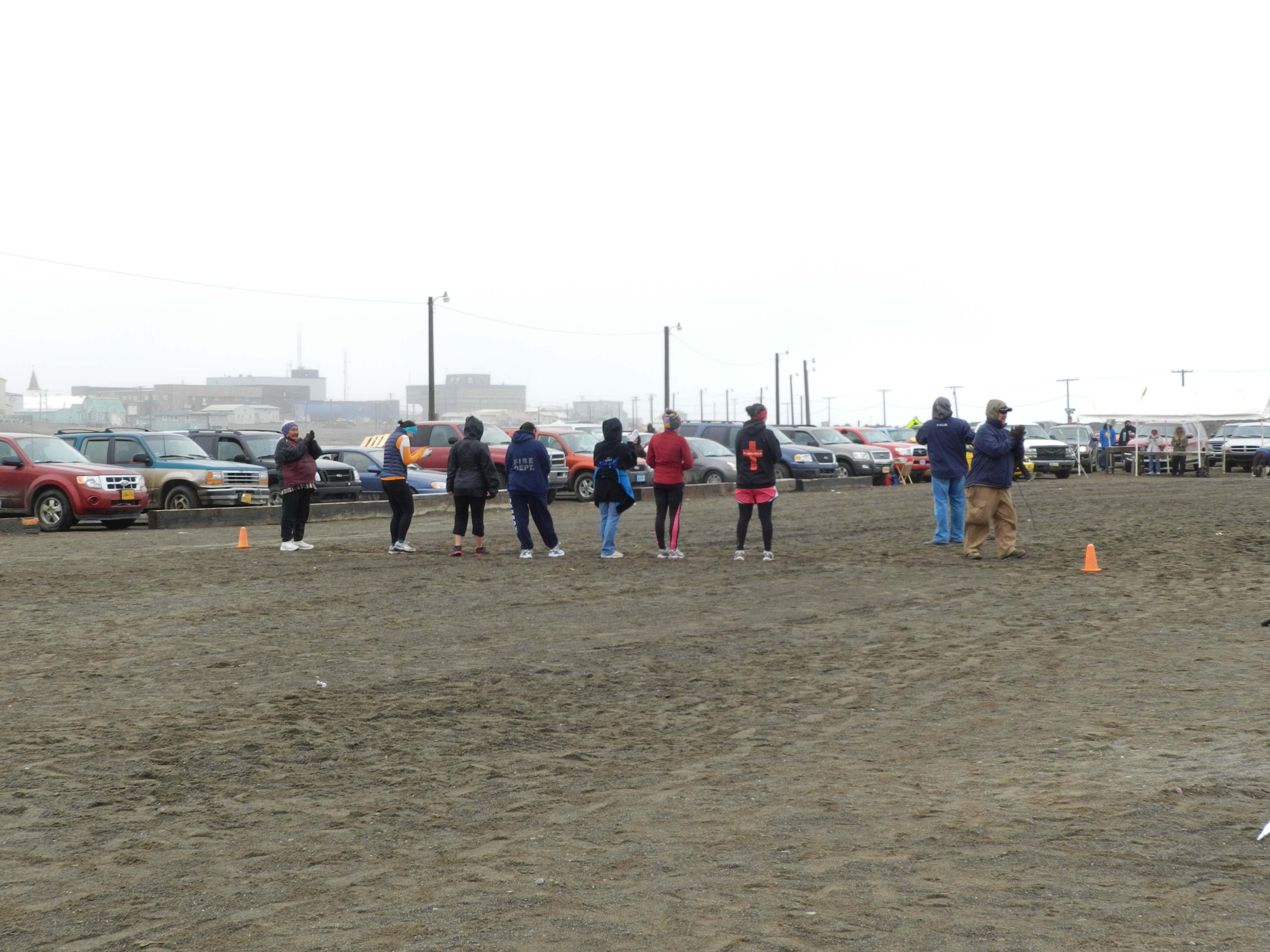
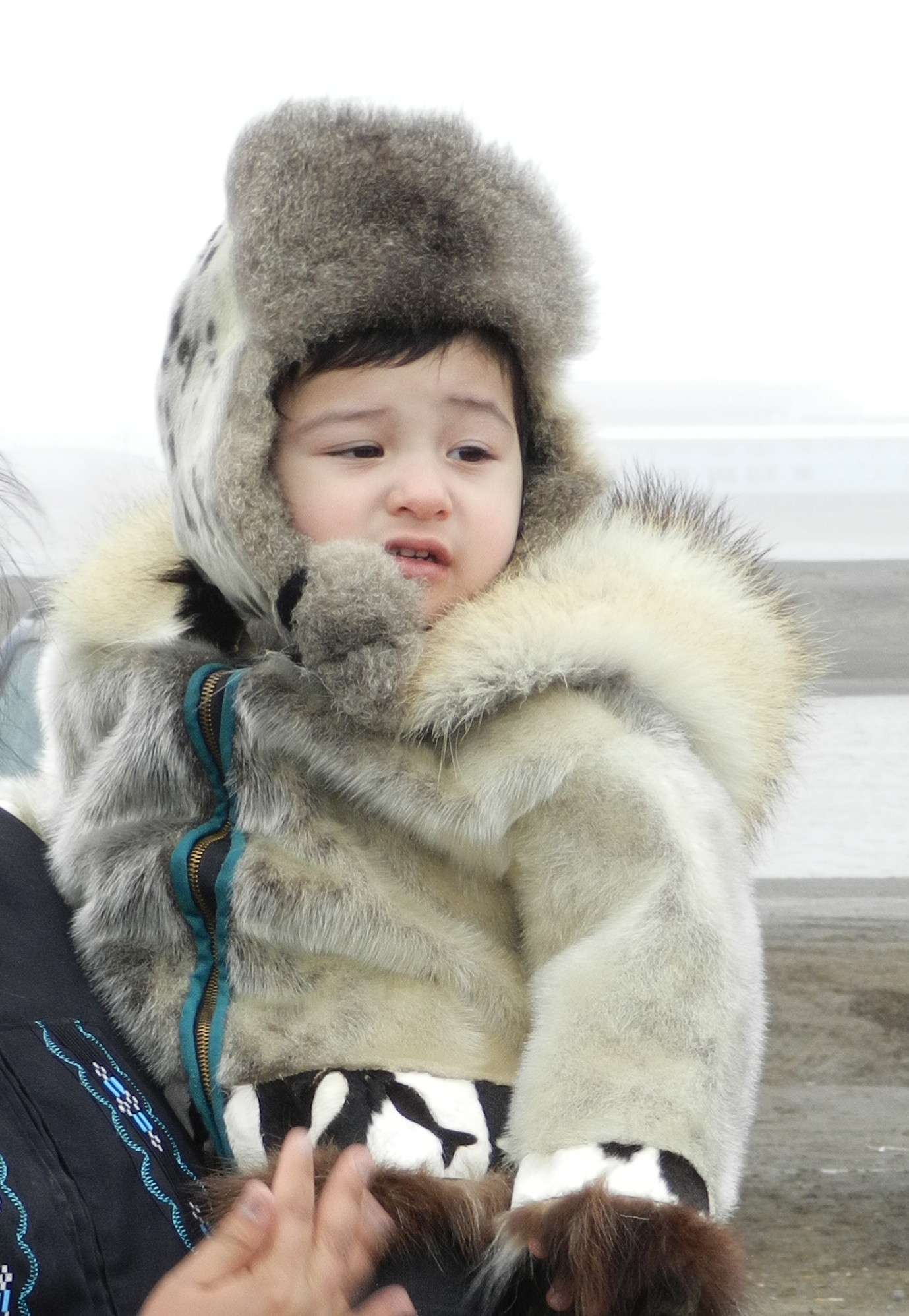
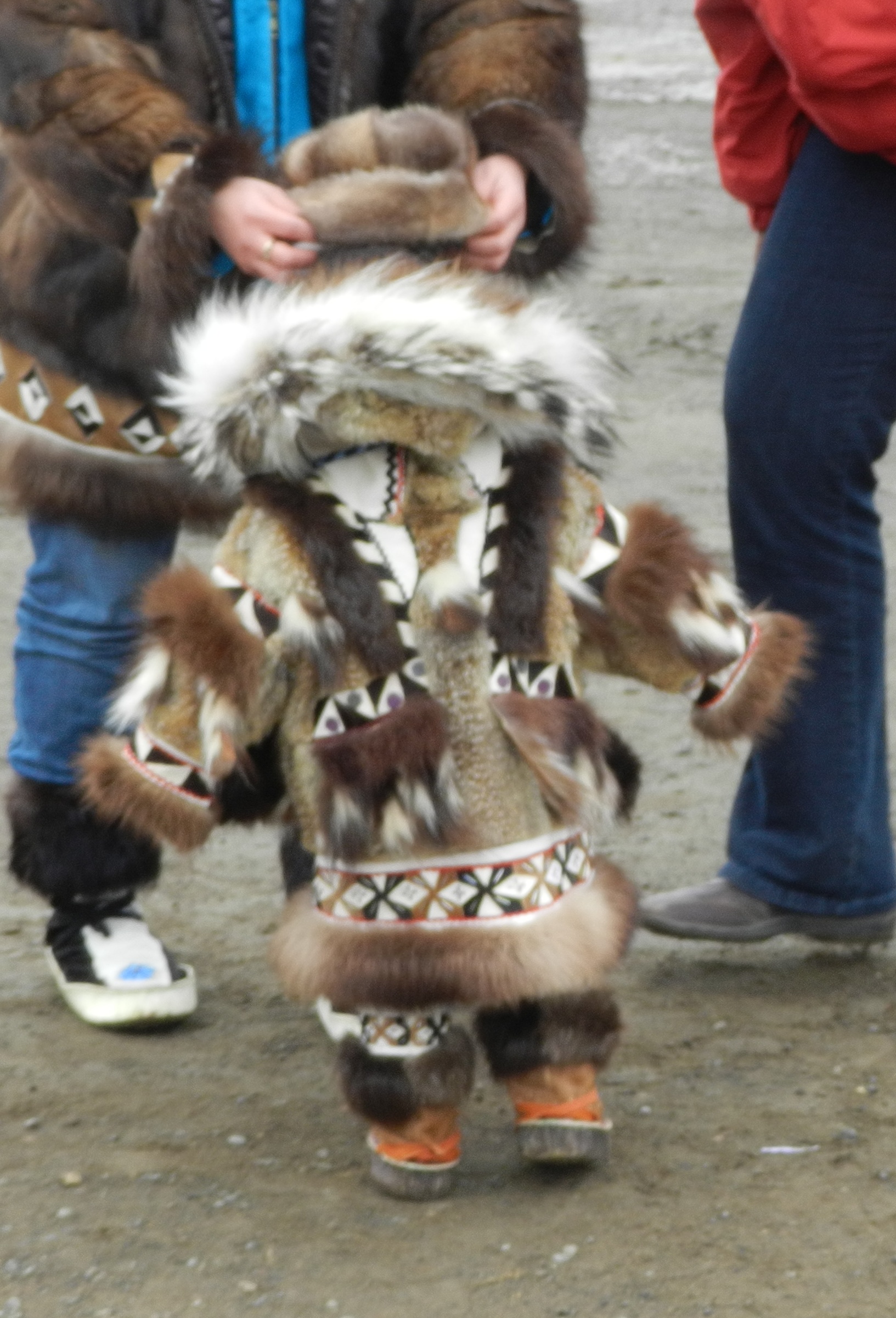
Since that shot my Saturday, I spent most of yesterday and today finishing various things that clients need before I get out of the field and dealing with various work-related issues. As a result, I missed almost all of the 4th of July festivities. We did get in for the start of the “marathon” in which crew member Emily Button was running, and the Pretty Baby contest, but Glenn hadn’t really dressed for the weather and the wind & drizzle picked up, so we left and I don’t know how either event came out! Maggie Rose Solomon won Miss Top of the World (thanks to DoeDoe for posting that on FB ).
Runners at the ready. Emily is in the red jacket.
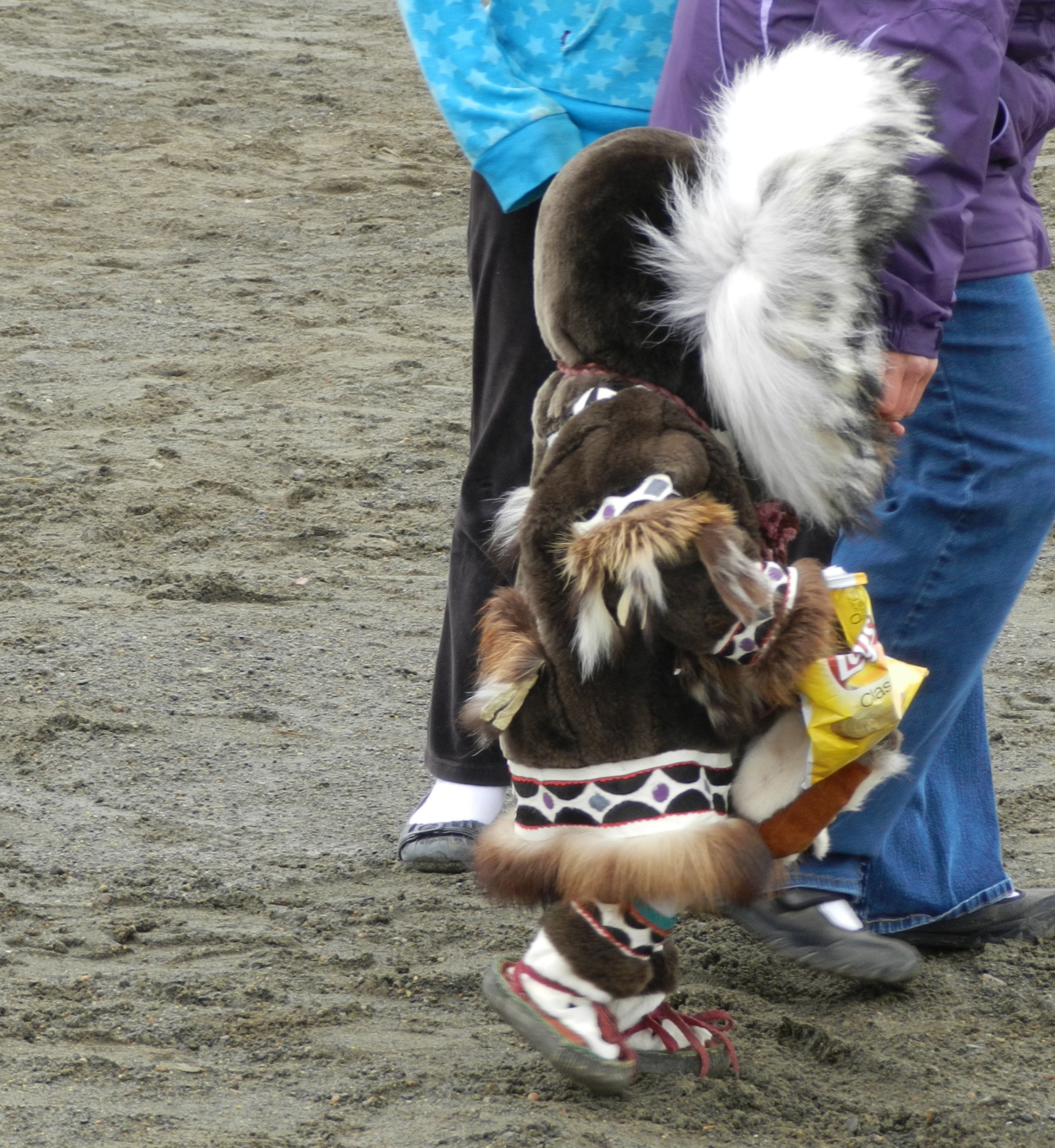
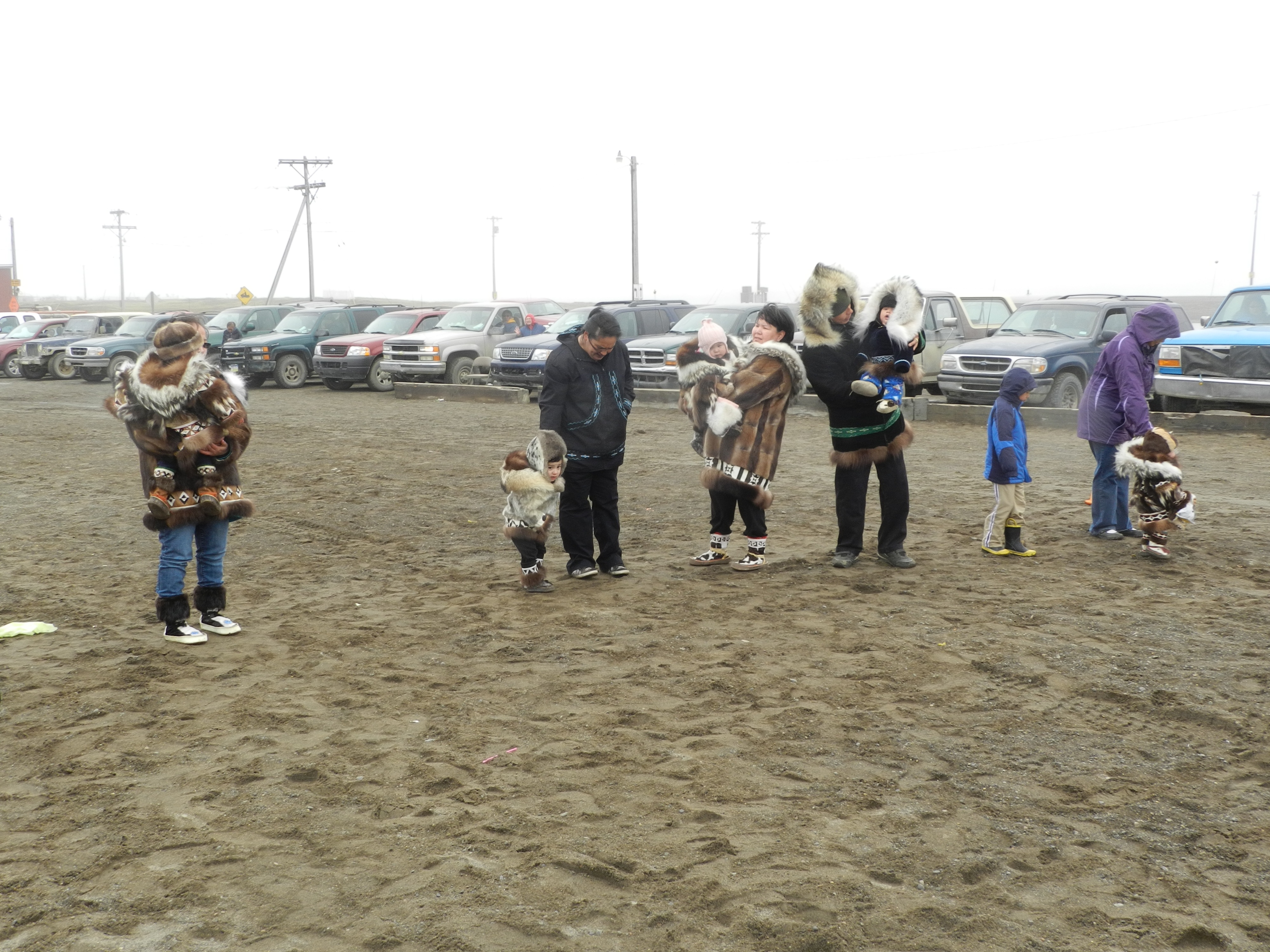
All the Pretty BabiesWhen the potato chips aren't enough...
Once again, I have been spending time choosing the crew for the summer season at Nuvuk. There are a lot of factors that go into the choice, as I explained last year. Once again, I think (hope) I’ve got a good group. Most of the high school students have worked on the project for some time, some for several years. We’ve got one who has been working in the lab for months, and a couple who are totally new. We start orientation on June 13th.
One of the NSF-funded folks was actually on the crew in 2009. Dr. Tom Besom was going to be in Kamchatka this summer, but the project sort of fell through, so he’s coming back to Nuvuk. A good thing, since he is fluent in Spanish (his primary research specialty is Andean mummies) and will be a big help with making sure the Mexican students from the Mexican-American Exchange project who will be joining us get clear explanations and translations. Krysta Terry was also going to return, but her father has a serious health problem, so she can’t take off for the Arctic. Even though we have jet service twice daily and three times on Thursdays and Saturdays, it can take a couple of days to get to most place that aren’t on the West Coast; more than that if the planes are fully booked with tourists or the weather is foggy.
I’ve still got to do the final update of the memo we’ve developed for new crew on what and what not to bring (no flashlights), and send that out. Now the fun of trying to book cheap, yet not horrendous travel for five people to Barrow…
I went out to Nuvuk today. The purpose of the trip was to accompany Hank Statscewich from the University of Alaska Fairbanks, who needs to pick out a new site for an experimental current radar. They have run it near NARL for a year, with no problems, so they want to try it further out-of-town. Since there is a good bit of archaeology out at the tip of Point Barrow, the idea was that I could help him find a spot that was not likely to have any archaeology. We’ll still test before anything gets put out there, but still.
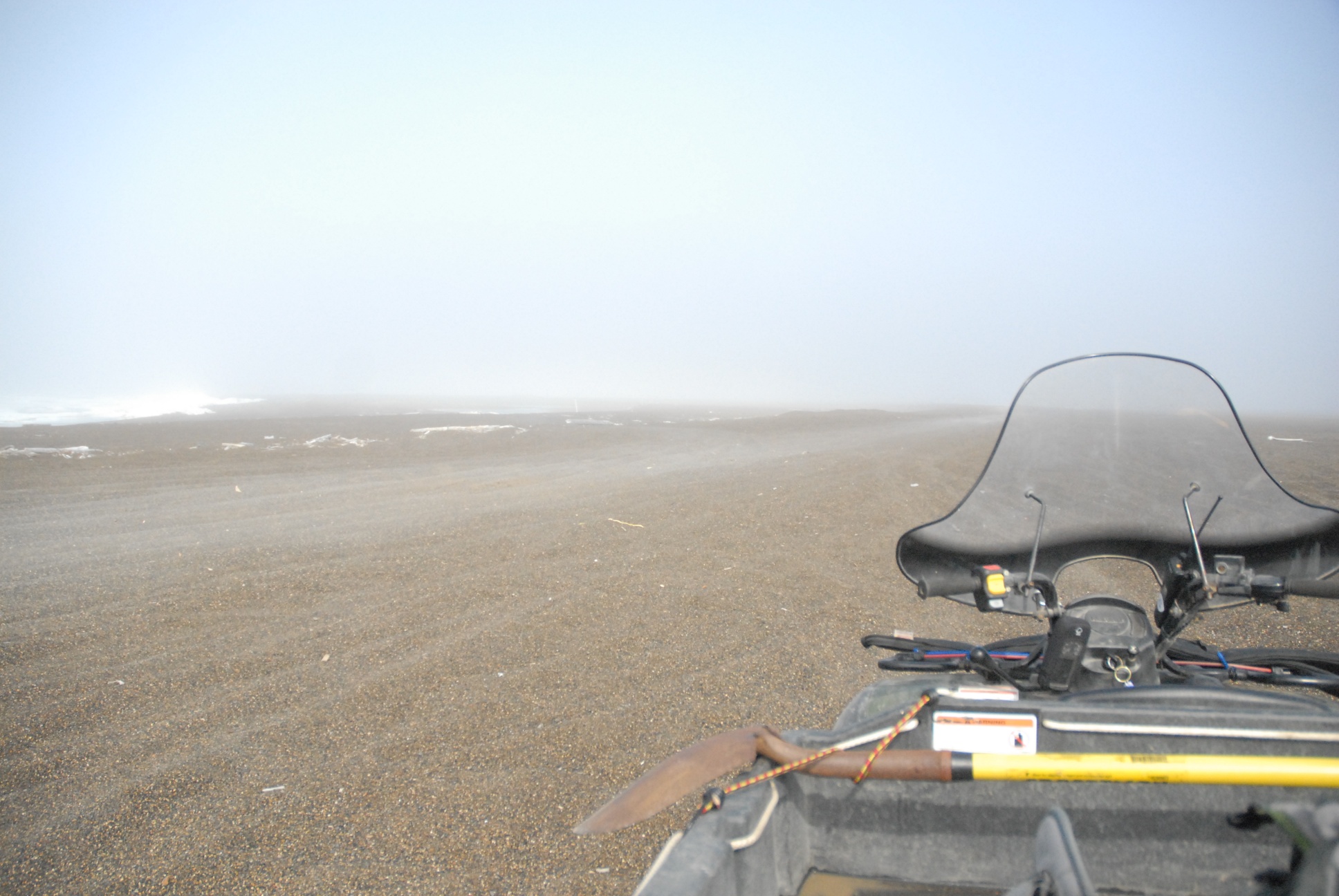
It was a sunny day, but there was a good East wind off the ice. We were heading into it, more or less, going probably 25-30 mph until we got off the road, and the ATVs from BASC didn’t have windshields on them yet (they take them off when storing them so they can fit more vehicles into a smaller space). That bit was not fun.
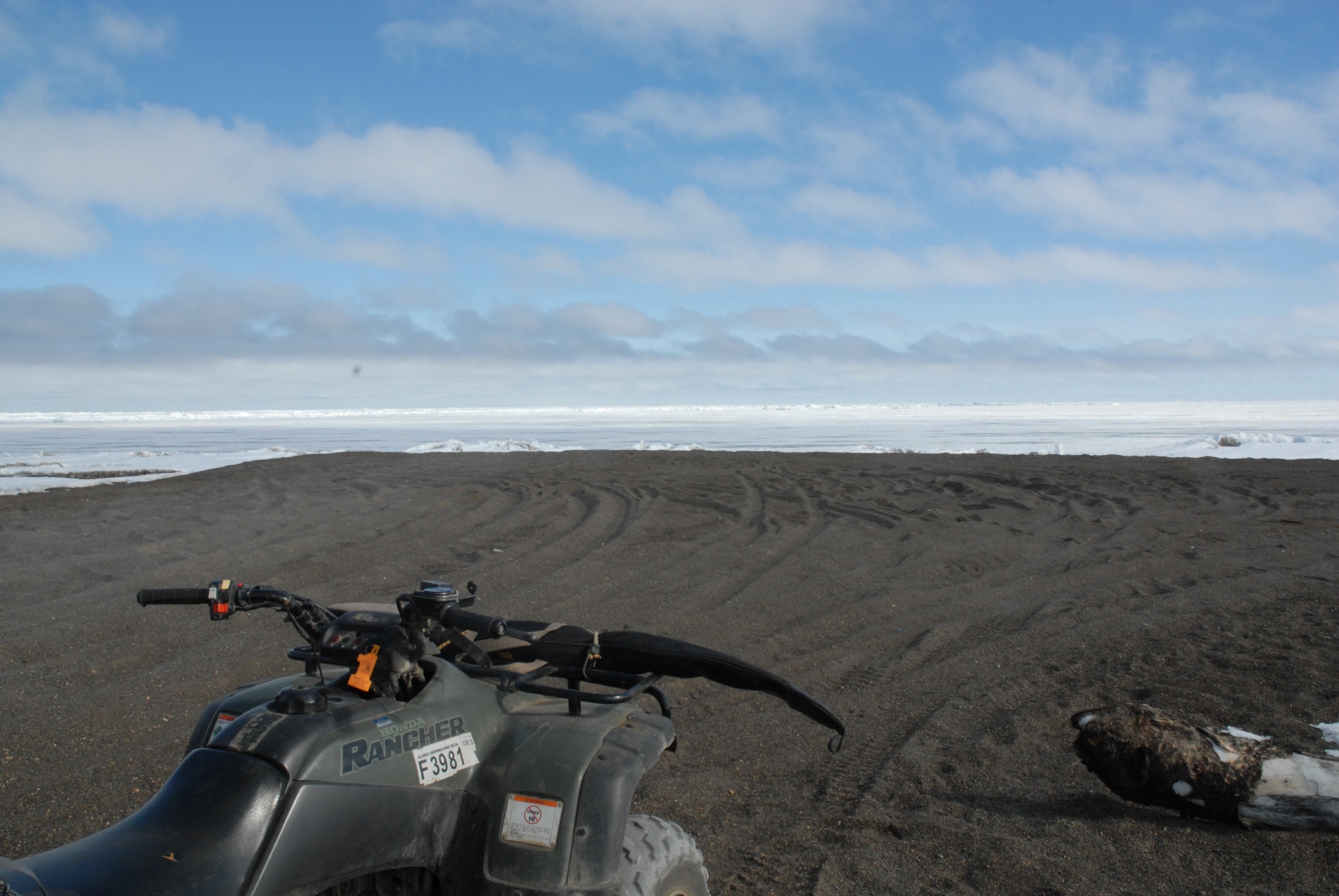
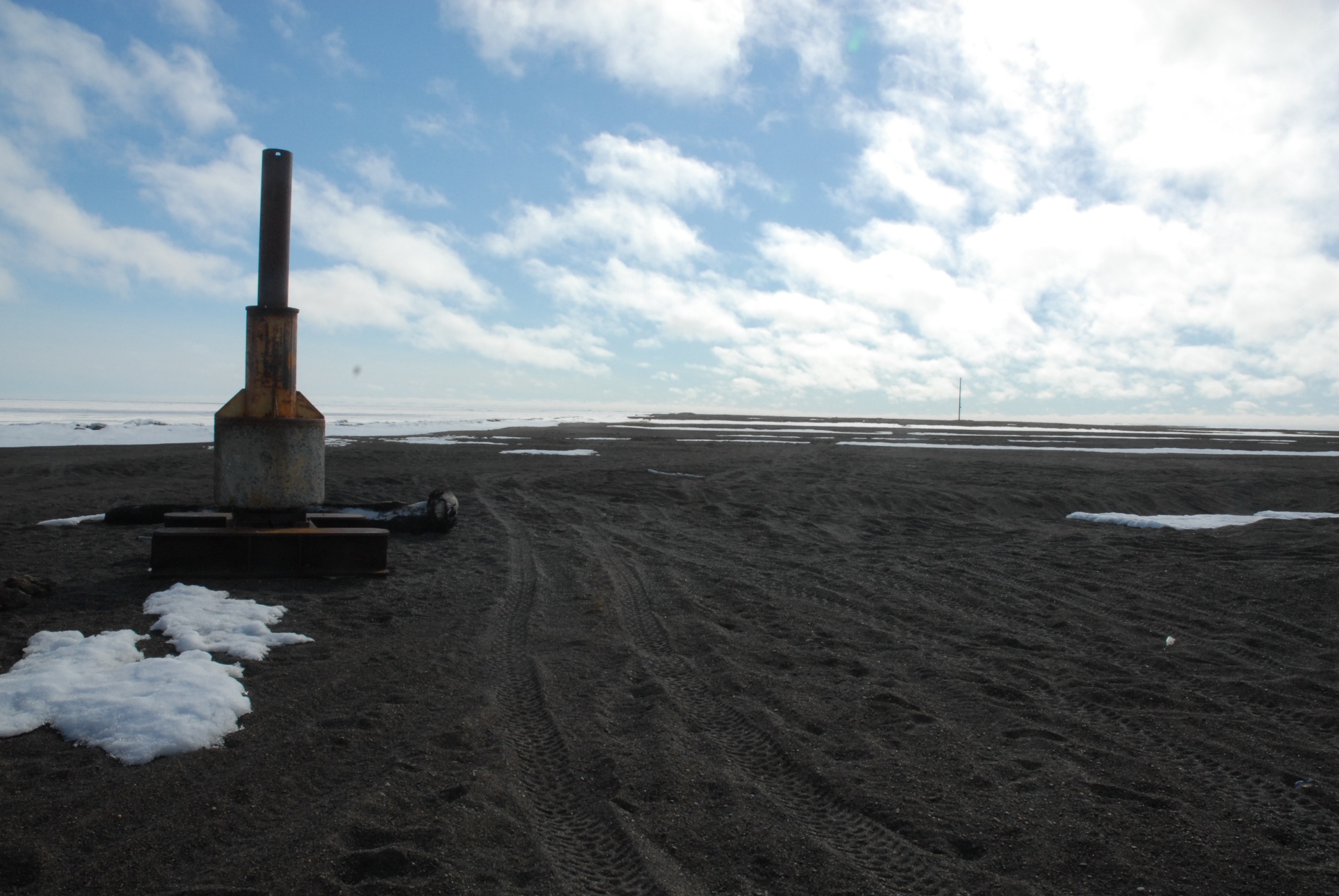
The first place we went was on the younger, more western of the two prominent beach ridges, near a weird concrete and steel device that reportedly was brought over from Prudhoe Bay during the gray whale rescue. It seemed like a good possibility, so we took GPS readings. It looks like there has been a good bit of er
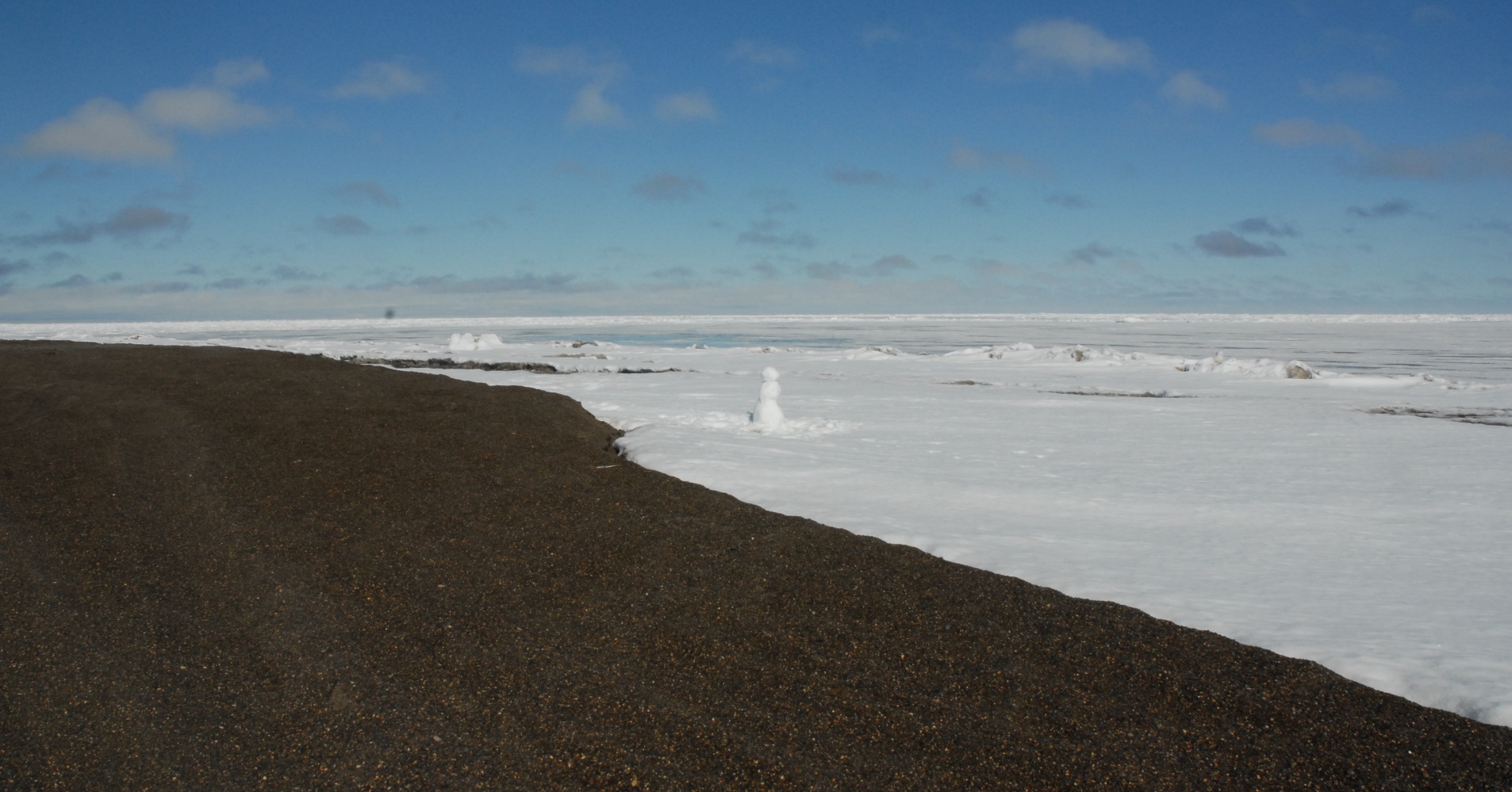
Looking at the ice on the Beaufort Sea, I was happy to see it was really flat for quite a way out. That will make it easy for bear guards to spot bears there, if only it will stay that way.
Flat ice on the Beaufort Sea, at the farthest north point in the US.
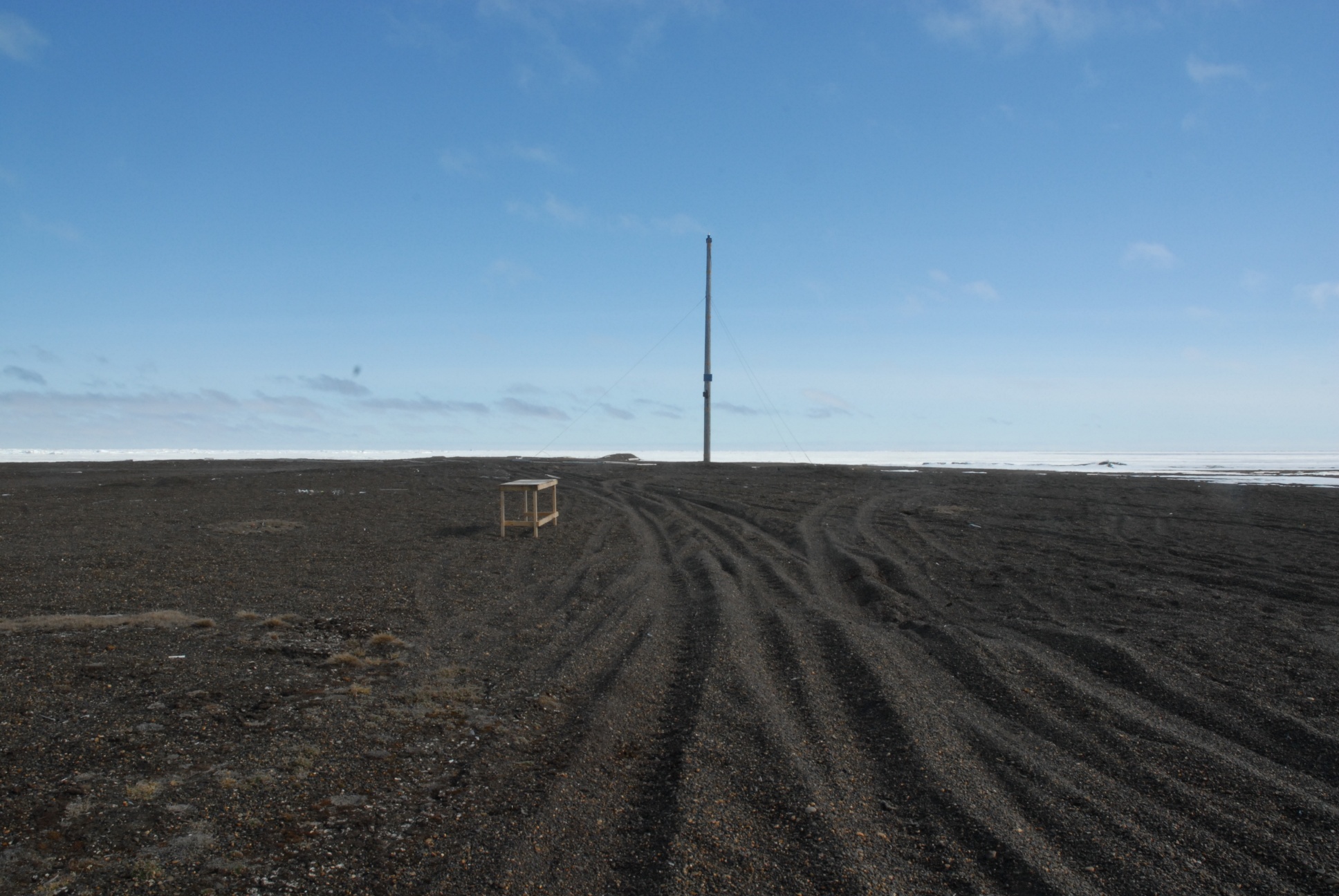
We looked over toward the ridge with the Nuvuk site on it. I was very discouraging about it as a site for the radar, but Hank was curious, and enough snow had melted so we could get there without bogging down (ATVs aren’t so great in snow), so we headed on over. There was some sort of rack that was new since fall, so I wanted to look at that.
Looking SE toward the Nuvuk site.
While we were over at the site, I double-checked how far we had tested in relation to the telephone pole with a light on it, since there is interest in mounting something on that pole, and access will be an issue until we are sure there are no graves right around the base. We mark the end of the tested area with a line of driftwood, which we move inland at the end of every field season. It’s only a few meters from the pole, so we should be able to clear that one way or another this summer.
Looking toward the Beaufort from the middle of the site. The line of driftwood on the ground marks the limit of the tested area.
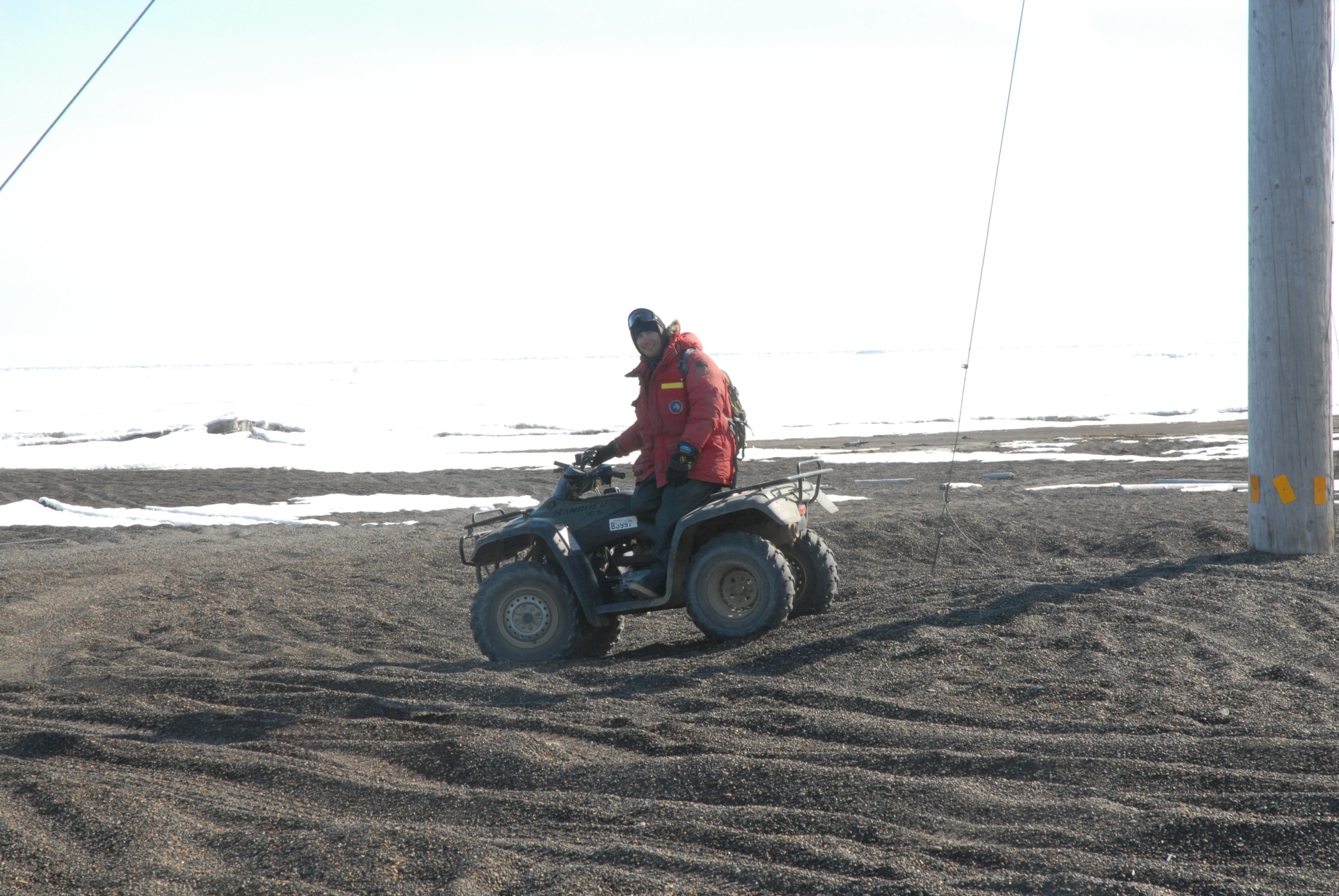
The “rack” turned out to be a table-like construction which was labeled as a survey marker for North Slope Borough Wildlife Department. I checked with them when they got in, and the survey is due to be completed in four days, so it won’t be a problem for us. I took a picture of Hank on his ATV while we were there. Actually, I took several with his camera too, but the image never looked in focus to me, so I took some with my camera just to make sure.
Hank S. at Nuvuk
We stopped at another spot that was also a possible radar site. Hank will take the GPSs back and do calculations to determine which one would work best for the radar, and then let me know and we’ll test it as part of determining if it can go out there.
The ride back was great, since the wind was at our backs. Alas, my face is covered with what look like hives, which is what happens when I windburn









 Out of Ice and Time