For some reason, two of the archaeology blogs I follow had recent posts which were perfect summaries of information for people considering getting into archaeology. Although the topics were quite different, neither was the sort of thing covered in most classes or textbooks.
On the practical side, GraecoMuse did a nice summation of what an archaeologist needs in the way of personal field equipment. I’d add a clipboard desk for forms, and certainly most US and Canadian archaeologists would substitute Marshalltown trowels for WHS.
On the other end of the spectrum, what appears to be a new blog gives an extended quote from an L. S. Klijn article in Acta Archaeologica listing 25 Commandments for archaeological researchers. I tend to think that not all archaeologists are quite as individualistic and cutthroat as #5 might imply, and would offer such highly successful collaboratives as NABO and GHEA as counterexamples. The list is a clear description of some very important principles of archaeological logic and epistemology. Many of the “commandments” are applicable to all scientific endeavor, no matter the discipline.
It’s been pretty cold the last few days. My vehicle has tire pressure sensors, and every time if goes below about -27, it shows low tire pressure, which resolves as soon as the temperature goes up. I guess I should add a bit of air, but it’s been a busy week.
I’m still working on papers. Only a couple more to submit, plus whatever revision need to be done!
I spent a bit of the afternoon straightening up the lab a bit, before a group from the US Coast Guard and RAND Corporation came by to tour the BARC. Naturally, they wanted to see the lab (there isn’t much happening just now in any of the other labs anyway). I gave them a nice tour, which they seemed to enjoy, before the headed off to look at the rest of the building. The lab humidifier seems to have gone belly up, so it looks like we’ll need another one.
Tomorrow is another lab day. We’re pulling some more items for C14 dating as well as working our way through the Ipiutak house floor. The new Mac is getting set up too!
I was traveling the last couple weeks to the Alaska Anthropological Association conference in Seattle, and then stopping in Anchorage on the way home to help my daughter get settled there. The conference and the session went well. I’ll try to put something up on the highlights, when I get a little more free time. I’ve still got papers and also homework for an on-line class I’m taking.
Yesterday, we got back to going through the Ipiutak floor material from the summer and the fall salvage excavation. Trace Hudson, Jacob Harris & Frieda Kaleak all came in, along with Laura Thomas, and we got going on the screening, floating and picking over the heavy and light fractions.
It’s a slow process, but a couple of things were found yesterday that may be interesting. A couple of very small fragments of rock crystal (probably clear quartz) showed up. This is interesting because of some of the properties of quartz crystals and the finds of larger quartz crystals at some Ipiutak sites.
We got so into that process that we didn’t actually get much straightening up done. I’ll have to do that later this week, since some visitors are being brought to the lab on a tour late in the week, and it’s a bit messy there now :-(.
I am in Seattle for the Alaska Anthropological Association meetings. Today was spent primarily in tours of the Burke Museum’s zoological collections (in the morning) and the marine mammal collections at NMML (in the afternoon). The Burke has pretty impressive collections, especially when you add in the off-site material, and NMML has a good range as well. After the tours, Jeff Bradley of the Burke took me to their off-site storage to look at whale mandibles.
I’ve been trying to track down whale mandibles ever since I was sent a picture of one from Cape Krusenstern and I saw one at Cape Espenberg that didn’t look like bowheads. I didn’t think they were grey whales either, but I’m not as familiar with their skeletons. There are bowhead skulls in front of every school in Barrow (& my daughter attended all three), the college, the library/heritage center, the city hall and the North Slope Borough building, as well as miscellaneous other sites around town, so I know bowhead jaws when I see them.
I found a couple that looked like possible matches, or at least members of the same family, so that is progress. The Burke has pretty restrictive photo policies (they hold a lot of art, so the policies are based on that), which means I can’t put any photos up here without permission. It would take days & several person-hours of work at both ends, so I’m not going to try for a blog post.
Now off to bed so I can be bright-eyed & bushy-tailed (or at least halfway coherent) for our session tomorrow. I don’t have to give any papers until afternoon, but still… The other organizers have papers in the morning, so I’m guessing I’ll be moderating…. We’re only winging it a little 🙂
I’ve been working on talks for the session on the Connected Arctic at next week’s Alaska Anthropological Association meeting in Seattle. My family was in Juneau lobbying, so I had some free time. I’m almost done with the one about the trade networks which moved large quantities of oil, blubber & baleen from the coast to be exchanged for caribou & sheep products from the interior. By volume, this greatly exceeded the amount of metal, jade and similar items that also moved through these networks. For some reason, the skin & oil trade has received less attention from archaeologists, although it has been documented ethnographically. In fact, it seems to have been a necessity for sustained interior occupation. I’ve been trying to make a good visual presentation, which takes a bit of doing. I think it should be done tomorrow.
I would have been done earlier if I hadn’t had to spend some time on sorting out some safety issues. The local phone company is installing a microwave link to carry internet for science, and the best spot is on the BARC, apparently on the tower where the radar is. For some reason, they didn’t think the FOUR signs on the locked door to the tower warning of possible radiation hazards and giving the numbers to contact someone who could make sure the radar was disabled before they went up on the tower meant THEM. The locked gate at the bottom of the tower deck stairway didn’t faze them either. Fortunately the radar was off, so no one got hurt. However, the radar can be activated remotely, so going up on the tower, even if you think you saw the radar was off when you went by the controls, is a really STUPID idea. Since they presumably will need to go up there again to finish the setup and for periodic maintenance, it was necessary to impress on them (management, not just the crew) that they need to call and get an OK every time. The excuse was that they’d talked to the building owner (who I’m sure approved putting stuff up there in concept, but never told them it was OK to ignore warning signs while doing it!) If people would just read and think….
I’ve been chipping away at a bunch of things. The main ones are the big Late Western Thule chapter and an associated project which involve evaluating every Birnirk & later C14 date I can get hold from Alaska, to see which ones hold up (a number that are cited a lot are really early solid carbon dates!) and what exactly was dated. In some cases, what was dated was in a different house from the “diagnostic” which is purportedly being dated, and there is no a priori reason to think the houses are contemporaneous. It may have been the best that could be done at the time, but some revision is needed here. Once those are done, I can finish the two other papers I am working on.
We got the symposium for the Alaska Anthropological Association meeting more or less put together, pending any additional papers submitted as general papers that the organizers may send us, and next week we’ll just have to decide on an order so the conference organizers can get their materials to the printer in good time.
I’ve also been invited to be a speaker at a small conference on Sustainability and Heritage in Kirkwall, Orkney which is sort of the main kick-off for a Research Coordination Network (RCN) on Global Long-Term Ecodynamics in which I am fortunate enough to be involved. I’ve never been to Orkney, but I love the Shetlands, so I’m looking forward to it. There are some great people involved, and we’re trying to do some really interesting things involving the use of archaeological data to illuminate questions about long-term sustainability. I actually owe them an abstract by tomorrow (which it actually is in Orkney), so I better get to it.
I wound up agreeing to help organize a session at the upcoming Alaska Anthropological Association meeting in Seattle. Long story about Seattle, but we have gone to Whitehorse, YT once or twice, so leaving Alaska is not a first.
Anyway, the deadline to submit sessions (including paper lists) is this Friday, so I though I’d put a description up here, since the AnthroAlaska list seems to be a bit slow showing up (although it might be my email). We have room for a few more papers and are being fairly expansive in our interpretation of the topic. If you are interested, the description and directions for how to participate follow:
Although the Arctic tends to be viewed as a place apart, both in the sociocultural sense and as a research area, the first has never been true, and the second is becoming less so. This symposium will look at the Connected Arctic from both perspectives.
Papers on any aspect of trade and/or travel (pre-or post-contact) from one or more disciplinary perspectives are welcome, as long as they involve the Arctic. We are interested in both specific case studies and methodological works.
We also welcome in papers dealing with aspects of connected Arctic research, including virtual repositories which can be used from multiple locations, shared databases, digital teaching and outreach tools, and social media.
N.B. People wishing to submit papers are asked submit the paper abstract directly to the meeting organizersby the deadline of February 3, using the Alaska Anthropological Association meeting website form: https://catalyst.uw.edu/webq/survey/fitzhugh/139716 . Note you will need to register for the meeting first. Please put “The Connected Arctic” in the space on the form. The symposium is not on the website list of symposia yet, but we have been assured that does not matter, since sessions are due the same day. Please also send your name and at least a paper title (preferably with the abstract) directly to one of the organizers: Anne Jensen (anne.jensen@uicscience.org), Herbert Maschner (maschner@isu.edu ) or Owen Mason (geoarch85@gmail.com ).
I haven’t been posting here much lately, but it isn’t because I haven’t been writing anything. In fact, I’ve been doing almost nothing but write, and my carpal tunnel has been acting up so badly that I’ve pretty much been trying to rest my hands. Over the past year, I’ve gotten invitations to contribute papers to several interesting volumes. I’ve sent in various abstracts for papers at meetings, some of which led on to proposed volumes. Then I actually submitted abstracts to a couple of proposed volumes I heard about from my husband or various listservs. All of them had deadlines well in the future, and I didn’t expect all of them to be of interest to the editors anyway.
But no one turned any of the abstracts down, and I had a more successful field season than expected, which lead to the RAPID proposal to NSF to salvage the Ipiutak structure, which took time to organize and execute. Then the person in the parka turned out to have more than a parka, which meant more time for documenting things. So now I have a bunch (by bunch I mean 6) of papers due by mid-January, along with a review, a short presentation for a meeting next week (which the organizers just asked be emailed to them by Thursday, a week before the talk!), travel for that meeting and another one, both in some way connected to developing repositories that are responsive to communities of origin, a proposal, Thanksgiving, Christmas shopping and travel to and from New York State for Christmas! Yikes! What in the name of caution was I thinking?
I don’t have much trouble doing papers for meetings. I tried to avoid the cognitive traps of PowerPoint (Tufte 1993), and use lots of pictures, and I’ve spent a fair bit of time in Toastmasters, so I can get up and talk. This is not a surprise to those who know me :-).
I can even write (via keyboard or voice recognition) fairly quickly, thanks to Freshman English at Bryn Mawr College. Having to have x pages handed in by 9AM Monday morning come hell or high water concentrates the mind wonderfully. However, actual papers, with proper references, formatted as required by the particular journal or publisher, take a bit more time. I’ve got one paper submitted, four in various stages of writing (one of which the research for is continuing but almost done), and will start the talk for the meeting tomorrow. My hands and wrists hurt a lot. So does my head, now that I think about it.
I’ve more or less recovered from whatever I had, so I’ve actually got some energy to post. Herewith a quick update on the person in the parka and the skin clothes, etc that accompanied her (I’m no sure the person is a girl, but I need to pick a pronoun.
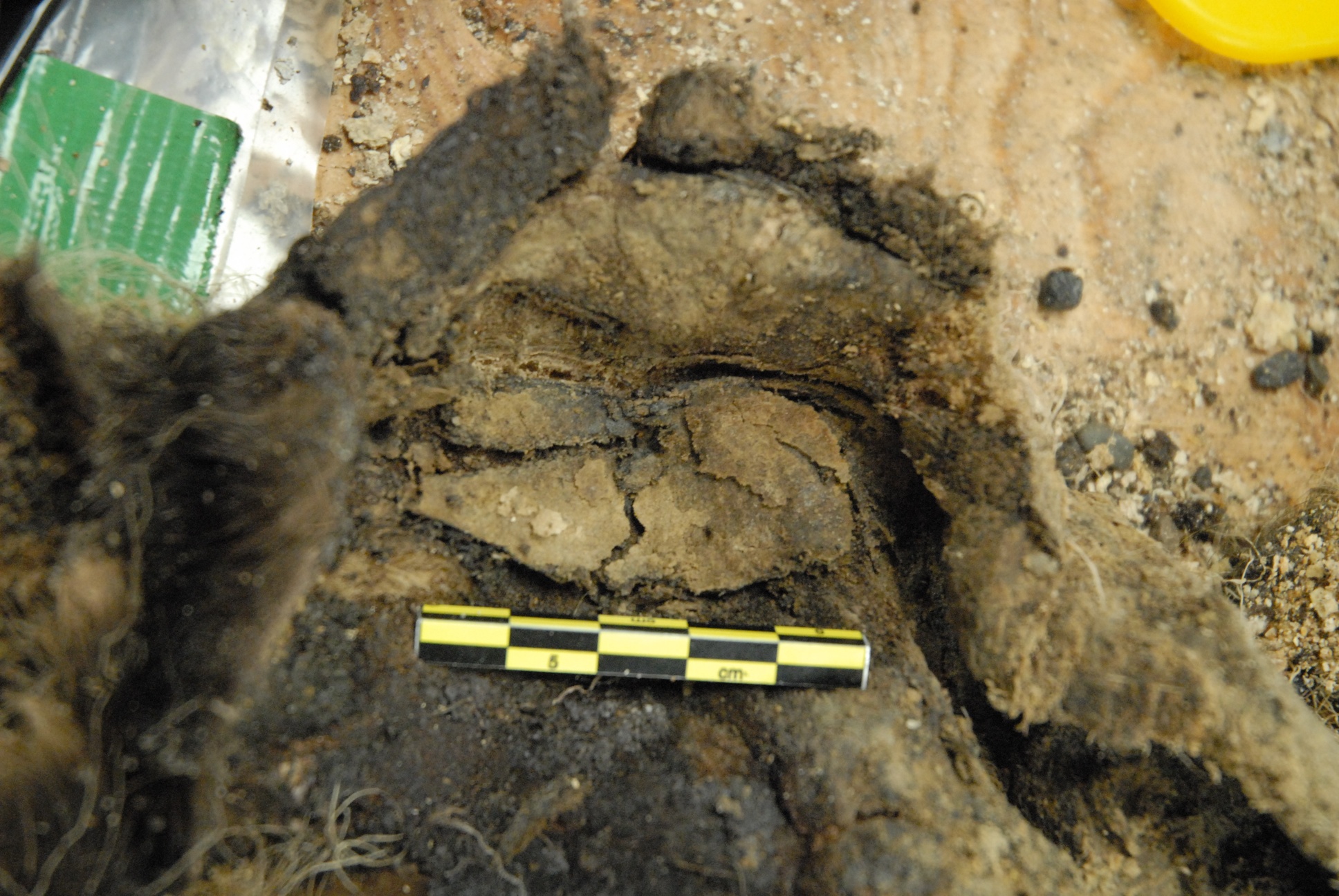
I was able to get the pantaloons off, although the legs fell apart. The boot part was apparently made from either leg skins or fawn skins. The waist seems to be have been made out of something similar, maybe as a waistband. The main part of the pants is regular caribou hide, which has much longer thicker hair. Since the waistband was wrapped around a belt made from a piece of hide, perhaps the regular caribou was too thick and inflexible to be suitable.
Fragment of belt, just above the photo scale.
The back of the parka was about 10-15 cm longer (I can’t be more precise since the preservation was not perfect), and looked like it may have had a rounded hem. As far as I could see, there were no seams. According to Murdoch (which seems to be out of print again except in print-on-demand), children’s parka didn’t have back seams, but I am waiting on a couple of other books on skin clothing, and a few more experienced skin sewers opinions.
Back of parka. Outside of garment (after it was flipped). Shoulders at top.
It took a bit of doing to get a look at the back, since it was fairly well stuck to the caribou hide underneath. I ended up getting Shawn to help me. We got a piece of Visqueen underneath the whole thing, very carefully, put plastic on top of it, and then put a piece of plywood on top to stabilize everything, held the plastic tight to the wood, and flipped everything. It worked well, and we were able to use the same method for the sewn wolf-skin item (still unidentified).
The wolf-skin has a lot of seams. Some bits are badly preserved or very badly matted, so it’s not clear what it used to be. However, a number of the smaller pieces that have been sewn together are still pretty much intact. I tried putting a picture of it onto my iPad, and opening it with Omnigraffle, so I could try drawing on the seam. I’m hoping that it will make it easier to understand, and that maybe someone will recognize what those pieces go to. I know this can work, since Bertha Leavitt was able to identify that the little girl from Ukkuqsi was buried with a kayak cover (among other things) based on the shape of a couple of pieces of sewn boat cover skins.
I’m still working on the drawings a bit to clean them up, and I’ll put them up on a separate page when they’re ready.
I also managed to finish a review today, and to get a bit done on a paper that I owe some folks. Both are actually for the same journal, different issues.
Folks were out whaling, and Panigeo crew took a whale, which is probably nearly done being butchered by now (judging by Jimmy Nukapigak’s Facebook updates :-)) . There was supposed to be one or maybe two more possibly struck, but I’m not sure yet. The weather is supposed to get worse, so I hope they get in soon.


 Out of Ice and Time