Onward & downward!

We made pretty good progress at Walakpa this week.  This, despite a few challenges.

On Tuesday, we had a really small crew, due to a variety of circumstances.  Only Trina, Mary Beth & I made it out.  It was quite a cold day, with  ice on the puddles when we got to Walakpa (or Monument).
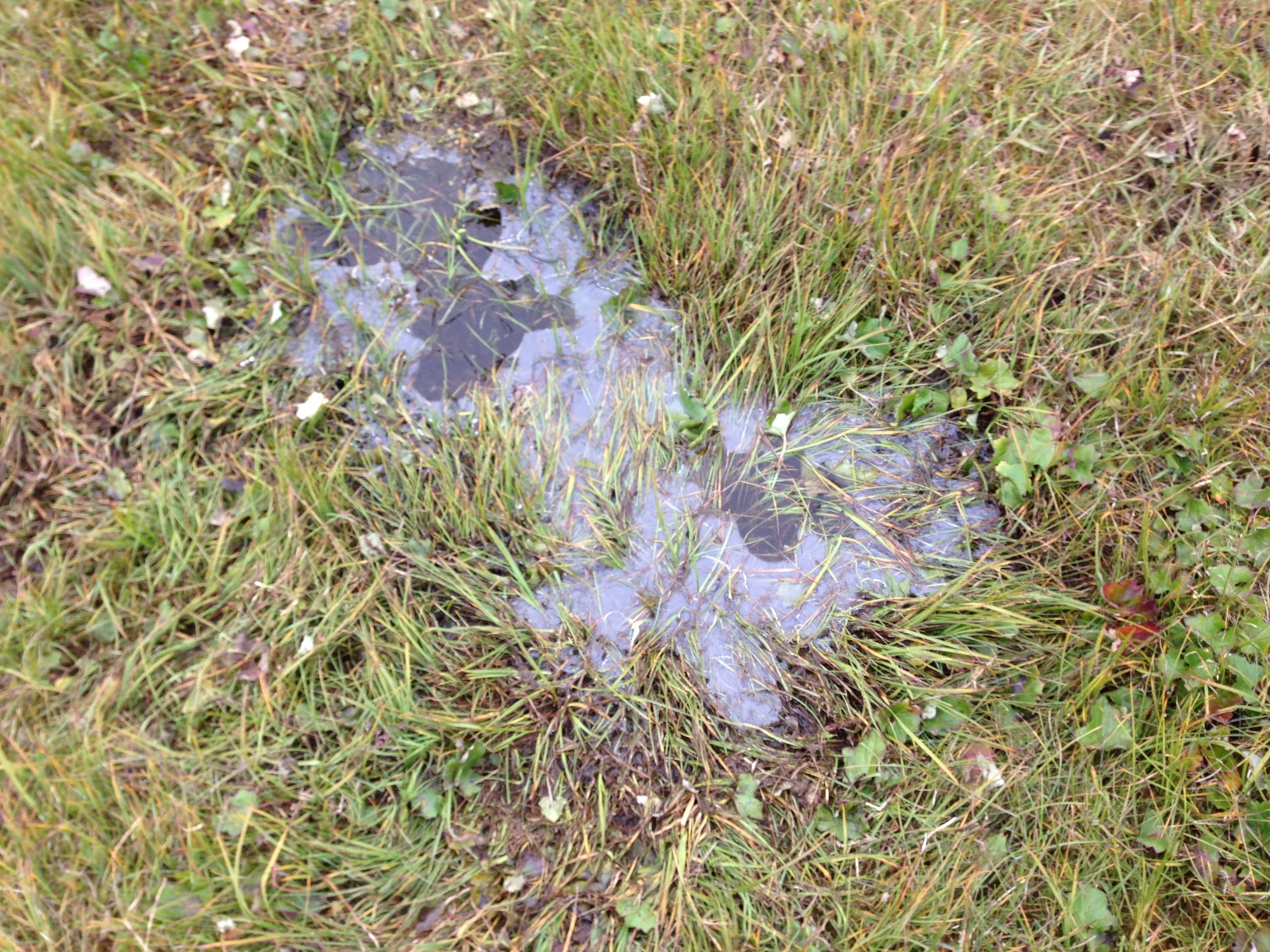
Ice on a tundra pond.

We decided to leave the screening for another day and just excavate.  It was cold enough that we actually took advantage of the removable floor in the Arctic Oven tent on site and used the Coleman stove inside, but on the ground.
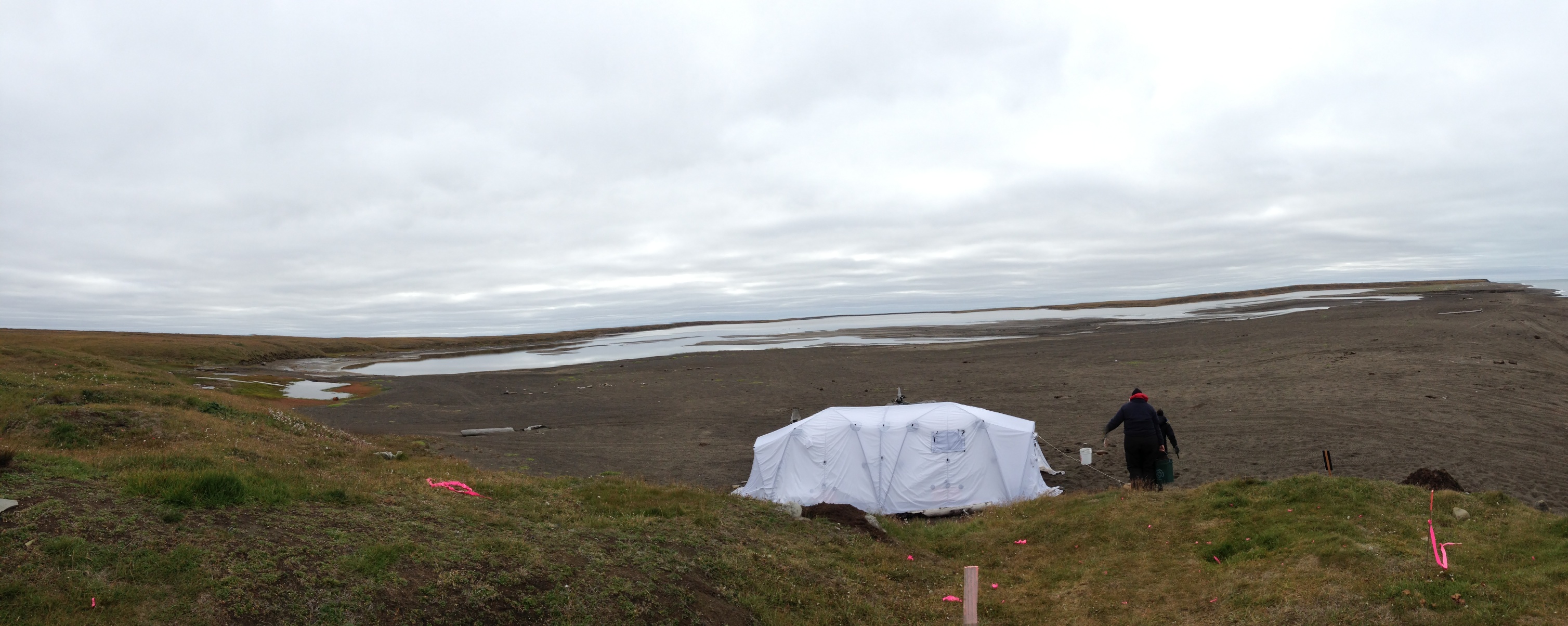
The Arctic Oven on a cold day

The next morning, we had a bigger crew, but there was snow on the ground when we set off.
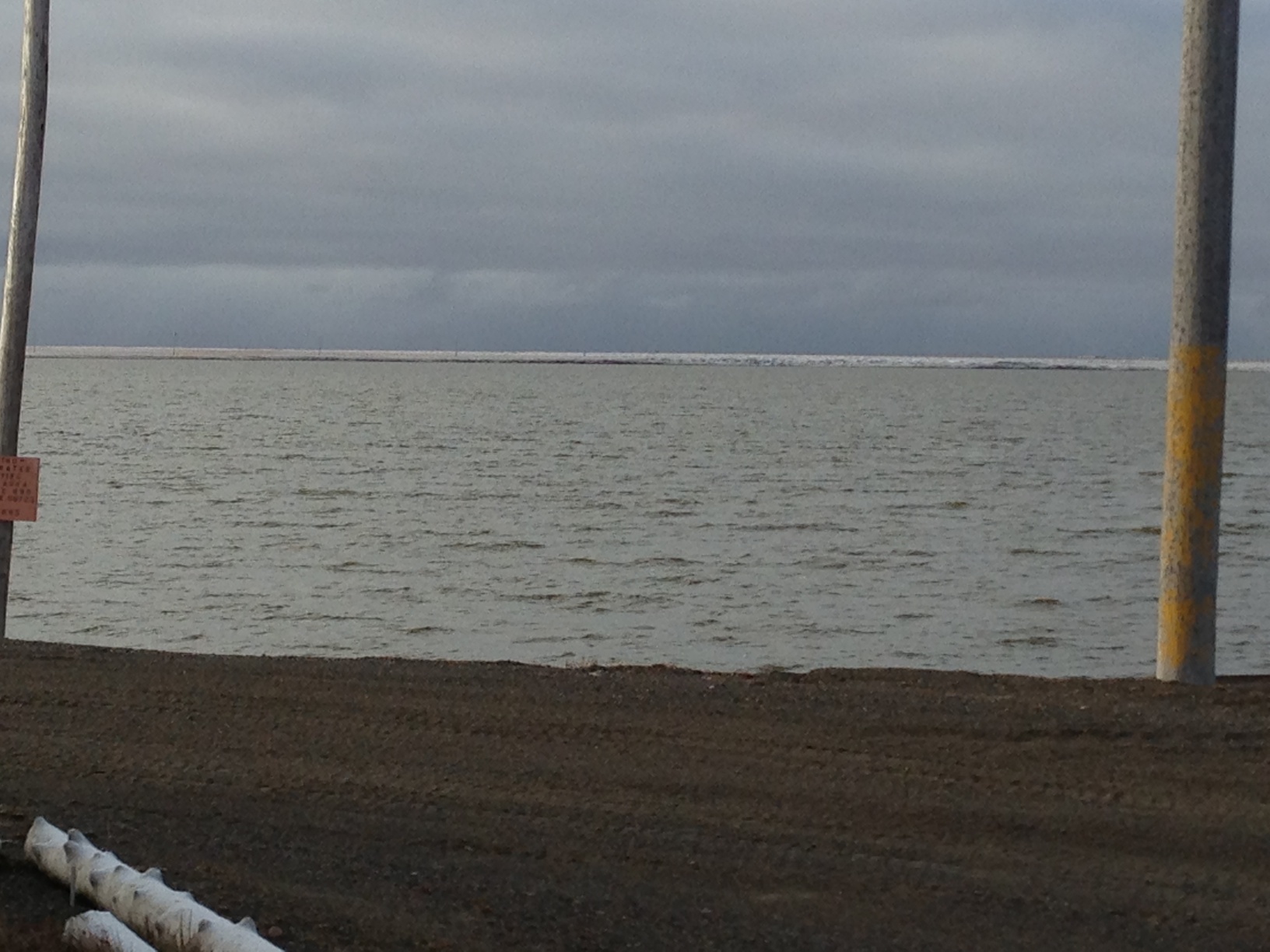
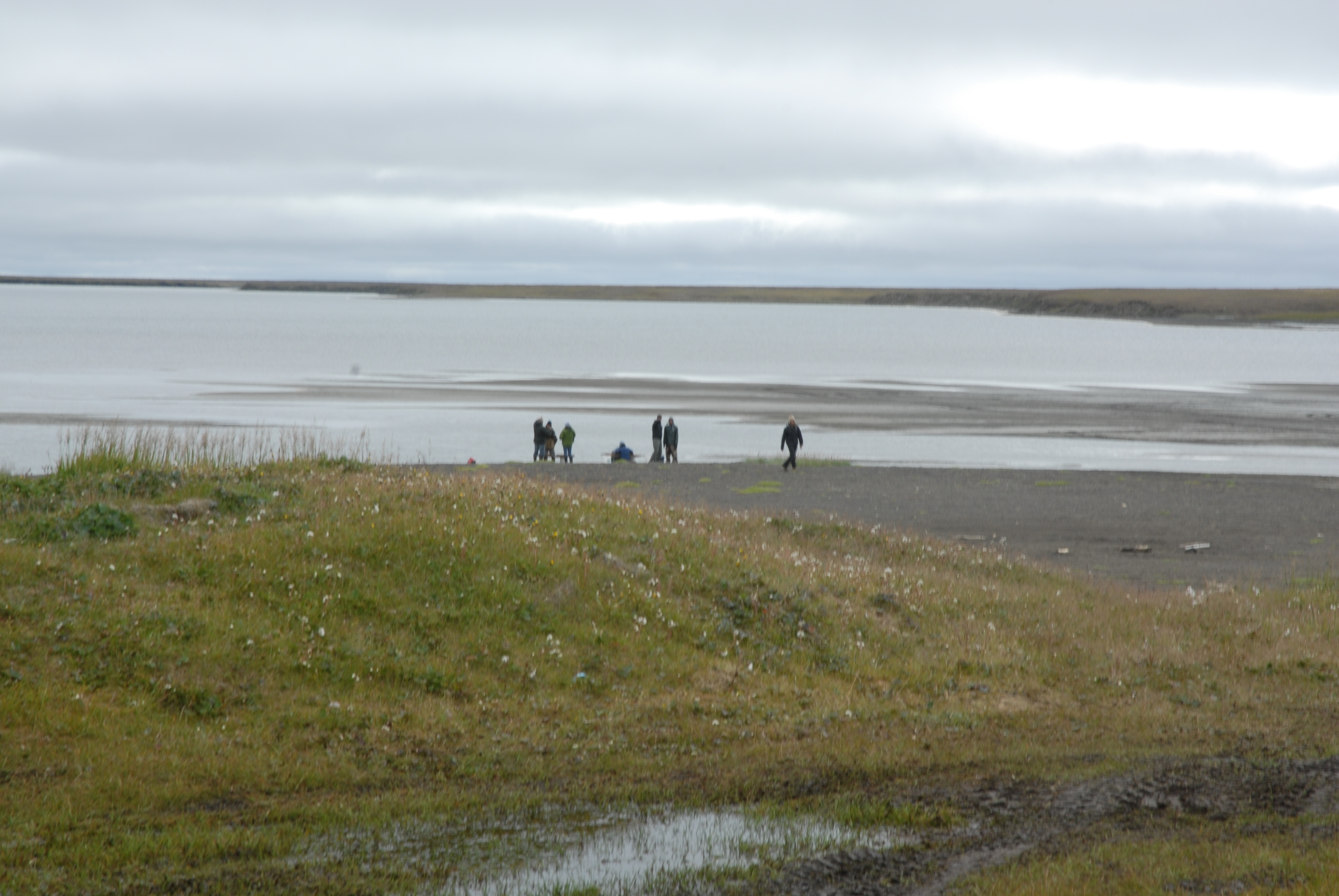
Snow on the tundra, seen across Middle Salt Lagoon.

We were not expecting to have a great day, but in fact it was warmer than the day before (no ice), and we started getting down to what seems to be structural wood from the house roof, so that was fairly satisfying.  We got a lot of water screening done, as well.  The beach had really stabilized, so we were able to go the whole way on hard sand, and even most of the lagoons had closed up, with sandbars across the entrances that we could just drive across.  The commute to the site was much quicker.

Thursday did not go well.  We headed  out, only to find that for some reason, the waves were really coming up the beach and running into the lagoons, so that we  were not able to get across the stream by the gravel pit.  We went around and through the gravel pit, but then could not get across the stream by Nunavak.  We did see a polar bear in the water near a dead walrus).  I decided we should try to go around, since it was otherwise a nice day & I hated to lose it, but we didn’t have any extra gas along, and by the time we were half-way around, even cutting across country rather than following the shoreline, it was clear that some of the Polaris’s are sort of gas hogs.  So back we went to the road, with only one minor mishap when the Tubby trailer bounced into a very wet low-centered polygon and dragged the ATV half-way in.  I got my feet wet getting it unstuck, but we still went back down to the beach so that David Pettibone could get a picture of the bear, still in the water, from a safe distance.

Today, despite no major change in wind strength or direction, was very different.  The beach was back to Wednesday’s shape, and we got to the site easily.  It was quite sunny in the morning, and we got right to work.  We had six people, so we started with 4 excavating and 2 screening.

View from the south end of the trench, where I was digging.  L to R:  Mary Beth Timm, JoAnn Akootchook and Michael Berger.
View from the south end of the trench, where I was digging. Pretty well maxed out.      L to R: Mary Beth Timm, JoAnn Akootchook and Michael Berger.

I played around with my iPad mini for taking pictures to supplement field notes & drawings.  I don’t draw all that well, and used to take Polaroids and draw on them, but that technology is gone and wasn’t that stable anyway.  I’ve use a couple of programs to annotate lab photos, but this was the first time I tried it in the field.  I used iAnnotate PDF, which lets you put sound files on the image, associated with notes or drawings.  They open fine in Acrobat.  This will be quite handy.


Enhanced by Zemanta

August 15th at Walakpa–78 years ago and today

Seventy-eight years ago, it was a foggy day at Walakpa.  The Okpeaha family was camping there.  A floatplane descended out of the fog, and two men asked how to get to Barrow, since they had lost their bearings in the fog.  Getting directions, the got back in the plane and took off.  The engine failed, and the nose-heavy aircraft crashed into the lagoon and flipped.  Unable to reach the plane to help the men, Clare Okpeaha ran all the way to Brower’s Trading Post in Barrow, over 12 miles of very rough going, to get help.  When boats got back to Walakpa & they got to the plane, it became clear the men had been killed instantly.  They were Will Rogers, a noted humorist and political commentator, who was traveling around Alaska to get stories for the newspapers, and Wiley Post, probably the most famous American aviator of the time after Charles Lindbergh.

The crash was national news at the time, and a few years later a monument was erected near the site, followed some time later by another one.  These are the monuments that show up in some of the pictures of the site.  For some reason, these are on the National Register of Historic Places, but the archaeological site isn’t.

The first monument , looking out over the lagoon where the crash occurred.

Today was a much better day at Walakpa.  We headed down with 7 volunteers, including David Pettibone, Michael Berger, dental extern Temurkin Cucukov, and the entire Von Duyke family, plus Marybeth Timm from the Inupiat Heritage Center.  The stream was running high and fast at Nunavak, but we got across, although not before I got my boot wet.  With that many people, it seemed worth getting the water screening going, so we did, using a small pump to take water out of the lagoon.  Alan & Scott Kerner happened by on an ATV ride and pitched in for a while as well.

Wet screeners in action by the lagoon.

The rest of us continued with taking down the rather disturbed level under the sod.  It would be a lot easier if we could just shovel it out, but the bluff doesn’t seem that stable & we’re afraid we’ll knock the whole thing down if we shovel, especially since there are still a lot of roots holding things together at this level.

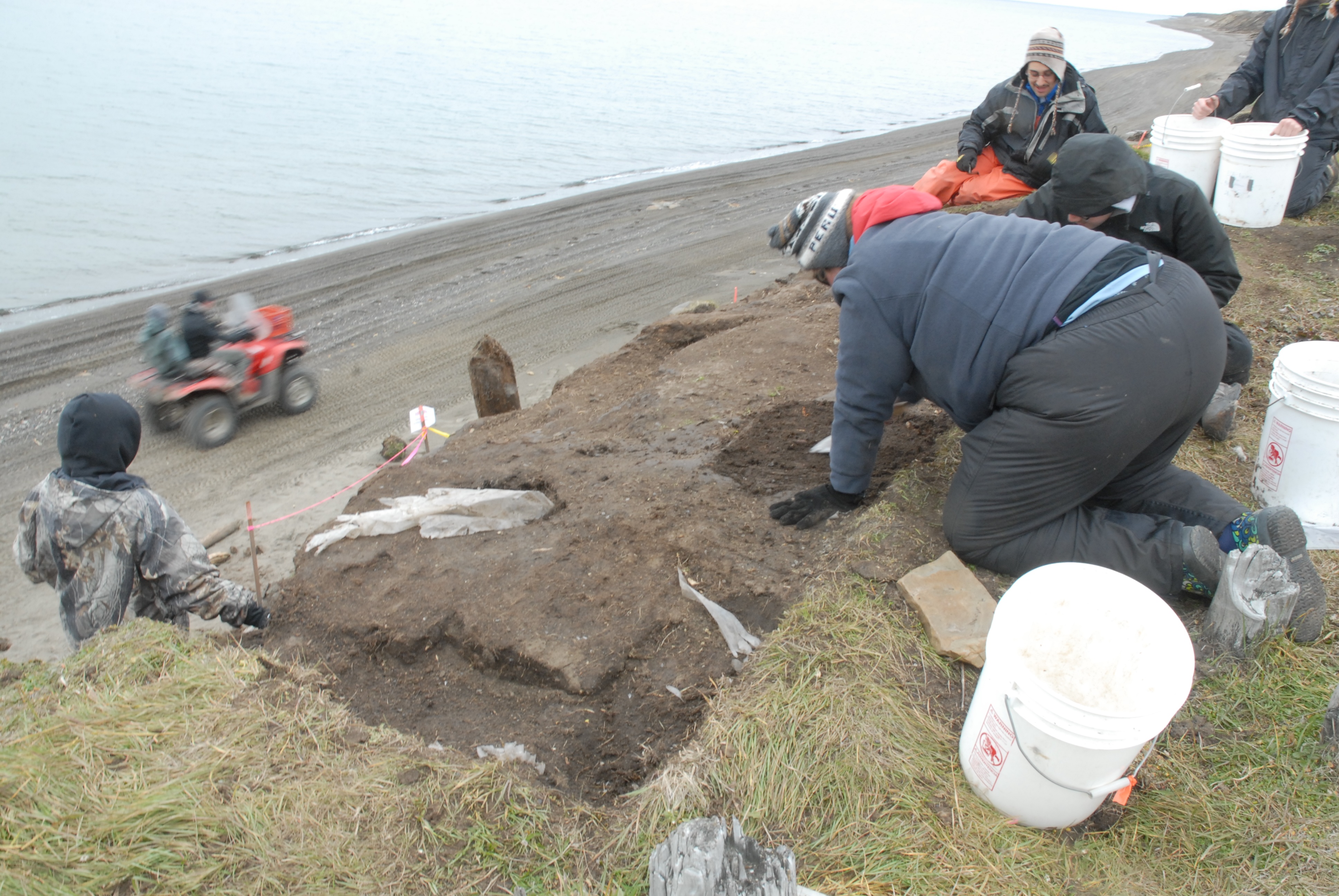
Excavating the disturbed layer. Note the Visqueen.

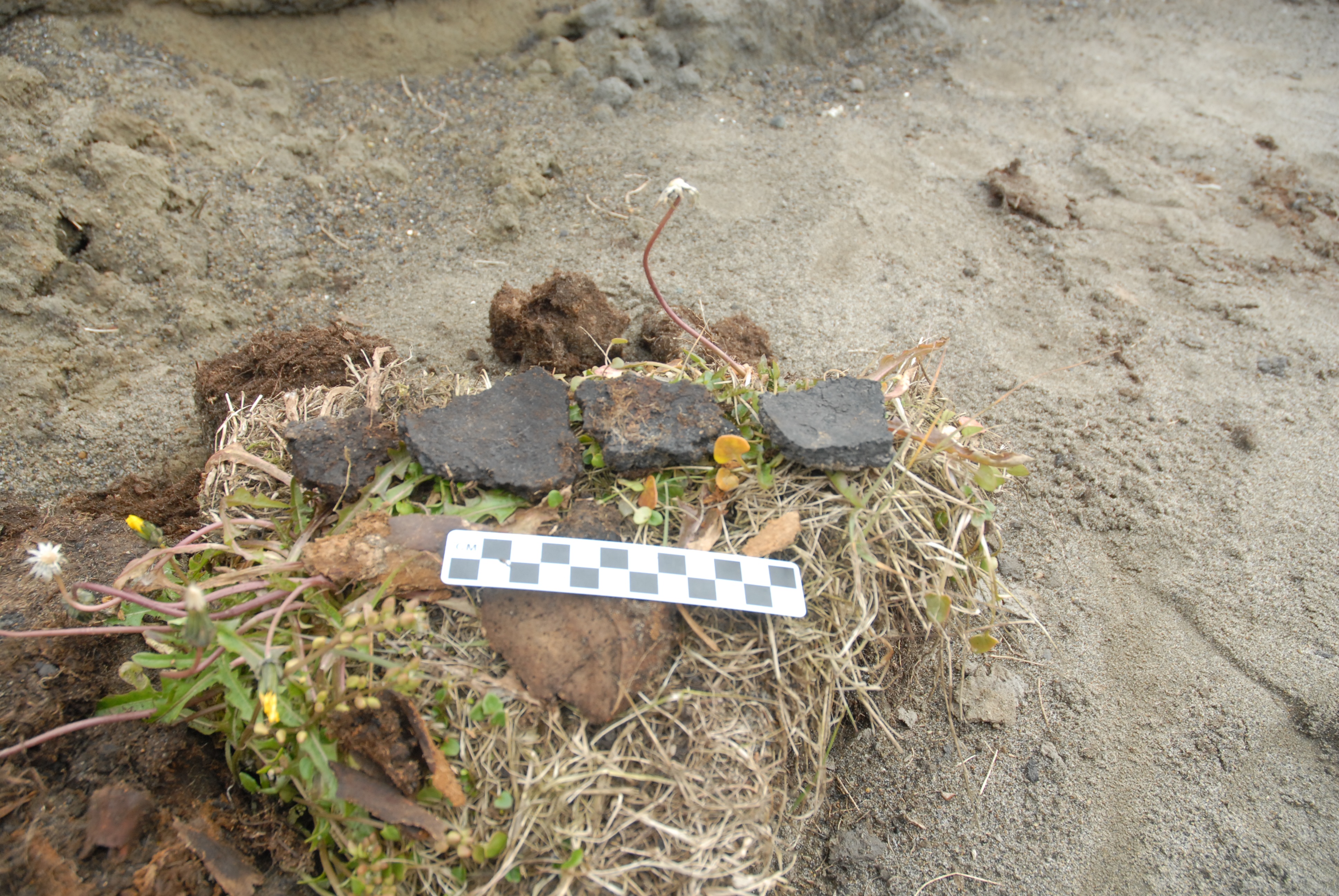
A while after we got there, a boat pulled in, and Jeff Rasic from the National Park Service (in town for a meeting at the Inupiat Heritage Center) Patuk Glenn (IHC) and Kunneak Nageak (IHLC) appeared.  They got a good tour, and spent a bit of time wandering around.  Jeff found a big sod with a lot of artifacts in it, including several very nice potsherds, one with residue, which we collected.

Excavation at Walakpa.
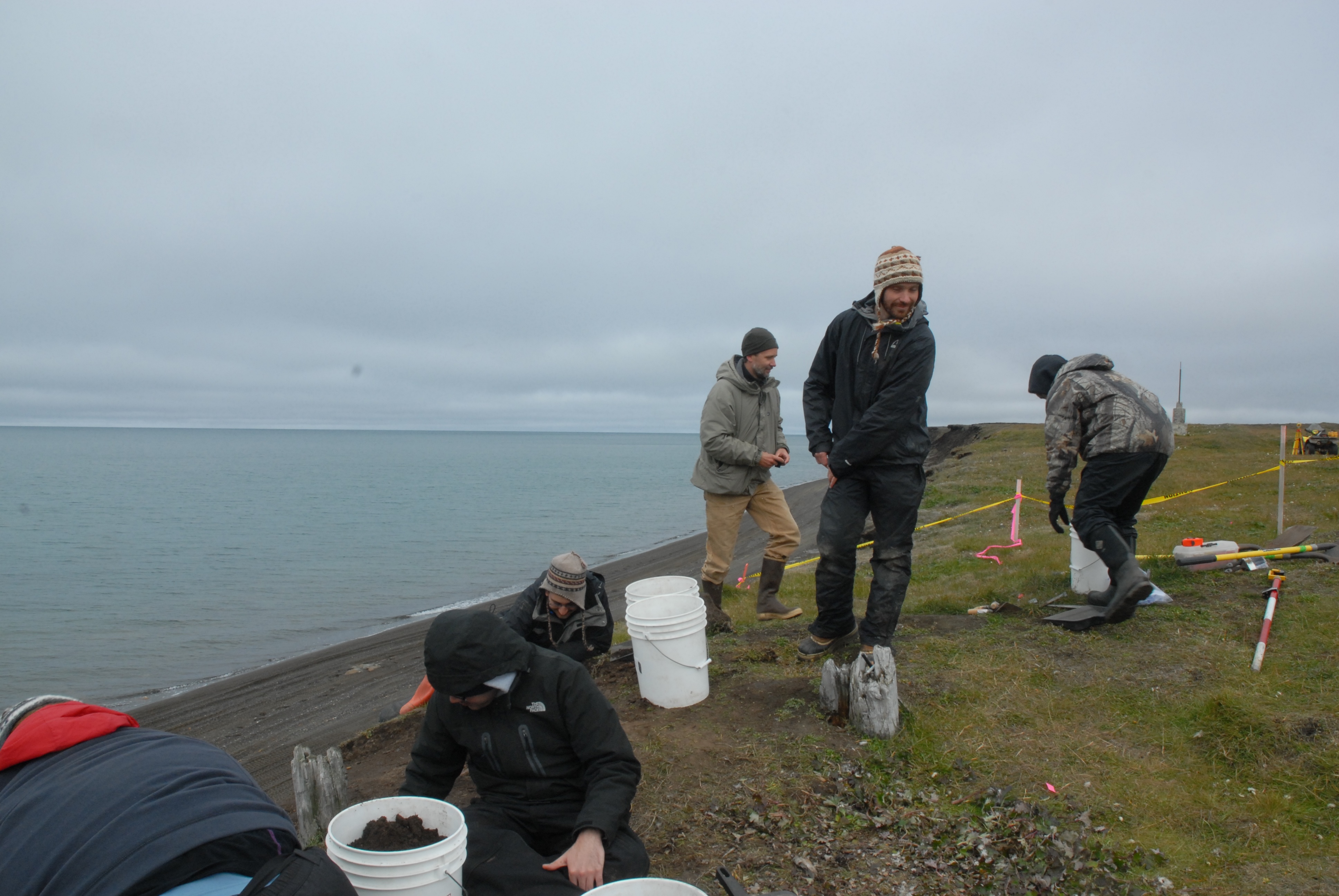
Excavation at Walakpa.  L. to R.  Marybeth Timm, Temerkin Cucukov, Michael Berger, Jeff Rasic, David Pettibone & Trina Brower.
Potsherds.
Potsherds.

The ride home was even more exciting.  Nunavak wasn’t too bad, but they were unloading a barge on the beach, so we took the old Nunavak “road” back to town.  It has pretty much disappeared back into the tundra on the middle section the last few years, and it was a very muddy ride!

A beautiful day at Walakpa!

We went to Walakpa today.  I’d heard that Nunavak might be running too hard to cross, so we were sort of preparing for having to ride around on the tundra, which would be time-consuming and bone-rattling.  When we got there, we were able to find a couple of ways across, so no worries.

We made good progress on removing the sod & an underlying level of disturbed soil.  Aside from the fact that it contains random fragments of bone, charcoal, rocks, lumps of clay, etc, the fact that it is on top of Visqueen in a lot of places is a strong hint.

Excavating at Walakpa.

The last bits of the overhang are gone.  One fell, and the rest we cut off where it was cracking.  It looks like the ground squirrels had a tunnel where the crack was, so there really wasn’t much holding it.  Some of what came off looked like a sod wall, but it had part of a plastic eyeglasses frame in it, so it can’t be very old, or associated with the house.  We are almost at the point where we should be able to excavate normally.

It was a beautiful day.

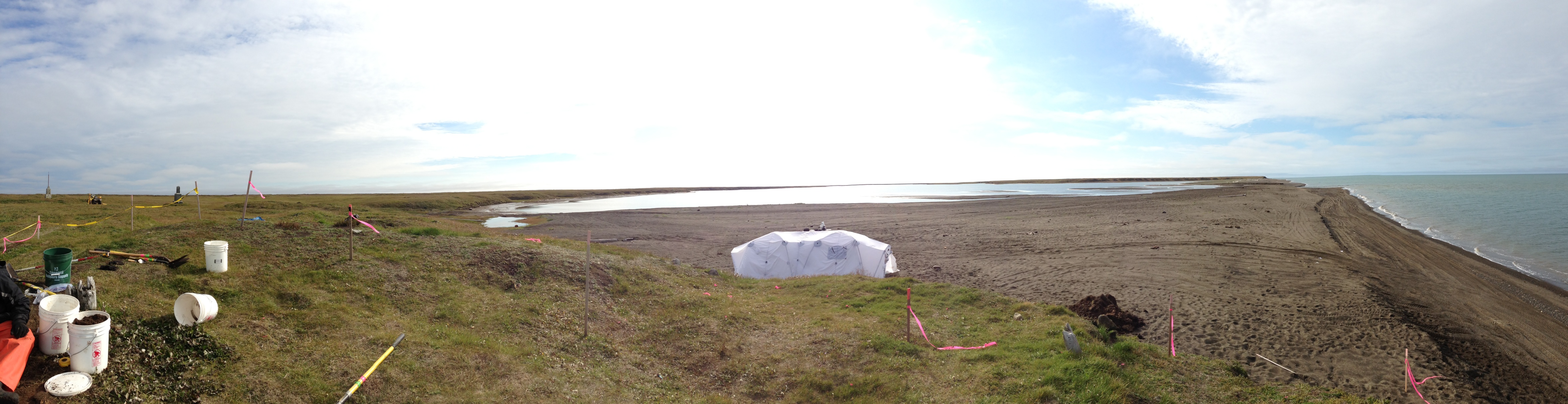
Walakpa around lunchtime.

On the way to Aukureyri

I’m heading to Akureyri, Iceland, to take part in a workshop and a NABO Open Meeting.  It’s a fairly long trip from Barrow to anywhere, but Icelandair is now flying direct Anchorage-Reykjavik, so that’s a help.  Not surprisingly, seats on the July 4th departure were very, very cheap, so it was more cost effective to fly me to Iceland then, and put me up in Reykjavik for a couple of days before I head to Akureyri.

When I left Barrow, the ice had come back in.  I got a good shot of the only operational heavy icebreaker in the US fleet, USCG Polar Star lying off Barrow.  You can see masts belonging to much smaller vessels off her bow.  They are a French group who are trying to take a catamaran to the North Pole (it apparently can move over ice as well as water, or they hope so).  They beat  Polar Star to Barrow by a couple days.

USCG Polar Star off Barrow in the ice.

The flight from Anchorage leaves at 3:15 PM AKDT, and gets in at 6AM local (GMT) which is before bedtime in Alaska, so I didn’t get much sleep.  I was wiped, so I took a nap, planning to get up and go wandering about Reykjavik.  Alas, the weather didn’t cooperate.  When I got up, it was raining & blowing 25+.

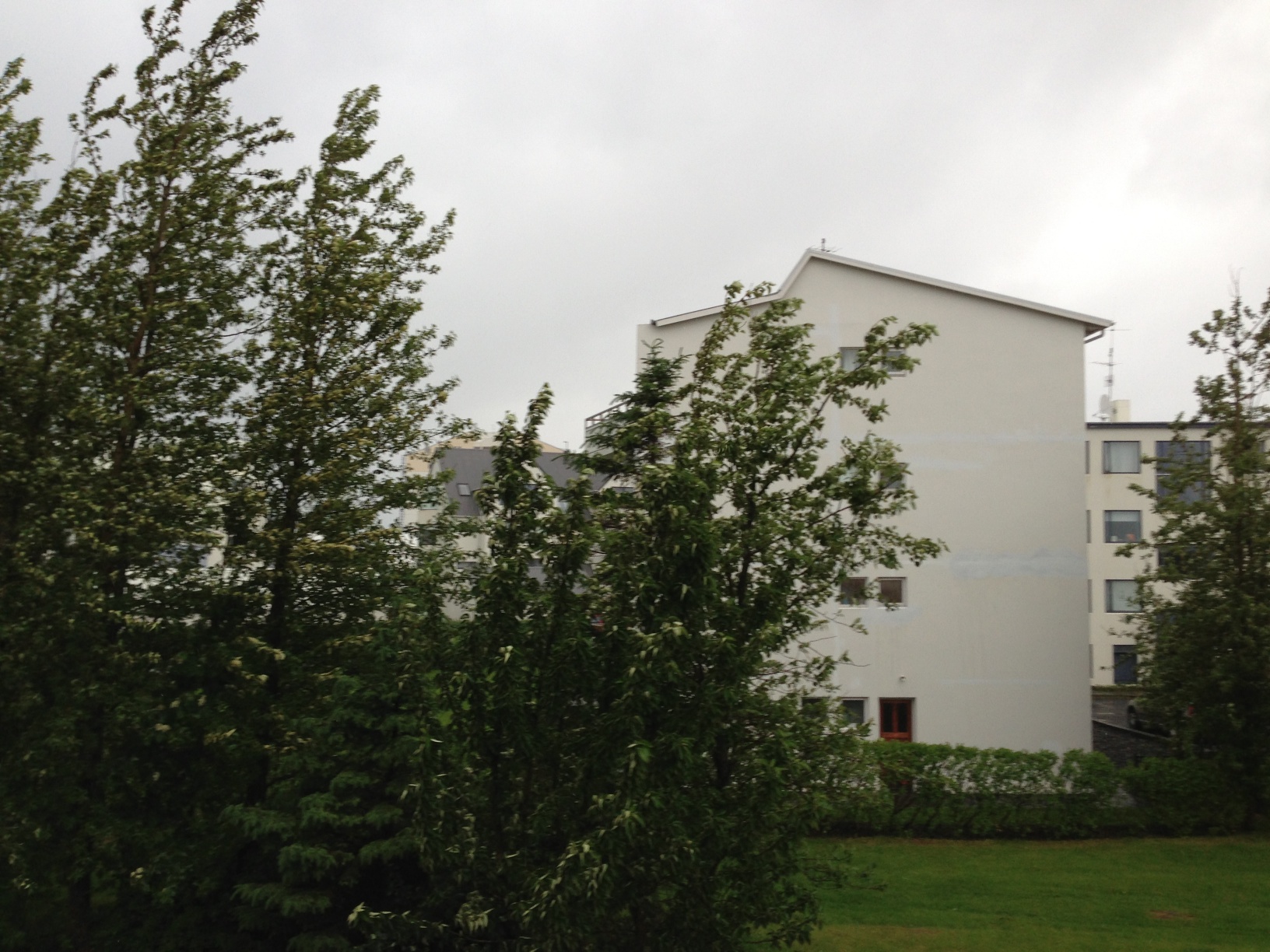
View out the livingroom window of the B&B
View out the living room window of the B&B

So I confined my walking to a trip to the grocery store and bakery.  Lots of nice local vegetables for good prices–geothermal greenhouses can do wonders.

This morning the weather had improved, so I headed out to see some sights.  I had intended to check out a Danish restaurant, but wound up doing something else entirely.  I found a food truck selling grass-fed beef hamburgers, which smelled wonderful.  So that’s what I had.  Then I wound up heading down to the harbor.

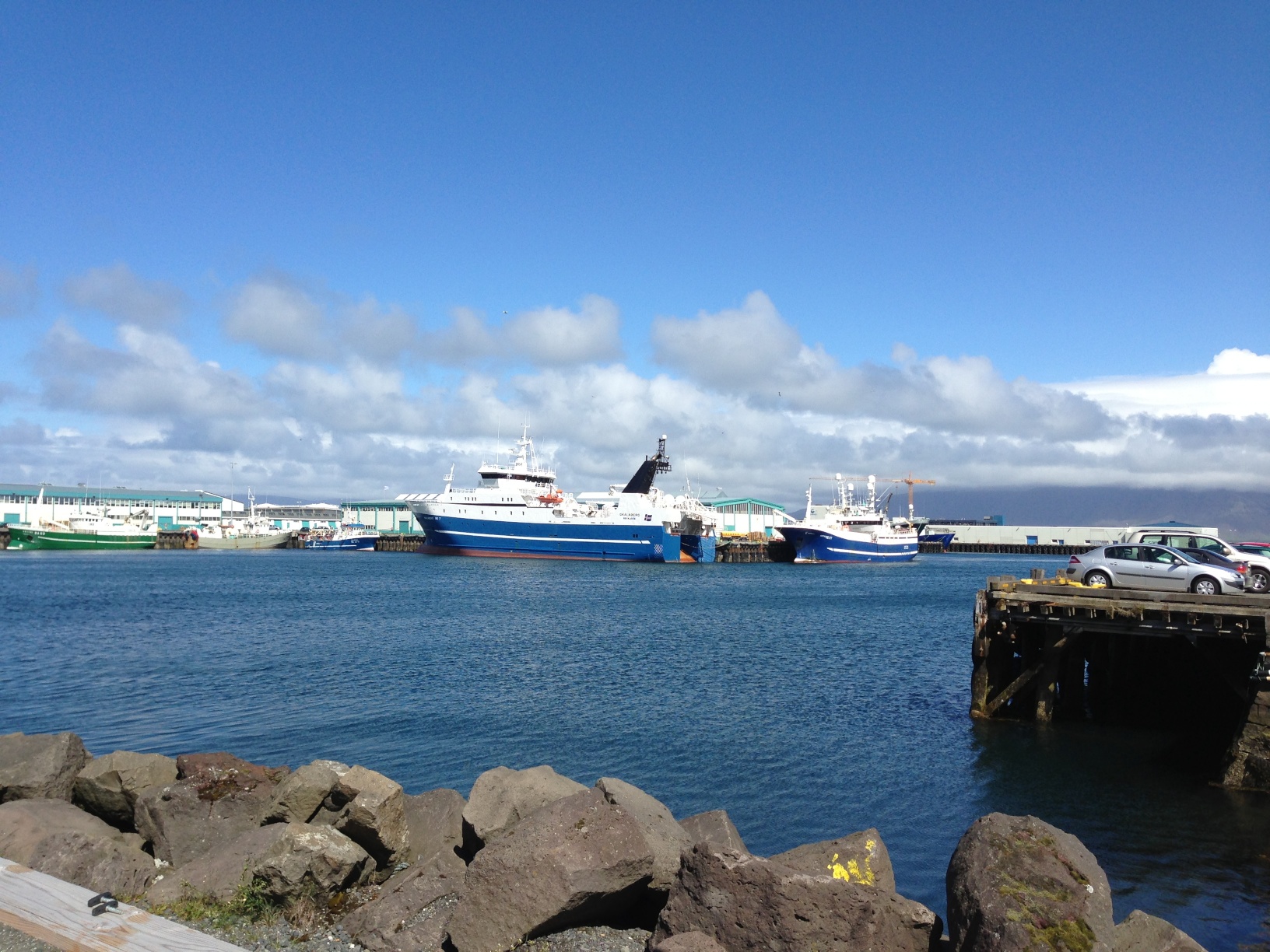
Reykjavik harbor
Reykjavik harbor

The green buildings on the left are former (mostly) fishmongers’ stalls that have been converted to shops & restaurants.  I wound up getting a bracelet made of wolfish leather.  There are still the old ladders, presumably for self-rescue by unfortunate fishermen who fell in on the way back to the ship.

Ladder in the old harbor
Trawler in Reykjavik harbor.

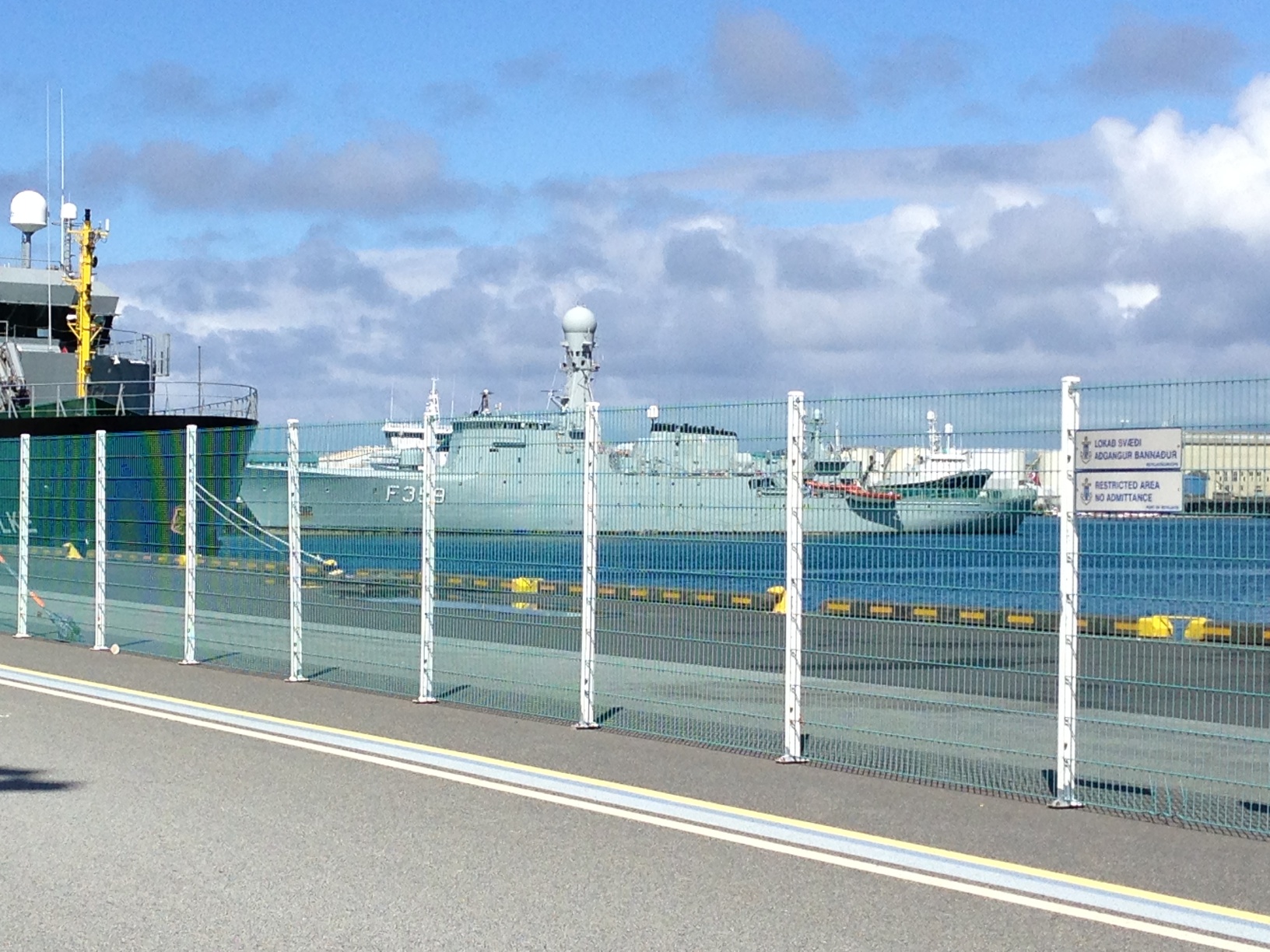
There were the expected Icelandic coast guard ships.  There were also a Danish naval ship and a German Fisheries Protection ship tied up.

Icelandic Coast Guard ships.
Danish ship.
Danish naval fisheries inspection ship, probably HDMS Triton.
German Fisheries Protection ship.

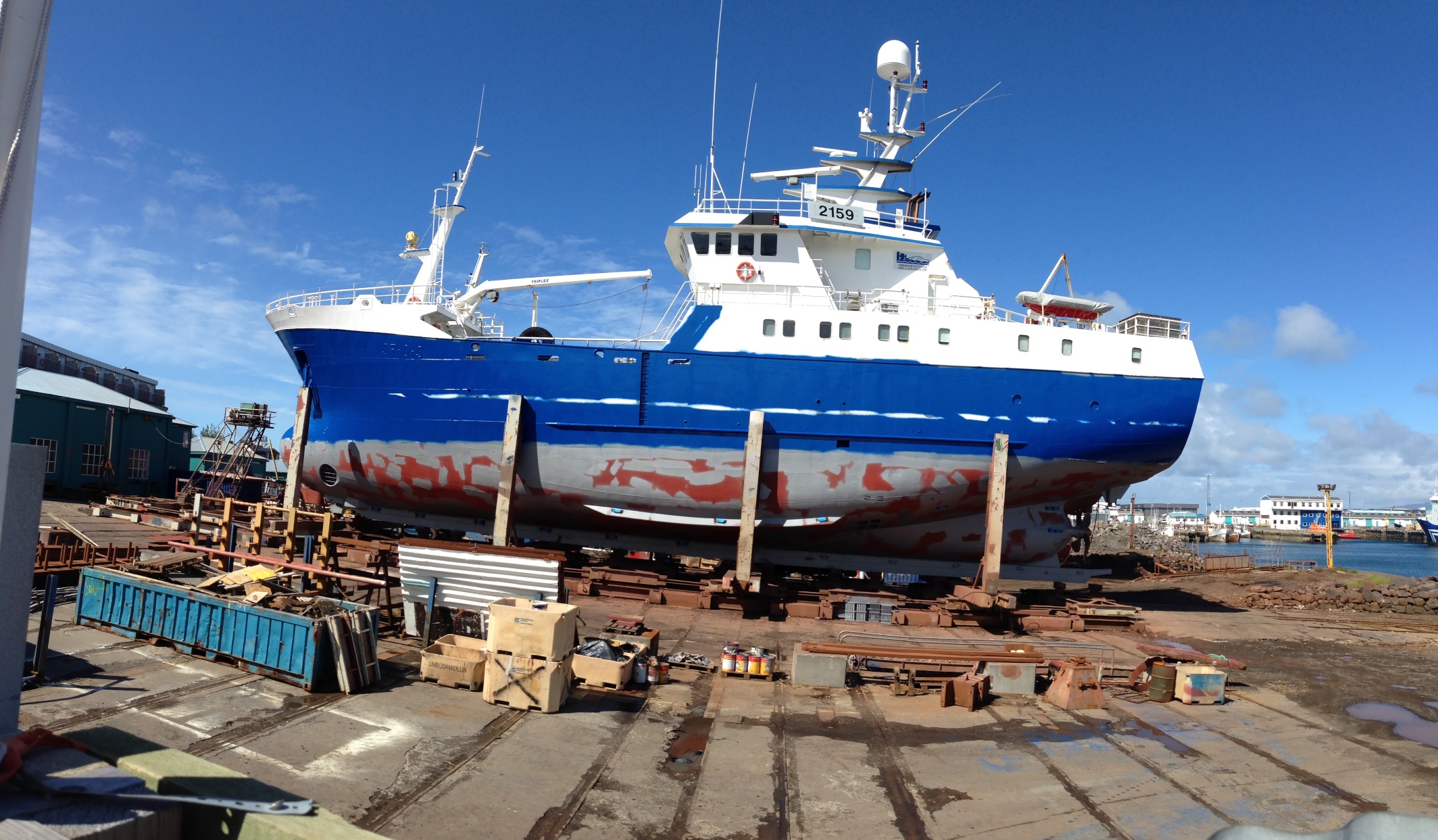
And there were several large fishing vessels out of the water.

Fishing vessel in the yard.
Fishing vessel in the yard, being scraped & painted.


Enhanced by Zemanta

A bit of interior decoration

We’ve added a couple of new student hire for the summer, but still have room for one or two more, so if you are interested, get in touch ASAP!

With the larger crew, we have been working on getting some of the Pingusugruk collection sorted and in proper archival boxes.  We need to move the container it was in, so we’d have to move the boxes anyway, and this way we can not only record which bag is in which numbered box, but also sort the “Tamis” bags, which are the 25% random sample drawn at time of excavation from the rest, to make future analysis easier, and find the rest of the bags from the column sample that Rebecca Connor & Angelique Neffe started on, so I can finish that analysis.  Most of this work is being done by our adult volunteers.

The students worked on this a little, mostly to get it set up so the volunteers can work easily, and also to get more room on the lab benches, so that they can work on the Nuvuk materials with no chance of things getting mixed up.  In the process, we had a number of animal bones that were collected on the beach or tundra and donated to us.  Some of them have been labeled as to species and element, and are being used to help with the preliminary sort and cataloging of the materials from Nuvuk Locus 6 midden.

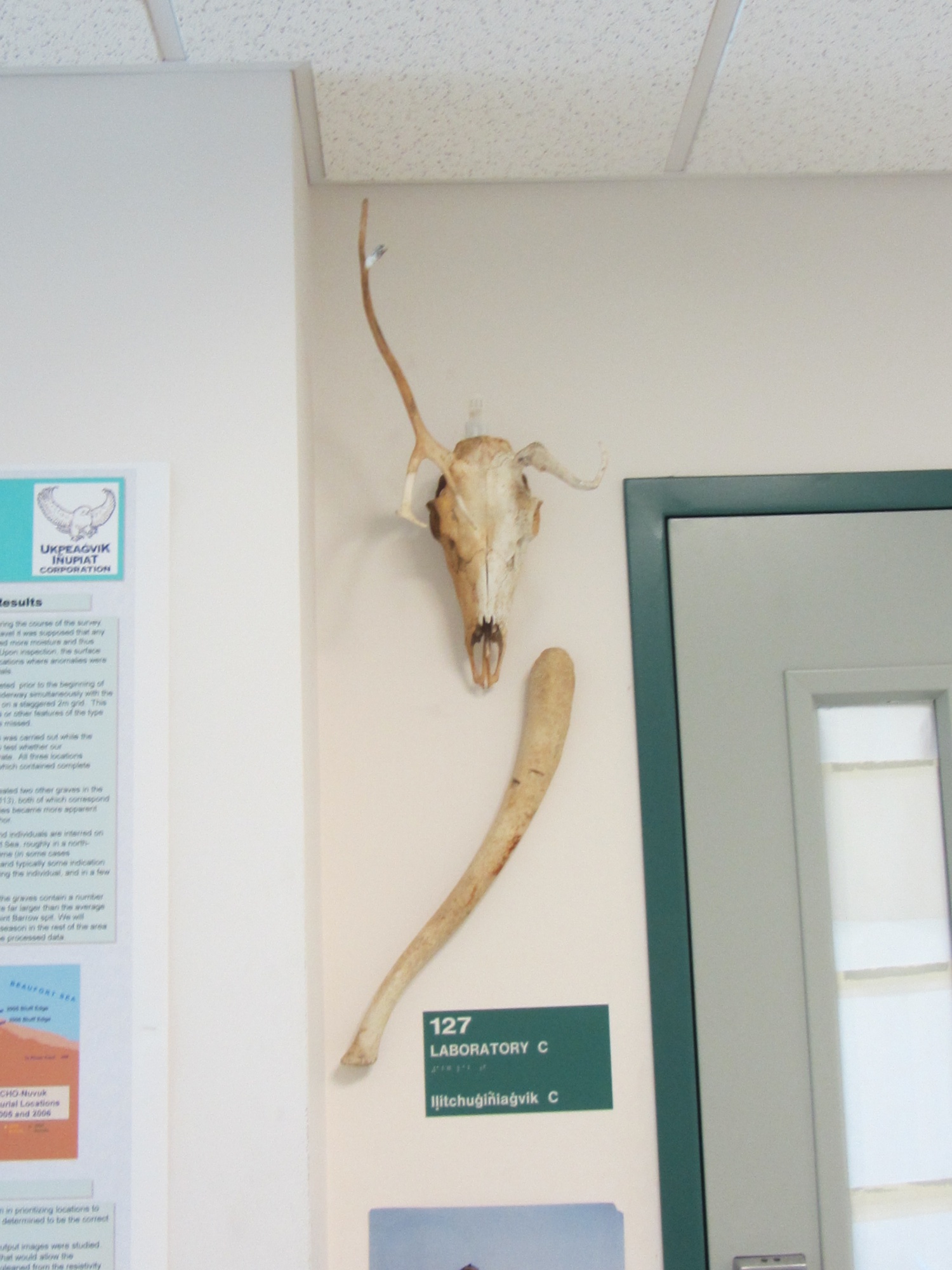
There were a few things which were sort of superfluous, like a caribou skull.  The students really wanted to use it as a decoration, so with a little glue to keep the teeth in, it was suspended outside the door (using peel-off hangers of course to avoid damaging the wall.

The caribou skull
The caribou skull

Apparently, they found something else they felt was not necessary to include in the comparative collection, either because we haven’t found any (we haven’t) or because they figure everyone already knows what it is.  The next day, this is what the door looked like.

A addition to the decor
The new addition is a walrus baculum, often known as an oosik.  I doubt some of the visiting scientists know what they are looking at :-).

Enhanced by Zemanta

Article on Nuvuk Project available Free Access for the rest of January

I just got an email from the editor of Polar Geography, the journal in which on of the articles I have been working on over the past year or so was recently published as part of a special issue on Arctic Community Engagement during the 2007-2008 International Polar Year.  He has been able to arrange for several of the contributions to the issue, including my article, to be available Free Access (no pay wall) until the end of January 2013.  My article is here, and the contents of the entire issue, with links to the various articles, is here.

This is a limited time offer, so if you are interested, head over there now.  You should be able to download the free articles to read later.


Enhanced by Zemanta

A trip to the nation’s capitol

Last week I went to Washington, DC.  I went for the 18th Inuit Studies Conference.  The Inuit Studies Conference happens somewhere every two years, and this year it was hosted by the Smithsonian.  I was a co-author on a paper on aDNA from the North Slope (I provided the archaeological background), and I wanted to hear it, as well as a couple of other Arctic genetics papers.  I also wanted to get together with several folks I collaborate with who were going to be there.  Sometimes face-to-face is better than Skype between Europe & Alaska.

Because of the Smithsonian hosting, it was a bit of an odd conference.  There was no main conference hotel.  Events & sessions took place at three different venues distributed around the mall, which in many cases made it logistically impossible to catch a paper in one session and hop over to another session.  The program didn’t have times set for papers, so it was tough to know when folks were talking even if the sessions were next door to one another.  And of course there was the usual problem of all the papers on a topic being scheduled in sessions which were opposite each other!  Despite the challenges, there was a very interesting Paleoeskimo session, which I was able to go to 2/3rds of.  I had to miss the end to go over the National Museum of the American Indian (NMAI) to hear the paper on Nuvuk (given by Justin Tackney) and one on the North Slope modern genetics given by Jenny Raff.  They were in a session with papers on 1) Unangan myth and magic, 2) theriomorphic imagery in the Liangzhu culture of China and Old Bering Sea, and 3) the Sealstone (a large petroglyph which was probably from Shemya in the Aleutian Islands, although it had been removed to a garden in California and the folks who were trying to return it to its home weren’t quite sure.  It was a bit incoherent.

All this happened opposite what looked like a very interesting session on ethnology and one on education with a number of my friends from the North Slope in it.  The next day I went to a session to hear a couple of archaeology papers, which were in a session with a paper on Greenlandic theater and a paper about a novel about Greenland.

I arrived to find my registration had gotten scrambled, so that there was no banquet ticket (and they were sold out).  A 1-day registration was $100, and the full conference was $325.  Even though I was only able to stay for 2 days, I had to pay the full conference fee!  It didn’t seem quite right, but there was supposed to be a free book included.  Unfortunately, they were out of all the books that I didn’t already own, and even though they kept saying more copies would come, they never did…  Hauling an extra copy of a book back to Alaska in my carry-on didn’t seem that attractive.

While I was there, it became clear that Sandy was going to play havoc with my planned return to Alaska (by way of my Mom’s in upstate NY).  That in turn would mess up plans for a trip to Valdez for an Arctic Visiting Scholars speaking tour and Seattle for a workshop.  I had to spend some time on the phone moving the travel up a day, and changing the routing out of Albany to head Alaska by going west to Minneapolis instead of south to Atlanta.

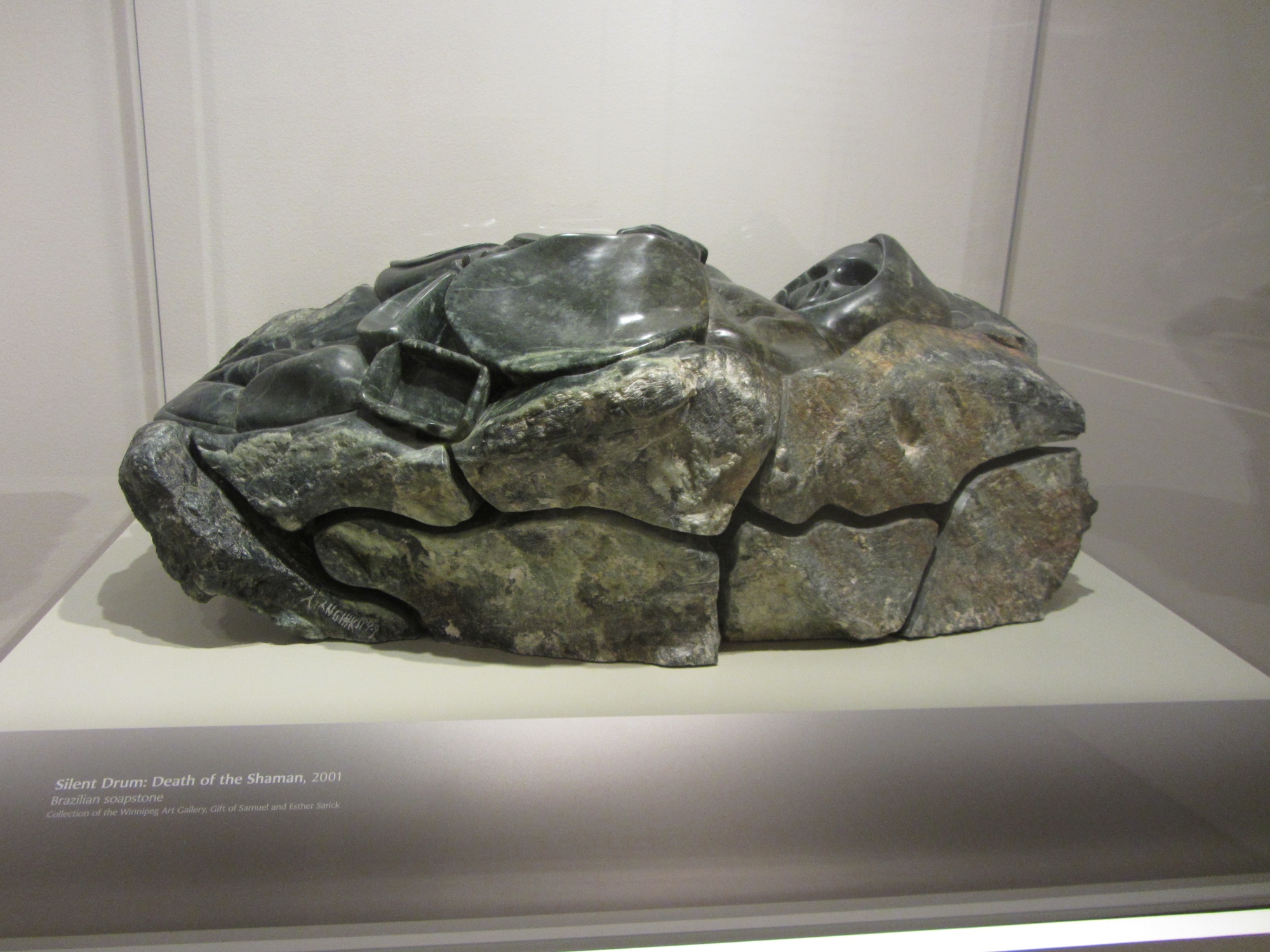
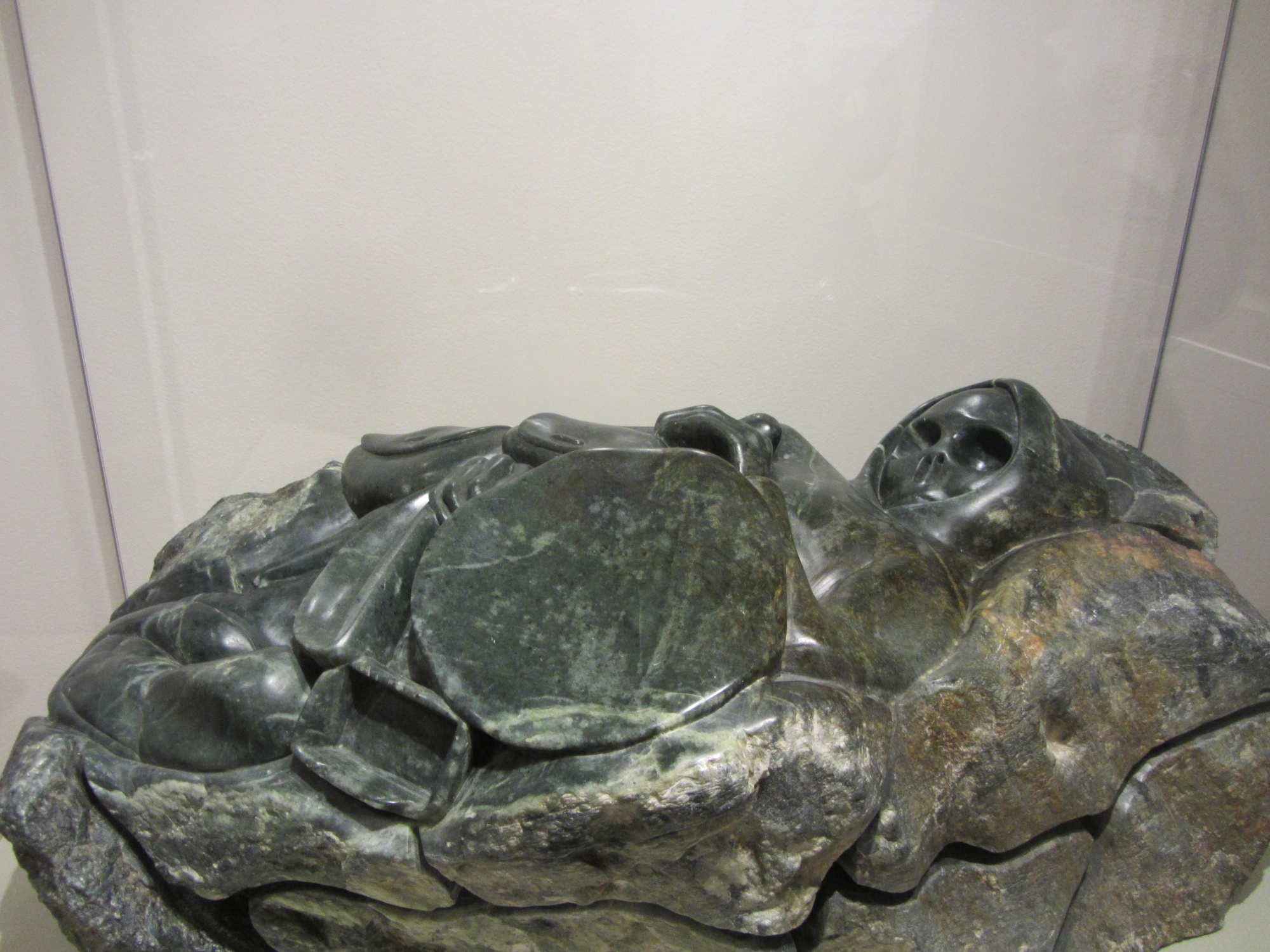
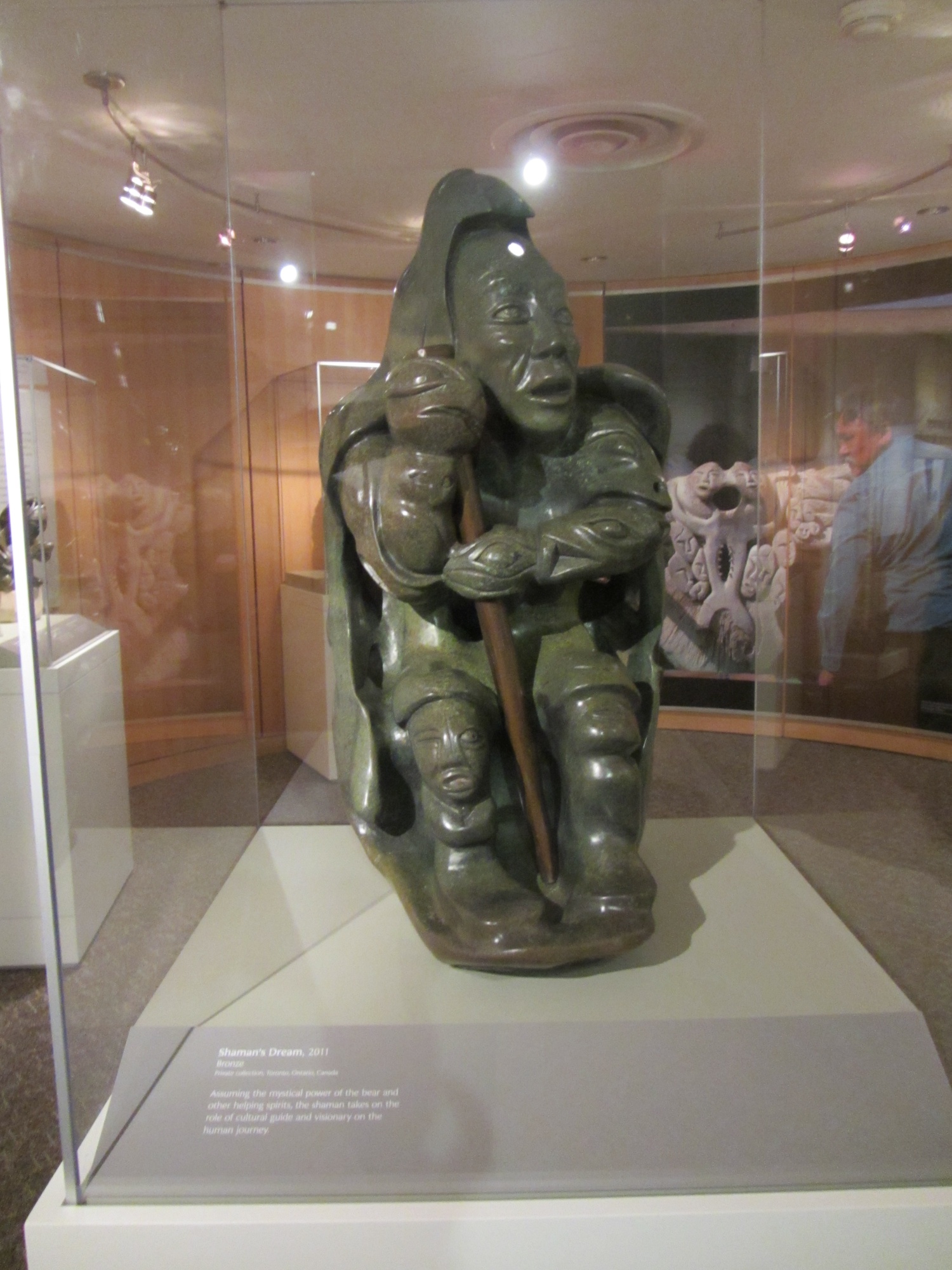
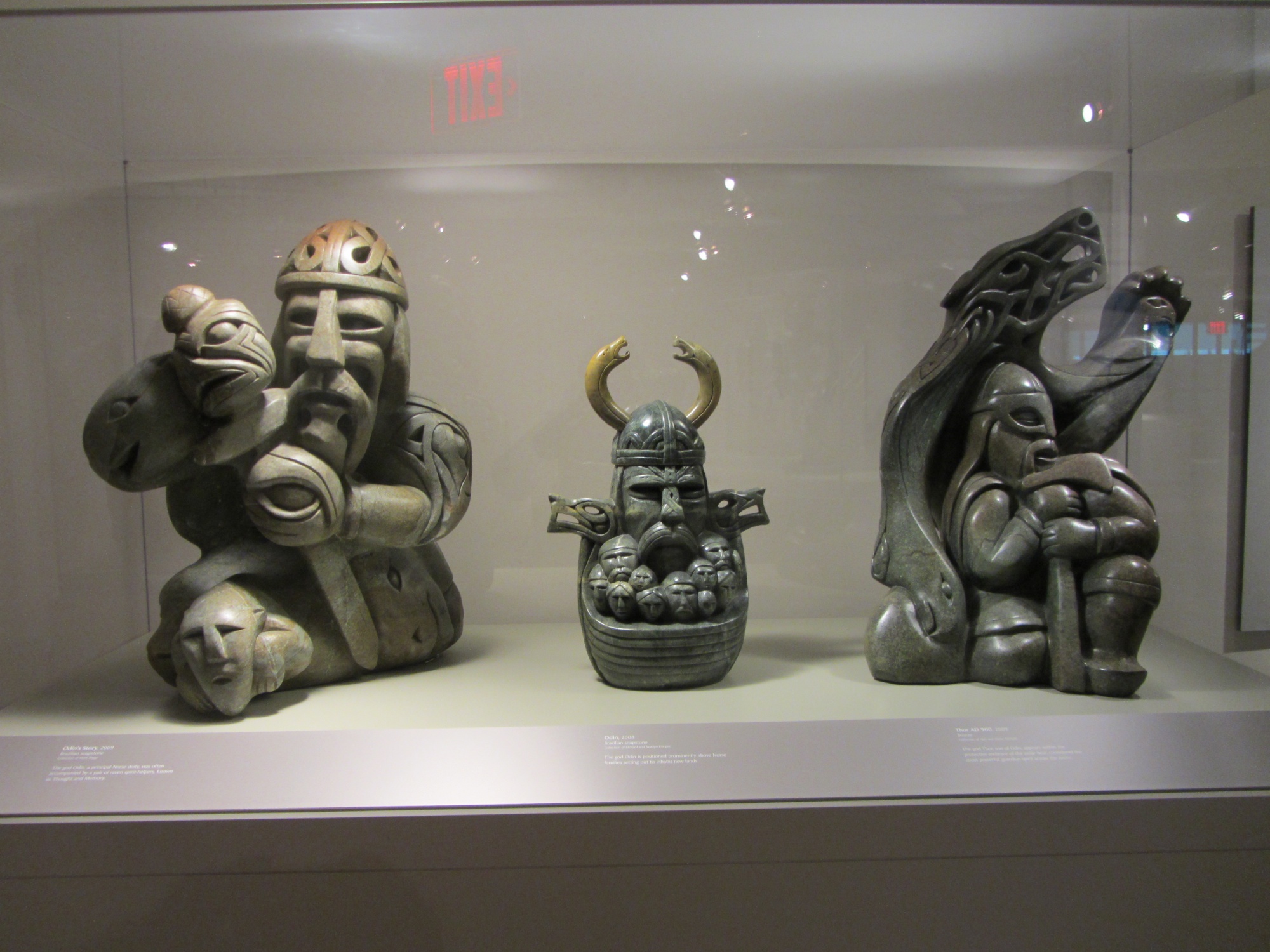
One of the pluses of the various venues was getting to see a special exhibition at NMAI of the sculpture of Abraham Anghik Reuben.  His work was using aspects of the lives of the ancient Norse and the Thule whalers.  There is a Flickr photo stream with professional pictures here, but I took some too.  My favorite of all was Silent Drum: Death of the Shaman.

This piece is so powerful.
Enhanced by Zemanta

The artist captured the way it would look in amazing fashion, given that he is working in stone, not with soft material.
This blind shaman’s eyes are astounding. You can see the cataracts (at least in person).
Odin, his ravens, & other Norse being.

So today is my birthday…

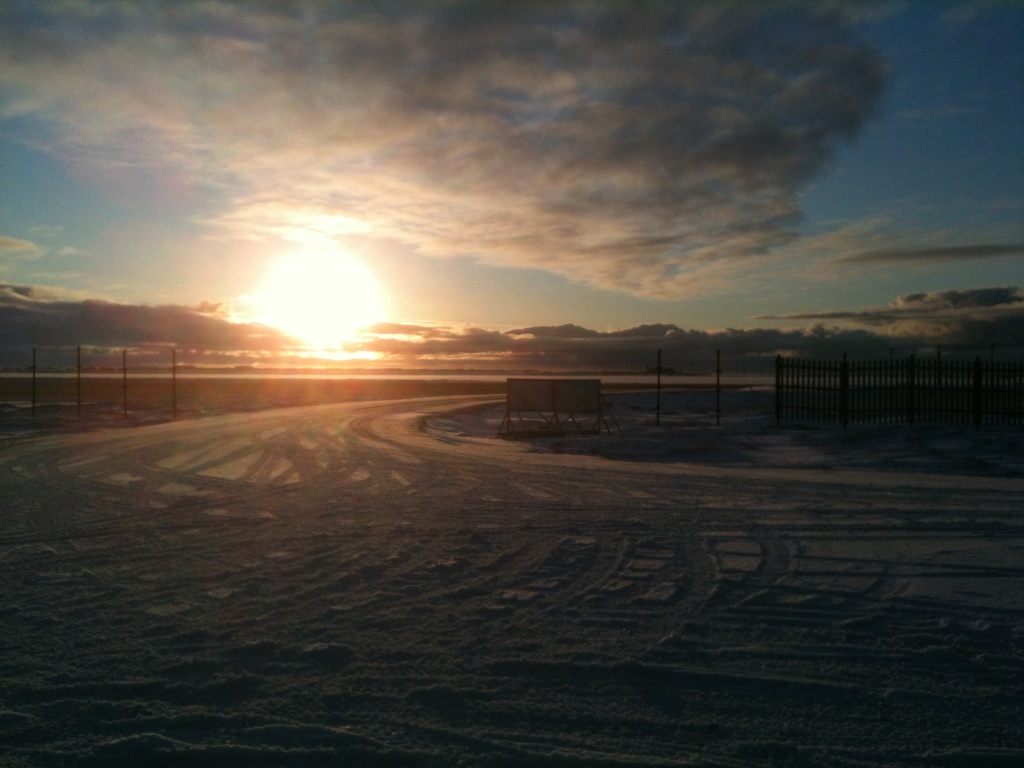
And it’s been great so far!  The weather has been gorgeous, not too cold or windy.  The light this morning was amazing, golden reflecting off the clouds & snow.  Unfortunately no pictures from when it was best because I was trying to get stuff done before I start a series of back-to-back trips, although I did look out the window a lot when I was making phone calls.  I did get some a bit later, and it is still pretty great.

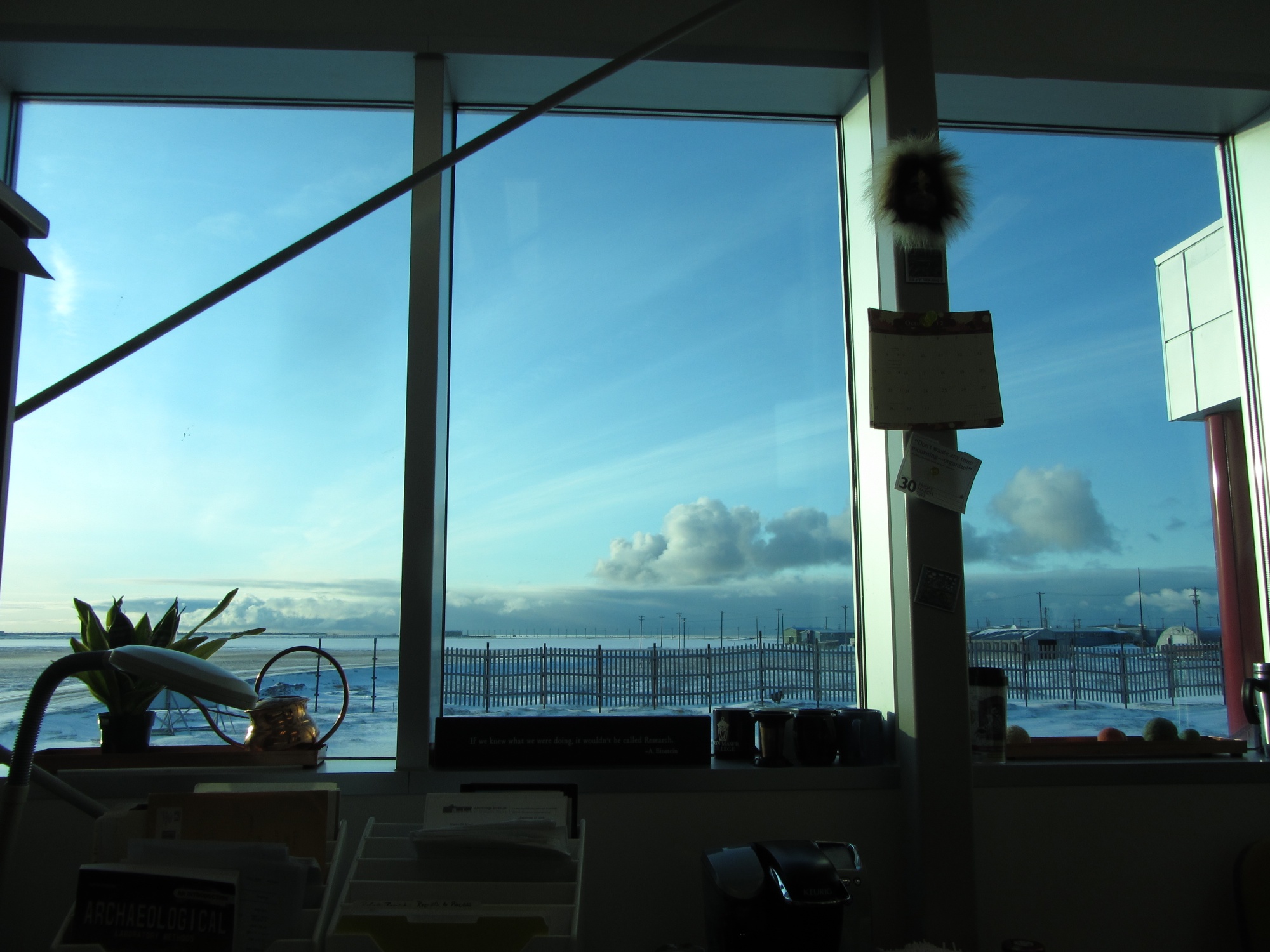
View out my office window
Looking south around 3 PM (local noon).
Clouds over Barrow & the Chukchi

Last year I got to finish unwrapping the child on my birthday.  This year was not nearly as exciting, but then archaeology really isn’t like Indiana Jones… much.  I finished and sent the quarterly report to the client on our activities supporting the ARM site.  It is good to look back and see what has been done, and I’m using a format that asks for lessons learned, so it forces one to think and track, which is not a bad thing and easy to skip when things get busy.

I made the final corrections on the encyclopedia entry on frozen sites, and am just waiting for one image to upload it to the publisher.  The Point Hope chapter is being read (quickly, I hope) by a couple of friends, and then will get sent to the editors for review.  I still need to recalibrate C14 dates for Northern Archaic and Palearctic, but that can get added to the final.

One of the things I’m involved in as part of the GHEA/Long-Term Sustainability RCN is a workshop on the Kurils & Aleutian Islands.  I’m a participant, not a discussant, which is a bit odd since I’ve never stepped foot in either one of them, or even worked on a collection from either area.  The workshop involves putting up some articles and a conference paper ahead of time, and some on-line discussion, in hopes that we will all be up to speed by the time we get to Seattle, and can hit the ground running.  I got put in a group looking at Ecological Dynamics and Paleoecological Histories, which is very cool.  I definitely have some catching up in the literature to do here, so I spent a chunk of the afternoon downloading the various papers & such folks in my group (and others) had put up.  I have put them into my Dropbox and synced my iPad, so I can read them while traveling.  It turns out I am not the only one who doesn’t have a conference paper done, and some of those that are there are not that formal :-).

I also need to find a way to get a paper I wrote on bearded seals in Greenland up.  I don’t have an electronic copy, but it seems pertinent.  One topic that seems to be coming up is possible sea ice extension into the region and folks seem to be making a few unwarranted assumptions about how species that are not now present in the area behave.  That would of course skew any climatic interpretations one might be trying to derive from faunal data.  I think the bearded seal paper covers that and provides a good example of some issues that are counter-intuitive.
And Barrow caught their final whale of the 2012 season!  Hey hey hey Anagi Crew!

View leaving the office.

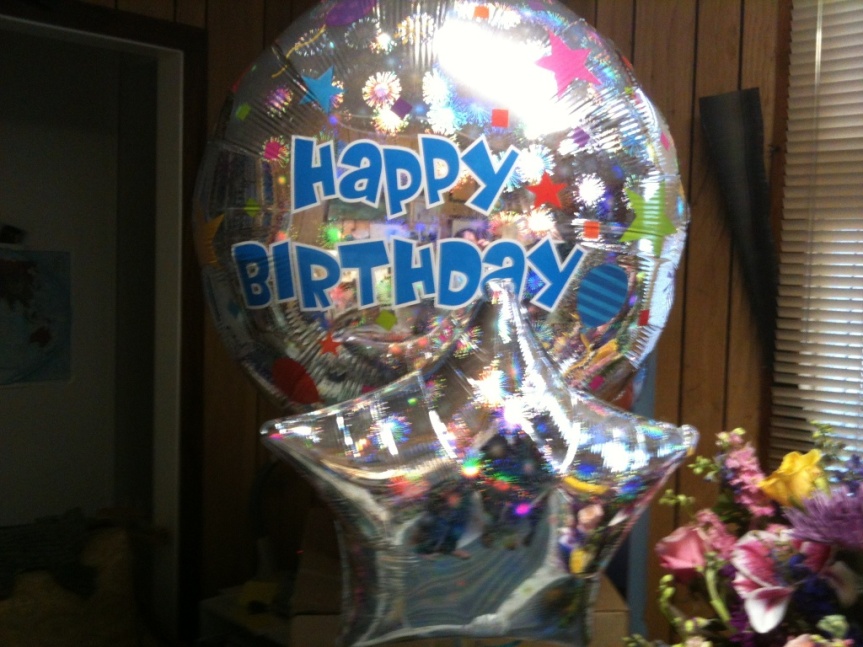
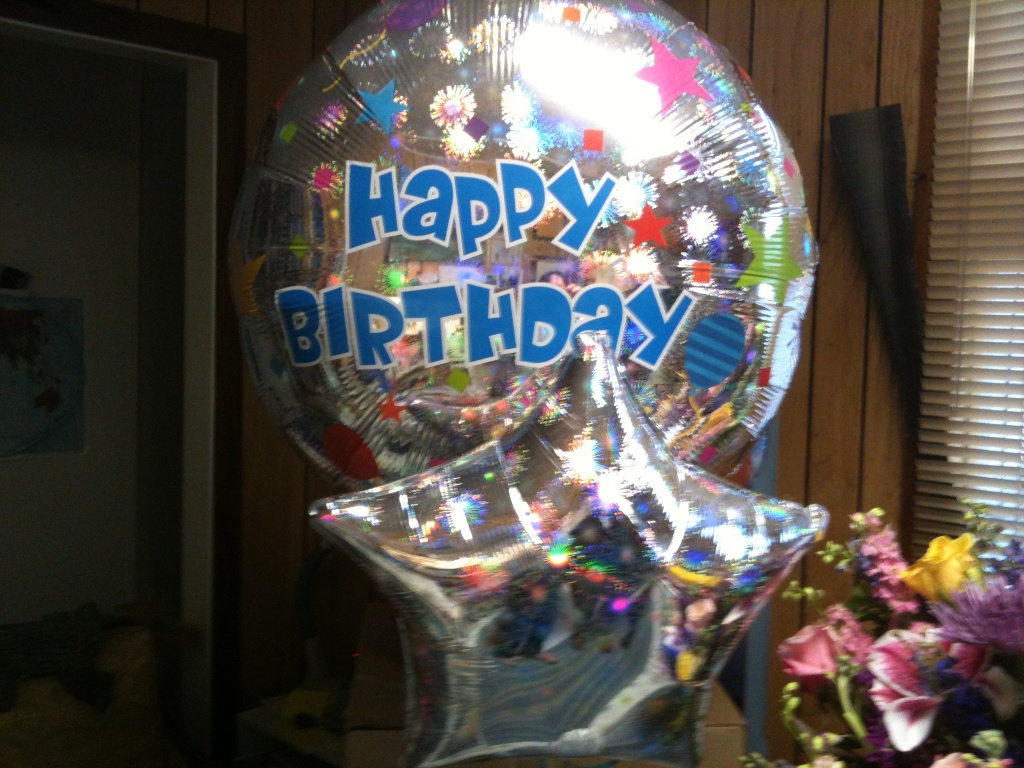
Shortly after I got home there was a know at the door & flowers & balloons arrived! That was quite the surprise, since Glenn had already bought me a huge arrangement of flowers (and a Kindle Paperwhite, which is supposedly in transit).  I unwrapped them, and they turned out to be from the entire staff at UICS (arranged in secret by Tammy).  The flower arrangement is gargantuan!

Flowers & Balloons, with me for scale.
The flowers in close-up.

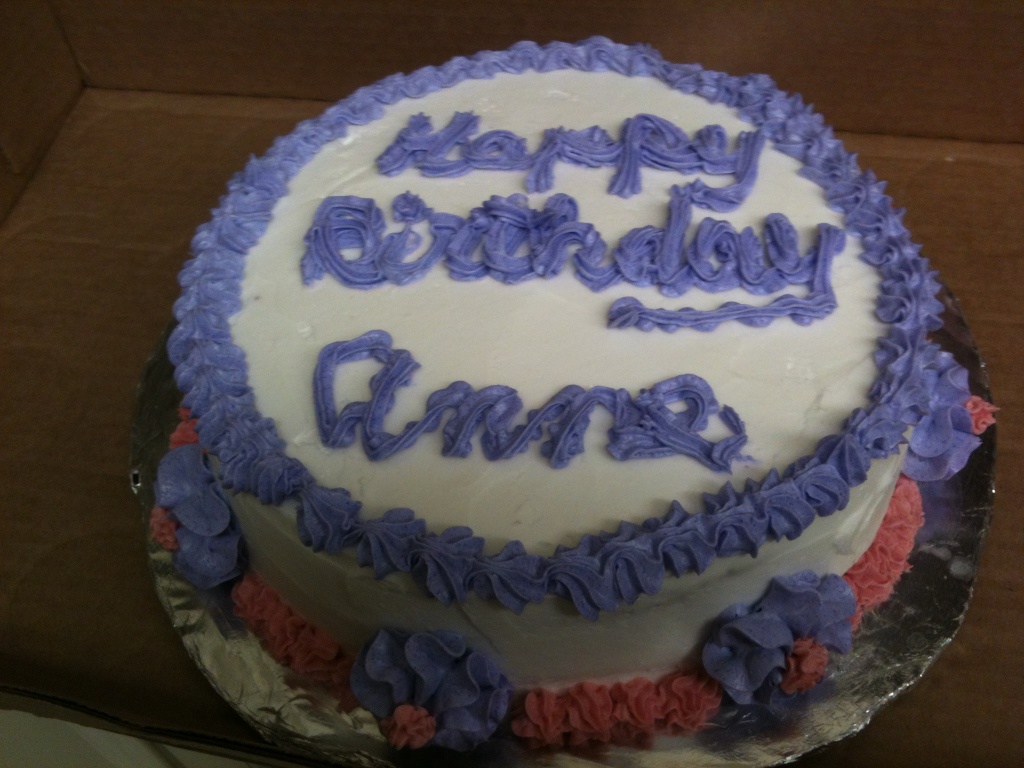
Now I am going to have cake.

Self-explanatory.
Enhanced by Zemanta

Fall storms

I got back to Barrow to find snow on the ground.  It hasn’t been that stormy here, but we  had a coastal flood warning over the weekend, with part of the road to Nuvuk getting washed out, and waves getting over many of the berms.  I am afraid that there may have been significant damage to the site beyond the 20 m we already lost in September.  I would like to get out and take a look, maybe even shoot in the bluff, before I go to Valdez & Seattle, but that is not looking too likely.

Apparently, there is a likelihood of a storm surge from the Chukchi and flooding over the next few days, maybe until the 22nd or so.  The North Slope Borough is quite worried, and sending out info on emergency kits & so forth.  Not a great situation.  The house I live in floated in the last really big storm surge event in 1963, and if it does it again, it could wind up in the NARL sewage lagoon.  Yuck.

We’ll be prepared, but I don’t think it is that likely to get that bad.  However, it most certainly is already damaging Nuvuk more.  It has been blowing from the north and winds are picking up.  It is a bit depressing given that erosion must nearly have reached the GPR returns that we think are Ipiutak features.

Not much to be done about it, so I just push on with writing proposals & papers.  I’m going to a workshop on the Kurils & Aleutians, and am slightly belated working on the conference paper.  Just as I got ready to really check out the other papers prior to doing the serious writing (the outline is done), it was discovered the website had lost the last 3 weeks of updates (explains where my stuff went–I thought they were just being slow getting it up), so I couldn’t get into it.  I hope we don’t lose Internet later this week, and that I have decent connectivity in Valdez.

Enhanced by Zemanta