Once again, I have been spending time choosing the crew for the summer season at Nuvuk. There are a lot of factors that go into the choice, as I explained last year. Once again, I think (hope) I’ve got a good group. Most of the high school students have worked on the project for some time, some for several years. We’ve got one who has been working in the lab for months, and a couple who are totally new. We start orientation on June 13th.
One of the NSF-funded folks was actually on the crew in 2009. Dr. Tom Besom was going to be in Kamchatka this summer, but the project sort of fell through, so he’s coming back to Nuvuk. A good thing, since he is fluent in Spanish (his primary research specialty is Andean mummies) and will be a big help with making sure the Mexican students from the Mexican-American Exchange project who will be joining us get clear explanations and translations. Krysta Terry was also going to return, but her father has a serious health problem, so she can’t take off for the Arctic. Even though we have jet service twice daily and three times on Thursdays and Saturdays, it can take a couple of days to get to most place that aren’t on the West Coast; more than that if the planes are fully booked with tourists or the weather is foggy.
I’ve still got to do the final update of the memo we’ve developed for new crew on what and what not to bring (no flashlights), and send that out. Now the fun of trying to book cheap, yet not horrendous travel for five people to Barrow…
I went out to Nuvuk today. The purpose of the trip was to accompany Hank Statscewich from the University of Alaska Fairbanks, who needs to pick out a new site for an experimental current radar. They have run it near NARL for a year, with no problems, so they want to try it further out-of-town. Since there is a good bit of archaeology out at the tip of Point Barrow, the idea was that I could help him find a spot that was not likely to have any archaeology. We’ll still test before anything gets put out there, but still.
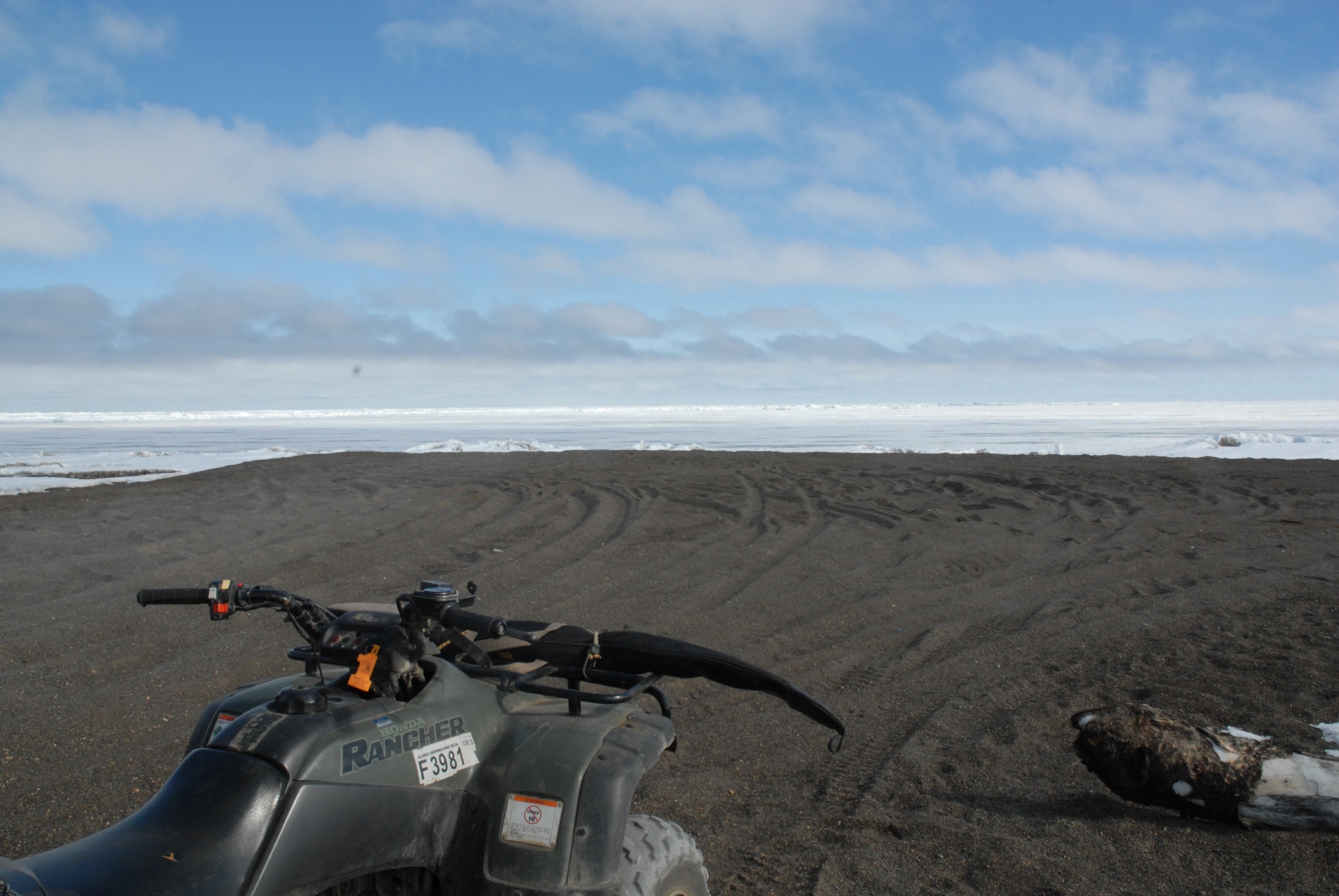
It was a sunny day, but there was a good East wind off the ice. We were heading into it, more or less, going probably 25-30 mph until we got off the road, and the ATVs from BASC didn’t have windshields on them yet (they take them off when storing them so they can fit more vehicles into a smaller space). That bit was not fun.
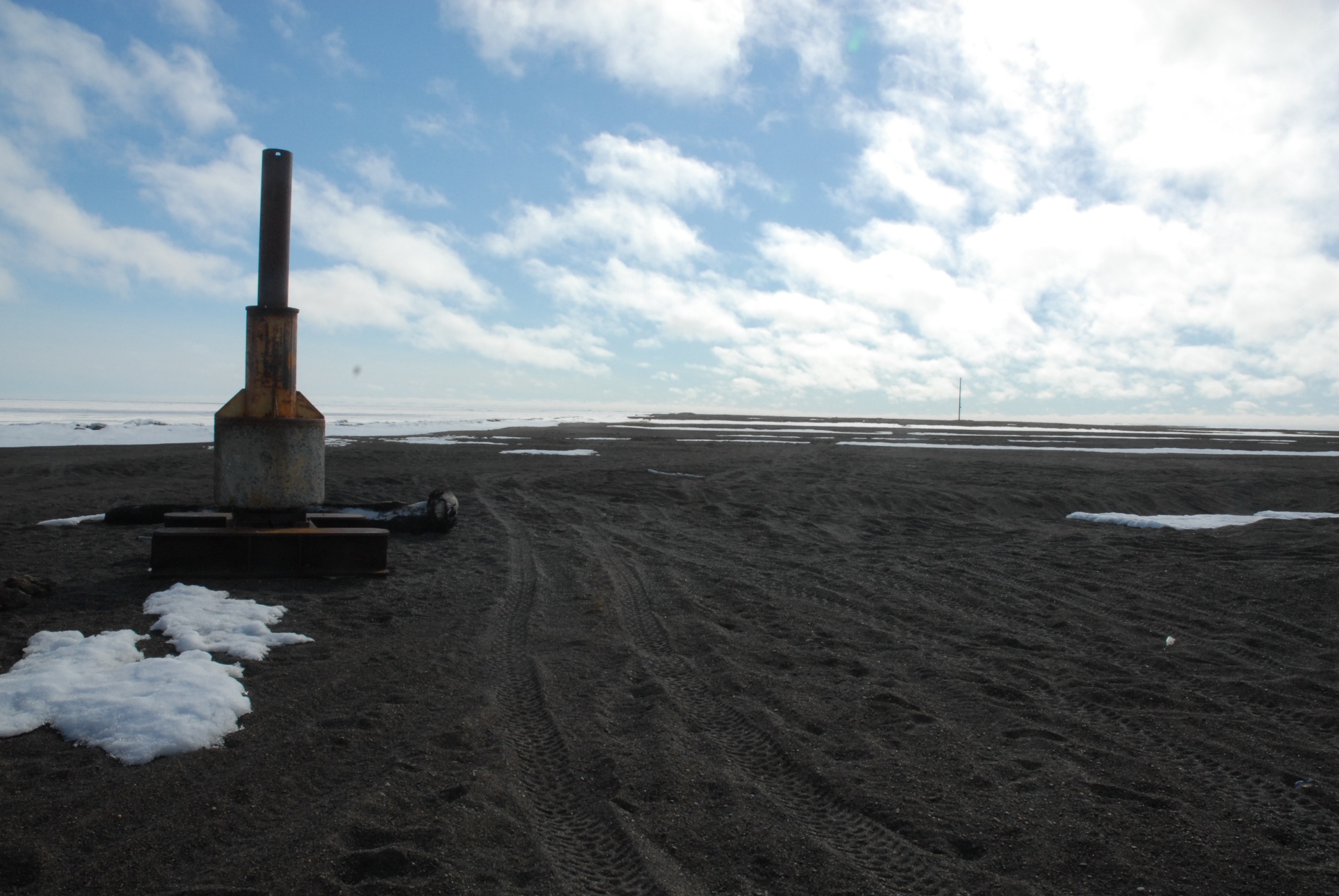
The first place we went was on the younger, more western of the two prominent beach ridges, near a weird concrete and steel device that reportedly was brought over from Prudhoe Bay during the gray whale rescue. It seemed like a good possibility, so we took GPS readings. It looks like there has been a good bit of er
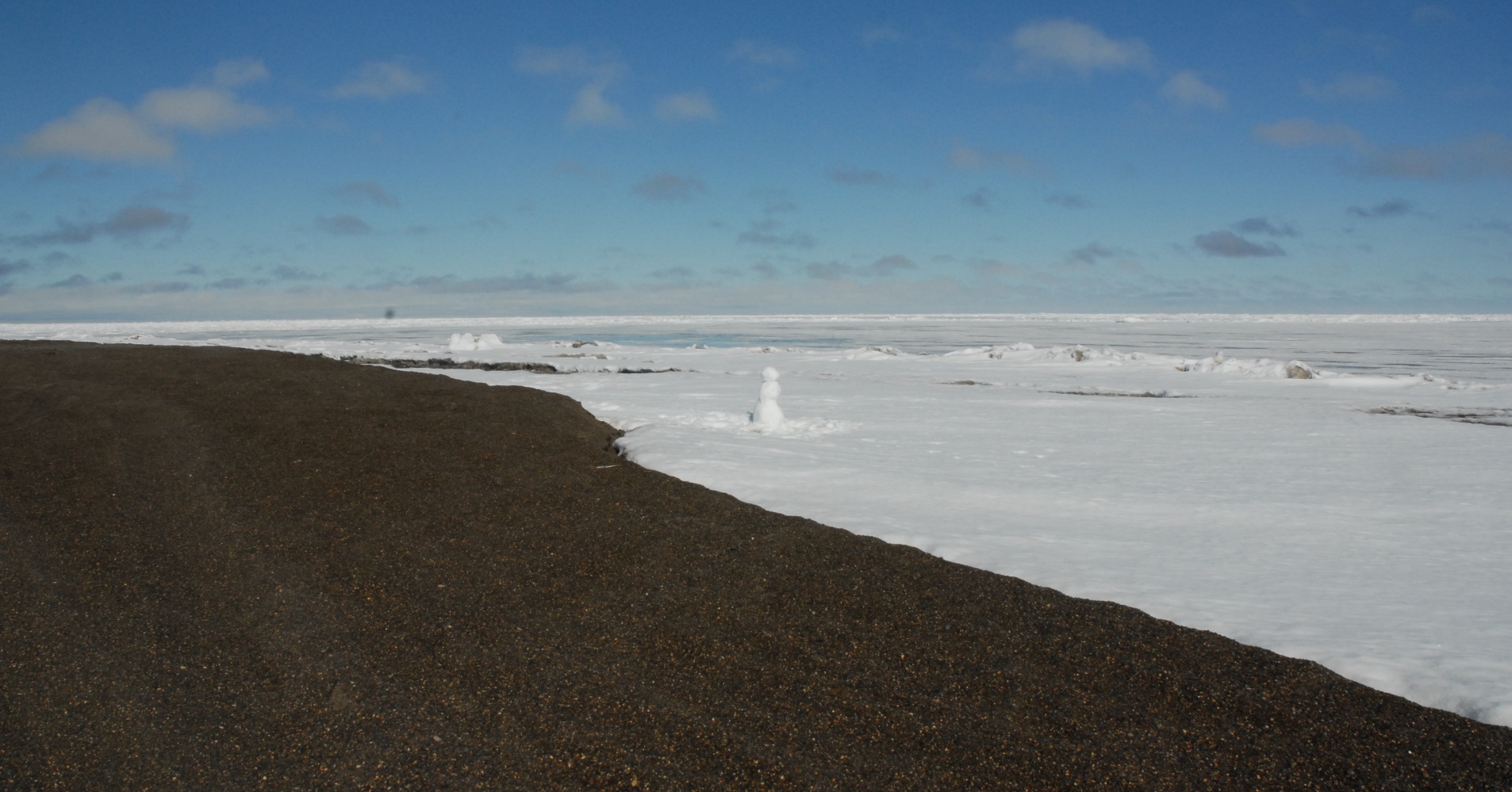
Looking at the ice on the Beaufort Sea, I was happy to see it was really flat for quite a way out. That will make it easy for bear guards to spot bears there, if only it will stay that way.
Flat ice on the Beaufort Sea, at the farthest north point in the US.
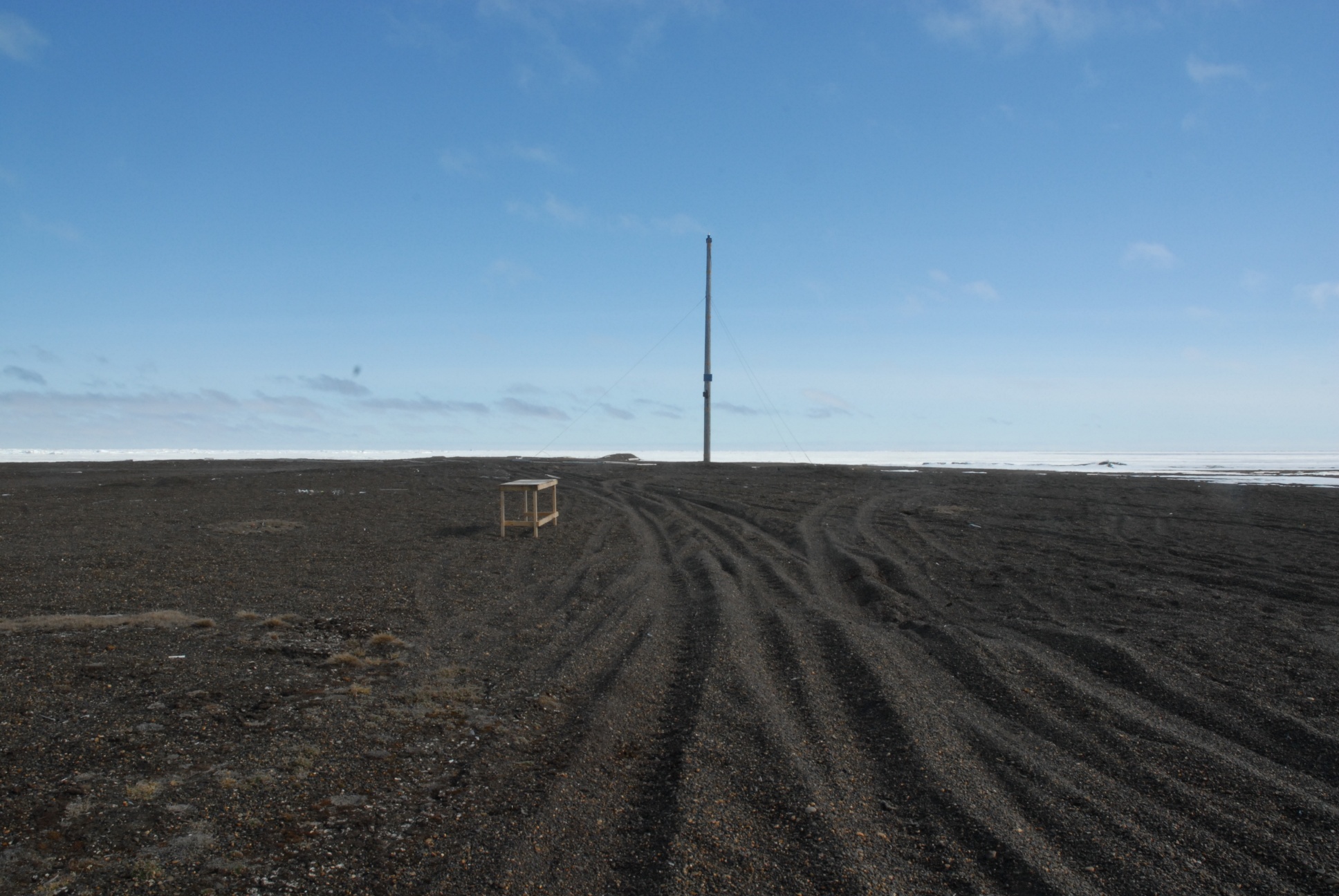
We looked over toward the ridge with the Nuvuk site on it. I was very discouraging about it as a site for the radar, but Hank was curious, and enough snow had melted so we could get there without bogging down (ATVs aren’t so great in snow), so we headed on over. There was some sort of rack that was new since fall, so I wanted to look at that.
Looking SE toward the Nuvuk site.
While we were over at the site, I double-checked how far we had tested in relation to the telephone pole with a light on it, since there is interest in mounting something on that pole, and access will be an issue until we are sure there are no graves right around the base. We mark the end of the tested area with a line of driftwood, which we move inland at the end of every field season. It’s only a few meters from the pole, so we should be able to clear that one way or another this summer.
Looking toward the Beaufort from the middle of the site. The line of driftwood on the ground marks the limit of the tested area.
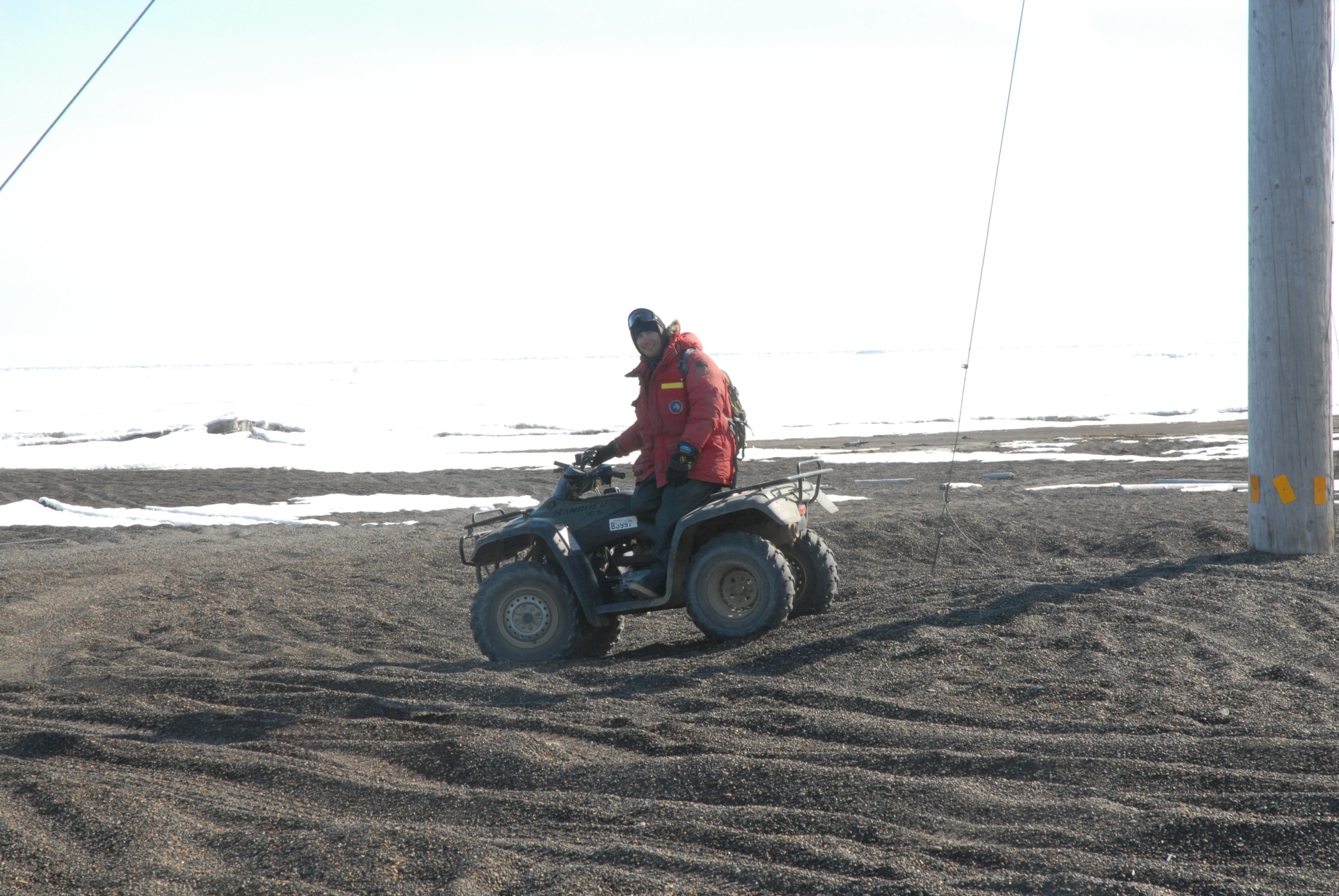
The “rack” turned out to be a table-like construction which was labeled as a survey marker for North Slope Borough Wildlife Department. I checked with them when they got in, and the survey is due to be completed in four days, so it won’t be a problem for us. I took a picture of Hank on his ATV while we were there. Actually, I took several with his camera too, but the image never looked in focus to me, so I took some with my camera just to make sure.
Hank S. at Nuvuk
We stopped at another spot that was also a possible radar site. Hank will take the GPSs back and do calculations to determine which one would work best for the radar, and then let me know and we’ll test it as part of determining if it can go out there.
The ride back was great, since the wind was at our backs. Alas, my face is covered with what look like hives, which is what happens when I windburn
We had a serious amount of snow last winter, although I’m not sure if it was an all-time record or not. By a couple of weeks ago I was beginning to get a bit worried. We’ve started work at Nuvuk in June some years ago, but it was pretty miserable. We’re starting in early July this year, but at the rate the snow was melting it was looking as if we might still have snow patches on the ground when we started.
However, we’ve had some warm sunny weather the last couple of weeks, and the snow is melting. Patches of tundra are starting to show through; people are heading inland after geese. We drove out to the end of the road to take a look at Point Barrow. I was happy to see lots of gravel showing. Once the gravel starts to appear, it absorbs lots of heat, and the snow melts faster. Given another month, we should be in good shape.
Point Barrow seen from the end of the road.
It was misty when we drove out, but I think it was a mist from snow ablating (going from solid to vapor directly). It happens here a lot on warm days, resulting in mist rising from the ground as well as from puddles & ponds.
Claire Alix, who is probably the world expert on precontact wood use in Alaska, is in Barrow for a 10-day stint of analyzing wood from Nuvuk. She is working on wood from the Driftwood Feature (DWF), because there is so much of it and we need to figure out what needs to be kept.
The DWF was a storm strand line which was washed up onto and mixed with an Ipiutak settlement. Not just any Ipiutak settlement, but the farthest north Ipiutak settlement by about 500 km. The result was a mass of wood, bark and marine invertebrates, with a number of clearly identifiable artifacts included. There was so much wood that we called the level “Wood/Sand/Gravel” because it seemed like there was more wood than matrix. However, some of the smaller pieces of wood and bark were also worked, but it seems that the storm picked up smaller floatable artifacts and mixed them with driftwood. Given the field situation, it was impossible to examine each small piece of wood in detail, so we erred on the side of caution and brought back a lot of things that probably aren’t artifacts, so they could be examined in a nice warm lab.
Chert artifact stands out in the middle of huge numbers of small pieces of wood, some worked and some not.Wood level in the DWF.
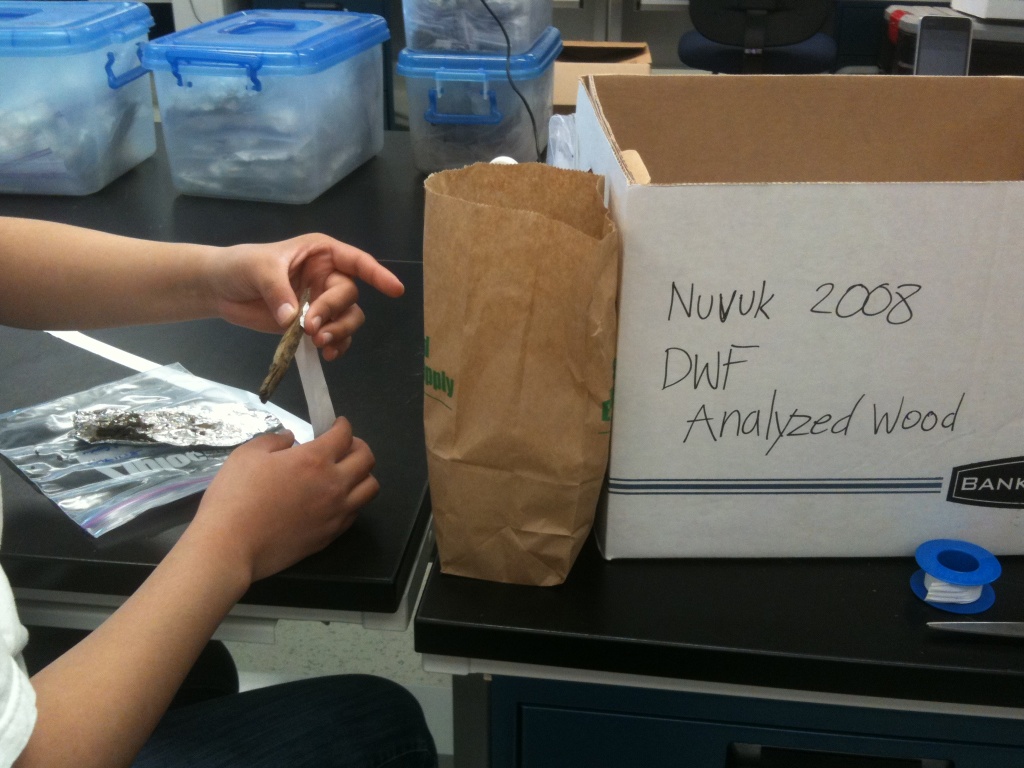
The DWF was actually frozen, and had been for centuries, so we didn’t just want to bring the wood into a warm lab and let it thaw. That generally leads to wood that looked really well-preserved “exploding.” We have a nice walk-in refrigerator at the Barrow Arctic Research Center (BARC) just down the hall from my lab, so we have been holding the wood there, thawing slowly and keeping it cool to retard mold growth. The large and important artifacts started the conservation process very quickly, but there are boxes of smaller things which need to be inspected to separate the worked wood and bark from the rest. The wood that is just driftwood will be lab discarded, with that being recorded in the catalog so it will be clear in the future that artifacts haven’t been lost. The artifacts will get analyzed and better information will be recorded. This also lets us identify things for the conservator to work on when she next can come to Barrow. Small artifacts are being brought out for gradual drying. Wrapping wood in teflon tape to hold it together during slow drying has worked fairly well, so we’re doing that to move more out of the walk-in
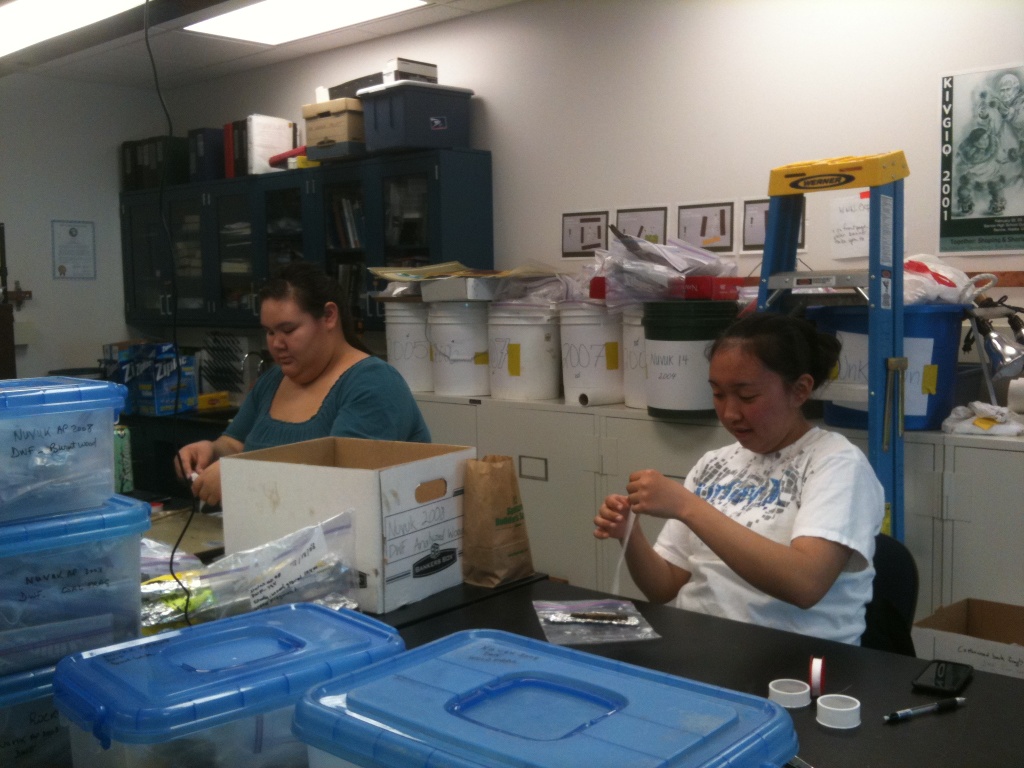
All this is pretty laborious. Claire has to do the analysis and wood IDs, but with her schedule we needed to find a way to speed things up. The initial sorting of bags of wood and the wrapping of the wood are two of the most time-consuming aspects of the process. So, last week Heather Hopson came in to do some data entry and initial sorting, and this week Trina Brower is joining Heather. They are doing the initial sorts, wrapping with Teflon tape & data entry, so Claire can keep looking at wood.
Heather & Trina hard at work in the lab.
Wrapping the delicate pieces of small wood is definitely fiddly work. It certainly helps having someone to work with & talk to while working.
Wrapping an artifact to keep it together while it dries.
I am still plowing through the literature seeking out information on C14 dates. Some of it is really hard to come by, with a date attributed to a house but no information on the sample, either what it was or where it came from. Then I look at the information on the artifacts from that house, turn to the plates (not naming any names here, but there are multiple offenders) to look at the artifacts, and see that the plates say they are from a house nearby. Obviously either the text or the plates are wrong (unless they both are, but I’d rather not go there), so now one is left quite unsure of what was really being dated, and what sorts of artifacts were actually associated with that date. Cross-dating based on artifact assemblages takes another one on the chin.
Another example from today: a date on wood and skin (what kind? caribou, seal, polar bear?) from a burial for which the description seems to indicate that it was only a few baby teeth! It’s one thing to have typos in a dissertation, but in published books that people are expected to pay money for? If people don’t read carefully, and compare about three different places in the book at once, it’s all too easy to accept a date at face value and assume that what is said about what it was found with is correct. Then it gets mentioned elsewhere, and people read it there and pass it on, and so forth.
Such dates do not get high scores for context or association with the event being dated. Actually they get zeros, since those factors are unknown.
All this in aid of a handbook article (well, two articles, since this C14 stuff should make an article as well). On the other hand, a number of people say it should be useful. I’m sure they’re all really glad that I’m doing it and they aren’t. Can’t say I blame them.




 Out of Ice and Time