Many Moving Parts

Things have been rather busy, to say the least.   I have been trying to work out a way to get the column sample at Walakpa.  For a few days, it looked like Ilisagvik College would be running a camp down there, so we made a plan to set up the camp and start the excavations, and then the campers would join us and be able to participate.  We were going to share logistics. IHLC is supporting the effort and letting one of its staff members participate.  Now it appears that the camp is in doubt, and we’ll find out sometime this week.

Since there is at least one person coming up to Barrow early to help out, another person who wants to help who is leaving in early August, and I am committed to a small project at Birnirk with National Park Service support (also early August),  I am having to come up with a Plan B.  UICS will let us use a tent and some other equipment, and we’ll just go down and camp, rotating a couple of people digging at at time and working as late as we can to finish as fast as possible.

If that isn’t enough, I’m working on several contracts, one of which requires trips to Kotzebue, Point Hope, Nome, and Wainwright, as well as work in Barrow.  It involves testing and in some cases monitoring.  The schedule for this just firmed up, and the Kotzebue work has to happen next week and over the weekend, since some of the work is taking place in the street and we need to monitor that excavation.  This is going to be a challenge with the weather we have been having meaning many canceled flights in and out of Barrow, the Walakpa work schedule and then the Birnirk work.

We also have some work that needs to be done in Wainwright, which was supposed to happen in the summer.  The only problem is that there are apparently no beds available in Wainwright for the crew, since the client (who was in charge of providing lodging since they own & run the camps) somehow forgot to reserve any!  Not sure how that will work out.

I’ve got two conference papers to give in the first half of September, one in Glasgow and one in Vienna, so they have to be finished as well.

Yikes!
Back to the Drawing Board

I’m trying to figure out a way to do at least a little fieldwork at Walakpa this summer.  I’ve got a proposal in for major fieldwork (3 field seasons) but decisions aren’t made yet, and even if it is successful, fieldwork couldn’t start until next summer.  That’ll be great, but there is a remote possibility that we could have another storm as big as the one that took over 11 meters of the deeply stratified deposits last Labor Day weekend.

Sites like Walakpa, with deep, frozen layers with good organic preservation can be seen as a special type of Distributed Long-term Ecological Observing Network of the Past.  In addition to the artifacts and structures left by past humans, these sites contain residues of human subsistence activities, in the form of stratified layers, often several meters deep and spanning millennia, of the remains of animals and plants gathered from the surrounding area. These remains are samples from past ecosystems that cannot be replicated, absent the invention of a working time machine.  A column sample from such a site is similar to an ice cores or a lake or bog core, with the addition of samples from a wider area.  It can tell us all sorts of things about the environment through time when analyzed with the right methods.  Information about how environmental change affected important subsistence species would be incredibly useful for those attempting to manage such species in today’s changing environment, and thus important to the food security of Northern residents.

Unlike ice cores, there is no elaborate infrastructure set up to collect and preserve such samples.  We really want to get a column sample from top to bottom of the site, just in case the worst happens.  It will only take a small crew, and maybe a week or so, since the bluff should be thawing in from the side as well as from the top, making excavation faster.

It looked like maybe it would be possible for the North Slope Borough Department of Iñupiat History, Language and Culture to run a camp there, which would have let students be involved.  I was writing a grant application to try for support for food, fuel and transportation to the site for that camp.  On Friday, we learned there was a conflict, so now I am trying to figure out another approach.  It is looking like it may need to be a volunteer effort, since most quick turn around funding sources don’t pay salary :-(.

If anyone has any ideas, or might be willing to volunteer to help out (digging, loaning camping gear, moving stuff to or from the site, camp cook, basic lab work afterwards), or would be interested in analyzing data from the site, please let me know.  This site is really important both a a part of Iñupiat  Heritage and a source of long-term environemtal data.

Back in Barrow

And just in time, too, since Fairbanks went into the high 80s on Saturday!  I had to get up around 3:30 AM to catch a flight to Anchorage to catch the flight to Barrow (definitely the long way home).  It was amazing flying into Deadhorse.  Water everywhere, and the Dalton Highway and some other roads gone in spots.  A whole lot of the snow in Barrow had melted too, but amazingly the roads are OK.  The Tundra Garden is emerging from under its snow cover, and flocks of redpolls have showed up to join the snow buntings.  I didn’t get much done the rest of the day except resting and a little mindless spring cleaning.

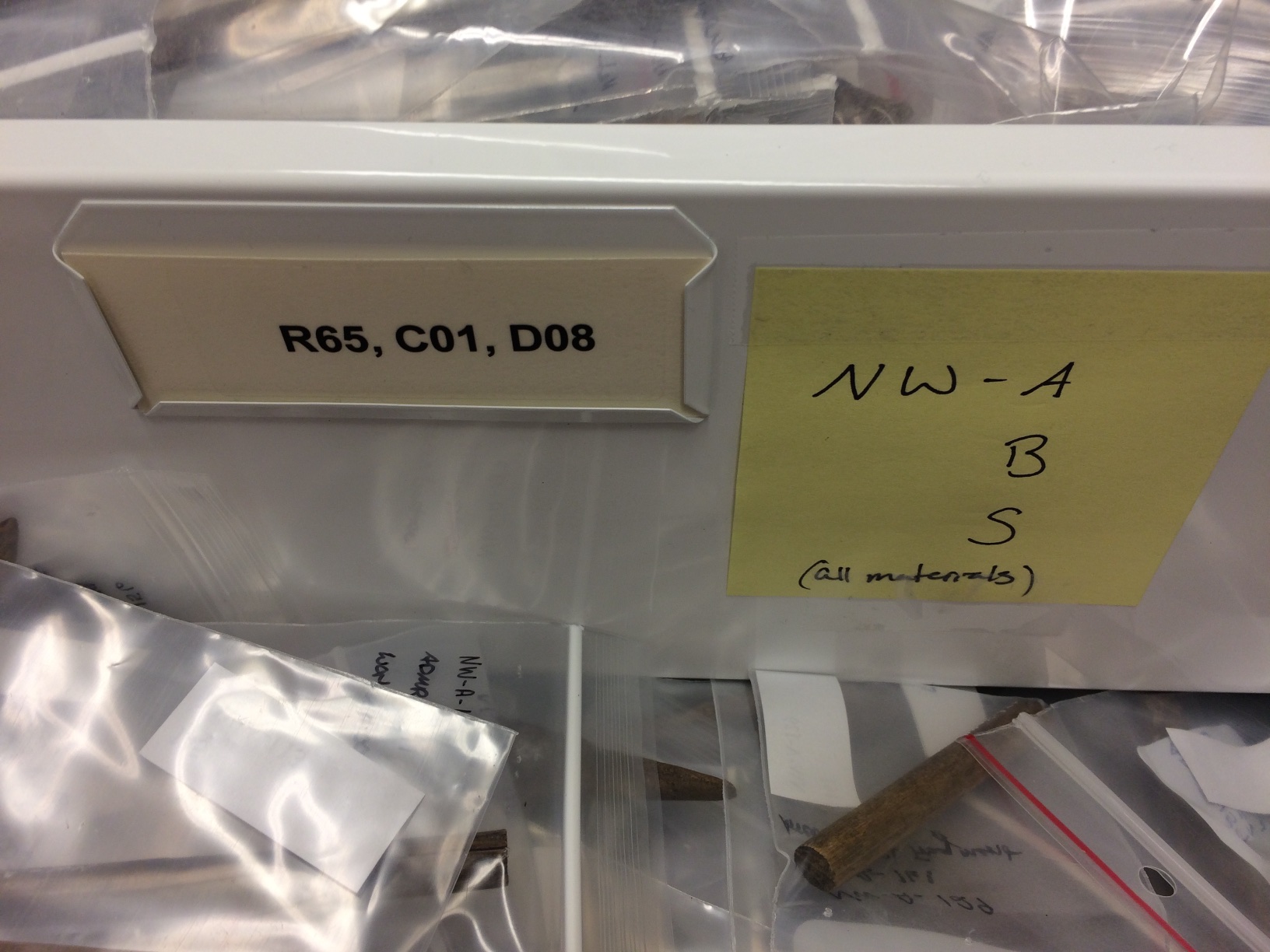
We looked through a huge number of drawers.  The older collections have little or no faunal material saved, so we needed to find worked bones, or in a pinch, artifacts  (preferably broken and non-diagnostic types with many examples) that were definitely made out of walrus bone.  That info wasn’t usually in the catalogs, so we just had to look. Some of the drawers were really full.

Drawers at the University of Alaska Museum

In the end, we have several hundred possible samples (plus associated caribou or wood samples for paired radiocarbon dates since marine mammals like walrus don’t give accurate C14 dates without a correction factor).  Now I need to figure out which may be from the same context, so we can look at them as a group and try to eliminate duplicates.

I’ve finished most of the bookkeeping paperwork that goes with any research trip, and will do the rest on Tuesday at work.  I hear there are a number of applications out for the internships, so I’ll be working on getting interviews done and hiring people as soon as possible.

Summer archaeology internships

It took a while to get everything in place, but we are ready to start taking applications for summer internships in archaeology through Ilisaġvik College! They will involve learning about laboratory work and participating in some interesting and important research on walrus in the past.   It will help prepare you to participate in some fieldwork that we hope to have coming up this summer and/or next, and you can also earn college credit.

I’ll be in Fairbanks working at the University of Alaska Museum on selecting samples from the collections there for the next two weeks.  In the meantime, you can get an application packet from Susie Stine (852-0921).  I’ll be interviewing the week of May 25 (not on Memorial Day) so get your applications in.

This is probably best for people who live in Barrow, since there is no housing with this internship.

In San Francisco for the SAA meeting

I’ve been very busy for the last months, although primarily it has been administrative things, many of them connected to moving my grants to a different institution.  It was very necessary, but also very time-consuming, depressing and annoying, and didn’t really make for worthwhile reading.  That’s more or less taken care of now, so back to “regularly scheduled programming” we go.

I’m currently in San Francisco to attend the Society for American Archaeology (SAA) 80th Annual Meeting.  I’m giving a paper in a very interesting Arctic session on Saturday morning.  The paper is on global environmental change threats to North Slope sites, and the urgent situation this creates with regard to the imminent loss of the archaeological and paleoecological information they contain.  Even some archaeologists who either haven’t worked in the Far North or haven’t been in the field there in the last 10-15 years don’t realize that things have changed drastically and this is a crisis.

Of course, this session is opposite a very cool IHOPE session into which it would have fit equally as well.  Sigh.  Someday someone will invent a meeting scheduling software that will minimize such conflicts.

Well, off to see if I can locate the early registration…

Call for Contributions—Alaska Journal of Anthropology Recent Research Notes 2014

It’s that time again.  I edit a column in the Alaska Journal of Anthropology which covers recent research.  I’ve sent copies of the call for contributions to several email lists, but it’s a very busy time of year and they seem to be a bit backlogged, so I thought I’d put it up here as well.

If you did something interesting this summer, please let your colleagues know.  You don’t have to have results yet.  If there are reasons that you can’t be very specific about where you were working, that’s fine.  It will still be helpful to others to know that work was done in an area if they are thinking of doing something there at a future date.  If nothing else, they will know who to contact for logistics advice 🙂

Made it to Austin

This is the first long trip since I came home from back surgery.  It involved connections in Anchorage and Seattle.  I was lucky enough to score upgrades from Anchorages all the way to Austin, but I still arrived in less than ideal shape, although the trouble seemed to be my hip, not my back.  I went to sleep with an ice pack, and everything seems fine except my right big toe, which really hurts.  With my luck, it’s probably gout…

Anyway, the GHEA RCN steering committee, of which I am part, is having a meeting about a mile from the Hilton.  I suspect it may take me a bit longer than Google maps thinks to walk it, so I am heading out now.  My paper is tomorrow afternoon, so we’ll see how that goes.

NB: Barrow is a very expensive place

NB: Barrow is a very expensive place to find lodging and buy food. We currently do not have project funds to help with this, nor support for travel to Barrow. This summer’s work is probably best suited for people who will be in Barrow anyway, or who can get some support for this from another source.

Ramping up in the lab

I have gotten far enough along in getting over the back surgery that I finally have enough energy to do things that are not strictly essential for work or staying fed.  So we are ramping things up in the lab.

We are looking for a few more people to work in the lab here in Barrow, joining the current crew on weekdays or weekends.  Due to the source of funding, these folks will need to be high school or college students.  We are also looking for volunteers.  I will post the announcements on here a static page and also as posts.

We aren’t sure yet if we will have funds available to do fieldwork this summer, but we are hopeful.  If we do get into the field this summer, people who have lab experience will have priority for fieldwork jobs.

If you are interested, please contact me ASAP.  Please pass this on to anyone you know who might be interested.