Back from the field

We got into town late last Thursday.  The field season went pretty well, after a slow start due to ice preventing us from getting out.  We lost a few days to major storms, but we had a great crew and accomplished a lot.

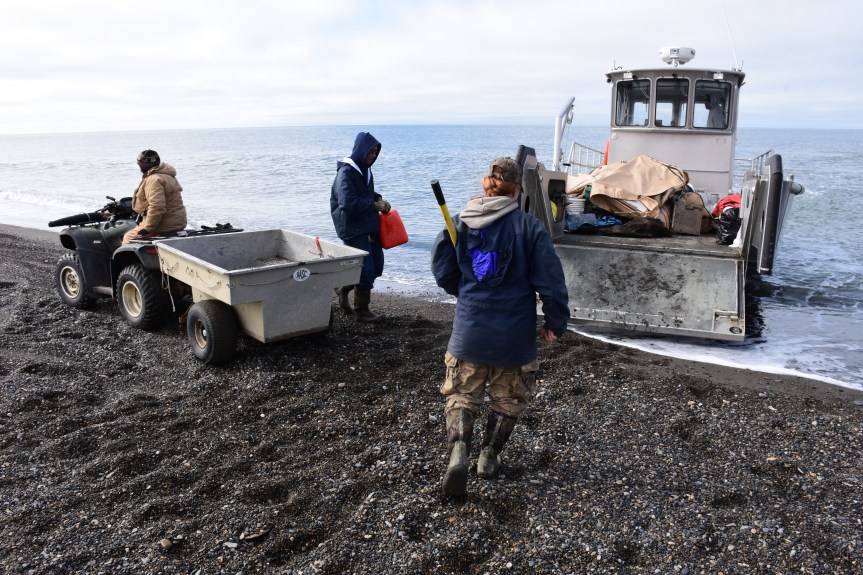
Breaking camp was a bit of a challenge, since we were down to seven people in the field. The big boat was scheduled to arrive at 9AM, so we broke everything down the day before except for the mess tent and the latrine, plus our sleeping tents.  Then we got up at 6 AM and took down all the sleeping tents, and started ferrying gear to the beach with the ATV & trailer.

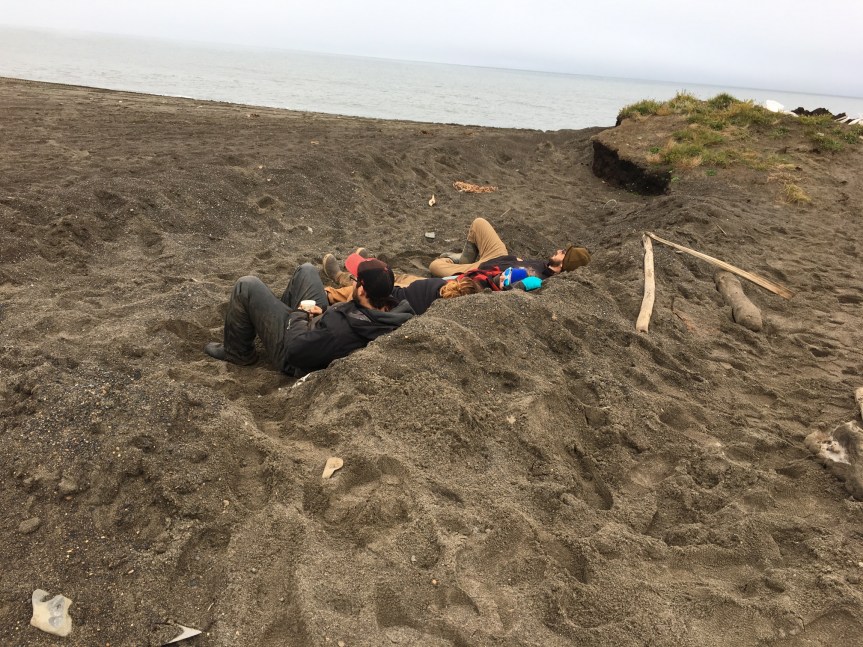
It turned out the boat ramp wasn’t in the water back in town, so the boat didn’t make it until nearly 1PM, after having to launch into Elson Lagoon and go around Point Barrow.  It was a cold morning, and once we had stuff packed, it was hard to stay warm, especially since we’d dressed for hard work and packed up everything else.  At one point, several of the crew were napping in a ditch.
IMG_4375
Crew members napping.

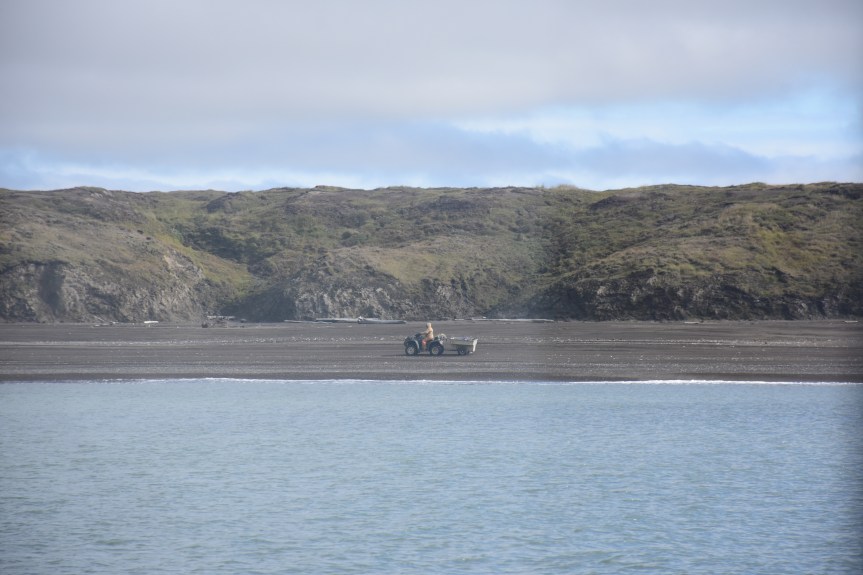
The boat had to make two trips, so we sent 3 people up with the first load, and then 3 more with the second.  I drove the ATV & Tubby back to town, so I was the last one in.  I left before the boat, but Doctor Island is pretty fast, and I was riding into a north wind and kept meeting people and stopping to chat, so they beat me home.
GRA_5861
Loading the boat.  Photo courtesy of Zac Peterson.
GRA_5878
Heading home.  Photo courtesy of Zac Peterson.

Our first day back was the last day of the UIC Science Fair, and the archaeology lab was featured tour.  Also I had a presentation scheduled.  Everyone was really tired, but we managed to pull things together for a good tour, and in fact had visitors well past the scheduled end of tours.  The presentation was well attended.

As I write this, another early storm with winds from the West is brewing, with predictions of coastal erosion.



All ready

Almost the entire crew has made it out to the site.  Some of them went down in the morning and set up a lot of things.  Half of them came back and took some more people and gear down, and should be heading back soon.

Meanwhile back in town Katrina Watson got the electronics packed up and into the yellow shed, while I got both lab computers back on the network, connected them to the project dropbox and put all the necessary files on them.  I reviewed the workflow with Katrina, who will be cycling in and of town, since she’s from here and her family and kids are here for the summer.  That means she can provide a bit of continuity for the lab.

I’m going down in the morning.  Since the wind is supposed to stay east for a few days, we hope a boat can go down on Monday and bring most of the rest of the heavy stuff (chairs, wood for tables) and more delicate things (cameras, computers, transit) down.

The crew asked for some board games.  I posted on Facebook to see if anyone in town had any they weren’t using anymore, and in about 2 minutes, Doe Doe Edwardsen said she had 5 we could use.  She even had them delivered!  Quyanaqpak Edwardsen family!

One of our international volunteers is coming a bit later.  She is currently working somewhere without internet, so she’s been communicating as she can.  When I got her itinerary, it became clear she’s going to have to overnight in Anchorage both ways.  Back to Facebook, and within a few minutes archaeologist friends Monty Rogers and Katie Meyers had offered to put her up.

Most of the archaeology crew are volunteers, and others are putting in a lot of volunteer time on top of what is paid.  Not everyone can take time and go into the field.  But we can’t do it without help, and the people like Doe Doe and Monte chipping in make this salvage possible.  The true Alaska spirit.  We appreciate every bit of help.


Last call for AJA RECENT RESEARCH NOTES for the next volume

I have to finalize the RRN in the next couple of days.  If you have something you’d like in there, pleas get it to me properly formatted (including C14 dates, tables, etc.).  We want to include δ13C for radiocarbon dates if it’s available.  More information is here.

Alaska Anthropological Association–Day 1

I’m in Fairbanks on a combined trip to do some work on the WALRUS project and to give a couple of papers at the Alaska Anthropological Association’s 44th Annual Meeting.  I was supposed to come down on Sunday and got to a zooarchaeological workshop on teeth, but alas there was a blizzard in Utqiaġvik, and that didn’t happen.

Last night, there was the opening reception.  Jenny Blanchard had organized 2-minute talks, which went well.  I did 2 minutes on Walakpa 2016, with a plug for Walakpa 2017.  We didn’t get quite as many people as we’d hoped, since we were in a room at the end of the main entry hall, and people had to pass the bar with free beer to get there, so some folks got sidetracked.

The day started early with a paper on Arctic genetics by Jennifer Raff, Justin Tackney, Margarita Rzhetskaya, Geoff Hayes and Dennis O’Rourke, in a session on the Seward Peninsula.   All of them except for Margarita had worked on the Nuvuk people as part of a big project, also involving modern that was at least in part done at the request of Utqiaġvik Elders (although they didn’t have to twist Dennis & Geoff’s arms too hard).  That project contributed to this paper, and as results continue to come out, it is only getting more interesting.  Now that the North Slope is somewhat understood, the Seward Peninsula is the next gap.

The rest of the session focussed largely on the first field season of a project at Cape Espenberg spearheaded by Claire Alix and Owen Mason.  They are working on a couple of Birnirk houses, one of which was started by an earlier project there that I spent a couple of weeks on.  Very interesting material coming out, and very interesting geomorphological and paleoenvironmental work in progress.  Their dates for Birnirk seem to be running a bit later than what we are seeing at Walakpa, up into the range I would call Early Thule at Nuvuk.  Of course, we aren’t really talking about two different groups of people here, bur rather a change through time, but it is still interesting.  They aren’t nearly done with one of the houses, so it will be interesting to see if they get some earlier dates.

Spent the afternoon polishing my PowerPoints for tomorrow, and now I’m going to try to catch up on sleep.

Walakpa Zooarchaeology

Last week I went to the Alaska Marine Science Symposium 2017 meetings in Anchorage.  I’ve never gone to those meetings before, but we were presenting two posters on finds from Walakpa.

amss2017
At the poster session.  Photo courtesy Raphaela Stimmelmayr.

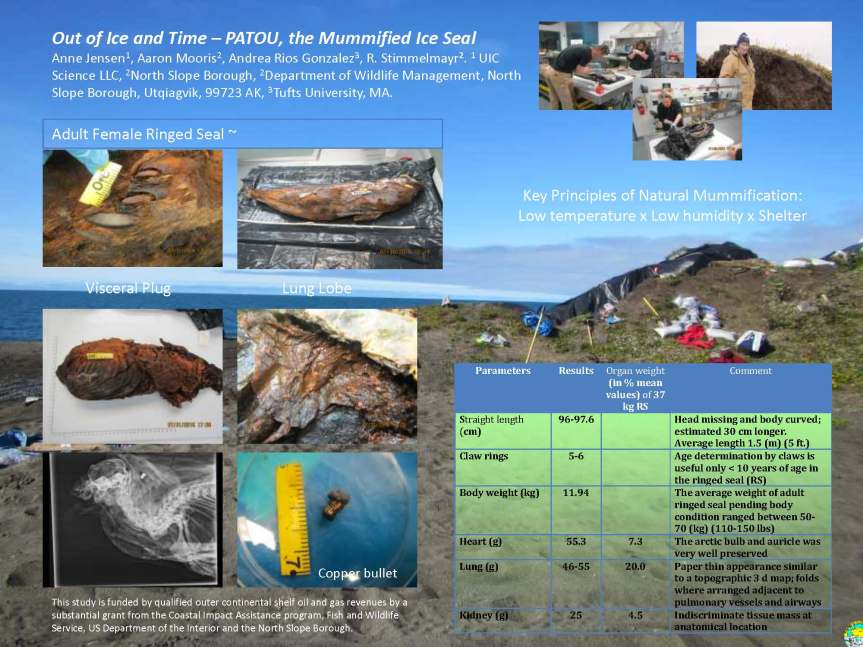
One was on the results of the necropsy of a mummified seal found in a 1944 ice cellar.  I was excited about it because it was pre-bomb with a pretty tight date and therefore helpful for refining radiocarbon correction factors.  It turns out to be the first mummified seal reported from anywhere outside the Dry Valleys of Antarctica!  Who knew?

patou_amms2016_final

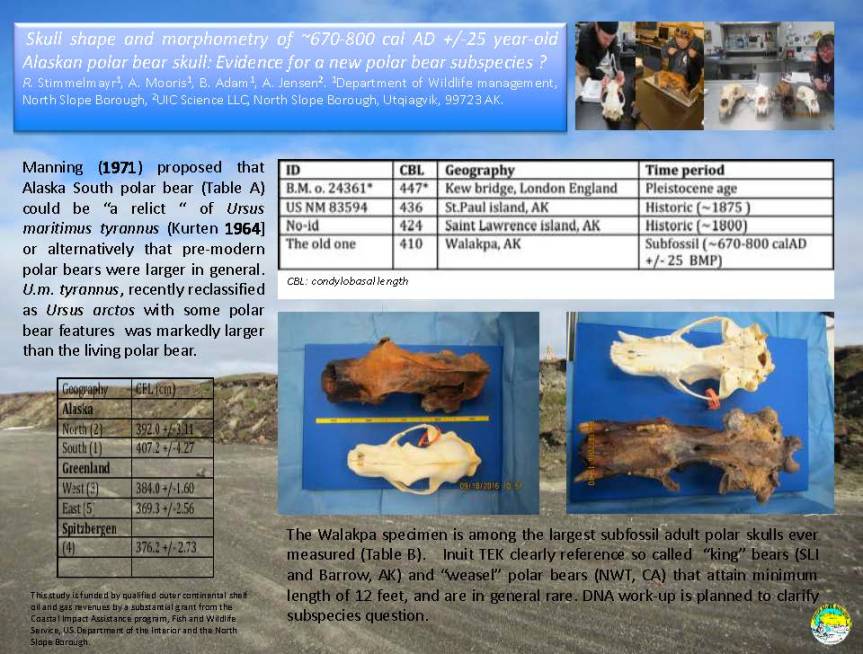
The second was presenting some preliminary results of investigations on a polar bear skull which eroded from Walakpa, and was recovered and turned in by Kenneth Brower.  It turned out to be somewhat unusual in shape, as well as being really big (maybe the 4th largest ever measured).  That bear must have been HUGE!

theoldone_amms2016_final


Talking with Teachers

I had a fun morning talking to about 40 elementary school teachers from the North Slope Borough School District.  They were having an in-service.  The original plan was to take them out to Walakpa by boat, but the weather this weekend features snow, a bit of rain and winds up to 30 mph.  So–not boating weather.

Since we knew this a couple of days ago, we were able to get the lab ready for visitors.  We (Ashtyn & I) put out several drawers with some of the more interesting artifacts from Walakpa and Nuvuk.  I put together a slide show to give them an idea about the project, which we showed before they visit d the lab.  I also talked a bit about the history of science in Barrow, and the building of the BARC.

A number of the teachers are interested in bringing their classes out to the lab.  A few of them are also interesting in volunteering, either in the lab or as photographers.  And I think I probably sold a bunch of the Barrow Science hoodies, given how many people asked how they could buy one :-).

Workshop at the World Conservation Congress

After we got back from Walakpa, we had fieldwork in both Deering and Wainwright, which kept me pretty busy.  After that, I had to head to Honolulu for the World Conservation Congress.  I had organized a workshop on Global Environmental Change Threats to Heritage and Long Term Observing Networks of the Past.  The timing of the conference was a bit unfortunate, since it overlapped with the World Archaeological Conference in Japan, so the workshop was fairly small.  However, the idea was to get some of the people who are active the conservation field to  look to the paleoecological data from archaeological sites to help build realistic conservation plans.  It was pretty well attended and on top of that, it was live-streamed.  The video is now up on YouTube for your viewing pleasure.

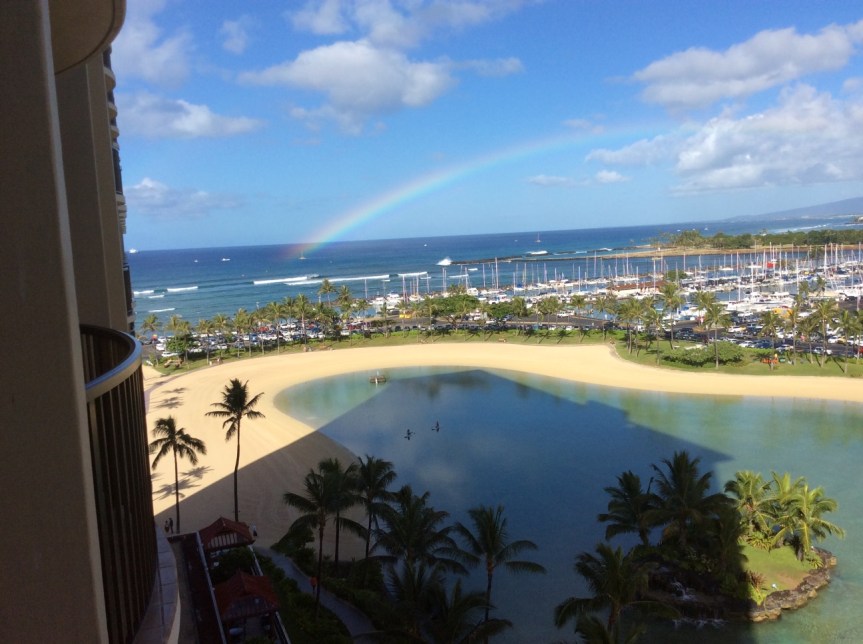
Honolulu was quite a switch from Alaska, with temperatures in the 80s the whole time.  It was beautiful, of course.

IMG_3512.jpg
Rainbow on the walk back to the hotel after the workshop.
IMG_0614.jpg
Another rainbow from the balcony of the hotel room.

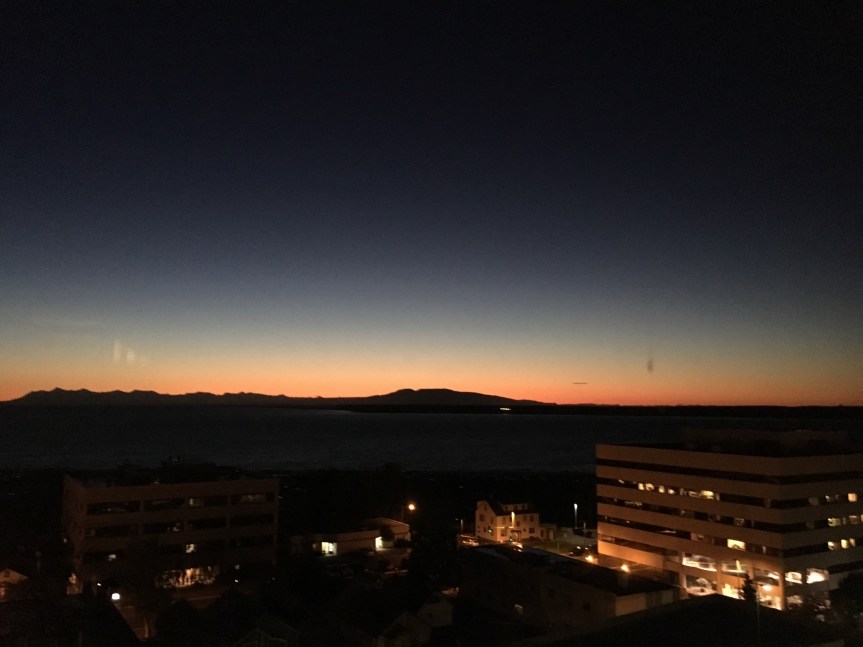
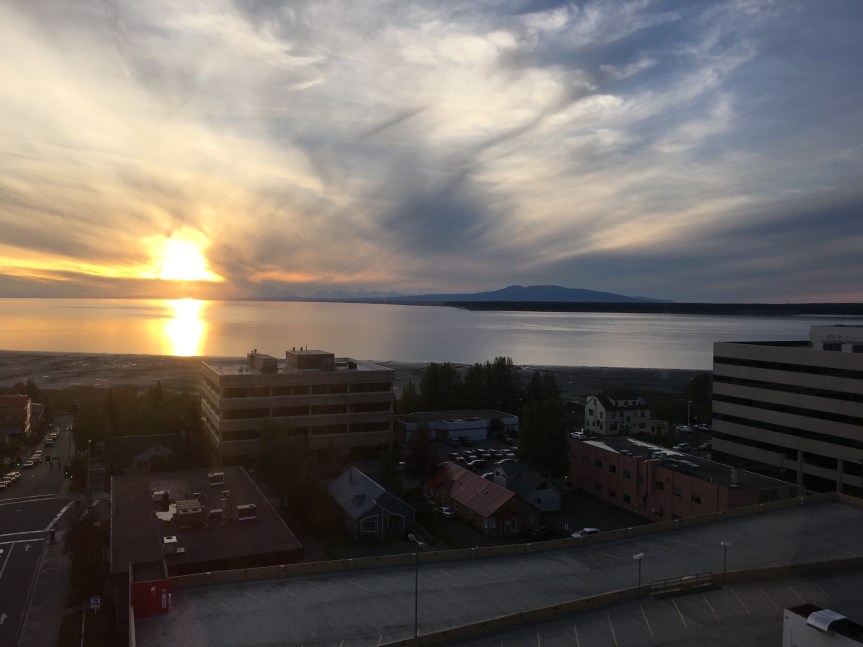
On the other hand, it was nice to get home to Alaska.  The sunsets are better.

img_3564img_3572

Back in town

We made it back into town just over two weeks ago.  The field season went well, despite a few challenges from sea ice, snow drifts on the beach and general cold weather.  There was  a huge amount of catching up to do (nearly 4000 emails), three projects which needed various forms filed, an MOA which had to be done for this project, some radiocarbon calibrations to write up for another project, lots of equipment which needed to be cleaned, dried, put away or returned, and many artifacts and samples which needed processing.  Although I had lots of help, I’ve been working 16 hour days since before we went into the field, and something had to give.

Unfortunately, we didn’t have good connectivity in the field, so the only updates I could send were from my deLorme InReach.  At 160 characters per message, it really isn’t up to blog posts.  That means I’m sort of going to have to do some catch-up posts.  I head to Deering for a monitoring project on Saturday, and it’s not clear how good the connectivity will be there either, so there may be another gap.

Looking for scrap lumber

We’re in need of a bit of scrap lumber (1x2s and 2x4s), to complete construction of a water screening device.  Alas, Barrow no longer has a lumberyard, so it is a real problem when it turns out you need a bit more lumber.  If anyone has some excess lumber they would be willing to contribute to the Walakpa salvage effort, please let me know.