Two neat finds

We started investigating the last GPR hit and came down on a jumble of wood.  The excavators were not optimistic, but I kept pushing to go a little further.  Eventually, this appeared:

Feature detected with GPR

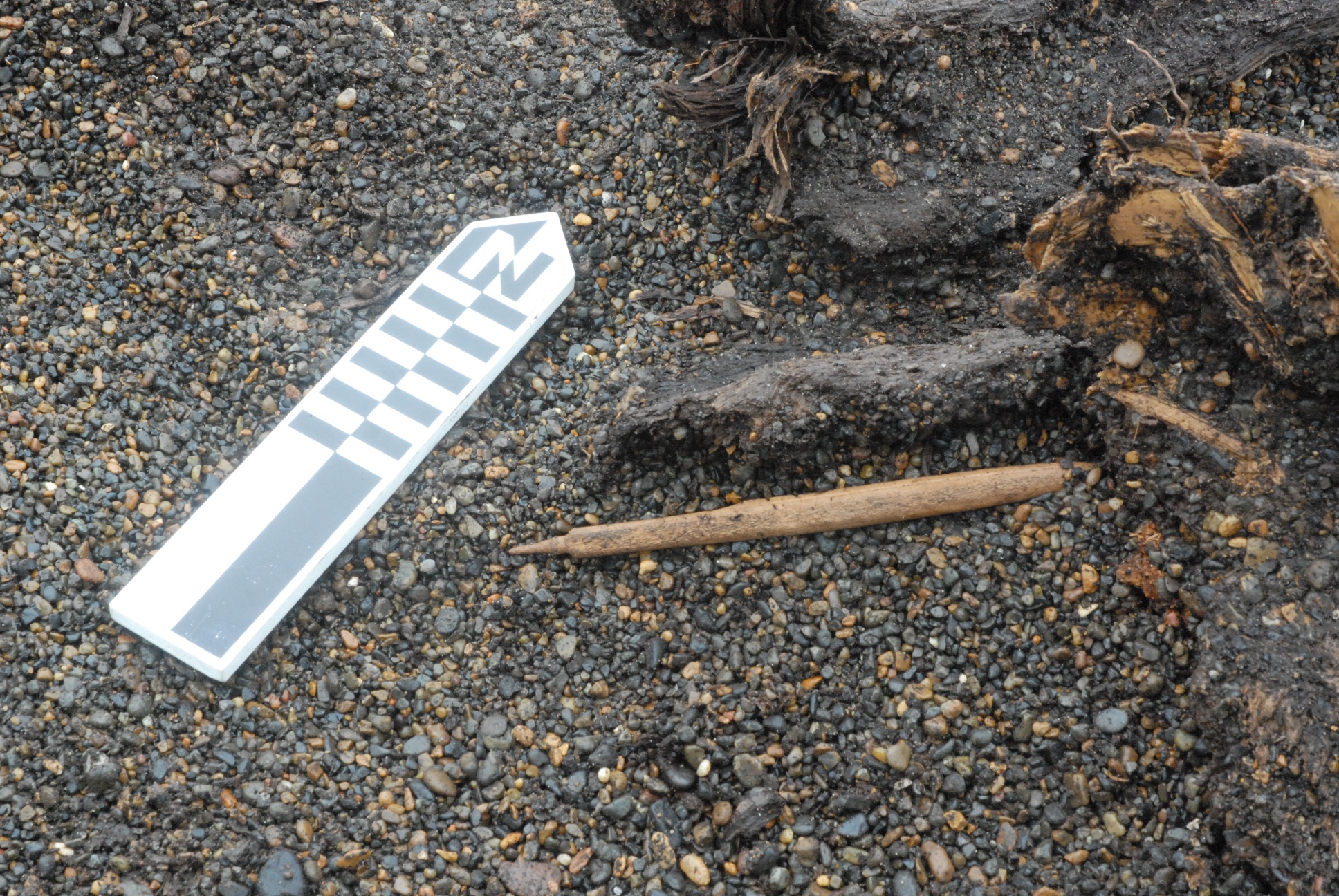
The feature (I’m not calling it a burial until there is evidence of human remains) was jumbled because at some time after it was constructed, someone dug a hole in the middle of it.  And right beside where the hole had punched into the feature was this:

Antler arrowpoint

The hole just missed it.

The DWF (Ipiutak) levels had their own surprises.  We found a good bit of fish bone, some lithics (nothing diagnostic) and a lot of broken bone, but the really cool thing, which I found on the edge of the hearth, was a flattened but apparently complete egg!

The remains of the egg

Sunshine & blue skies…

…and a full crew.  We started work on the burial under the plank.  It took quite a while, as the plank was complex to define.  It was all one piece, in some places up to 9 cm thick, and had obviously required a great deal of work and skill to make.  The top surface looked like the outer surface of the tree.  The bottom surface showed evidence of burning, in some areas completely charcoal.  It should be good for C14 dating.

The remains are those of a large male.  Preservation is a bit variable, but it looks like there might be some ribs that could yield aDNA.  In any event, he will be safely out of the trail.

Many on the crew did STPs.  So far nothing has shown up.  It is beginning to look as if there is a gap in the burials (or at least a much thinner distribution).  I’ve begun to wonder if this could be the result of a village move due to erosion, which brought the village close to the cemetery and made them skip a bit of ground to put the new cemetery at a proper distance from their residences.

At least it was a beautiful day.

The Snowman at the Top of the World

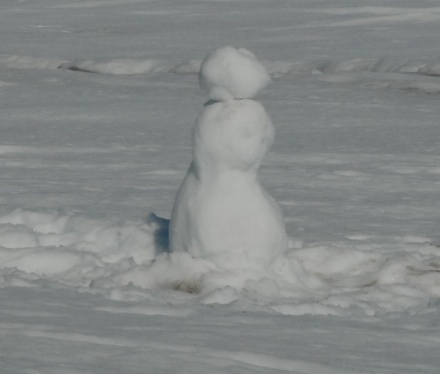
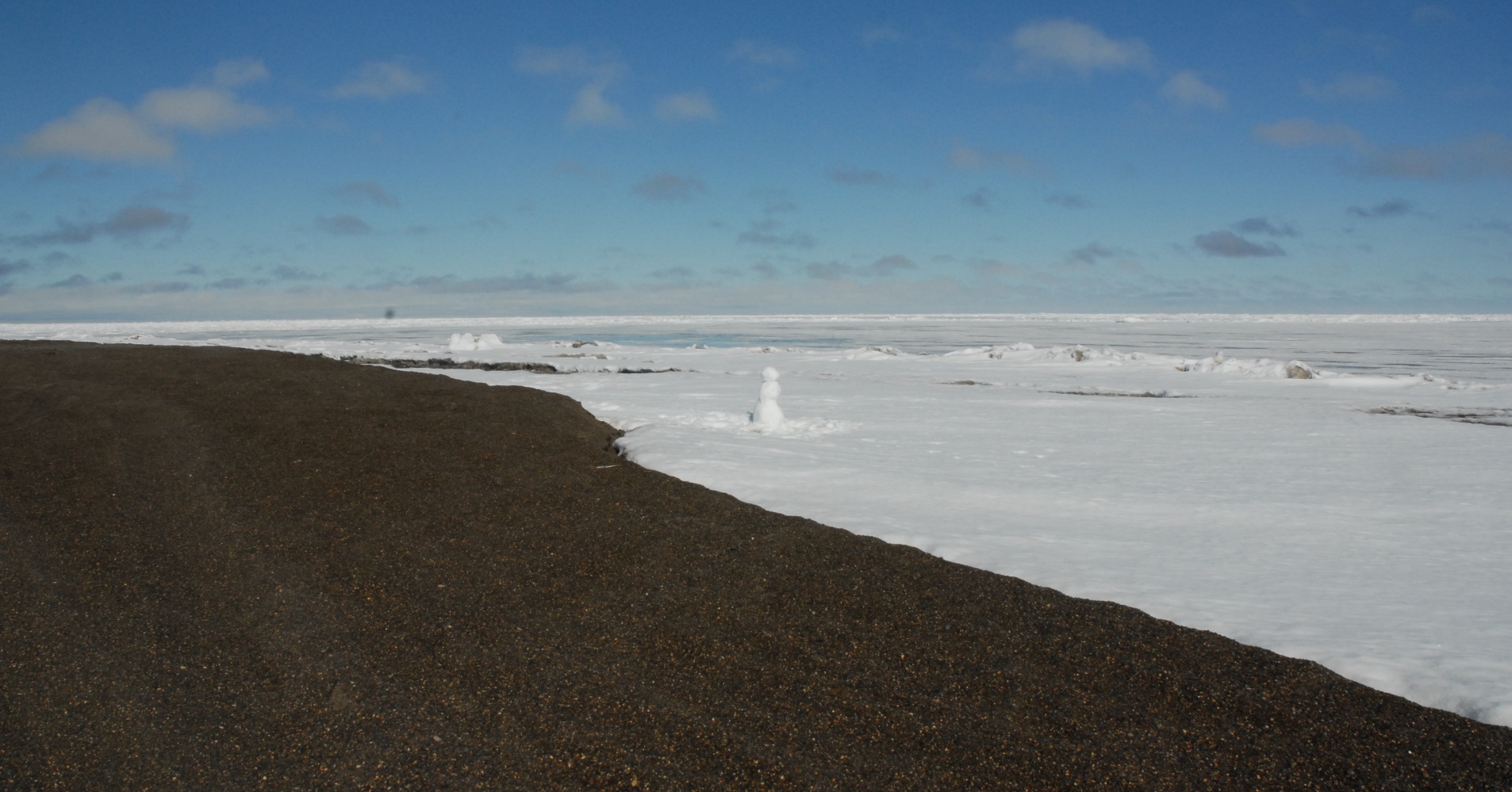
On yesterday’s trip to Nuvuk we came upon this fellow…

The snowman

just standing there at the northernmost spot of Point Barrow, all alone…

at the Top of the World

First trip to Nuvuk in 2011

I went out to Nuvuk today.  The purpose of the trip was to accompany Hank Statscewich from the University of Alaska Fairbanks, who needs to pick out a new site for an experimental current radar.  They have run it near NARL for a year, with no problems, so they want to try it further out-of-town.  Since there is a good bit of archaeology out at the tip of Point Barrow, the idea was that I could help him find a spot that was not likely to have any archaeology.  We’ll still test before anything gets put out there, but still.

It was a sunny day, but there was a good East wind off the ice.  We were heading into it, more or less, going probably 25-30 mph until we got off the road, and the ATVs from BASC didn’t have windshields on them yet (they take them off when storing them so they can fit more vehicles into a smaller space).  That bit was not fun.

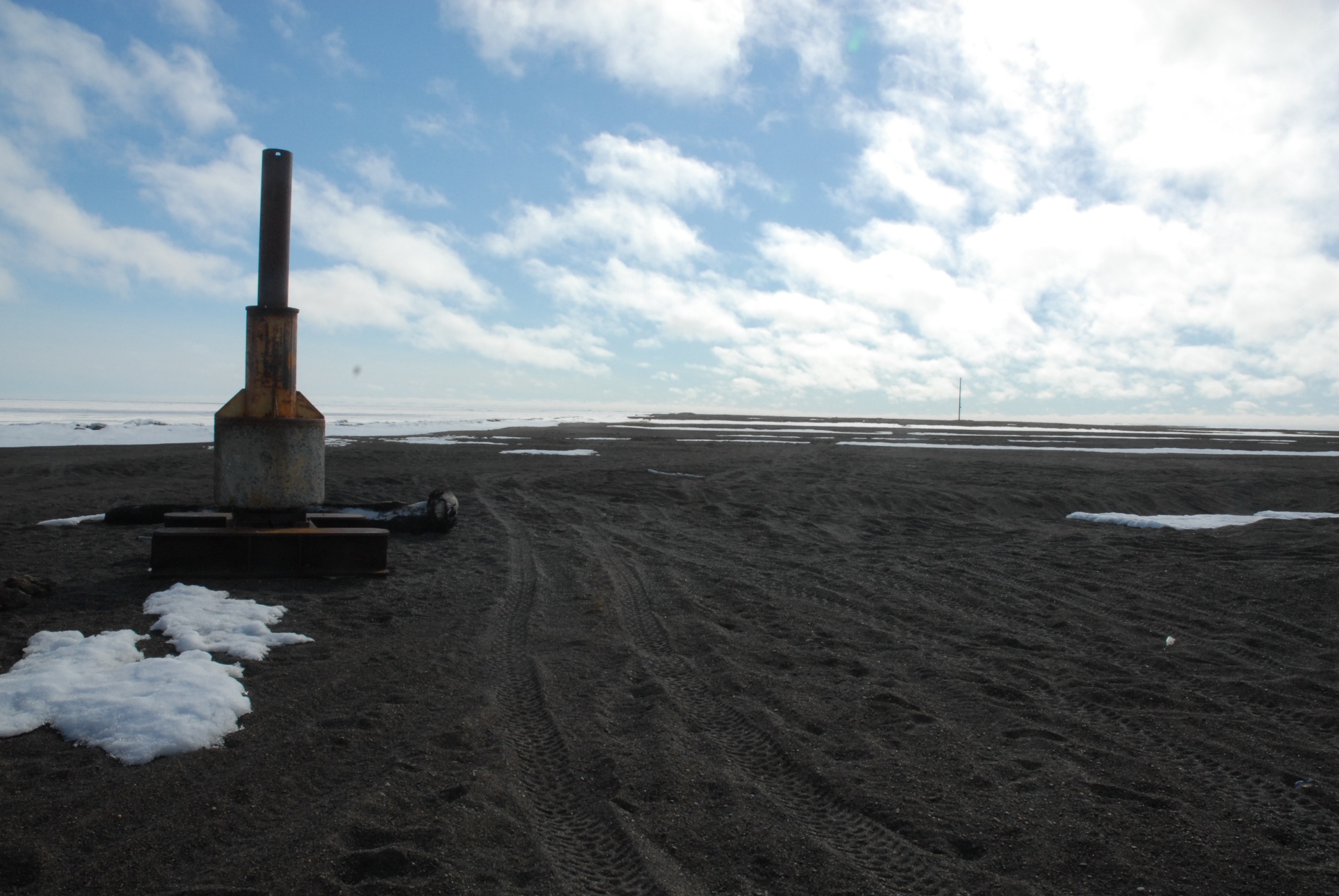
The first place we went was on the younger, more western of the two prominent beach ridges, near a weird concrete and steel device that reportedly was brought over from Prudhoe Bay during the gray whale rescue.  It seemed like a good possibility, so we took GPS readings.  It looks like there has been a good bit of er

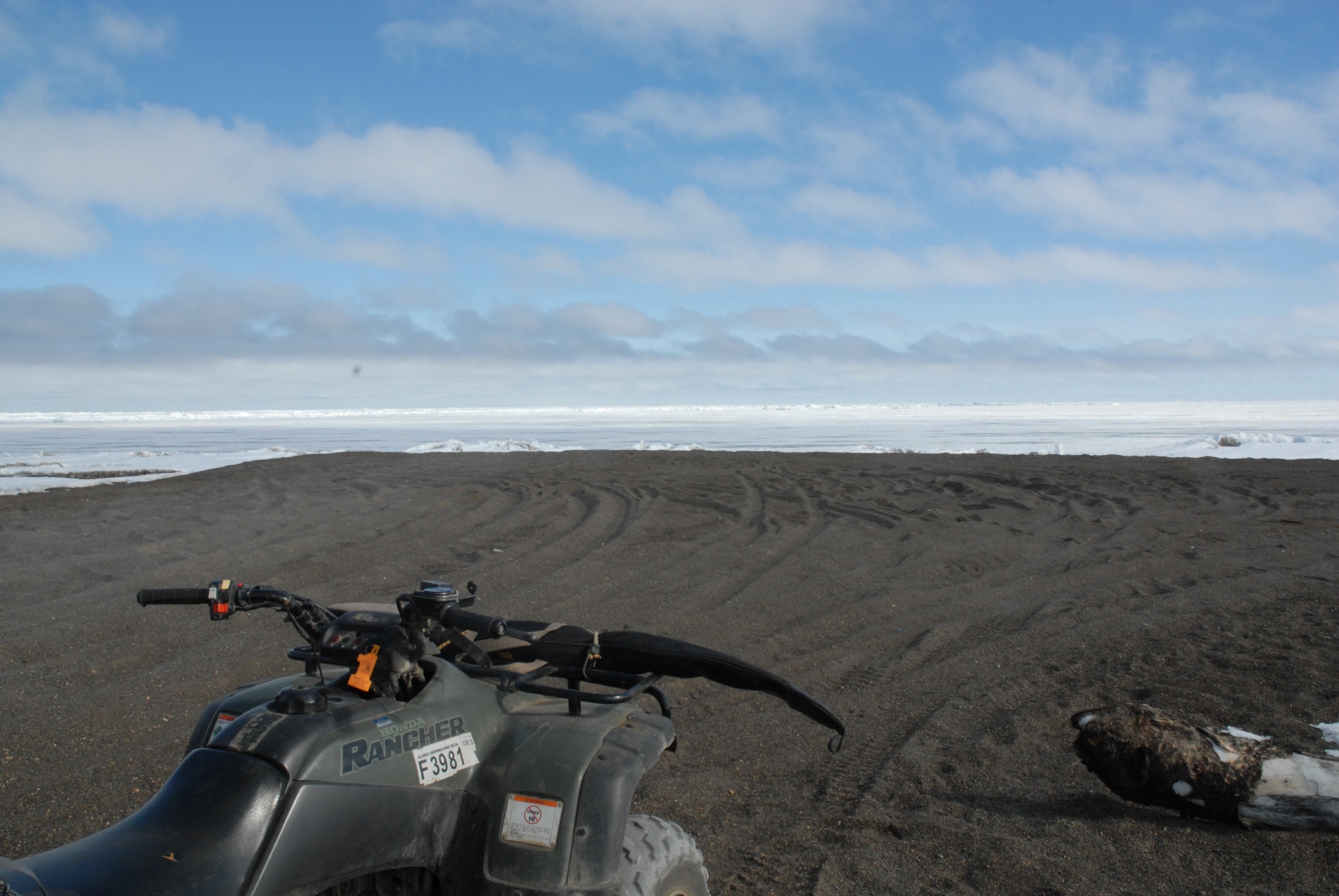
Looking at the ice on the Beaufort Sea, I was happy to see it was really flat for quite a way out.  That will make it easy for bear guards to spot bears there, if only it will stay that way.

Flat ice on the Beaufort Sea, at the farthest north point in the US.

We looked over toward the ridge with the Nuvuk site on it.  I was very discouraging about it as a site for the radar, but Hank was curious, and enough snow had melted so we could get there without bogging down (ATVs aren’t so great in snow), so we headed on over.  There was some sort of rack that was new since fall, so I wanted to look at that.

Looking SE toward the Nuvuk site.

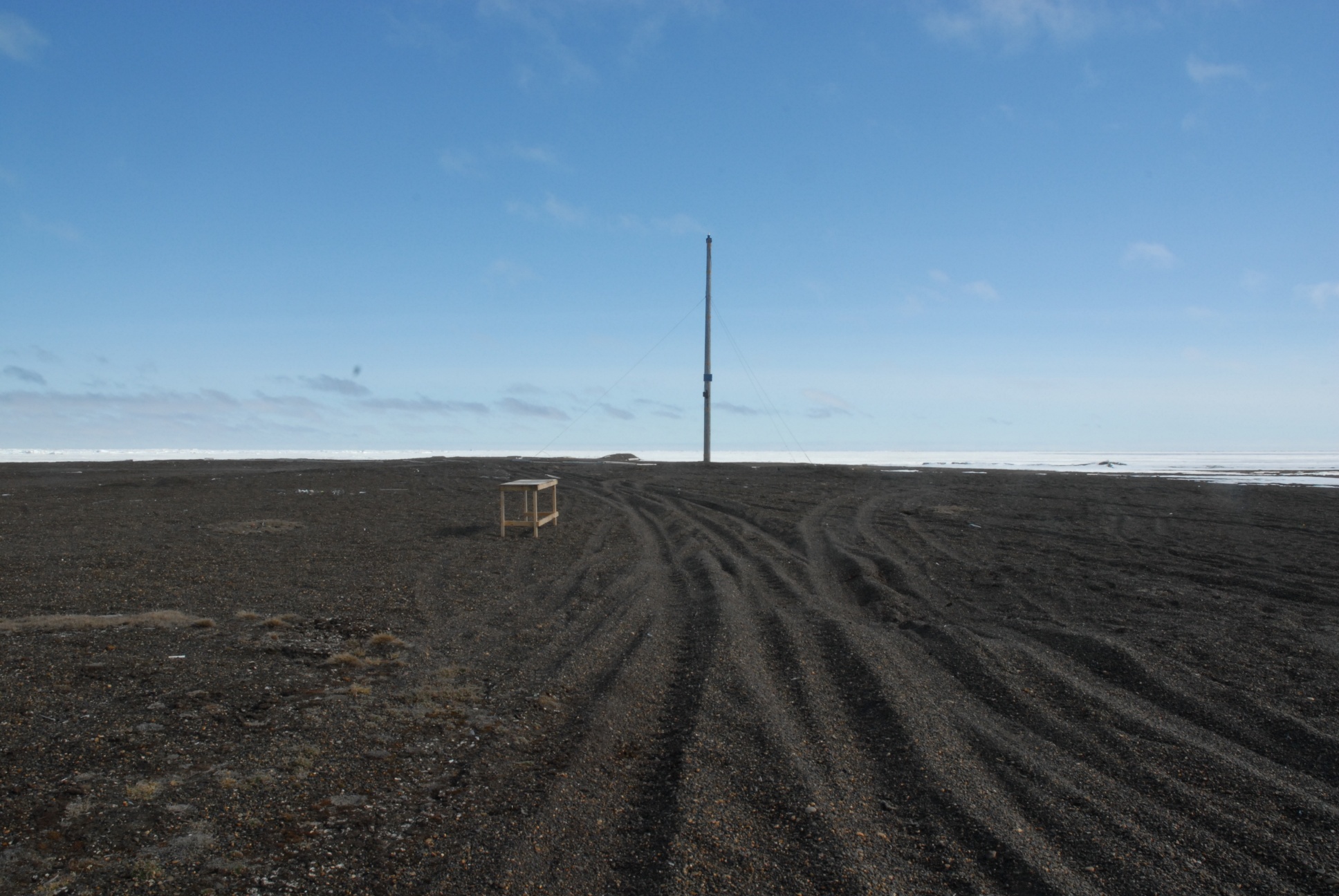
While we were over at the site, I double-checked how far we had tested in relation to the telephone pole with a light on it, since there is interest in mounting something on that pole, and access will be an issue until we are sure there are no graves right around the base.  We mark the end of the tested area with a line of driftwood, which we move inland at the end of every field season.  It’s only a few meters from the pole, so we should be able to clear that one way or another this summer.

Looking toward the Beaufort from the middle of the site. The line of driftwood on the ground marks the limit of the tested area.

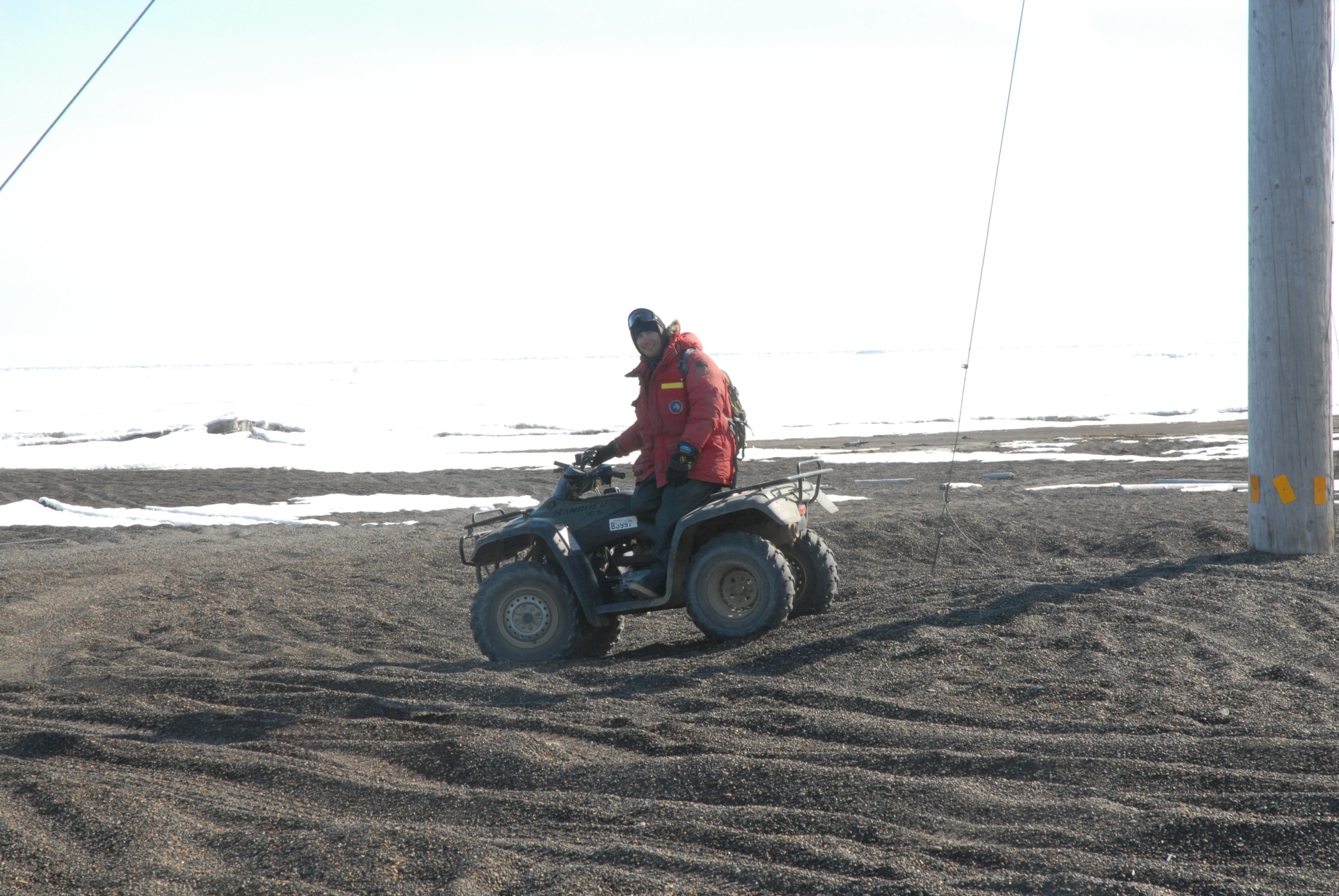
The “rack” turned out to be a table-like construction which was labeled as a survey marker for North Slope Borough Wildlife Department.  I checked with them when they got in, and the survey is due to be completed in four days, so it won’t be a problem for us.  I took a picture of Hank on his ATV while we were there.  Actually, I took several with his camera too, but the image never looked in focus to me, so I took some with my camera just to make sure.

Hank S. at Nuvuk

We stopped at another spot that was also a possible radar site.  Hank will take the GPSs back and do calculations to determine which one would work best for the radar, and then let me know and we’ll test it as part of determining if it can go out there.

The ride back was great, since the wind was at our backs.  Alas, my face is covered with what look like hives, which is what happens when I windburn

The snow is finally melting!!

We had a serious amount of snow last winter, although I’m not sure if it was an all-time record or not.  By a couple of weeks ago I was beginning to get a bit worried.  We’ve started work at Nuvuk in June some years ago, but it was pretty miserable.  We’re starting in early July this year, but at the rate the snow was melting it was looking as if we might still have snow patches on the ground when we started.

However, we’ve had some warm sunny weather the last couple of weeks, and the snow is melting.  Patches of tundra are starting to show through; people are heading inland after geese.  We drove out to the end of the road to take a look at Point Barrow.  I was happy to see lots of gravel showing.  Once the gravel starts to appear, it absorbs lots of heat, and the snow melts faster.  Given another month, we should be in good shape.

Point Barrow seen from the end of the road.

It was misty when we drove out, but I think it was a mist from snow ablating (going from solid to vapor directly).  It happens here a lot on warm days, resulting in mist rising from the ground as well as from puddles  & ponds.

Last sunset until August

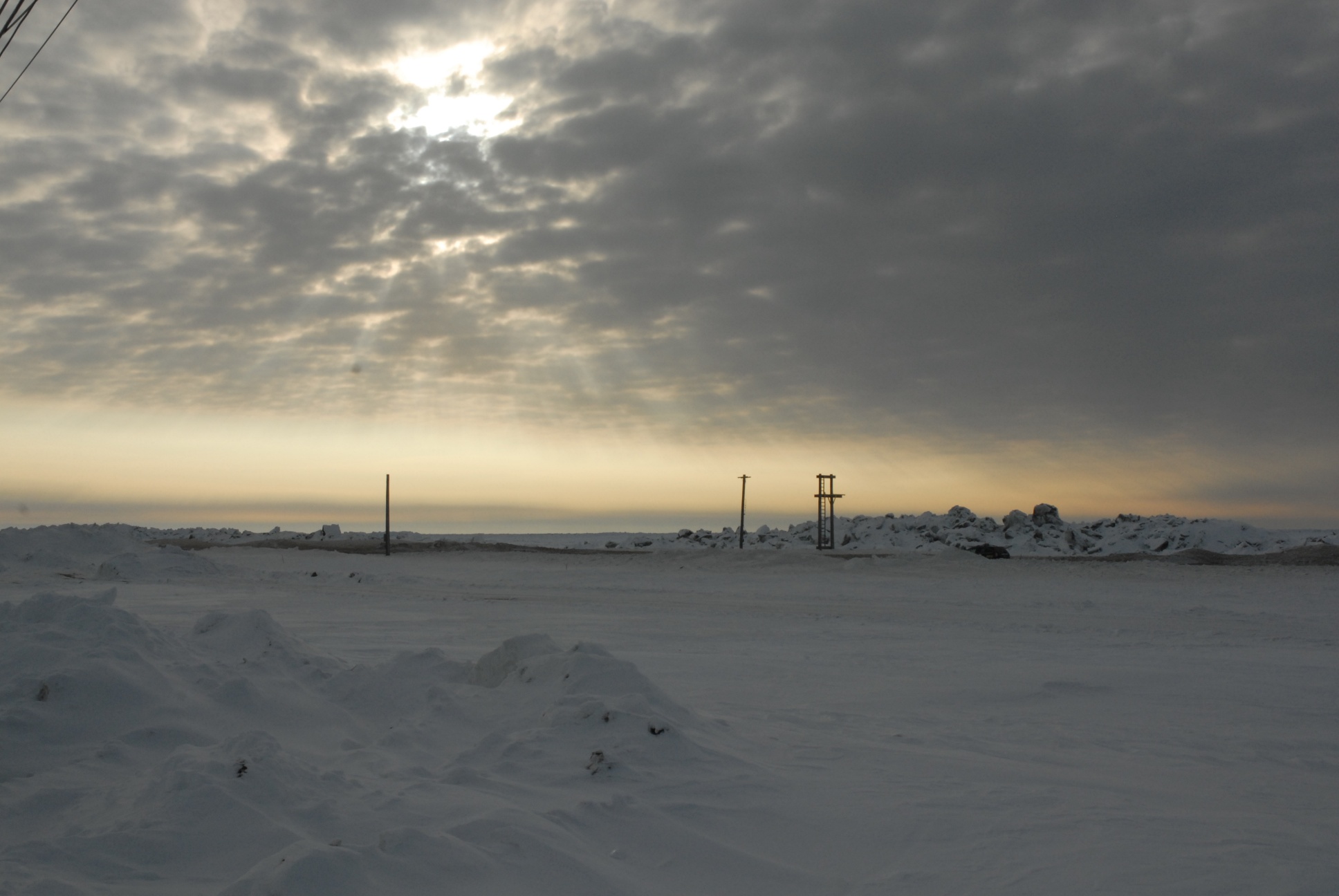
Tomorrow, May 11, the sun will set at 2:08 AM and rise 21 minutes later.  It won’t set again until early August.

This does not mean that there aren’t many inches of snow still on the ground, however…

The slog continues…

I am still plowing through the literature seeking out information on C14 dates.  Some of it is really hard to come by, with a date attributed to a house but no  information on the sample, either what it was or where it came from.  Then I look at the information on the artifacts from that house, turn to the plates (not naming any names here, but there are multiple offenders) to look at the artifacts, and see that the plates say they are from a house nearby.  Obviously either the text or the plates are wrong (unless they both are, but I’d rather not go there), so now one is left quite unsure of what was really being dated, and what sorts of artifacts were actually associated with that date.  Cross-dating based on artifact assemblages takes another one on the chin.

Another example from today: a date on wood and skin (what kind? caribou, seal, polar bear?) from a burial for which the description seems to indicate that it was only a few baby teeth!  It’s one thing to have typos in a dissertation, but in published books that people are expected to pay money for?  If people don’t read carefully, and compare about three different places in the book at once, it’s all too easy to accept a date at face value and assume that what is said about what it was found with is correct.  Then it gets mentioned elsewhere, and people read it there and pass it on, and so forth.

Such dates do not get high scores for context or association with the event being dated.  Actually they get zeros, since those factors are unknown.

All this in aid of a handbook article (well, two articles, since this C14 stuff should make an article as well).  On the other hand, a number of people say it should be useful.  I’m sure they’re all really glad that I’m doing it and they aren’t.  Can’t say I blame them.

Occam’s Razor is going to be coming in handy

The fun with radiocarbon dates continues.  I did manage to get a proposal off to a client, make some preparations for the summer field season and take care of the usual admin sorts of things.  Otherwise, I was working on the C14 dates.

It was slow going, in part because I read French much more slowly than I do English, and I was working my way through the Blumer compendium of St. Lawrence dates, which requires looking in at least 3 places to figure out how to evaluate the dates.  In some cases, one also has to go to other books to look at what the original excavator recorded (or didn’t).  Thank goodness for the American Museum of Natural History and their very nice downloadable PDFs (although the link seems troubled at the moment) of their Anthropological Papers.  I had a couple of them on my hard drive, which saved me a trip to get the actual books.

Anyway, St. Lawrence is going to be quite a mess.  There are a lot of whale and walrus dates, and Dumond  has calculated a correction for them by paired dating with terrestrial plants.  The only problem is that the whales in St. Lawrence are the same stock as the whales they catch here, and whalebone C14 doesn’t turn over very fast (a couple of decades at least) so they average the ∂C13 over that period.  That means that the correction factor for those whales should be the same anywhere in their range.  We’ve worked on it here for the Nuvuk graves, and the correction factor that works is much smaller.  I’m guessing walrus ingest relatively huge amounts of old carbon and skewed the calculations…

There was a very nice evening sky on the way home.

Sky from NARL. It was actually brighter, but this exposure shows the colors best.

Wrestling with dating

That’s what I’ve been doing lately.  No, not that kind of dating.  I’ve been wrestling with how old sites are, combined with the catching up after travel and working on taxes and other forms, it’s kept me busy enough that blogging kept coming in second to sleep.

I got started on this because I agreed to write a chapter for a forthcoming handbook of arctic archaeology dealing with Western Thule to Late Precontact in Northern & Western AK.  The northern part was fairly easy, since this is where I have been working for years, and I know the literature inside out, and am responsible for most of the C14 dates in that time frame, as it turns out (a lot of the major sites here were excavated before C14 dating was invented) but I needed to brush up a bit on the more southern parts of the area, I felt.  When I started doing that, I realized that terminology was a bit fuzzy (early investigators tended to think the entire sequence had to be present, and to call things, say, “Birnirk” because they thought there must be Birnirk, rather than because there were any diagnostic (types or designs only found in one culture) Birnirk artifacts at the site.

Then it became clear that people were using some artifact types as “index fossils” without being clear that they were really only in use for a limited time period.  So if they found such an artifact in a feature, they assumed the feature was used at the same time as all other features with that artifact in them.  Fairly recent C14 dating of some such artifacts has shown that some are pretty good to use, and others were being made for hundreds of years, so they aren’t really much help.

There is a pretty good dendrochronological (tree ring) series for the southern part of the area, due to Lou Giddings‘ pioneering work.  This has enabled people to date wood, although in some cases the possibility of wood reuse seems not to have been considered thoroughly, and only one log dated in a feature.  Then artifacts and artifacts assemblages (groups of artifacts often found together) found in that feature have been dated from the dendro date, and similar assemblages have been assumed to be about the same age.

Add the fact that there are a number of beach ridge complexes  in the area (Cape Krusenstern, Cape Espenberg), which develop over time.  Once people figured that out, it was a logical (and frequently correct) assumption that maritime-adapted people would choose to live on the ridge closest to the ocean.  From there, it was only a short step to deciding that all features on a particular ridge were fairly close in age.  In fact, as people have started doing more C!4 dating, and understanding how to interpret the dates better, it’s clear that isn’t the case.

As you can see, it’s not a pretty picture.  Add the tendency of earlier researchers to conflate time periods (as they understood they) with archaeological cultures, and things get really confusing.  Since this is a handbook, which one assumes is meant to be around for a while (although come to think of it, the Encyclopedia of Marine Mammals, in which I have a co-authored article, is in a 2nd edition less than seven years after the original came out), one would like to write an article that will not be rendered obsolete immediately.

So….  I’ve been going through the literature actually looking at the details of dates given for sites, dendro, C14 or otherwise, and am evaluating them on 9 different criteria to try to winnow out dates that are really reliable to base the chronology on.  That doesn’t mean other sites/features won’t be mentioned, but it does mean I’ll avoid putting hard dates on them, or using them as a basis to date yet other sites.

This is not fun.  I just hope it’s productive.