I just got an email from the editor of Polar Geography, the journal in which on of the articles I have been working on over the past year or so was recently published as part of a special issue on Arctic Community Engagement during the 2007-2008 International Polar Year. He has been able to arrange for several of the contributions to the issue, including my article, to be available Free Access (no pay wall) until the end of January 2013. My article is here, and the contents of the entire issue, with links to the various articles, is here.
This is a limited time offer, so if you are interested, head over there now. You should be able to download the free articles to read later.
Back in September, I did some work with some folks from KTUU, a television station in Anchorage, AK. The story finally aired, and I think it came out quite well. As is the case with most archaeologists, I’ve had some, well, odd experiences with journalists (the 45,000 year-old habitation of the Barrow area stands out–I said 4 to 5 thousand). These guys were the opposite. I think they did a nice job, and even emailed and called to let me know the story was airing. A lot of journalists say they will, but Dan Carpenter actually followed up!
If you are interested in what was happening earlier this fall, you can see here. Unfortunately this has continued since then and we’ve lost a lot more ground.
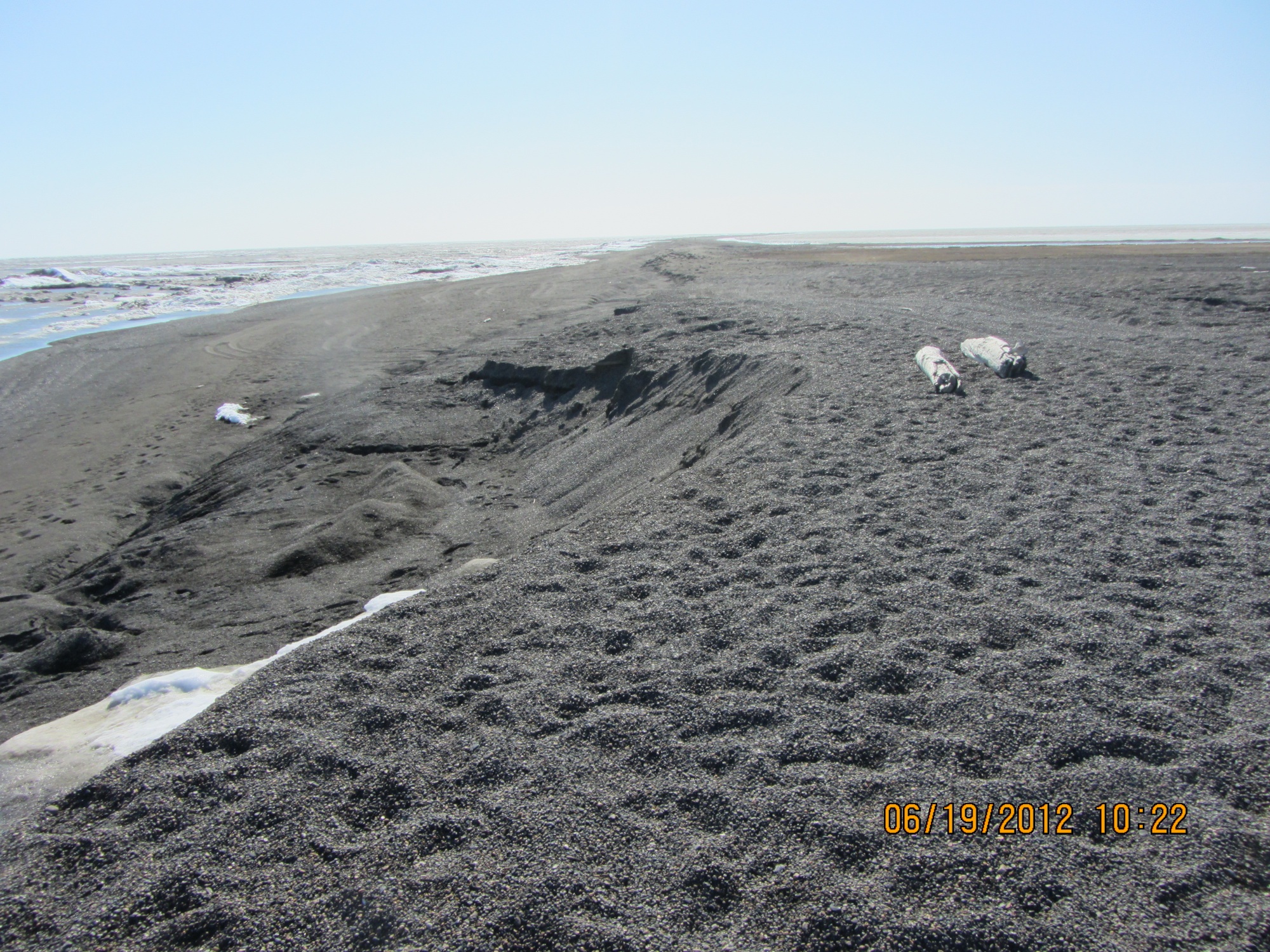
I got back to Barrow to find snow on the ground. It hasn’t been that stormy here, but we had a coastal flood warning over the weekend, with part of the road to Nuvuk getting washed out, and waves getting over many of the berms. I am afraid that there may have been significant damage to the site beyond the 20 m we already lost in September. I would like to get out and take a look, maybe even shoot in the bluff, before I go to Valdez & Seattle, but that is not looking too likely.
Apparently, there is a likelihood of a storm surge from the Chukchi and flooding over the next few days, maybe until the 22nd or so. The North Slope Borough is quite worried, and sending out info on emergency kits & so forth. Not a great situation. The house I live in floated in the last really big storm surge event in 1963, and if it does it again, it could wind up in the NARL sewage lagoon. Yuck.
We’ll be prepared, but I don’t think it is that likely to get that bad. However, it most certainly is already damaging Nuvuk more. It has been blowing from the north and winds are picking up. It is a bit depressing given that erosion must nearly have reached the GPR returns that we think are Ipiutak features.
Not much to be done about it, so I just push on with writing proposals & papers. I’m going to a workshop on the Kurils & Aleutians, and am slightly belated working on the conference paper. Just as I got ready to really check out the other papers prior to doing the serious writing (the outline is done), it was discovered the website had lost the last 3 weeks of updates (explains where my stuff went–I thought they were just being slow getting it up), so I couldn’t get into it. I hope we don’t lose Internet later this week, and that I have decent connectivity in Valdez.
The important but not overly exciting routine of proposal preparation & writing on my part, and cataloging on Coby’s part was broken on Friday. KTUU TV, the Anchorage NBS affiliate, sent a crew to Barrow for a few days. They were covering the football team, and wanted to get some practice footage, but that left them with lots of free time, so they had to get as many other stories as possible, and they decided to go for science stories.
I know they did an interview with George Divoky, who had just made it in off Cooper Island (the weather has been really awful–not boating weather at all). They also shot some footage about Nuvuk and coastal erosion.
First they stopped into my lab for an hour or so. They shot a fair bit of footage of Coby Hatcher (who is going to HS on-line and therefore was working in the lab when they were there) doing various things one does in an archaeology lab, including re-bagging cataloged artifacts and entering storage locations for artifacts in the catalog database so they can be found again.
Coby updating storage locations in the catalog
With a big collection, this is pretty important, since otherwise it can be very hard to retrieve things. It actually came up because I was trying to find the bird bone from the Ipiutaq levels that had been used to make needle blanks. A number of folks think it looks like it is an albatross bone, which is interesting if true, since there aren’t many albatross around here. One of them is involved in a project which is doing ancient DNA work, and offered to run some of this bone to see if it really is albatross. There was no storage location in the catalog, so we had to look a bit. We found it and I’ll mail it out, and Coby put updates in the catalog.
Then they shot some footage of me showing some of the artifacts, and some of me doing an interview about the project and what one can learn through archaeology. That lead into what gets lots when sites are lost to coastal erosion and/or warming and permafrost thawing.
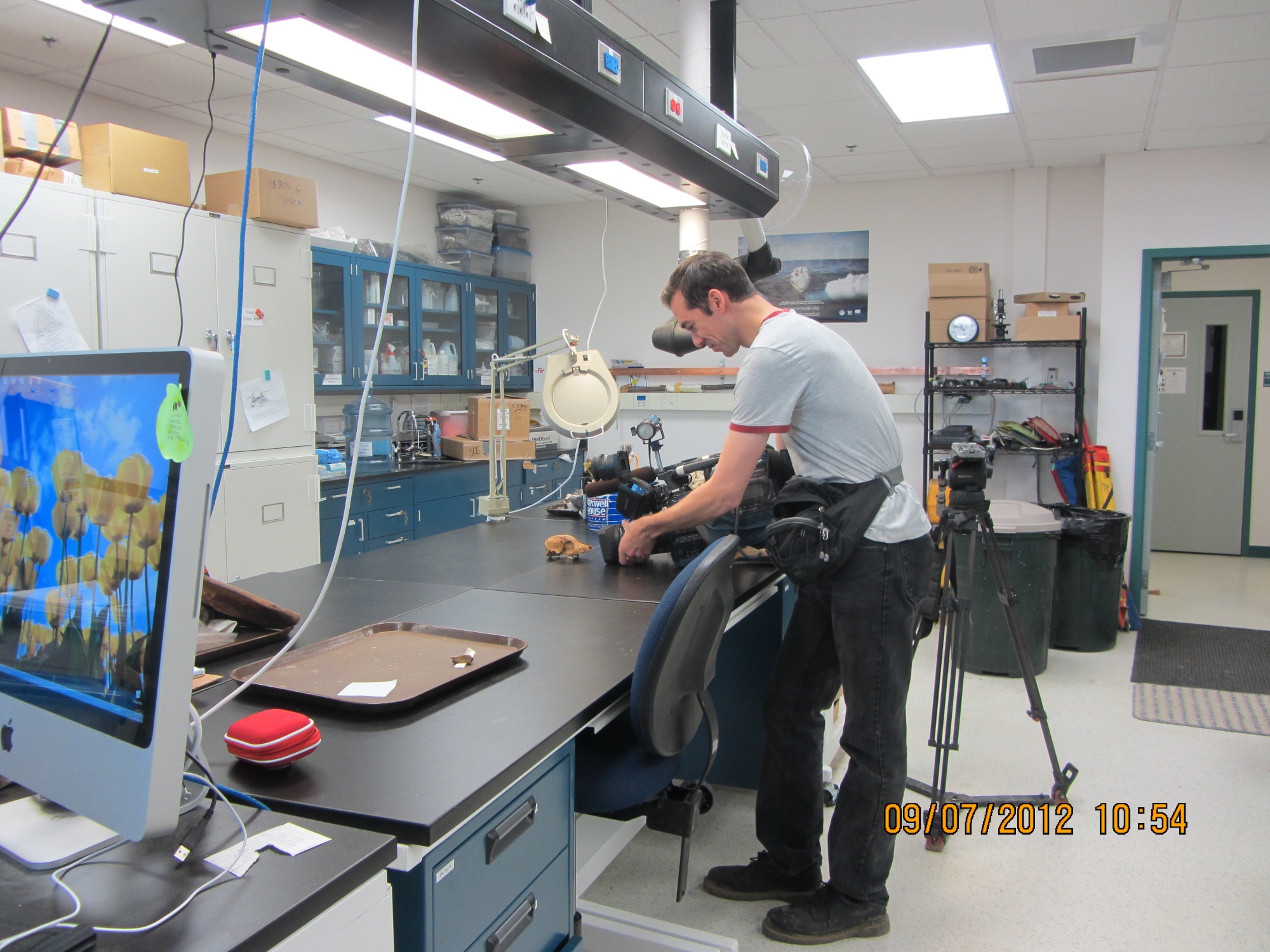
Dan Carpenter shooting video. He really liked this fox skull.Dan Carpenter, KTUU, interviewing me in the lab. Photo by Coby Hatcher.
After that, they headed off to do something else. In the late afternoon, we headed out to Point Barrow for them to get some shots of the site and, as it turned out, coastal erosion in action. That’s a story in itself, so that will be the next post.
I’ve been busily writing away at a couple of overdue papers, and the students have been going great guns processing and cataloging artifacts in the lab. While all this work is important, it doesn’t make for the most exciting blog posts, so I’ve been focusing on the papers.
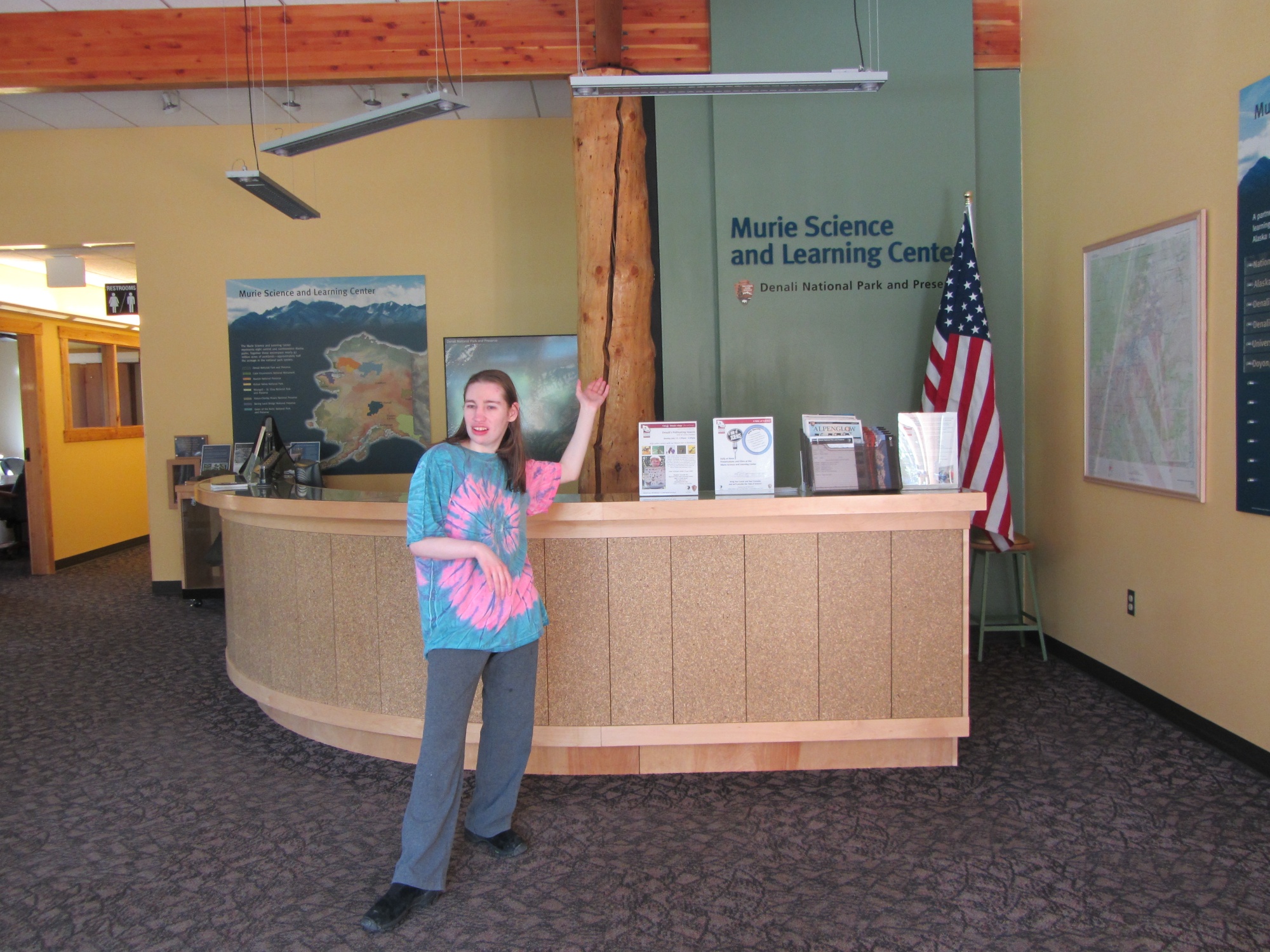
Last week I wound up doing a couple of outreach events. The first was a public talk at the Murie Science and Learning Center at Denali National Park. Since I don’t live anywhere near Denali NP, this was no small undertaking. I flew to Anchorage, rented a car and went to the Apple store to pick up some video adapters for my Mac Air on Sunday, picked up my daughter Justine on Monday morning, and we made some sandwiches and set out. It is a 240 mile (more or less) north out of Anchorage, up the Parks Highway to the Park and the MSLC. I was speaking at 7 PM, but wanted to get there a bit early to make sure I found the place and my computer worked with their projector & so forth.
We had a pretty nice drive. The weather was sunny, but since I was driving north that was no problem. The drive is beautiful, although there were clouds around Denali (the mountain some call Mt. McKinley) so it wasn’t out.We stopped at a couple of viewing areas, but no luck. There are actually mountains between Denali and the Parks Highway, but Denali is so big it would have been visible anyway except for the clouds.
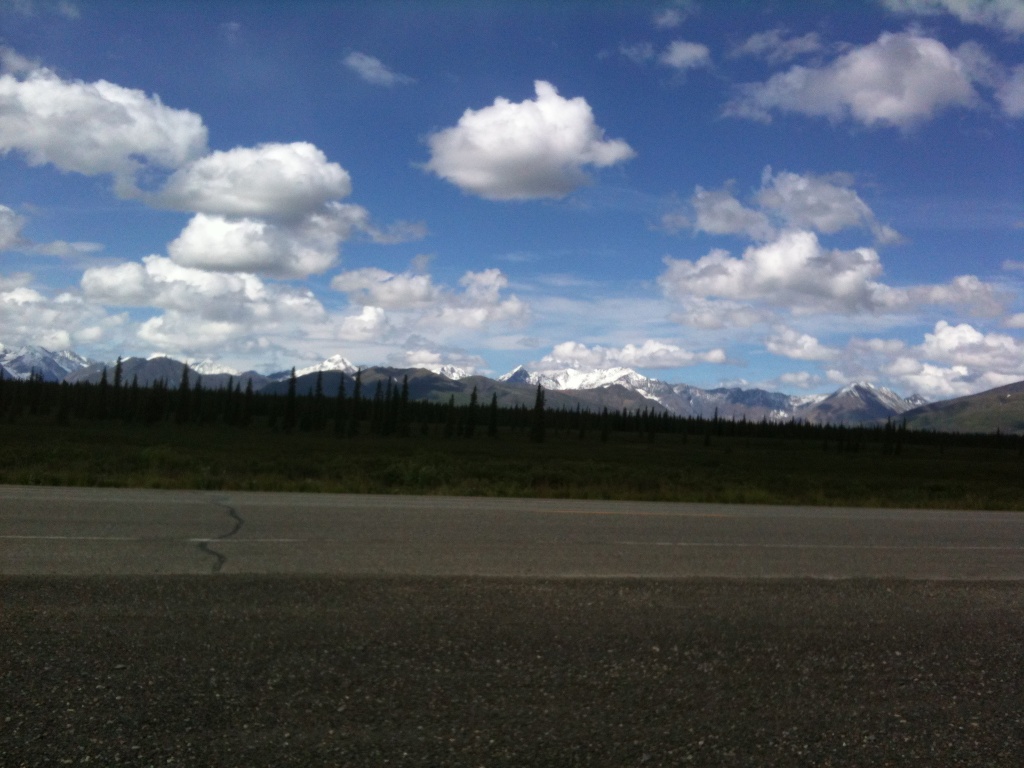
Alaska Range from Parks Highway
We made good time to Denali. It is very beautiful country, to my way of thinking, and gets prettier as you climb away from sea level and taiga forests with tundra on the mountains. It took a bit of doing to find the MSLC, but we succeeded.
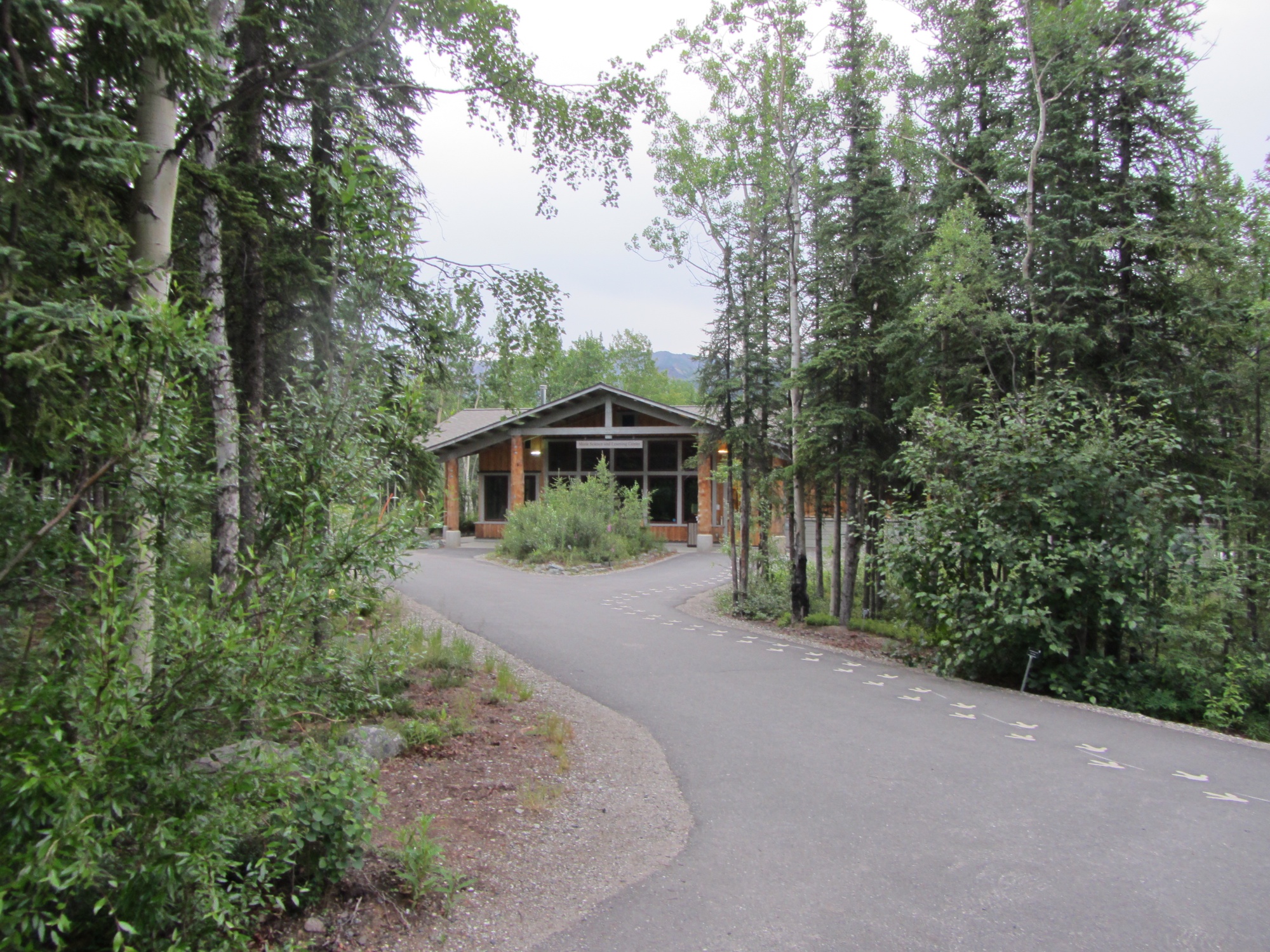
Pathway to Murie Science and Learning Center. The white dinosaur footprints lead to the MSLC from the Denali NP Visitors’ Center.
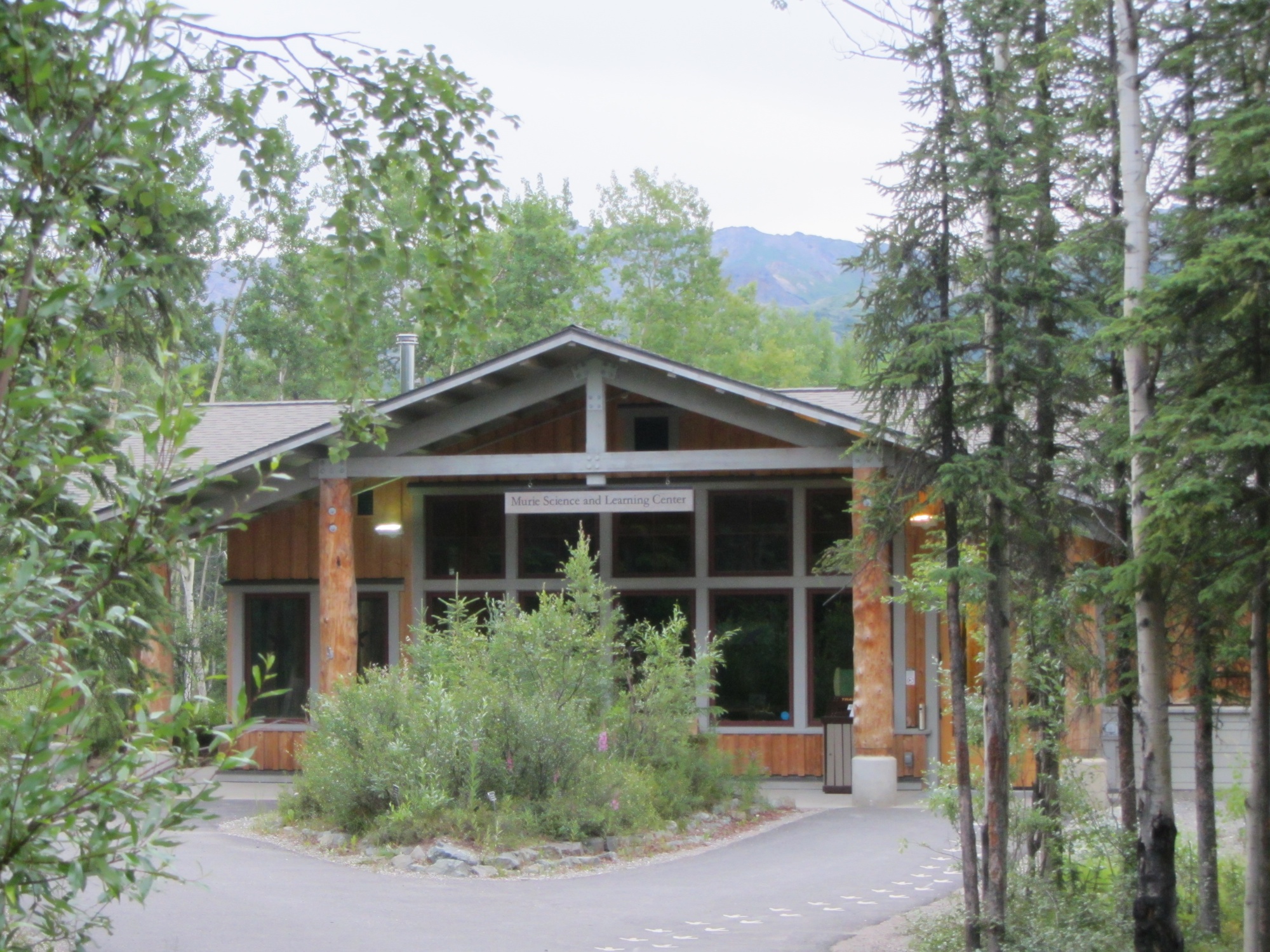
Closer view of MSLC.
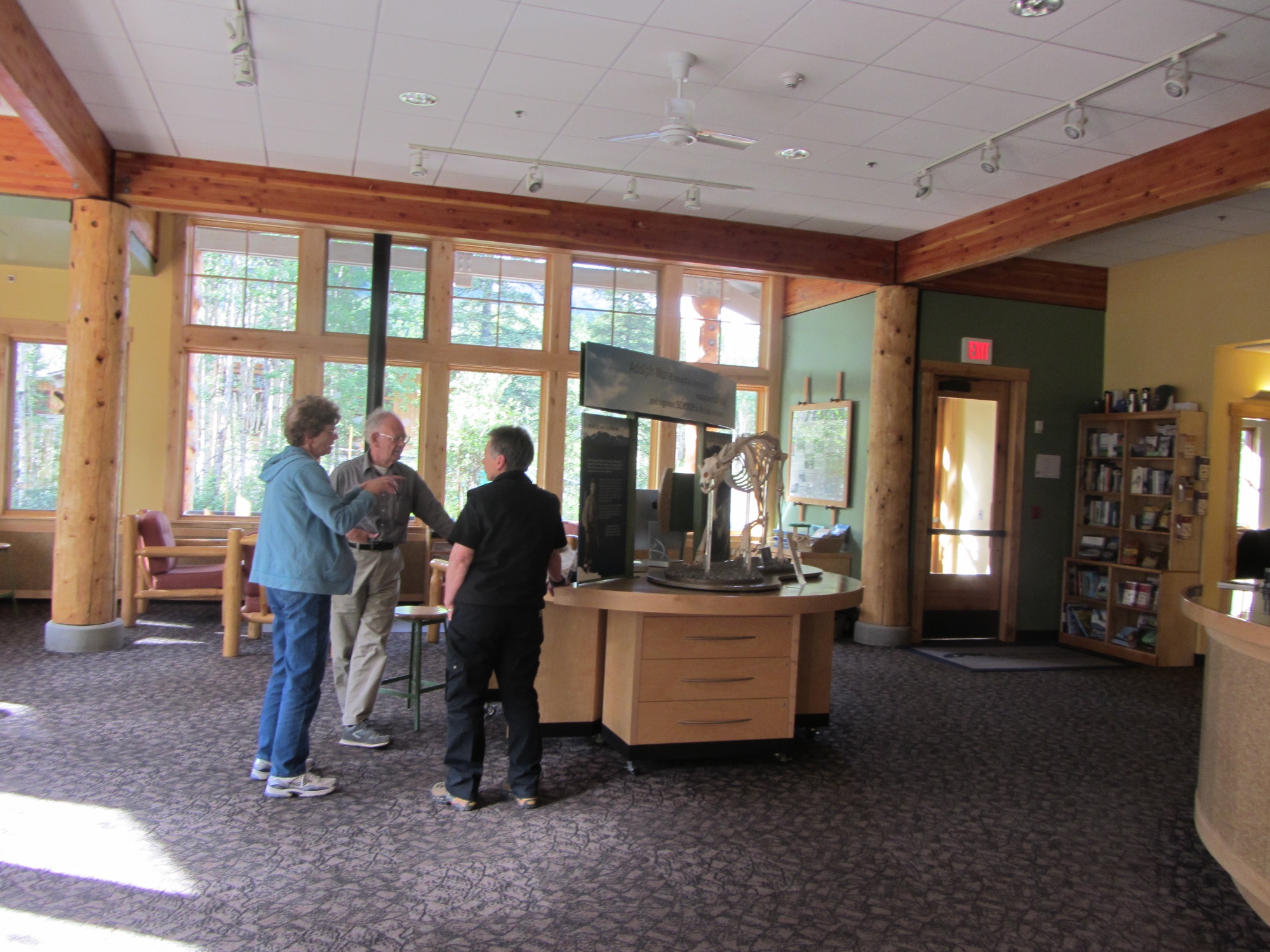
Justine indicating where we are for the photographic record of the trip.Main room of the MSLC, with a couple of park visitors and an interpreter.
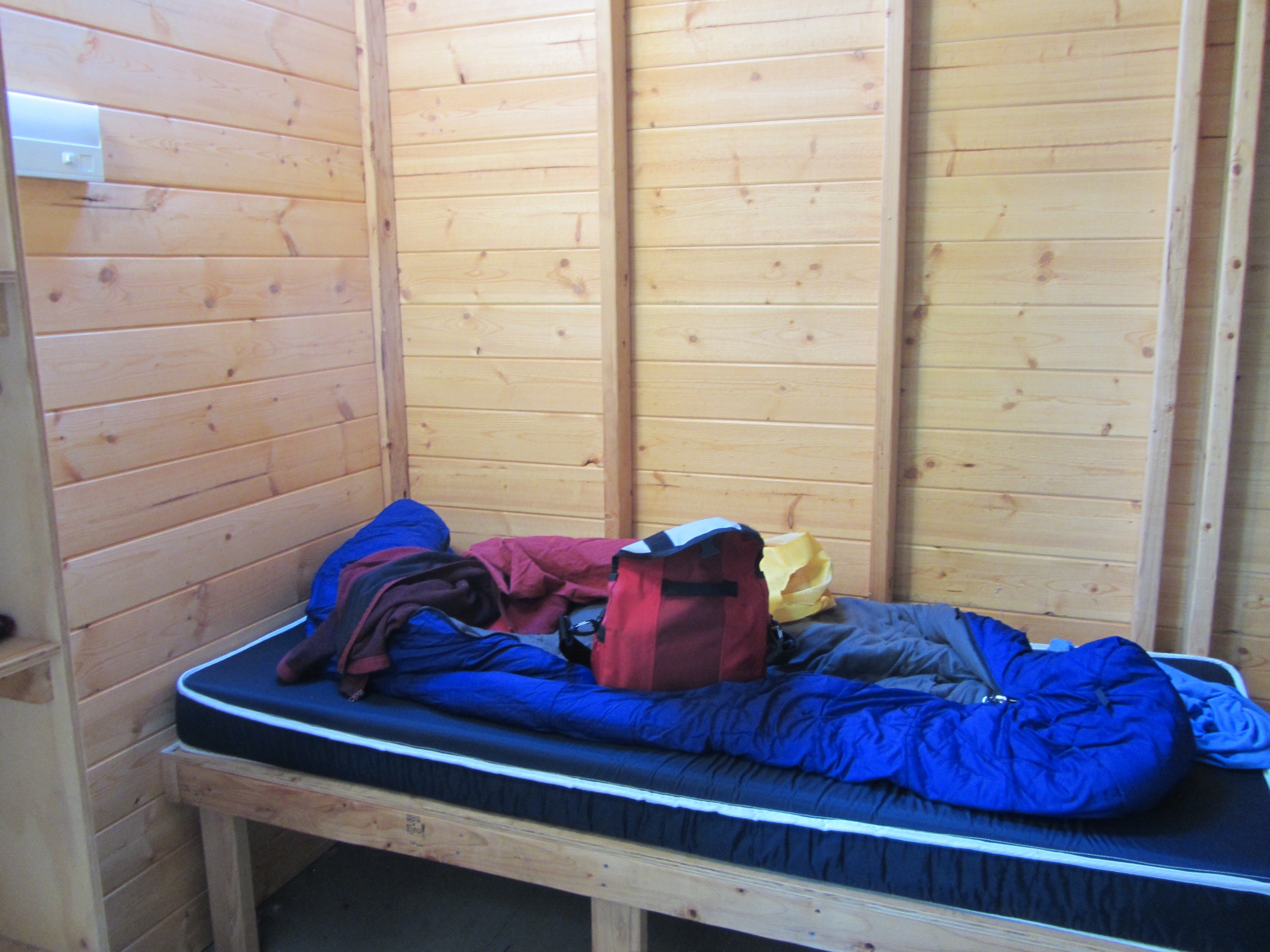
We got in touch with NJ Gates, who runs the speakers’ program and she got us settled. I made sure my computer worked with their projector. Although this was not a paying gig, they were kind enough to put us up in a yurt that they have for visiting researchers. Since there weren’t many around, we each got our own room. I had brought down sleeping bags & a Thermarest (since we thought one of us would be sleeping on the floor) from Barrow. The Park has wagons, and we used one to pull our gear to the yurt. I somehow didn’t manage to get a picture of the outside or the bear-proof box into which all food and toiletries went. The interior was divided into 3 rooms, 2 of which shared an entryway. We got those two.
Bed in yurt, strewn with gear.Interior view of yurt & skylight.
After we got settled, we went to the grill at the visitors’ center for a quick dinner, and headed back to give the talk. We got a decent crowd for a Monday night, I thought. It went well, except for the earthquake in the middle of it. It was big enough to really shake the screen, and given that the MSLC is a heavy timber-frame building, I waited a few seconds to see if it would get bigger. It didn’t, so on we went. Some folks had a lot of questions, but we were all done, and in bed in the yurt by about 9:30.
This was important, because Justine had a doctor’s appointment in Anchorage at 11AM the next day. We got up at 4:15, grabbed a couple of sandwiches & a drink and were on the road a little after 5AM. The weather wants quite as nice, but it didn’t rain until we were nearly to Wasilla (yeah, that Wasilla), but stopped quickly a little later. Still no sight of Denali, but the drive was beautiful.
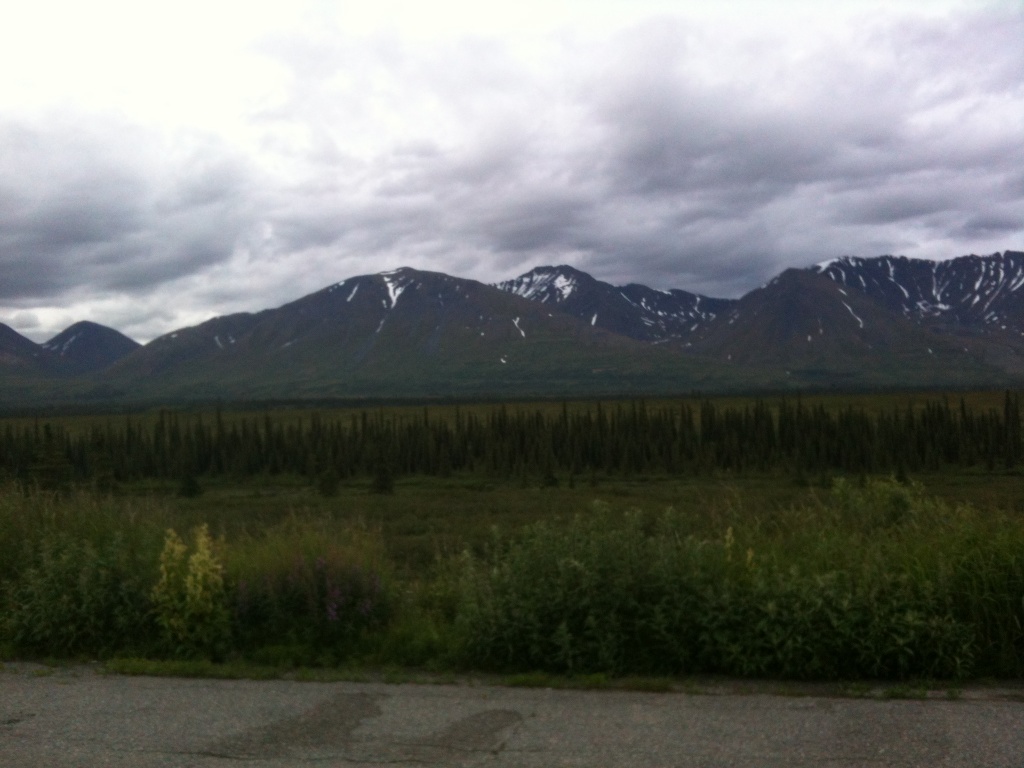
Mountains along the Parks Highway.
We made it to the doctor’s office around 10AM, I dropped Justine off, met my husband for lunch (he was in Anchorage on his way back from Ketchikan to Barrow), and caught a plane back to Barrow on Tuesday night.
Wednesday, we got ready for a visit by kids from the City of Barrow summer program. More about that in the next post.
Interesting post pointing out that heritage is what matters to a community,and not always something wonderful and fancy. It might not be the Coliseum, but the Långban football (soccer in US-speak) pitch is part of that community’s heritage.
As we’re in the middle of a fantastic European football championship and one can watch top match after match delivered as they were produced on a conveyor belt – it’s kind of hard imagine a time with less or no top football to watch – though we all know it’s lurking there just around the corner. With several months for the next Champions league, Premier League, La Liga, Bundesliga or Italian Serie A and then again years for the next World or European championship.
In Sweden we can still enjoy football during the summer as Allsvenskan (Swedish first division) and Superettan (Swedish second division) etc. runs its course during this part of the year (though I wont claim it’s great football) and still here is my love in the football world – Jönköping Södra IF aka J-Södra, somewhere in the middle of the second division. And though it seems…
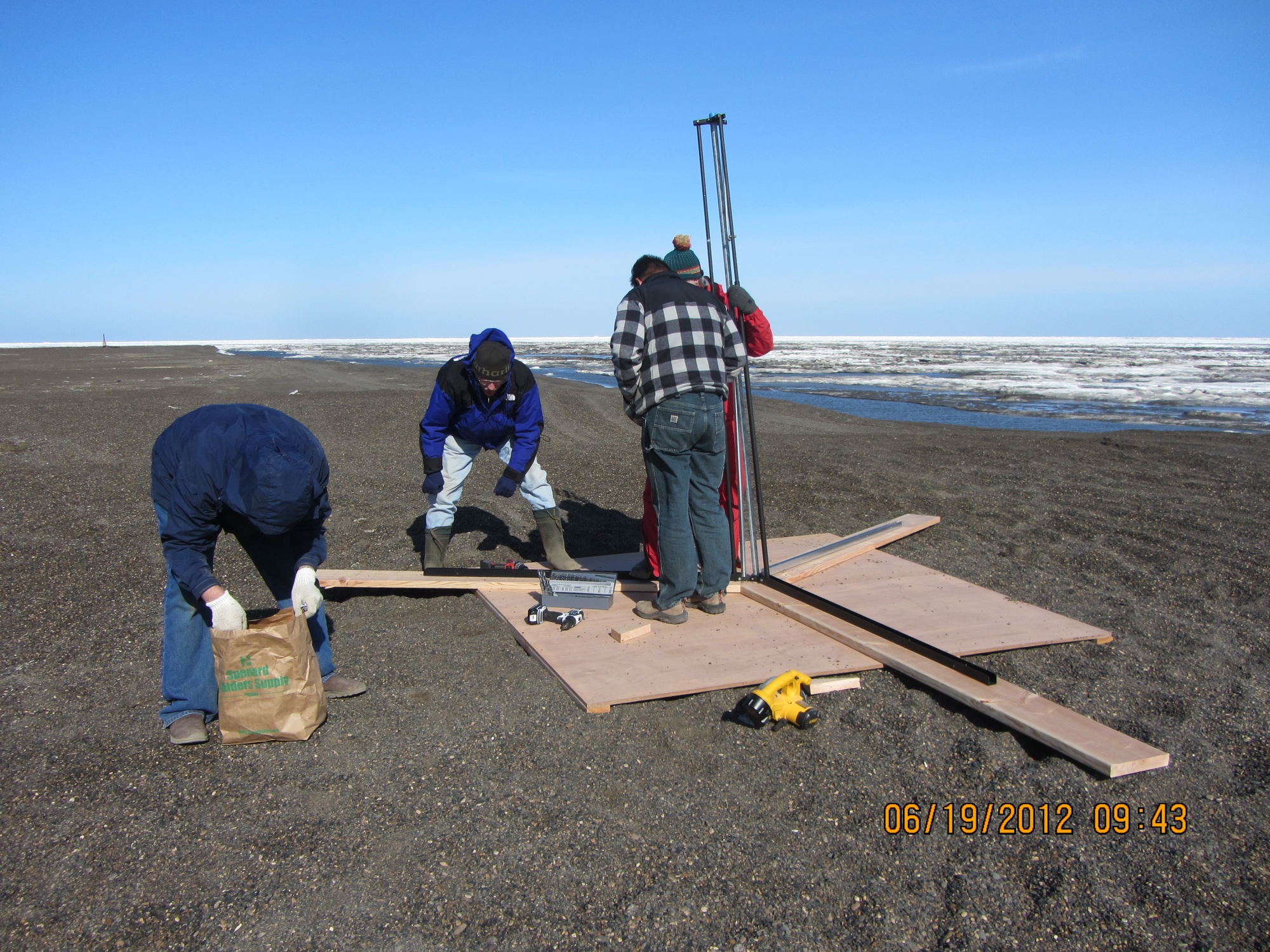
I got out to Nuvuk today for the first time today. The ARM project that we support want to put a flux tower at the Point to measure flux off the ocean during the open water season. The thing is that the ideal spot for the tower is on the ridge where the Nuvuk site is.
In the past, other folks wanted to put flux towers there, but there simply wasn’t room for a tower in an area where we had already tested and recovered all the burials, and we didn’t want to chance disturbance to a burial. Now we’ve gotten a good way ahead of the erosion, so it seemed that it might be possible. However, I didn’t want the tower to be on top of the possible Ipiutaq structures, just in case funding for their excavation is available. Since the tower installation involved moving a little gravel, it was important for me to be there just in case something showed up.
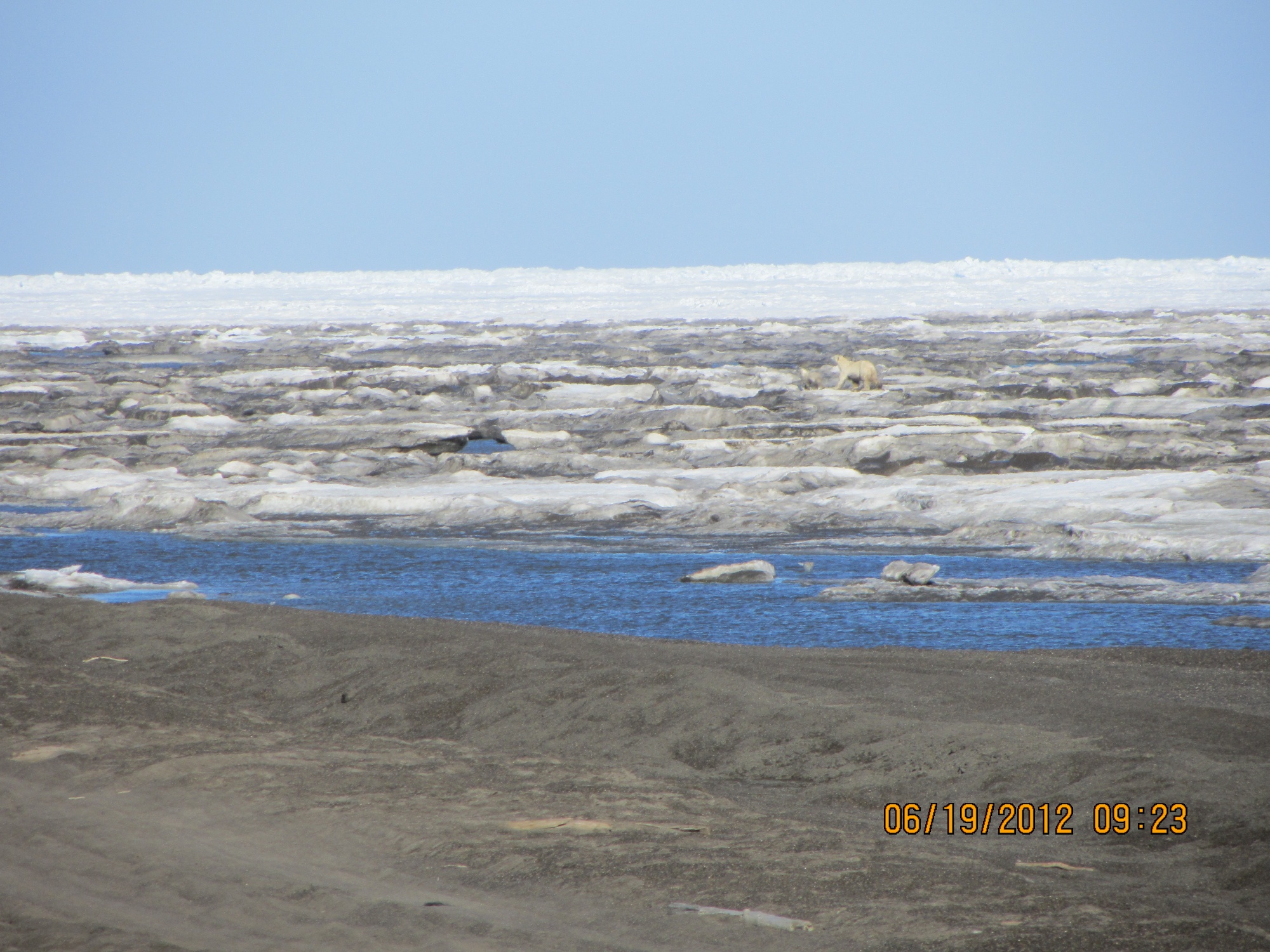
It took a while to get out there, since the ARM Kubota is on tracks and can only go about 15 miles an hour. We quickly got a spot picked for the tower. After that, I spent most of my time looking around for bears while the others started putting the tower together. I spotted 2, a mom and a cub, who were heading to the bone pile.
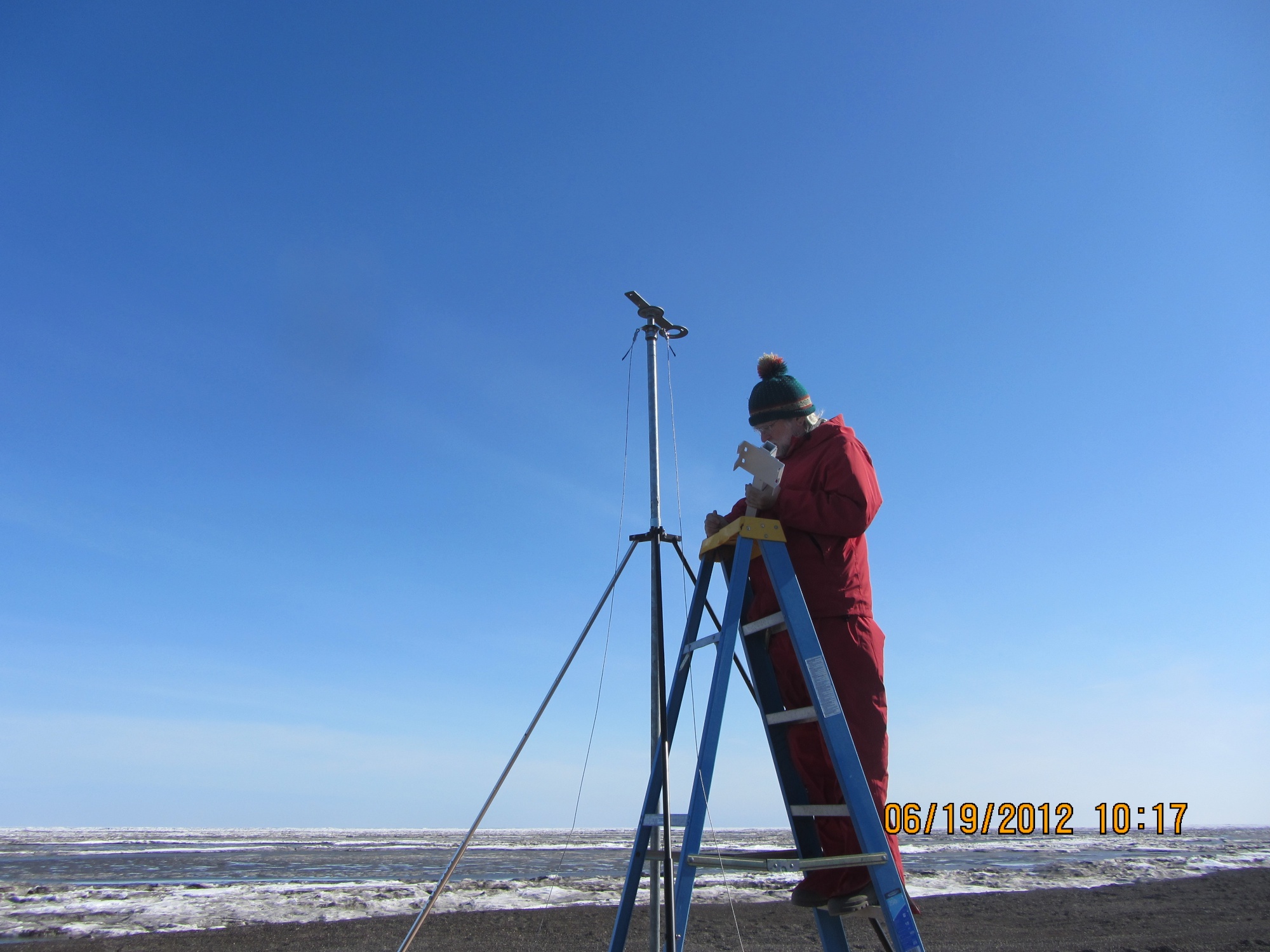
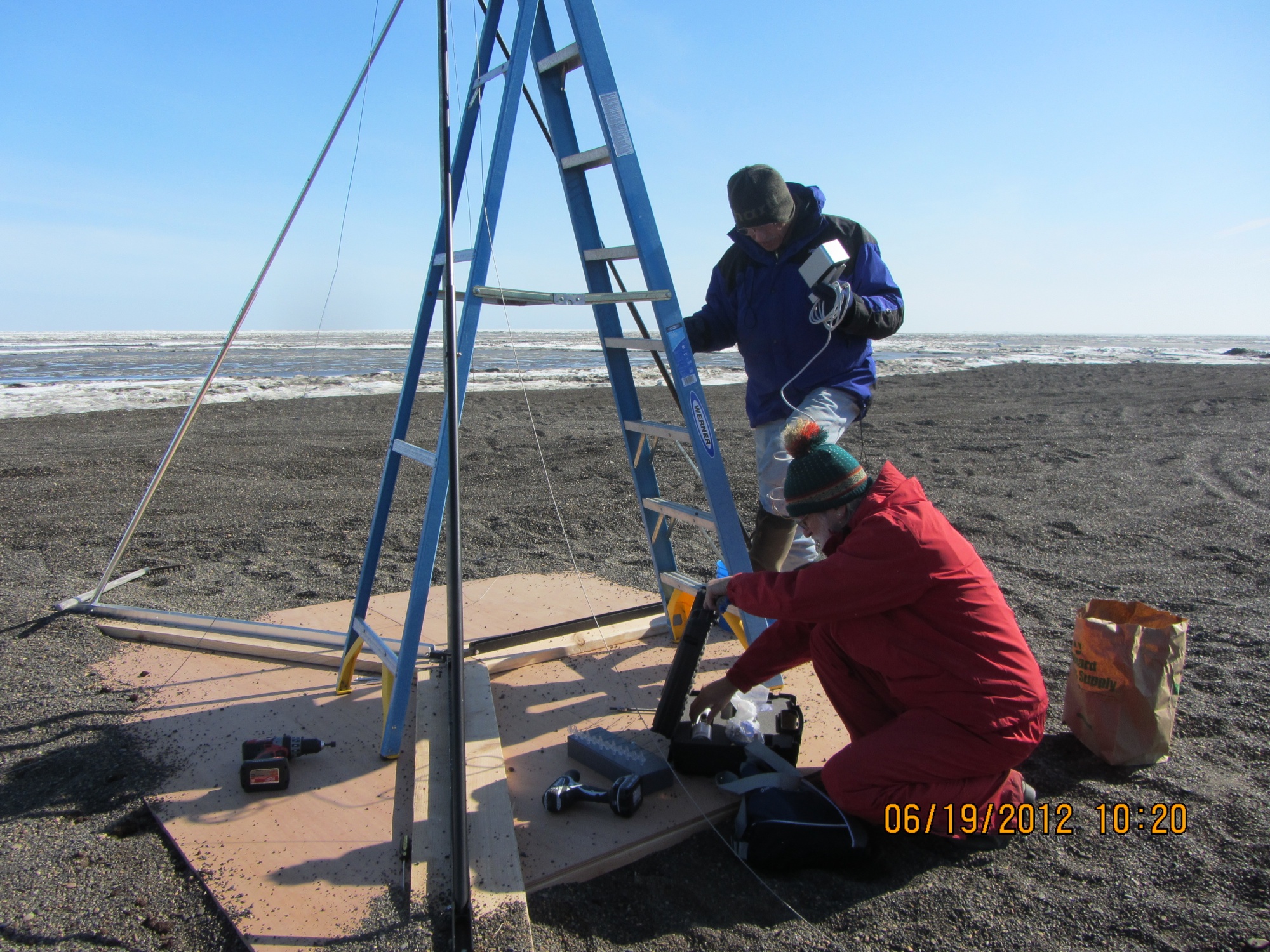
Polar bears heading for a meal.Assembling the base for the tower.Putting the tower together.Putting the instruments on the tower.
We decided to use sandbags for the guy-wires and then added some more on top the tracks on the base plate. To minimize disturbance to the site, we decided fill the “sand”bags with beach gravel, and bring them up with a four-wheeler.
“Sand”bags on the Honda.
After the tower was assembled and the instruments were on, the instruments needed to be wired up. That took a while, but I had to sick around since one of them needed to look down are gravel, so we needed to cover the plywood base plate, which meant more digging.
That gave me time to check out the area where we salvaged the Ipiutak structure last fall. Good thing we did that last fall, because that area is gone. There is a big notch in the bluff there, and that’s it. It would have been a pity to lose that, because we found some very interesting things in the field and in the lab.
Where the Ipiutak structure was…
While I was getting to play, the crew was working away in the lab. They have finished floating and sorting the materials from the fall salvage, and are moving on. Over the winter, we’ve had several sets of visitors on short notice, which required some materials to be cleaned off benches fairly quickly. As a result, there were a lot of miscellaneous boxes around the lab. The crew has reorganized several cabinets and gotten most of the boxes emptied. There is plenty of bench space, so we are moving on to cataloging and marking.
Part of the hard-working lab crew (l. to r. Victoria, Trina & Trace) working on faunal remains.







 Out of Ice and Time