Some serious blizzards

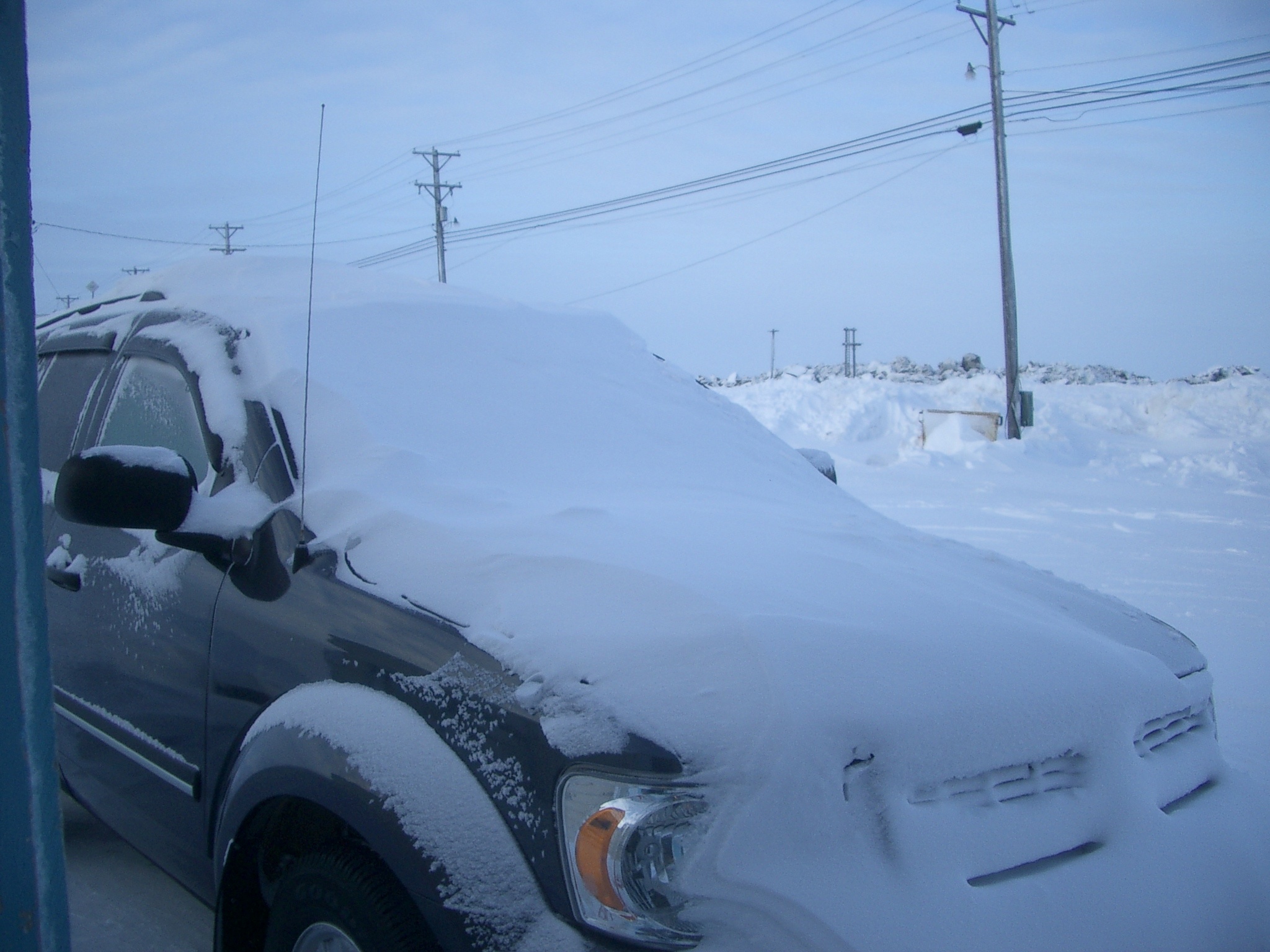
For the past week, the weather has been fairly unfortunate here in Barrow.  We had a snow day on Wednesday.  It was a total whiteout,with so much snow blowing around that I could barely see my car out the front door, let alone the
house next door.  The UICS staff discussed it and decided to hold off until after daylight to go to work (so we could at least have a chance to see drifts).  By that time, UIC and everybody else had closed for the day.
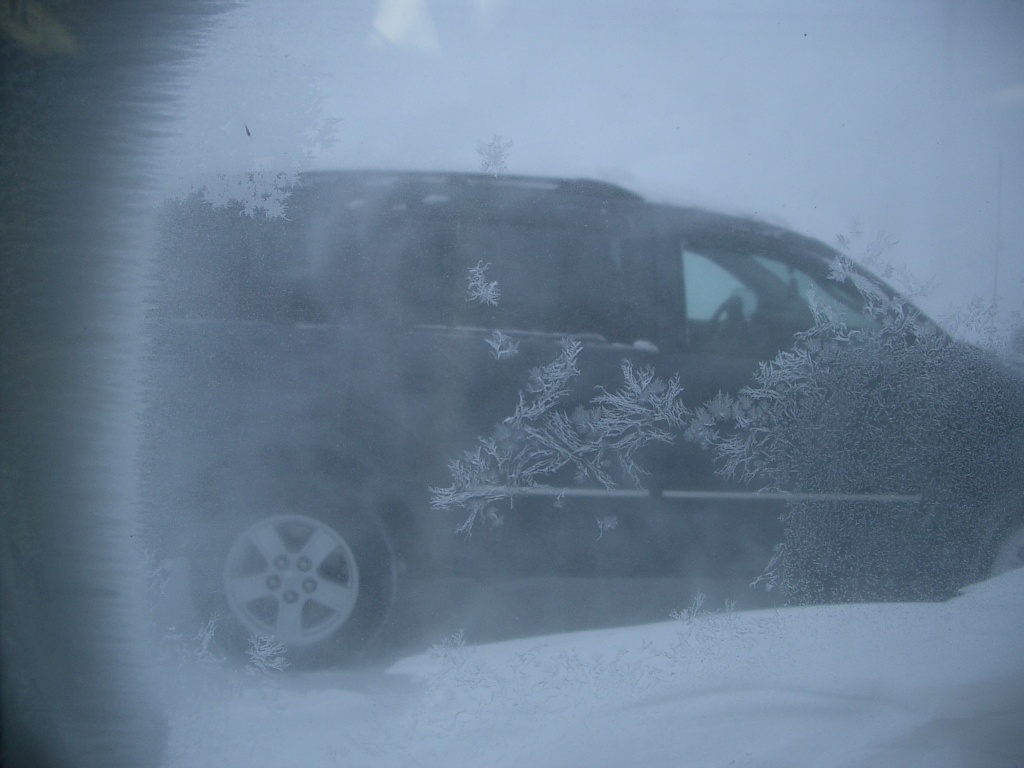
View out the front window during Wednesday's blizzard. Notice the snow streaks and the frost flowers.

The weather improved Wednesday night, but no loaders had been heard at NARL by the next morning.  I called into the regular teleconference with one of our clients, and then headed for the BARC.  Good choice.  The drift across the drive was huge.  I headed back to my house for snowshoes.

Fortunately, the ARM project has a telehandler with a bucket.  They also have a contractor who is trying to finish an upgrade to the BARC instrument platform and is a bit behind schedule.  Once the telehandler was dug out and the area around the ARM duplex was clear, Walter brought the telehandler over to the BARC drive.  One and a half hours later, he had a single lane through the drift and place for me to park, so I went in.  Susie, who’s filling in as the UICS temporary admin assistant, came out in a cab.

The wind was already rising and the barometer dropping again.  I went home at for a quick lunch, and there was already a drift at my door.
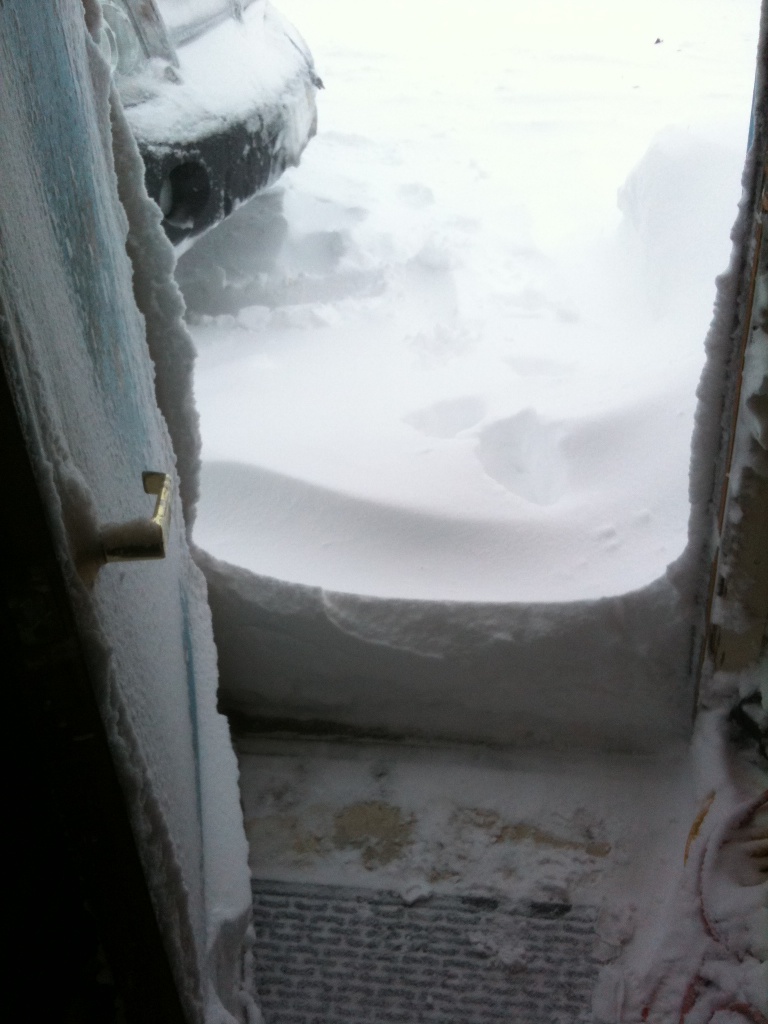
Drift at the door at lunchtime on Thursday.

The snow was sculpted in very interesting ways, which had gotten more elaborate while the car was out of the way.
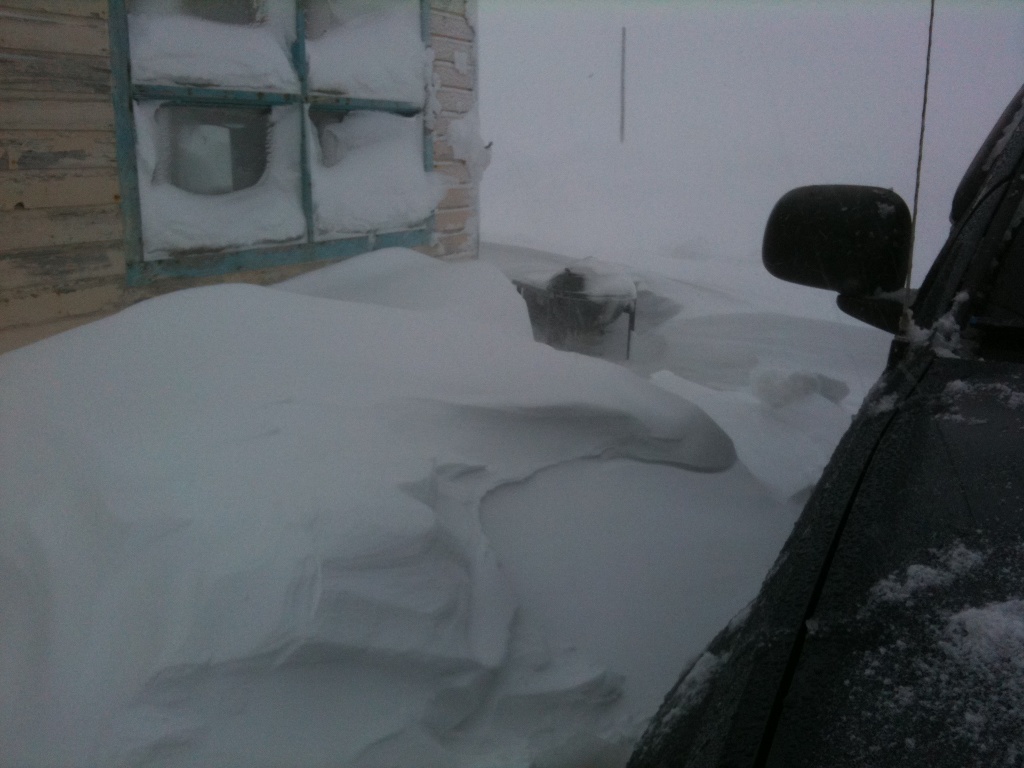
Drift at the front of my house, lunchtime on Thursday. The grill is almost completely exposed.

I went back to work, but by 3 PM it was getting really nasty with low visibility.  I told everyone it was time to head home, since the road from NARL was going to get bad (and Susie and I would be spending some time at the BARC with the contractor if we didn’t get out ASAP).  Shortly after that, they closed pretty much everything in town for the day.

We were closed for everything all day today (Friday), too.  I managed to get a few things done and written from home.  We’ve canceled lab for tomorrow, since the loader has only been working enough to get a path for the water and sewer trucks to get the residential huts, and the BARC is undoubtedly behind a huge drift again.  We haven’t actually gotten water or sewer trucks, mind you, but they can at least come tomorrow.

My husband’s weather day was interrupted by the news that something had blown in in the BASC Bldg. 360 server room.  He went over on foot (falling into snowdrifts that he couldn’t see without glasses) and eventually got a repair crew organized to come secure the room so snow didn’t keep blowing in and wreck the servers.  They had to turn off an air conditioner, but that didn’t seem to be a real problem, given all the cold air that was coming in everywhere.

The wind is finally going around to the north, with temperatures dropping, and even a little bit of sunset sky showing!  It’ll be a chore to get to work on Monday, no doubt, but that is the Arctic.  The entire North Slope was under blizzard warning for a couple days.  That was a huge storm, apparently bigger than any they’re recorded for a decade or more.
Now that I’m home…

I was lucky enough to get an upgrade from Alaska Airlines, so at least I wasn’t bent up like a pretzel all the way to Barrow.  They weren’t any too quick about getting the baggage out, and no-one was to be found to issue the Baggage Service Guarantee vouchers after the 20 minutes had passed, so we took my bag when it showed up (after about 1/2 hour) and went home.

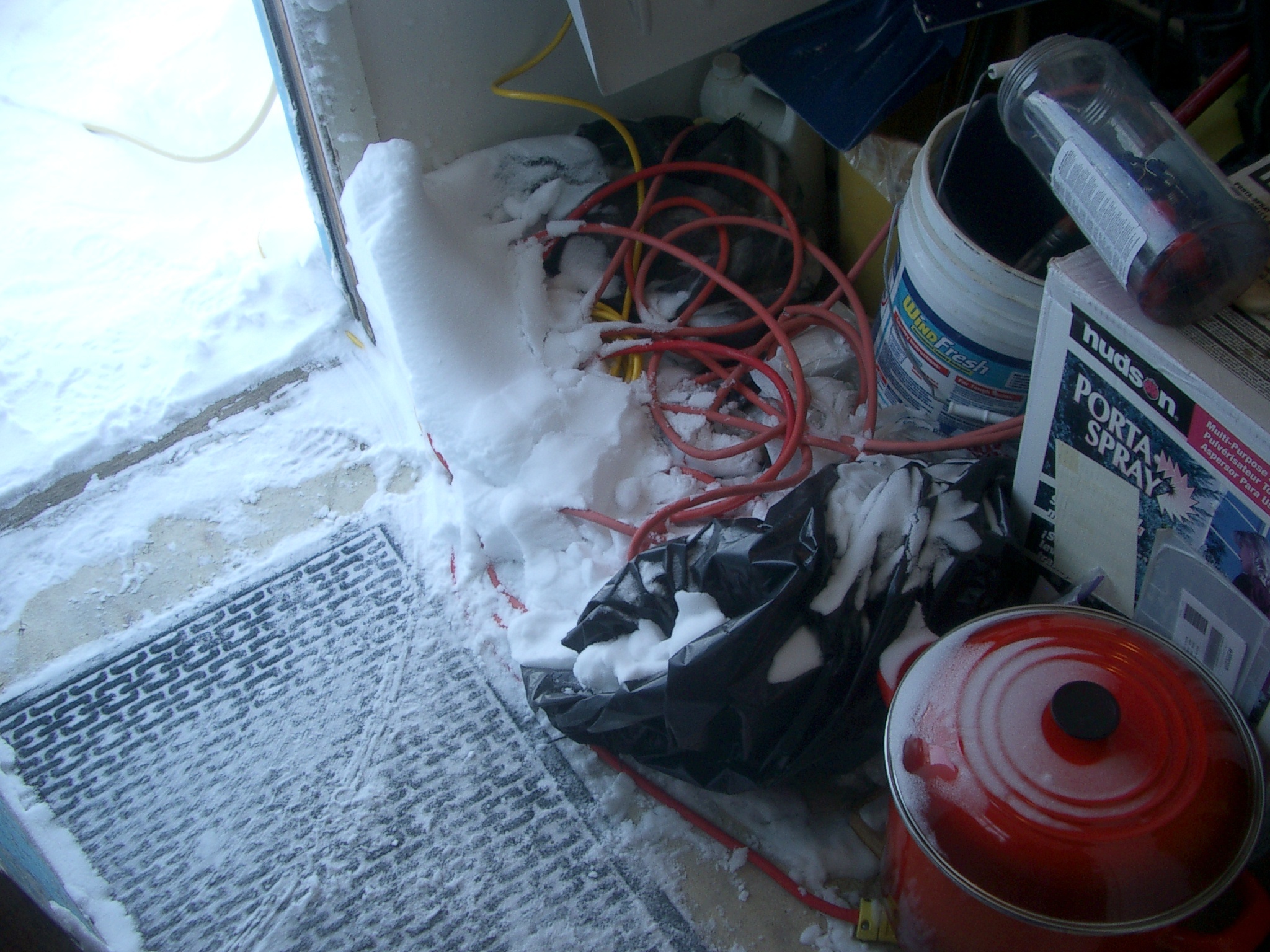
Luckily, today was a holiday so I could sleep late.  Once up, there was the usual post-travel laundry pile to start on.  Once that was underway, I had to dig out my car.  There had been a blizzard in Barrow on Friday, which had blown snow into our arctic entryway, among other places.

Snow in the arctic entryway.

It had also blown all over my vehicle, which required significant digging out.  Apparently the blowing or subsequent plowing had somehow packed snow around my left rear mudflap, since that shattered when I pulled out (only went forward) although I didn’t discover that until I got home.

View out the front door, showing snowed-in car, and ivu (ice push) on the beach in the background.

The wind had apparently also caused some pretty significant ice push from the Chukchi Sea onto the beach.  You can see it in the background of the photo above.  The ice is black in places because it was frozen to the bottom.  The ice is very thin for this time of year.  In some places it is probably 20 or more feet tall.

Once I got to work I caught up on emails, drafted a “mission statement” for a working group on coastal erosion I am helping to organize (contact me if you are interested–it’s global, not just Arctic in focus), worked on an encyclopedia article a bit, and took care of things like time-sheet approvals which can be a time suck, but are fairly important (we all like getting paid!).

18th Arctic conference–Part 4 (Day 2-AM)

This penultimate chapter is a bit belated, to say the least, due to holidays, much travel and associated presentations, and proposal preparation.  However, there were some very interesting papers on the final day as well, and I decided I needed to get this written before yet another conference happened.  And I needed a break from final tweaking of the PowerPoint for said conference.

The first paper was by Molly Odell, on economic change at  Mitksqaaq Angayuk between 3400-100BP.  The site, on Kodiak, seems to have had discontinuous occupations from Early Katchemak to the Russian occupation.  Molly focused on the fauna from a midden associated with an Alutiiq house.  The house seemed to have been occupied primarily by men, based on the artifacts.  The midden showed a change from a pre-contact mixed fishery (primarily cod but with significant amounts of salmon and small amounts of other locally available fish) to a fishery focused almost entirely on cod in the historic period.  Molly interprets this as a shift from a winter settlement to a cod-fishing camp, presumably staffed by men.

Jennifer Raff gave a paper on mitochondrial aDNA (ancient DNA) from the Lower Alaska Peninsula & Eastern Aleutians.  This is interesting, as there are disagreements about how/when various cultures in that area appeared, and whether or not they represent in situ (in place) developments or population replacements.  This work may help settle some of those questions.  Not to spoil any surprises, as this paper is being published, but both haplotypes A & D are well represented, and there is B from one site!

Rick Knecht, a fellow Bryn Mawr College PhD, gave a “just out of the field” talk about excavations at Nunalleq, a Yup’ik site in the Yukon-Kuskokwim delta.  The Yup’ik culture is quite well-known ethnographically, but almost no archaeology has been done in the area.  Nunalleq, for which there is a date of 1300BP (not sure if that’s calibrated or what it’s on or associated with) has extraordinary organic preservation at the moment, but is suffering erosion, which is accelerating due to permafrost melting and sea level rise.  The local community actually contacted the archaeologists in concern.  The 2010 season excavated a house, with lots of organic artifacts (rye grass matting, for example) present on the floor.  They think it might have been a men’s house, which are known for the Yup’ik from the ethnographic record, based on the low numbers of women’s artifacts recovered.  There was a burnt side room, with a large number of arrowheads present, which is possibly a result of conflict.  More work is planned.

Chistyann Darwent followed with a report on the 2010 work at Cape Espenberg, a beach ridge complex which is located near Kotzebue in the Bering Land Bridge National Preserve.  This project has been doing survey there for a couple of years and has surveyed and mapped extensively, especially the more recent periods.  They have actually been able to excavate several houses (one on each of the 3 Thule-age ridges) to a considerable extent.  One thing they discovered was that the surface mapping did not necessarily give a good picture of what was under the ground in terms of houses, side rooms and so forth.  One of the houses seems to have burned, although why is not yet clear.  They excavated an outdoor ceramic manufacturing area (inadvertently–it looked like part of the house from the surface).  The houses on the oldest and middle Thule ridges had Thule 2 harpoon heads associated with them, suggesting that they were fairly early.  The also found a copper eyed needle, slat armor.  The tunnel floor was lined with baleen.  The youngest house was of a type that was familiar to the project’s elder consultant, who had been in the US Army during the Korean War, since he’d grown up in a similar house.  It had lots of evidence for fishing.  The dates were a bit later than prior testing had led them to expect, the oldest around 1260-1400BP, the middle 1450-1650BP.

Justin Tackney gave a paper on mDNA (mitochondrial DNA) from Nuvuk, as well as presenting the new direct dates that Joan Coltrane has for the human remains. The results show a number of haplogroups hypothesized to be founders to modern Inuit populations all in one area, which is new.  In general, this supports a Thule expansion from North Alaska.

I got the slot before lunch, and gave a paper looking at the material culture of modern Iñupiat whaling.  I am using this as a way to approach what sort of evidence might be expected in archaeological sites of whalers, and where that evidence might be found.  Essentially, the modern case has a number of artifacts that are needed for whaling and nothing else, most of which have pre-contact equivalents.  The interesting thing is that they are generally not stored in the house, which implies that excavations focused on houses may not be able to address presence/absence whaling too well.

Streaming URL update

OK, this is the fixed URL for streamed Saturday Schoolyard talks:  http://www.alaska.edu/oit/cts/streaming/BARC/

It should work whenever they are being streamed.

We’ll be on around 1:30 AKDT today.  No Heather, since she fell on the ice we’ve got covering everything here (they even canceled the evening plane due to an icy runway) and hurt her ankle, so she’s laid up.

Nuvuk Project at Saturday Schoolyard!

I’ve mentioned the Saturday Schoolyard series of talks presented by the Barrow Arctic Science Consortium before.  Tomorrow it’s the Nuvuk Archaeological Project’s turn!  Heather Hopson and Trace Hudson, two of the students working on the project and I are going to be giving the presentation.

If you’re in Barrow, there’s a van leaving the library about 1:15 or so, or you can drive yourself to the BARC at NARL.  The talk starts about 1:30.

If you’re not in Barrow, it will be streamed, technology spirits permitting, starting around 1:30 PM AKDT.  The feed will probably start earlier.  I’ll try to post the URL, but it should be the same as in an earlier post.  They are now archiving the Schoolyard talks as well, and they can be found in iTunes U.

Running to stand still

No, not on a treadmill, although it would be nice to have a bit of free time for that.  Actually, it’s where I’m at with work.  I’ve been thinking about archaeology and ways that it can inform things besides our knowledge of past lifeways.  For the past week or so, I’ve been running into lots of articles, posts, calls for white papers, and so on that connect to that in various ways.  Today I attended a seminar that brought up a number of issues that archaeology could play a part in addressing in a meaningful way.

However, to take these thoughts further means I need a bit of time to think and read, and then try to put thoughts into sensible words that can communicate with a variety of communities.  But the situation at work is still pretty stressful.  My boss has sent her admin assistant to help me out and get cross-trained on our stuff for a week or two.  Jennifer’s doing great, but it’s a really complex job, so she does have to ask me questions (which she does, instead of grinding to a halt, thank goodness) but I don’t actually know the filing system inside out (we’ve found 2 sets of files for some things where we would only expect one, and aren’t sure what the difference is yet) so sometimes it takes some time.

I am at least making progress on the reports, although ArcMap (the GIS program) decided to get weird this afternoon and refuse to import a bunch of STP (shovel test pit) locations I needed to finish a final map for one of the reports.  It should have taken less than half an hour to do the map, but several hours later, no joy.  Tomorrow (fingers crossed here).

I also have to finish assembling the PowerPoint for the Saturday Schoolyard talk this Saturday.  Trace sent me his  piece this evening (amazingly, he’d picked the same template & color scheme I was already using for my part, so that bit should be pretty easy.  Heather just found out she isn’t leaving for Fairbanks for the Alaska Federation of Natives (AFN) meetings until Saturday night, so she’s going to talk too.

Sunday and Monday (which is a holiday in Alaska, so we are off work, theoretically) I am making a quick trip to Anchorage.  Maybe I’ll get a little time to think on the plane…

More Whales! Hey, hey, hey Iceberg 17!

Friday two more whales were taken for Barrow, by Yugu and Arey crews, and another two on Saturday, by Ben Itta’s crew and Herman Ahsoak’s crew.

But the really exciting news comes from Wainwright!  For the first time in many years (Glenn & I both seem to remember hear a story about a fall gray whale from the 1930s), Wainwright, Alaska, took a fall whale!  The successful crew was Iceberg 17.  The news made it to Kaktovik where a North Slope Healthy Communities meeting was going on, and John Hopson Jr., a Wainwright whaling captain, as well as NSB Assemblyman, and a great guy, announced it from the podium.  Bill Hess, who has been taking great photographs of the North Slope for decades, was there, and he took a photo which pretty much sums up what whales mean to people here.  The man in the background is NSB Mayor Edward Itta, also a whaling captain.  Aarigaa Iceberg 17!

Barrow took 3 whales today; a great finish to a series of minor catastrophes

The last couple days have been interesting, in the Chinese curse sense of that word.  I’ve got two reports that the clients need ASAP.  That’s normal for this time of year.  Neither is very complicated, and neither project has anything in the way of what they want to do.

It’s the other stuff that’s been a bit over the top.  For one thing, my admin assistant is on an extended leave, and getting a temporary replacement is proving hard, so I’m having to try to get her work done too.  The person who usually fills in for her had to go out for some medical stuff, and the person who was going to fill in for her had his girlfriend medevaced the evening before he was supposed to start, and the doctors don’t want her flying so close to delivery, so he had to stay with her.  Everyone is OK, thank goodness, which is the main thing, but it doesn’t get the office work done.

On top of that, I’ve had 3 abstracts for meeting papers due, only one of which is in yet, travel to arrange for a meeting in Munich (which the organizers want done ASAP so they know how much they’ve got left after paying for a ticket from Barrow to Munich), vacation travel to arrange to Hawaii and upstate New York (which needs to happen ASAP so we can afford the tickets and don’t have to go by way of Phoenix or Atlanta), two separate people who need the list of UIC Science phones & emails (which I update at least monthly, to no effect, since the updates appear to get lost and ancient lists resurface with phones that have been disconnected for two years), a new company budget process, credit cards to reconcile & approve (and a clunky new system to do it with), some checks to print, possibly a proposal to work on with a colleague in the Lower 48, the DMV had apparently lost paperwork regarding insurance on a company truck that was involved in a fender-bender, and a bunch more stuff I’ve forgotten.

You’ll have noticed most of this needs connectivity. Tuesday evening, in the middle of this I got a call from my staff saying the power was messed up in a building that houses the offices of the ARM project.  The guys got a small generator to provide clean power to the servers, which needed a midnight refueling and we got the landlord to get the power company, but no luck.  The next day they came back out, and decided all power would need to be shut off to change a transformer that feeds all of NARL.  This required shutting down all servers, so no connectivity.  No email, no Web, no Skype, no VOIP phones.  At least the BARC had power from the generator, so I could write.

In the middle of that, a fellow who works with my husband had a propane explosion on his boat while out whaling.  Amazingly, the boat did not sink, only one guy had to go to the hospital in an ambulance (although they all got checked out) and everything went about as well as it could have gone.  The windows were all blown out, some of the guys had glass embedded in their coats, I’ve heard, but no serious cuts.  Pretty much a miracle.

We scrambled around getting our Herman Nelson heater back from a fellow who had borrowed it to deal with the aftermath of a winter house fire, so that we would be able to keep the pipes from freezing if it got really cold.  The power came on at the end of the day, only to find out that the ARM building still had bad power, so into a second night of refueling.  It proved really complicated to take the servers down, and the guy handling the job is really sick at the moment, so it was decided not to bring them back up until we were sure there wouldn’t be an abrupt power cut.  They started this morning, but it took until early afternoon until everything was mostly back to normal.  Then the queued email flood began.  My husband was on the way to Anchorage this evening, and we had to get BASC checks printed so he could sign them (the other check signers are busy with whaling right now) before he left.

The power guys got the ARM building back on-line in the afternoon, the checks got done, and I actually was able to email some of the stuff people needed to them.

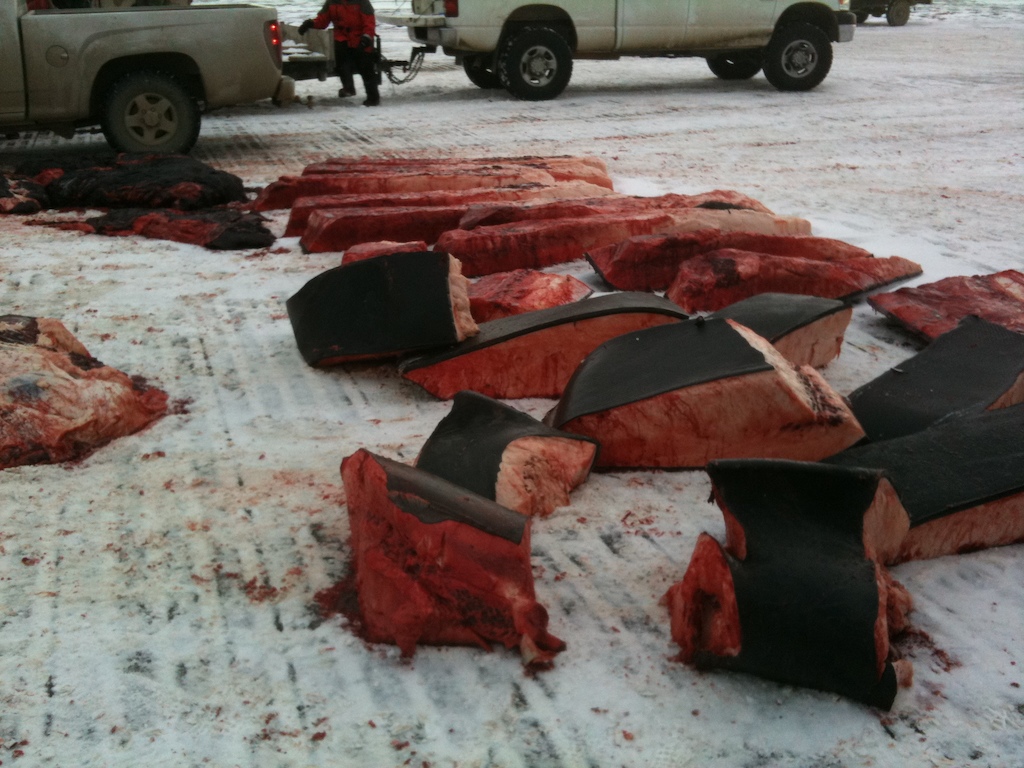
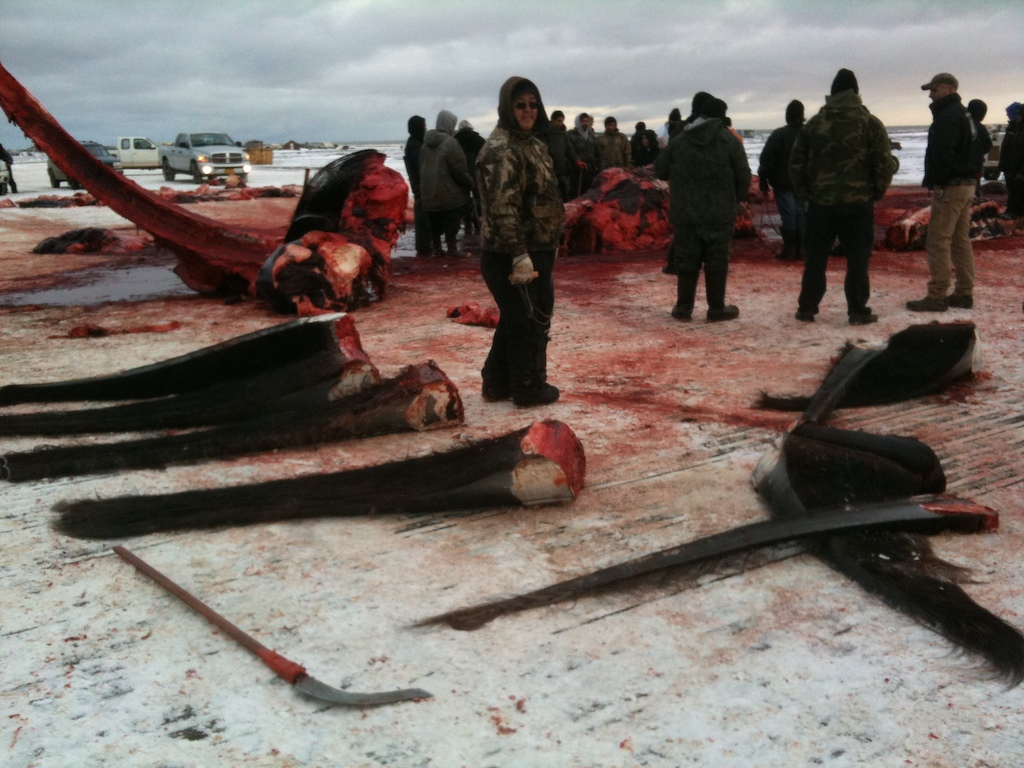
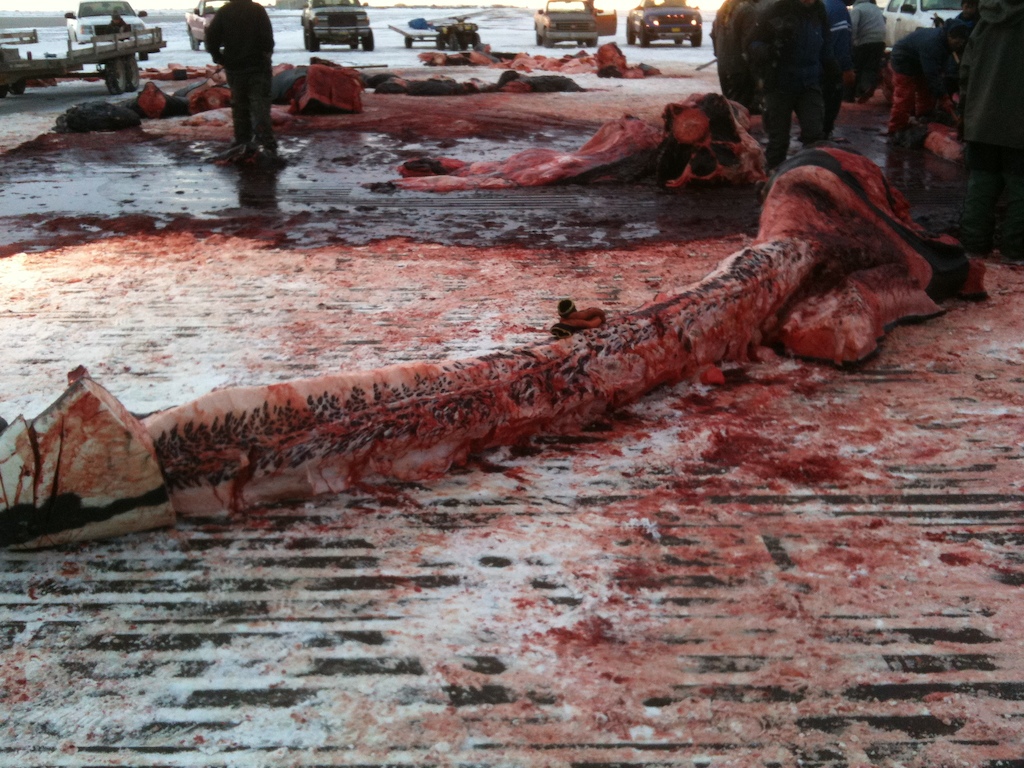
But the best thing was after work, after I dropped Glenn off at the airport, I got to go out to the old NARL runway.  Barrow caught three whales today (Savik, Saavgaq and Panigeo crews); one was already butchered when I got there, and many happy people were working on the other two.  I talked to Maasak Brower, who had a huge smile on his face, and the first thing he said to me was it was a good day.  It’s a fine thing to have a whale give itself and help you feed the community.


Savik whale being butchered.


Maktak and flipper from Savik crew's whale.


Baleen from Savik crew's whale


Mandible (jawbone) of Panigeo crew's whale in foreground. Some of the whale still being butchered is in the upper right, and in the background are some of the shares that will go to many people in the community of Barrow and beyond.


The meat and maktak is distributed according to set rules.  Shares go to the captain, to the boat (or its owner, since the boats don’t eat maktak), various crew members, other boats that helped tow the whale in, and to anyone who turned up and helped with the butchering.  In turn, those shares will be passed on to family members and friends across the North Slope and Alaska and down to the Lower 48.  It takes about 3-4 hours to completely cut up a 30 foot (~10 m) whale, which weighs about 30 tons.  Then shares are distributed and people bring them home.  There has been a constant stream of vehicles, some with trailers piled with maktak, past my house, coming back from the runway.  Guys went out in really small boats on a very cold ocean, about 1000 miles from the nearest Coast Guard help, and had leviathans give themselves to them, and towed them home, and got a lot of food for people, as their ancestors have for many centuries.  Tomorrow, weather permitting, people will try again.

Adventures with journalists; or, I never said anything about 45,000 yr. old Eskimos

Obviously, I think that archaeology is interesting. In my experience, so do most non-archaeologists I meet. People ask lots of questions, and it’s amazing how many of them say they always wanted to be archaeologists (hey, we take volunteers!).

So, I imagine that there’s a reasonable audience for journalism (print, broadcast or Web) that covers it. The Arctic, as the canary in the climatic coal mine and home to endangered charismatic megafauna (AKA polar bears), also seems to be a hot journalistic topic. Given that Barrow is served by at least two jet flights a day and has decent connectivity, we get our fair share of journalists, and a fair number of them want to talk to me.

The public pays for most archaeology (and other science) so I think they deserve to hear what they’re paying for us to learn, especially since most people are interested in other people and their doings, as opposed to, say, permafrost or midge hatches, for which the interested audience may be smaller. So I take the time to talk to journalists. I also try to find out a bit about the journalist in question. If I get the sense that they are not very experienced with science or research, I’ll offer to at least check dates and spellings in their story before it goes to print, pointing out that that’s less embarrassing than having to issue corrections of errors later. Some take me up; some don’t.

I also take the time to attend panels on working with the media at scientific meetings. They are usually composed of a variety of people who are public information officers for scientific organizations or institutions and science journalists, often quite well-known ones who write for national science magazines or newspapers. They are all very earnest and full of good advice. They are usually amazed at the questions asked by the audience, and horrified by those of us who want to see stories prior to publication. They seem bewildered that the archaeologists making up the audience don’t all see journalists as friends and a great help.

Of course, if all journalists were like the ones on the panels, we probably would see them that way. I’ve worked with some great folks. Angelika Franz, a German writer who has done several pieces about Nuvuk, actually has a doctorate in archaeology, so she’s been great to work with, knowing what sorts of information are critical to get right, and understanding technical terms so we can concentrate on the interesting parts of the story. She has done pieces for Spiegel Online Wissenschaft, a magazine called Epoc and now she’s got a book coming out with a number of pieces she’s done.

I had great fun being interviewed (in Danish) by some Danish journalists who were retracing Knud Rasmussen’s travels across Arctic America. The story wound up mostly being about the fact that I have a complete set of the 5th Thule Report, in Barrow. We also had a nice trip to Nuvuk in the local tour van, which resulted in some good polar bear pictures for them.

Most of the others have been reasonably competent, and haven’t garbled the stories too much, although they haven’t written stories that answer the sorts of questions people ask me.

And then there are the others. There was a group of filmmakers working on video for a major producer of science programming. They had decided to focus on an ice scientist and his (cute female) grad student. It was spring, so there was not much to see at Nuvuk, but they wanted to go there anyway. They wanted to film them pulling up on snow machines. The tracks aren’t the best thing for the site, but we had already excavated the area near the bluffs, so I said that would be OK there. Of course, they didn’t like the shot, or the light, and wanted to have them coming from a different angle, and retake it, and I kept having to tell them to stay in the cleared area. Then they decided that the scientists/protagonists should start scraping away gravel from logs (actually a NARL-era sled shed base) projecting from the bluff, with their mittens. Since this is precisely what we want the public to avoid, it didn’t’ seem like a good idea to show them SCIENTISTS doing it on a reputable science TV series. I pointed that out, to no avail. So I told them I couldn’t be party to that, on film or off, and since they seemed bent on damaging the site, which belonged to my employer, I was going to have to ask them to leave.

Better yet was a Barrow reporter for the local newspaper, the Arctic Sounder. The Sounder is not a bad paper given the area it covers and the budget it has. However, I doubt that the editor considers this fellow one of his better hires. He was an odd duck. He once asked me to help him set up the Mac that the paper had given him so that he could file electronically. I got everything set up, and then went to plug the modem into the phone line (this was some years ago). He would not let me. I suggested that we could test it, and then he could plug it in to file and unplug it. No dice. He also thought there was a hole at the North Pole. He interviewed me about some work I had been doing, and in the course of the interview asked me how long people had been in the Barrow area. I said it was hard to be sure, since sea levels had risen and between that and erosion the earliest evidence was probably gone, but that there was some Arctic Small Tool Tradition (ASTt) material there, which was probably “4 to 5 thousand years old”.

Imagine my surprise at being quoted (in quotation marks, no less) as having said that there were “45,000-year-old Eskimos” in the Barrow area! I got calls from folks as far away as Pennsylvania (Tiger Burch for one) who basically wanted to know if I was off my rocker. When I suggested to the reporter that perhaps a correction was in order, he refused on the grounds that “someday they’ll find 45,000-year-old sites here, and then you’ll have been the first to say it in print.” I have heard, although I can’t confirm, that he was removed from town in a straitjacket.

And they wonder why archaeologists view journalists with a somewhat jaundiced eye…