Excavation of the hearth & surroundings continued. When we first found fish bones we were pretty excited. We just keep finding more in and near the hearth and I must admit the thrill is rapidly fading 🙂 . We’re finding some other bone too, not all of which has been burnt past the point of recognition.
The egg was successfully extracted and packaged, and has made it back to the lab, I hope more or less intact. We shall see when we start processing things. If we can’t figure out what it was, Dennis said they’ll take a crack at IDing it through DNA.
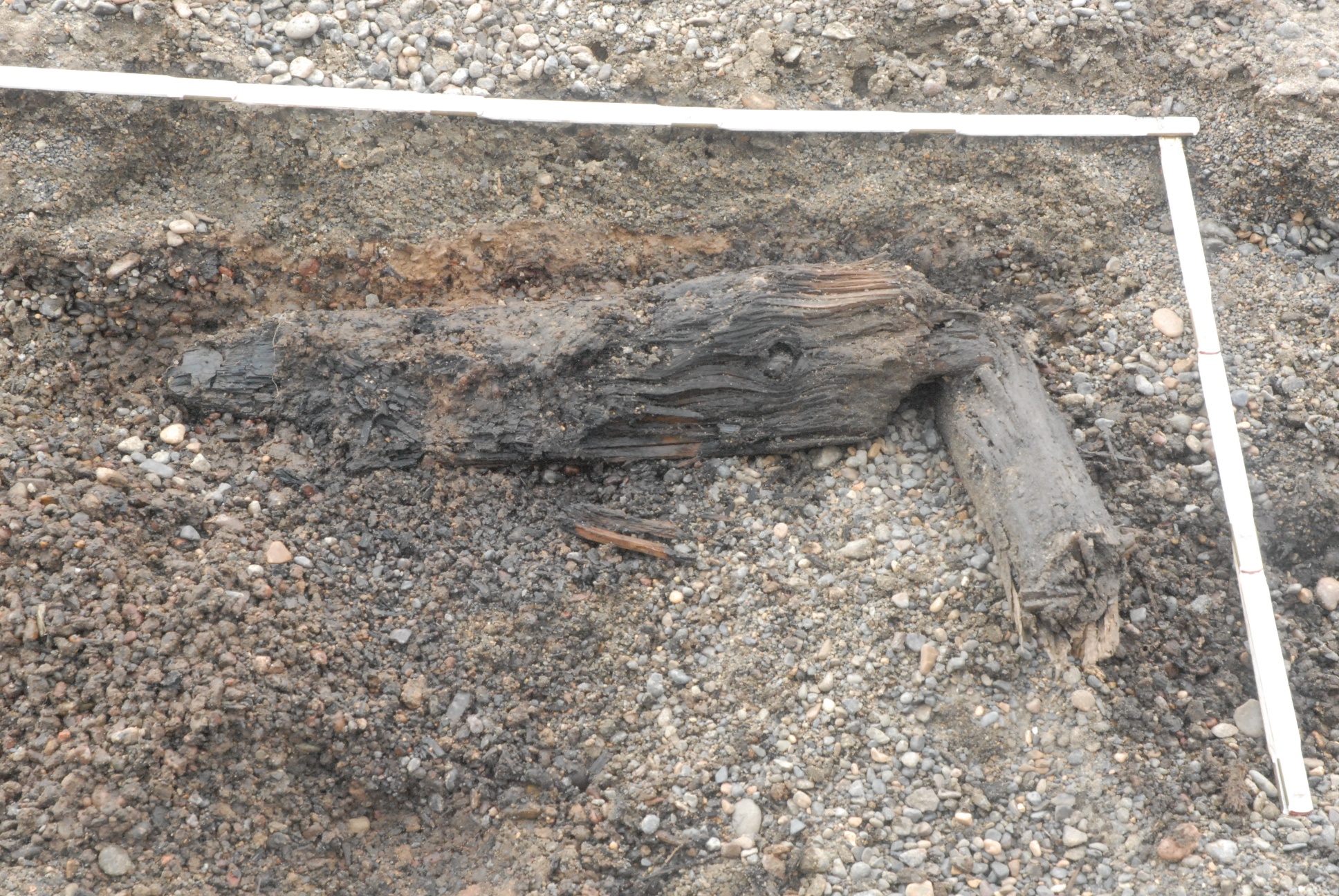
We started investigating the last GPR hit and came down on a jumble of wood. The excavators were not optimistic, but I kept pushing to go a little further. Eventually, this appeared:
Feature detected with GPR
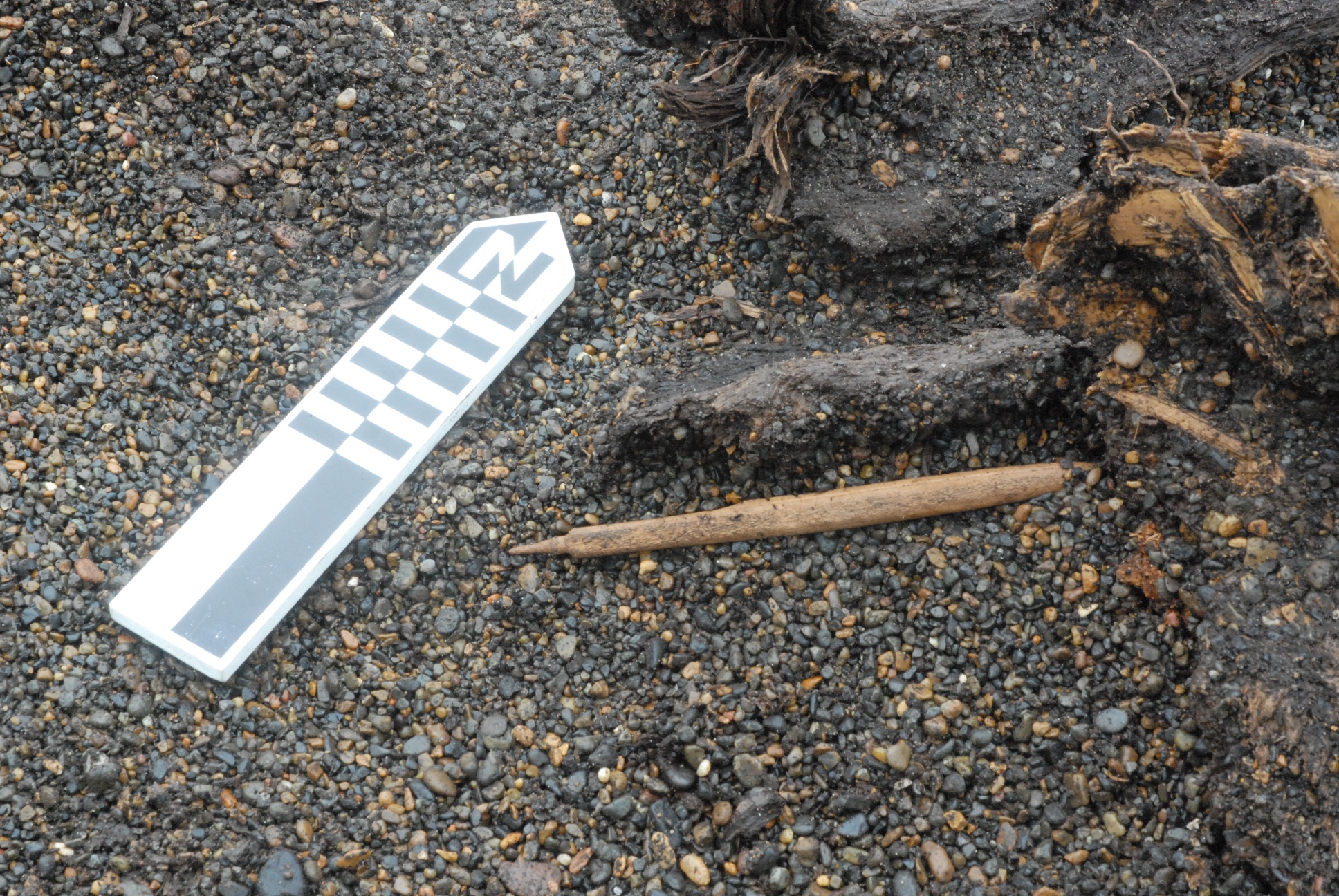
The feature (I’m not calling it a burial until there is evidence of human remains) was jumbled because at some time after it was constructed, someone dug a hole in the middle of it. And right beside where the hole had punched into the feature was this:
Antler arrowpoint
The hole just missed it.
The DWF (Ipiutak) levels had their own surprises. We found a good bit of fish bone, some lithics (nothing diagnostic) and a lot of broken bone, but the really cool thing, which I found on the edge of the hearth, was a flattened but apparently complete egg!
We were a small crew today since the high school students weren’t working, so we concentrated on the Ipiutak area. It was fairly tricky to excavate, since there is unconsolidated gravel under the Wood/sand/gravel layer that covers the Ipiutak surface, and a large pile of unconsolidated gravel uphill from the features. Plus the hearth ash is covered with a mushy skin of peat, and both the hearth surface and the peat undulate. Despite that, we recovered 2 fin rays, some burnt bone, a pot-lidded flake (probably rhyolite), a grey chert flake, and a black biface fragment from the hearth. We also got some large ungulate (species in dispute at the moment–probably caribou) bone, and a small fragment of decorated ivory, plus several interesting pieces of wood, which appear to be worked.
It was quite cold. Even though we had a windbreak, the levels are just thawing, and the ground is cold and wet. My hands are still stiff, so more will have to wait until tomorrow.
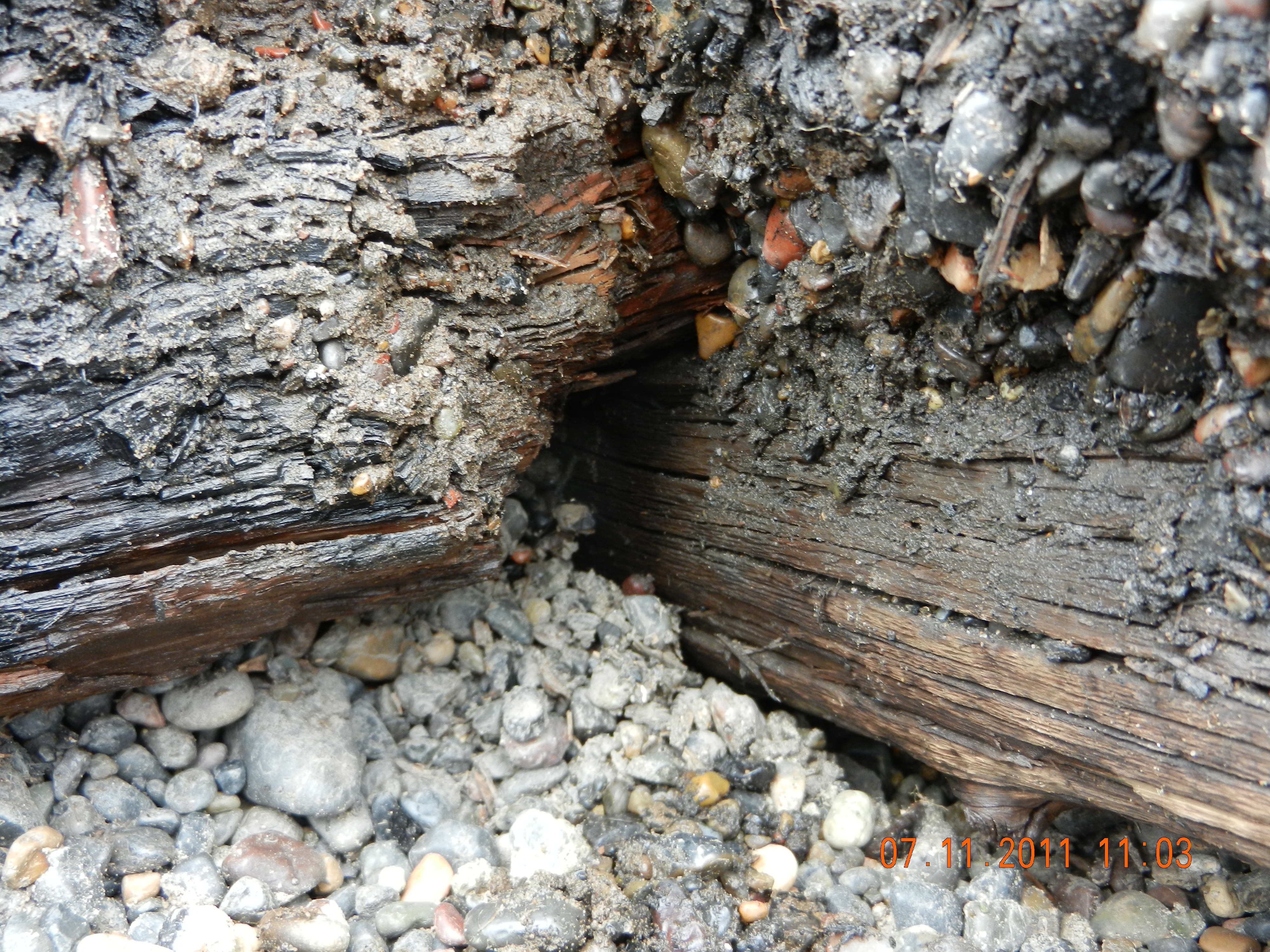
We spent most of the day with shovel testing, shooting in pits and moving gravel. The gravel moving was in aid of getting a better look at the worked wood protruding from the erosion face at what appears to be the Ipiutak level. So far, there seems to have been a fire and a lot of ash in association with one of the wood features, and it’s not clear if it was a hearth or a structure that burned accidentally. Opening it up a bit more would help, but it is under a lot of gravel.
Structural timbers with possible hearth in Ipiutak level
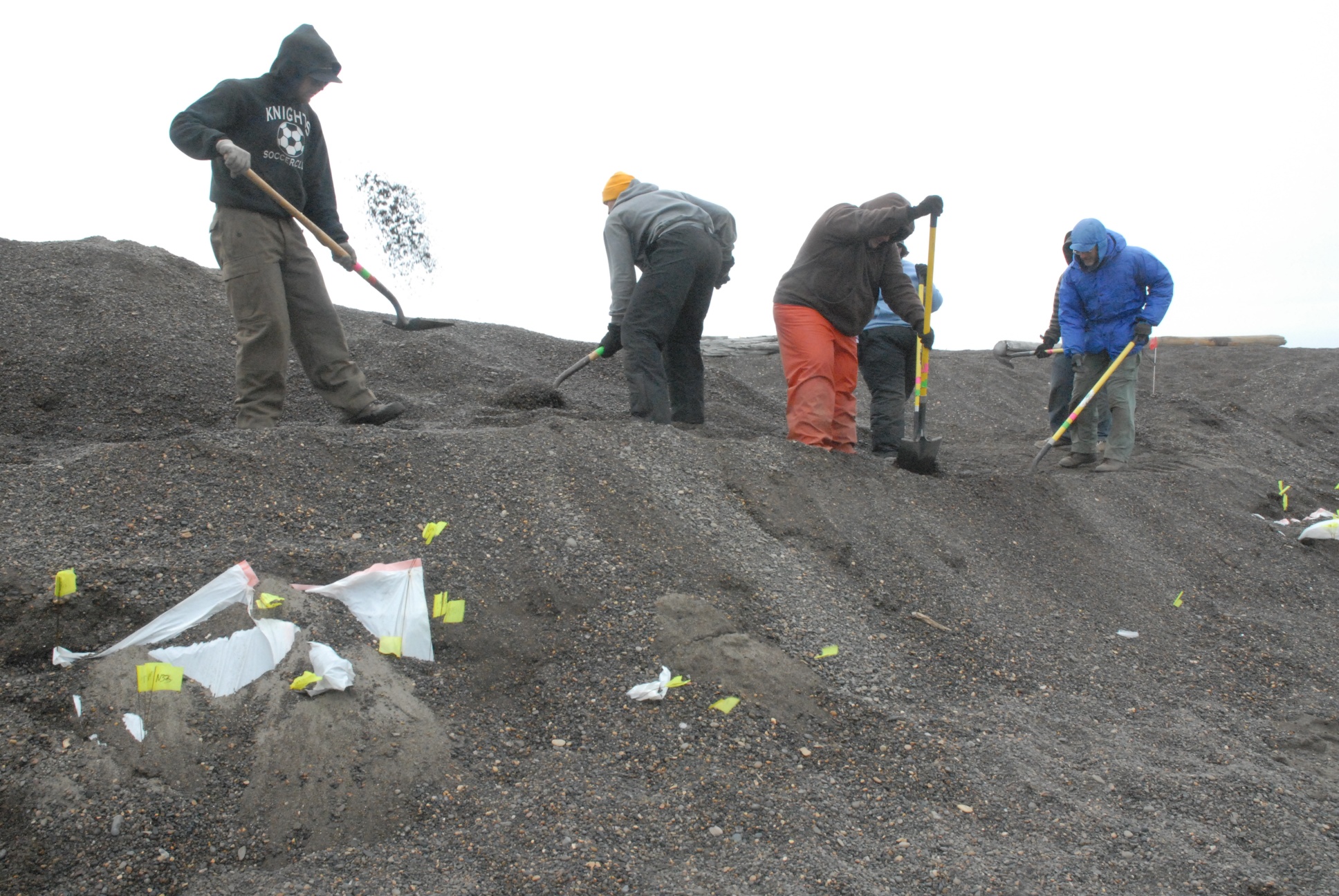
The crew did yeoman work, and much gravel was moved, so we can get a look tomorrow. There is actually a frozen layer under where most of them are standing, which will have thawed by tomorrow if we are lucky.
Flying gravel! L to R: Adam, Trace, Laura, Candace, Dennis, Tom
It really was, and chilly besides. Winds were probably over 30 knots at Nuvuk, so we didn’t even try to excavate. The day went with shovel testing, shooting in various things with the transit, and checking out the wood projecting from the erosion face that appears to be in the Ipiutak layer. It’s looking pretty interesting, but hard to get at.
It was a long cold day, and I had a lot of paperwork to do, as well as homework for a course I am taking online, so… More tomorrow.
After a day off, we were back in the field today. The GPR hits we tested were mostly concentrations of water, and buried whale bones (not part of graves, unless it was a whale grave). However, we also looked at two other areas that had turned up in the trails on the first day’s walkover. One proved to be nothing but a concentration of refuse. The other wasn’t looking much more promising, with peat and a little wood, but we took it down to expose all the wood, and low and behold, a very large piece of wood indeed, which is a burial cover. We will have to excavate that tomorrow. There will also be a new set of GPR results to test.
The burial cover exposed. That is one piece of wood! The dustpan is covering what may be a bone, so the photo can be used for the public.
There is also some wood exposed on the erosion face at what looks like the Ipiutak level, including something that looks like architecture.
Claire Alix, who is probably the world expert on precontact wood use in Alaska, is in Barrow for a 10-day stint of analyzing wood from Nuvuk. She is working on wood from the Driftwood Feature (DWF), because there is so much of it and we need to figure out what needs to be kept.
The DWF was a storm strand line which was washed up onto and mixed with an Ipiutak settlement. Not just any Ipiutak settlement, but the farthest north Ipiutak settlement by about 500 km. The result was a mass of wood, bark and marine invertebrates, with a number of clearly identifiable artifacts included. There was so much wood that we called the level “Wood/Sand/Gravel” because it seemed like there was more wood than matrix. However, some of the smaller pieces of wood and bark were also worked, but it seems that the storm picked up smaller floatable artifacts and mixed them with driftwood. Given the field situation, it was impossible to examine each small piece of wood in detail, so we erred on the side of caution and brought back a lot of things that probably aren’t artifacts, so they could be examined in a nice warm lab.
Chert artifact stands out in the middle of huge numbers of small pieces of wood, some worked and some not.Wood level in the DWF.
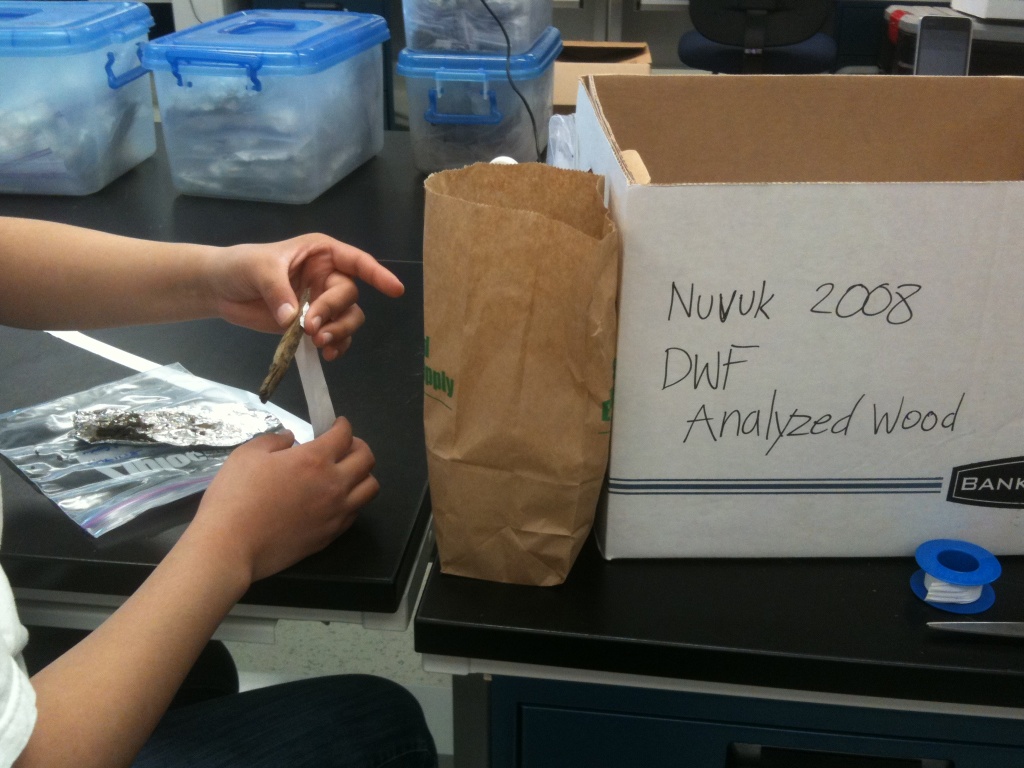
The DWF was actually frozen, and had been for centuries, so we didn’t just want to bring the wood into a warm lab and let it thaw. That generally leads to wood that looked really well-preserved “exploding.” We have a nice walk-in refrigerator at the Barrow Arctic Research Center (BARC) just down the hall from my lab, so we have been holding the wood there, thawing slowly and keeping it cool to retard mold growth. The large and important artifacts started the conservation process very quickly, but there are boxes of smaller things which need to be inspected to separate the worked wood and bark from the rest. The wood that is just driftwood will be lab discarded, with that being recorded in the catalog so it will be clear in the future that artifacts haven’t been lost. The artifacts will get analyzed and better information will be recorded. This also lets us identify things for the conservator to work on when she next can come to Barrow. Small artifacts are being brought out for gradual drying. Wrapping wood in teflon tape to hold it together during slow drying has worked fairly well, so we’re doing that to move more out of the walk-in
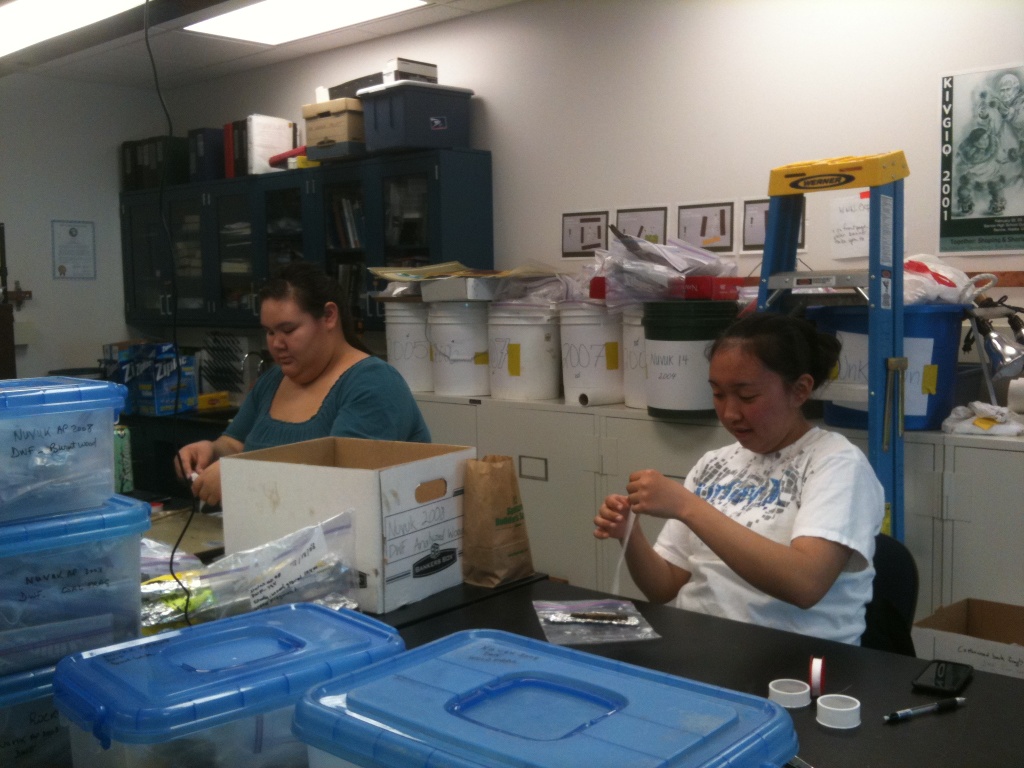
All this is pretty laborious. Claire has to do the analysis and wood IDs, but with her schedule we needed to find a way to speed things up. The initial sorting of bags of wood and the wrapping of the wood are two of the most time-consuming aspects of the process. So, last week Heather Hopson came in to do some data entry and initial sorting, and this week Trina Brower is joining Heather. They are doing the initial sorts, wrapping with Teflon tape & data entry, so Claire can keep looking at wood.
Heather & Trina hard at work in the lab.
Wrapping the delicate pieces of small wood is definitely fiddly work. It certainly helps having someone to work with & talk to while working.
Wrapping an artifact to keep it together while it dries.
Despite the fact that I am still in New York on vacation (except for things like on-line payroll and P-card reviewing and approving, which can’t wait), I’m taking a bit a of a break from reading mysteries and eating Christmas goodies to work on several things I have in progress. I’m not going to be able to finish any of them, since I don’t have any books here for checking references, and most of the images I want to use are in the Aperture vault on my computer back in Barrow. However, I can do outlines, and get a fair bit of the text drafted before I get home, at least for some of them.
In order they are: 1) PowerPoint & accompanying paper on Iñupiat and Cold War Science for a conference in Munich, 2) encyclopedia article on Western Thule 1300-1750AD in North & Northwest Alaska (in 7000 words maximum!), 3)PowerPoint on Alaskan archaeological sites and threats to them from climate change as it has been observed to be occurring for a conference in Tromsø, Norway, 4) article I’m working on with Claire Alix and Owen Mason on Ipiutak at Nuvuk, 5) encyclopedia article on Barrow sites (Nuvuk, Birnirk and Utqiagvik), 6) paper on ethnographic data on storage of whaling gear, and 7) a paper on whaling gear recovered from archaeological sites which are known to have had whaling taking place.
These all have places they are to go, and times they need to be there. Nothing concentrates the mind like deadlines, except perhaps the threat of execution…
I woke up and turned on the radio this morning in time to hear the morning fellow recommend paying attention to the weather. Since most folks here do that anyway, it was obvious that something a bit unusual was coming.
…COASTAL FLOOD WATCH REMAINS IN EFFECT FROM 2 AM AKDT SATURDAY THROUGH LATE SATURDAY NIGHT…
A COASTAL FLOOD WATCH REMAINS IN EFFECT FROM 2 AM AKDT SATURDAY THROUGH LATE SATURDAY NIGHT. LOW PRESSURE 400 MILES NORTH OF BARROW EARLY THIS AFTERNOON WILL STRENGTHEN TONIGHT AS THE LOW MOVES SOUTH. BY SATURDAY MORNING THE LOW IS EXPECTED TO BE ABOUT 250 MILES NORTH OF BARROW. STRONG NORTHWEST WINDS WILL DEVELOP ALONG THE BACKSIDE OF THE LOW. WIND SPEEDS OF AROUND 25 KNOTS ARE EXPECTED IN BARROW LATE TONIGHT THROUGH SATURDAY NIGHT WITH WINDS TO 35 KNOTS OFFSHORE.
THE SEA ICE IS NOW NEAR SEASONAL MINIMUMS AND THERE IS OPEN WATER SEVERAL HUNDRED MILES TO THE NORTHWEST OF BARROW. THIS WILL CAUSE SEAS NEAR SHORE TO BUILD TO 9 TO 13 FEET ON SATURDAY. THE SEAS ARE EXPECTED TO BREAK ALONG OR NEAR SHORE. IN ADDITION TO THE HIGH SEAS A STORM SURGE OF UP TO 2 FEET IS POSSIBLE AROUND THE TIMES OF HIGH TIDE SATURDAY AND SATURDAY NIGHT. SIGNIFICANT BEACH EROSION IS EXPECTED WITH MINOR COASTAL FLOODING POSSIBLE AROUND THE TIMES OF HIGH TIDE. THE AREA AROUND STEVENSON STREET NEAR THE BOAT LAUNCH BY THE CITY PLAYGROUND IS PARTICULARLY VULNERABLE TO FLOODING. OTHER LOW SPOTS ON DOWN THE BEACH WILL ALSO HAVE THE POTENTIAL FOR MINOR FLOODING.
ADDITIONALLY…SIGNIFICANT EROSION TO THE BLUFFS ARE LIKELY AS WELL.
PRECAUTIONARY/PREPAREDNESS ACTIONS
… A COASTAL FLOOD WATCH MEANS THAT CONDITIONS FAVORABLE FOR FLOODING ARE EXPECTED TO DEVELOP. COASTAL RESIDENTS SHOULD BE ALERT FOR LATER STATEMENTS OR WARNINGS…AND TAKE ACTION TO PROTECT PROPERTY. NOW IS THE TIME TO MAKE PREPARATIONS AND MOVE ALL PROPERTY WELL AWAY FROM THE BEACH.
Not what I needed to hear… Turns out it’s the first big fall storm. With the ice so far out, that means lots of room for the wind to put energy into the water, which means big waves and a storm surge. That means beach erosion for sure, and maybe coastal flooding. Our weather forecasts here are a bit less accurate than those most other places, because there are no observing stations where the weather is coming from. It’s sort of like trying to predict weather in Pennsylvania using data from nothing but a weather station in Chicago.
I don’t like fall storms and coastal erosion. Aside from the dangers associated with flooding (the house I live in floated in 1963, and if it does it again we might wind up in a sewage lagoon), erosion is the most immediate threat to coastal archaeological sites. I spend my summers trying to organize things so that we got well ahead of erosion at Nuvuk and now are trying to stay that way.
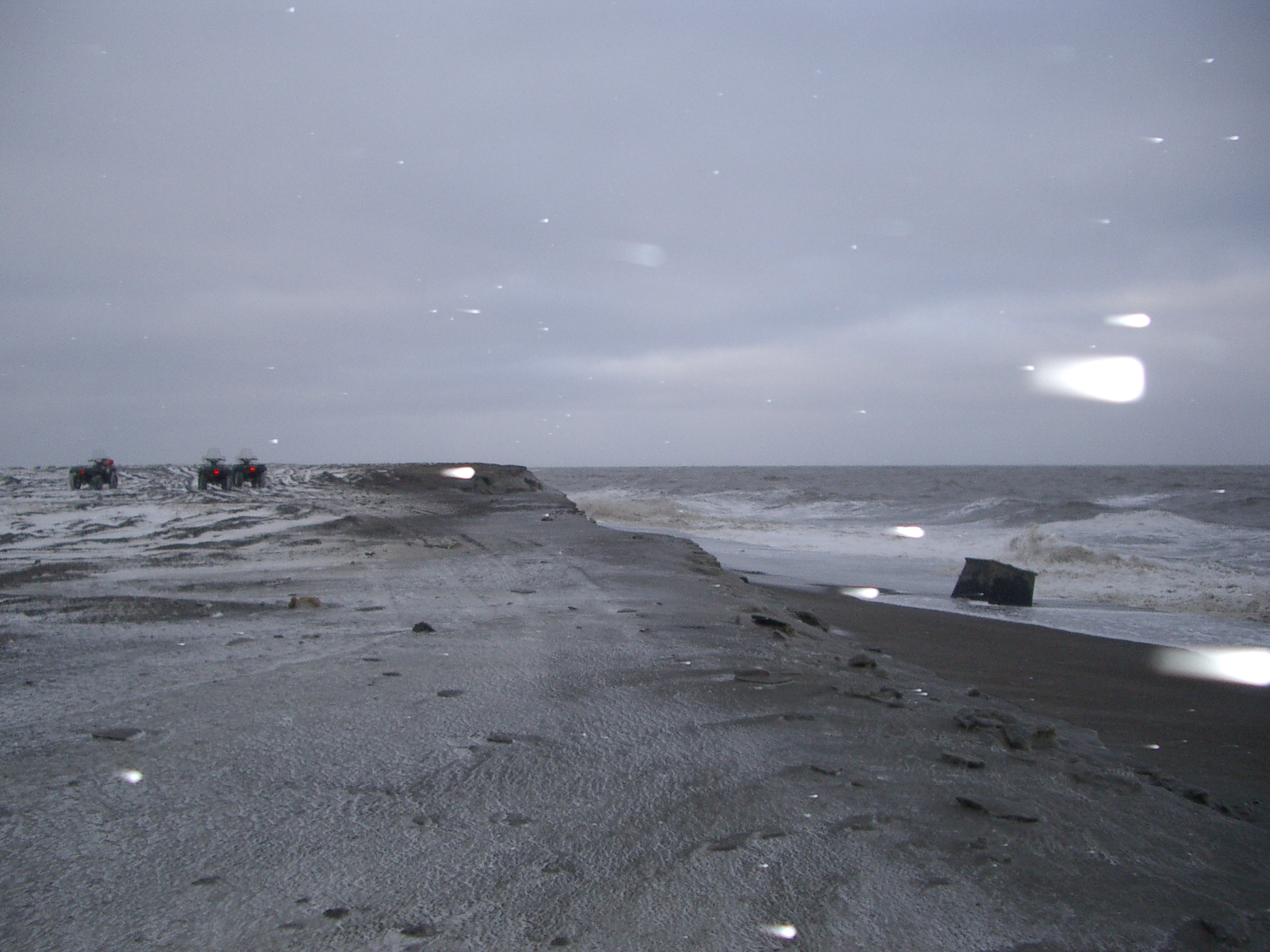
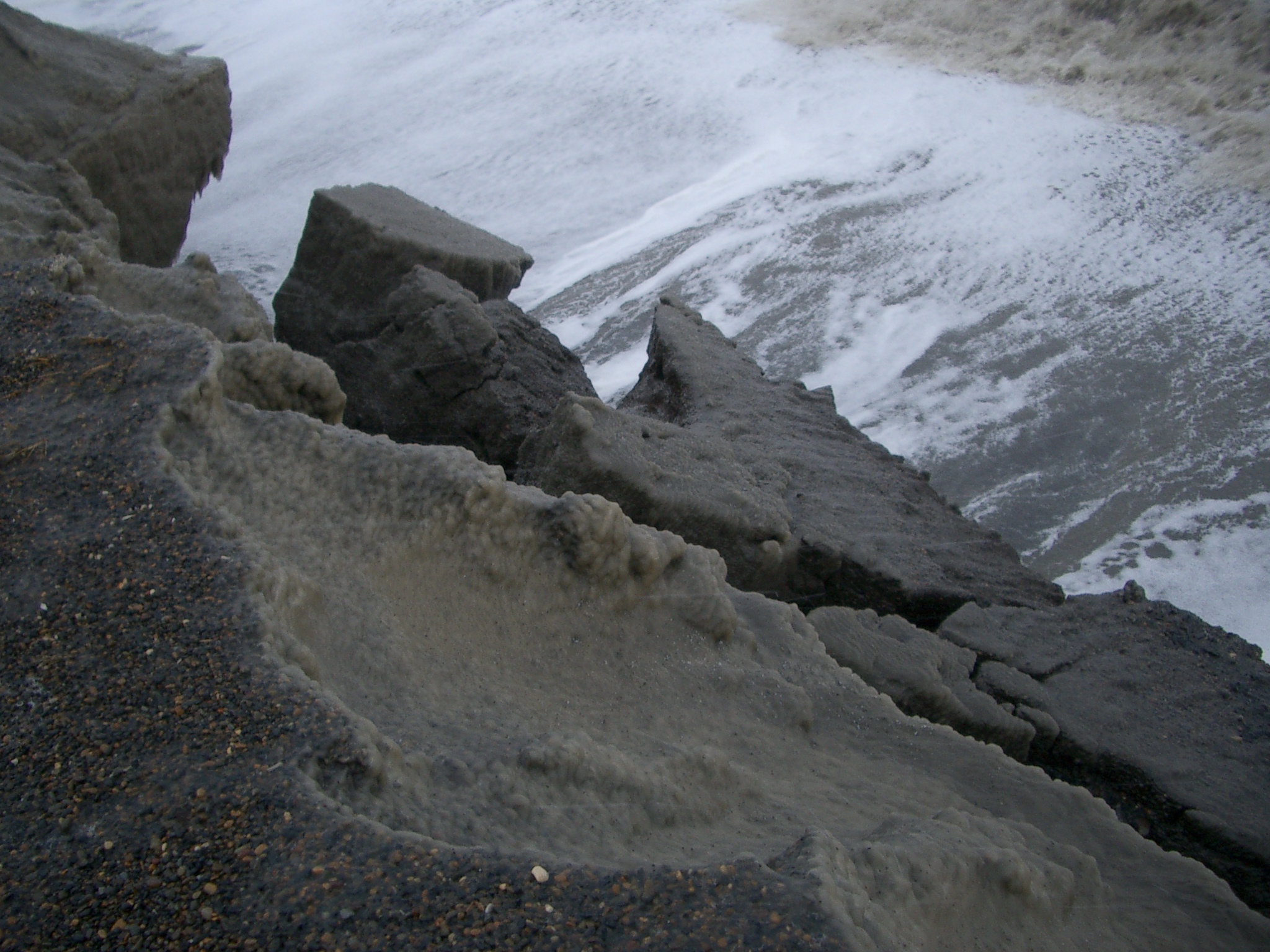
2004 fall storm erodes NuvukNuvuk bluff slumps from effects of surf
The thing is, Nuvuk, where “the houses are all gone under the sea” to borrow T.S. Elliot’s phrase, is just one of many important sites. Utqiagvik, Nunagiak, Ipiutak, Tikigak (Point Hope), and so on down the coast. Most of the sites on the Beaufort coast from Point Barrow east to the Mackenzie River Delta in Canada have already washed away and out of the archaeological record.







 Out of Ice and Time