Yesterday was supposed to be a big day for interviews. One of the Alaska TV stations has someone coming to Barrow who wanted an interview, and Joe Schuldenrein was scheduled to prerecord an interview with me for his internet radio show on archaeology, Indiana Jones: Myth, Reality and 21st Century Archaeology. Unfortunately for them, the TV folks went on a tour of the entire state, except Barrow, courtesy of Alaska Airlines and didn’t get in until after 7 PM. We may reschedule.
The radio interview did happen, and will be broadcast today, 1 PM EDT, 4PM AKDT. I believe you should be able to access the archived version here after the broadcast. If you want to listen live, I think you can log in here and do so, but I don’t know the details, since I have only tried the saved version of the show.
Now for some time in the lab, and maybe another interview…
Wednesday at 3 PM Pacific Time on VoiceAmerica Variety Channel
Indiana Jones: Myth, Reality and 21st Century Archaeology
Imagine that you are an archaeologist carrying your equipment to site only to meet a polar bear along the way! Once you’ve arrived at site, weather conditions may mean the ground is too frozen to dig or you have a chance of getting hypothermia if you try waterscreening. While Indiana Jones is well known for his travels to far off places and harrowing recovery of artifacts, what are the dangers of archaeology in less desirable destinations? Our guest, Dr. Anne Jensen, has over 30 years experience working in Barrow, Alaska, the ninth northernmost city in the world! Although remote, the climate of Alaska’s north coast allows for the recovery of some remarkable items including ivory harpoons, plank floors, and even seal oil. Join our guest, Dr. Anne Jensen, and us as we discuss her archaeological work in this far-flung part of the world and how her findings challenge the idea that such environments are inhospitable for human occupation. Learn More »
Missed the Live Shows? Past Episodes are available On Demand and Podcast Ready.
… can be a bit overpowering. I chose one of the bags of frozen samples from Utiqiaġvik to thaw out for the lab tour after the Saturday Schoolyard talk.
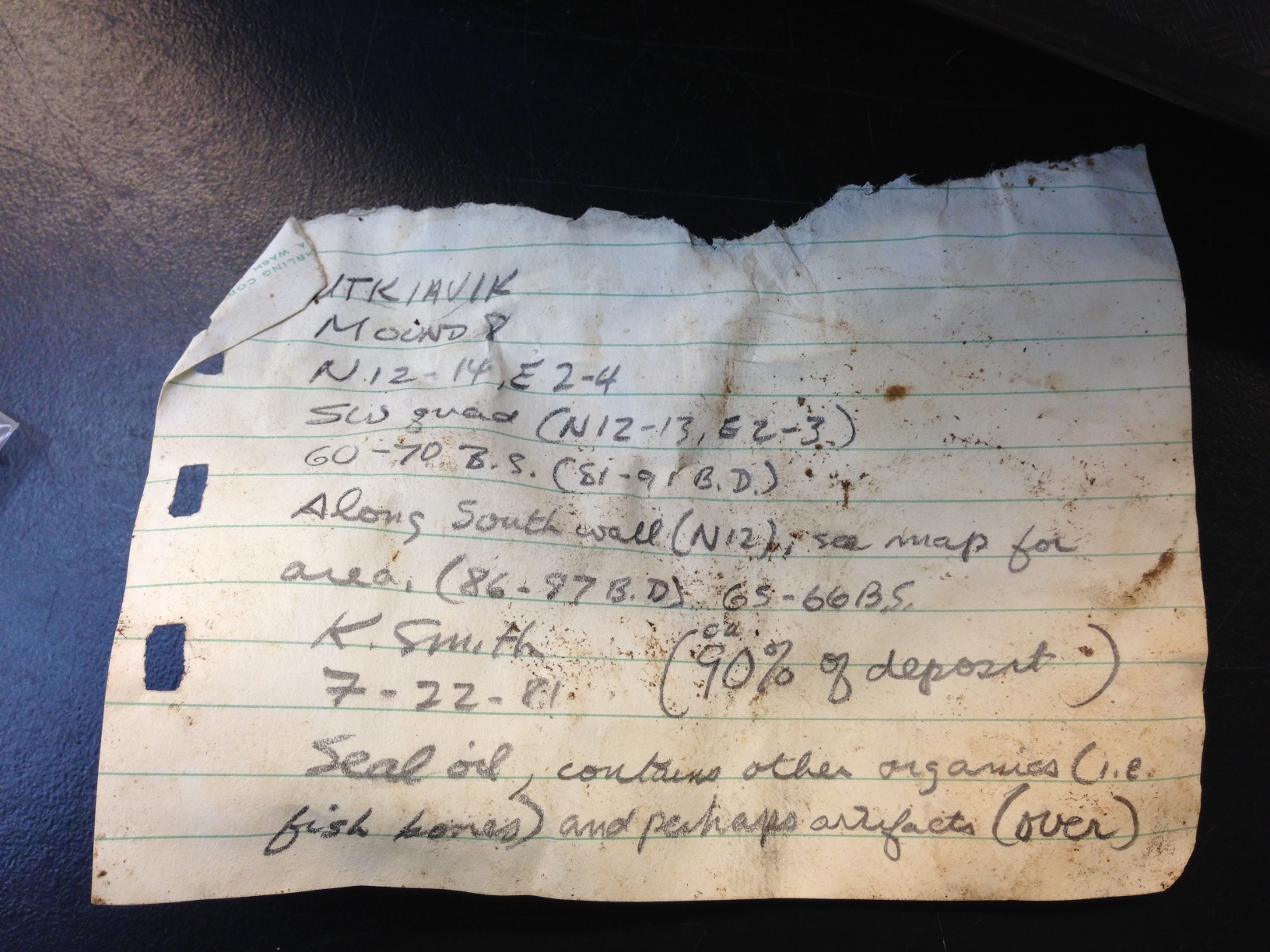
The talk went well, with a very large turn out. Afterwards, a fair number of them came by the lab for a tour. And then I opened the bag. It was from Mound 8, and was described as containing fish bones and perhaps artifacts embedded in seal oil.
Provenience tag from the bag.
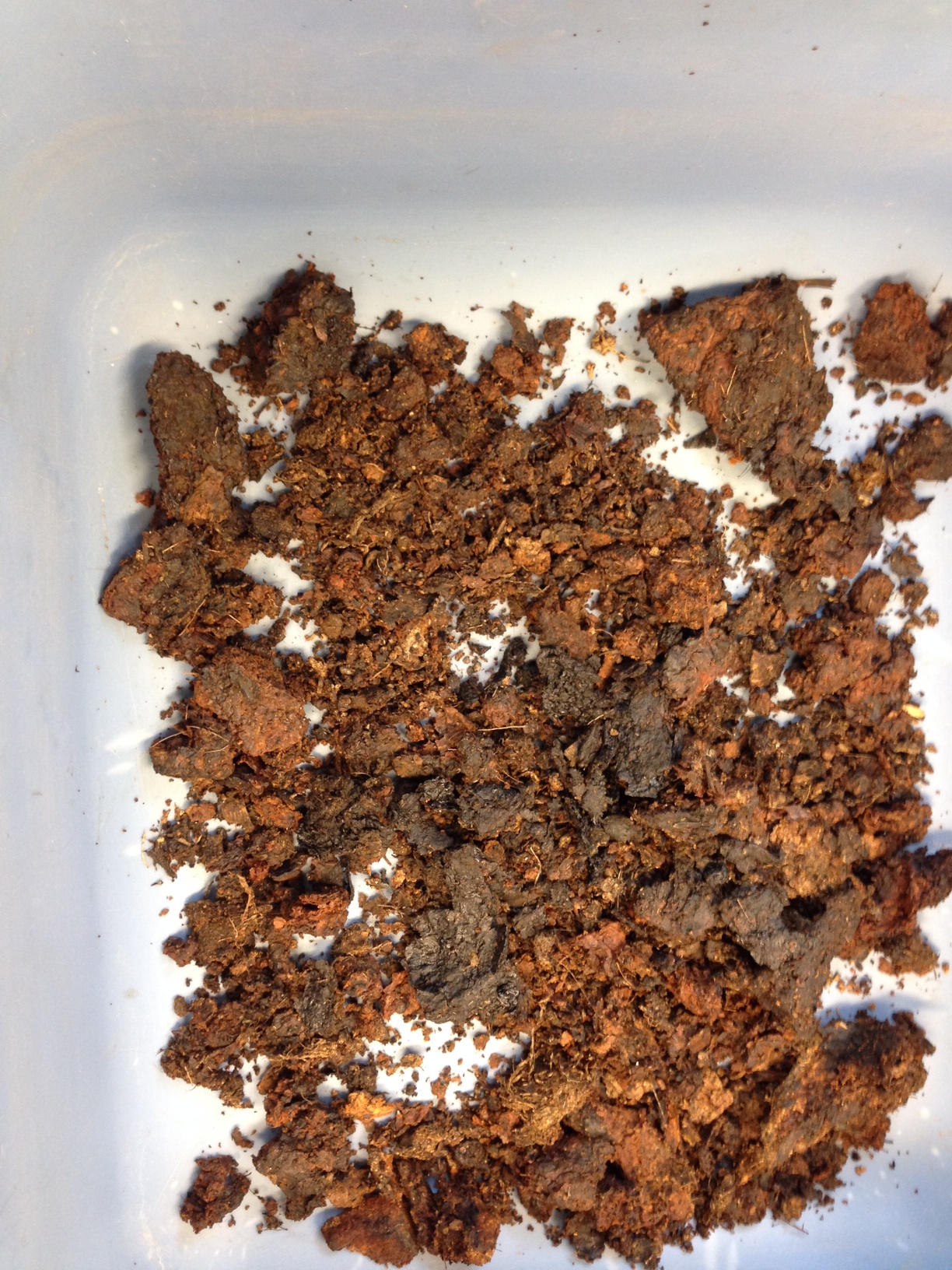
It was rather smelly to say the least. The oil made up most of the matrix, with a consistency like cold greasy peanut butter. Not only that, the most obvious contents were wood chips and hair, which weren’t too exciting. Most folks didn’t feel like hanging around too long. Since it was my birthday & there was a party at my house, I didn’t finish the bag.
Today I got back to work on it for an hour or so. It still smelled, I guess, but I think the smell of old seal oil is sort of nice. It’s the smell of archaeological sites, and they are places I like to be. The couple of extra days had let the oil warm up and it was a little easier to work with.
Contents of the bag.
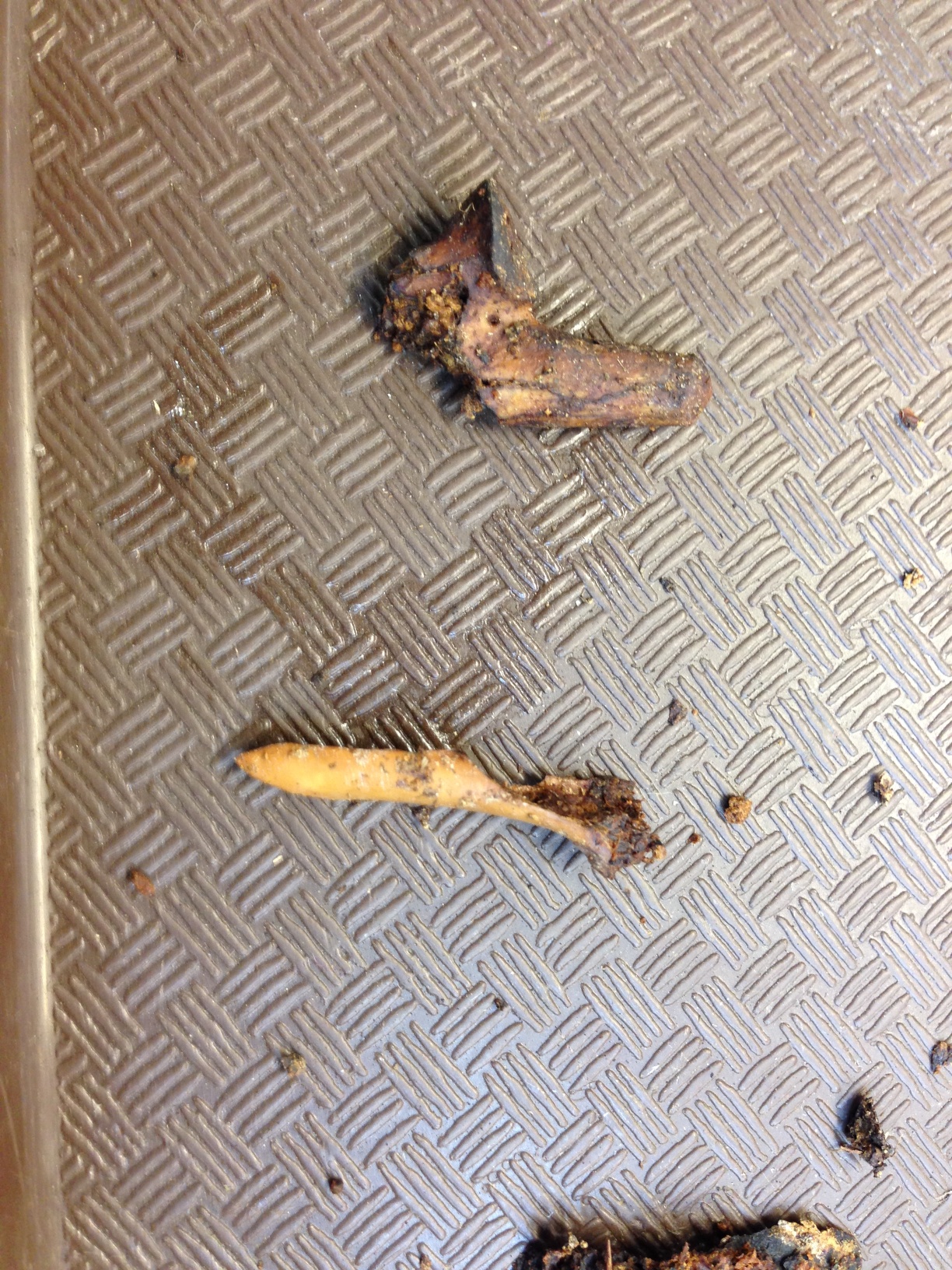
I found a number of interesting things, including a fish vertebra, some fish scales, a number of hairs, some bone fragments, and of course, wood chips. When I was labeling the bags, I realized it had been excavated by none other than Kevin Smith, now at the Haffenreffer, exactly 32 years and 3 months ago.
This Saturday, I’m giving a Saturday Schoolyard talk about the Walakpa salvage project. That means I need a lot of pictures. So I spent the last couple of days in the lab taking pictures of the artifacts from we recovered.
Just a few of the results:
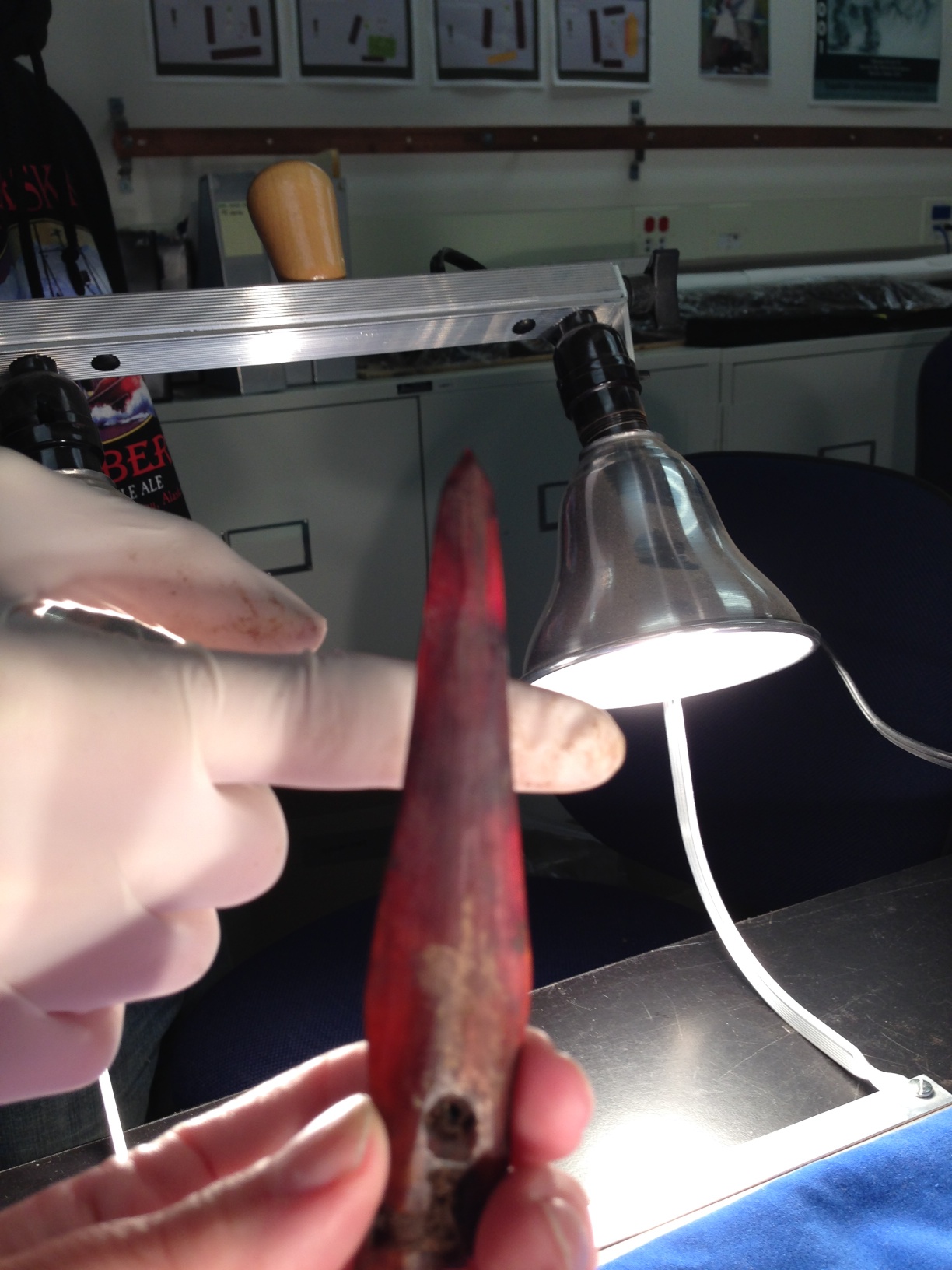
Rim sherdFragments of arrowheads.Very thin ivory harpoon head. Note the shadow of the finger showing through the artifact.
I am currently in Washington, DC, participating in a workshop on Arctic Research and Logistic Support planning. The idea is to get a group of scientists working in the Arctic together to see what we think Arctic research will be like in 10-20 years, and what sort of logistic support will be needed. Then, action steps to get there from here will be formulated. One hopes it is not just an exercise in futility.
As is usual at such gatherings, there are not very many social scientists. There are a lot of physical scientists (marine, terrestrial & atmospheric) and a fair number of biology types. Many of the groups are quite interested in new “toys” (UAVs) and the like, as well as more icebreakers. Better connectivity is also something that is high on most people’s lists, mine included. What I find interesting as an anthropologist is how the cultures of various disciplines vary so widely. One of the breakout sessions was organized more or less by location of research (with social sciences its own group). I actually went to the Coastal group, since I’d just had lunch with Sophia Perdikaris & Genny LeMoine, both of whom are archaeologists, who were going to be in the social science group, and I thought it might be more valuable to get a social science voice into one of the other groups.
The variation in the visions of the groups when they reported back was quite striking. Although there were some things all agreed on, one group saw research in 10-20 years as being done remotely. They even thought that maybe social science could be conducted through social media. Unfortunately they didn’t describe how they imagined one could excavate a site that way; I’m sure it would be a lot warmer than what I was doing last month!
While all that was going on, the Alaska Dispatch picked up Abra’s Arctic Sounder story. Then Archaeology magazine added it to their website news, even asking if they could use a specific picture from this blog. Then they used another one… Oh, well. And I got another interview request.
Things got rather busy around here, since I hadn’t actually been planning to be in the field, and had several other things going at work that required some time and attention. Combined with rather chilly weather and a commute that did my no-longer-fused spine no favors, I wound up putting sleep ahead of updating the blog. Now that the fieldwork is done & I’m getting everything else caught up, time for an update on what happened before the season ended.
We managed to get quite a bit accomplished before the weather stopped us. Fortunately, the entrances to the lagoons closed up, and we generally had less trouble getting to the site in September, thank goodness! In the end, we had just hit frozen ground at the back corner of the excavation when everything started freezing up. This is good, since that means everything behind/below that should still be in great shape if erosion doesn’t get to it before we can. We actually had some really lovely days. And enough wind so no bugs!
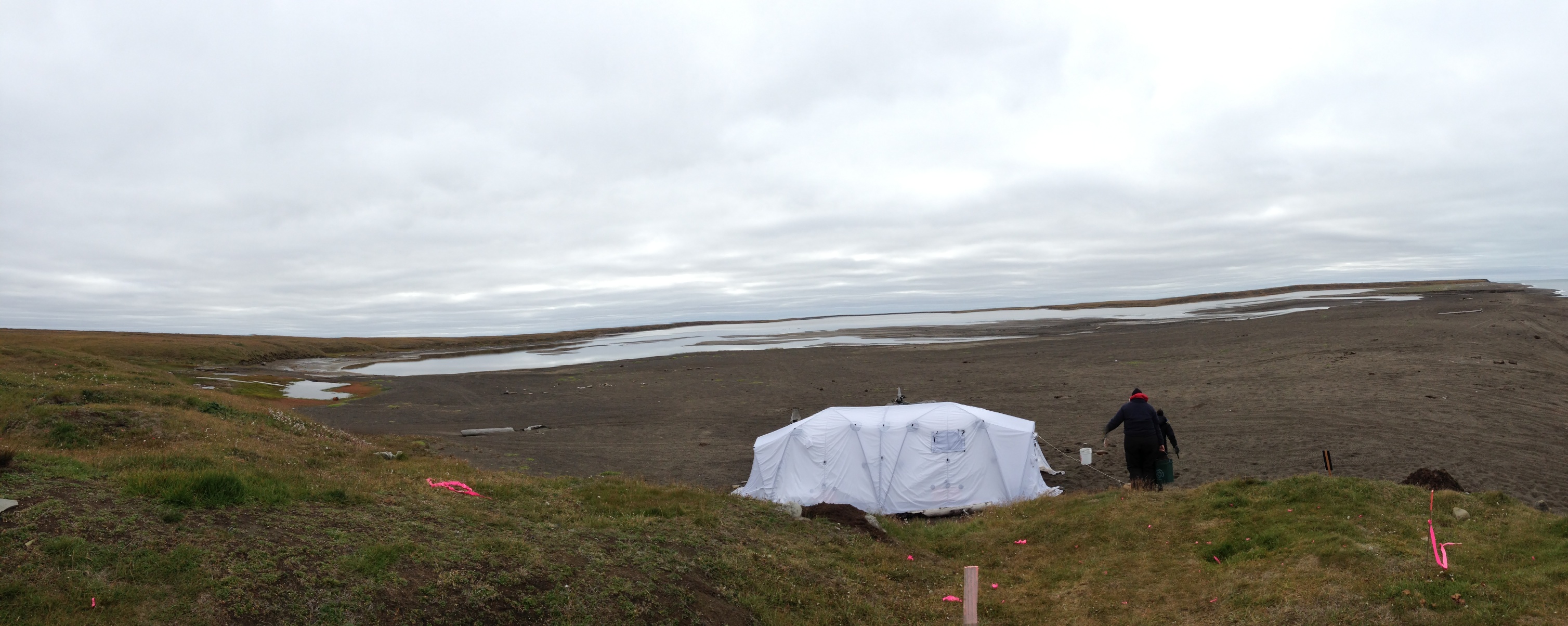
Lagoon and tent on a nice day, as seen from the excavation.
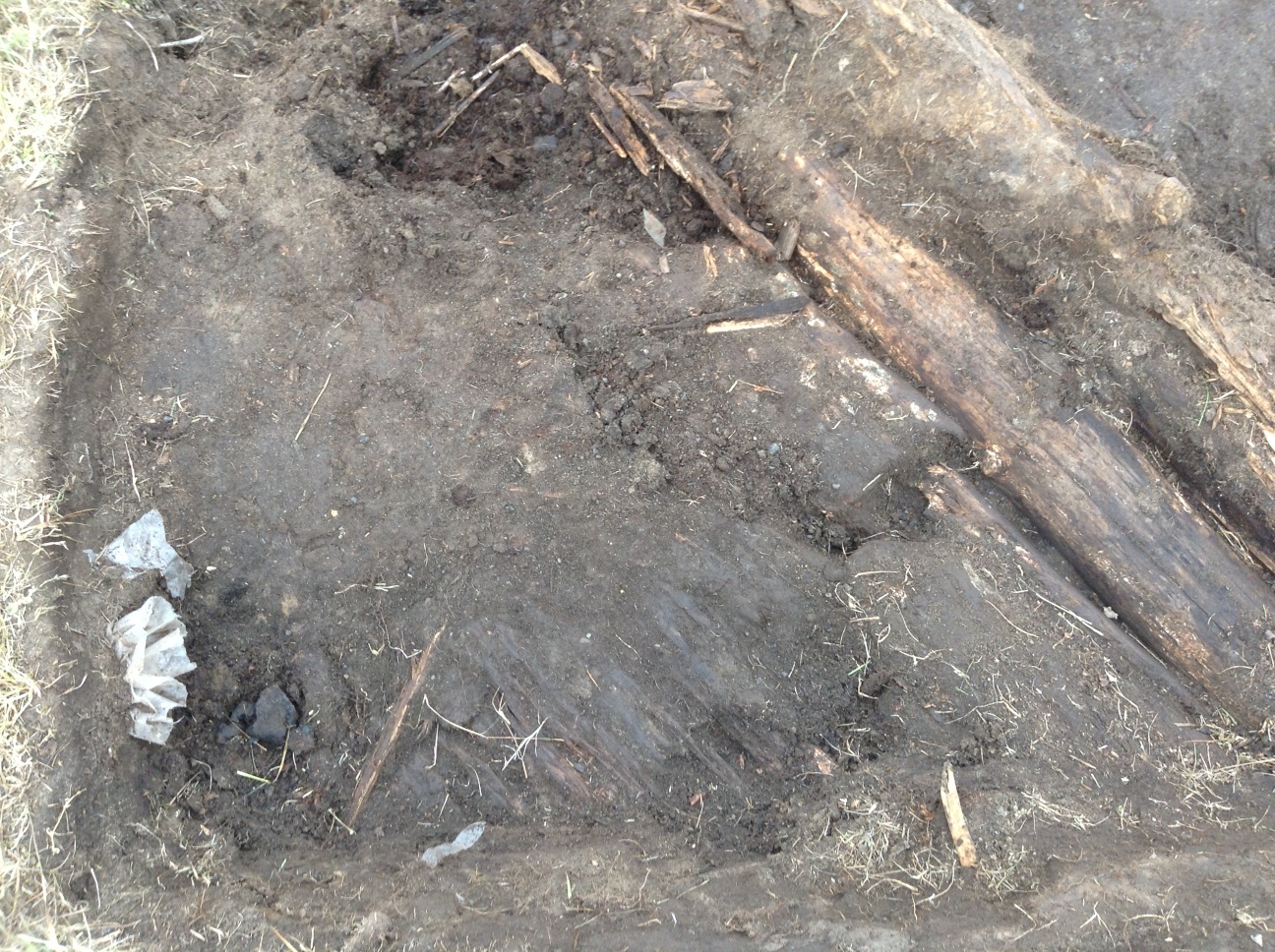
The floor that we had encountered in the south end of the trench cleaned up nicely. There had been a pot in the corner, but all that was left was a pile of smashed sherds. The digging of the pit that someone had put in above it had probably smashed what was left. Near where the arrow shafts were found was an area of floor so soaked with marine mammal oil that you could actually wipe it off of one patch of floor. It seems most likely that this was a tent floor, since there was no evidence of structure otherwise, and it was not far enough below the surface for a semi-subterranean house.
Probable tent floor after cleaning. Pot was located in the lower left corner, left of the stick. The oil patch surrounds the North arrow.
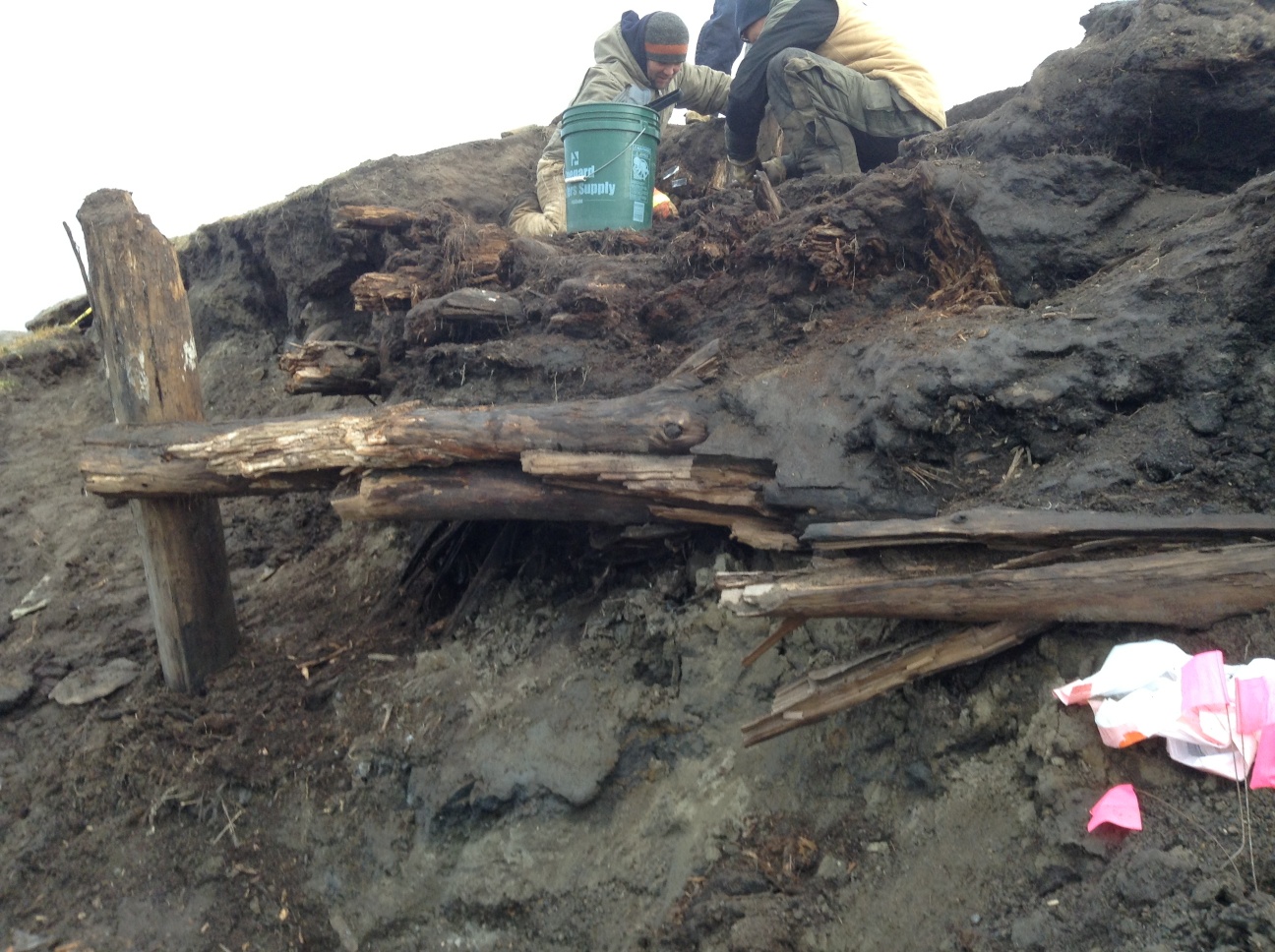
The house (at least I think it was a house) proved very complex. The small area we were able to open was not big enough to let me see what was going on well enough to be definite. However, there seem to have been several floors. We were not able to get down to them before freeze up, but we determined that there were several layers of midden (trash deposit) on them, so it would appear that the house must have been abandoned and reused, rather than just rebuilt.
View from the side showing several layers of floor logs above the sill logs & below the green bucket.
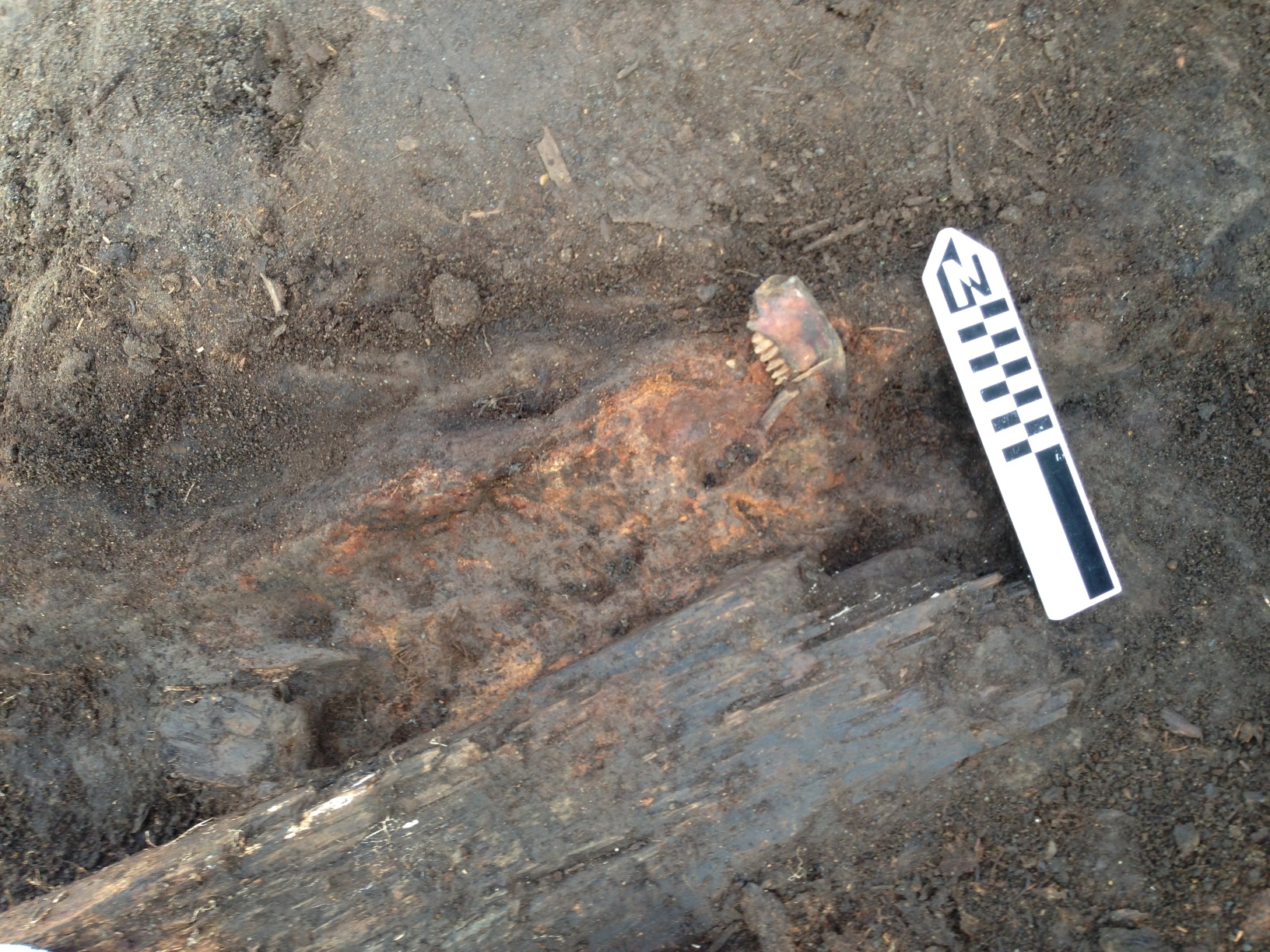
At some point in the sequence, it looks like the structure may have had a meat cache pit (sort of the forerunner of today’s ice cellars) in it. There was a distinct line of hardened red marine mammal oil
North edge of the meat pit. Caribou jaw lying along the sloping side just to the left of the North arrow. The red oil layer continued under the plank. The north logs were above the edge of the pit, but there was a layer of midden in between, so they were not associated.Another view of the red oil level underneath some logs (possibly 2 separate floors). Notice the seal scapula used as a chock under the plank on the right.Another view of the red oil layer showing it sloping up to the right. Note that the apparent sill logs for the main structure are below what is visible in the picture.
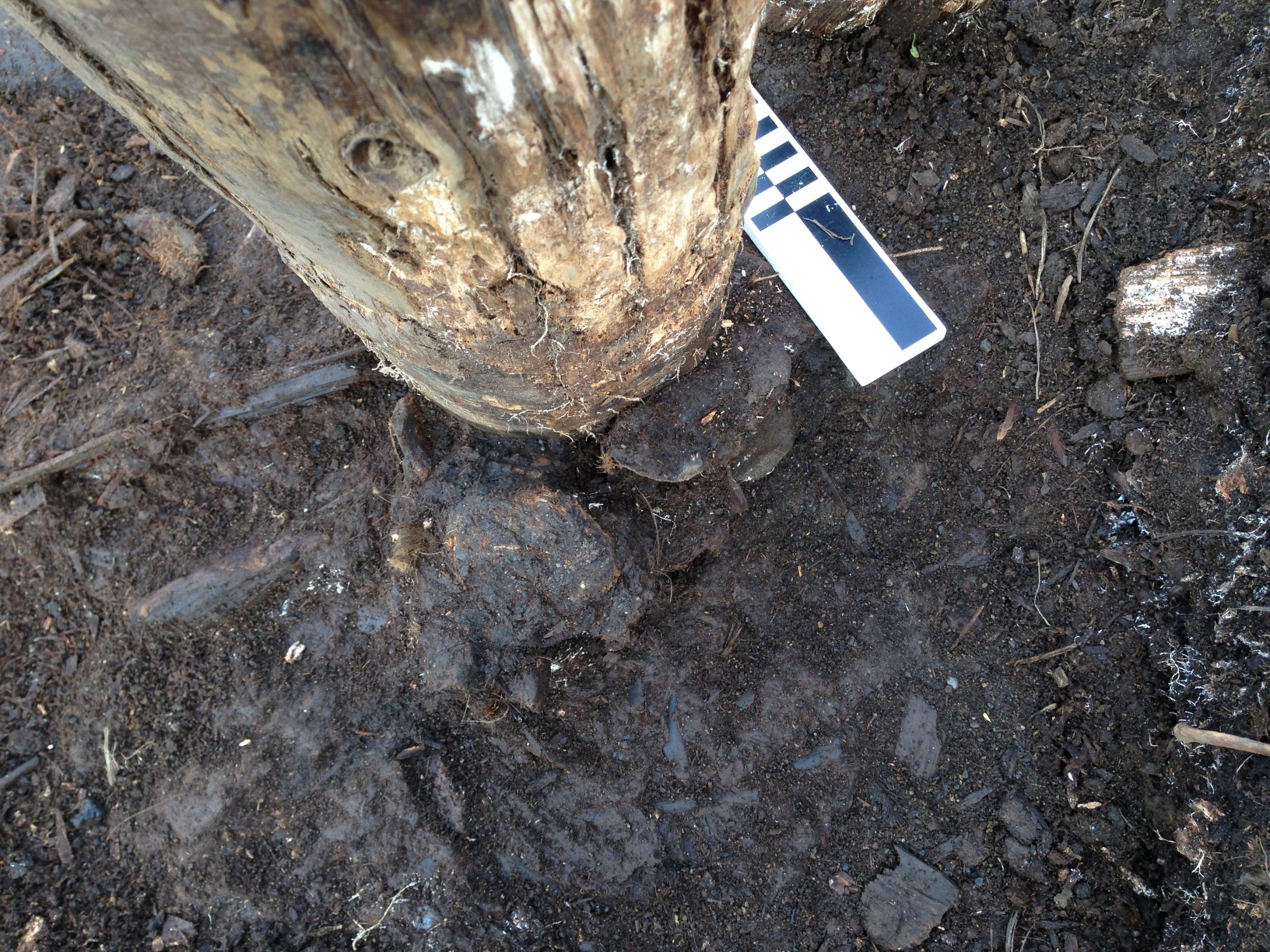
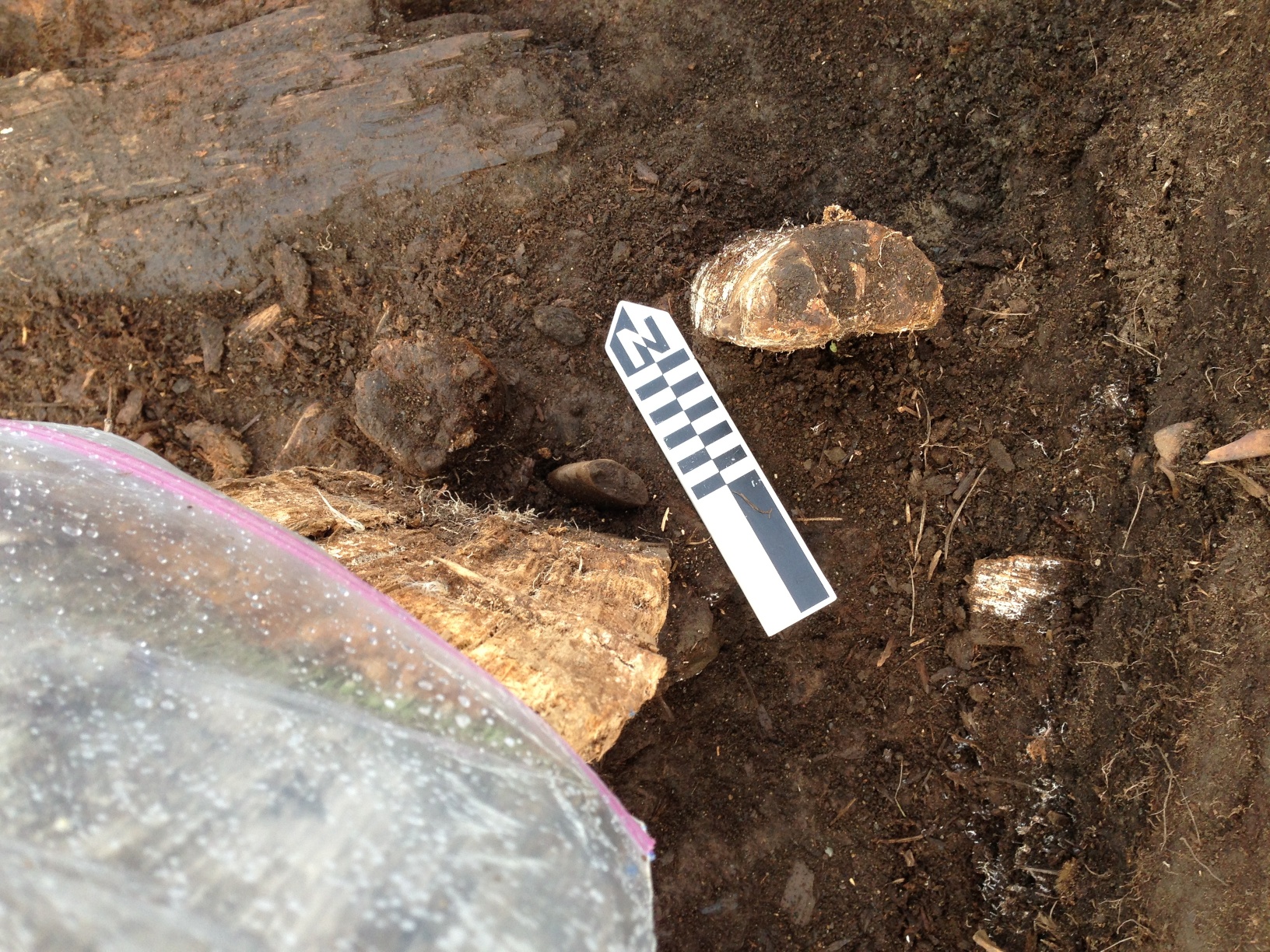
We got all the way to the bottom of the large post in the northern half of the trench. It turned out to be a later addition, dug into an existing midden, and chocked with a seal sacrum, a walrus vertebra and a broken pick head. There were two smaller (and apparently earlier) posts very close to it, one of which had a deposit of shell next to it. That will be interesting if we can ID any of them.
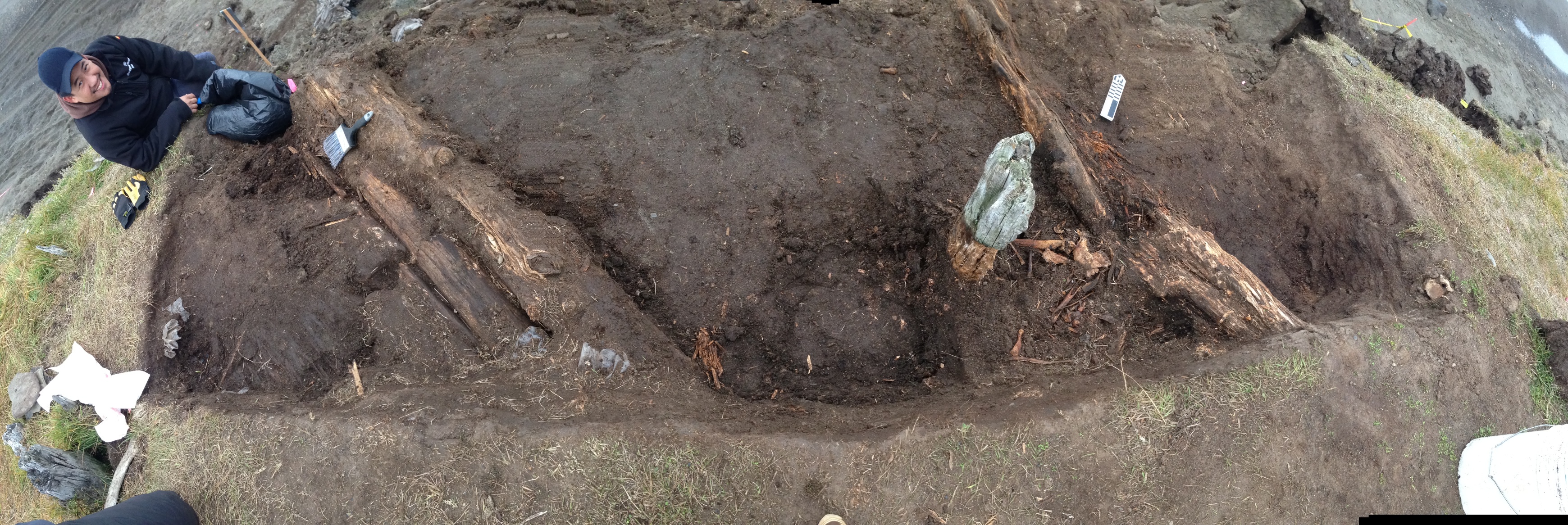
Post, showing sacrum and vertebra used as chocks.Post with pick used as chock at base to left of North arrow.A view of the excavation before the post and north logs came out. NO, the wall was not curved; this is a raw iPhone panorama shot, & that happens. Our walls are straighter than that!
We had been working as fast as we could on the structures at Walakpa. Given how far north we are, “Winter is coming!” pretty much applies as soon as it starts thawing in spring. We had a fair bit of windy weather, so it wasn’t pleasant working conditions, but the ambient temperature was generally above freezing, so the ground remained soft, and we were able to continue excavation.
The batteries on the transit were not happy, and we pretty much needed to have one charging at all times, or risk shut-down until we could charge a battery. The batteries are a bit old, and need to be re-celled or replaced, but since I hadn’t expected to be excavating this summer, that was scheduled to happen over the coming winter, which left us a bit handicapped.
But then, last Monday, there was a dusting of snow on the ground in the morning, and it didn’t melt. Further south in Alaska, snow on the tops of the mountains is often called “Termination Dust” since its appearance signals the beginning of the end of the summer season. And so it was here.
I had started accumulating materials to protect the site over the weekend. UIC Construction had some surplus damaged materials in their yard which would otherwise have just gone to the dump, and they were kind enough to donate them to the cause. Monday, we started hauling them down to Walakpa.
A dusting of snow on the site & the beach in the morningShards of ice from the tarp after the site was uncovered.
We kept digging, since the ground wasn’t frozen. The next morning, there was a lot more snow on the beach, and the ground was really stiff although we did manage to dig a bit more and screen all but two buckets.
We met a polar bear on the way down to the site. It was tired, resting on the beach, but was so wary that it got up and moved before we could detour around it so it could rest.
More snow on the beach. And a tired polar bear, who was none too happy when we showed up on ATVs.
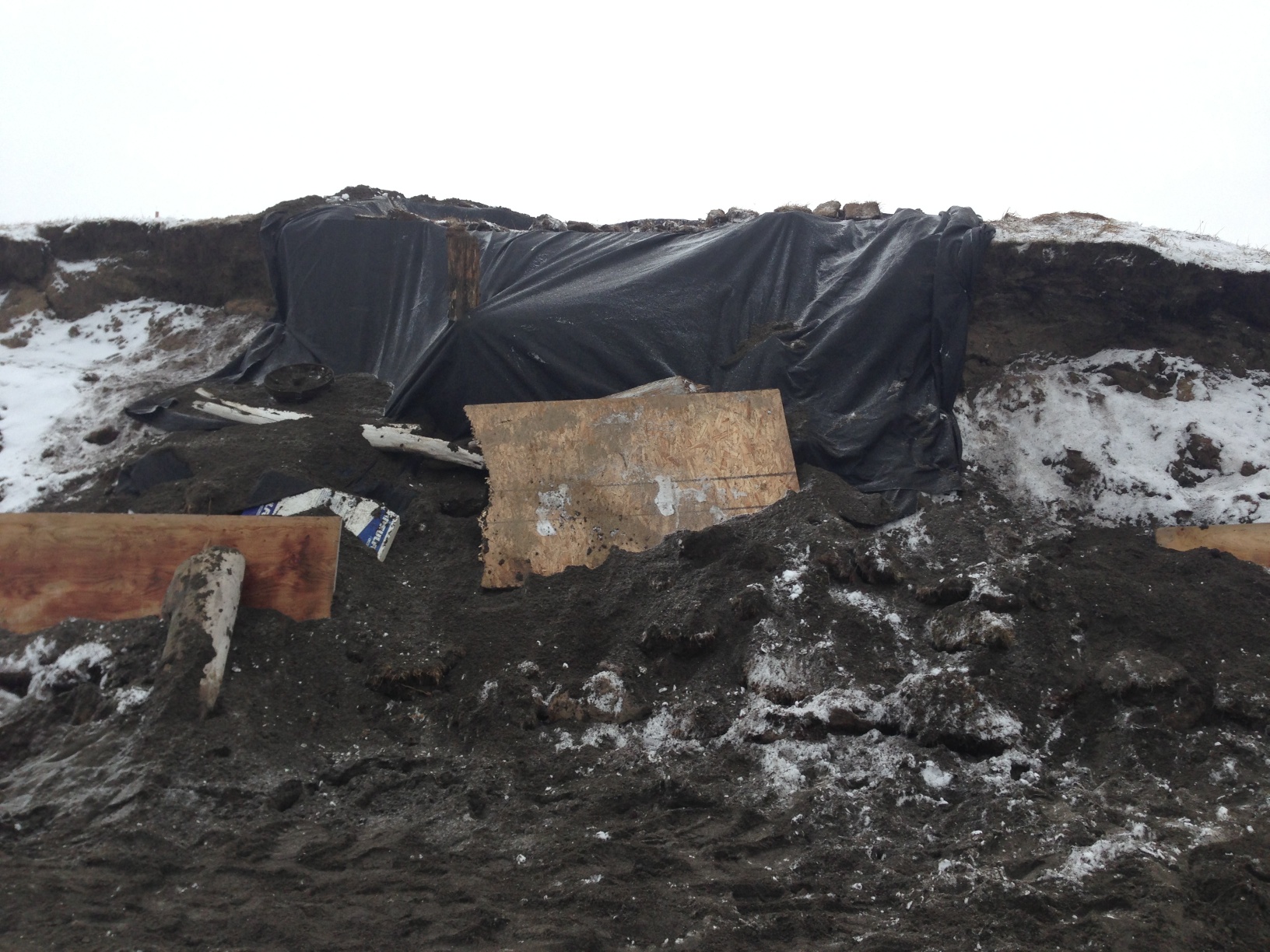
We put particle board along the erosion face of the site, and gathered sods from the beach to stack up to hold them in place. We also used upright driftwood to help hold this in place. By the end of the day, I concluded that things were freezing to the point where only a pickax would move dirt, which would sort of defeat the purpose of archaeological excavation, so we started hauling gear back to town that night.
We allowed the site to freeze more the next day, and Thursday we went down to put the site to bed & take down the tent.
We put a layer of whiteboard insulation on the top and front of the site, and then covered it with geotextile fabric, fastened in place with spikes. Then we covered that with the original sods which had been saved.
Excavation surface covered by whiteboard.Protecting the site with particle board, geotextile, sod and driftwood.Sod back on the site.
Once we had that taken care of, the gear had to be packed up and the tent taken down. We spray painted the hubs of the Arctic Oven frame so the next folks who set it up will have an easier time of it than we did doing it without instructions.
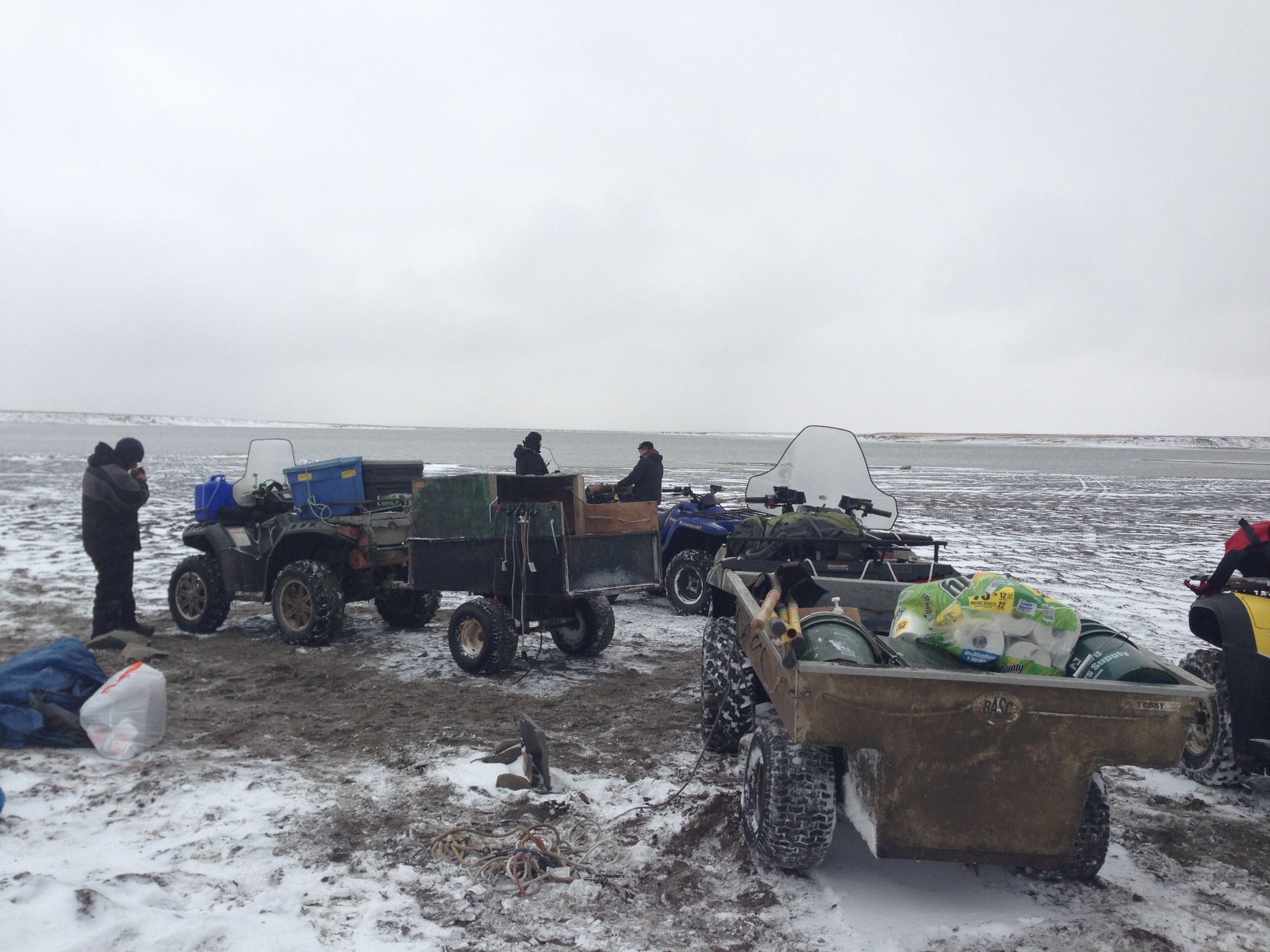
Tent & fly are packed and Jason Thomas is disassembling the frame.Packing the trailers. Riley Kalayauk brought his trailer down too, so we had 2.Happy hard-working crew ready to head home.
Now all we can do is hope and pray that there are no storms before the ocean freezes up that generate waves big enough to reach the site, and if there are, that they don’t last long enough to destroy the protection that we built. If we are fortunate, it will still be there next year, and we can learn more.
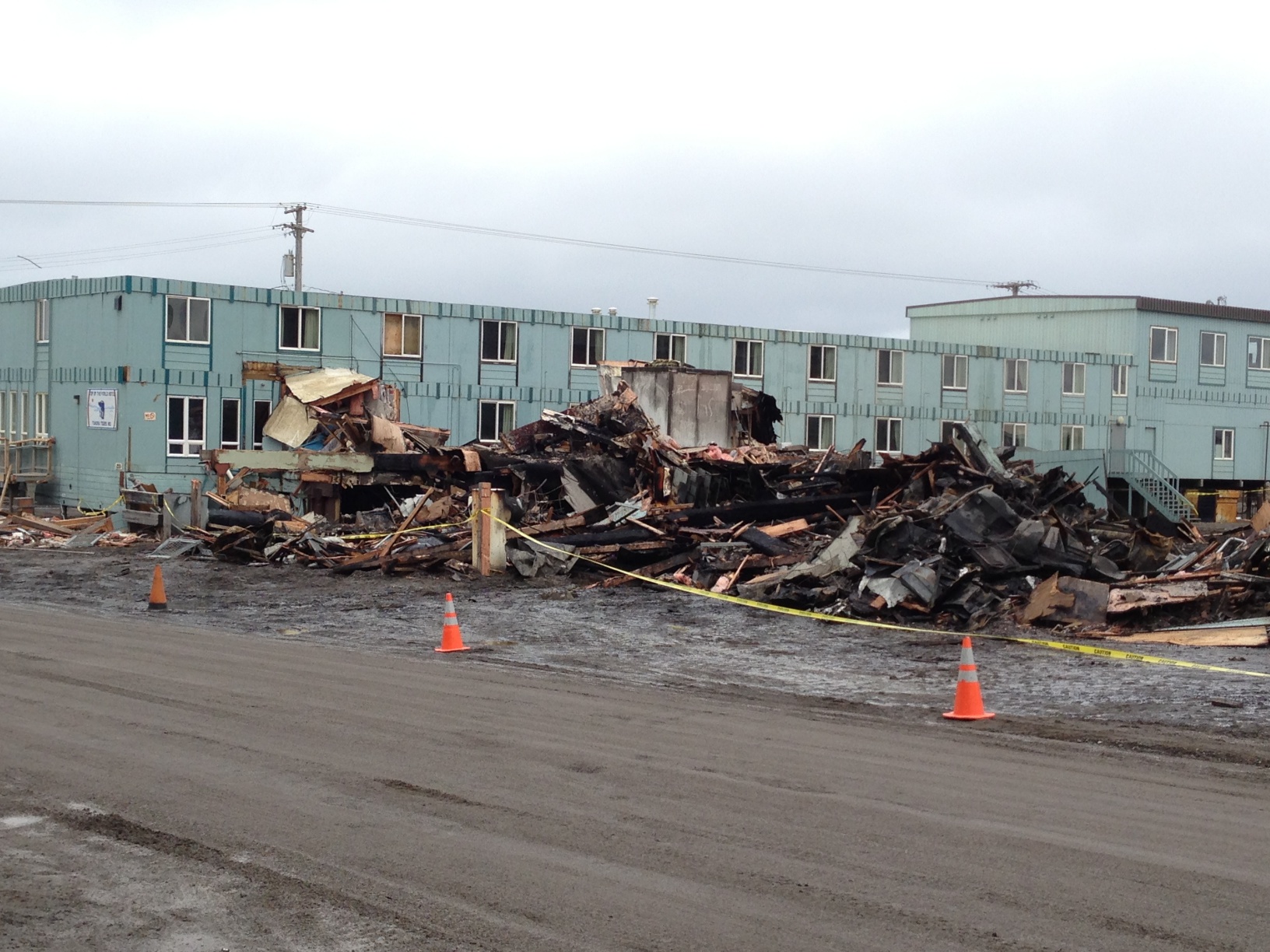
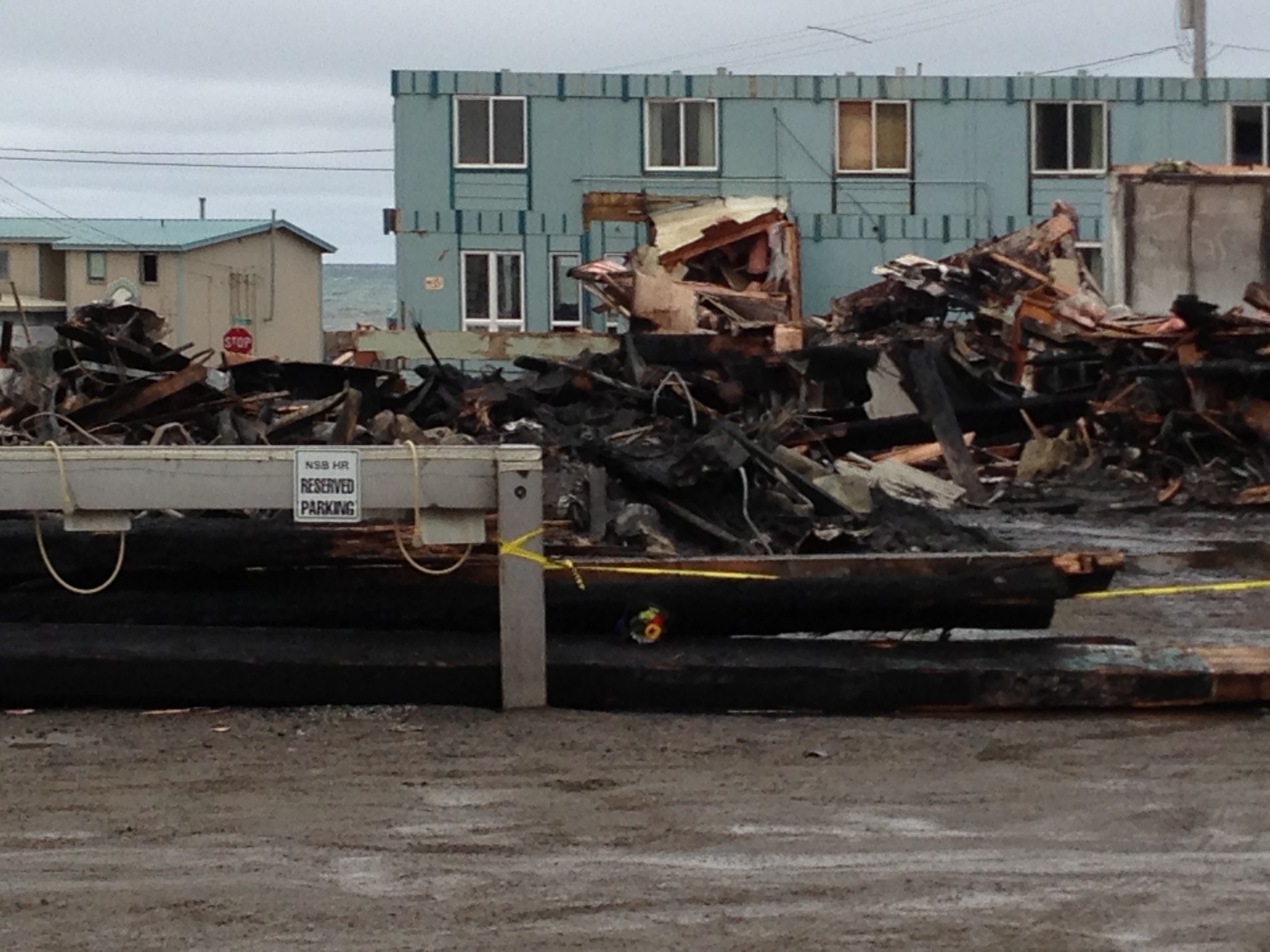
Thursday, we had an even more exciting trip to Walakpa, which really messed up my back, so I was pretty much flat on my back when not actually working. I was going to do a post about that this morning, but when I woke up, there was very sad news. Pepe’s North of the Borderburned to the ground last night.
All that’s left of Pepe’sThe remainsTop of the World Hotel in the backgroundBurned beamsThe bank building almost caught on fire too. Great save NSBFD!
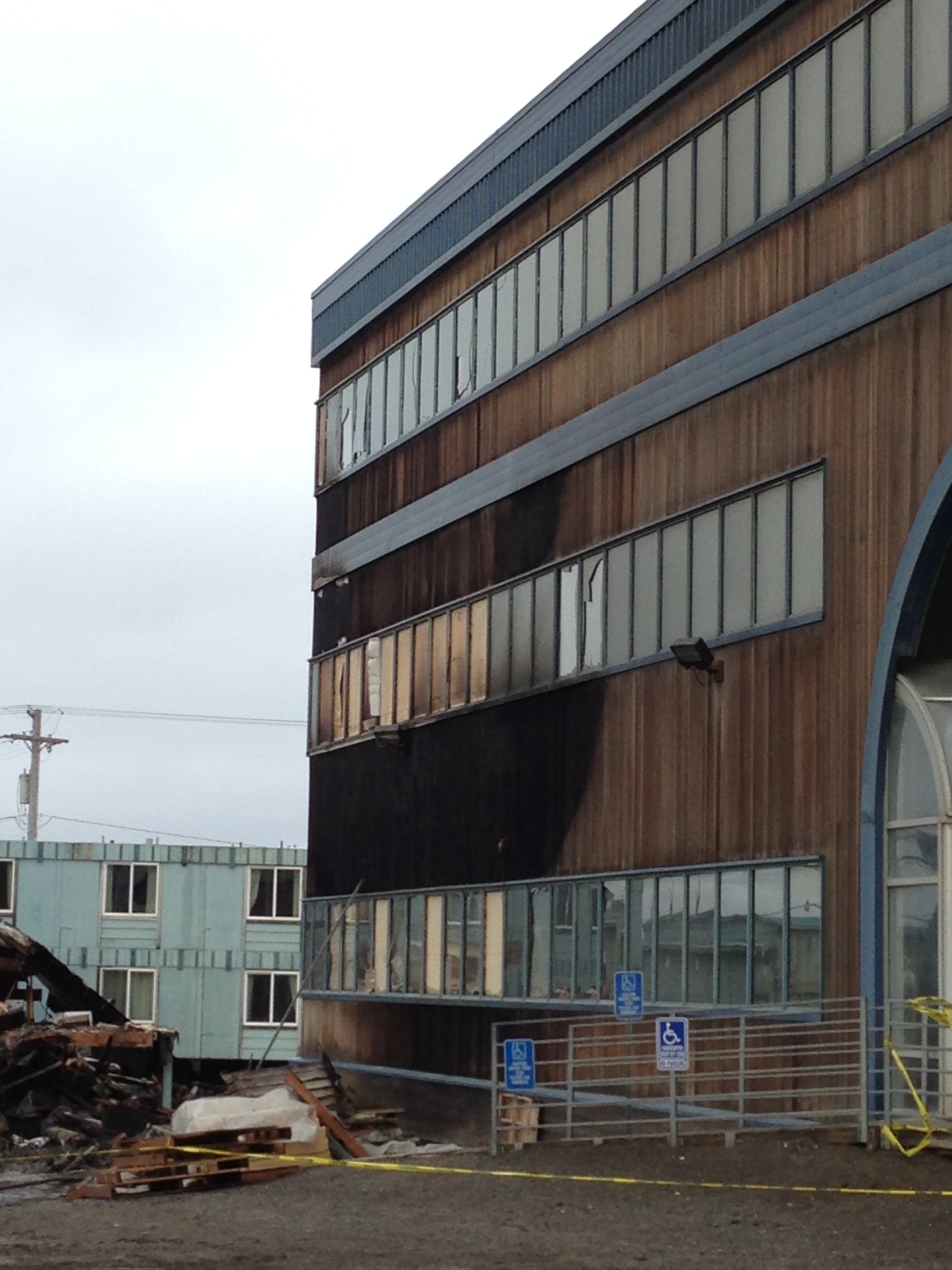
There was some damage to the Top of the World Hotel, including the destruction of the entrance. As you can see, the bank building nearly caught fire as well. It’s charred and a lot of windows are broken, but the North Slope Borough Fire Department managed to save it. Much credit to them.
Fran Tate, who started and owns Pepe’s is quite ill, and in Anchorage for medical treatment. She’s donated a lot to her adopted hometown (free meals for school sports teams, food for bereaved families, fund-raising for children’s hospitals, just for starters) and here’s hoping some way can be found to help resurrect Pepe’s. We are going to be hurting for restaurant seats and catering here in Barrow if not.
The water was a bit higher than yesterday on the way down, and we had to winch a couple of the 4-wheelers out of deeper mud, but we got to the site with not too much trouble. We put a stick in a the high water mark so we could see what the ocean was doing and went to work on the structure.
Yesterday, the strong winds made water screening where we have to do it a pretty sure ticket to hypothermia, so we tried just dry screening on the beach in the shelter of the bluffs, and it worked well.
Dry screening on the beach.
We made pretty good progress on the excavation. More logs were exposed in both of the parallel log features (fallen walls?). The area between the logs is getting soft, and seems to contain a lot of animal bones, many of which are lying in a way suggesting they were tossed into a depression. South of the southern logs, we uncovered what appears to be part of a plank floor, maybe for a tent, since it doesn’t seem deep enough for a house. Next to, but apparently not on it, there was a cluster of ceramic sherds, including a large rim sherd. This was right under an old looters pit, and their activity may have broken the pot.
Panorama of the excavation.Ceramic sherds at lower left (with Visqueen sticking out of the wall above them), plank floor in lower center, south logs at right, and arrow shafts at top center.
Beside the logs, but again not on the plank floor, we found two arrow shafts, apparently associated with a strip of baleen, and a fragment of bird hide. A couple of pieces of hide, one sewn, had been found just above this. This could be the remains of a quiver, or possibly a work bag, since there was a ground slate knife blade fragment and a worked piece of chert nearby. We’ll continue there tomorrow.
We didn’t stay out as long as we might have, since the waves seemed to be coming higher up the beach. It turned out to be a good thing. Going back to town was a bit of an adventure for us, although only one of us got stuck, but even more so for a man & his son we met on the way. They were trying to head out towing a trailer, and had gotten really stuck in a deep soft spot. It looked like they had been there a while trying to get out. We were able to get one of the 4-wheelers with a winch to where we could pull them out, and then waited until they got turned around and back on the town side.
We made pretty good progress at Walakpa this week. This, despite a few challenges.
On Tuesday, we had a really small crew, due to a variety of circumstances. Only Trina, Mary Beth & I made it out. It was quite a cold day, with ice on the puddles when we got to Walakpa (or Monument).
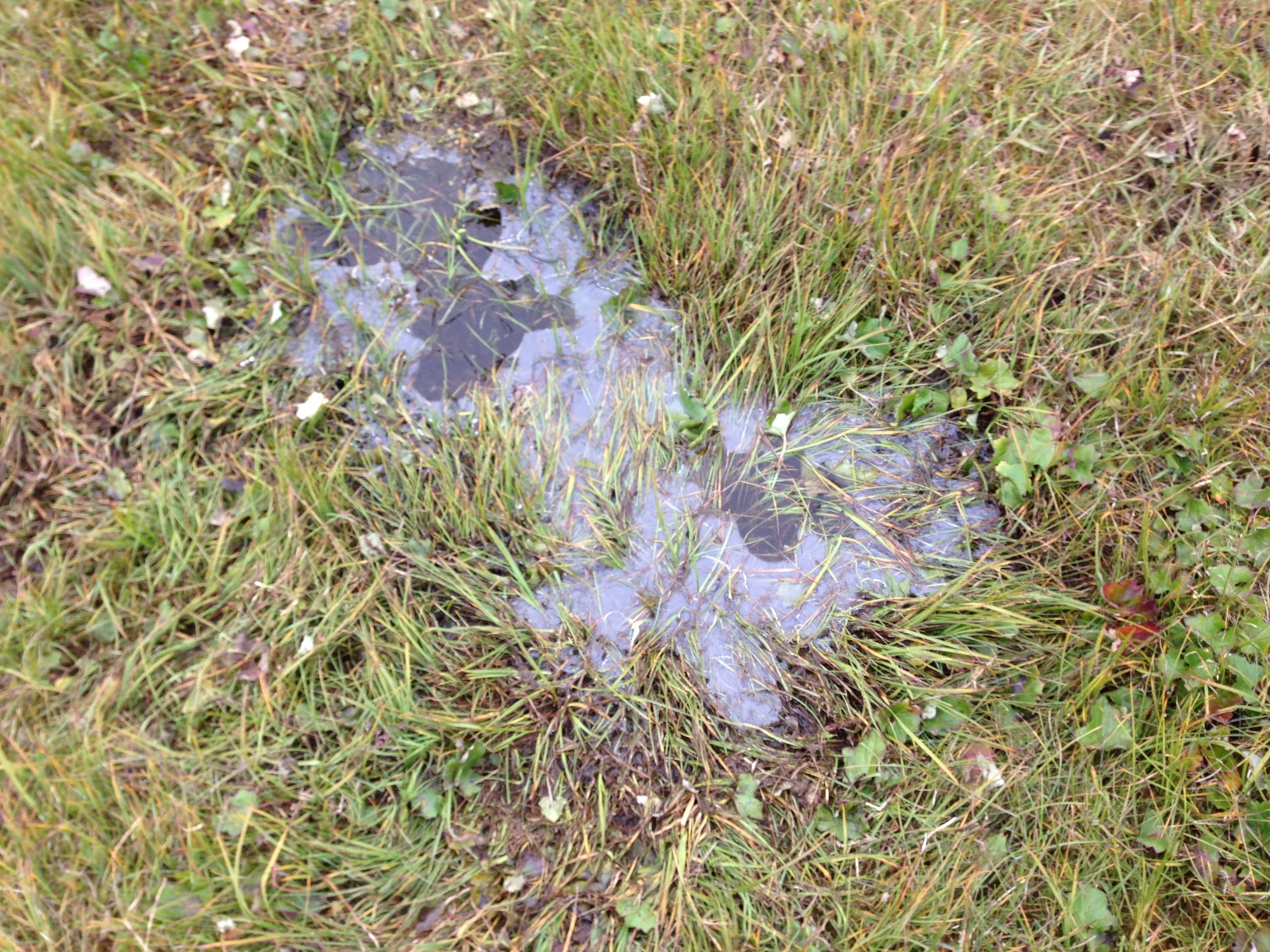
Ice on a tundra pond.
We decided to leave the screening for another day and just excavate. It was cold enough that we actually took advantage of the removable floor in the Arctic Oven tent on site and used the Coleman stove inside, but on the ground.
The Arctic Oven on a cold day
The next morning, we had a bigger crew, but there was snow on the ground when we set off.
Snow on the tundra, seen across Middle Salt Lagoon.
We were not expecting to have a great day, but in fact it was warmer than the day before (no ice), and we started getting down to what seems to be structural wood from the house roof, so that was fairly satisfying. We got a lot of water screening done, as well. The beach had really stabilized, so we were able to go the whole way on hard sand, and even most of the lagoons had closed up, with sandbars across the entrances that we could just drive across. The commute to the site was much quicker.
Thursday did not go well. We headed out, only to find that for some reason, the waves were really coming up the beach and running into the lagoons, so that we were not able to get across the stream by the gravel pit. We went around and through the gravel pit, but then could not get across the stream by Nunavak. We did see a polar bear in the water near a dead walrus). I decided we should try to go around, since it was otherwise a nice day & I hated to lose it, but we didn’t have any extra gas along, and by the time we were half-way around, even cutting across country rather than following the shoreline, it was clear that some of the Polaris’s are sort of gas hogs. So back we went to the road, with only one minor mishap when the Tubby trailer bounced into a very wet low-centered polygon and dragged the ATV half-way in. I got my feet wet getting it unstuck, but we still went back down to the beach so that David Pettibone could get a picture of the bear, still in the water, from a safe distance.
Today, despite no major change in wind strength or direction, was very different. The beach was back to Wednesday’s shape, and we got to the site easily. It was quite sunny in the morning, and we got right to work. We had six people, so we started with 4 excavating and 2 screening.
View from the south end of the trench, where I was digging. Pretty well maxed out. L to R: Mary Beth Timm, JoAnn Akootchook and Michael Berger.
I played around with my iPad mini for taking pictures to supplement field notes & drawings. I don’t draw all that well, and used to take Polaroids and draw on them, but that technology is gone and wasn’t that stable anyway. I’ve use a couple of programs to annotate lab photos, but this was the first time I tried it in the field. I used iAnnotate PDF, which lets you put sound files on the image, associated with notes or drawings. They open fine in Acrobat. This will be quite handy.





















 Out of Ice and Time