Two abstracts submitted!

I still don’t have an admin assistant, and I’m getting stretched pretty thin.  The other day I had to print some checks, and got interrupted by something else before I got the check stock out of the printer.  The first five pages of an interesting white paper by Tom McGovern wound up on check stock.  I didn’t even notice until I got home and started to read the thing…  So there were some checks to void.

But I did manage to do a good bit of work yesterday on the maps for the ice road corridor for the Barrow Gas field project.  Still not report ready, but I was able to talk with the woman who is the main GIS person for the project, and mark up a map so she could constrict the cleared corridor a bit where it got close to some possible hunting stand locations.  It’s still plenty wide, although apparently the engineers were worried that if they can’t go exactly there, they’ll have to go through lots of polygonized ground, which is more expensive to build ice roads on.  The thing is the well pad the ice road is going to is on polygonized ground, and surrounded by lots more of it, so I don’t think they’re going to avoid much that way.  I can always test it next summer if they really want to go just there.

Today I managed to get two different abstracts for talks in, which is pretty amazing.  One was for the Saturday Schoolyard talk that Trace Hudson, one of the Barrow HS students from this summer, and I are giving on the 16th (gotta get my part done before then…) and the other was for the 18th Arctic Conference, which is being held at Bryn Mawr College this year.  Since I’d been implicated in talking Rick Davis and the BMC Anthro department into hosting this (the fact that I hosted it in Barrow, with 2 HS students for assistance, while writing my dissertation and working full-time so how hard can it be did figure prominently in my arguments), it really was incumbent on me to give a paper.  I’m talking about the material culture of modern whaling (the stuff that a whaling captain and his wife and crew members need to have specifically for whaling) and where those things get used and stored.

So folks, especially East Coast Arctic types, the registration/paper/poster deadline is Friday, October 15.  So get a move on!

Adventures with journalists; or, I never said anything about 45,000 yr. old Eskimos

Obviously, I think that archaeology is interesting. In my experience, so do most non-archaeologists I meet. People ask lots of questions, and it’s amazing how many of them say they always wanted to be archaeologists (hey, we take volunteers!).

So, I imagine that there’s a reasonable audience for journalism (print, broadcast or Web) that covers it. The Arctic, as the canary in the climatic coal mine and home to endangered charismatic megafauna (AKA polar bears), also seems to be a hot journalistic topic. Given that Barrow is served by at least two jet flights a day and has decent connectivity, we get our fair share of journalists, and a fair number of them want to talk to me.

The public pays for most archaeology (and other science) so I think they deserve to hear what they’re paying for us to learn, especially since most people are interested in other people and their doings, as opposed to, say, permafrost or midge hatches, for which the interested audience may be smaller. So I take the time to talk to journalists. I also try to find out a bit about the journalist in question. If I get the sense that they are not very experienced with science or research, I’ll offer to at least check dates and spellings in their story before it goes to print, pointing out that that’s less embarrassing than having to issue corrections of errors later. Some take me up; some don’t.

I also take the time to attend panels on working with the media at scientific meetings. They are usually composed of a variety of people who are public information officers for scientific organizations or institutions and science journalists, often quite well-known ones who write for national science magazines or newspapers. They are all very earnest and full of good advice. They are usually amazed at the questions asked by the audience, and horrified by those of us who want to see stories prior to publication. They seem bewildered that the archaeologists making up the audience don’t all see journalists as friends and a great help.

Of course, if all journalists were like the ones on the panels, we probably would see them that way. I’ve worked with some great folks. Angelika Franz, a German writer who has done several pieces about Nuvuk, actually has a doctorate in archaeology, so she’s been great to work with, knowing what sorts of information are critical to get right, and understanding technical terms so we can concentrate on the interesting parts of the story. She has done pieces for Spiegel Online Wissenschaft, a magazine called Epoc and now she’s got a book coming out with a number of pieces she’s done.

I had great fun being interviewed (in Danish) by some Danish journalists who were retracing Knud Rasmussen’s travels across Arctic America. The story wound up mostly being about the fact that I have a complete set of the 5th Thule Report, in Barrow. We also had a nice trip to Nuvuk in the local tour van, which resulted in some good polar bear pictures for them.

Most of the others have been reasonably competent, and haven’t garbled the stories too much, although they haven’t written stories that answer the sorts of questions people ask me.

And then there are the others. There was a group of filmmakers working on video for a major producer of science programming. They had decided to focus on an ice scientist and his (cute female) grad student. It was spring, so there was not much to see at Nuvuk, but they wanted to go there anyway. They wanted to film them pulling up on snow machines. The tracks aren’t the best thing for the site, but we had already excavated the area near the bluffs, so I said that would be OK there. Of course, they didn’t like the shot, or the light, and wanted to have them coming from a different angle, and retake it, and I kept having to tell them to stay in the cleared area. Then they decided that the scientists/protagonists should start scraping away gravel from logs (actually a NARL-era sled shed base) projecting from the bluff, with their mittens. Since this is precisely what we want the public to avoid, it didn’t’ seem like a good idea to show them SCIENTISTS doing it on a reputable science TV series. I pointed that out, to no avail. So I told them I couldn’t be party to that, on film or off, and since they seemed bent on damaging the site, which belonged to my employer, I was going to have to ask them to leave.

Better yet was a Barrow reporter for the local newspaper, the Arctic Sounder. The Sounder is not a bad paper given the area it covers and the budget it has. However, I doubt that the editor considers this fellow one of his better hires. He was an odd duck. He once asked me to help him set up the Mac that the paper had given him so that he could file electronically. I got everything set up, and then went to plug the modem into the phone line (this was some years ago). He would not let me. I suggested that we could test it, and then he could plug it in to file and unplug it. No dice. He also thought there was a hole at the North Pole. He interviewed me about some work I had been doing, and in the course of the interview asked me how long people had been in the Barrow area. I said it was hard to be sure, since sea levels had risen and between that and erosion the earliest evidence was probably gone, but that there was some Arctic Small Tool Tradition (ASTt) material there, which was probably “4 to 5 thousand years old”.

Imagine my surprise at being quoted (in quotation marks, no less) as having said that there were “45,000-year-old Eskimos” in the Barrow area! I got calls from folks as far away as Pennsylvania (Tiger Burch for one) who basically wanted to know if I was off my rocker. When I suggested to the reporter that perhaps a correction was in order, he refused on the grounds that “someday they’ll find 45,000-year-old sites here, and then you’ll have been the first to say it in print.” I have heard, although I can’t confirm, that he was removed from town in a straitjacket.

And they wonder why archaeologists view journalists with a somewhat jaundiced eye…

Snow and wind, wind and snow

That’s the forecast, and tomorrow more of the same. The wind is supposed to drop a bit, although that was supposed to happen today too. Not so much.

Unfortunately for me, and the two guys who are going to be helping me. I have to stake out the locations for the heating elements for the tundra warming prototype experiment. We are going to have to lug the total station, tripod, computer, batteries, and a whole action packer full of stakes out the boardwalk to the area on the BEO where this thing is supposed to be located. No 4-wheelers are allowed, so we’ll have to use a wheelbarrow to drag it out there. I figure we can leave the stakes & such overnight if we don’t finish, but everything else will have to come back in.

The array is hexagonal, so it’s more complex than just laying out a grid. Actually, it’s sort of two offset grids, except that the boxes are rectangular, not square, so there are a lot of weird angles. In some cases, I’m just going to have to move the transit, rather than accumulate error, since the total station I’m using is only accurate to 5 sec of arc. Anyway, it will make the math simpler, and should probably be faster. I hope.

Coastal Flood Watch Remains in Effect

I woke up and turned on the radio this morning in time to hear the morning fellow recommend paying attention to the weather.  Since most folks here do that anyway, it was obvious that something a bit unusual was coming.

…COASTAL FLOOD WATCH REMAINS IN EFFECT FROM 2 AM AKDT SATURDAY THROUGH LATE SATURDAY NIGHT…

A COASTAL FLOOD WATCH REMAINS IN EFFECT FROM 2 AM AKDT SATURDAY THROUGH LATE SATURDAY NIGHT. LOW PRESSURE 400 MILES NORTH OF BARROW EARLY THIS AFTERNOON WILL STRENGTHEN TONIGHT AS THE LOW MOVES SOUTH. BY SATURDAY MORNING THE LOW IS EXPECTED TO BE ABOUT 250 MILES NORTH OF BARROW. STRONG NORTHWEST WINDS WILL DEVELOP ALONG THE BACKSIDE OF THE LOW. WIND SPEEDS OF AROUND 25 KNOTS ARE EXPECTED IN BARROW LATE TONIGHT THROUGH SATURDAY NIGHT WITH WINDS TO 35 KNOTS OFFSHORE.

THE SEA ICE IS NOW NEAR SEASONAL MINIMUMS AND THERE IS OPEN WATER SEVERAL HUNDRED MILES TO THE NORTHWEST OF BARROW. THIS WILL CAUSE SEAS NEAR SHORE TO BUILD TO 9 TO 13 FEET ON SATURDAY. THE SEAS ARE EXPECTED TO BREAK ALONG OR NEAR SHORE. IN ADDITION TO THE HIGH SEAS A STORM SURGE OF UP TO 2 FEET IS POSSIBLE AROUND THE TIMES OF HIGH TIDE SATURDAY AND SATURDAY NIGHT. SIGNIFICANT BEACH EROSION IS EXPECTED WITH MINOR COASTAL FLOODING POSSIBLE AROUND THE TIMES OF HIGH TIDE. THE AREA AROUND STEVENSON STREET NEAR THE BOAT LAUNCH BY THE CITY PLAYGROUND IS PARTICULARLY VULNERABLE TO FLOODING. OTHER LOW SPOTS ON DOWN THE BEACH WILL ALSO HAVE THE POTENTIAL FOR MINOR FLOODING.

ADDITIONALLY…SIGNIFICANT EROSION TO THE BLUFFS ARE LIKELY AS WELL.

PRECAUTIONARY/PREPAREDNESS ACTIONS

… A COASTAL FLOOD WATCH MEANS THAT CONDITIONS FAVORABLE FOR FLOODING ARE EXPECTED TO DEVELOP. COASTAL RESIDENTS SHOULD BE ALERT FOR LATER STATEMENTS OR WARNINGS…AND TAKE ACTION TO PROTECT PROPERTY. NOW IS THE TIME TO MAKE PREPARATIONS AND MOVE ALL PROPERTY WELL AWAY FROM THE BEACH.

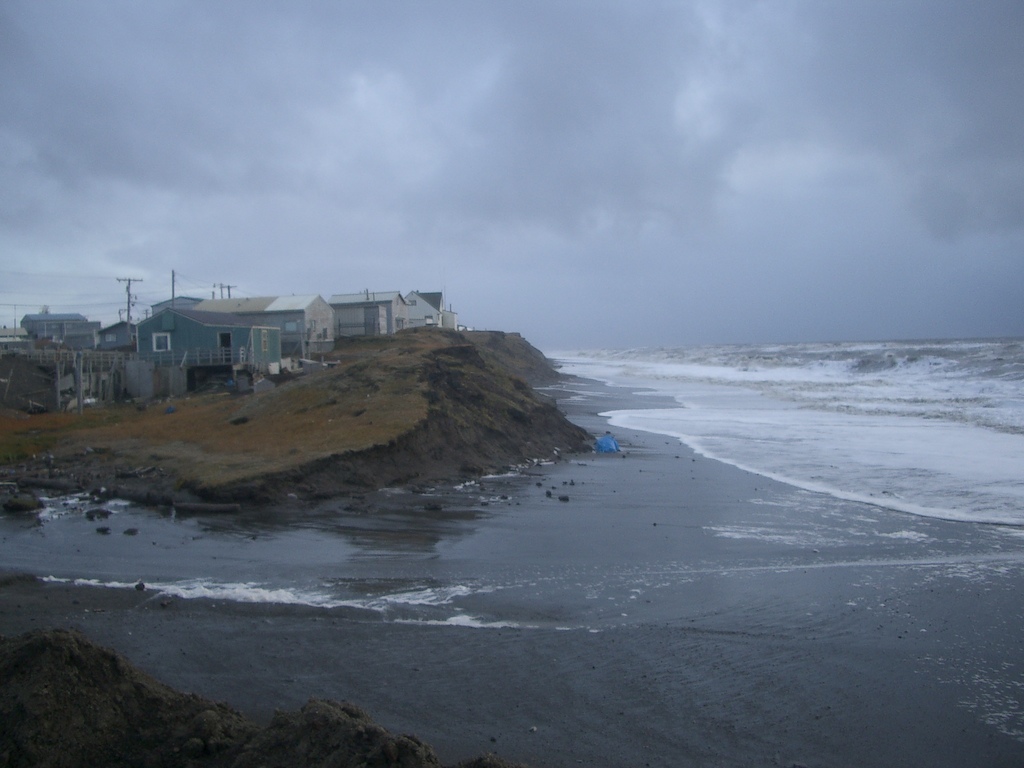
Not what I needed to hear…   Turns out it’s the first big fall storm.  With the ice so far out, that means lots of room for the wind to put energy into the water, which means big waves and a storm surge.  That means beach erosion for sure, and maybe coastal flooding.  Our weather forecasts here are a bit less accurate than those most other places, because there are no observing stations where the weather is coming from.  It’s sort of like trying to predict weather in Pennsylvania using data from nothing but a weather station in Chicago.

I don’t like fall storms and coastal erosion.  Aside from the dangers associated with flooding (the house I live in floated in 1963, and if it does it again we might wind up in a sewage lagoon), erosion is the most immediate threat to coastal archaeological sites.  I spend my summers trying to organize things so that we got well ahead of erosion at Nuvuk and now are trying to stay that way.

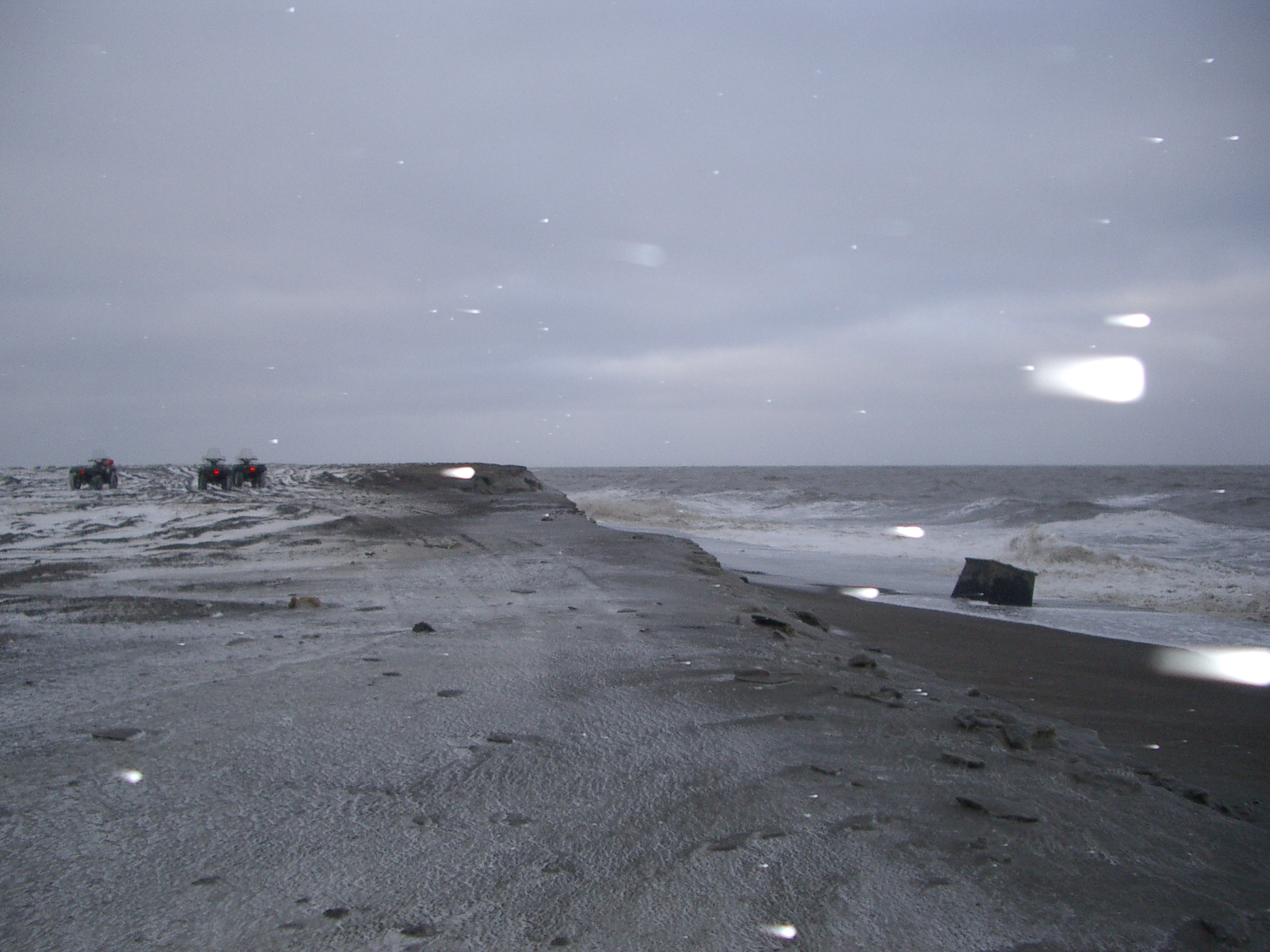
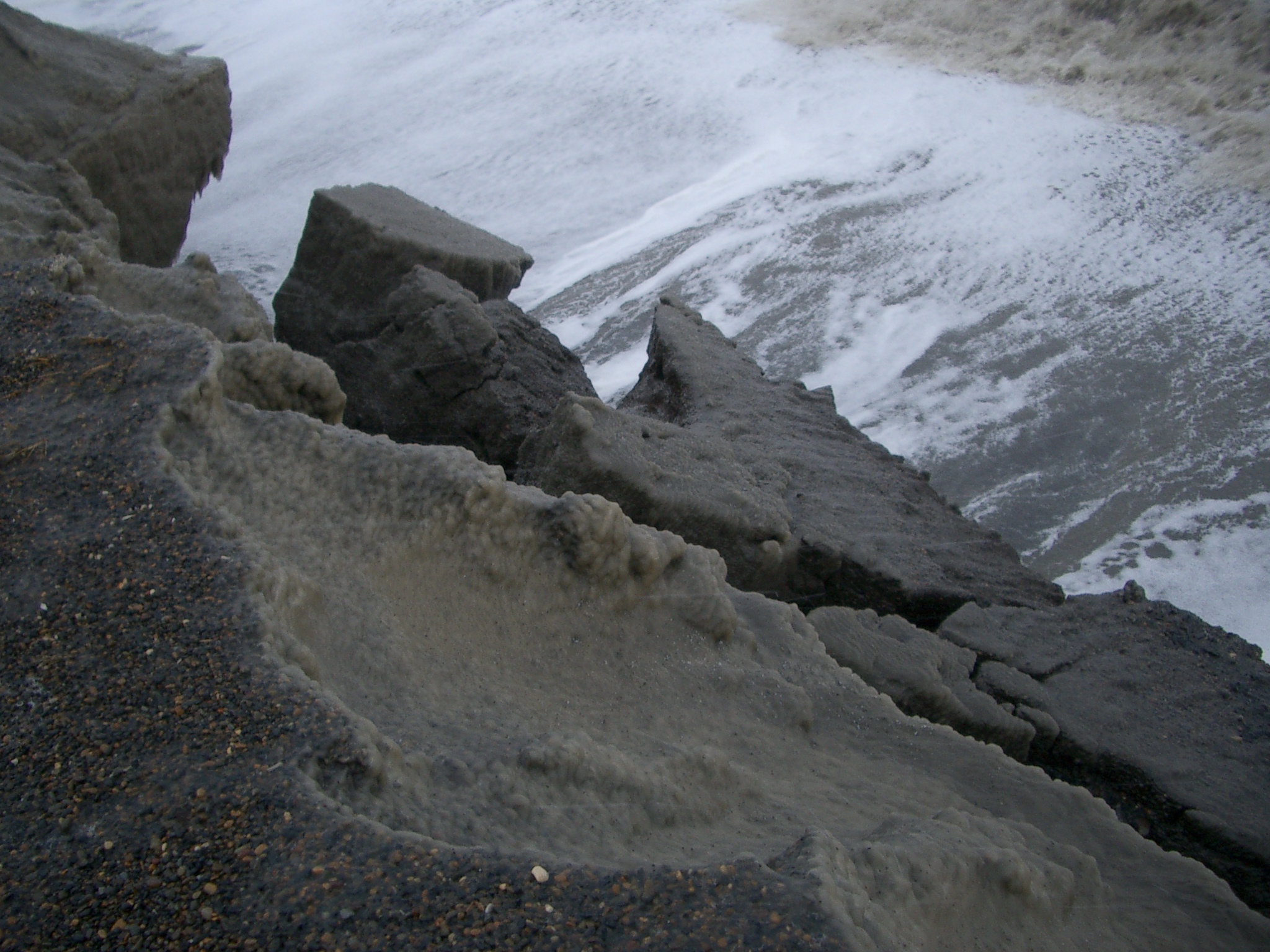
2004 fall storm erodes Nuvuk
Nuvuk bluff slumps from effects of surf

The thing is, Nuvuk, where “the houses are all gone under the sea” to borrow T.S. Elliot’s phrase, is just one of many important sites.  Utqiagvik, Nunagiak, Ipiutak, Tikigak (Point Hope), and so on down the coast.  Most of the sites on the Beaufort coast from Point Barrow east to the Mackenzie River Delta in Canada have already washed away and out of the archaeological record.

Fairbanks, finally

I finally made it to Fairbanks and to my hotel. The flight was delayed, and the rental car reservation was missing, but all worked out in the end. In the morning, I’m going to see Dave Norton, who has already gotten to work on the marine inverts, and then off to the museum at UAF.

Taking the temperature of permafrost and archaeology

Today the Saturday Schoolyard talk was about warming permafrost.  The speaker was Dr. Vladimir Romanovsky, head of the Permafrost Laboratory at the Geophysical Institute at UAF.  He gave a really good talk, explaining what permafrost is (permanently frozen ground, basically), why it matters if it melts, and how permafrost researchers go about taking its temperature (with thermistor (temperature sensor) strings down boreholes, mostly).  He then went on to show how permafrost temperatures had changed through time as the atmospheric temperature had changed.

After that, he moved to predictive modeling based on climatic models.  Using even a fairly middle-of-the-road climate model, it doesn’t look too good for permafrost in Alaska by the end of the century.  He also showed active layer (the soil layer at the top that freezes and thaws every year) modeling done on a similar basis some years ago, and pointed out that over the 10 years since the model was run it had been spot on in its predictions.  The active layer is clearly going to be a lot deeper if the predictions hold.

This is not good news for Arctic archaeology.  Compared to most of the rest of the world, where archaeologists are left to puzzle out what people were doing from a few stone tools, waste flakes and potsherds, we get really good organic preservation here, which makes it possible to look at questions that can’t be addressed elsewhere for lack of relevant data.  The reason the preservation is so good is in large part permafrost, and permanently frozen sites.  Last week, when Claire was here, we were getting a lot of well-preserved 1600-1700 year old marine invertebrates from the samples.  They exist because the layer was frozen for most, if not all, of that time.

I’m been thinking a lot about site destruction, and how to determine which areas are at highest risk, in order to prioritize field efforts.  Perhaps because coastal erosion is the big and immediate threat at Nuvuk (and all the other coastal sites I’ve worked at except for Ipuitak, where the immediate threat was the seawall being built to prevent coastal erosion), I’ve tended to focus on that, as well as eroding river banks for sites along rivers.  The melting of exposed ice wedges, which then leads to collapse of the overlying ground is also something I’ve been concerned about.  And these are major threats, which can tumble entire houses upside down on the beach for the waves to destroy.

Undercutting by waves caused the gravel to slump from underneath this grave at Nuvuk.
Storm-driven surf tears into the mound at Ukkuqsi in Barrow.
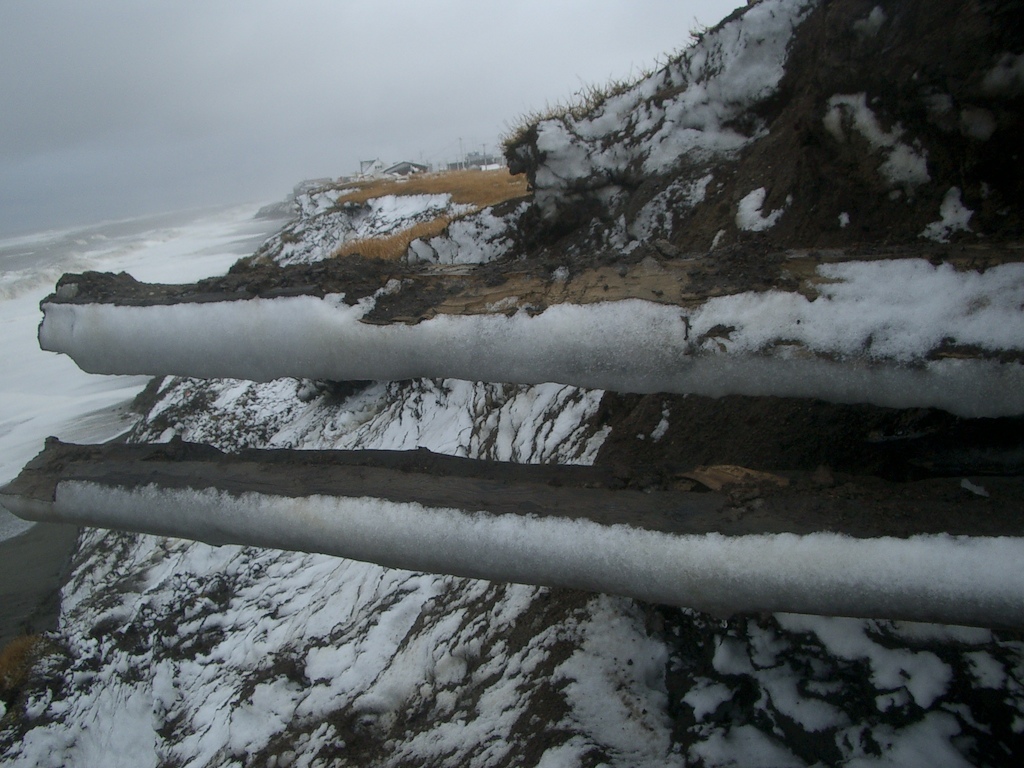
Tunnel remnants after the storm. The house was to the left, where only thin air can be seen.
Ice wedge in bluffs near Barrow. They can be much larger.
Slump block on beach at Barrow after a storm.
Slumps from thawing ground along a Colville River cut bank.
A Colville River cut bank from the air. Notice the earlier slump that has stabilized and even grown over, and the fresh cut at the bottom from the river's current.

I hadn’t thought much at all about the risks to Arctic archaeology from a significant deepening of the active layer, which will mean that artifacts and ecofacts (animal bones, insects, etc.) will freeze and thaw every year (which is hard on things to begin with, often causing rocks and bones to split) and while they are thawed, they will be decaying.  Even now, really old sites don’t have much organic preservation.  Even sites that are in no danger of eroding are threatened with the gradual invisible loss of a great deal of the information they now contain.

Obviously, if we are going to develop a “threat matrix” for Arctic archaeological sites, this has to be part of it.  I talked to Vlad a bit after the talk, and he thought he had students who could be put to work on this problem, perhaps by combining what we know about site locations in Alaska (by no means a complete listing) and the existing models for permafrost change.  He also said that one could do active layer modeling for a specific site with a year’s worth of soil and air temperatures, so that’s something we definitely need to get started on.

Just another day at the office…

…except that I got back to Barrow to discover that all keys for a crucial filing cabinet have disappeared.  I managed to find a place that sells replacements, call them and get them to agree to Express Mail them rather than FedEx them (it’s faster and cheaper to Barrow).

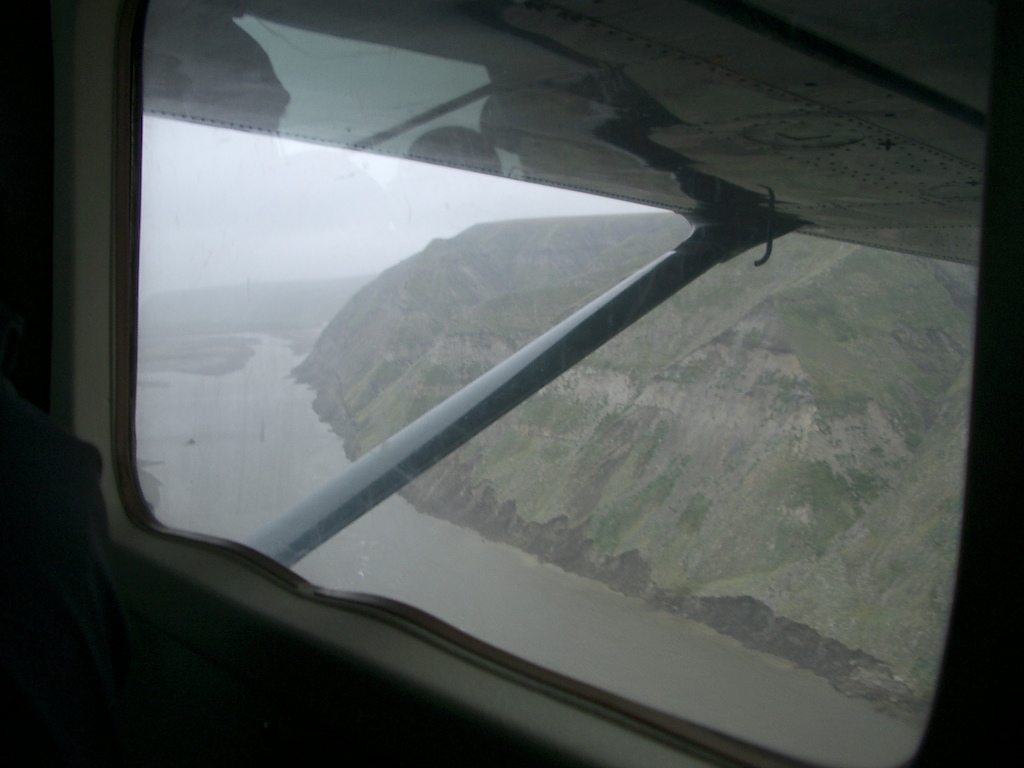
I also had to touch base with folks about yet another ice road route for the work on the Barrow Gas Fields upgrades, so it looks like I will be going flying again.

Then I had to do a quick fact check on an abstract for a poster on the Nuvuk burials for the physical anthropology meetings that I am a co-author on.  Nice to see that others are as last-minute with their abstract submissions as I can be!

Besides that, there was the usual Monday time-sheet approving, with a call to the Payroll folks because they still haven’t gotten around to giving us proxy access to input time-sheets for people who are away and can’t do it themselves.  Well, my temp admin assistant has it because she was temping in Payroll, but she’s the one who’s out and can’t do it herself….

And all three of the sewage hauling trucks in Barrow are broken.  This matters to me because I live at NARL and we do not have piped water and sewage.  The water comes to the house in a truck, which pumps it into a tank.  Then we use water, and the sewage goes into a holding tank.  Another truck comes and takes it away to the sewage treatment plant.  That truck is broken.  We’re lucky in that our kitchen gray water doesn’t go into the holding tank.  We don’t actually know where it goes (under the house?  into the NARL gravel pad?  into the NARL sewage lagoon?) so we can still wash dishes & hands with no problems.  No showers, though, so we can try to postpone the honey bucket use until a truck  gets fixed.  Crossing my fingers.

In praise of second opinions

I’m in Anchorage at the moment. The unfortunate reason for the trip is to attend the memorial service for an old friend, Stefanie Ludwig. She passed away far too young from multiple myeloma, which sadly was misdiagnosed until it was too late. Get a second opinion, people, if the treatment for the original one isn’t doing any good. Doctors aren’t perfect. Just ask my mom, the retired pathologist.

Stef was a great person. She was the review archaeologist for the Alaska State Historic Preservation Officer (SHPO) for many years, and did that difficult job in a sensible and efficient fashion, with little recognition, probably because she made it seem easier than it was. I’ve worked in a number of states, and interacted with a number of Stef’s counterparts, and she was the best. I don’t say that just because we were friends, either. I really don’t think some of my colleagues with limited experience Outside (of Alaska) appreciate how lucky we were to have her.

Stef and I met when I was a crew chief on the Susitna Hydro Project archaeological surveys. My crew consisted of Stef and a fellow named Chuck. Chuck was a very hard worker, and could dig Tets pits to our one. This may have been because he was working off some anger. We were in a remote camp, and most of us were having our pay direct deposited. So was Chuck. A couple weeks in, he received a letter from his wife informing him that she was divorcing him. He discovered that she was cleaning out the bank accounts, and it took the university bureaucracy some time to stop the direct deposit, so for several weeks the poor guy was working for money he’d never see. He (understandably) was a bit morose and misogynistic in our lunch conversations for a while. He carried the gun for our crew (a personal sidearm) and occasionally when he’d go off into the bushes after being particularly down, we’d wind up worrying if he didn’t return in a reasonable amount of time. Fortunately we never heard a gunshot.

Stef leaves behind her husband, Owen Mason, also a good friend and the geomorphologist on the Nuvuk project, as well as many family members and friends. She’ll be sorely missed, both personally and professionally.

Lunch with a conservator

I had lunch today with Monica Shah. She is one of two conservators (people with specialized training in the preservation of delicate and fragile items, like artifacts) in Alaska. She’s also a fellow Bryn Mawr alumna. Monica has been assisting and advising on the conservation of the wooden artifacts from the Ipiutak feature at Nuvuk, including the only two full-sized Ipiutak sled runners ever recovered. When we started, she was a free-lancer. She went to work for the Anchorage Museum, and they’ve been kind enough to let her continue working on the sled runners.

We went to a new restaurant on 4th Ave., called South. It has good sandwiches and generally HUGE portions. I can recommend the salmon salad, and Monica said the egg salad was tasty if rather sloppy. They have outside tables, but are a bit hampered by a tour company which picks up busloads of tourists right in front of them. Most of the tables were taken up by waiting tourists, most of whom weren’t buying anything. I hope they don’t get run out of business.

The Nuvuk artifacts are getting to the point in treatment where they need to come out of the PEG baths they’ve been in and get looked at by a professional. We figured out that Monica should be able to squeeze in a visit to Barrow in February. With any luck, we may be able to get good pictures of the sled runners in a few more months!