Further adventures

I have been majorly busy since the last post.  I had two days to get a RAPID proposal in to NSF for funds to salvage the remaining portion of the Ipiutak structure.

The Ipiutak structure excavation and the sea

I was scheduled to go to Cape Espenberg to take part in a project there under the direction of John Hoffecker of INSTAAR, and had to get on a plane on July 28.   I wasn’t due back in Barrow until August 13th, and NSF had to process all grants before then, so if the proposal didn’t get in then, they wouldn’t be able to get the money out if it was successful.  Since the house could go in a storm, I spent 2 days writing & submitting the proposal, threw my stuff in a dry bag & my day pack and left for Cape Espenberg.

I had a great time there, with interesting archaeology, which will be a post for another day.  From Cape Espenberg, I flew to Kotzebue and then on to Point Hope for the North Slope Borough Elders/Youth Conference.  It was a great conference, and I had a great time, despite finding out that the workshop I thought I was giving was actually a talk to the entire conference (which I had no PowerPoint for).  Another post for another day.  While there, I found out that the RAPID was successful.

I got back to Barrow after some weather and plane repair delays, to find that the surveyors who I was supposed to work with had done their thing and left town.  I’ve been extracting info from them and trying to get that survey set up, since the report needs to get done, the helicopter needs to head south & I have a 4-day  trip to New York State scheduled on the 25th.  Meanwhile, it turns out that most if not all of the heavy equipment in Barrow is either committed to a job or broken, so we’re having trouble getting a bulldozer to move the 100 yards of gravel piled on top of the rest of the Ipiutak structure.

If that’s not enough, a human skull was found in Wainwright by surveyors (actually the same surveyors) who were doing preliminary work for a possible road project.  The client decided that it would be a good idea to get an archaeologist to come down and see if the skull was an isolated find or if there might be more, and give them suggestions for how to proceed with the road design, as well as make sure the proper reports and documentation were done.  I leave for Wainwright tomorrow afternoon, and hope to be back Friday night, weather permitting.

On top of that, there’s a teleconference & a meeting in the morning.  I just finished an interview with Pat Yack of Alaska Public Radio Network (APRN), who won a ticket to anywhere ERA flies and used it to come to Barrow.   It was quite enjoyable, since he’d done some homework, and asked intelligent questions.  Turns out he’s next-door neighbors with Max Brewer, the long-time NARL science director who lived in the house we now live in.  Small world.
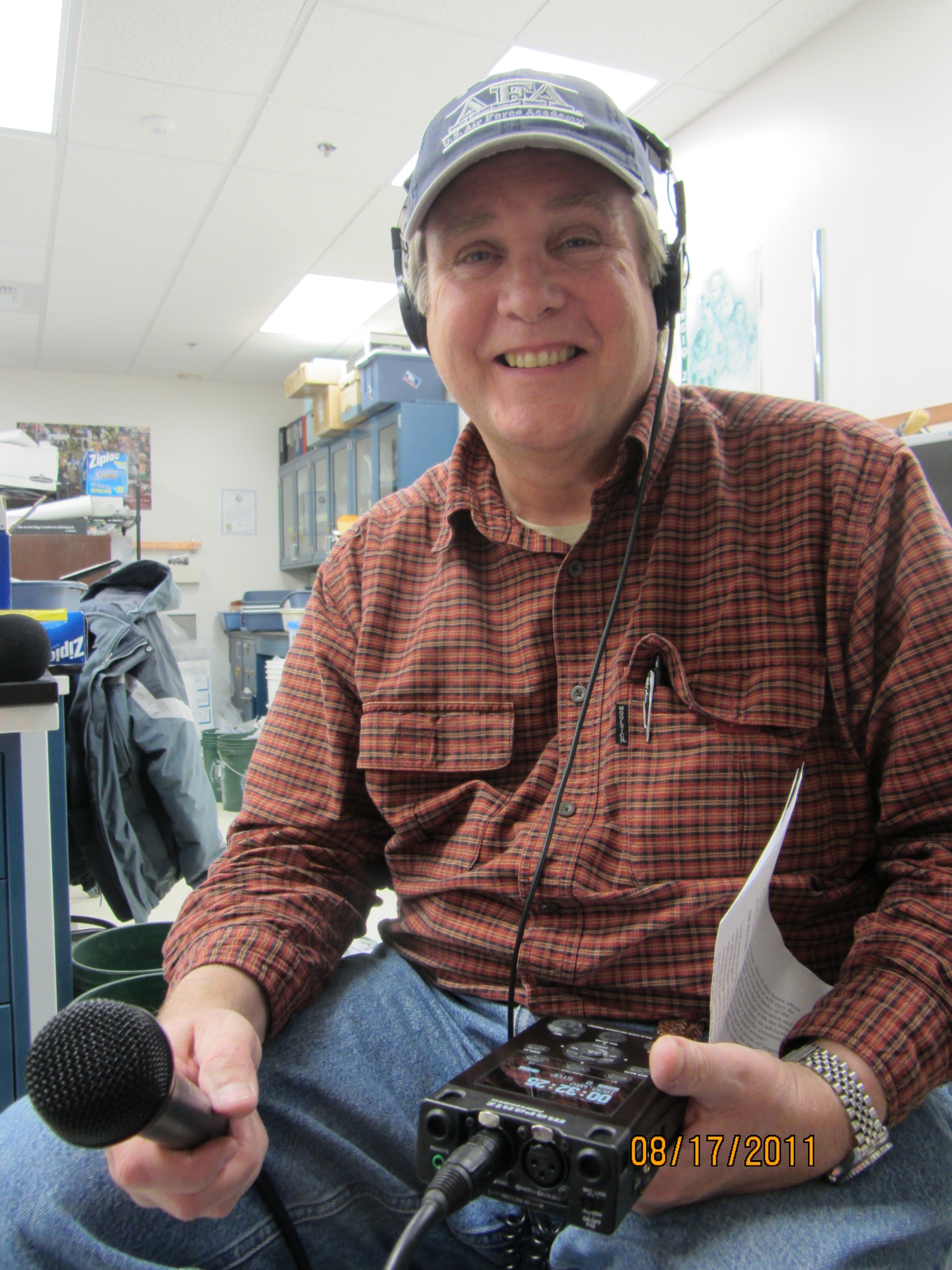
Pat Yack, APRN, at work in the Nuvuk lab

Sometimes science produces unexpected results…

Much of today went trying to find freezer space for the person in the parka.  We were able to get X-rays done by the North Slope Borough vet clinic (they needed a bit of practice with a new machine anyway), and there are skeletal elements in the parka.  I talked to a conservator and it seems possible that the garments might be able to be preserved if the community chooses. We need to have a discussion with the Elders about that.

At least we need to document them really well, as they are being removed so the person can be examined and reburied.  To do that we need not only a good videographer, but also a group of experience skin sewers, since the sinew has decayed, and it may only be possible to figure out what stitch was use by skilled sewers looking at the ghosts they left.  We need to get the funds for that work, which probably won’t be available until October or so.  That means that we need a freezer to keep the person in a stable environment until the examination can happen.

CPS/UMIAQ couldn’t really offer anything right now, except to note that it hadn’t been requested in the program plan last year (sadly, I’m not clairvoyant–if I were, we could skip all the pesky shovel testing).  Fortunately, North Slope Borough Wildlife Management also has a freezer, and they were kind enough to step up and help out in this urgent situation.  Many thanks to DWM!  One UMIAQ fellow later thought of a freezer that might be a possible fallback, although it’s got stuff in it at the moment.

Next step, grant applications for that work and for the Ipiutak structure that remains at the bluff in the DWF, waiting for the next big storm to take it out.

The tale of an osteometric board

I recently contributed a post about a field-made osteometric board to ThenDig, a blog about archaeology which has been doing a theme month on tools and archaeology.  There are a number of interesting posts over there, and it’s worth checking out.

Best day yet

We had a really great finish to the official field season.  We excavated a last burial which turned out to be that of a very muscular person, who seems to have been buried in or on bird skin (maybe a bird parka).  A possible burial (a human bone showed up in a test pit) turned out to be an isolated find, so we don’t have an unexcavated burial undone.  There was a complete egg in the dark organic soil by the bone, which looks like something a fox might do to hide a stolen egg, so maybe the fox brought the bone there from somewhere else.  The DWF continued to have a number of interesting artifacts (nice lithics, ground slate, composite labret). I’ll try to get pictures up in the next few days.

We were able to backfill all the big holes, record all surface finds, cover the DWF in hopes of being able to come back later this year, and still get the students home at a reasonable hour.

Some of us are going out again in the morning with an NSF-funded Mexican/North Slope student exchange group of about 25 or so.  We’ve worked with them before, but not after the season ends, so it’s a bit challenging to find something to teach them that doesn’t risk disturbing something we haven’t got the time or crew to deal with.

I only got 4 hours of sleep last night, so off to bed.

What a day!

The weather was not pleasant.  It rained all day, and was pretty cold.  My fingers are swollen up like sausages.  The rain also took out the track pad on the computer for the transit, so we couldn’t back up the files in the field.  We were able to use a mouse in the lab, and got the files backed up and transferred to the other laptop, so if the track pad doesn’t perk up, we’re OK.  My Nikon Coolpix S9100, which I just got last night to replace one that failed after a week, died the same way today.  Nikon won’t issue a refund for 15 days, which is truly ridiculous under the circumstances.  I’ve been committed to Nikon, loved all the SLRs I’ve had (FM, 4 FEs, 4 N70s, D200) and liked everything about this camera, too, except it won’t work.  Epic fail.  So don’t buy one!

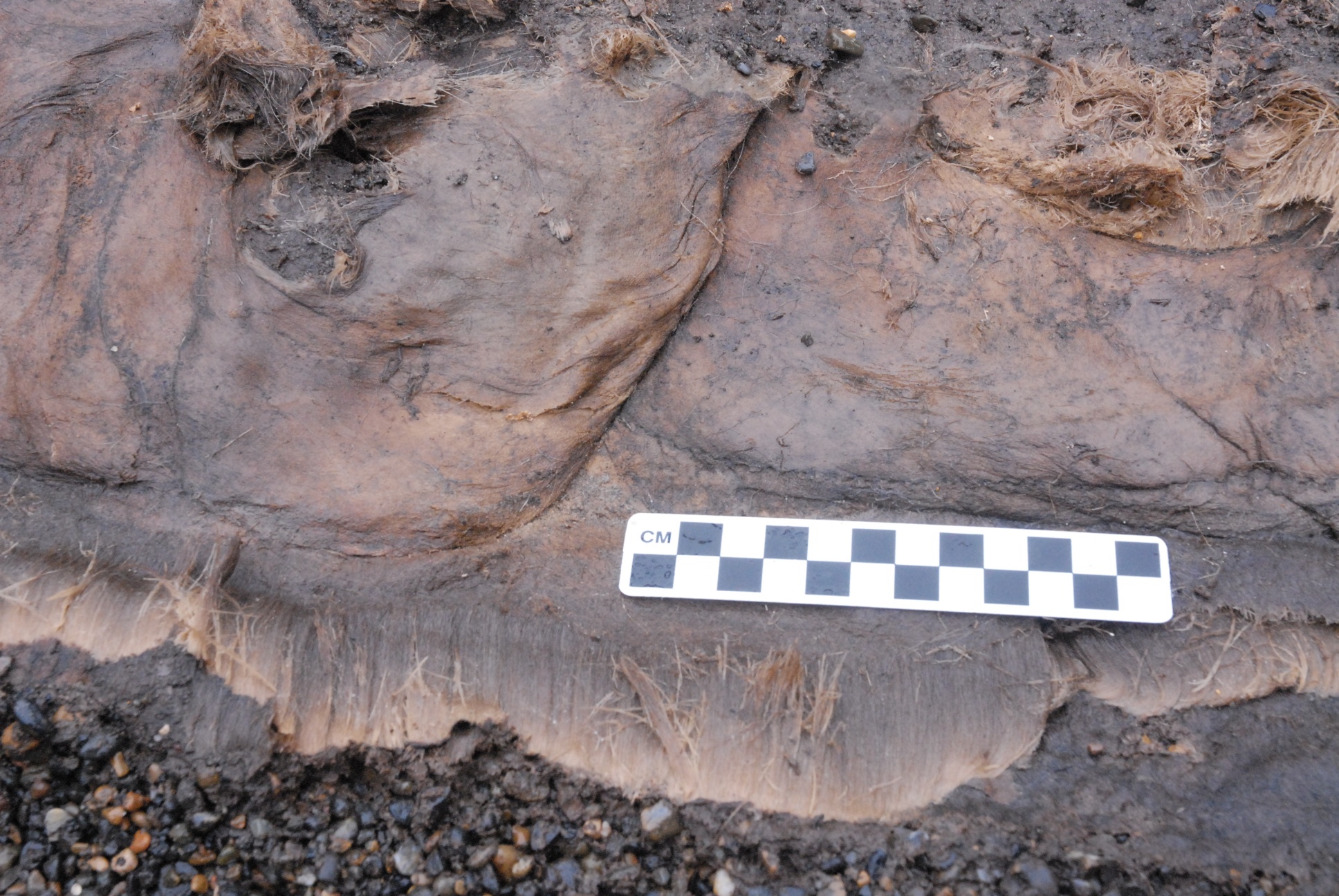
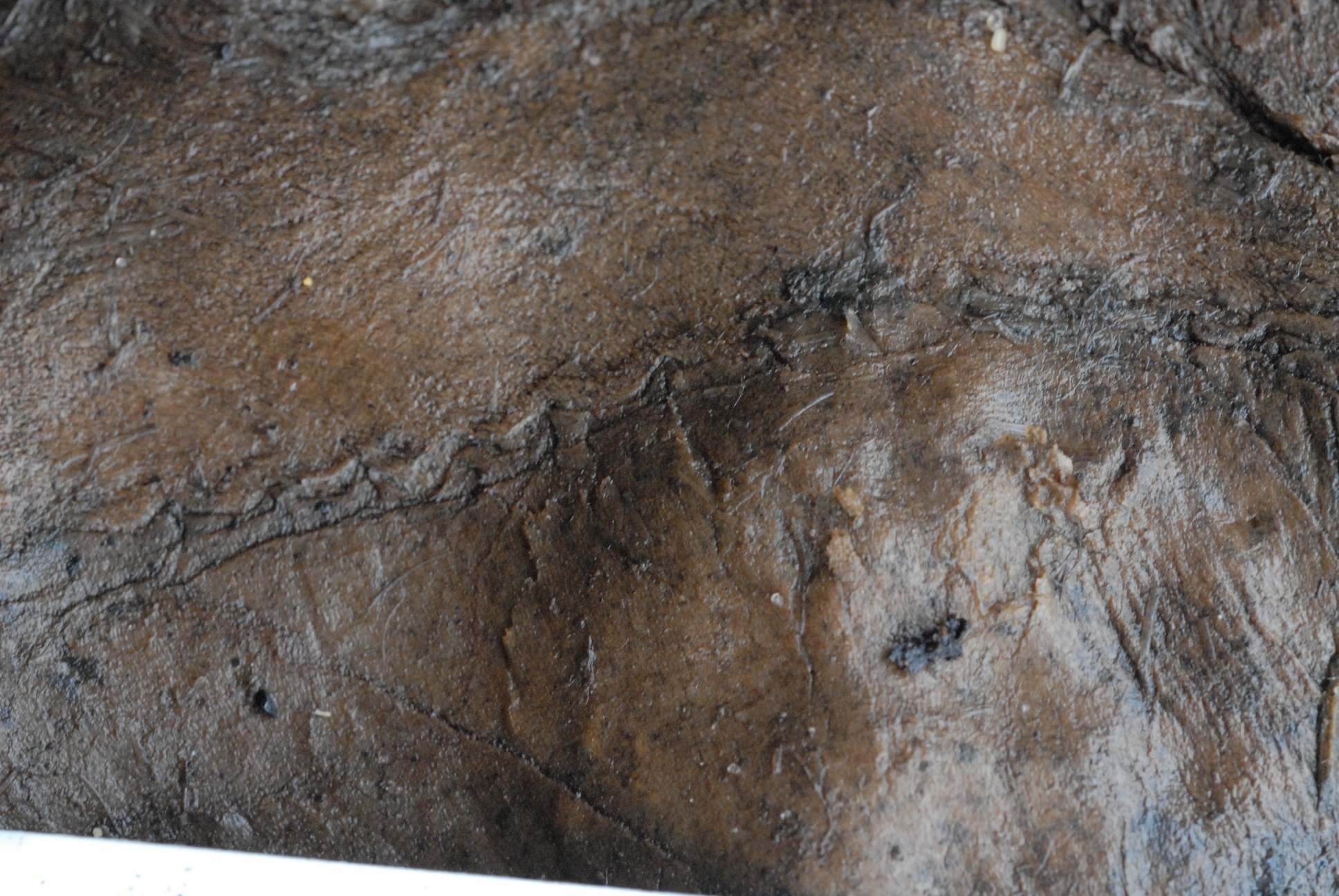
On the plus side, the very deep burial turned out to be a person wearing a fur parka and wrapped in hide!  You can even see traces of the stitching.  We aren’t sure how well-preserved the person is (we found a few finger bones and a nail inside the cuff).  We decided to take it out en bloc (complete) and take it back to the lab to excavate in controlled conditions so we can document the garment better, since it is very fragile.  We had some plywood brought out and managed to slide it through the gravel under the entire burial and lift the whole thing.  This required the digging of a very large hole, which we’ll now need to backfill.  Many thanks to Brower Frantz and his crew for bringing out the plywood and transporting the individual back to the lab while we kept on in the field.

Right arm and side of the fur parka, lying on a hide.
Close-up of stitching on parka

The DWF keeps yielding more artifacts, some of which are quite nice.  We’re trying to get to a reasonable stopping point and figure out a way to protect the exposed feature in case we can get funds to work on it in September.

Artifacts from DWF.

Things get a bit exciting…

As is traditional at the end of a field season, things started getting a bit exciting.  The possible burial we found in STPs yesterday proved to be the real thing this morning, and the feature we worked on on Monday also turned out to be a burial. It is the deepest burial I’ve seen at Nuvuk in the fifteen years I’ve worked there.  It appears to contain two children, covered in fur.  We hope to finish it tomorrow.

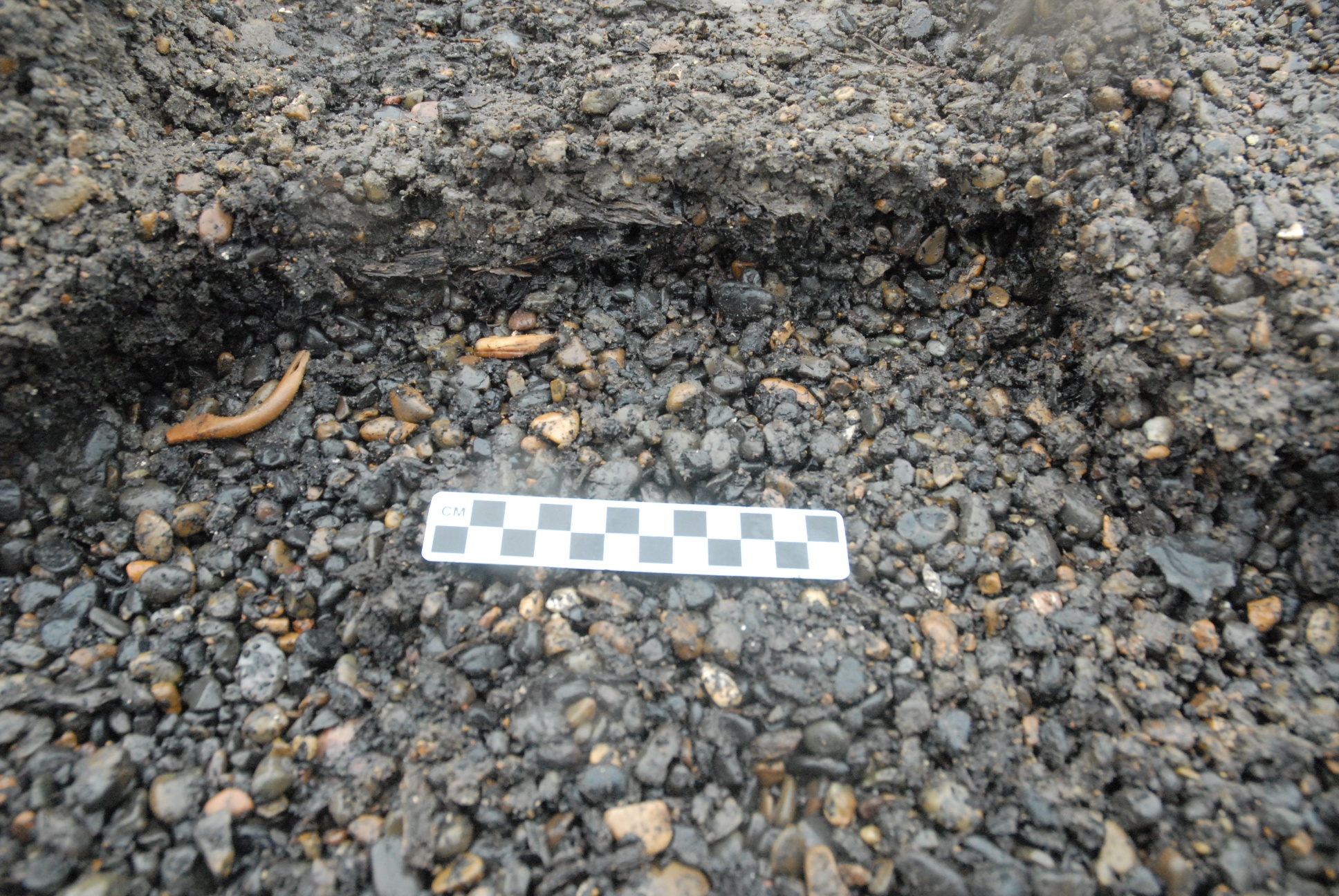
I had hoped to be done with the DWF today, but fish bones kept coming, along with an arrowpoint, a worked walrus humerus, some worked bird bone, what look like a broken needle, and more lithics.  Recording all that with the transit took time.  We still had the windbreak up, but there wasn’t much wind, and since it was the second warm day in a row, the mosquitos were swarming.  Thank goodness I always have bug dope in my pack, or I don’t think much would have gotten done.

In other good new, the replacement for the Nikon Coolpix S9100 which I had for a week before it stopped working arrived, so I will have a pocket camera for snapshots.  More pictures for here without lugging the D200 home to download the card every night.


Plenty of fish

Excavation of the hearth & surroundings continued.  When we first found fish bones we were pretty excited.   We just keep finding more in and near the hearth and I must admit the thrill is rapidly fading 🙂 . We’re finding some other bone too, not all of which has been burnt past the point of recognition.

The egg was successfully extracted and packaged, and has made it back to the lab, I hope more or less intact.  We shall see when we start processing things.  If we can’t figure out what it was, Dennis said they’ll take a crack at IDing it through DNA.

Two neat finds

We started investigating the last GPR hit and came down on a jumble of wood.  The excavators were not optimistic, but I kept pushing to go a little further.  Eventually, this appeared:

Feature detected with GPR

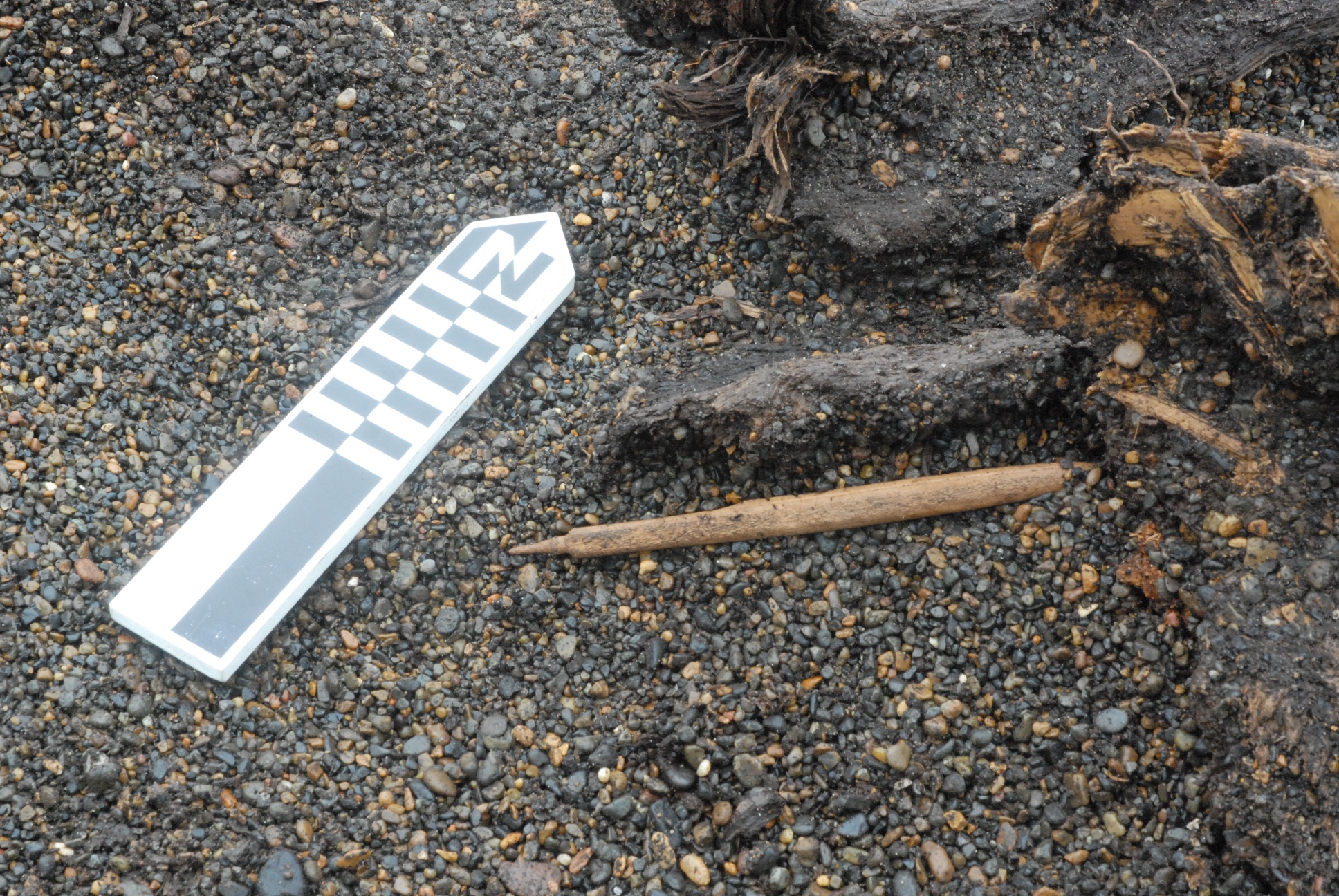
The feature (I’m not calling it a burial until there is evidence of human remains) was jumbled because at some time after it was constructed, someone dug a hole in the middle of it.  And right beside where the hole had punched into the feature was this:

Antler arrowpoint

The hole just missed it.

The DWF (Ipiutak) levels had their own surprises.  We found a good bit of fish bone, some lithics (nothing diagnostic) and a lot of broken bone, but the really cool thing, which I found on the edge of the hearth, was a flattened but apparently complete egg!

The remains of the egg

Looks like it’s a hearth

We were a small crew today since the high school students weren’t working, so we concentrated on the Ipiutak area. It was fairly tricky to excavate, since there is unconsolidated gravel under the Wood/sand/gravel layer that covers the Ipiutak surface, and a large pile of unconsolidated gravel uphill from the features.  Plus the hearth ash is covered with a mushy skin of peat, and both the hearth surface and the peat undulate.  Despite that, we recovered 2 fin rays, some burnt bone, a pot-lidded flake (probably rhyolite), a grey chert flake, and a black biface fragment from the hearth.  We also got some large ungulate (species in dispute at the moment–probably caribou) bone, and a small fragment of decorated ivory, plus several interesting pieces of wood, which appear to be worked.

It was quite cold.  Even though we had a windbreak, the levels are just thawing, and the ground is cold and wet.  My hands are still stiff, so more will have to wait until tomorrow.