Vienna & CHAGS

From Glasgow, we went on to Vienna and CHAGS (the Conference on Hunting and Gathering Societies), by way of Düsseldorf.  The Düsseldorf airport is not high on my list of airports in Europe.

In Vienna, we stayed in Hotel-Pension Bleckmann, a nice family-run hotel near the University, where all the conference sessions were being held.  The hotel had great breakfasts, and the staff was really nice and very helpful.  They recommended a restaurant that had great food and a local clientele, so it was more reasonable than the more touristy places.

Glenn having dinner at D'Landsknect, Porzellengasse.
Glenn having dinner at D’Landsknect, Porzellengasse.

The conference was very interesting.  Both Glenn & I were giving papers in a session on Aboriginal Whaling in the 21st Century.  I talked about the archaeological evidence for whaling in Alaska, and Glenn talked about the late pre-contact/protohistoric whaling-centric system in North Alaska.  There were a number of other northern papers in the session, including papers on Central and Eastern Canadian whaling archaeology from Jim Savelle and Peter Whitridge, as well as papers on whaling in places like Korea & Bequia.  There were 51 other sessions, all having to do with hunting and gathering groups.  Of course there were a lot of northern papers, but some of the other papers were very interesting as well.  The organizing committee and the students really made an effort to have a green conference, including the food and drinks served at breaks, and all in all it was quite fun.

We ran into a couple of hooded crows in one of the courtyards on campus.  Oddly, we’d seen one at the University of Glasgow as well.

Hooded crow.
Hooded crows.

The campus has all sort of restaurants and beer gardens more or less on or next to it.  It was very convenient after sessions.  Several times we wound up at Steigel-Ambulanz.  This was a restaurant/beer garden right across a walkway from the area where the sessions were concentrated.  It featured seriously large portions, but the food was very good.  We also had a dinner at Universitätsbräuhaus, which was more or less across the quad.


Seriously large (and very carefully arranged) caprese salad).
Claire Alix about to enjoy that salad.

The conference banquet was held in a banquet hall in the Wiener Rathauskeller.   That literally means the cellar of the city hall, and that’s exactly where it is, in the basement of Vienna City Hall.  It is set up for  banquets (and also as a restaurant).  The food was great, and Richard Lee (of Man the Hunter fame) was honored for his contributions.  He was just back from something like his 50th field season!

Conference banquet in Wiener Rathauskeller.

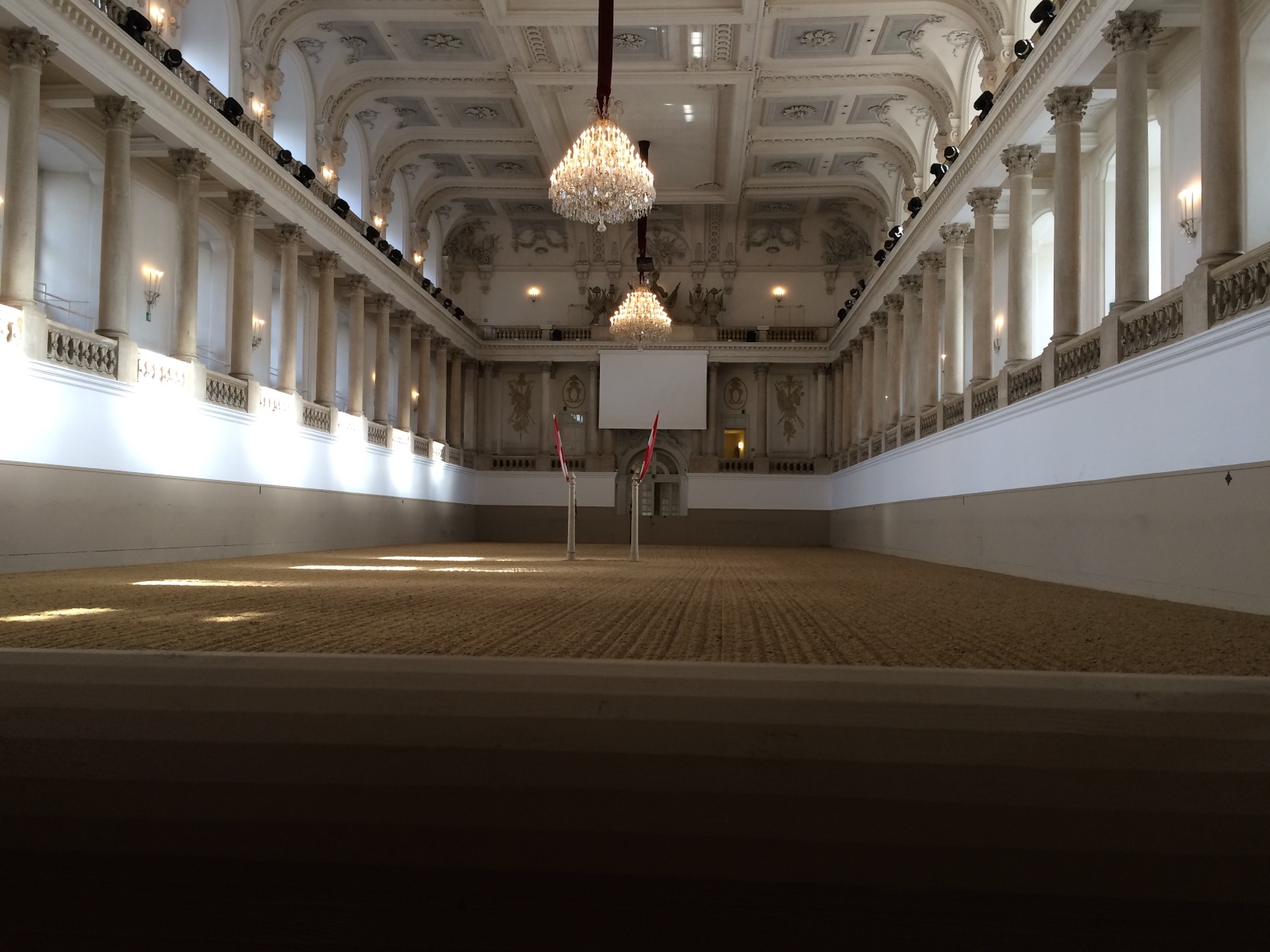
Vienna had more places that only took cash than do most cities these days.  We wound up having to wake quite a way to find a bank that exchanged money, since we needed more Euros than we had exchanged in the first place.  On the way, we stopped by the Spanish Riding School (home of the Lipizzaner stallions), and booked a stable tour for the next afternoon, when there weren’t any sessions we simply needed to hear.  The building the Riding School is in had a stratified archaeological site under the plaza in front of it, and portions had been preserved with a wall around it.

Archaeological site in Michaelerplatz. There are portions of a Roman road, Roman fortifications, and even 18th century apartments and drains exposed.
Archaeological site in Michaelerplatz.  There are portions of a Roman road, Roman fortifications, and even 18th century apartments and drains exposed.  The entrance to the Winter Riding School is in the background.

The next day we went for the stable tour.  It was pretty interesting, and the stables were very nice, although we weren’t allowed to take pictures in the actual stables.  Much like the Royal Stables in Denmark, the horses were all in box stalls, but you could see they had been converted from tie stalls at some point in the past.

Entrance to the Hofburg from Michaelerplatz. The Riding School is on the left of the main archway.
Largest walker in the world.
Saddles in the tack room at the Winter Riding School.
Saddles in the tack room at the Spanish Riding School.
The Winter Riding School.


Chandelier at the Winter Riding School.

Believe it or not, when it was built, the Winter Riding School hall was considered very simple in design, the better to show off the horses!

We walked back to our hotel through the Hofburg grounds.  Being in Vienna really brings home that until pretty recently, it was the seat of a major empire.
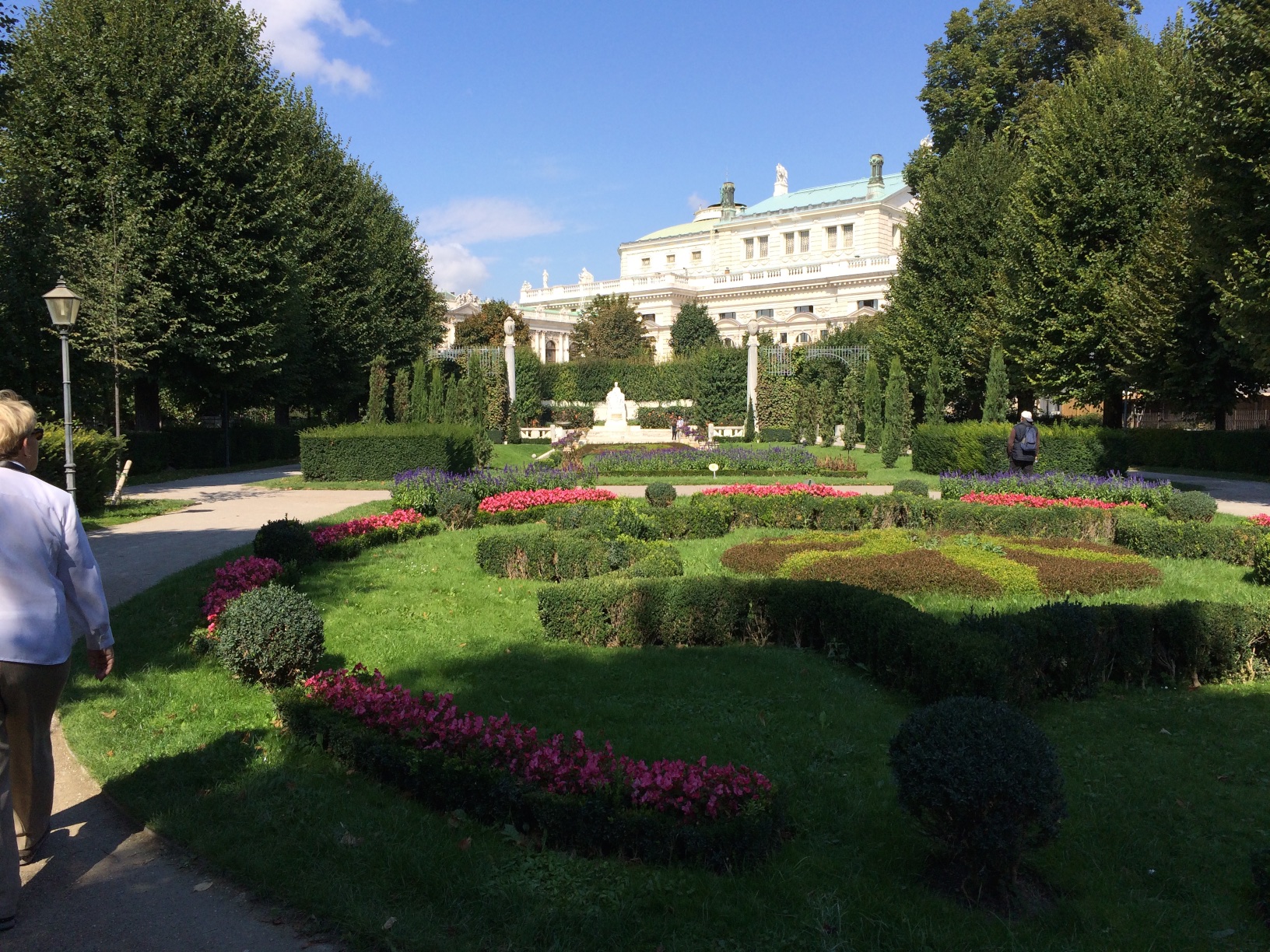
Gardens in Vienna.
Gardens in Vienna.
Display rose garden. It seemed to have one bush of each variety of rose, clearly labeled.


Another garden.
Another garden.

I couldn’t resist adding this.  The German for ice cream is “eis” and this is an ice cream shop.

An ice cream shop in Vienna.

DNA results from the North Slope published!

When we first started archaeological work at Nuvuk, it took a while to find a physical anthropologist who was willing to work with the human remains here in Barrow.  Dennis O’ Rourke and his team were willing to do that.  Dennis came up to Barrow to speak to the community and the Elders to get their permission.  His lab works with genetic studies as well as skeletal material, and he asked if they would be interested in allowing ancient DNA studies on the remains from Nuvuk.  The Elders were not only interested in those studies, they suggested that the group undertake a program of modern DNA studies across the North Slope as well.   They developed a proposal to do just that, and once it was funded, research got underway, with resident of all seven North Slope communities contributing samples.

The analysis took a while.  The team traveled to all the villages to collect the data and returned to present the results to North Slope residents before they were published.  Finally, the first paper based on the project is published!  It is based on looking at mitochondrial DNA, which is inherited only from your mother.  It is present in many more copies than the more familiar (to most people) nuclear DNA, and therefore is often studied in archaeological situations, since all the extra copies make it more likely that some of it will survive.

The short version is that the modern DNA results support the North Slope as the source for the populations that migrated to the eastern Arctic, both the Neoeskimo (ancestors of today’s Inuit/Inupiat people) and the earlier Paleoeskimo.  This fits well with the picture from the archaeological data.

Jennifer Raff is senior author, with Margarita RzhetskayaJustin Tackney and Geoff Hayes as co-authors.

This paper has gotten picked up by a number of science news sources.


Edit:  4/30/15  Fixed a link that WP had put an ellipsis in the middle of the link.  It should work now.

A trip to the nation’s capitol

Last week I went to Washington, DC.  I went for the 18th Inuit Studies Conference.  The Inuit Studies Conference happens somewhere every two years, and this year it was hosted by the Smithsonian.  I was a co-author on a paper on aDNA from the North Slope (I provided the archaeological background), and I wanted to hear it, as well as a couple of other Arctic genetics papers.  I also wanted to get together with several folks I collaborate with who were going to be there.  Sometimes face-to-face is better than Skype between Europe & Alaska.

Because of the Smithsonian hosting, it was a bit of an odd conference.  There was no main conference hotel.  Events & sessions took place at three different venues distributed around the mall, which in many cases made it logistically impossible to catch a paper in one session and hop over to another session.  The program didn’t have times set for papers, so it was tough to know when folks were talking even if the sessions were next door to one another.  And of course there was the usual problem of all the papers on a topic being scheduled in sessions which were opposite each other!  Despite the challenges, there was a very interesting Paleoeskimo session, which I was able to go to 2/3rds of.  I had to miss the end to go over the National Museum of the American Indian (NMAI) to hear the paper on Nuvuk (given by Justin Tackney) and one on the North Slope modern genetics given by Jenny Raff.  They were in a session with papers on 1) Unangan myth and magic, 2) theriomorphic imagery in the Liangzhu culture of China and Old Bering Sea, and 3) the Sealstone (a large petroglyph which was probably from Shemya in the Aleutian Islands, although it had been removed to a garden in California and the folks who were trying to return it to its home weren’t quite sure.  It was a bit incoherent.

All this happened opposite what looked like a very interesting session on ethnology and one on education with a number of my friends from the North Slope in it.  The next day I went to a session to hear a couple of archaeology papers, which were in a session with a paper on Greenlandic theater and a paper about a novel about Greenland.

I arrived to find my registration had gotten scrambled, so that there was no banquet ticket (and they were sold out).  A 1-day registration was $100, and the full conference was $325.  Even though I was only able to stay for 2 days, I had to pay the full conference fee!  It didn’t seem quite right, but there was supposed to be a free book included.  Unfortunately, they were out of all the books that I didn’t already own, and even though they kept saying more copies would come, they never did…  Hauling an extra copy of a book back to Alaska in my carry-on didn’t seem that attractive.

While I was there, it became clear that Sandy was going to play havoc with my planned return to Alaska (by way of my Mom’s in upstate NY).  That in turn would mess up plans for a trip to Valdez for an Arctic Visiting Scholars speaking tour and Seattle for a workshop.  I had to spend some time on the phone moving the travel up a day, and changing the routing out of Albany to head Alaska by going west to Minneapolis instead of south to Atlanta.

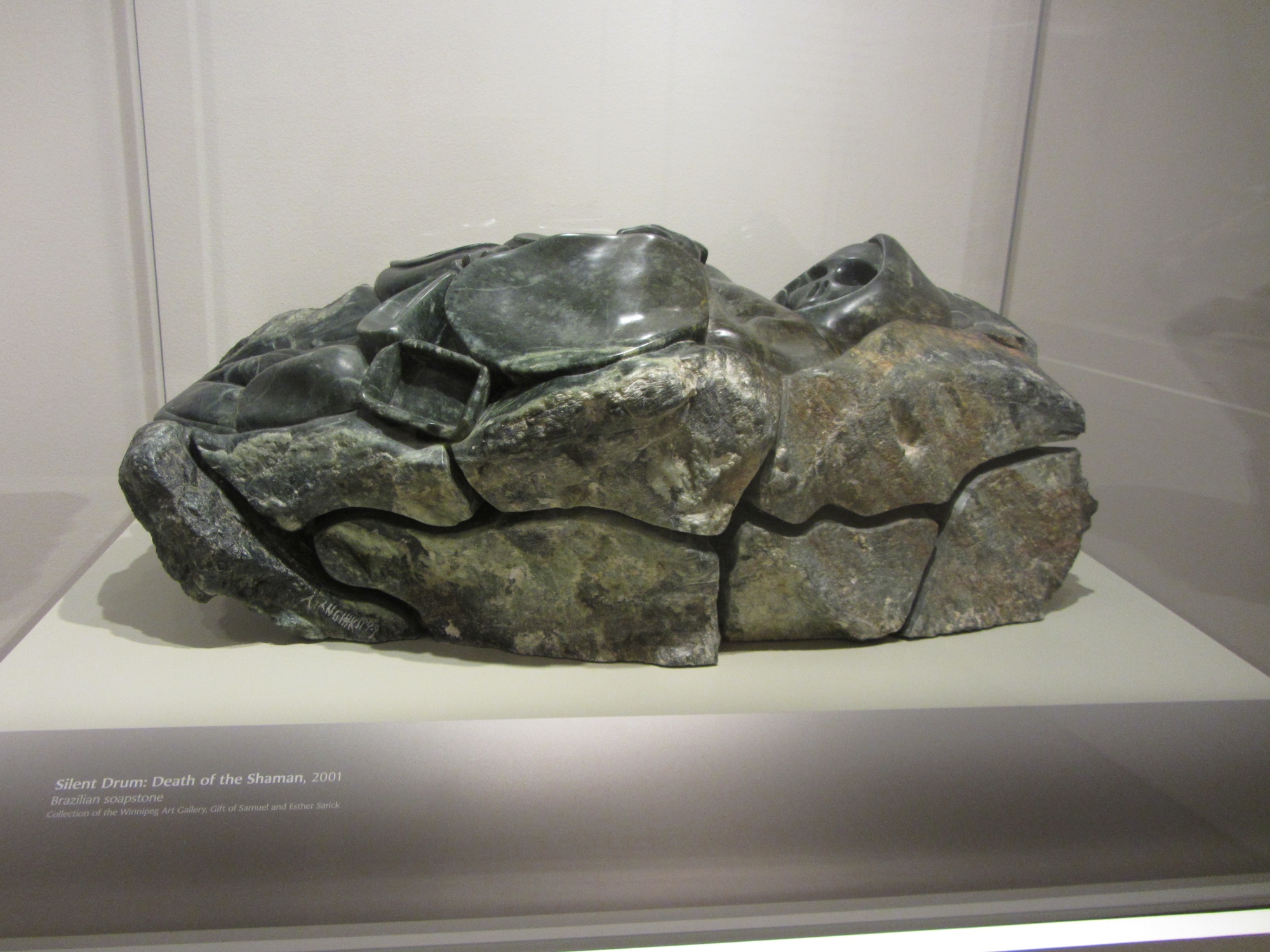
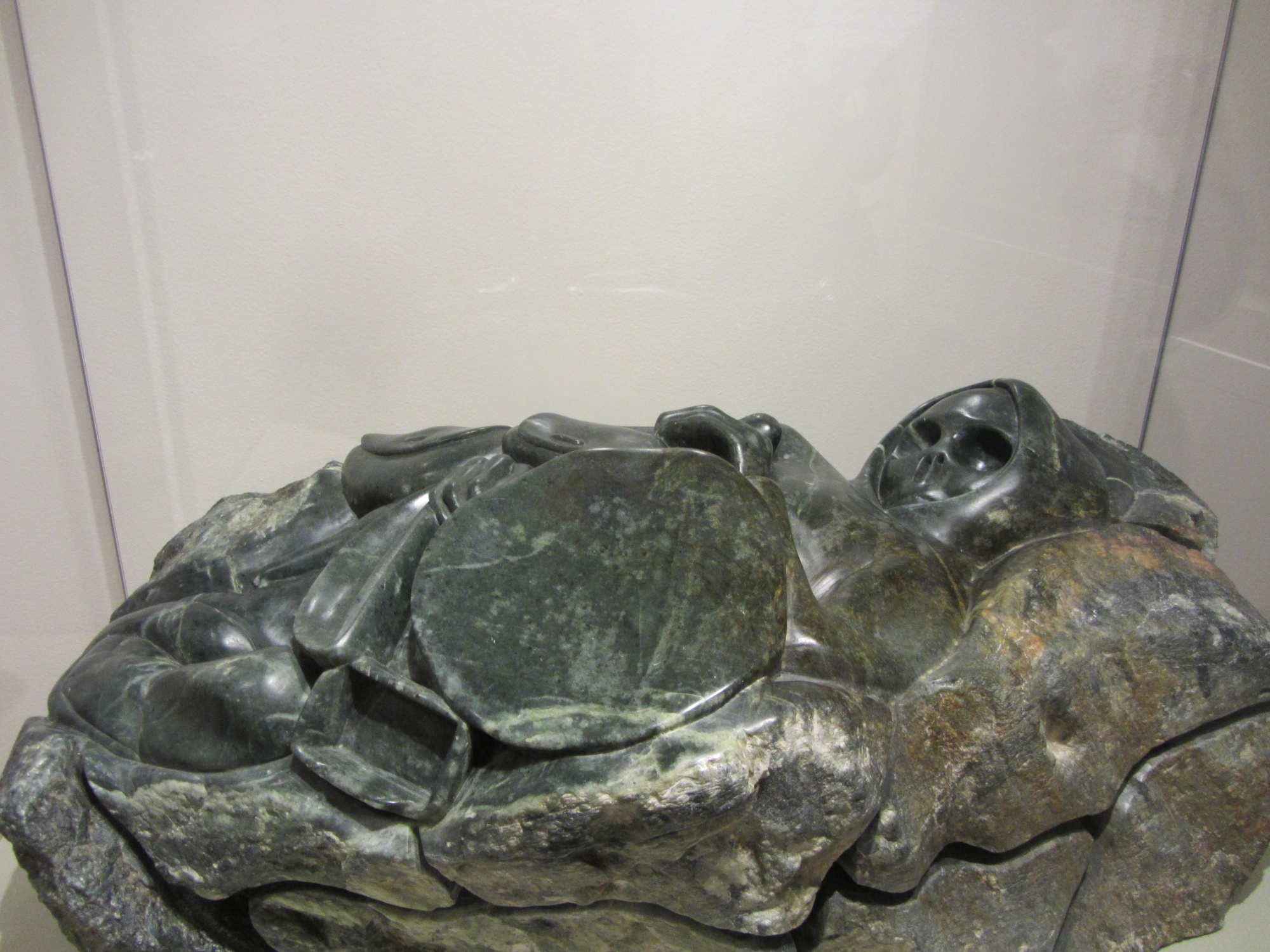
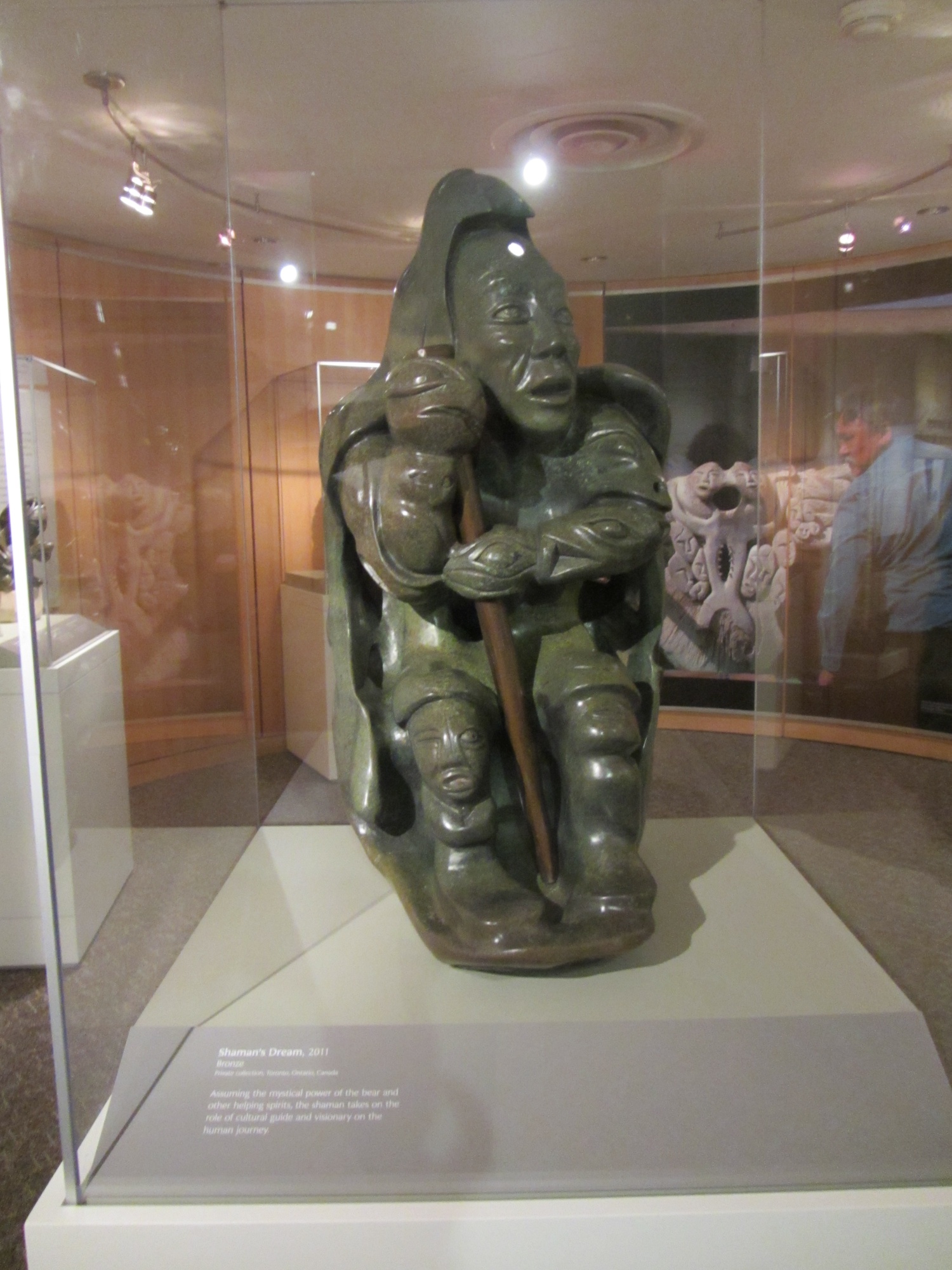
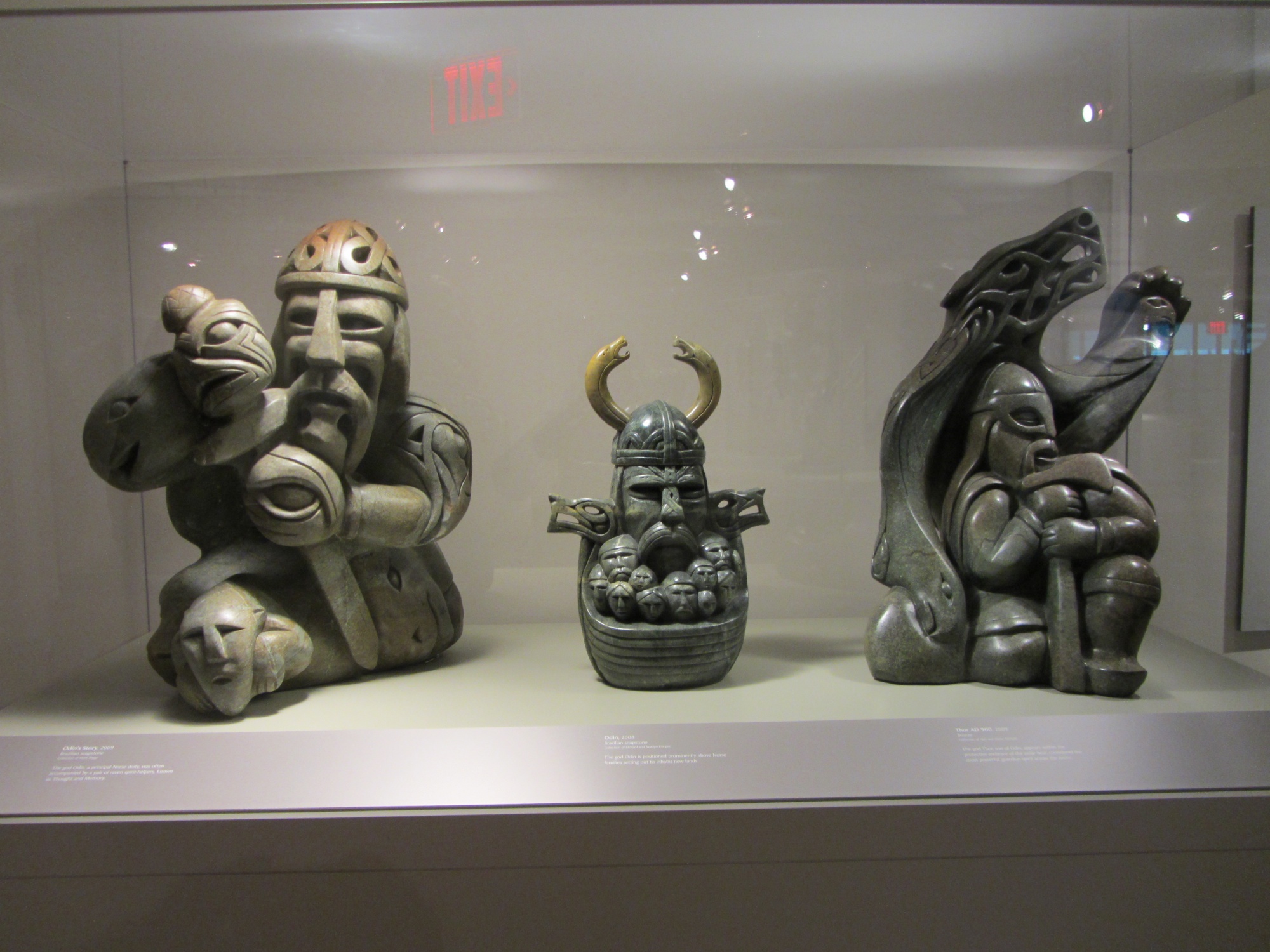
One of the pluses of the various venues was getting to see a special exhibition at NMAI of the sculpture of Abraham Anghik Reuben.  His work was using aspects of the lives of the ancient Norse and the Thule whalers.  There is a Flickr photo stream with professional pictures here, but I took some too.  My favorite of all was Silent Drum: Death of the Shaman.

This piece is so powerful.
Enhanced by Zemanta

The artist captured the way it would look in amazing fashion, given that he is working in stone, not with soft material.
This blind shaman’s eyes are astounding. You can see the cataracts (at least in person).
Odin, his ravens, & other Norse being.

BASC talk tonight with Dennis O’Rourke & Geoff Hayes–GeANS project results

Dennis O’Rourke and Geoff Hayes are scheduled to give a talk at the Iñupiat Heritage Center tonight as part of the BASC Saturday Schoolyard series.  They are giving a report to the community on the results of the GeANS (Genetics of the Alaskan North Slope) project, involving both modern and ancient (mostly from Nuvuk) DNA.  It should be really interesting.

Dennis is scheduled to arrive on the evening Alaska Airlines flight, and then head over to the IHC to start the talk at 8PM.  I think Geoff may either be here or is coming in from a village.  I  just hope the AK Airlines flight isn’t as late as the one I was on yesterday; I didn’t get here until almost 9PM.

Visits to zoological collections

I am in Seattle for the Alaska Anthropological Association meetings.  Today was spent primarily in tours of the Burke Museum’s zoological collections (in the morning) and the marine mammal collections at NMML (in the afternoon).  The Burke has pretty impressive collections, especially when you add in the off-site material, and NMML has a good range as well.  After the tours, Jeff Bradley of the Burke took me to their off-site storage to look at whale mandibles.

I’ve been trying to track down whale mandibles ever since I was sent a picture of one from Cape Krusenstern and I saw one at Cape Espenberg that didn’t look like bowheads.  I didn’t think they were grey whales either, but I’m not as familiar with their skeletons.  There are bowhead skulls in front of every school in Barrow (& my daughter attended all three), the college, the library/heritage center, the city hall and the North Slope Borough building, as well as miscellaneous other sites around town, so I know bowhead jaws when I see them.

I found a couple that looked like possible matches, or at least members of the same family, so that is progress.  The Burke has pretty restrictive photo policies (they hold a lot of art, so the policies are based on that), which means I can’t put any photos up here without permission.  It would take days  & several person-hours of work at both ends, so I’m not going to try for a blog post.

Now off to bed so I can be bright-eyed & bushy-tailed (or at least halfway coherent) for our session tomorrow.  I don’t have to give any papers until afternoon, but still…  The other organizers have papers in the morning, so I’m guessing I’ll be moderating….  We’re only winging it a little 🙂

Last Call for Papers: The Connected Arctic–An Alaska Anthropological Association symposium sponsored by the Arctic Conference

I wound up agreeing to help organize a session at the upcoming Alaska Anthropological Association meeting in Seattle.  Long story about Seattle, but we have gone to Whitehorse, YT once or twice, so leaving Alaska is not a first.

Anyway, the deadline to submit sessions (including paper lists) is this Friday, so I though I’d put a description up here, since the AnthroAlaska list seems to be a bit slow showing up (although it might be my email).  We have room for a few more papers and are being fairly expansive in our interpretation of the topic.  If you are interested, the description and directions for how to participate follow:

Although the Arctic tends to be viewed as a place apart, both in the sociocultural sense and as a research area, the first has never been true, and the second is becoming less so.  This symposium will look at the Connected Arctic from both perspectives.

Papers on any aspect of trade and/or travel (pre-or post-contact) from one or more disciplinary perspectives are welcome, as long as they involve the Arctic.  We are interested in both specific case studies and methodological works.

We also welcome in papers dealing with aspects of connected Arctic research, including virtual repositories which can be used from multiple locations, shared databases, digital teaching and outreach tools, and social media.

N.B.  People wishing to submit papers are asked submit the paper abstract directly to the meeting organizers by the deadline of February 3, using the Alaska Anthropological Association meeting website form:  https://catalyst.uw.edu/webq/survey/fitzhugh/139716 .  Note you will need to register for the meeting first.  Please put “The Connected Arctic” in the space on the form.  The symposium is not on the website list of symposia yet, but we have been assured that does not matter, since sessions are due the same day.  Please also send your name and at least a paper title (preferably with the abstract) directly to one of the organizers:  Anne Jensen (anne.jensen@uicscience.org), Herbert Maschner (maschner@isu.edu ) or Owen Mason (geoarch85@gmail.com ).

Physical anthroplogy underway

Shawn Miller, the physical anthropology PhD student (and University of Utah anatomy instructor) who examines and records the data on the human remains from Nuvuk prior to their reburial, is here.  He has been working on the multiple burial with an intact box that we excavated in early July.  It is looking like there were two primary individuals, probably both men.  The juvenile elements could all have come from the same individual, Shawn thinks, so there may have only been three people in this burial.

It is looking like one of the adults has signs of porotic hyperostosis and cribra orbitalia.  These have generally been considered as signs of iron-deficiency anemia and a diet lacking in animal food-sources, but recently it has been suggested that this may be incorrect (Walker et al. 2009).  Certainly that would seem unlikely for someone living at Nuvuk, as there really was almost nothing available there but animal food.  It will be interesting to get the dates for the individual, who was apparently more recent, since there was reportedly considerable starvation after Yankee whalers decimated the bowhead stocks.

I went to get the coffins that we had in stock.  UIC RE Maintenance folks had made us a bunch, since it is easiest to cut a whole lot of standard size pieces at once.  Unfortunately, things seem to have been moved around in the warehouse where they were stored, and we seem to be short a few boxes and quite a few lids.  The ones I found were scattered in several locations.  I was able to find enough for the individuals in the burial, and will see about getting some new lids made later this week.

Education, Culture & the Past

I just got back from the local library, where I went for a talk by Aviâja Egede Lynge on Mental Decolonization in Greenland.  Aviâja is a really great speaker, with a graduate degree in social anthropology, who is working on the process of changing the school system to be truly Greenlandic in nature.  If you ever get a chance to hear her talk, take it.

The talk was about the lingering effects of the Danish colonization of Greenland.  A benign colonization, perhaps, but that brings its own issues.  A very complex problem.  Much of it is probably the same in any area that has been colonized, other aspects are perhaps specific to this particular case.

Sometimes science produces unexpected results…

Much of today went trying to find freezer space for the person in the parka.  We were able to get X-rays done by the North Slope Borough vet clinic (they needed a bit of practice with a new machine anyway), and there are skeletal elements in the parka.  I talked to a conservator and it seems possible that the garments might be able to be preserved if the community chooses. We need to have a discussion with the Elders about that.

At least we need to document them really well, as they are being removed so the person can be examined and reburied.  To do that we need not only a good videographer, but also a group of experience skin sewers, since the sinew has decayed, and it may only be possible to figure out what stitch was use by skilled sewers looking at the ghosts they left.  We need to get the funds for that work, which probably won’t be available until October or so.  That means that we need a freezer to keep the person in a stable environment until the examination can happen.

CPS/UMIAQ couldn’t really offer anything right now, except to note that it hadn’t been requested in the program plan last year (sadly, I’m not clairvoyant–if I were, we could skip all the pesky shovel testing).  Fortunately, North Slope Borough Wildlife Management also has a freezer, and they were kind enough to step up and help out in this urgent situation.  Many thanks to DWM!  One UMIAQ fellow later thought of a freezer that might be a possible fallback, although it’s got stuff in it at the moment.

Next step, grant applications for that work and for the Ipiutak structure that remains at the bluff in the DWF, waiting for the next big storm to take it out.