Today, back in Barrow

Jeff Rasic from the National Park Service, along with Rebekah DeAngelo from Yale and her grad student Brooke Luokkala are in town to do some work, along with Laura Crawford, at the Birnirk National Historic Landmark site, which is on UIC lands (and yes, the actual name of the place is Piġniq, but the site has been written about as Birnirk, so I’m using that name for the site).  Becky and Brooke got in Sunday, after travel from the east coast, and Jeff got in yesterday.  However, the weather was pretty bad, so we postponed real fieldwork until today.

I did see them in the field briefly yesterday.  I had to take a quick trip to the point to check on something for UIC Lands.  On the way back, I met them near the Birnirk site, unfortunately a bit stuck in gravel.  They were successfully extracted and continued their tour of Barrow.

Today we went out to Birnirk.  We looked at all the mounds, Jeff got GPS points on mounds and other reference points, and Laura did quite a bit of coring.  I flagged the perimeter of a “box” that we hope to have some of Craig Tweedie’s crew do detailed DGPS measurements on.  That data can be used to make a contour map of the site, which can then be compared to the map James Ford made in the early 1950s, when he was there with Carter.  It should be interesting to see how much sea level has changed.  It clearly has risen since the earliest houses were occupied, and even since the early aerial photos, but the question is, how much?
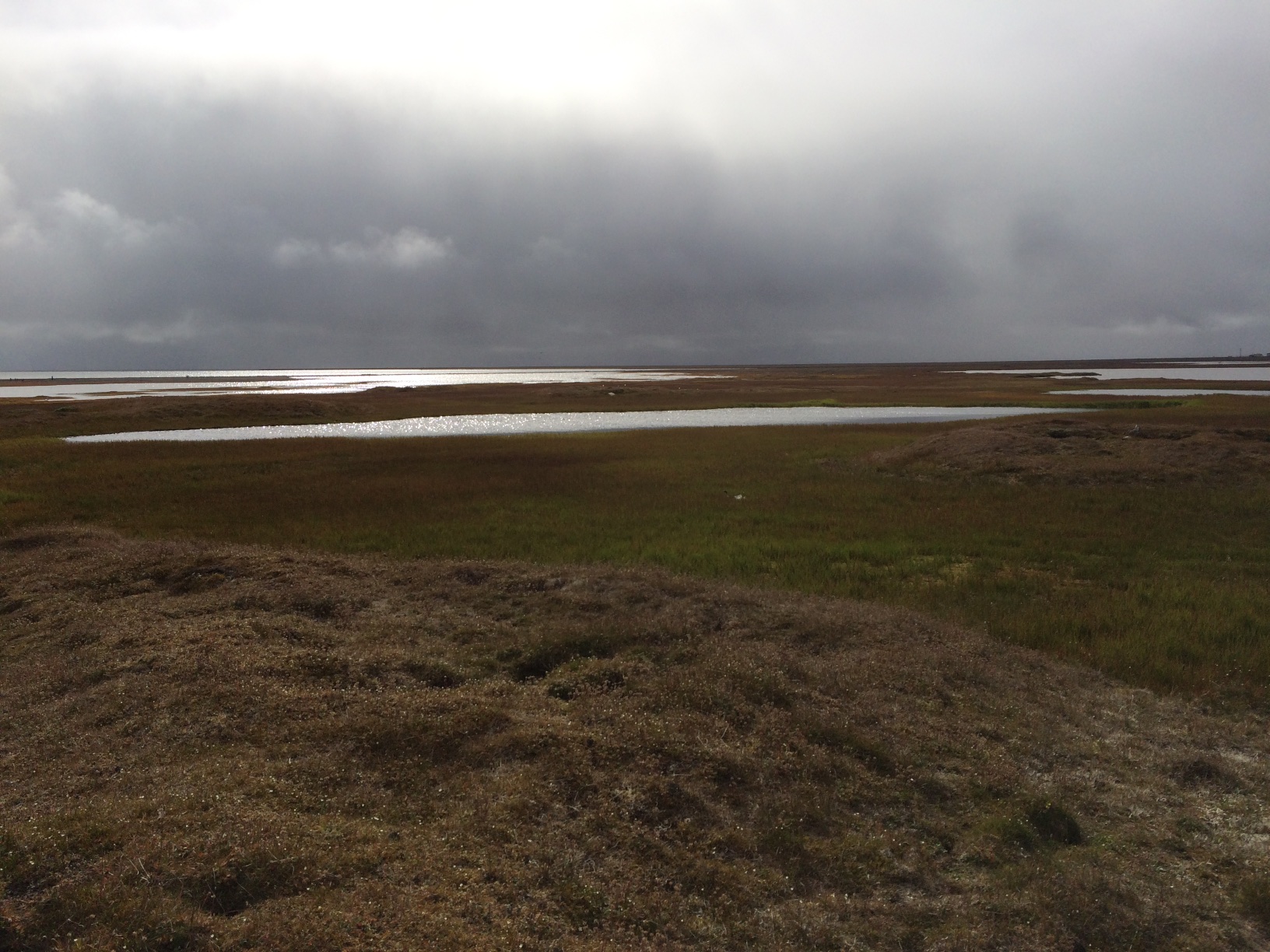
Sun on water at Birnirk.
Part of the crew visiting one of the mounds at Birnirk.

Walakpa–July 26, 2015

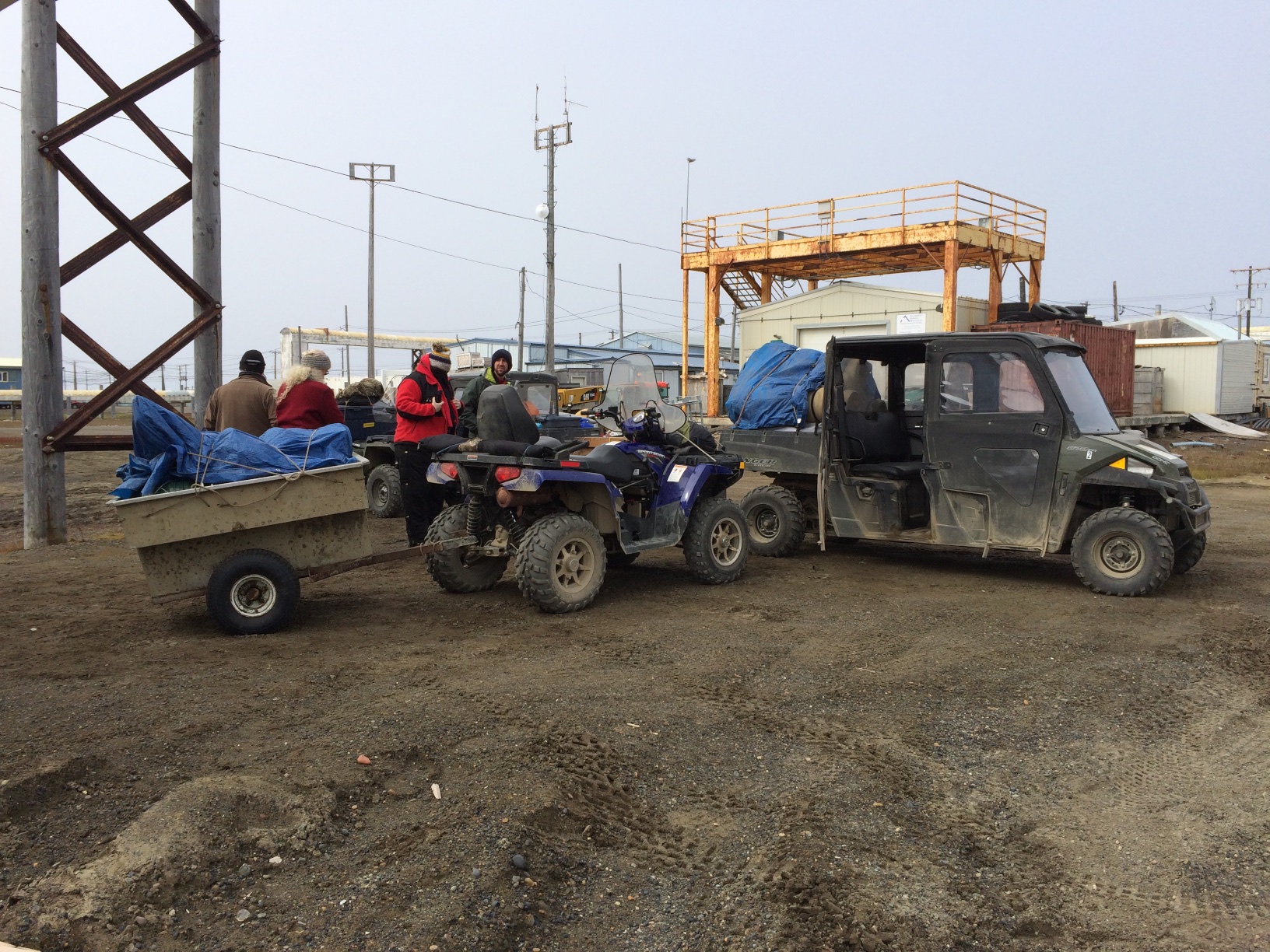
The crew (Owen Mason, Anne Garland, Mary Beth Timm, Laura Crawford and myself) gathered out at NARL, at a small yellow warehouse.  We were using UIC Science archaeological gear.  IHLC & Ilisagvik College let us use some tents, sleeping pads & kitchen gear.  We managed to get everything packed into side-by-sides and trailers and headed off to Walakpa with Sean Gunnells, Oona Edwardsen and Ray Kious of the UICS logistics staff who weren’t otherwise occupied.

Loading up to head to Walakpa

We got to Walakpa around 2PM.  We got camp set up, with a slight hitch because  some of the tents had not been repacked properly when last used.  However, the logistics staff dealt with it, and headed back to town.

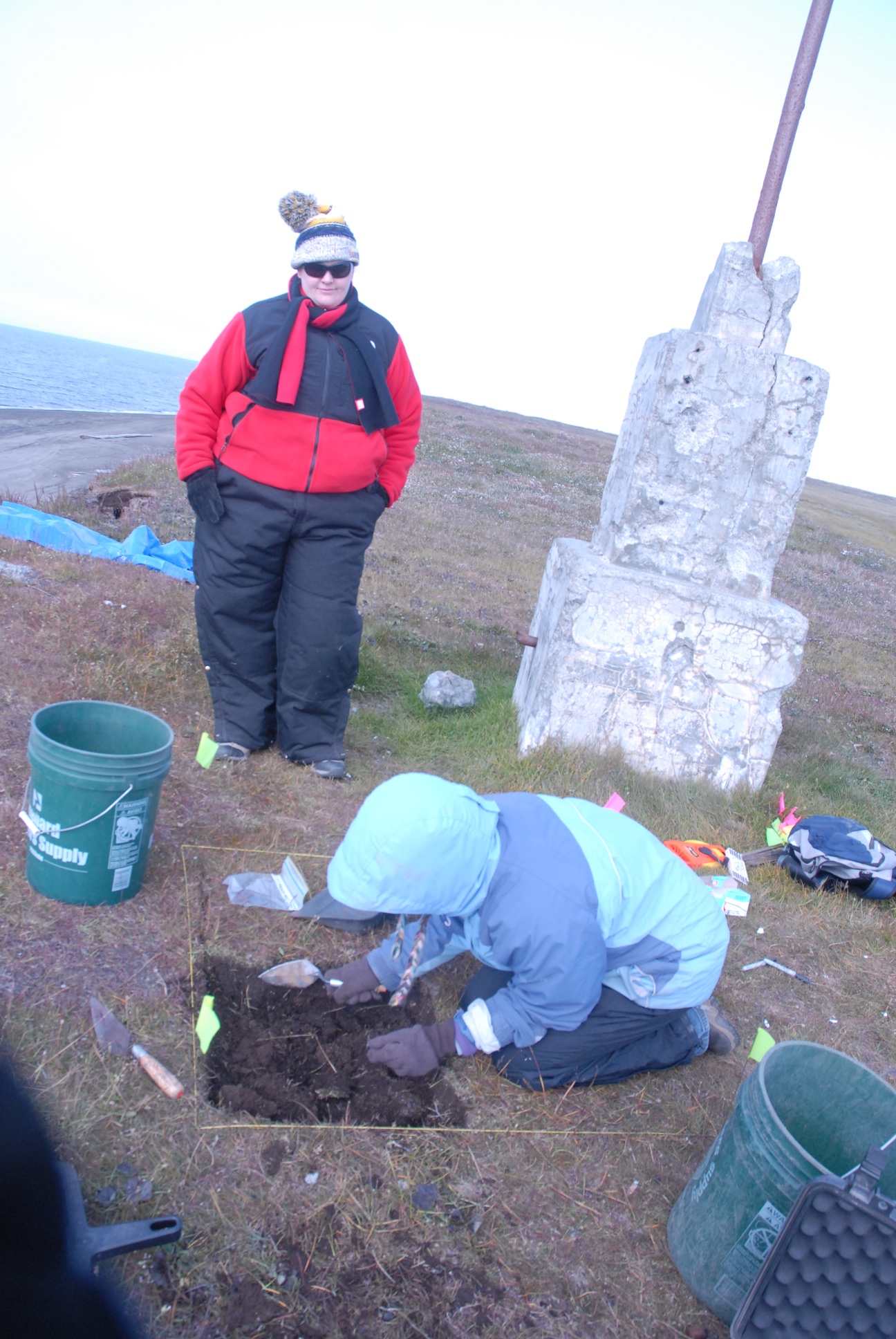
We uncovered portions of the bluff so that we could examine the profiles and decide where we want to take the column sample.  While walking the beach examining the bluff profiles, we noticed that there was a cultural layer exposed in the mound with one of the two monuments on it.  Anne Garland laid out a 1×1 meter test, well back from the edge of the bluff, to see if it continued across the mound.

Laura Crawford excavating the SW quadrant of a 1x1 while Mary Beth Timm looks on.
Laura Crawford excavating the SW quadrant of a 1×1 while Mary Beth Timm looks on.  View NE along the coast toward Barrow.

It was clear that we couldn’t safely do a profile in the central area where the meat cache had been, since there was still an overhang.  In addition, some of the geotextile fabric protecting the site was pinned by collapse of bluffs, preventing its removal.  Eventually, after cleaning profiles on either side of the overhang, we picked a spot and Owen went to work on a detailed drawing.

We had visitors in the early morning, a young couple whose ATV had a flat, and were hoping that we had a tire pump.  Unfortunately, we didn’t, so they headed on up the coast with both of them on one side of the ATV.

Back from the field

We’re back from Walakpa, most of the gear is cleaned up and put away, and initial sample processing is done.  We couldn’t post from the field, so I’m going to put the posts up a day at a time.

Getting ready to head to Walakpa…

We’re packing and should head down today.  Anyone in the Barrow area who wants to stop by to help or chat, or wouldn’t mind carrying messages, please stop by!  No connectivity, so no posts from the field–we are doing this entirely out of personal pockets and on in-kind donations from UIC Science & others.

In Kotzebue with no clothes…

…except the ones I was wearing (and a spare pair of socks I have in my field pack).  Alaska Airlines lost one of my bags.  Sigh.  It may not even have been loaded in Barrow, and of course they don’t answer the phone there, so there was no way for the agents in Kotzebue to check and make sure it got on tonight’s flight to Anchorage so it could get here in the morning.

At least most of the field gear made it in, so we can start work.  I’ll go buy a toothbrush & spare T-shirt if it doesn’t come in tomorrow morning.  I don’t have my steel toe boots, though, which could be a factor when we are ready to start monitoring.  I doubt I can find a pair of women’s steel-toe size 7.5 or men’s 5 in Kotzebue.

In other news, there is an amazing amount of fireweed blooming here.

Readers, would you be willing to help a grad student with her research?

I’ve had a request from Fleur Schinning, a graduate student of Leiden University in the Netherlands. She is doing research on archaeology blogs, and how they can help the public be involved in archaeology, and has a questionnaire she would like to ask readers to fill out.  I’ve tried to attach it here:  Questionnaire for blog readers.  It should also be available at this link: http://goo.gl/forms/z3BAUTyYUL   

You can fill out the form anonymously, or if you give her your email she will be holding a drawing for 6 issues of Archaeology magazine.

Many Moving Parts

Things have been rather busy, to say the least.   I have been trying to work out a way to get the column sample at Walakpa.  For a few days, it looked like Ilisagvik College would be running a camp down there, so we made a plan to set up the camp and start the excavations, and then the campers would join us and be able to participate.  We were going to share logistics. IHLC is supporting the effort and letting one of its staff members participate.  Now it appears that the camp is in doubt, and we’ll find out sometime this week.

Since there is at least one person coming up to Barrow early to help out, another person who wants to help who is leaving in early August, and I am committed to a small project at Birnirk with National Park Service support (also early August),  I am having to come up with a Plan B.  UICS will let us use a tent and some other equipment, and we’ll just go down and camp, rotating a couple of people digging at at time and working as late as we can to finish as fast as possible.

If that isn’t enough, I’m working on several contracts, one of which requires trips to Kotzebue, Point Hope, Nome, and Wainwright, as well as work in Barrow.  It involves testing and in some cases monitoring.  The schedule for this just firmed up, and the Kotzebue work has to happen next week and over the weekend, since some of the work is taking place in the street and we need to monitor that excavation.  This is going to be a challenge with the weather we have been having meaning many canceled flights in and out of Barrow, the Walakpa work schedule and then the Birnirk work.

We also have some work that needs to be done in Wainwright, which was supposed to happen in the summer.  The only problem is that there are apparently no beds available in Wainwright for the crew, since the client (who was in charge of providing lodging since they own & run the camps) somehow forgot to reserve any!  Not sure how that will work out.

I’ve got two conference papers to give in the first half of September, one in Glasgow and one in Vienna, so they have to be finished as well.

Yikes!

Back to the Drawing Board

I’m trying to figure out a way to do at least a little fieldwork at Walakpa this summer.  I’ve got a proposal in for major fieldwork (3 field seasons) but decisions aren’t made yet, and even if it is successful, fieldwork couldn’t start until next summer.  That’ll be great, but there is a remote possibility that we could have another storm as big as the one that took over 11 meters of the deeply stratified deposits last Labor Day weekend.

Sites like Walakpa, with deep, frozen layers with good organic preservation can be seen as a special type of Distributed Long-term Ecological Observing Network of the Past.  In addition to the artifacts and structures left by past humans, these sites contain residues of human subsistence activities, in the form of stratified layers, often several meters deep and spanning millennia, of the remains of animals and plants gathered from the surrounding area. These remains are samples from past ecosystems that cannot be replicated, absent the invention of a working time machine.  A column sample from such a site is similar to an ice cores or a lake or bog core, with the addition of samples from a wider area.  It can tell us all sorts of things about the environment through time when analyzed with the right methods.  Information about how environmental change affected important subsistence species would be incredibly useful for those attempting to manage such species in today’s changing environment, and thus important to the food security of Northern residents.

Unlike ice cores, there is no elaborate infrastructure set up to collect and preserve such samples.  We really want to get a column sample from top to bottom of the site, just in case the worst happens.  It will only take a small crew, and maybe a week or so, since the bluff should be thawing in from the side as well as from the top, making excavation faster.

It looked like maybe it would be possible for the North Slope Borough Department of Iñupiat History, Language and Culture to run a camp there, which would have let students be involved.  I was writing a grant application to try for support for food, fuel and transportation to the site for that camp.  On Friday, we learned there was a conflict, so now I am trying to figure out another approach.  It is looking like it may need to be a volunteer effort, since most quick turn around funding sources don’t pay salary :-(.

If anyone has any ideas, or might be willing to volunteer to help out (digging, loaning camping gear, moving stuff to or from the site, camp cook, basic lab work afterwards), or would be interested in analyzing data from the site, please let me know.  This site is really important both a a part of Iñupiat  Heritage and a source of long-term environemtal data.

Back in Barrow

And just in time, too, since Fairbanks went into the high 80s on Saturday!  I had to get up around 3:30 AM to catch a flight to Anchorage to catch the flight to Barrow (definitely the long way home).  It was amazing flying into Deadhorse.  Water everywhere, and the Dalton Highway and some other roads gone in spots.  A whole lot of the snow in Barrow had melted too, but amazingly the roads are OK.  The Tundra Garden is emerging from under its snow cover, and flocks of redpolls have showed up to join the snow buntings.  I didn’t get much done the rest of the day except resting and a little mindless spring cleaning.

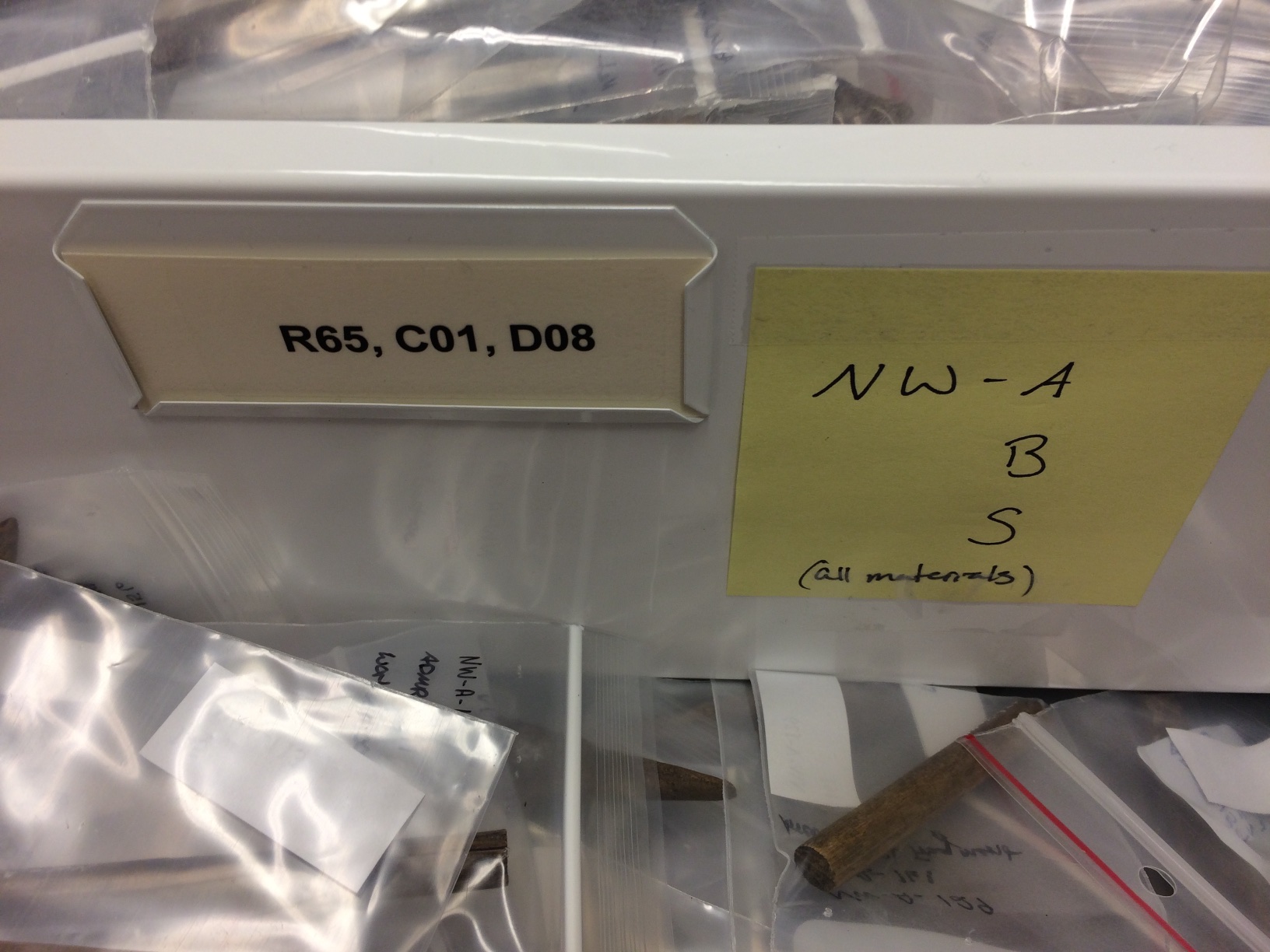
We looked through a huge number of drawers.  The older collections have little or no faunal material saved, so we needed to find worked bones, or in a pinch, artifacts  (preferably broken and non-diagnostic types with many examples) that were definitely made out of walrus bone.  That info wasn’t usually in the catalogs, so we just had to look. Some of the drawers were really full.

Drawers at the University of Alaska Museum

In the end, we have several hundred possible samples (plus associated caribou or wood samples for paired radiocarbon dates since marine mammals like walrus don’t give accurate C14 dates without a correction factor).  Now I need to figure out which may be from the same context, so we can look at them as a group and try to eliminate duplicates.

I’ve finished most of the bookkeeping paperwork that goes with any research trip, and will do the rest on Tuesday at work.  I hear there are a number of applications out for the internships, so I’ll be working on getting interviews done and hiring people as soon as possible.