A radio interview

Yesterday was supposed to be a big day for interviews.  One of the Alaska TV stations has someone coming to Barrow who wanted an interview, and Joe Schuldenrein was scheduled to prerecord an interview with me for his internet radio show on archaeology, Indiana Jones:  Myth, Reality and 21st Century Archaeology.  Unfortunately for them, the TV folks went on a tour of the entire state, except Barrow, courtesy of Alaska Airlines and didn’t get in until after 7 PM.  We may reschedule.

The radio interview did happen, and will be broadcast today, 1 PM EDT, 4PM AKDT.  I believe you should be able to access the archived version here after the broadcast.  If you want to listen live, I think you can log in here and do so, but I don’t know the details, since I have only tried the saved version of the show.

Now for some time in the lab, and maybe another interview…


Voice America - The Leader in Internet Media

Wednesday at 3 PM Pacific Time on VoiceAmerica Variety Channel

Indiana Jones: Myth, Reality and 21st Century Archaeology

Extreme Archaeology: Doing Archaeology above the Arctic Circle

October 30, 2013

Imagine that you are an archaeologist carrying your equipment to site only to meet a polar bear along the way! Once you’ve arrived at site, weather conditions may mean the ground is too frozen to dig or you have a chance of getting hypothermia if you try waterscreening. While Indiana Jones is well known for his travels to far off places and harrowing recovery of artifacts, what are the dangers of archaeology in less desirable destinations? Our guest, Dr. Anne Jensen, has over 30 years experience working in Barrow, Alaska, the ninth northernmost city in the world! Although remote, the climate of Alaska’s north coast allows for the recovery of some remarkable items including ivory harpoons, plank floors, and even seal oil. Join our guest, Dr. Anne Jensen, and us as we discuss her archaeological work in this far-flung part of the world and how her findings challenge the idea that such environments are inhospitable for human occupation. Learn More »

Listen NowView HostpageView Channel

Missed the Live Shows? Past Episodes are available On Demand and Podcast Ready.

Listen Live to VoiceAmerica Variety

Be sure to tune into
Indiana Jones: Myth, Reality and 21st Century Archaeology

Log on to Listen: www.voiceamerica.com

Questions? Comments? Call: 1-866-472-5788

Links

Voice America

World Talk Radio

Voice America TV

iRadio


Enhanced by Zemanta

The smell of old seal oil in the afternoon…

… can be a bit overpowering.  I chose one of the bags of frozen samples from Utiqiaġvik to thaw out for the lab tour after the Saturday Schoolyard talk.

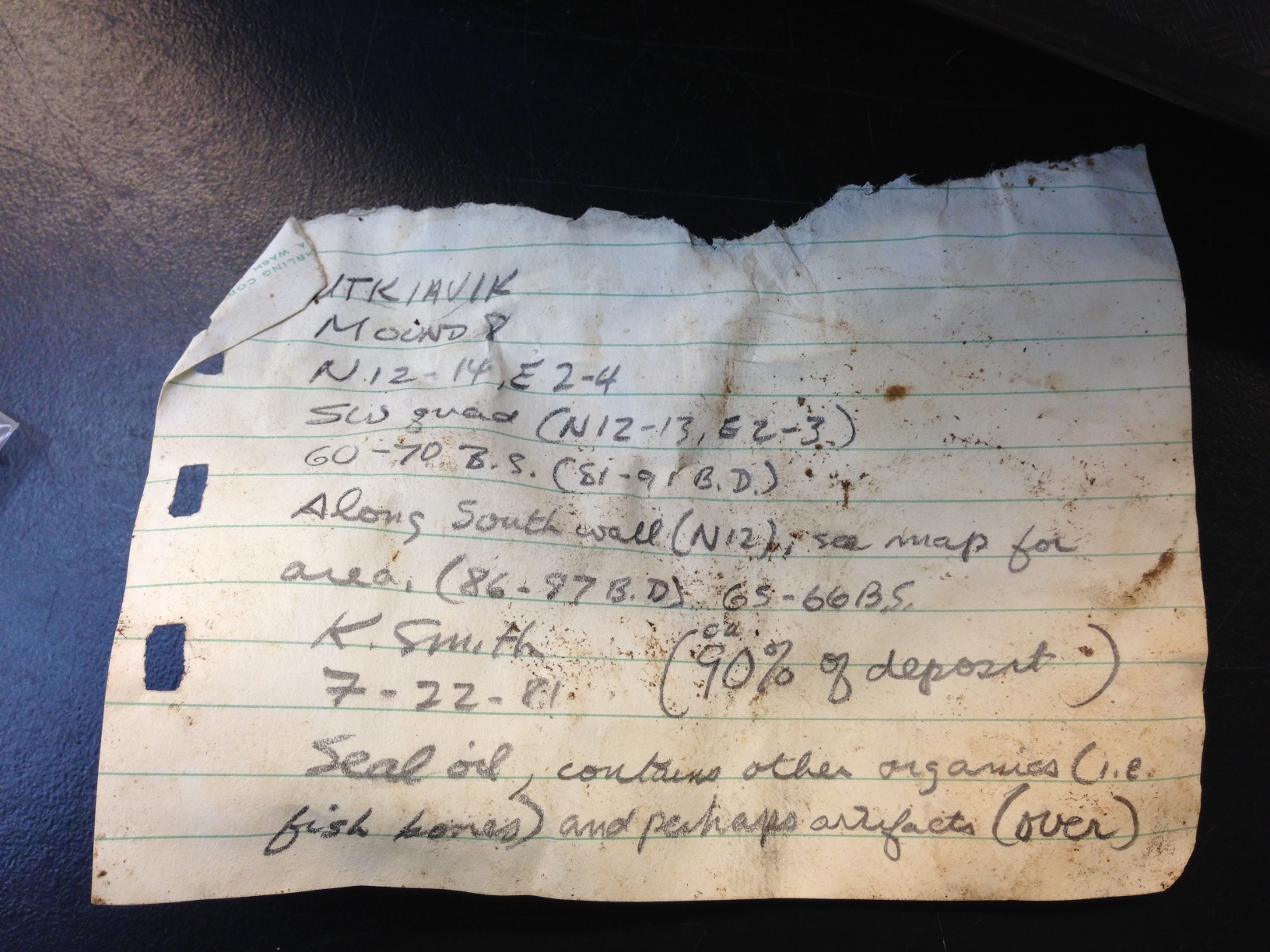
The talk went well, with a very large turn out.  Afterwards, a fair number of them came by the lab for a tour.  And then I opened the bag.  It was from Mound 8, and was described as containing fish bones and perhaps artifacts embedded in seal oil.

Provenience tag from the bag.

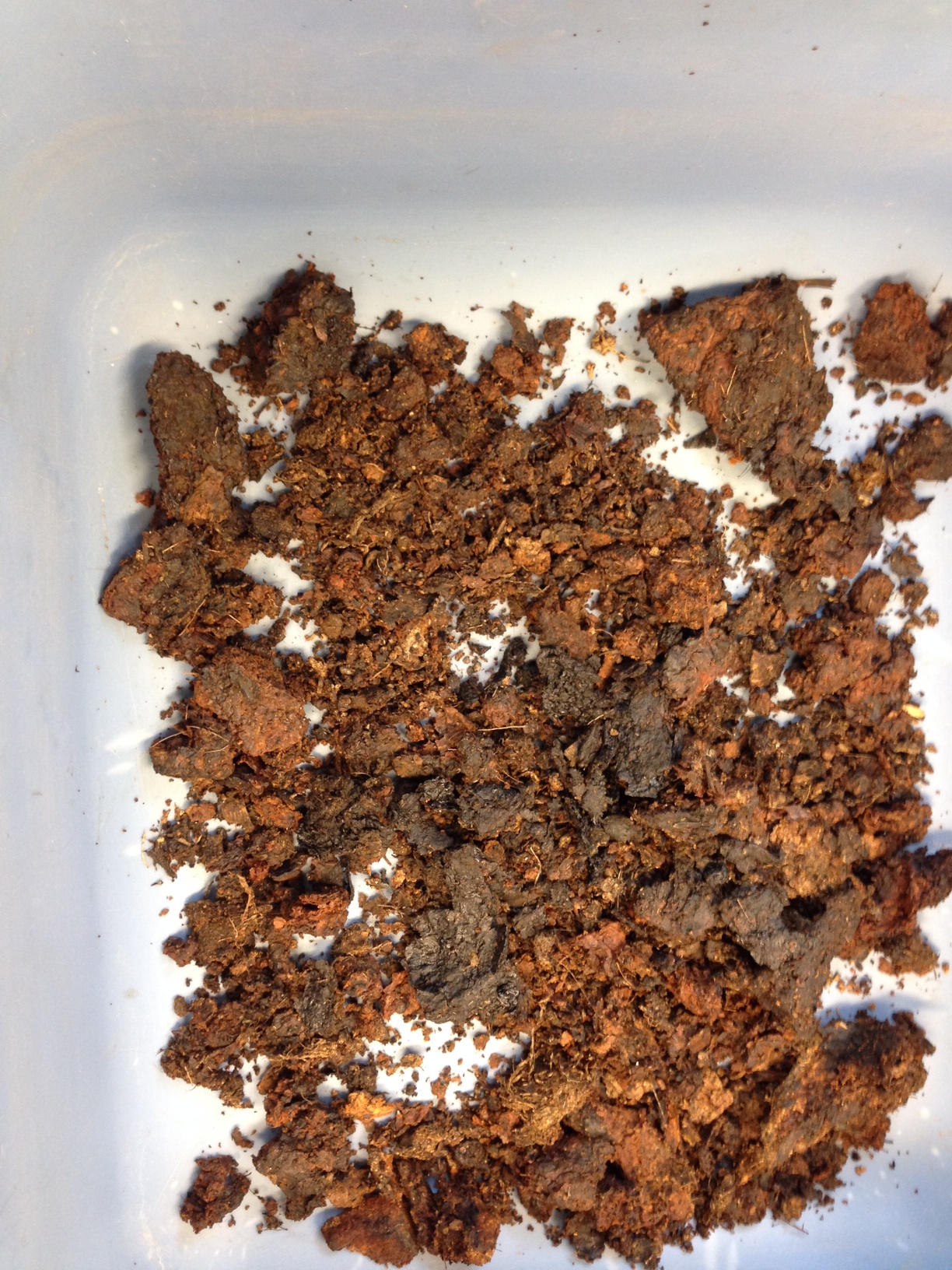
It was rather smelly to say the least.  The oil made up most of the matrix, with a consistency like cold greasy peanut butter.  Not only that, the most obvious contents were wood chips and hair, which weren’t too exciting.  Most folks didn’t feel like hanging around too long.  Since it was my birthday & there was a party at my house, I didn’t finish the bag.

Today I got back to work on it for an hour or so.  It still smelled, I guess, but I think the smell of old seal oil is sort of nice.  It’s the smell of archaeological sites, and they are places I like to be.  The couple of extra days had let the oil warm up and it was a little easier to work with.

Contents of the bag.

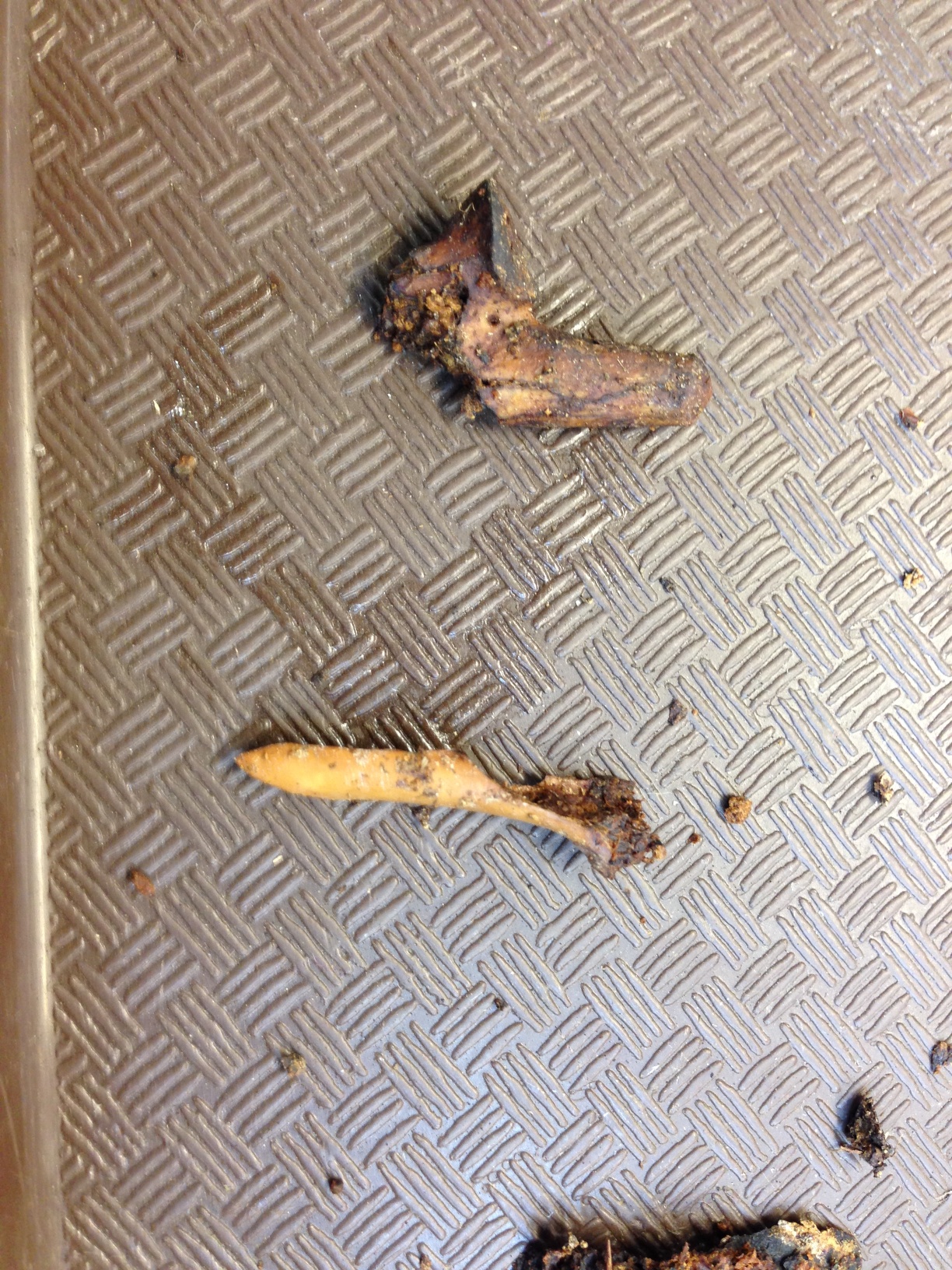
I found a number of interesting things, including a fish vertebra, some fish scales, a number of hairs, some bone fragments, and of course, wood chips.  When I was labeling the bags, I realized it had been excavated by none other than Kevin Smith, now at the Haffenreffer, exactly 32 years and 3 months ago.

Fish vertebra
Fish vertebra
IMG_0852
Grass?
IMG_0853
Bone fragments

Tomorrow I’ll do some more.

A day of taking pictures

This Saturday, I’m giving a Saturday Schoolyard talk about the Walakpa salvage project.  That means I need a lot of pictures.  So I spent the last couple of days in the lab taking pictures of the artifacts from we recovered.

Just a few of the results:

Rim sherd
Rim sherd
Fragments of arrowheads.
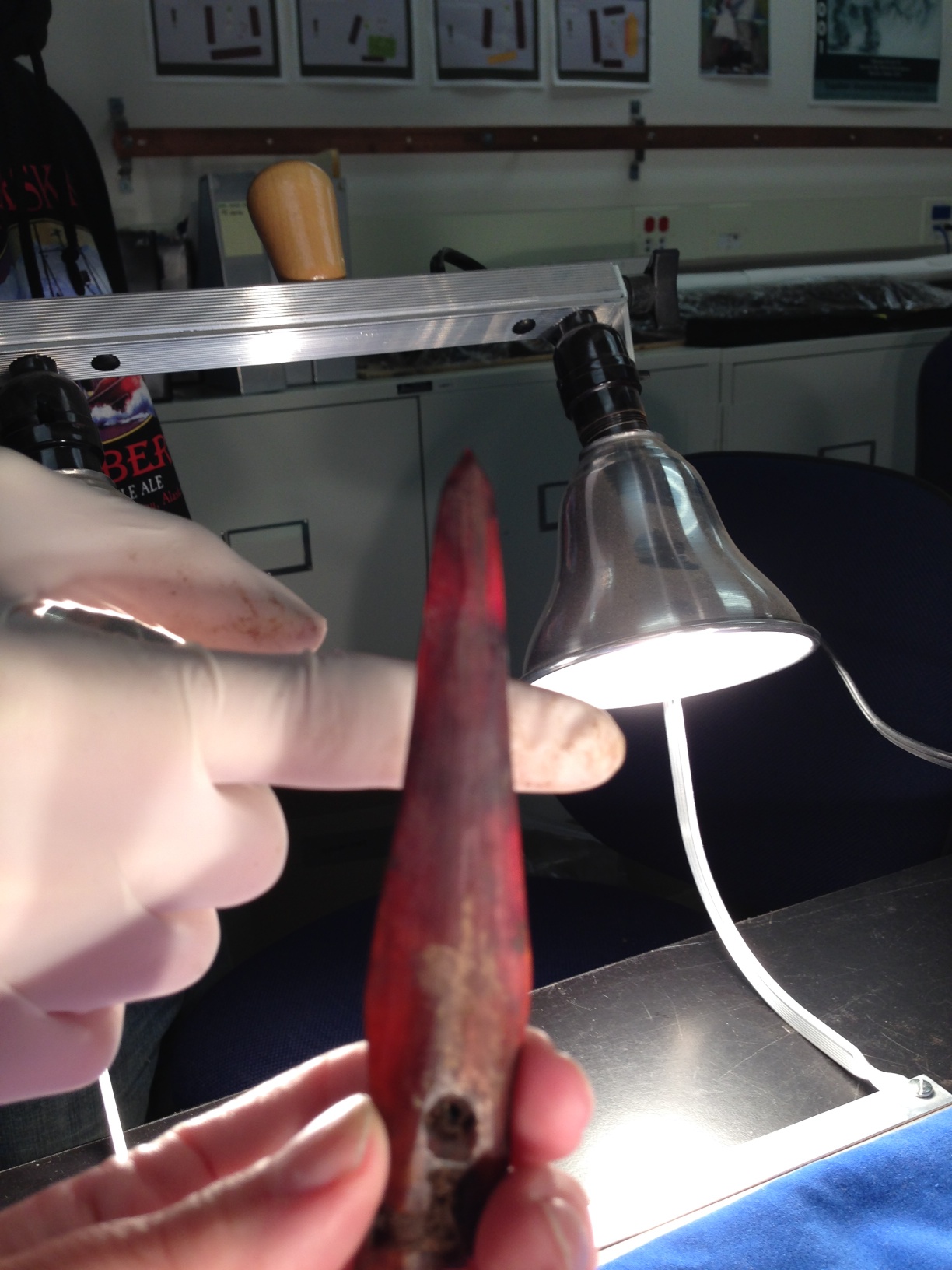
Very thin ivory harpoon head.  Note the shadow of the finger showing through the artifact.
Very thin ivory harpoon head. Note the shadow of the finger showing through the artifact.

A book about Nuvuk

I made it back from DC on Thursday night.  Friday was the usual scramble after being out of town.  Saturday night was the annual meeting of the Friends of the Library.  There was a business meeting, and a potluck dinner.  But the highlight of the meeting was the guest speaker, none other than Daniel Inulak Lum, author of the book Nuvuk, the Northernmost: Altered Land, Altered Lives in Barrow, Alaska.

Dan Lum showing slides of the photos in his book

Dan’s family is Nuvukmiut (that’s how it is spelled in Nuvuk dialect–it would be Nuvugmiut in Barrow dialect), originally from Nuvuk.  He ran a tour company which took tourists to Nuvuk for much of the time the Nuvuk Archaeological Project was active.  While doing that, he wound up taking a whole lot of pictures.  He has some really great animal photos, particularly of bears, as well as some really beautiful landscapes shots.  His family had to move to Fairbanks for a while for reasons connected to health of a family member, so he isn’t running the tour company any more, but it gave him an opportunity to look through his pictures and he wound up writing a book about Nuvuk and life in Barrow.

When he was running the tour company, Dan gave great tours.  He really wanted to pass on accurate information to his clients, and would stop at our excavations and talk to us, so he had the latest news.  As he said in his talk, the village is no longer there (due to erosion) so all the Nuvukmiut have to remember it by is information from oral history and archaeology.  He’d always check to see if it was OK to bring the tourists over (not if we were excavating human remains), and was always willing to bring things back and forth for us in his van.  When the Ipiutak sled runners were uncovered, Dan  stood by until we had them out of the ground around 2AM (despite having had tours all day) and then drove them very slowly back to the lab at NARL, making sure that they weren’t bounced around.  It took over an hour to go the five or so miles.  He also brought pop out for the crew on warm days.

Dan showed slides of many of the photos from the book, and talked about how he came to write a book in the first place.  He was very encouraging to audience members about writing and publishing their own books.

Dan takes questions from the audience.

I’m going to be spending a good bit of time getting ready for International Archaeology Day, which is Saturday.

IMG_0841

Thinking about logistics & links

I am currently in Washington, DC, participating in a workshop on Arctic Research and Logistic Support planning.  The idea is to get a group of scientists working in the Arctic together to see what we think Arctic research will be like in 10-20 years, and what sort of logistic support will be needed.  Then, action steps to get there from here will be formulated.  One hopes it is not just an exercise in futility.

As is usual at such gatherings, there are not very many social scientists.  There are a lot of physical scientists (marine, terrestrial & atmospheric) and a fair number of biology types.  Many of the groups are quite interested in new “toys” (UAVs) and the like, as well as more icebreakers.  Better connectivity is also something that is high on most people’s lists, mine included.  What I find interesting as an anthropologist is how the cultures of various disciplines vary so widely.  One of the breakout sessions was organized more or less by location of research (with social sciences its own group).  I actually went to the Coastal group, since I’d just had lunch with Sophia Perdikaris & Genny LeMoine, both of whom are archaeologists, who were going to be in the social science group, and I thought it might be more valuable to get a social science voice into one of the other groups.

The variation in the visions of the groups when they reported back was quite striking.  Although there were some things all agreed on, one group saw research in 10-20 years as being done remotely.  They even thought that maybe social science could be conducted through social media.  Unfortunately they didn’t describe how they imagined one could excavate a site that way; I’m sure it would be a lot warmer than what I was doing last month!

While all that was going on, the Alaska Dispatch picked up Abra’s Arctic Sounder story.  Then Archaeology magazine added it to their website news, even asking if they could use a specific picture from this blog.  Then they used another one…  Oh, well.  And I got another interview request.

Some media attention, and why it can be a double-deged sword

For some reason, this year there has been quite a bit of media interest in Barrow and archaeology.  To begin with, there were several film crews in Barrow while we were working at Walakpa, two of which actually came out to the site and filmed as well as filming in the lab.  Only one of them has anything out yet.  PBS filmed for several both in the field and in the lab, and a little bit of it made it into this piece,  and a shot in the slideshow that they put up on the web in conjunction with the series on sea ice change. It was a very buggy day in the field, and it was quite the challenge not to be swatting mosquitoes all the time.

Oh, and the buoy experiment that Ignatius Rigor is working on in the film clip is supported by UIC Science staff (not that they have to do much, the idea is to see how the buoys do with no servicing). Their data can be compared to data from ARM’s established serviced meteorological instruments.   That way, when scientists get buoy data, they have an idea how reliable it is, and if there are any special considerations in interpretation (becoming uncalibrated over time, etc.)

We’ve also gotten interest from the press. Abra Stolte-Patkotak, one of our volunteers writes for the Arctic Sounder, and did a piece on the Walakpa excavations, which is on-line here.  For some reason, they don’t have the picture that was published up on-line, but I will ask Abra if I can put it up here & add it if so.

I am currently working with a free-lancer who has interviewed me and asked me to fact check the article before he goes further.  A very good idea, as many years ago I was interviewed by a reporter who mis-heard my answer to the question of how far back in time human occupation of the Barrow area was archaeologically demonstrated to extend.  I said “maybe 4 to 5 thousand years” which was what people thought reasonable for Denbigh at the time.  He refused fact-checking help, and published an article in which I was directly quoted as saying “45,000 years”.  Although Glenn & I could never get the Arctic Sounder to mail our subscription to us in Pennsylvania, apparently Tiger Burch could.  I got a very puzzled email from him after the article came out, in which I believe he was politely trying to ask me if I’d lost my mind.  Fortunately, he had enough experience with the press that he believed the explanation.

Enhanced by Zemanta