Sometimes science produces unexpected results…

Much of today went trying to find freezer space for the person in the parka.  We were able to get X-rays done by the North Slope Borough vet clinic (they needed a bit of practice with a new machine anyway), and there are skeletal elements in the parka.  I talked to a conservator and it seems possible that the garments might be able to be preserved if the community chooses. We need to have a discussion with the Elders about that.

At least we need to document them really well, as they are being removed so the person can be examined and reburied.  To do that we need not only a good videographer, but also a group of experience skin sewers, since the sinew has decayed, and it may only be possible to figure out what stitch was use by skilled sewers looking at the ghosts they left.  We need to get the funds for that work, which probably won’t be available until October or so.  That means that we need a freezer to keep the person in a stable environment until the examination can happen.

CPS/UMIAQ couldn’t really offer anything right now, except to note that it hadn’t been requested in the program plan last year (sadly, I’m not clairvoyant–if I were, we could skip all the pesky shovel testing).  Fortunately, North Slope Borough Wildlife Management also has a freezer, and they were kind enough to step up and help out in this urgent situation.  Many thanks to DWM!  One UMIAQ fellow later thought of a freezer that might be a possible fallback, although it’s got stuff in it at the moment.

Next step, grant applications for that work and for the Ipiutak structure that remains at the bluff in the DWF, waiting for the next big storm to take it out.

Best day yet

We had a really great finish to the official field season.  We excavated a last burial which turned out to be that of a very muscular person, who seems to have been buried in or on bird skin (maybe a bird parka).  A possible burial (a human bone showed up in a test pit) turned out to be an isolated find, so we don’t have an unexcavated burial undone.  There was a complete egg in the dark organic soil by the bone, which looks like something a fox might do to hide a stolen egg, so maybe the fox brought the bone there from somewhere else.  The DWF continued to have a number of interesting artifacts (nice lithics, ground slate, composite labret). I’ll try to get pictures up in the next few days.

We were able to backfill all the big holes, record all surface finds, cover the DWF in hopes of being able to come back later this year, and still get the students home at a reasonable hour.

Some of us are going out again in the morning with an NSF-funded Mexican/North Slope student exchange group of about 25 or so.  We’ve worked with them before, but not after the season ends, so it’s a bit challenging to find something to teach them that doesn’t risk disturbing something we haven’t got the time or crew to deal with.

I only got 4 hours of sleep last night, so off to bed.

Lab and logistics–Pt. 1

The past couple of weeks have been really hectic.  The local students have been working in the lab, and I’ve been dealing with logistics non-stop.

We’re at the point where we could go through the bags from the shovel test pits.  In the early days of archaeology, only artifacts were collected, and sometimes only the unbroken ones, at that.  The details of their provenience were often recorded in very broad term.  As the discipline progressed, new methods kept developing, and it became clear that many of the things that had been discarded could have yielded information, had they only been collected.  The pendulum swung toward keeping everything, including large volumes of samples, on the principle that someday methods would catch up, and then the information could be recovered.  This is the same reason that practice moved toward only excavating part of a site, or even of a feature.

Now, however, it is becoming clear that museums cannot expand indefinitely, and that not everything can be kept.  In fact, some places are deaccessioning items.  Many places are being much more selective in what they will accept.  There is a real storage space crunch in Barrow (particularly for climate controlled storage) so we need to be judicious about what is retained for the future.

At the same time, we are excavating with crews which include beginning excavators, in sometimes unpleasant weather.  The only good way to make sure that important data (or artifacts) don’t get left in the field is to have people collect things even if they are not sure they are artifacts.   And they do.

When the bags are gone through and the contents cleaned, obvious mistakes are discarded at that point.  That still leaves an enormous volume of material.  There simply isn’t place for it all, so some decisions have to be made in how to deal with it.  The most rational approach is to discard the items with the least information potential first.

The Point Barrow spit has been used by people and animals for the entire period of its existence.  Faunal remains have been dropped and scattered by humans and animals alike.  Artifacts have been dropped and lost and refuse has been tossed.  That’s true of most sites, but the  post-depositional processes acting at Nuvuk are a bit different.

At the majority of sites, the site is built up like making a layer cake.  The bottom layer goes on the plate first, then a layer of frosting, then another layer of cake, and so forth.  The oldest layer is on the bottom, and the newest on top.  If you put a piece of candy on the cake and push it down into the bottom layer, there are traces of that, so that it is possible to figure out that it was the last thing added.

At Nuvuk, on the other hand, the loose gravel matrix means that something can be dropped on the surface, stepped on twice and be 10 cm under the surface, covered with apparently undisturbed gravel, in 15 minutes.  Digging can bring older items to the surface, as can frost heaving and the action of tires.  In other words, there is no way to tell what was deposited before what.  One can get relative dates for artifacts based on their style or even patent dates for trade items, but that doesn’t tell you anything about when they were deposited at the site.  Faunal remains are even worse.  There is no way to date them (C14 dates at $900/bone aren’t likely to happen) and since polar bears hunt the same animals as the Nuvukmuit (people of Nuvuk) did, and drop bones on site, we can’t even be sure the bones were introduced by humans.  The only exceptions are areas where there was a sufficient amount of organic matter to support plant growth and soil development.  These include the graves and middens (and the sod houses before they eroded away).

This difference was taken into account when we developed the protocols for shovel test pits.  The excavators collected the artifacts and faunal material by natural levels.  In most cases, the entire STP was in the same loose gravel level.  This means that the materials from those STPs have much less information potential that the materials from the areas of the site with some soil development and stratigraphy.  Any research questions that could be addressed with this material can also be addressed with material with better stratigraphic control, at far less cost and with more confidence in the results.  That makes them an ideal place to start when trying to reduce the volume of the collections to be retained for the long-term.

We have been digging over 2000 STPs each season (and really hope the GPR will reduce that a lot).  Some of them had nothing in them, but most had at least a few animal bones and artifacts.  So we are working with the bags from STPs where there had been only an undifferentiated gravel level.  Any particularly interesting or unique artifacts are being saved (although they are few and far between, most having been found during excavation).  Recent trash (cigarette butts, juice boxes, etc), recent nails & metals straps, cloth gloves and the like are recorded and lab discarded.  Items with maker’s marks or other markings that might allow identification and/or dating are being retained for further analysis, and others are being sorted, counted and recorded prior to lab discard.  So far there seems to be a good collection of Pabst Blue Ribbon cans from the pull-tab era.  We are also retaining items (gears, lock sets, etc) which look as if they might be further identified with the right documentation for additional analysis.  The faunal material is being sorted.  Modified items are being retained for further analysis, identifiable elements are being recorded and lab discarded (with particularly good examples being saved for a teaching collection), and unidentifiable fragments are being counted and lab discarded.  This is good practice for the students, and since the STP material isn’t well-suited for future research (due to the issues mentioned above), overall this is a positive step.

First trip to Nuvuk in 2011

I went out to Nuvuk today.  The purpose of the trip was to accompany Hank Statscewich from the University of Alaska Fairbanks, who needs to pick out a new site for an experimental current radar.  They have run it near NARL for a year, with no problems, so they want to try it further out-of-town.  Since there is a good bit of archaeology out at the tip of Point Barrow, the idea was that I could help him find a spot that was not likely to have any archaeology.  We’ll still test before anything gets put out there, but still.

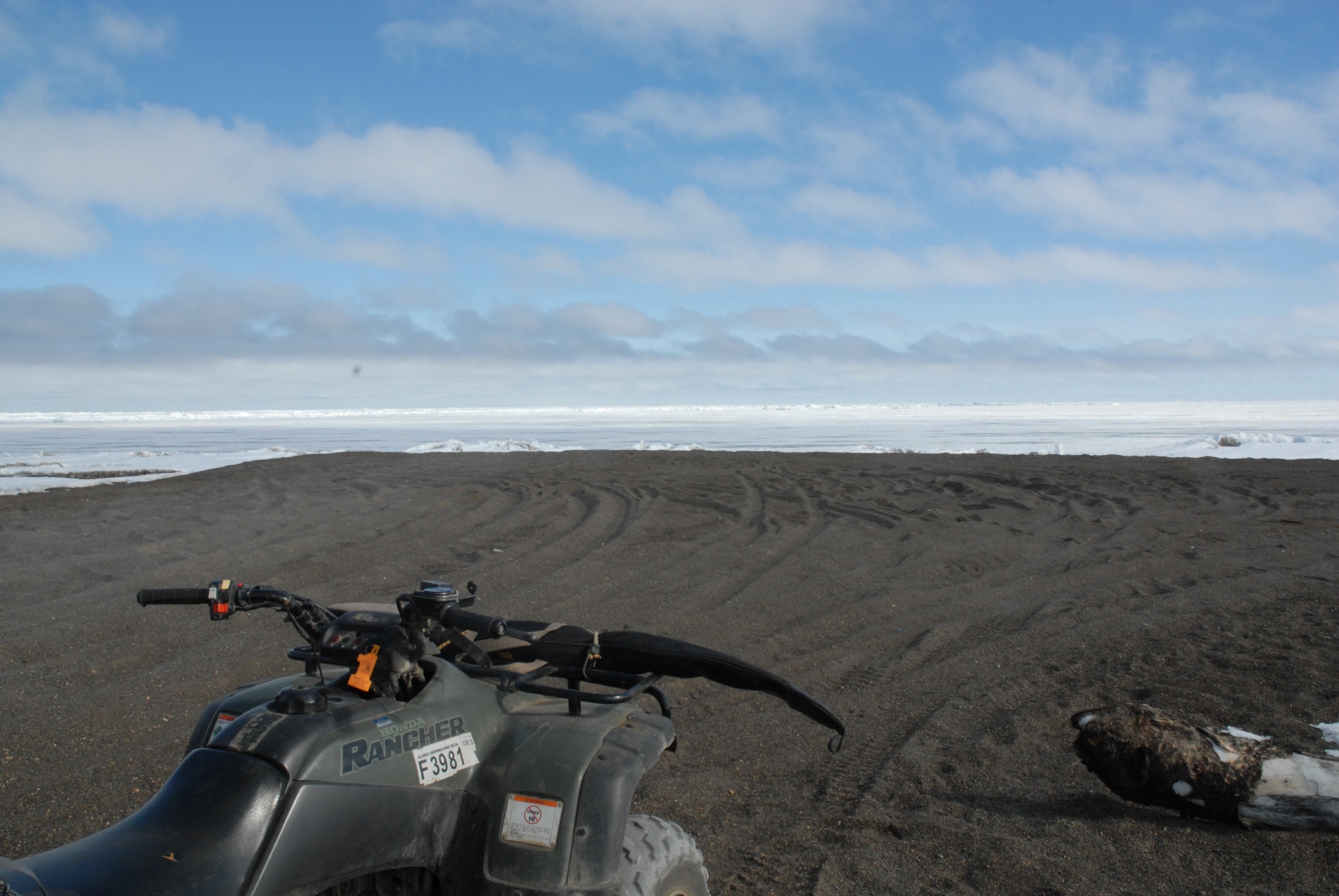
It was a sunny day, but there was a good East wind off the ice.  We were heading into it, more or less, going probably 25-30 mph until we got off the road, and the ATVs from BASC didn’t have windshields on them yet (they take them off when storing them so they can fit more vehicles into a smaller space).  That bit was not fun.

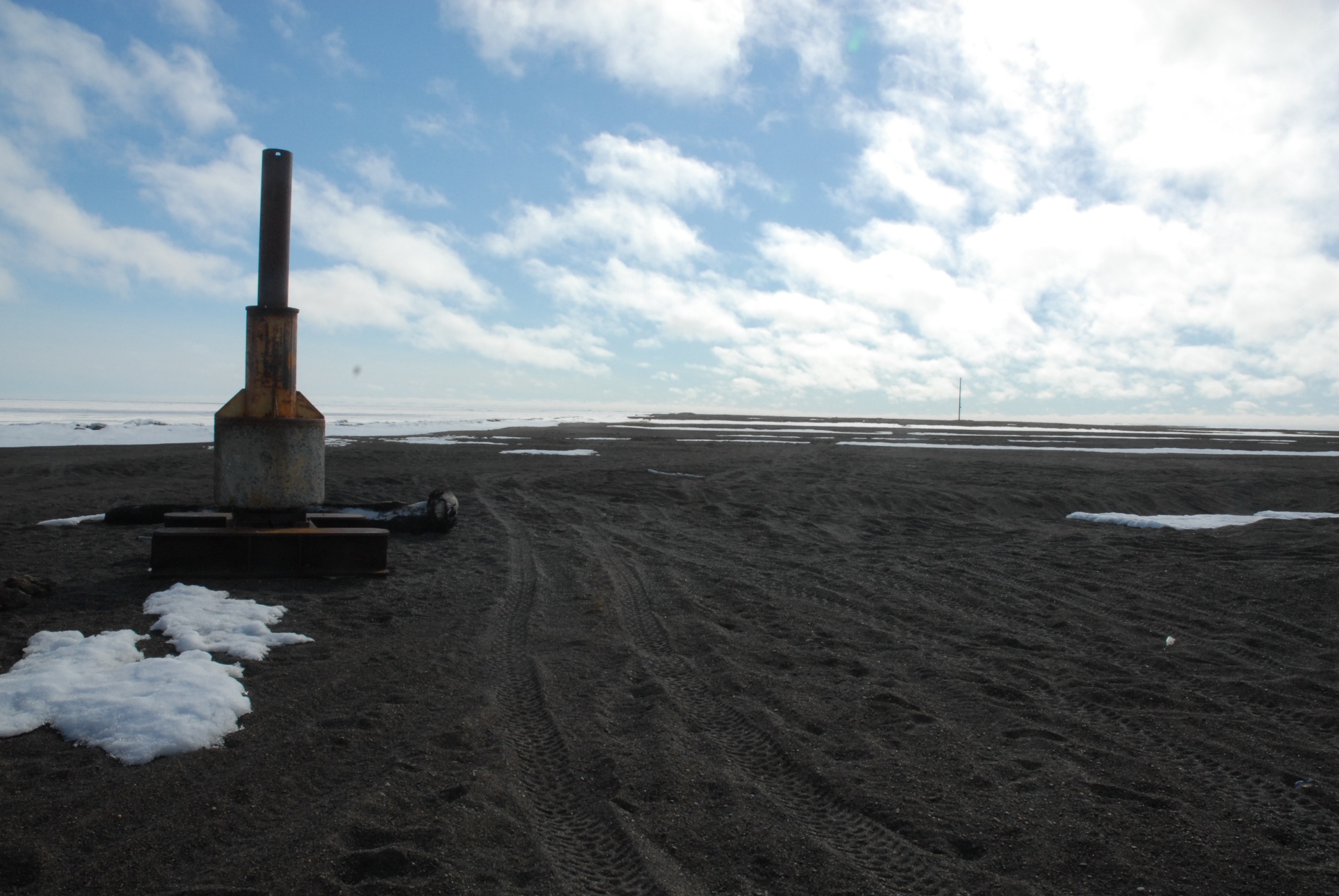
The first place we went was on the younger, more western of the two prominent beach ridges, near a weird concrete and steel device that reportedly was brought over from Prudhoe Bay during the gray whale rescue.  It seemed like a good possibility, so we took GPS readings.  It looks like there has been a good bit of er

Looking at the ice on the Beaufort Sea, I was happy to see it was really flat for quite a way out.  That will make it easy for bear guards to spot bears there, if only it will stay that way.

Flat ice on the Beaufort Sea, at the farthest north point in the US.

We looked over toward the ridge with the Nuvuk site on it.  I was very discouraging about it as a site for the radar, but Hank was curious, and enough snow had melted so we could get there without bogging down (ATVs aren’t so great in snow), so we headed on over.  There was some sort of rack that was new since fall, so I wanted to look at that.

Looking SE toward the Nuvuk site.

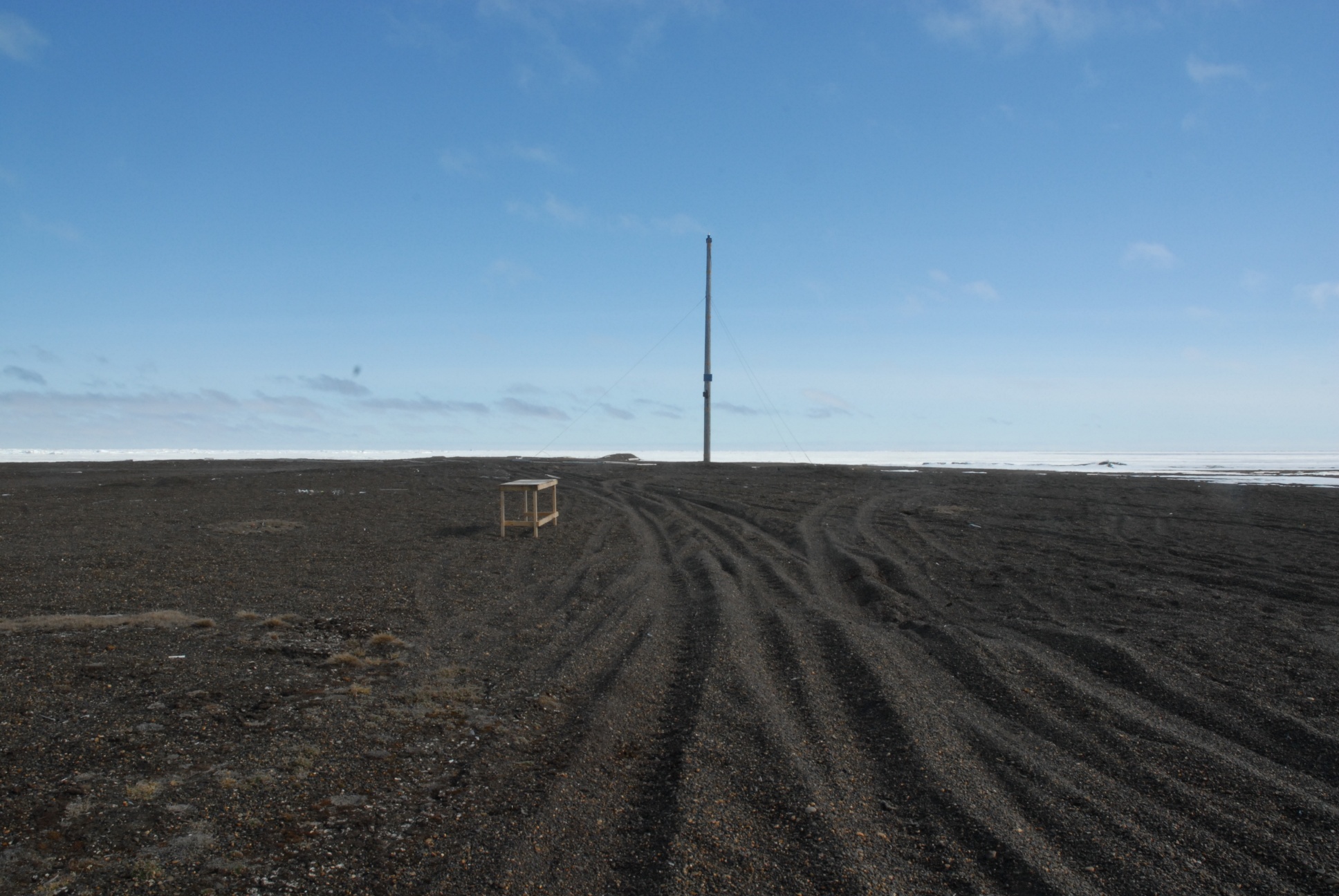
While we were over at the site, I double-checked how far we had tested in relation to the telephone pole with a light on it, since there is interest in mounting something on that pole, and access will be an issue until we are sure there are no graves right around the base.  We mark the end of the tested area with a line of driftwood, which we move inland at the end of every field season.  It’s only a few meters from the pole, so we should be able to clear that one way or another this summer.

Looking toward the Beaufort from the middle of the site. The line of driftwood on the ground marks the limit of the tested area.

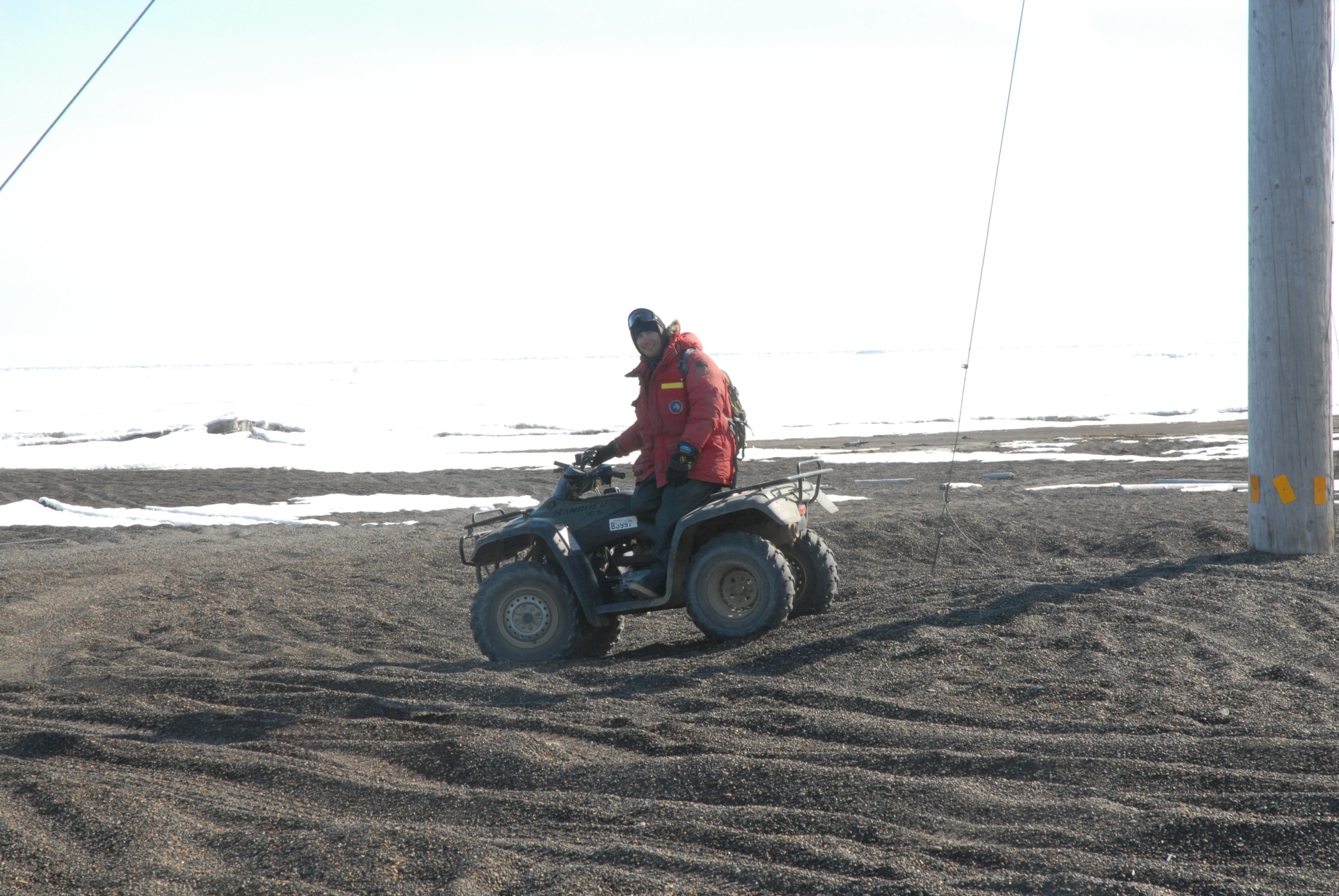
The “rack” turned out to be a table-like construction which was labeled as a survey marker for North Slope Borough Wildlife Department.  I checked with them when they got in, and the survey is due to be completed in four days, so it won’t be a problem for us.  I took a picture of Hank on his ATV while we were there.  Actually, I took several with his camera too, but the image never looked in focus to me, so I took some with my camera just to make sure.

Hank S. at Nuvuk

We stopped at another spot that was also a possible radar site.  Hank will take the GPSs back and do calculations to determine which one would work best for the radar, and then let me know and we’ll test it as part of determining if it can go out there.

The ride back was great, since the wind was at our backs.  Alas, my face is covered with what look like hives, which is what happens when I windburn

Actual incremental progress on several fronts!

Now that the storms have passed for the moment, and I can once again get to the office, I’ve actually gotten a few things done.  I managed to take the few comments on the mission statements for the GHEA working groups and finalize them.  That done, I set up, not one, but two (!), working groups.  The first is focused on coastal erosion, and the second on global change effects on the archaeological and paleoecological records.   They are now open for members (a few have already joined).

Monday’s time-sheet approvals were particularly onerous, because a change of user ID in the time-sheet system didn’t work quite right, and not only detached users from approvers until they logged in again on Monday, it also rescinded submitted and approved time-sheets from last week which were done before the update!  Much confusion and a royal pain for us and for the IT/accounting folks, I can assure you.  But we persevered and everyone should get paid on time!  There were a few other accounting and proposal related details to deal with today, but they’re pretty well in hand, and I just need a few more numbers to get the proposal out the door.

That done, I moved on to drafting a summary for newsletters (several paragraphs) of the Polar Archaeological Network meeting in Tromsø, which somewhat coincidentally (since I am the only overlap between the two groups at the moment) was all about global change and threats to the Polar archaeological and paleoecological records.  That’s been circulated and I’ve made several revisions based on comments.  I’ve gotten one more set from Maribeth Murray at UAF, which actually suggests two versions, one for social science audiences and one speaking more to the paleoecology/global change folks, so I should have that ready for final circulation to the attendees tomorrow, and then it should be ready to go to out.  Maribeth and I (and the other meeting attendees) are also doing a poster at the Alaska Anthropological Association annual meeting in Fairbanks next week.  PAN had a preliminary poster, which I am majorly rewriting and putting Alaska-specific images on (since this version is for an Alaska meeting).  I’ve got to get that finished, circulated, and down to Maribeth in Fairbanks so she can get it printed up (since large-format printers are almost as scarce as hen’s teeth in Barrow).

Also needing finishing and polishing is my paper/PowerPoint for the meeting.  I am in a session in honor of Ernest S. “Tiger” Burch Jr., one of the most renowned ethnologists who ever worked in the North, who passed away unexpectedly last September.  He was a brilliant and meticulous researcher, widely admired among Iñupiaq people, particularly those of Kivalina, where he and his wife lived for some time, and an all-around good person.  I was proud to have him as a friend, as was my husband, Glenn Sheehan, and it’s an honor to be asked to be in this session.

I had somehow lost track of when the meeting was, and had rather a jolt today when I opened an email about a side meeting, which mentioned the attached agenda for next week’s meeting!  A mad dash to make travel plans ensued, so I now have a room, a car, a plane ticket and am registered for the meeting.  All told–1.5 hours.  Practice makes perfect (or at least faster).

18th Arctic Conference–Part 5 (Day 2-PM)

At last!  After a fine lunch, we reassembled in Dalton for the afternoon session.  We moved from Alaska to the North Atlantic, and a variety of Norse sites.  Tom McGovern kicked it off with an overview of what had been accomplished during the most recent IPY.  Much of this is due to the work of various NABO members.  He talked about some really neat school outreach programs, including one issuing GPS and camera to students & teachers to record archaeology and in the case of Iceland, place names.  He also highlighted a very interesting initiative to develop

Konrad Smiarowski talked about zooarchaeology associated with the Vatnahverfi Project, part of the Norse Eastern Settlement, Greenland.  The project involved survey and excavation (following NABO common protocols, which make for great inter-site inter-comparability).  He was looking at how the Norse immigrants adapted to a new environment with new (to them) resources.  He had evidence for the adoption of seal hunting, which the Norse seem not to have done elsewhere, despite the presence of seals, as well as hunting of walrus for ivory and birding.  Bones of harp and hooded seals, both of which are migratory, show up even at more inland sites, so it looks like either people are coming to the outer coast to hunt or the seals are being traded inland.  It looks like they were net or drive hunting.  Things seem to have been going on well, but increasing amounts of ice seem to have changed things, driving people to intensify sealing at the same time as it was affecting the local seal populations.  Things ended badly, as we know.

Ramona Harrison gave an interesting paper on the farm Gásir and its hinterlands, including various types of landscape (hayfields, pastures, etc).  She is working on the zooarchaeology as part of a long-term human eco-dynamics in Eyjafjörður, Northeast Iceland.  Unfortunately, my notes on this appear not to have been saved, so I won’t go into more detail, so as not to mis-report anything Ramona said, but it was quite interesting, and reports should be on the NABO website soon, if they’re not there now.

The final paper was given by Seth Brewington on work in the Faroes, particularly at Undir Junkarinsflotti.  It was abandoned in the 1300s due to repeated sand blows, which were a problem at that time in a number of places on the eastern side of the North Atlantic.  The paper dealt with the zooarchaeology, which is quite unique as bone preservation generally seems to be bad in the Faroes, and the idea of keeping bone is still relatively new.  The inhabitants seem to have been eating lots of birds (mostly puffins), even in comparison to other Norse sites, where the bird consumption seems to drop after the earliest settlement period. 

18th Arctic conference–Part 4 (Day 2-AM)

This penultimate chapter is a bit belated, to say the least, due to holidays, much travel and associated presentations, and proposal preparation.  However, there were some very interesting papers on the final day as well, and I decided I needed to get this written before yet another conference happened.  And I needed a break from final tweaking of the PowerPoint for said conference.

The first paper was by Molly Odell, on economic change at  Mitksqaaq Angayuk between 3400-100BP.  The site, on Kodiak, seems to have had discontinuous occupations from Early Katchemak to the Russian occupation.  Molly focused on the fauna from a midden associated with an Alutiiq house.  The house seemed to have been occupied primarily by men, based on the artifacts.  The midden showed a change from a pre-contact mixed fishery (primarily cod but with significant amounts of salmon and small amounts of other locally available fish) to a fishery focused almost entirely on cod in the historic period.  Molly interprets this as a shift from a winter settlement to a cod-fishing camp, presumably staffed by men.

Jennifer Raff gave a paper on mitochondrial aDNA (ancient DNA) from the Lower Alaska Peninsula & Eastern Aleutians.  This is interesting, as there are disagreements about how/when various cultures in that area appeared, and whether or not they represent in situ (in place) developments or population replacements.  This work may help settle some of those questions.  Not to spoil any surprises, as this paper is being published, but both haplotypes A & D are well represented, and there is B from one site!

Rick Knecht, a fellow Bryn Mawr College PhD, gave a “just out of the field” talk about excavations at Nunalleq, a Yup’ik site in the Yukon-Kuskokwim delta.  The Yup’ik culture is quite well-known ethnographically, but almost no archaeology has been done in the area.  Nunalleq, for which there is a date of 1300BP (not sure if that’s calibrated or what it’s on or associated with) has extraordinary organic preservation at the moment, but is suffering erosion, which is accelerating due to permafrost melting and sea level rise.  The local community actually contacted the archaeologists in concern.  The 2010 season excavated a house, with lots of organic artifacts (rye grass matting, for example) present on the floor.  They think it might have been a men’s house, which are known for the Yup’ik from the ethnographic record, based on the low numbers of women’s artifacts recovered.  There was a burnt side room, with a large number of arrowheads present, which is possibly a result of conflict.  More work is planned.

Chistyann Darwent followed with a report on the 2010 work at Cape Espenberg, a beach ridge complex which is located near Kotzebue in the Bering Land Bridge National Preserve.  This project has been doing survey there for a couple of years and has surveyed and mapped extensively, especially the more recent periods.  They have actually been able to excavate several houses (one on each of the 3 Thule-age ridges) to a considerable extent.  One thing they discovered was that the surface mapping did not necessarily give a good picture of what was under the ground in terms of houses, side rooms and so forth.  One of the houses seems to have burned, although why is not yet clear.  They excavated an outdoor ceramic manufacturing area (inadvertently–it looked like part of the house from the surface).  The houses on the oldest and middle Thule ridges had Thule 2 harpoon heads associated with them, suggesting that they were fairly early.  The also found a copper eyed needle, slat armor.  The tunnel floor was lined with baleen.  The youngest house was of a type that was familiar to the project’s elder consultant, who had been in the US Army during the Korean War, since he’d grown up in a similar house.  It had lots of evidence for fishing.  The dates were a bit later than prior testing had led them to expect, the oldest around 1260-1400BP, the middle 1450-1650BP.

Justin Tackney gave a paper on mDNA (mitochondrial DNA) from Nuvuk, as well as presenting the new direct dates that Joan Coltrane has for the human remains. The results show a number of haplogroups hypothesized to be founders to modern Inuit populations all in one area, which is new.  In general, this supports a Thule expansion from North Alaska.

I got the slot before lunch, and gave a paper looking at the material culture of modern Iñupiat whaling.  I am using this as a way to approach what sort of evidence might be expected in archaeological sites of whalers, and where that evidence might be found.  Essentially, the modern case has a number of artifacts that are needed for whaling and nothing else, most of which have pre-contact equivalents.  The interesting thing is that they are generally not stored in the house, which implies that excavations focused on houses may not be able to address presence/absence whaling too well.

A Meeting in Abisko

I’m at the Abisko Naturvetenskapliga Station (Scientific Research Station) in northern Sweden.  There is a meeting here of scientists and station managers who are involved either directly (or indirectly in the case of non-EU participants) in a project called INTERACT which is about building research & monitoring infrastructure for arctic research.  I’ve come along since my husband is here representing the Barrow Environmental Observatory, and we are both giving papers at a meeting in Munich after this.

It was quite the trip to get here, but the station is very nice, and it looks like it will be quite an interesting meeting.

Running to stand still

No, not on a treadmill, although it would be nice to have a bit of free time for that.  Actually, it’s where I’m at with work.  I’ve been thinking about archaeology and ways that it can inform things besides our knowledge of past lifeways.  For the past week or so, I’ve been running into lots of articles, posts, calls for white papers, and so on that connect to that in various ways.  Today I attended a seminar that brought up a number of issues that archaeology could play a part in addressing in a meaningful way.

However, to take these thoughts further means I need a bit of time to think and read, and then try to put thoughts into sensible words that can communicate with a variety of communities.  But the situation at work is still pretty stressful.  My boss has sent her admin assistant to help me out and get cross-trained on our stuff for a week or two.  Jennifer’s doing great, but it’s a really complex job, so she does have to ask me questions (which she does, instead of grinding to a halt, thank goodness) but I don’t actually know the filing system inside out (we’ve found 2 sets of files for some things where we would only expect one, and aren’t sure what the difference is yet) so sometimes it takes some time.

I am at least making progress on the reports, although ArcMap (the GIS program) decided to get weird this afternoon and refuse to import a bunch of STP (shovel test pit) locations I needed to finish a final map for one of the reports.  It should have taken less than half an hour to do the map, but several hours later, no joy.  Tomorrow (fingers crossed here).

I also have to finish assembling the PowerPoint for the Saturday Schoolyard talk this Saturday.  Trace sent me his  piece this evening (amazingly, he’d picked the same template & color scheme I was already using for my part, so that bit should be pretty easy.  Heather just found out she isn’t leaving for Fairbanks for the Alaska Federation of Natives (AFN) meetings until Saturday night, so she’s going to talk too.

Sunday and Monday (which is a holiday in Alaska, so we are off work, theoretically) I am making a quick trip to Anchorage.  Maybe I’ll get a little time to think on the plane…