Nuvuk Project at Saturday Schoolyard!

I’ve mentioned the Saturday Schoolyard series of talks presented by the Barrow Arctic Science Consortium before.  Tomorrow it’s the Nuvuk Archaeological Project’s turn!  Heather Hopson and Trace Hudson, two of the students working on the project and I are going to be giving the presentation.

If you’re in Barrow, there’s a van leaving the library about 1:15 or so, or you can drive yourself to the BARC at NARL.  The talk starts about 1:30.

If you’re not in Barrow, it will be streamed, technology spirits permitting, starting around 1:30 PM AKDT.  The feed will probably start earlier.  I’ll try to post the URL, but it should be the same as in an earlier post.  They are now archiving the Schoolyard talks as well, and they can be found in iTunes U.

Running to stand still

No, not on a treadmill, although it would be nice to have a bit of free time for that.  Actually, it’s where I’m at with work.  I’ve been thinking about archaeology and ways that it can inform things besides our knowledge of past lifeways.  For the past week or so, I’ve been running into lots of articles, posts, calls for white papers, and so on that connect to that in various ways.  Today I attended a seminar that brought up a number of issues that archaeology could play a part in addressing in a meaningful way.

However, to take these thoughts further means I need a bit of time to think and read, and then try to put thoughts into sensible words that can communicate with a variety of communities.  But the situation at work is still pretty stressful.  My boss has sent her admin assistant to help me out and get cross-trained on our stuff for a week or two.  Jennifer’s doing great, but it’s a really complex job, so she does have to ask me questions (which she does, instead of grinding to a halt, thank goodness) but I don’t actually know the filing system inside out (we’ve found 2 sets of files for some things where we would only expect one, and aren’t sure what the difference is yet) so sometimes it takes some time.

I am at least making progress on the reports, although ArcMap (the GIS program) decided to get weird this afternoon and refuse to import a bunch of STP (shovel test pit) locations I needed to finish a final map for one of the reports.  It should have taken less than half an hour to do the map, but several hours later, no joy.  Tomorrow (fingers crossed here).

I also have to finish assembling the PowerPoint for the Saturday Schoolyard talk this Saturday.  Trace sent me his  piece this evening (amazingly, he’d picked the same template & color scheme I was already using for my part, so that bit should be pretty easy.  Heather just found out she isn’t leaving for Fairbanks for the Alaska Federation of Natives (AFN) meetings until Saturday night, so she’s going to talk too.

Sunday and Monday (which is a holiday in Alaska, so we are off work, theoretically) I am making a quick trip to Anchorage.  Maybe I’ll get a little time to think on the plane…

A mystery tooth

One of the fun parts of the job is that people find all sorts of things around Barrow.  Often, they show them to me, or at least send me pictures.  In a lot of cases I can ID them, but I’m not expert on extinct fauna, and the printed/online resources available are not as good as those for modern critters.

I usually send pictures to some folks at UAF (University of Alaska Fairbanks), since they actually have a pretty good collection.  Unfortunately their current curator of mammals flatly denies any knowledge (!) of extinct animals, and doesn’t seem inclined to rural residents of the state that pays his salary by taking a peek in the collections to try to make an ID.  So I’m broadening the search.

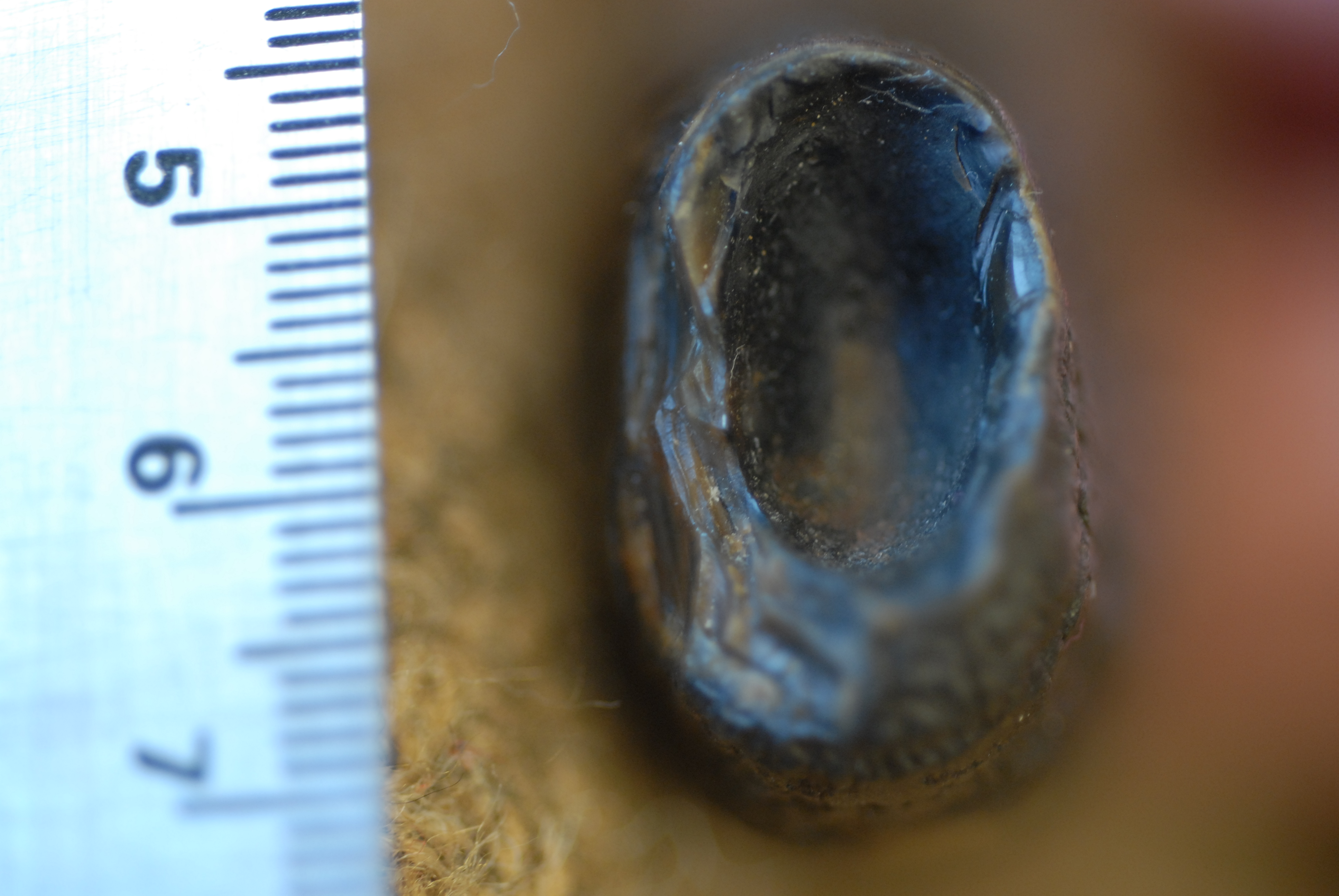
This particular tooth was given to the current owner.  Matu believes it was found in a gravel operation near Barrow, AK.  He’s really anxious to know what it is.  If you have any ideas what it might be from, please let me know.  If you have any colleagues who might be able to ID it, we’d appreciate it if you’d give them the URL for this post and ask them to take a look if they have time.

The following pictures aren’t great.  I didn’t have a tripod or photo stand, or decent lighting.  If you think you know what it might be, but need better pictures (not hard to imagine) or a particular angle, let me know and I’ll see if I can have him bring it to the lab for a better-lit portrait.

Mystery tooth from near Barrow, AK.
Root of mystery tooth.
Close-up of mystery tooth. Any comments on traces at photo center?

Back Home Again–Finally

The conference wound up on Saturday with a really interesting circumpolar archaeozoology session, organized by Max Friesen of the University of Toronto.  I’ll do another post about the papers; this one is about coming home.  A bunch of us went out to dinner at a restaurant on a little square up Rue Lacépéde from Rue Monge.

The next day I started home.  My flight was late in the day, so I had a while to hang around Charles De Gaulle (the airport), which resulted in spending money at the duty-free shops on chocolates (for Glenn) and perfume (for me).  The Air France flight had really good food, and was even a bit early into JFK.  Passport control and US customs were the usual slow lines winding around like snakes, but eventually I made my way (by train) to the place where the hotel shuttles stop and got to the room.  A few glitches with the card keys (apparently their machine is on its last legs and only one of 3 worked) and I was able to sleep.

I had to get up quite early Monday, which wasn’t such a chore since I was still on Paris time, since my flight was at 7AM.  While checking in, I discovered that what had appeared as a JFK-ANC flight actually stopped in Salt Lake City.  And that’s where the trouble started.

We arrived in a perfectly good plane, a bit early, and were told that we were going to change planes.  They re-boarded us an hour or so later on the new plane, closed the doors, and discovered that an engine light was on.  They replaced a part, took the jet-way away, tested the engine, put the jet-way back, did something else, took the jet-way away, tested the engine, put the jet-way back, went looking for some other parts, found them, started replacing them, decided that they should deplane us because one of the parts was hard to get at and it would take a while  (they didn’t know that until they started doing the work?  what kind of mechanics are these?),  but we could leave larger luggage on board to speed re-boarding.  They handed us $6 meal vouchers and told us not to leave the boarding area (where there was only one place to get food for 100+ people).  Several hours later, it was clear that I would not be making my connection in ANC to go to Barrow.

When I went up to get re-booked, they were not able to find me a seat from ANC to Barrow until Wednesday.  I had them book it anyway, so I didn’t wind up having to wait even longer.  Eventually, they had us go on the plane five at a time to get the stuff we’d left there, and then sent us to another gate with another plane.  We finally made it to ANC about 4.5 hours late.  A few of us were stuck overnight, but at least the large contingent of senior citizens from the Midwest heading for a cruise ship didn’t miss their sailing.

It took them quite a while working on my ticket, and in the end they took my email and emailed me the itinerary later.  I did wind up standing around so long that when it was time for hotel vouchers, I’d checked the room availability, and was able to get them to put me in the Millennium, which has a decent restaurant and a gift shop that sells T-shirts (which I needed since I didn’t want to do laundry), instead of the Puffin Inn.  I think the problem was that they managed to book me on a Tuesday flight to Fairbanks, with a layover until the Barrow flight arrived, but hadn’t canceled the Wednesday reservation, so the prices weren’t coming out right, and the poor fellow didn’t have a calculator and was having to do all the math by hand.  They handed me more meal vouchers (which didn’t go that far in ANC in the summer) and off I went to catch the shuttle.

The flights on Tuesday went smoothly, Glenn was there to meet the plane, and my bag was one of the first out, so it was only about a 45 minute wait.  We then went over to the library where there was a BASC-sponsored talk going on, to hear the rest of the program, and pick up our daughter and an archaeologist friend, Rick Reanier, who is in Barrow getting ready to do some survey for Shell Oil down the coast.

Naturally, the first couple of days back have been a zoo.  One client has a procedure where they need to get letters estimating how much you are likely to charge them until the end of the fiscal year (September 30) so they can move money around.  The person who does that is going on vacation, so they needed this done ASAP.  So I made those letters, only to have them discover they didn’t have enough money in the projects to do that, and they didn’t have time before the woman left to move the money.  So I had to rewrite the letters to fit their budget!  I really don’t know why they don’t just do it themselves…  That took most of the last 2 days.

In between rewrites, I had a group of Secretary Salazar’s staffers (he’s in Barrow holding a public hearing) tour my lab while touring the building.  Fortunately, they were busy so the tour was brief.  Then I had a regular teleconference with clients, which I got called out of to go and photograph a very large tooth for a local man, Matu.   We think it may be a saber-tooth cat.  Photos have been forwarded to various paleontologists & mammologists, and we await the verdict.

Very neat website about Science and Barrow

Barrow is a pretty interesting place in terms of the sheer amount and variety of science that gets done here, as it has been since the 1st International Polar Year (IPY).  It can be hard keeping track of it even if you live here and are a scientist.  We don’t have a local newspaper reporter, and the radio station can no longer afford a full-time reporter, so there is no local source of science stories for the general public.

Many scientists want to let people know what they are doing, and what they are learning by it, but there are a number of barriers (another post for another day).  One way is blogging.  On bigger hard-science projects, websites and more are possible, since the cost of people to take care of them is really a tiny  portion of the project budget.

A recent project called OASIS really takes this to another level.  Dr. Paul Shepson, the PI, actually built in an author to write about the project, and things grew from there.  Peter Lourie, the author, has written two children’s’ books and has moved on to multimedia.  They’ve made a really neat website, which has video from a number of scientists who work in Barrow.  There’s a lot from various folks on the OASIS project, but also from people who live in Barrow, like Fran Tate of Pepe’s, whaling captain Eugene Brower and even me.  I actually got interviewed twice, because the sound on the first set got messed up, so I had to do it all over again when Peter came up again!

Definitely worth checking out.

We see this much sun in December (although it snows a bit more…)

It has pretty much been overcast all week.  The sun is not visible, although at times the clouds have thinned enough that it was fairly bright.  Coupled with constant strong wind, and mixing in fog, rain showers, and a half-day of snow squalls, the weather has been unfortunate, to say the least.  Despite all that, we managed to completely excavate two more burials, and start a third, as well as dig a whole bunch of STPs.

On Thursday, I stayed in town in the morning to take part in a call-in radio show on  KBRW, the local public (in the best way) radio station, about the graves at Nuvuk, ancient and modern, and the issues about vehicle traffic and erosion, as well as some broader discussion of similar issues in the other North Slope villages.  Delbert Rexford, UIC Land Chief, some of whose ancestors lived and are buried at Nuvuk, organized the show, which went in a time slot normally used by the North Slope Borough Health Department.  They had a cancellation, so we filled in.  We also had Wesley Aiken, a respected local elder, Patuk Glenn, from IHLC (the Inupiat History Language and Culture Commission), Vera Williams from NVB (the Native Village of Barrow–the local tribal government) realty department, and Heather Dingman from the Health Department.  It went well, and we got several callers, including one who called to say they appreciated the work the NAP has been doing with the students, which was nice to hear.  Thanks to Seismic Isaac Tuckfield for engineering, and letting us run over the time slot a bit.

Once we were done, I headed back home to put on the warm gear, and Dennis O’Rourke (who’d been catching up on manuscripts since no burial excavation that might require sampling was happening when I wasn’t there) and I headed out to Nuvuk.  On the way, we ran into Mike and Patsy Aamodt.  Mike has a set net near the site, and he and Patsy often stop and see how things are going.  One of their nieces, Jackie, worked on the project for several years.  Anyway, Mike has finally been getting fish (they’re late here like everywhere else in Alaska this year) and he asked if I would like one.  Of course, yes, so he said he’d drop it off in my qanitchat (Arctic entryway, or stoop for those of you from upstate NY).  When I got home, there were 3 lovely fresh chum salmon in a bag, so they needed to be taken care of right away.

Friday was still somewhat windy, with fairly serious rain for Barrow.  Since the wind had changed direction, we would have had to move the windbreak before we could even start work, and our crew was very small.  Flora left for firefighter training in Fairbanks (yeah, Flora!) and a couple of others were out for the day for various reasons, so we decided it was more sensible to do a lab day.  That was a good thing, since I was having a minor freezer space crisis at home, and so I invited the non-local project members (AKA the grown-ups) plus Laura (& her husband Bryan and baby Violet) over to eat one of the fish for dinner.  Jenny Raff contributed a fine salad, and beverages were provided by Laura & Bryan & Dennis.  A fine time was had by all.

Today I went to the BASC Saturday Schoolyard talk, which featured a NOAA LTjg talking about hydrography (actually a very interesting talk) and then added all the week’s transit data to the catalog, updated the lab computer, and spent some time plotting the data and checking IDs for the radiocarbon dates I got in this week.  After I finished that, I was going to head home and get the pictures ready to post on the week’s progress int he field.  I’ve fallen a bit behind since standing in the cold wind at the transit for much of the day does take it out of you a bit, and then one tends to get really sleepy when one gets back into a warm building.   However, I got a call from an archaeologist friend from Anchorage who brought her 17-year-old son to Barrow as a field trip for his Alaska Studies class (very cool), so I met them for dinner at Osaka, the local sushi restaurant (which is quite good).  Just got back, as they are heading for Nuvuk on the Aarigaa Tours van tour.  I’ll have to get the pictures ready for a descriptive post tomorrow.

Living where you work has its down-side

Unlike most other Arctic archaeologists, I live where I work.  My house is less than 10 miles from the site I am currently working on, and there are other sites closer than that.  In general, that’s a good thing, and I wouldn’t change it for the world, but like so much else in life, it’s not an unmixed blessing.

PROS OF LIVING WHERE YOU WORK

  • Community members can take part in all parts of the project, and can find you to ask questions whenever they want.
  • No long expensive trips to get to the field.
  • Logistics can be arranged before the field season, by talking to people you know or making local phone calls.
  • Gear doesn’t have to be shipped to and from the field, at great expense.
  • If you run out of Ziplocs during the season, you can get more at the grocery store (assuming they haven’t run out, of course.)
  • The artifacts get to the lab every night, after a short trip, and can be treated and stabilized quickly if necessary.
  • The artifacts stay in the community.
  • You get to sleep in your own comfortable bed.
  • You get to cook meals in a real kitchen and go to restaurants, instead of having to eat only things that everyone else will eat too. (Arctic archaeology is hard work, and camp cooking can’t get so far off the beaten track that some folks won’t eat it.)
  • You have access to laundry equipment.
  • You’ve got your professional library handy if something unexpected shows up.
  • You have a good computer and internet access.

CONS OF LIVING WHERE YOU WORK

  • No long expensive trips to get to the field, so people can’t understand why you can’t take a day off during the field season, or don’t want to run out at midnight to see some archaeology they just found.
  • You get to sleep in your own comfortable bed (so you stay warm and can’t eat unlimited amounts of fat and sugar and still lose weight during the field season, so you have to exercise & watch your diet the rest of the year 😦 ).
  • You get to cook meals in a real kitchen (which means you have to cook and clean up, even if you’re exhausted.)
  • You have access to laundry equipment (which means you are expected not to wear the same clothes for 6 weeks, or at least to wash them frequently if you do, so you don’t get out of doing laundry.)
  • You’ve got your professional library handy so you feel like you should be writing professional material in your spare time.
  • You have a good computer and internet access so people expect you to respond to all email just as fast as when you’re not in the field, as well as doing all the work-related tasks you do then (like approving time sheets, etc.).

As you can see, the cons are pretty much personal convenience things, and being here makes the archaeology better and makes it possible to involve local high school students in a way that would be impossible if I didn’t live here.  Aside from the time away from home and school issue (not a minor one with high-stakes testing), no funding agency would pay for a bunch of high school students (& chaperones) to spend weeks somewhere else so they could be part of the lab work.

Right now, I’m trying to get as much “housekeeping” type stuff out-of-the-way, both at work and at home, as I can before the fieldwork starts on July 5.   No way I’m going to get through the to-do before the field list.  Oh well.

Public Meetings & Archaeology

For the 2nd Tuesday evening in a row, I was at a public meeting being held by a NSB Assistant Borough Attorney, who is working on the monumental task of revising Titles 18 and 19 of the North Slope Borough Municipal Code.  These Titles deal with permitting and land use, including issues affecting cultural resources.  She’s certainly trying to do a good job, and the people who came had good input.  Unfortunately, it’s been pretty nice weather both nights, so turnout was light.

Since I’m one of maybe 3 archaeologists resident in Barrow, and the others were otherwise occupied (well, I did bring Glenn along this evening), it seemed like it was pretty much my duty as a concerned citizen to go and make sure the attorney is aware of issues that she might not have thought of.   Many more meetings in all the villages and more drafts and Planning Commission and then NSB Assembly need to pass it before anything really comes out of it, but at least there is some progress.  I certainly hope so, since otherwise I might have finished a piece of needlepoint I’ve been working on for 6 months.  Maybe tomorrow…