I woke up and turned on the radio this morning in time to hear the morning fellow recommend paying attention to the weather. Since most folks here do that anyway, it was obvious that something a bit unusual was coming.
…COASTAL FLOOD WATCH REMAINS IN EFFECT FROM 2 AM AKDT SATURDAY THROUGH LATE SATURDAY NIGHT…
A COASTAL FLOOD WATCH REMAINS IN EFFECT FROM 2 AM AKDT SATURDAY THROUGH LATE SATURDAY NIGHT. LOW PRESSURE 400 MILES NORTH OF BARROW EARLY THIS AFTERNOON WILL STRENGTHEN TONIGHT AS THE LOW MOVES SOUTH. BY SATURDAY MORNING THE LOW IS EXPECTED TO BE ABOUT 250 MILES NORTH OF BARROW. STRONG NORTHWEST WINDS WILL DEVELOP ALONG THE BACKSIDE OF THE LOW. WIND SPEEDS OF AROUND 25 KNOTS ARE EXPECTED IN BARROW LATE TONIGHT THROUGH SATURDAY NIGHT WITH WINDS TO 35 KNOTS OFFSHORE.
THE SEA ICE IS NOW NEAR SEASONAL MINIMUMS AND THERE IS OPEN WATER SEVERAL HUNDRED MILES TO THE NORTHWEST OF BARROW. THIS WILL CAUSE SEAS NEAR SHORE TO BUILD TO 9 TO 13 FEET ON SATURDAY. THE SEAS ARE EXPECTED TO BREAK ALONG OR NEAR SHORE. IN ADDITION TO THE HIGH SEAS A STORM SURGE OF UP TO 2 FEET IS POSSIBLE AROUND THE TIMES OF HIGH TIDE SATURDAY AND SATURDAY NIGHT. SIGNIFICANT BEACH EROSION IS EXPECTED WITH MINOR COASTAL FLOODING POSSIBLE AROUND THE TIMES OF HIGH TIDE. THE AREA AROUND STEVENSON STREET NEAR THE BOAT LAUNCH BY THE CITY PLAYGROUND IS PARTICULARLY VULNERABLE TO FLOODING. OTHER LOW SPOTS ON DOWN THE BEACH WILL ALSO HAVE THE POTENTIAL FOR MINOR FLOODING.
ADDITIONALLY…SIGNIFICANT EROSION TO THE BLUFFS ARE LIKELY AS WELL.
PRECAUTIONARY/PREPAREDNESS ACTIONS
… A COASTAL FLOOD WATCH MEANS THAT CONDITIONS FAVORABLE FOR FLOODING ARE EXPECTED TO DEVELOP. COASTAL RESIDENTS SHOULD BE ALERT FOR LATER STATEMENTS OR WARNINGS…AND TAKE ACTION TO PROTECT PROPERTY. NOW IS THE TIME TO MAKE PREPARATIONS AND MOVE ALL PROPERTY WELL AWAY FROM THE BEACH.
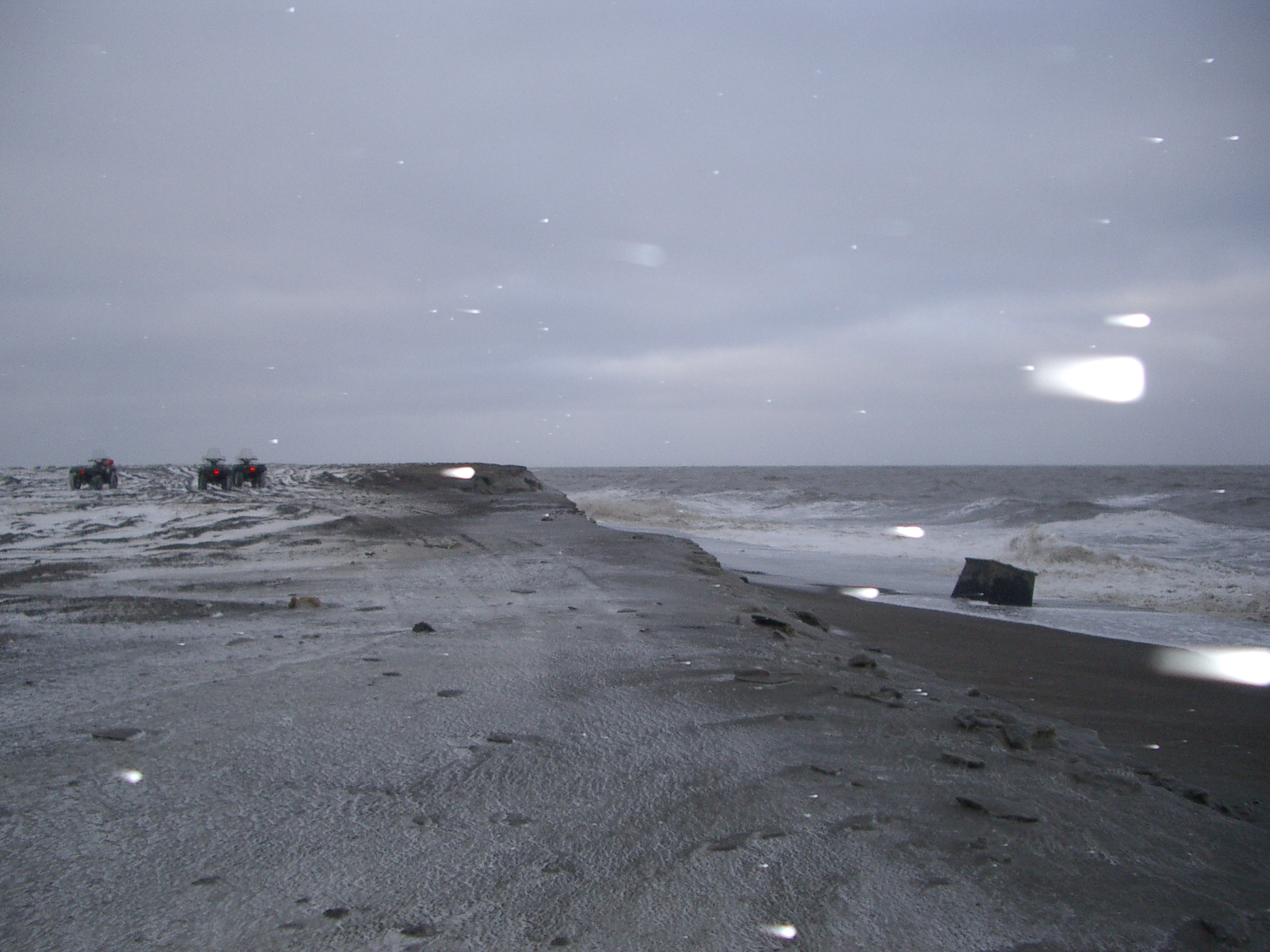
Not what I needed to hear… Turns out it’s the first big fall storm. With the ice so far out, that means lots of room for the wind to put energy into the water, which means big waves and a storm surge. That means beach erosion for sure, and maybe coastal flooding. Our weather forecasts here are a bit less accurate than those most other places, because there are no observing stations where the weather is coming from. It’s sort of like trying to predict weather in Pennsylvania using data from nothing but a weather station in Chicago.
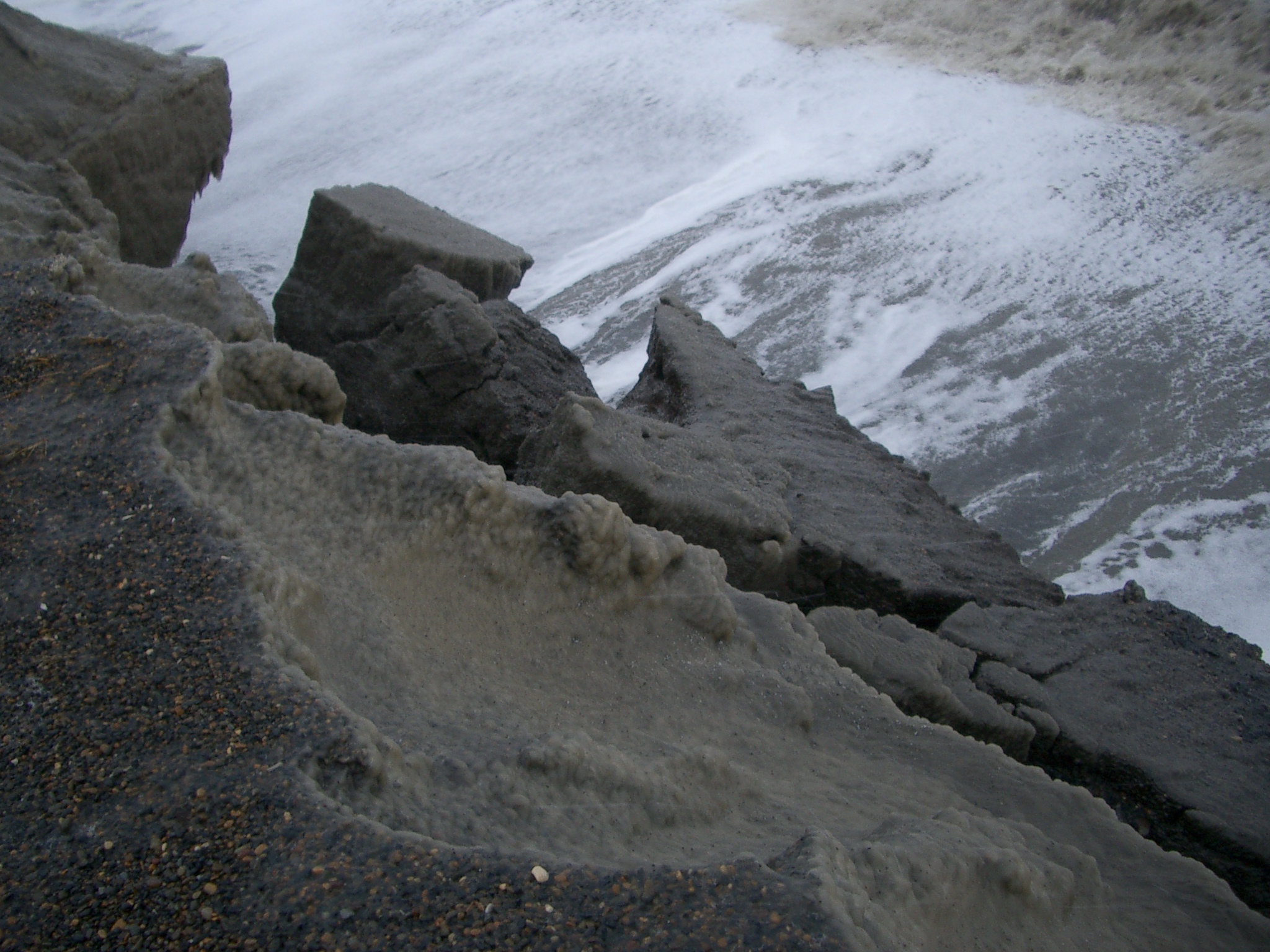
I don’t like fall storms and coastal erosion. Aside from the dangers associated with flooding (the house I live in floated in 1963, and if it does it again we might wind up in a sewage lagoon), erosion is the most immediate threat to coastal archaeological sites. I spend my summers trying to organize things so that we got well ahead of erosion at Nuvuk and now are trying to stay that way.
2004 fall storm erodes NuvukNuvuk bluff slumps from effects of surf
The thing is, Nuvuk, where “the houses are all gone under the sea” to borrow T.S. Elliot’s phrase, is just one of many important sites. Utqiagvik, Nunagiak, Ipiutak, Tikigak (Point Hope), and so on down the coast. Most of the sites on the Beaufort coast from Point Barrow east to the Mackenzie River Delta in Canada have already washed away and out of the archaeological record.
The processing of the large bulk samples is proceeding. It’s slow going, but we are reducing the overall volume. We have found a few things that are noteworthy.
Claire has found some well-preserved wood that she was able to take samples of for species identification and possible tree-ring dating.
We also found one piece of coal with one flat, highly polished side. The rest of it looks like it broke naturally and got smoothed by being rolled in the water, but the one side looks different. It’s a maybe, but a pretty good one, although we’ll probably never know what it was or was going to be…
There are also a variety of marine worms, shells and what we think are marine plants. I just spoke to a friend of mine, “retired” biologist, Dr. Dave Norton, who used to live in Barrow and is fairly familiar with the contents of modern strand lines here. Claire is going to take the oddities we are sorting out down to Fairbanks (where he lives) tomorrow night, and he will look at the specimens and try to connect with the appropriate curators at the UAF Museum of the North. I’m going to Fairbanks (for shotgun refresher qualifications for a non-archaeology project I manage for Sandia National Labs) the week after next, and will go visiting the curators with him, in hopes of getting good IDs.
…because Shawn Miller, the physical anthropologist who will be documenting the human remains excavated at Nuvuk this summer, is supposed to be on it. The weather has been rather unfortunate of late, and a number of flights have tried to land, only to be turned back by visibility below minimums, thanks to the fact that the folks who sited the Will Rogers-Wiley Post Memorial Airport seem to have picked the foggiest spot they could find. A lot of folks have gone back and forth between Anchorage or Fairbanks and Barrow a couple of times by now (and you don’t get frequent flier miles for that).
We’ve got the lab all ready, and Laura is getting Shawn’s equipment (various digital measuring devices) out in case he wants to get an early start. Once he’s done, we can arrange the reburial.
I mentioned that we started excavating a burial on the 15th of July and didn’t finish until the evening of the 19th, due to some really nasty weather. It was simply too windy to excavate from Thursday afternoon until Monday the 19th after lunch. Rain, sleet, and snow are all bothersome, but can be worked around. Once the wind speeds get over about 30 mph, the chances of small artifacts (or even worse, small skeletal elements) being moved before their position is recorded or even blowing away altogether is real. Wind speeds at Nuvuk are usually 5-10 mph higher than the official NWS measurements in Barrow. Last year we had a Kestrel 4000 portable anemometer on site, but Laura’s dog Sir John Franklin ate it, so we have to estimate a bit.
We started work on the burial, called 10A927 on Wednesday, clearing vegetation and the organic soils covering the actual burial. On the 15th, we began exposing the individual. The skeleton was quite well-preserved. It quickly became apparent from the size of the femur (thighbone) that this had been a very large person. Dennis O’Rourke, the physical anthropologist who has the grant to work on the aDNA from Nuvuk, helps with the excavations each season. He’s pretty tall (I’m guessing maybe 6’4″) and his opinion was that the burial was of someone who was very close to his height. That would pretty much have been a giant at the time of European contact, since the tallest man the Ray expedition’s surgeon George Oldmixon measured in 1882-3 was 5’8 3/4″ tall. There have been several other fairly tall individuals in the ancient graves at Nuvuk, so maybe the average height was depressed at contact because of poor nutrition because Yankee whaling had depleted the whale stocks pretty badly. We were able to get an aDNA sample, which we take as soon as the ribs begin to show. Jenny suits up and excavates and collects a previously unexposed rib. Weather forced us to tarp the burial to protect it until conditions improved.
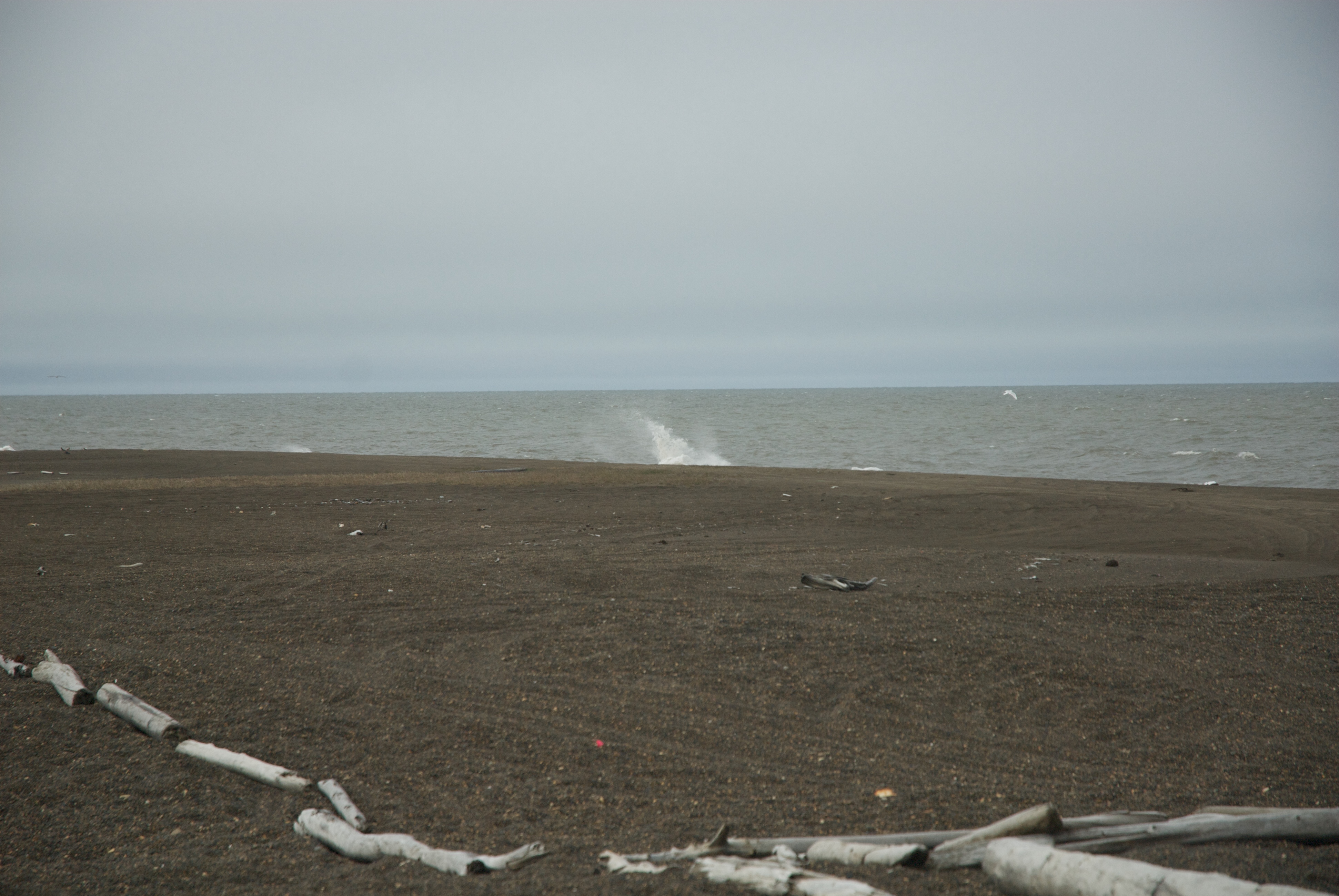
Wave breaking on the Beaufort beach at Nuvuk as the weather improves.
On Monday the 19th, the weather was pretty bad in the morning, but by lunch time it was improving, so we went out. The passing of the storm had brought the winds around from SW to ENE, so the first order of business was to move the windbreaks on burials 10A927 and 10D75 (which we were excavating simultaneously). We then began excavating. 10A927 turned out to be a very interesting burial. The skeleton was nearly complete and well-preserved, and the positioning and grave structure were pretty typical for Nuvuk. It was very nice to be able to show the students a real-life example.
I can’t show any pictures, as the Barrow Elders do not want them made public, based on past unfortunate experience. I’ll do my best to describe the burial. A shallow pit had been dug in the gravel (it’s pretty hard to dig anything else, even with metal shovels, which they didn’t have back then), and surrounded it with a “frame” of wood and/or whalebone. 10A927 had a nice whale rib at the foot, and wood at the sides and head. The man had been placed on a hide, probably caribou, on his back with his knees bent. His legs were bent a bit more than usual for Nuvuk, with his feet right by nis pelvis, almost as if the grave had been a bit small. Perhaps the grave diggers had made the standard grave and he was a little too tall to fit easily. His face was turned left. His arms were folded over his chest and stomach.
A number of things had been put in the grave with him. We found a number of whalebone bola weights (bolas were used for hunting birds), which may actually have been put in as a complete bola. We also found a lot of the beach cobbles (bigger than the regular gravel and not that common at Nuvuk) that we have come to call “burial rocks” that were placed in some burials. Most interestingly, he had the top of a human skull , which had apparently been placed on his stomach under his hand, since we found finger bones and a bola weight in it. The skull appeared to have been on the surface at one point, as it was lighted in color than the skeleton, but it seems to have been placed in the burial deliberately, not found its way in later. We have had a couple of burials with more than one person in them, and some where a later burial had disturbed an earlier one and ended up with parts of the earlier burial in and around the later one, but nothing like this.
All this was quite complicated to excavate and record. Since the high school students are all minors, and some are only 15, the easiest way to avoid violating any child labor laws is to make sure they don’t work late. So they went back to town with one of the bear guards just before 5pm, and the rest of us (Jenny, Laura, Ron & I) stayed out to finish. It’s kind of unfortunate, since we only work late when something delicate and usually interesting is being excavated, and it seems tough on the students to make them leave just as things get really cool, but since this is a real job for them, we have to be on the safe side and follow all the rules.
We didn’t get done until about 9:15pm. It wasn’t the greatest weather for all this (never got above 36ºF) but at least the wind dropped for the last couple of hours.
10A927 by the blue tarp, as we pack up at 9:20pm for the ride back to NARL after finishing the excavation.
It has pretty much been overcast all week. The sun is not visible, although at times the clouds have thinned enough that it was fairly bright. Coupled with constant strong wind, and mixing in fog, rain showers, and a half-day of snow squalls, the weather has been unfortunate, to say the least. Despite all that, we managed to completely excavate two more burials, and start a third, as well as dig a whole bunch of STPs.
On Thursday, I stayed in town in the morning to take part in a call-in radio show on KBRW, the local public (in the best way) radio station, about the graves at Nuvuk, ancient and modern, and the issues about vehicle traffic and erosion, as well as some broader discussion of similar issues in the other North Slope villages. Delbert Rexford, UIC Land Chief, some of whose ancestors lived and are buried at Nuvuk, organized the show, which went in a time slot normally used by the North Slope Borough Health Department. They had a cancellation, so we filled in. We also had Wesley Aiken, a respected local elder, Patuk Glenn, from IHLC (the Inupiat History Language and Culture Commission), Vera Williams from NVB (the Native Village of Barrow–the local tribal government) realty department, and Heather Dingman from the Health Department. It went well, and we got several callers, including one who called to say they appreciated the work the NAP has been doing with the students, which was nice to hear. Thanks to Seismic Isaac Tuckfield for engineering, and letting us run over the time slot a bit.
Once we were done, I headed back home to put on the warm gear, and Dennis O’Rourke (who’d been catching up on manuscripts since no burial excavation that might require sampling was happening when I wasn’t there) and I headed out to Nuvuk. On the way, we ran into Mike and Patsy Aamodt. Mike has a set net near the site, and he and Patsy often stop and see how things are going. One of their nieces, Jackie, worked on the project for several years. Anyway, Mike has finally been getting fish (they’re late here like everywhere else in Alaska this year) and he asked if I would like one. Of course, yes, so he said he’d drop it off in my qanitchat (Arctic entryway, or stoop for those of you from upstate NY). When I got home, there were 3 lovely fresh chum salmon in a bag, so they needed to be taken care of right away.
Friday was still somewhat windy, with fairly serious rain for Barrow. Since the wind had changed direction, we would have had to move the windbreak before we could even start work, and our crew was very small. Flora left for firefighter training in Fairbanks (yeah, Flora!) and a couple of others were out for the day for various reasons, so we decided it was more sensible to do a lab day. That was a good thing, since I was having a minor freezer space crisis at home, and so I invited the non-local project members (AKA the grown-ups) plus Laura (& her husband Bryan and baby Violet) over to eat one of the fish for dinner. Jenny Raff contributed a fine salad, and beverages were provided by Laura & Bryan & Dennis. A fine time was had by all.
Today I went to the BASC Saturday Schoolyard talk, which featured a NOAA LTjg talking about hydrography (actually a very interesting talk) and then added all the week’s transit data to the catalog, updated the lab computer, and spent some time plotting the data and checking IDs for the radiocarbon dates I got in this week. After I finished that, I was going to head home and get the pictures ready to post on the week’s progress int he field. I’ve fallen a bit behind since standing in the cold wind at the transit for much of the day does take it out of you a bit, and then one tends to get really sleepy when one gets back into a warm building. However, I got a call from an archaeologist friend from Anchorage who brought her 17-year-old son to Barrow as a field trip for his Alaska Studies class (very cool), so I met them for dinner at Osaka, the local sushi restaurant (which is quite good). Just got back, as they are heading for Nuvuk on the Aarigaa Tours van tour. I’ll have to get the pictures ready for a descriptive post tomorrow.
As usual, things were a bit disorganized getting ready to go to Nuvuk this morning. However, after rounding up a non-leaking pump, gassing up 5 of the ATVs, buying bungee cords (the many folks who had gotten all the field gear from last year out had somehow not noticed the bungee cords had gone missing), airing up a couple of tires, etc., we set off.
After getting to the site and orienting the newbies, we put all the gear into the proper tents, gave the lesson on how to make up a honey bucket that is unlikely to fail in transit (they have to be backhauled to a proper disposal site), and set off in a line, pin flags in hand, to survey the site. We located one burial during the survey (exposed by recent vehicular traffic, alas) and spent some time getting driftwood to block off and reroute the trail until we can excavate the person. We also located a number of features, and a few loose teeth.
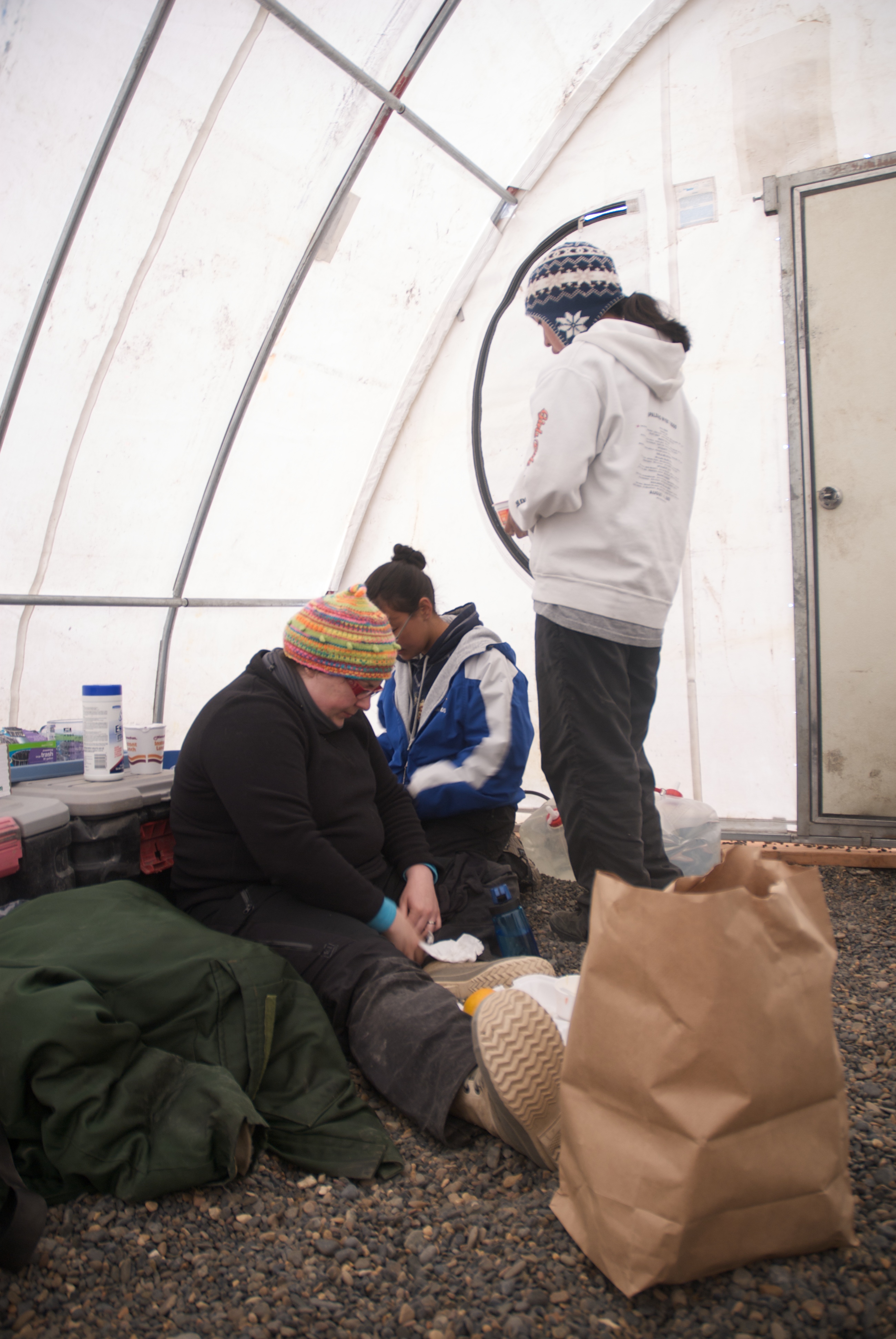
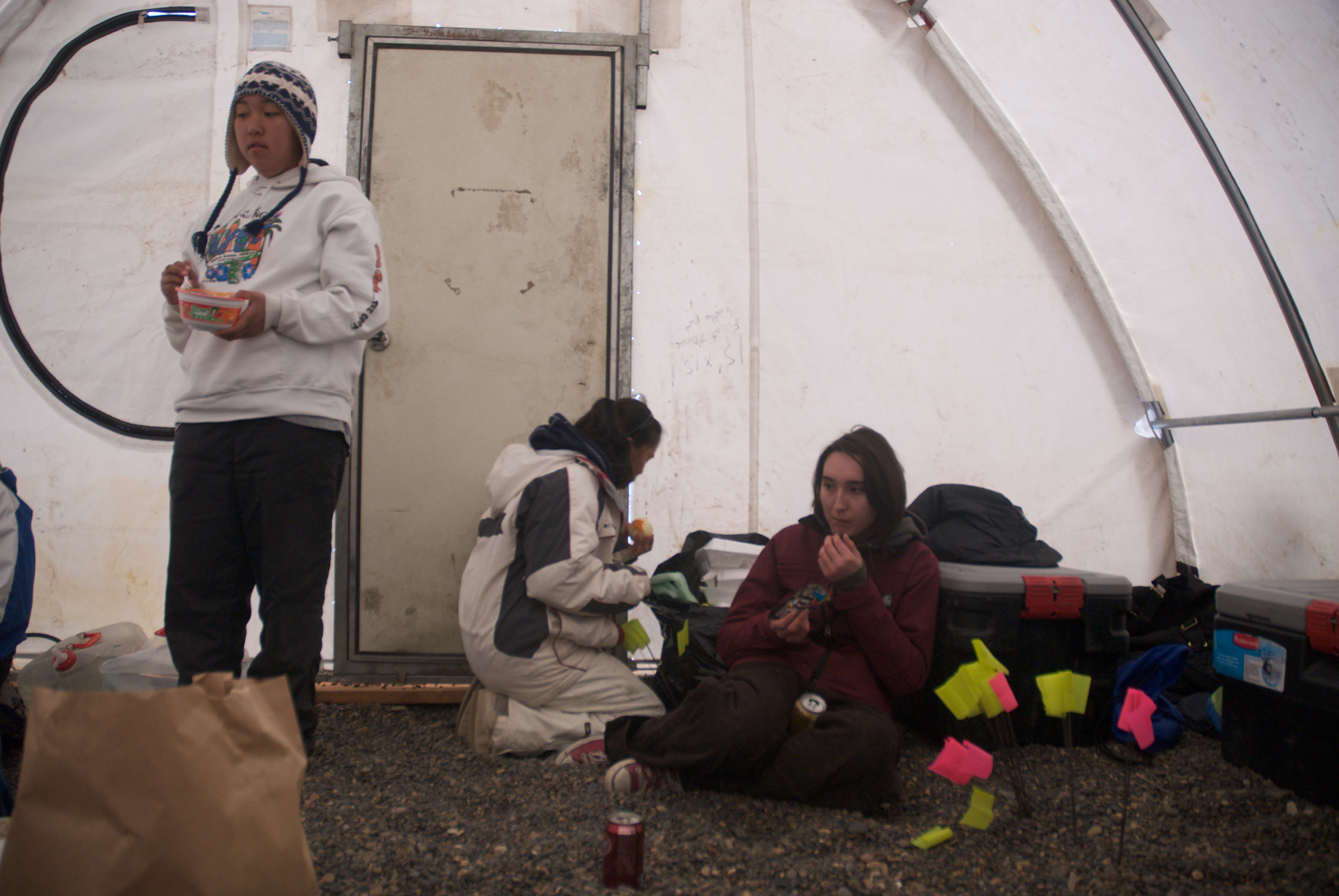
Then it was time for lunch. We have a relatively small crew this year, so the tent felt quite roomy.
Laura, Flora and Trina get their lunches ready.Trina, Nora & Victoria have lunch in our spacious Weatherport.
We took the usual hour for lunch (Rochelle actually caught a nap), and then we went back at it. It started raining, and kept it up until just before clean-up time. Everyone was well dressed, and since the wind was WSW, it wasn’t too cold. The NWS had called for rain or snow, and we’d all be hoping for snow if anything, since it is less wet AND makes for better pictures.
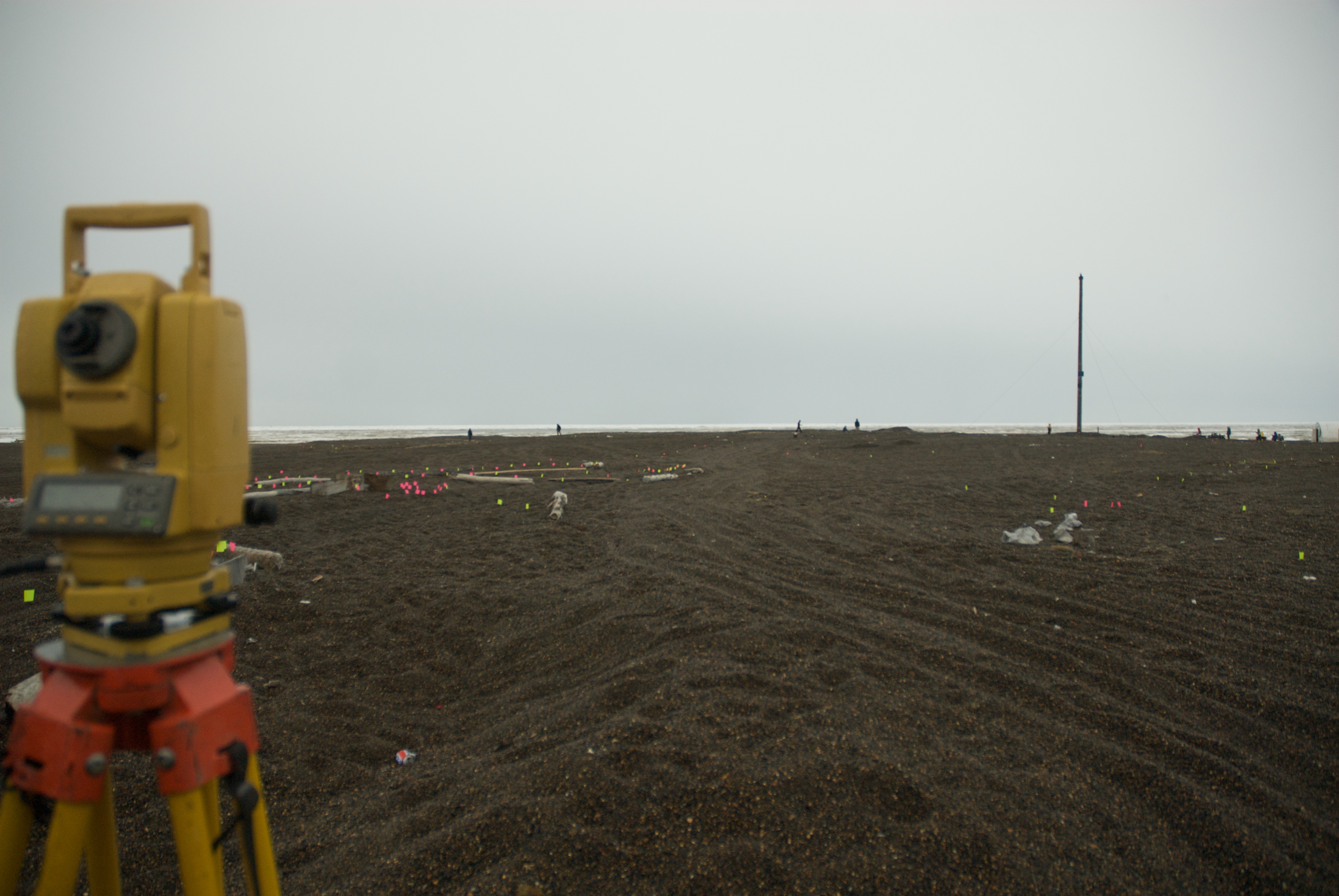
Flora and I set up the transit to shoot in the locations of the burial and some artifacts near it. We are moving from the primary datum we have used for many years, because erosion is approaching and we will lose it in the near future. Fortunately, the work we had done last summer setting up paid off and everything went smoothly. We need to mark a couple of the additional datum points tomorrow so they are easier to find.
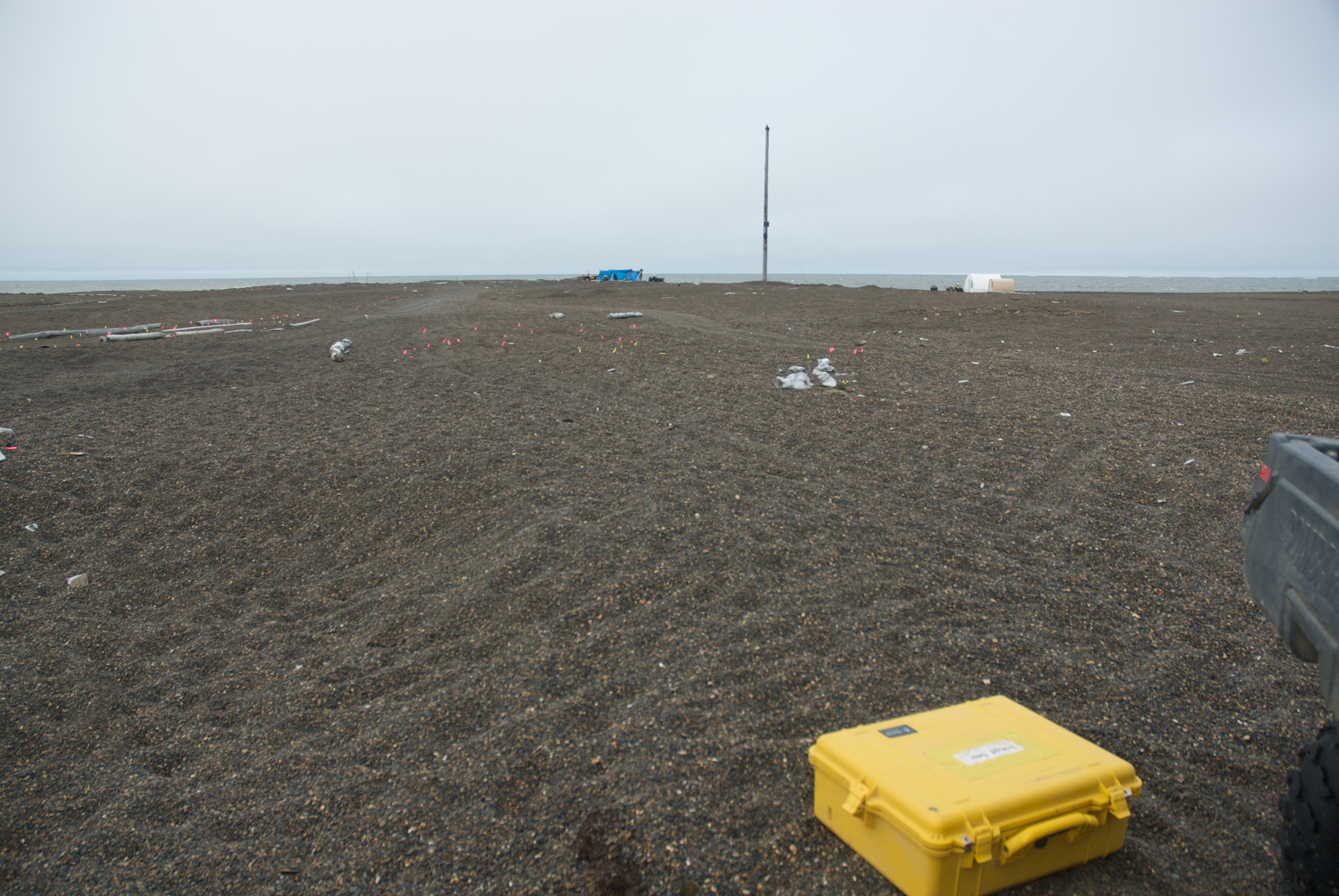
View from transit station over the area we will be working in this season.
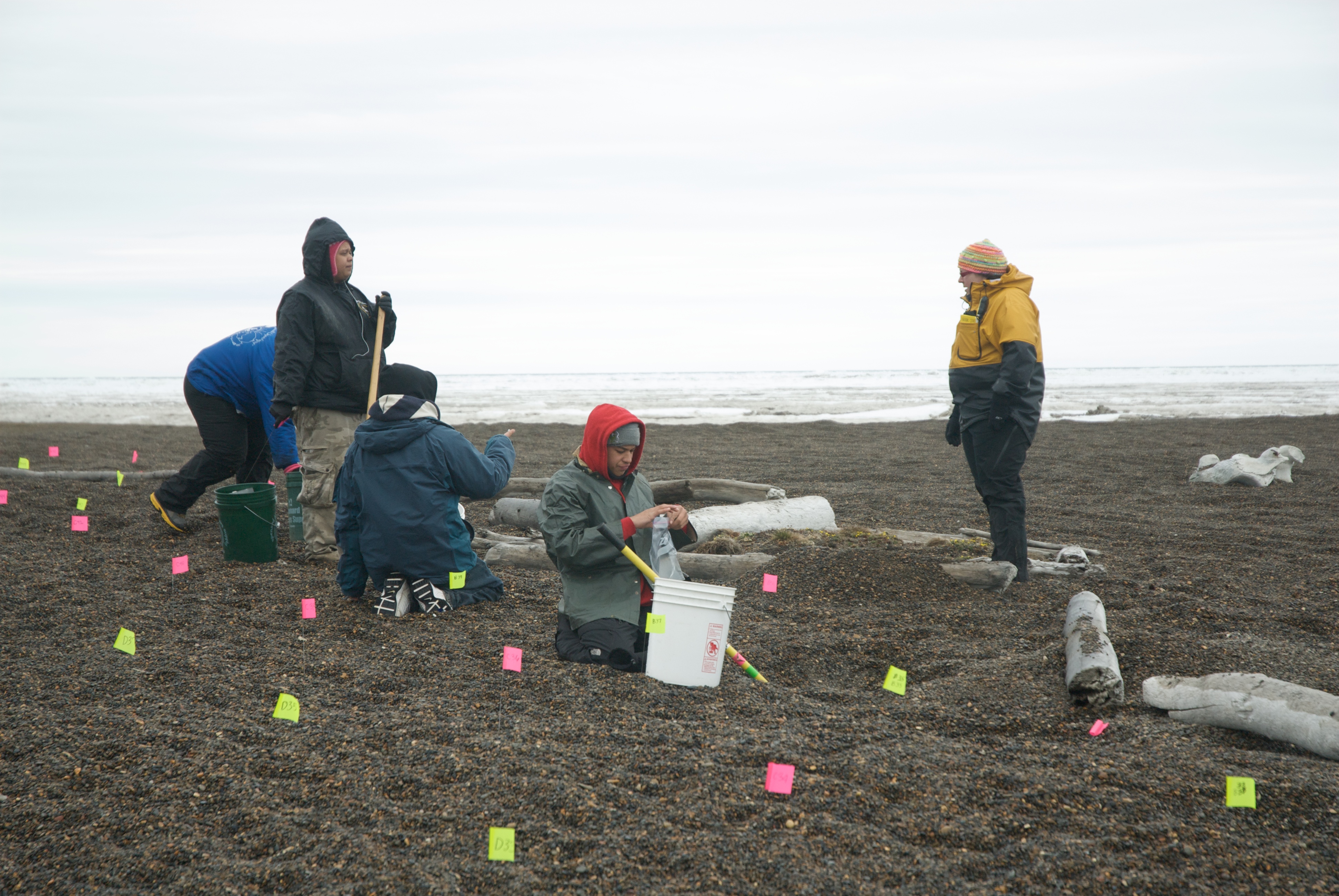
The rest of the crew laid out lines of shovel test pits, and soon Nuvuk was festooned with lines of bright pin flags. We had to dig some of the STPs (shovel test pits) quickly, as they fell on the trail, and we needed to clear that area so people don’t start diverting into untested areas.
Part of crew hard at work among the pin flags.
Flora shot in the STPs, and Brody backfilled about 20 by himself. Then we packed up, rather quickly for the first day, and headed back in. We didn’t see any bears all day. A couple of hours later, all data is downloaded and backed up, everything is on a charger that needs to be, my houseguest and husband have been fed dinner, and I’m going to bed.
Monday afternoon I got to take a quick trip to Nuvuk to check on the two tents BASC had put up for us to use doing the field season. The big one is for lunches and gear storage, and the little one is for the honey bucket (the tour van kept showing up at such awkward times…). It was a nice sunny day, not too windy.
On Point Barrow, heading toward NuvukLooking northwest across Point Barrow. The horizon is white because of "ice blink" since the ice pack is still in.
We even got to see a polar bear. It was sleepy, and just lay there snoozing. There was a van full of tourists snapping away (just out of frame to the right).
Sleepy bear at Nuvuk.Blown-up picture of the bear.
You never see Indiana Jones doing labwork. Of course, you never see him taking notes, either, so perhaps one should not take the good Dr. Jones as a guide to good archaeological practice.
In fact, for projects which involve actual excavation of a site (presumably thereby giving rise to a collection of artifacts and other sorts of physical data such as C14 samples and faunal remains), far more time will be spent in the lab than was spent in the field. Labwork is a necessary and important part of archaeology. After all the time and energy spent in the field finding, recording and excavating things, it would be a real pity to just let them deteriorate for lack of cleaning and care, or get mixed up and lose their proveniences because they weren’t properly marked. Then things need to be cataloged, with field IDs checked and expanded on, and the data needs to get into a database so that more detailed analysis can happen without having to root through the entire collection to find things. No labwork = chaos.
The thing is that many of the activities which have to be done in the lab just aren’t that exciting :-(. For example, cleaning things is not on most peoples’ Top 10 Things to Do list. We actually had almost everything cleaned from previous seasons, so there hasn’t been any of that yet. When it happens, it often involves very slow and fiddly removal of gravel, dirt and roots by the gentlest means possible. Sometimes artifacts are so delicate that complete cleaning can’t be done at once, or sometimes at all without the help of a conservator (of whom there are only 2 in Alaska, both at museums).
Our first big task was marking & cataloging, which generally happens after the cleaning. This is really important, and important to get right.
Ideally, all items collected at a site are put into containers (usually Ziploc bags of some sort) or tagged (if they are too big to go in a container) with information as to site of origin, location of find, level and excavation unit they were found in, date found, and who collected them clearly written on the bag or label. The idea is to assign each item (or group of small items like flakes or fish scales) a unique catalog number. The information about that item goes into the catalog, and the item is marked with the catalog number. These days, the catalog is usually a database on a PC, which is a huge improvement on the index cards that were in use when I started, or even the mainframe-based databases which came in shortly after that.
That way, if later an archaeologist decides they need to look at all the harpoon heads, say, from a site (or even many sites), they can be retrieved, and spread out in the lab, grouped and regrouped endlessly, and still not get mixed up or lose associated information. When the analysis is done, everything can get back where it belongs. New information from the analysis can be added to the catalog.
People used to just mark on artifacts with ink, often with a layer of clear nail polish or White-Out as a base coat, and a clear nail polish cover coat, but that wasn’t stable or reversible, and the idea today is that nothing should be done to an artifact that can’t be reversed. We have used Paraloid B-72 dissolved in acetone as base and cover, with the catalog number written in India ink or white ink with a quill pen for years. However, there are not a lot of people who can write a hand that is both tiny and legible. The schools stopped teaching penmanship at all and started kids keyboarding very early, so they don’t really get practice. We went to a system where the catalog numbers are printed on very thin archival paper, which is dunked in the Paraloid and then stuck to the artifact in an unobtrusive (one hopes) spot.
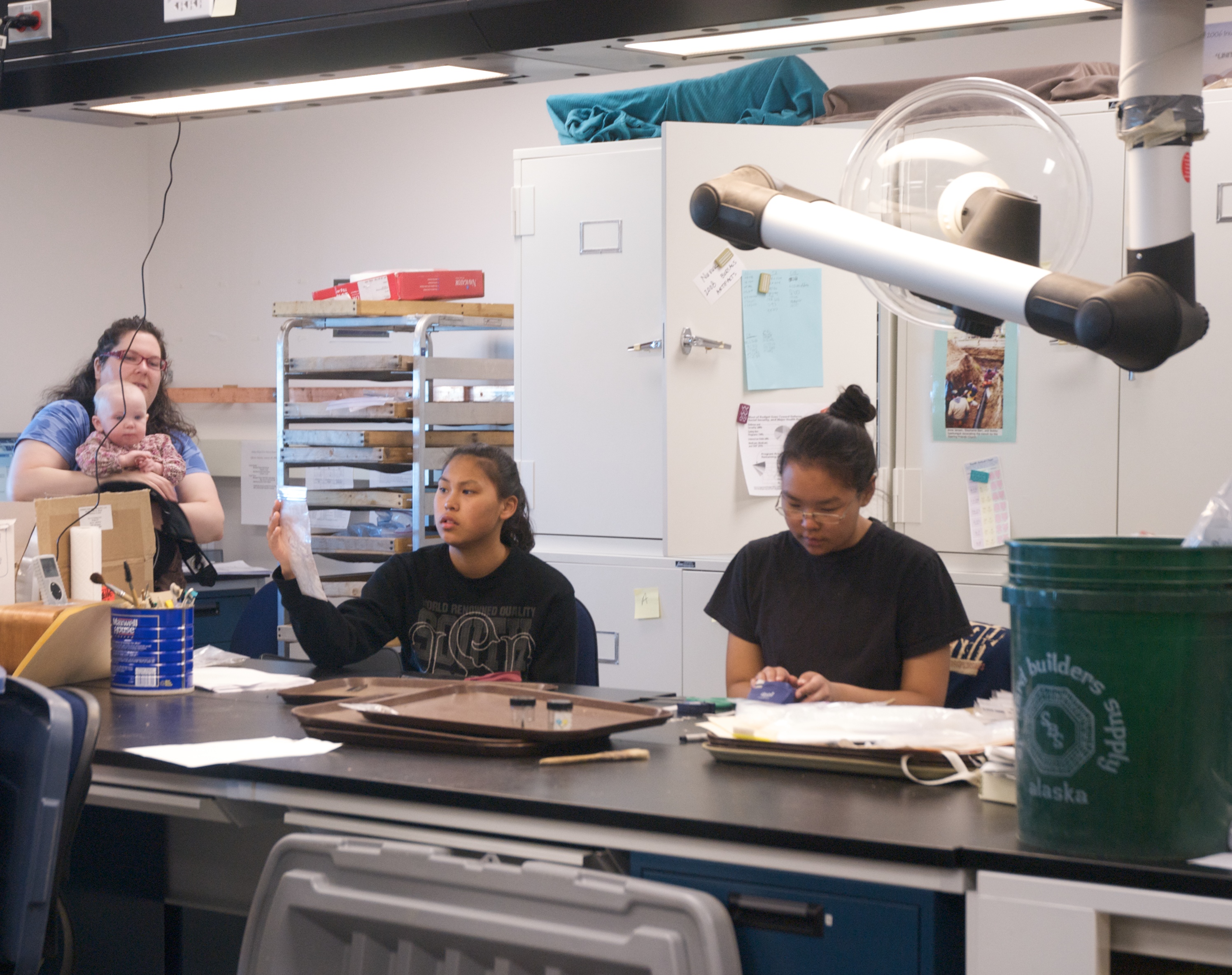
Nora selects artifact to mark, while Flora makes cabinet labels, while Laura & Violet "supervise".
We had some major struggles at first, with the Paraloid bubbling and making everything illegible. We finally realized that the only thing that had changed was a move from a lab in a 1968 building to the new lab in the BARC, which is supposed to be very energy-efficient. It is also extraordinarily dry. One day a woman checking the air flow on the fume hoods measured the relative humidity in the lab, and got 3.8% (not a typo!). I think the Sahara desert is more humid than that! We realized the acetone was evaporating so fast it was making the bubbles. We are now running one house-size and two room-size humidifiers in the lab, and the bubbling problem has gone away. This method is proving very fast, with the only challenge being to get the right label on the right artifact.
However, it isn’t really that exciting, and can get repetitive, which can lead to people getting tired and therefore careless. Like most labs, we try to have people work as a group, although each person is working on their own. It is possible to label and talk at the same time. We’ve got an iPod speaker for tunes, and so far there seems to be enough overlap in musical taste on crew that no-one has had to resort to ear plugs. Like pretty much everyone in archaeology, I’ve spent a lot of time marking and cataloging artifacts, and while time doesn’t usually fly, I can tell you it goes a lot faster when you’re having fun.
Once the artifacts are marked, the catalog info is checked and they are put into cabinets, with the storage location entered into the catalog. In the field, we tend to use quart (“small”) and gallon (“large”) Ziplocs, because they are easy to get, less expensive and too many sizes makes life complex. Most artifacts don’t really need that much room. We are moving the artifacts into the smallest possible archival bags they will fit in, and this is saving a huge amount of space. Particularly nice artifacts, which visitors want to look at, are getting special containers. They get individual beds of ethafoam, inside clear plastic archival boxes with lids. Ron Mancil, a crew member who is currently a MA student at UAF, has museum experience and is very handy as well. He has been applying his skills to making mounts for a bunch of artifacts, so visitors can get a closer look without endangering the artifacts.
Ron hard at work making a mount for a special artifact
It’s true that a lot of what happens in the field isn’t all that exciting either, as you will see in the next post or two. But there’s always the possibility that something really cool will show up in the next shovel test pit (STP) or the next one, or the next one…
A big part of the past couple weeks has involved choosing the crew for work at Nuvuk. There are two funding sources for this project. One is a grant to the North Slope Borough from the Department of Education, through the Education through Cultural and Historical Organizations program (ECHO), and the other is a regular research grant from the Arctic Social Sciences program of the Office of Polar Programs of the National Science Foundation.
The ECHO funds are targeted at K-12 education, so they need to be used for pre-college students and those who teach/supervise them. We’ve been focusing on high school students for those slots. For one thing, we run the dig for these students as a job. That way, even if they don’t find their life’s work in archaeology, they’ll have some spending money for the next school year, and will have learned about interviews, resumes, time-sheets, paychecks and good work habits before they are out on their own. Students who are less than 15 are very restricted in the hours they can work, even in the summer. The first year, we hired a couple of students that young, only to find that every time we needed to stay late in the field (usually because something exciting was happening) we’d have to send them home or violate child labor laws. Essentially, they got punished for being young, which was really no fun for anyone :-(. After that, we only hired students who were older, and could work some OT, so they wouldn’t need to go home just when things got really exciting.
We’ve been doing interviews with students who haven’t worked before, both to assess motivation and to make sure they understand what they are getting into. It’s really cold at Nuvuk, even compared to Barrow, and the wind comes right off the ice. With the field season so short, and the erosion ongoing, we don’t take many weather days.
We’ve also been seeing who is returning, and for how much of the season they are available. Many of the high school students who want to work at Nuvuk are active in many things, including sports (with summer camps), band, Mayor’s Youth Advisory Council, Model UN, and Rural Alaska Honors Institute. Most of these involve some travel, so scheduling is complex. We need to have a good-size crew, but not more than we have 4-wheelers for (allowing for a couple of folks in the lab or sick). I actually do that in MS Project, just so I can get a clear picture and spot pinch-points more easily.
Anyway, we’ve got all the high school students selected, and have notified most of them, except for the ones who are out of town on family vacations. We’ve also got one person on tap for the NSF-funded crew, but it looks like we might have room for 1-2 more, since the planned GPR component fell through. Rhett Herman, a geophysicist from Radford U. in Virginia who has worked with us at Nuvuk in the past, was going to do some geophysical prospecting for burials, which would save us much time & effort. He had hoped to run a field school, but funding was not available for this summer, so a couple of interested students were going to come up as participants in the dig and help with the GPR on the side. Rhett’s wife has come down with some unexplained health problems, and he obviously doesn’t want to travel so far while they are unresolved. Looks like -2 for the crew. So I need to see if I can find suitable replacements.




 Out of Ice and Time