
Shawn made it in on Friday, but some of his digitizing equipment, which had been shipped in advance with a promise from UPS that it would be here last Tuesday or Wednesday, didn’t. He had to start with analyses that didn’t need the equipment, and we’re hoping it gets here in time for him to use it before he travels back to Utah on Wednesday.
Tag: lab
Here’s hoping the plane makes it in tonight…
…because Shawn Miller, the physical anthropologist who will be documenting the human remains excavated at Nuvuk this summer, is supposed to be on it. The weather has been rather unfortunate of late, and a number of flights have tried to land, only to be turned back by visibility below minimums, thanks to the fact that the folks who sited the Will Rogers-Wiley Post Memorial Airport seem to have picked the foggiest spot they could find. A lot of folks have gone back and forth between Anchorage or Fairbanks and Barrow a couple of times by now (and you don’t get frequent flier miles for that).
We’ve got the lab all ready, and Laura is getting Shawn’s equipment (various digital measuring devices) out in case he wants to get an early start. Once he’s done, we can arrange the reburial.
We see this much sun in December (although it snows a bit more…)
It has pretty much been overcast all week. The sun is not visible, although at times the clouds have thinned enough that it was fairly bright. Coupled with constant strong wind, and mixing in fog, rain showers, and a half-day of snow squalls, the weather has been unfortunate, to say the least. Despite all that, we managed to completely excavate two more burials, and start a third, as well as dig a whole bunch of STPs.
On Thursday, I stayed in town in the morning to take part in a call-in radio show on KBRW, the local public (in the best way) radio station, about the graves at Nuvuk, ancient and modern, and the issues about vehicle traffic and erosion, as well as some broader discussion of similar issues in the other North Slope villages. Delbert Rexford, UIC Land Chief, some of whose ancestors lived and are buried at Nuvuk, organized the show, which went in a time slot normally used by the North Slope Borough Health Department. They had a cancellation, so we filled in. We also had Wesley Aiken, a respected local elder, Patuk Glenn, from IHLC (the Inupiat History Language and Culture Commission), Vera Williams from NVB (the Native Village of Barrow–the local tribal government) realty department, and Heather Dingman from the Health Department. It went well, and we got several callers, including one who called to say they appreciated the work the NAP has been doing with the students, which was nice to hear. Thanks to Seismic Isaac Tuckfield for engineering, and letting us run over the time slot a bit.
Once we were done, I headed back home to put on the warm gear, and Dennis O’Rourke (who’d been catching up on manuscripts since no burial excavation that might require sampling was happening when I wasn’t there) and I headed out to Nuvuk. On the way, we ran into Mike and Patsy Aamodt. Mike has a set net near the site, and he and Patsy often stop and see how things are going. One of their nieces, Jackie, worked on the project for several years. Anyway, Mike has finally been getting fish (they’re late here like everywhere else in Alaska this year) and he asked if I would like one. Of course, yes, so he said he’d drop it off in my qanitchat (Arctic entryway, or stoop for those of you from upstate NY). When I got home, there were 3 lovely fresh chum salmon in a bag, so they needed to be taken care of right away.
Friday was still somewhat windy, with fairly serious rain for Barrow. Since the wind had changed direction, we would have had to move the windbreak before we could even start work, and our crew was very small. Flora left for firefighter training in Fairbanks (yeah, Flora!) and a couple of others were out for the day for various reasons, so we decided it was more sensible to do a lab day. That was a good thing, since I was having a minor freezer space crisis at home, and so I invited the non-local project members (AKA the grown-ups) plus Laura (& her husband Bryan and baby Violet) over to eat one of the fish for dinner. Jenny Raff contributed a fine salad, and beverages were provided by Laura & Bryan & Dennis. A fine time was had by all.
Today I went to the BASC Saturday Schoolyard talk, which featured a NOAA LTjg talking about hydrography (actually a very interesting talk) and then added all the week’s transit data to the catalog, updated the lab computer, and spent some time plotting the data and checking IDs for the radiocarbon dates I got in this week. After I finished that, I was going to head home and get the pictures ready to post on the week’s progress int he field. I’ve fallen a bit behind since standing in the cold wind at the transit for much of the day does take it out of you a bit, and then one tends to get really sleepy when one gets back into a warm building. However, I got a call from an archaeologist friend from Anchorage who brought her 17-year-old son to Barrow as a field trip for his Alaska Studies class (very cool), so I met them for dinner at Osaka, the local sushi restaurant (which is quite good). Just got back, as they are heading for Nuvuk on the Aarigaa Tours van tour. I’ll have to get the pictures ready for a descriptive post tomorrow.
Black Powder!!
What an interesting (in the Chinese curse sense) afternoon in the lab!
I went in to the lab to deal with the shoulder gun shell that we found yesterday which had traces of black powder (which is pretty unstable when dry) around the primer hole. In fact, they turned out to be mere traces, and it was easily cleaned and is now drying on a drying rack.
However, in retrieving it from the bucket with yesterday’s finds, I found not one, but two, other items which appeared to contain black powder, and significant amounts at that! One was a shotgun shell head, which had not been fired. Older shells had a paper casing, not the plastic most now have, and that can decay, so we often find the heads alone, filled with gravel. There was a bit of gravel at the mouth of the head, but it had started to fall off in the Ziploc on the way in from the field, to reveal a full load of powder. I was able to soak the shell remnant and get most of the powder out. The primer is still intact, though, so I have it in a bottle of water until we can get it properly disposed of, just to be on the extra safe side.
The other is, I think, some sort of fuse for a fairly large projectile. It was collected as a cartridge casing, but it isn’t. It seems to have had an end blown off, from the way the metal is deformed, but what is left turned out to be packed solidly with some dark substance, nature unknown. Since it was already wet and hadn’t exploded or combusted, I put it into a bottle of water as well, pending disposal.
This just goes to show that when I told one of the students, who was wondering what she should major in when she got to college, that anthropology was great because almost anything you can think of can be related to one of the four fields of anthropology, I really wasn’t lying. I wasn’t thinking of small arms ammunition and explosives when I said it, but there you go.
I also managed to find time to plot all the new transit data. The STPs are falling in just the right place, with no gaps between last year and this year. I also measured the amount of erosion since last year. The bluff edge has receded up to 10 meters at some spots, which is almost exactly average for the ten years I have been mapping the Nuvuk. bluff. In the late 1940s and early 1950s, the erosion at Nuvuk was measured at 4.7 meters per year. The folks that did that got a paper in Arctic out of it. Hmm, I wonder if that would work now?
All the foregoing took a good bit longer than planned, and there were a few things I had to take care of at home, like laundry, so the fieldwork update with pictures will have to wait until tomorrow. Staying up all night when the whole week ahead looks cold is not an option.
Living where you work has its down-side
Unlike most other Arctic archaeologists, I live where I work. My house is less than 10 miles from the site I am currently working on, and there are other sites closer than that. In general, that’s a good thing, and I wouldn’t change it for the world, but like so much else in life, it’s not an unmixed blessing.
PROS OF LIVING WHERE YOU WORK
- Community members can take part in all parts of the project, and can find you to ask questions whenever they want.
- No long expensive trips to get to the field.
- Logistics can be arranged before the field season, by talking to people you know or making local phone calls.
- Gear doesn’t have to be shipped to and from the field, at great expense.
- If you run out of Ziplocs during the season, you can get more at the grocery store (assuming they haven’t run out, of course.)
- The artifacts get to the lab every night, after a short trip, and can be treated and stabilized quickly if necessary.
- The artifacts stay in the community.
- You get to sleep in your own comfortable bed.
- You get to cook meals in a real kitchen and go to restaurants, instead of having to eat only things that everyone else will eat too. (Arctic archaeology is hard work, and camp cooking can’t get so far off the beaten track that some folks won’t eat it.)
- You have access to laundry equipment.
- You’ve got your professional library handy if something unexpected shows up.
- You have a good computer and internet access.
CONS OF LIVING WHERE YOU WORK
- No long expensive trips to get to the field, so people can’t understand why you can’t take a day off during the field season, or don’t want to run out at midnight to see some archaeology they just found.
- You get to sleep in your own comfortable bed (so you stay warm and can’t eat unlimited amounts of fat and sugar and still lose weight during the field season, so you have to exercise & watch your diet the rest of the year 😦 ).
- You get to cook meals in a real kitchen (which means you have to cook and clean up, even if you’re exhausted.)
- You have access to laundry equipment (which means you are expected not to wear the same clothes for 6 weeks, or at least to wash them frequently if you do, so you don’t get out of doing laundry.)
- You’ve got your professional library handy so you feel like you should be writing professional material in your spare time.
- You have a good computer and internet access so people expect you to respond to all email just as fast as when you’re not in the field, as well as doing all the work-related tasks you do then (like approving time sheets, etc.).
As you can see, the cons are pretty much personal convenience things, and being here makes the archaeology better and makes it possible to involve local high school students in a way that would be impossible if I didn’t live here. Aside from the time away from home and school issue (not a minor one with high-stakes testing), no funding agency would pay for a bunch of high school students (& chaperones) to spend weeks somewhere else so they could be part of the lab work.
Right now, I’m trying to get as much “housekeeping” type stuff out-of-the-way, both at work and at home, as I can before the fieldwork starts on July 5. No way I’m going to get through the to-do before the field list. Oh well.
Labwork–A necessary evil?
You never see Indiana Jones doing labwork. Of course, you never see him taking notes, either, so perhaps one should not take the good Dr. Jones as a guide to good archaeological practice.
In fact, for projects which involve actual excavation of a site (presumably thereby giving rise to a collection of artifacts and other sorts of physical data such as C14 samples and faunal remains), far more time will be spent in the lab than was spent in the field. Labwork is a necessary and important part of archaeology. After all the time and energy spent in the field finding, recording and excavating things, it would be a real pity to just let them deteriorate for lack of cleaning and care, or get mixed up and lose their proveniences because they weren’t properly marked. Then things need to be cataloged, with field IDs checked and expanded on, and the data needs to get into a database so that more detailed analysis can happen without having to root through the entire collection to find things. No labwork = chaos.
The thing is that many of the activities which have to be done in the lab just aren’t that exciting :-(. For example, cleaning things is not on most peoples’ Top 10 Things to Do list. We actually had almost everything cleaned from previous seasons, so there hasn’t been any of that yet. When it happens, it often involves very slow and fiddly removal of gravel, dirt and roots by the gentlest means possible. Sometimes artifacts are so delicate that complete cleaning can’t be done at once, or sometimes at all without the help of a conservator (of whom there are only 2 in Alaska, both at museums).
Our first big task was marking & cataloging, which generally happens after the cleaning. This is really important, and important to get right.
Ideally, all items collected at a site are put into containers (usually Ziploc bags of some sort) or tagged (if they are too big to go in a container) with information as to site of origin, location of find, level and excavation unit they were found in, date found, and who collected them clearly written on the bag or label. The idea is to assign each item (or group of small items like flakes or fish scales) a unique catalog number. The information about that item goes into the catalog, and the item is marked with the catalog number. These days, the catalog is usually a database on a PC, which is a huge improvement on the index cards that were in use when I started, or even the mainframe-based databases which came in shortly after that.
That way, if later an archaeologist decides they need to look at all the harpoon heads, say, from a site (or even many sites), they can be retrieved, and spread out in the lab, grouped and regrouped endlessly, and still not get mixed up or lose associated information. When the analysis is done, everything can get back where it belongs. New information from the analysis can be added to the catalog.
People used to just mark on artifacts with ink, often with a layer of clear nail polish or White-Out as a base coat, and a clear nail polish cover coat, but that wasn’t stable or reversible, and the idea today is that nothing should be done to an artifact that can’t be reversed. We have used Paraloid B-72 dissolved in acetone as base and cover, with the catalog number written in India ink or white ink with a quill pen for years. However, there are not a lot of people who can write a hand that is both tiny and legible. The schools stopped teaching penmanship at all and started kids keyboarding very early, so they don’t really get practice. We went to a system where the catalog numbers are printed on very thin archival paper, which is dunked in the Paraloid and then stuck to the artifact in an unobtrusive (one hopes) spot.
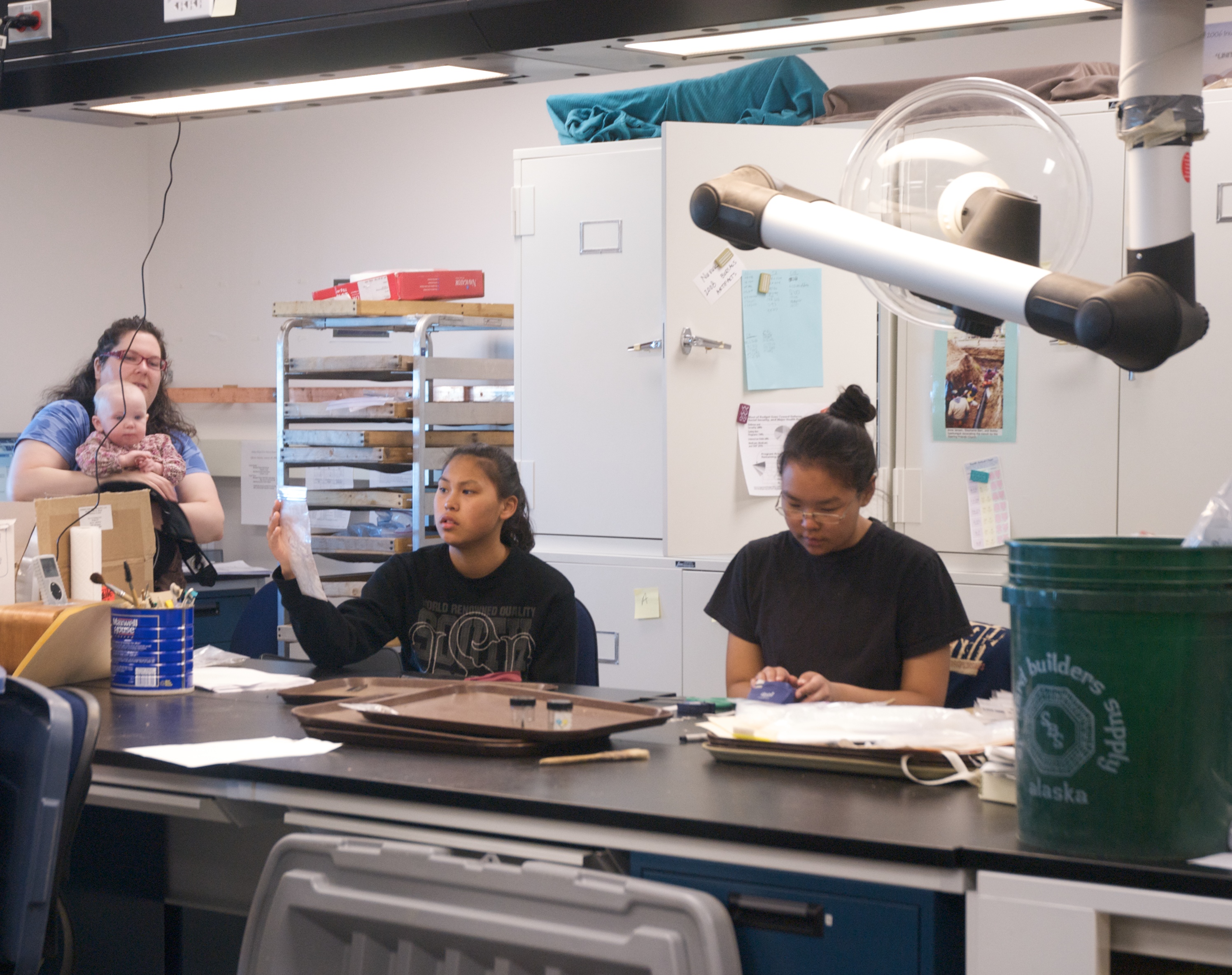
We had some major struggles at first, with the Paraloid bubbling and making everything illegible. We finally realized that the only thing that had changed was a move from a lab in a 1968 building to the new lab in the BARC, which is supposed to be very energy-efficient. It is also extraordinarily dry. One day a woman checking the air flow on the fume hoods measured the relative humidity in the lab, and got 3.8% (not a typo!). I think the Sahara desert is more humid than that! We realized the acetone was evaporating so fast it was making the bubbles. We are now running one house-size and two room-size humidifiers in the lab, and the bubbling problem has gone away. This method is proving very fast, with the only challenge being to get the right label on the right artifact.
However, it isn’t really that exciting, and can get repetitive, which can lead to people getting tired and therefore careless. Like most labs, we try to have people work as a group, although each person is working on their own. It is possible to label and talk at the same time. We’ve got an iPod speaker for tunes, and so far there seems to be enough overlap in musical taste on crew that no-one has had to resort to ear plugs. Like pretty much everyone in archaeology, I’ve spent a lot of time marking and cataloging artifacts, and while time doesn’t usually fly, I can tell you it goes a lot faster when you’re having fun.
Once the artifacts are marked, the catalog info is checked and they are put into cabinets, with the storage location entered into the catalog. In the field, we tend to use quart (“small”) and gallon (“large”) Ziplocs, because they are easy to get, less expensive and too many sizes makes life complex. Most artifacts don’t really need that much room. We are moving the artifacts into the smallest possible archival bags they will fit in, and this is saving a huge amount of space. Particularly nice artifacts, which visitors want to look at, are getting special containers. They get individual beds of ethafoam, inside clear plastic archival boxes with lids. Ron Mancil, a crew member who is currently a MA student at UAF, has museum experience and is very handy as well. He has been applying his skills to making mounts for a bunch of artifacts, so visitors can get a closer look without endangering the artifacts.

It’s true that a lot of what happens in the field isn’t all that exciting either, as you will see in the next post or two. But there’s always the possibility that something really cool will show up in the next shovel test pit (STP) or the next one, or the next one…
The Gathering Crew
I’ve been working on a major update to the Nuvuk catalog database structure, and the subsequent import and merging of data from 2 Access databases with about 18,000 records or so. Much keyboard & screen time involved, leaving my hands too sore to type more.
Anyway, that’s done, without disaster, and I’m typing again…
The first of the non-Barrow residents arrives on the evening plane. He’s coming up a bit early to help get ready for actual fieldwork. It looks like he may wind up in the hut next door, which will be handy, since we won’t get a truck assigned to the project for a week or so. The physical anthropologists won’t get here for a couple of weeks, since they can’t do a lot (except help dig) until we’re in the field & finding things. They’ve using the time in the lab instead.
 Out of Ice and Time