No, not on a treadmill, although it would be nice to have a bit of free time for that. Actually, it’s where I’m at with work. I’ve been thinking about archaeology and ways that it can inform things besides our knowledge of past lifeways. For the past week or so, I’ve been running into lots of articles, posts, calls for white papers, and so on that connect to that in various ways. Today I attended a seminar that brought up a number of issues that archaeology could play a part in addressing in a meaningful way.
However, to take these thoughts further means I need a bit of time to think and read, and then try to put thoughts into sensible words that can communicate with a variety of communities. But the situation at work is still pretty stressful. My boss has sent her admin assistant to help me out and get cross-trained on our stuff for a week or two. Jennifer’s doing great, but it’s a really complex job, so she does have to ask me questions (which she does, instead of grinding to a halt, thank goodness) but I don’t actually know the filing system inside out (we’ve found 2 sets of files for some things where we would only expect one, and aren’t sure what the difference is yet) so sometimes it takes some time.
I am at least making progress on the reports, although ArcMap (the GIS program) decided to get weird this afternoon and refuse to import a bunch of STP (shovel test pit) locations I needed to finish a final map for one of the reports. It should have taken less than half an hour to do the map, but several hours later, no joy. Tomorrow (fingers crossed here).
I also have to finish assembling the PowerPoint for the Saturday Schoolyard talk this Saturday. Trace sent me his piece this evening (amazingly, he’d picked the same template & color scheme I was already using for my part, so that bit should be pretty easy. Heather just found out she isn’t leaving for Fairbanks for the Alaska Federation of Natives (AFN) meetings until Saturday night, so she’s going to talk too.
Sunday and Monday (which is a holiday in Alaska, so we are off work, theoretically) I am making a quick trip to Anchorage. Maybe I’ll get a little time to think on the plane…
I’m in Anchorage at the moment. The unfortunate reason for the trip is to attend the memorial service for an old friend, Stefanie Ludwig. She passed away far too young from multiple myeloma, which sadly was misdiagnosed until it was too late. Get a second opinion, people, if the treatment for the original one isn’t doing any good. Doctors aren’t perfect. Just ask my mom, the retired pathologist.
Stef was a great person. She was the review archaeologist for the Alaska State Historic Preservation Officer (SHPO) for many years, and did that difficult job in a sensible and efficient fashion, with little recognition, probably because she made it seem easier than it was. I’ve worked in a number of states, and interacted with a number of Stef’s counterparts, and she was the best. I don’t say that just because we were friends, either. I really don’t think some of my colleagues with limited experience Outside (of Alaska) appreciate how lucky we were to have her.
Stef and I met when I was a crew chief on the Susitna Hydro Project archaeological surveys. My crew consisted of Stef and a fellow named Chuck. Chuck was a very hard worker, and could dig Tets pits to our one. This may have been because he was working off some anger. We were in a remote camp, and most of us were having our pay direct deposited. So was Chuck. A couple weeks in, he received a letter from his wife informing him that she was divorcing him. He discovered that she was cleaning out the bank accounts, and it took the university bureaucracy some time to stop the direct deposit, so for several weeks the poor guy was working for money he’d never see. He (understandably) was a bit morose and misogynistic in our lunch conversations for a while. He carried the gun for our crew (a personal sidearm) and occasionally when he’d go off into the bushes after being particularly down, we’d wind up worrying if he didn’t return in a reasonable amount of time. Fortunately we never heard a gunshot.
Stef leaves behind her husband, Owen Mason, also a good friend and the geomorphologist on the Nuvuk project, as well as many family members and friends. She’ll be sorely missed, both personally and professionally.
While the dental extern was busy in the lab, Laura was there to help her find things, answer questions, and so forth. I was busy with other things.
A couple of Navy archaeologists (yes, the US Navy has archaeologists) were in Barrow last week to look at a tract that the Navy may be transferring to UIC, the Barrow village corporation, to get an idea of what needs to be done to comply with cultural resource protection laws prior to transferring Federal land. Neither of them has any Arctic experience, and they stopped by my office to pick my brain a bit. The next day they were doing a few STPs on an old beach ridge on the tract, and asked if I’d like to join them. It was a warm sunny day, with not much wind, and therefore many mosquitos. I hiked our from my office building to meet them, we checked out the area a bit & I hiked back. Other than all the bugs, it was great.
Navy archaeologists David Grant and Bruce Larson surveying.
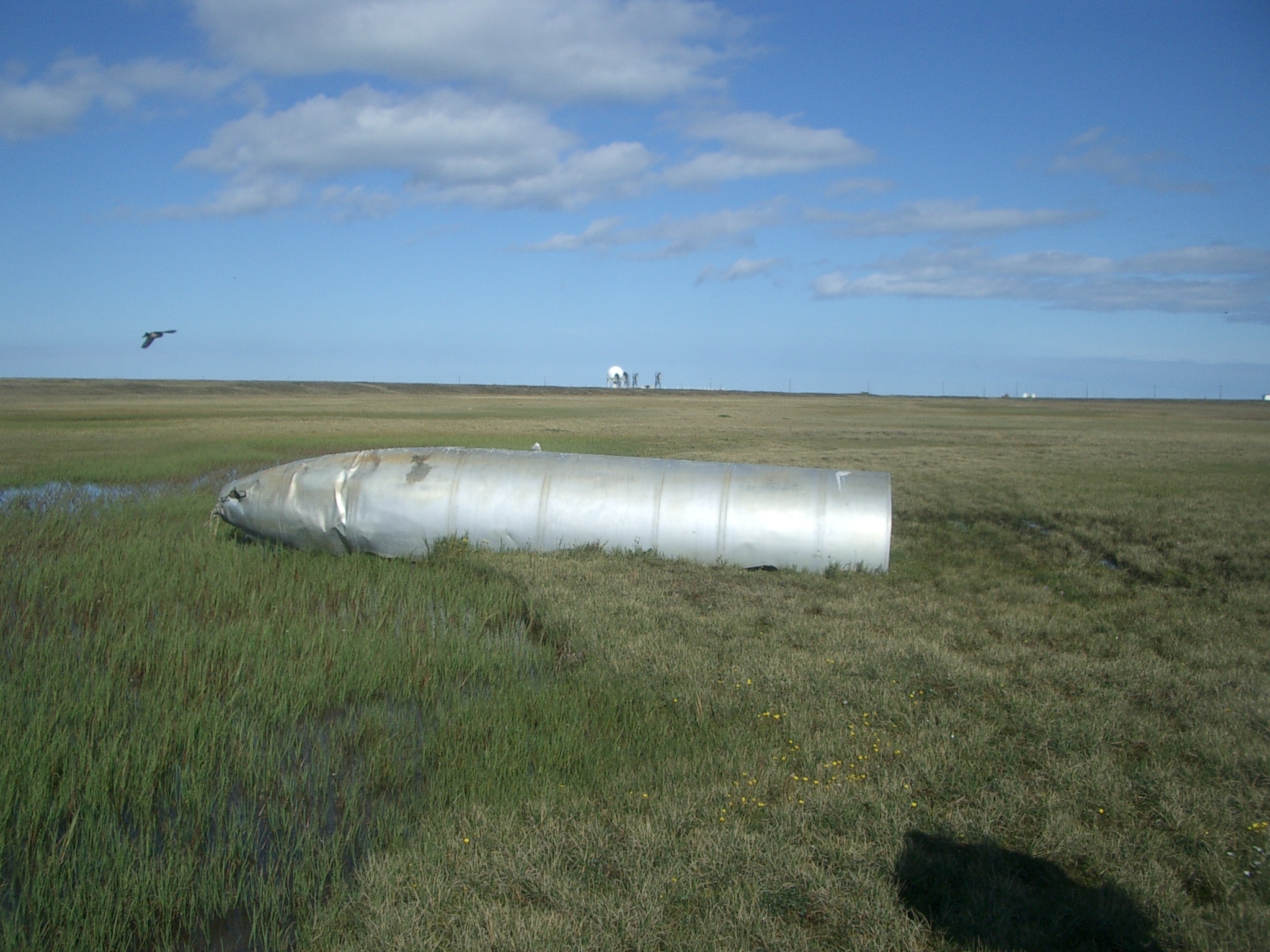
We didn’t find anything cultural that was older than NARL, but we did find a couple very old gravel beaches. We did find some stakes that had probably marked research plots, and a big aluminum object that looked like an aircraft part. It had some cable attached to the front, as if someone had been trying to tow it. Apparently they gave up. If you happen to recognize this, please let me know and I’ll pass the information on.
Large aluminum mystery object on Navy tract.
The next day I got a call from the City of Barrow. They run the cemeteries, and had been getting reports that a coffin was partially open. They had checked, and indeed a coffin had been frost-heaved and was damaged. They asked if I could come over when they moved the person into a new coffin. We decided to do it the next afternoon, after they got the new coffin built.
Fortunately, the old coffin wasn’t damaged except for a bit of the lid, so we were able to get the dirt off to make it lighter without disturbing the remains. The City crew was able to lift the entire box out and place it in the new larger coffin. It was a tight fit, because the old coffin had been covered with canvas that was nailed on, but that wasn’t clear when they had measured for the new box! Luckily they had left a bit of space, so they were able to pry a bit and get it in. I got the canvas that had frozen in out so it could go along. I’d mostly been there in case the coffin was fragile and we had to transfer the individual, to make sure that nothing got left, but that wasn’t needed.
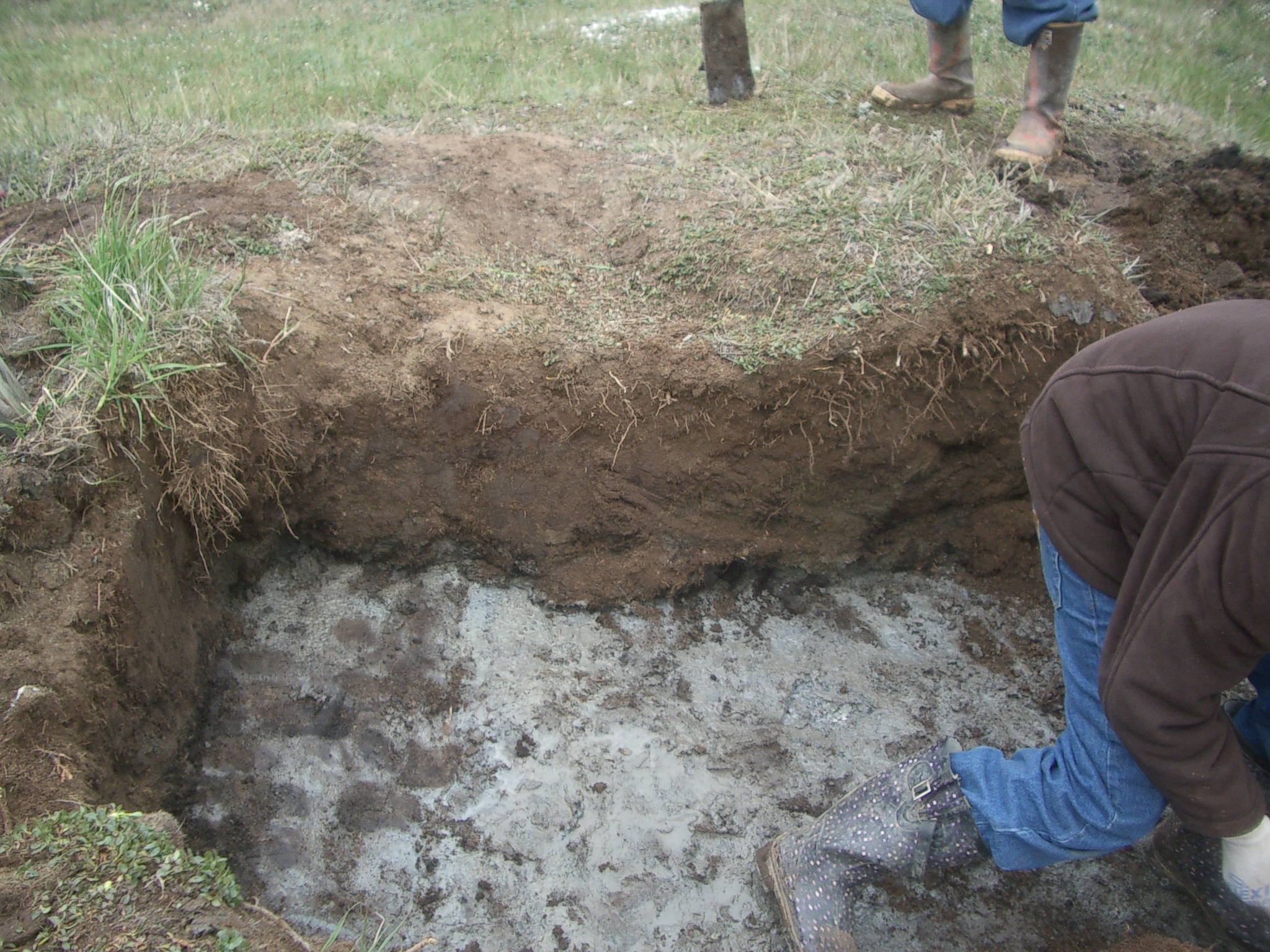
Once the coffin was out of the grave, the idea was to dig it a bit deeper, and then rebury the person. The soil profile was pretty interesting. There was clay (which generally is deposited on the bottom of bodies of still water) very close to the surface, despite the fact that the grave was on a mound. Apparently the permafrost has pushed it up a good bit, although it may have been deposited when sea level was higher than today.
Permanently frozen clay exposed in grave in Barrow cemetery.
The crew did what they could with shovels, but thaw was not that deep, as you can see from the picture above, so they were going to get a compressor and jack hammer, to really get the grave deeper, when I left. If not, frost heaving would just bring the box up again in a few years.
Since 2004, we have had a primary site datum NUVUK 1, with two others that were used as control points. As the bluff continued to erode, it became clear that we would need to abandon the primary datum, so last year local surveyor Chris Stein set three more datums. This year, the primary datum was no longer a good place to set up, so I switched to setting the total station up at NUVUK 2 (our former primary reference point, and using NUVUK 1 as the reference.
The program we use, called EDM, is a really nice special purpose piece of software, written just for recording archaeological excavations with a total station. It is really configurable and can make major use of menus, which means no typos and a cleaner field catalog down the road. It allows you to set up (once you get the instrument over the datum point and level) by putting a reflector on the reference point (another datum for which you have coordinates, telling the program where the instrument is. It then does the geometry and lets you confirm where the program thinks the instrument is and which way it is facing. With that information and the angle and distance to any other point, the program does the geometry to figure out where the artifact you are recording is in the site grid.
For all this to work, the datums have to be precisely recorded. On July 20th, we actually had to move NUVUK 1. When Chris set it, he’d chosen a high point, with vegetation, as a good stable vantage point. The only problem was that we weren’t sure that it didn’t have a grave under, and the erosion was getting closer. We had to pull it and see, rather than risk loosing a person to the ocean. All the other datums were quite far away (a good thing for control points) so we needed something more convenient to where we were excavating for ease in checking the setup, or restarting after battery issues. I picked a spot below one of the guy wires for the beacon pole, since the wire made it less likely that anyone would disturb it with a vehicle. We made extra sure of our setup, checked it with NUVUK 4, and tried to yank NUVUK 1.
It didn’t want to come out. We tried tapping gently with a mallet. We really didn’t want to be too aggressive, because we weren’t sure if it was in a burial. In the end, we had to excavate shovel test pits all around to loosen it enough to remove. Fortunately, there was no burial.
We put the stake into the chosen new location, and shot it in. For the rest of the season, we checked setups with NUVUK 4 as well as NUVUK 1(A), and it seems to be stable.
While all this was going on, part of the crew was finishing excavation of another burial 10D75. This burial appeared to be quite disturbed at first, but actually was fairly well-preserved except for the top. The rest of the crew was STPing. Rochelle found one burial in an STP, and Trace found another by exposing some aged wood (we call it “burial wood” because the wood in burials just has a certain look to it) while walking. We recorded and back-filled STPs around the two locations so that we could shift windbreaks there the next day.
Conditions at Nuvuk are never ideal for excavation of burials, or most other features, really. The matrix (soil) is mostly loose gravel, so things don’t stay put too well and it is very easy to undercut or otherwise displace things before their position is accurately recorded. We have learned to take lots of photos, and record things with the transit as they are exposed, and that works fairly well. This past week was particularly challenging.
We started the week with 3 burials located through shovel testing. Two of them were very close together, so they could not be excavated at the same time. It would confuse the EDM data recording program, and the excavators would get in each other’s way. So we picked two that were separated by a good distance, and got them ready to excavate on Monday. It was really windy, and one of the burials had a bit of vegetation on top of it. In the Arctic, vegetation dies back each winter, but the dead stuff doesn’t decay, it just stays there. Once you start excavating and cut the vegetation loose, it can start blowing around. Some of the crew wore goggles to excavate.
Dennis, Trina, Trace and Heather excavate the surface levels of a grave in a high wind.
Needless to say, the construction of good windbreaks at both units was a priority. After that, life was a bit more pleasant for the excavators. On Tuesday we went to work in earnest. With excavation at both burials, I was busy on the transit. Both of my experienced transit operators were excavating, and things had to move so fast that it was not a training day.
Excavation going on at two burials, as seen from the transit. I took the picture during the brief sunny period after the snow squalls were over.
One of the burials seemed to have an intact wood frame around most of it. Oddly, when we finished the excavation, the lower body seemed to have been undisturbed, but the upper body was mostly missing. The grave was fairly shallow, and in the past explorers, anthropologists and others are known to have collected surface human remains, especially skulls, for museums. Most of those individuals have been repatriated and reburied, so it is possible that is what happened to the upper body. It is also possible that someone dug a hole and scattered the remains unknowingly. The osteologist will look at any human skeletal elements that have been found on the surface nearby to see if they are part of this individual and reunite the elements before the reburial. We were able to finish that burial on Tuesday. Unfortunately, this was not the burial that was close to the other burial, so the excavators had to switch to STPs.
The other burial took longer. Once we got the vegetation off without anyone wrecking their eyes, we came down on several patches of charcoal, as well as most of the bones of a bird (probably a duck, although I need to look more closely in the lab to be sure). We spent a good deal of time defining the charcoal, prior to taking C14 samples for possible dating. In the end, it looked like maybe someone had made a fire and cooked a bird over the grave (probably not knowing it was there). The charcoal pattern was a bit odd for just a fire, and I think that the grave could have had some wooden framing elements which had been ignited by the fire on top of them, and smoldered into charcoal in place. So it’s not clear what dating the charcoal will date.
Two of the charcoal patches in the process of being defined.
As we continued excavating, it became clear that the individual’s bones were well-preserved, but were very jumbled. It appears that they may have been dug up, possibly even at another location, and then reburied in a hole where we found them. From the soil and the amount of vegetation over the grave, it is clear that this happened quite some time ago, possibly hundreds of years ago, perhaps well before the bonfire. Because of the jumbling, it took a very long time to document and removed the remains, and we weren’t able to finish until Wednesday morning.
Once we got done with that burial, we immediately started getting ready to excavate the other burial nearby (within about 3 meters). I programmed a unit into the data recording software, and the crew started to work. First order of business was a windbreak, since it was still windy. We also tested several vegetated area we had reached at the end of last season and chosen not to test because they were really high probability burials and we would not have had time to excavate them. Two were negative, and the third turned out to be positive. We assigned it a number, set up a windbreak, and went to work on that one as well. It just kept getting windier.
On Thursday, I didn’t get to the site until after noon, due to the radio show, so the crew worked on STPs and getting one of the burials ready to start shooting in artifacts as soon as I got there. This burial turned out to have a lot of artifacts, especially the “burial rocks” which we find in many of the burials, so we didn’t finish. With the small crew and bad weather on Friday, we will have to finish Monday.
It has been a busy week, with all sorts of things to do after the day’s fieldwork was over and the data was downloaded and backed up, including a public meeting (which will need to be rescheduled because the weather was nice and the TV didn’t get it on the announcement roll-around in time), baking dozens of cookies for the community potluck my employer was holding, and dealing with the aftermath of a minor ATV accident involving one of the students (she is fine, but wrenched an already sore shoulder and therefore will be on limited duty next week). We have tomorrow off, so I’ll provide more details and pictures on the fieldwork then.
Just a quick note while I try to get the flash card downloading. The pictures are all shot as hi-res JPEGs and RAW, so it takes forever. I doubt I can stay up long enough to post pictures tonight.
We worked today. Normally we do fieldwork Monday-Friday, because the students are paid by the hour (so they get practical job experience as well as archaeological training) and child labor laws make it complicated to work more than that, especially for the younger students. We had a vacation day on Monday, though, and since it’s a short season and some of the students are trying to earn money we decided to do a 5-day week anyway. In the end, only 5 of them made it to work today. One was out of town, Trina was taking part in a fundraiser for the basketball and volleyball teams, two were sick, one was hurt and we don’t know what happened to the other one. It was wicked cold this morning, so hats off to Rochelle, Trace, Nora, Warren and Victoria. Not only was it cold, it was windy & foggy (yes, at the same time). In fact, it was so foggy we were having trouble with the transit because the lens and/or the reflector kept getting obscured by water drops. And it rained before lunch, and toward the end of the day.
However, as compensation, we finished excavation of the first burial of the season. It turned out to have been disturbed, probably in the late 1880s, judging by the artifacts scattered along an old ground surface along with some of the individual’s bones. We found some very cool artifacts (a bit unusual for Nuvuk burial excavations) although they weren’t really in the burial. Highlights were a copper end-blade (for a harpoon head or possibly arrow), a split blue glass bead, and best of all, the cartridge for a shoulder gun. The last still seems to have a bit of black powder around the primer area, so we have it in VERY wet conditions, and I will try to clean it tomorrow before there is any chance of the powder drying at all. Our bear guard, Larry Aiken, who is a whaler, said it was the oldest style, shorter than the ones they use now.
As further compensation, we decided to order our lunches from the fundraiser, so Trina brought 13 lunches to the end of the road to Nuvuk (called my cell before she headed out), and Larry took a trailer back to get them. So we all had BBQ chicken, potato salad, rice, pancit and a hot dog for lunch, along with the hot beverage of our choice and chips courtesy of Nora! Even with the big propane cooker going the tent was cold enough to see our breath. We hung in and finished the burial, and tested the areas where two other single human bones had turned up in a trail. Neither one had a grave beneath it. We already have 3 other probable graves, based on subsurface indications in STPs, waiting for us next week.
It’s been very busy the last couple of weeks doing all the last-minute things to get ready for the field. As a result, I haven’t been able to keep up with blog posts on everything, so I’ve spent part of the July 4th weekend catching up. That way, I can post catch-ups when I don’t have time to do something from that day (or when the day was so dull no-one would want to hear about it 🙂 ). A bit out of sequence, but that’s life.
Unlike many projects, particularly in the Arctic, where the expenses of getting & keeping people in the field tend to make PI (Principal Investigators–the people in charge of projects) prefer experienced excavators with college backgrounds in archaeology/anthropology, most of our crew is made up of high school students who have never taken a course in archaeology. Obviously, there’s no way to give them (or any other normal human being) that sort of background in the time between hiring them and starting fieldwork. The good thing is, it’s not actually necessary. The skill set that an excavator or basic archaeological laboratory worker needs are actually learned on the job, not in the classroom or from books. Having worked with complete newbies (high school kids, Earthwatch volunteers, college field school students) as well as folks with advanced degrees (some of whom couldn’t have dug their way out of a paper bag if their life had depended on it) has proven this to me beyond the shadow of a doubt.
That said, a bit of background does make it easier to understand why things need to be done a certain way, and therefore to remember to do them, as well as to not go crazy from boredom after the 25th sterile STP in a row. We do have a short reading list we send to college-level & higher folks, but for the high school students that’s not really the best plan. It’s summer, and reading is easy to put off, unless we want to start giving quizzes. Anyway, most high school students haven’t really gotten the knack of learning just by reading, since they almost never have to do that in high school, as far as I can tell (my daughter graduated recently). So I figured some type of exercise would work better. I wanted something fun, that could be done inside (people learn better when they aren’t too uncomfortable, as a general rule).
There are a bunch of books that deal with various exercises people have developed to teach archaeology, so I went through those and found some stuff that looked good. Then I think I remembered my 6th grade teacher, who had developed a teaching method which relied on Milky Way bars (usually hurled from the front of the room to the student’s desk) as rewards for various achievements. It made for a lively classroom, and seemed to motivate kids who usually wouldn’t have cared enough about the subject to exert themselves. Being a good student, I got a lot of Milky Ways, which was ironic, since I didn’t actually like them that much to begin with. So, candy, but a variety of it.
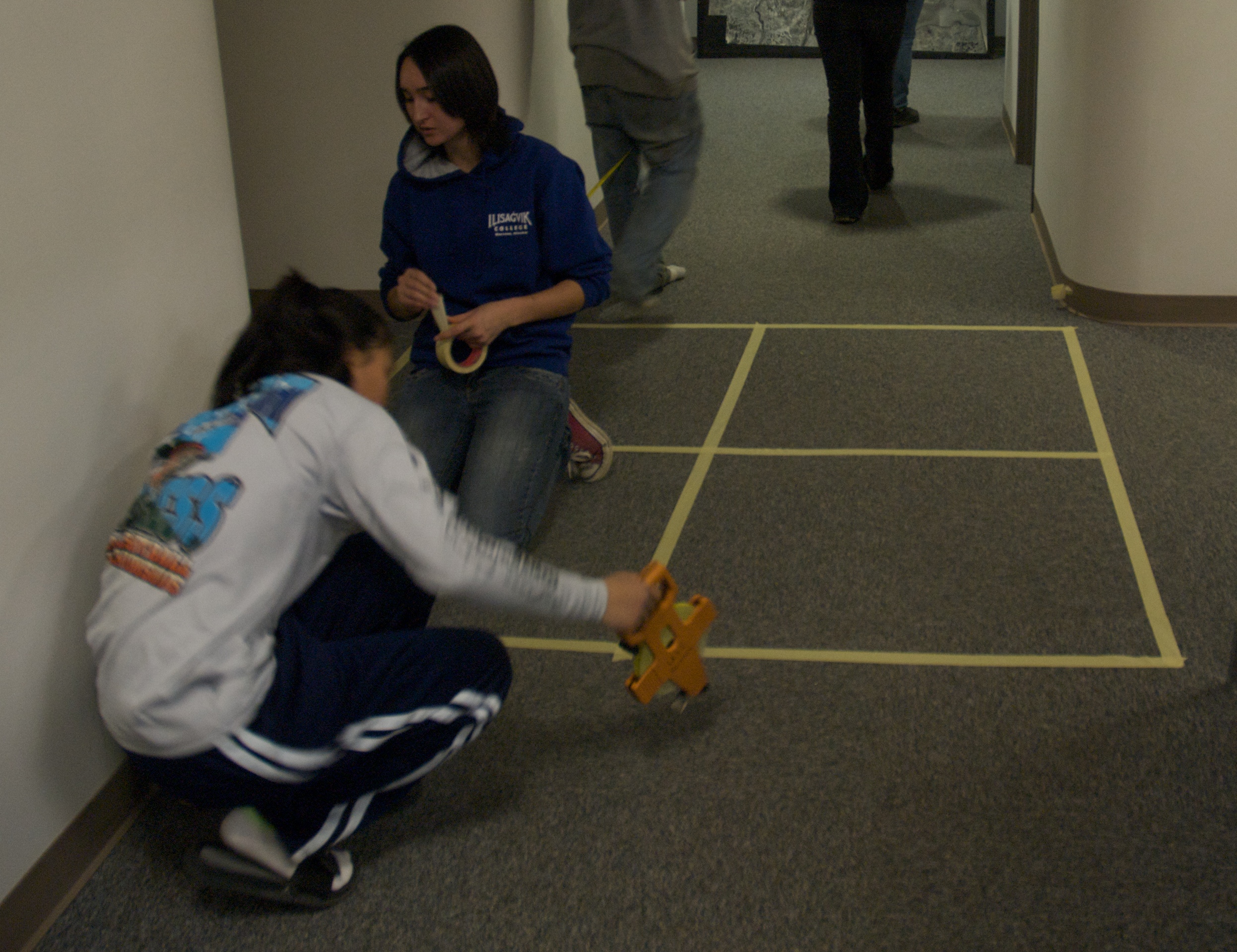
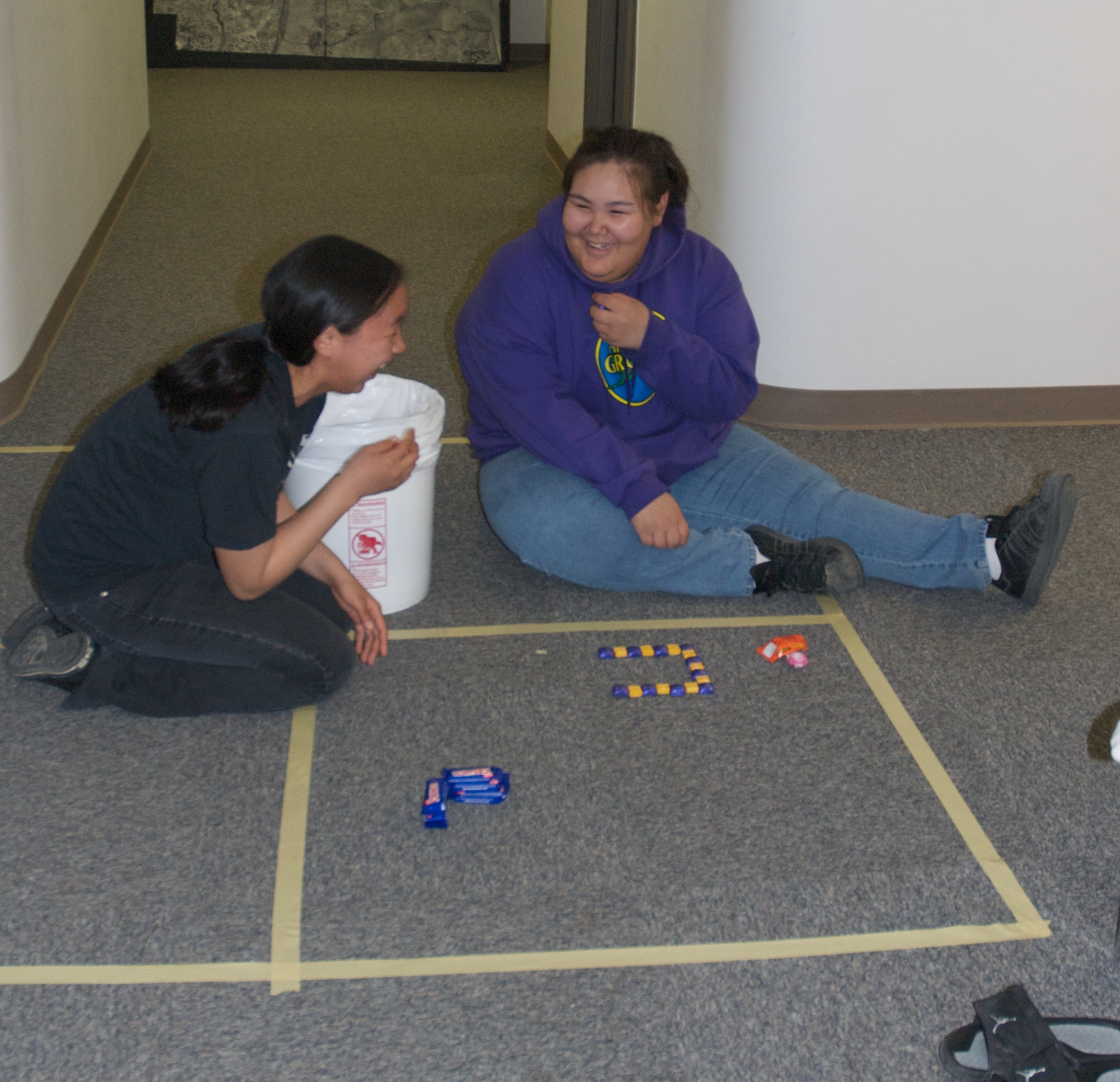
The exercise goes like this. We lay out 2 2m x 2m units with masking tape on the floor (learning how to do units with hand tapes and geometry).
Nora and Victoria lay out a 2 x 2 on the hall floor.
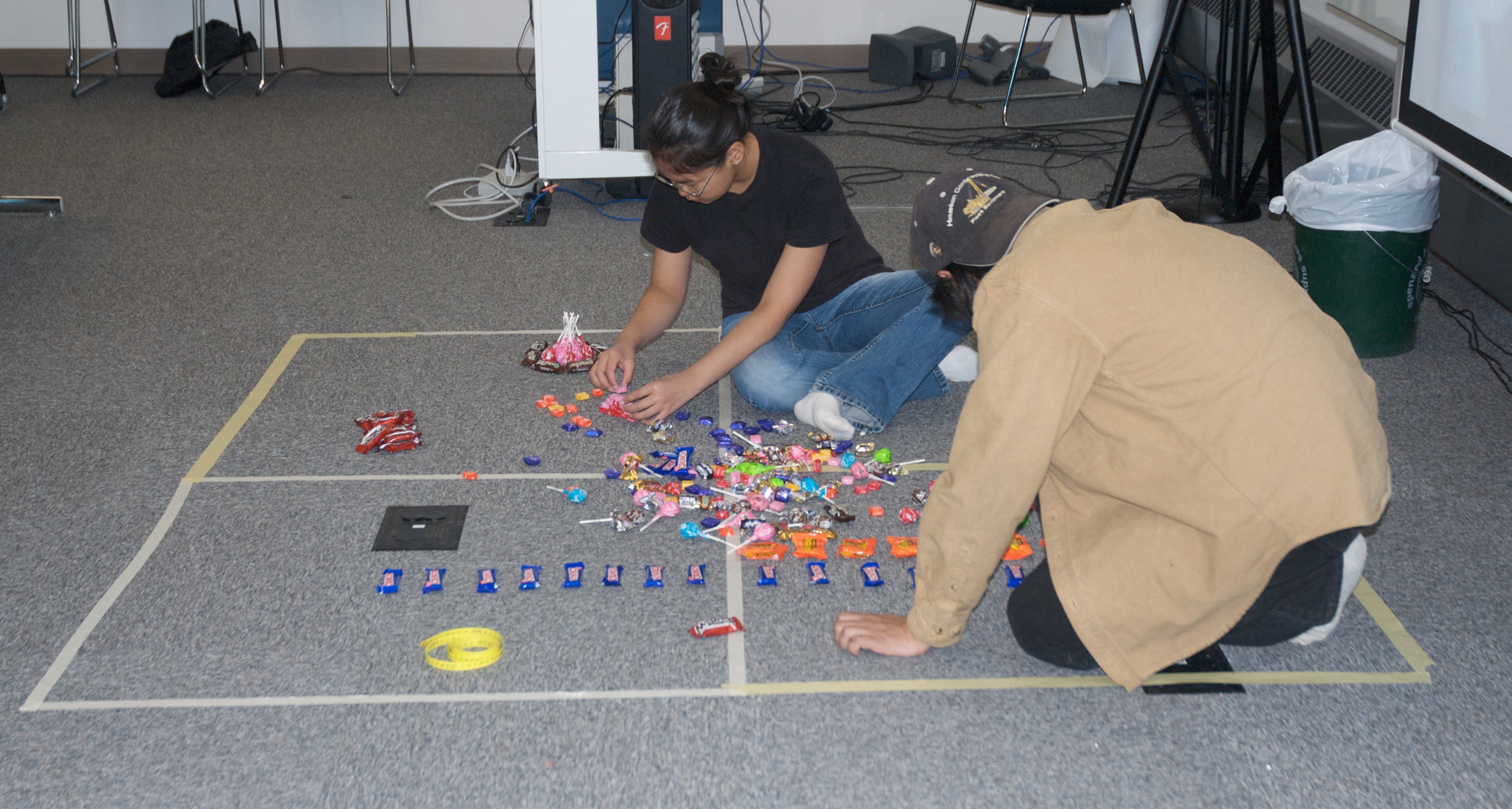
Then, two crew members who already have archaeological experience get to be the “actors,” which involves getting a big bucket with all sort of candy in it, and doing something in and around a 2 x 2. They can talk about it beforehand, and they can do whatever they want, talking or not.
Trina and Heather start making something for the newbies to figure out!Flora and Ron create a site from candy in the conference room.
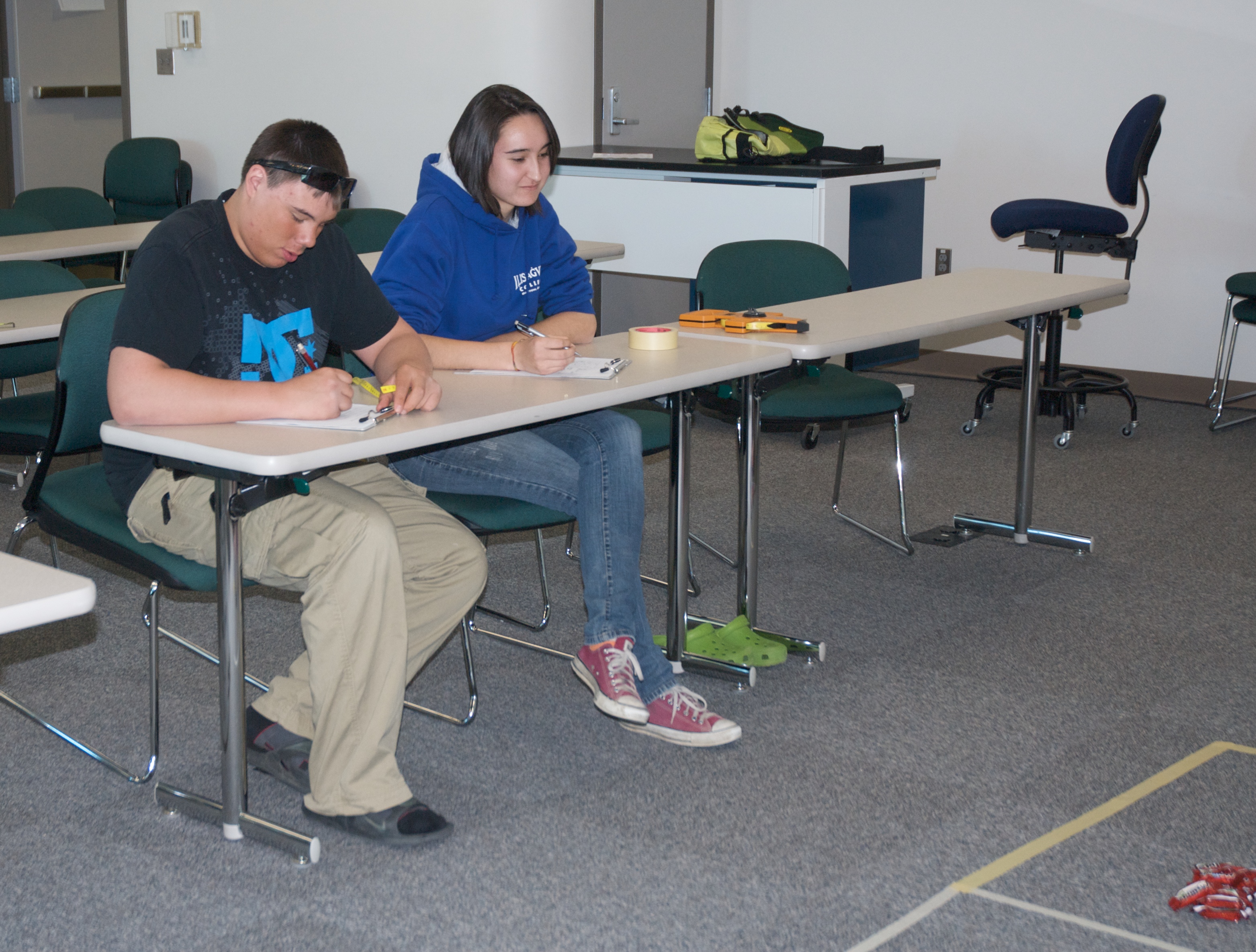
Meanwhile, the newbies are divided into two groups. Each group is assigned to one of the 2 x 2s, where they have to act like ethnographers, recording what they see the “actors” do and say.
Warren and Victoria play ethnographer.Nora carefully records what Heather and Trina are doing.
Then the newbies swap places and practice mapping the site that they didn’t see being made, as an archaeologist would. We give them a bit of information on the kinds of choices (piece plotting, sketching, classifying things by color or type of candy, etc.) that they might need to make and why, what they need on a map (scale, key, North arrow) and let them figure it out. More experienced students help them with the mechanics, which makes a good review for them.
Nora draws a map, while Trina & Heather give advice.Ron gives some pointers on mapping to Victoria and Warren.
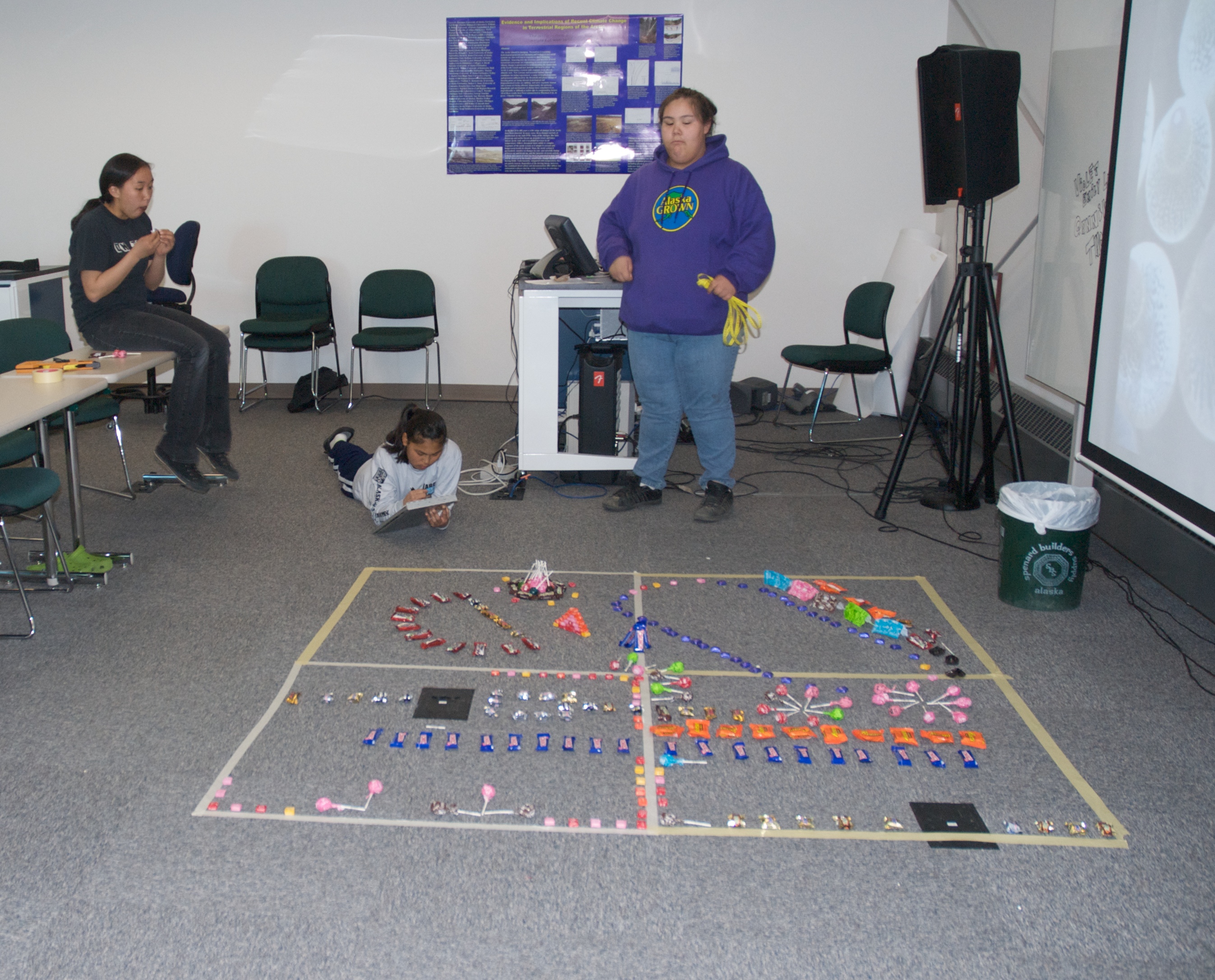
After that, we all get together, and I put up a picture of a “site” on-screen (digital technology is great for this!) and the “archaeologists” describe what they saw, and what they think it can tell us about the activities at the site. Then the “ethnographers” add what they saw, and we talk about how it can enhance (or change) the interpretation possible through material culture alone. Finally, the “actors” tell us what was REALLY going on!
The exercise seems to get the general ideas about the possibilities and limits of archaeology and ethnography across to the students fairly quickly, without lots of jargon. It also shows them a lot about the point of recording proveniences accurately, and the difference between doing archaeology and just digging for artifacts. The candy makes it fun. And, we get to have the leftovers for pick-me-ups in the field!
As usual, things were a bit disorganized getting ready to go to Nuvuk this morning. However, after rounding up a non-leaking pump, gassing up 5 of the ATVs, buying bungee cords (the many folks who had gotten all the field gear from last year out had somehow not noticed the bungee cords had gone missing), airing up a couple of tires, etc., we set off.
After getting to the site and orienting the newbies, we put all the gear into the proper tents, gave the lesson on how to make up a honey bucket that is unlikely to fail in transit (they have to be backhauled to a proper disposal site), and set off in a line, pin flags in hand, to survey the site. We located one burial during the survey (exposed by recent vehicular traffic, alas) and spent some time getting driftwood to block off and reroute the trail until we can excavate the person. We also located a number of features, and a few loose teeth.
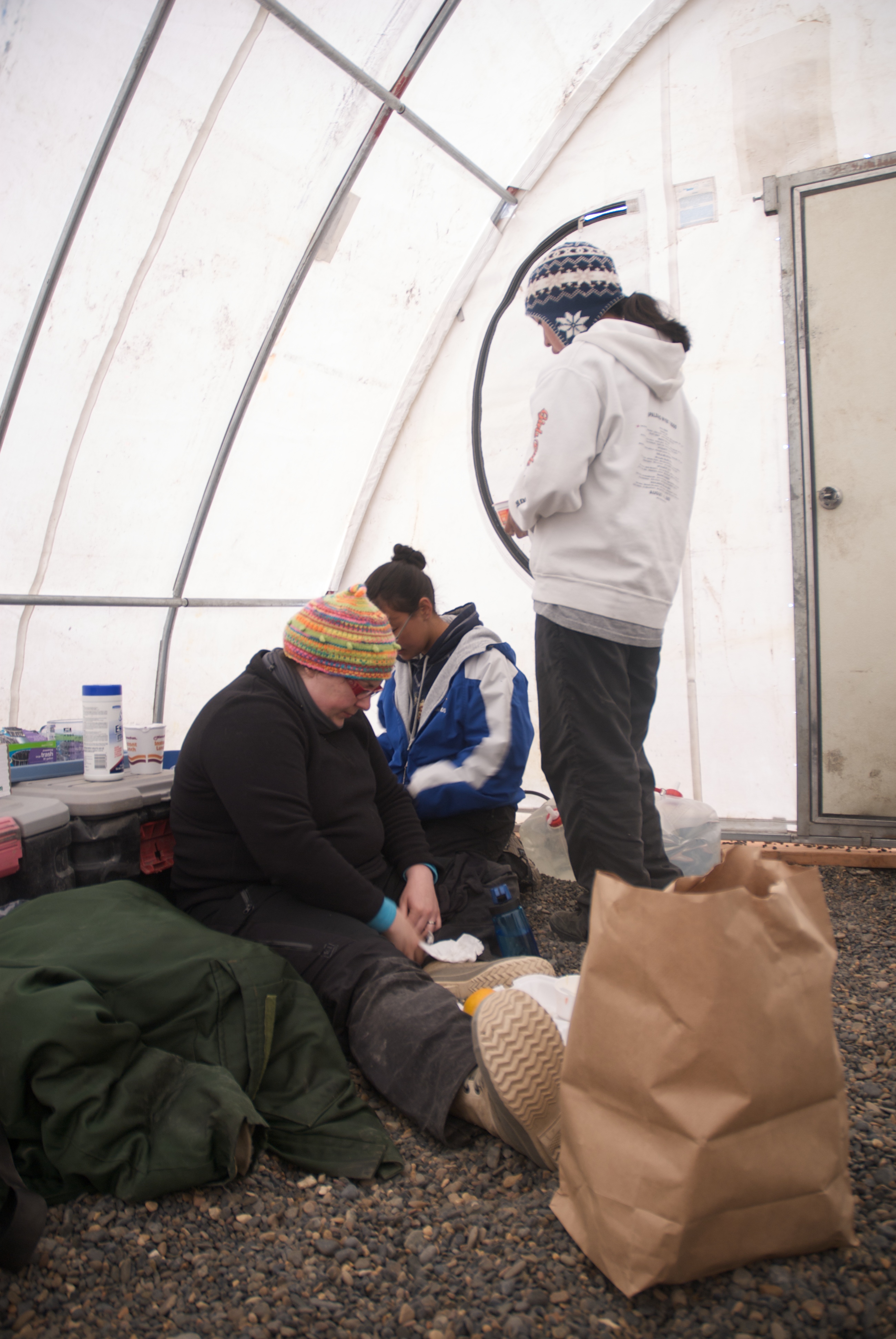
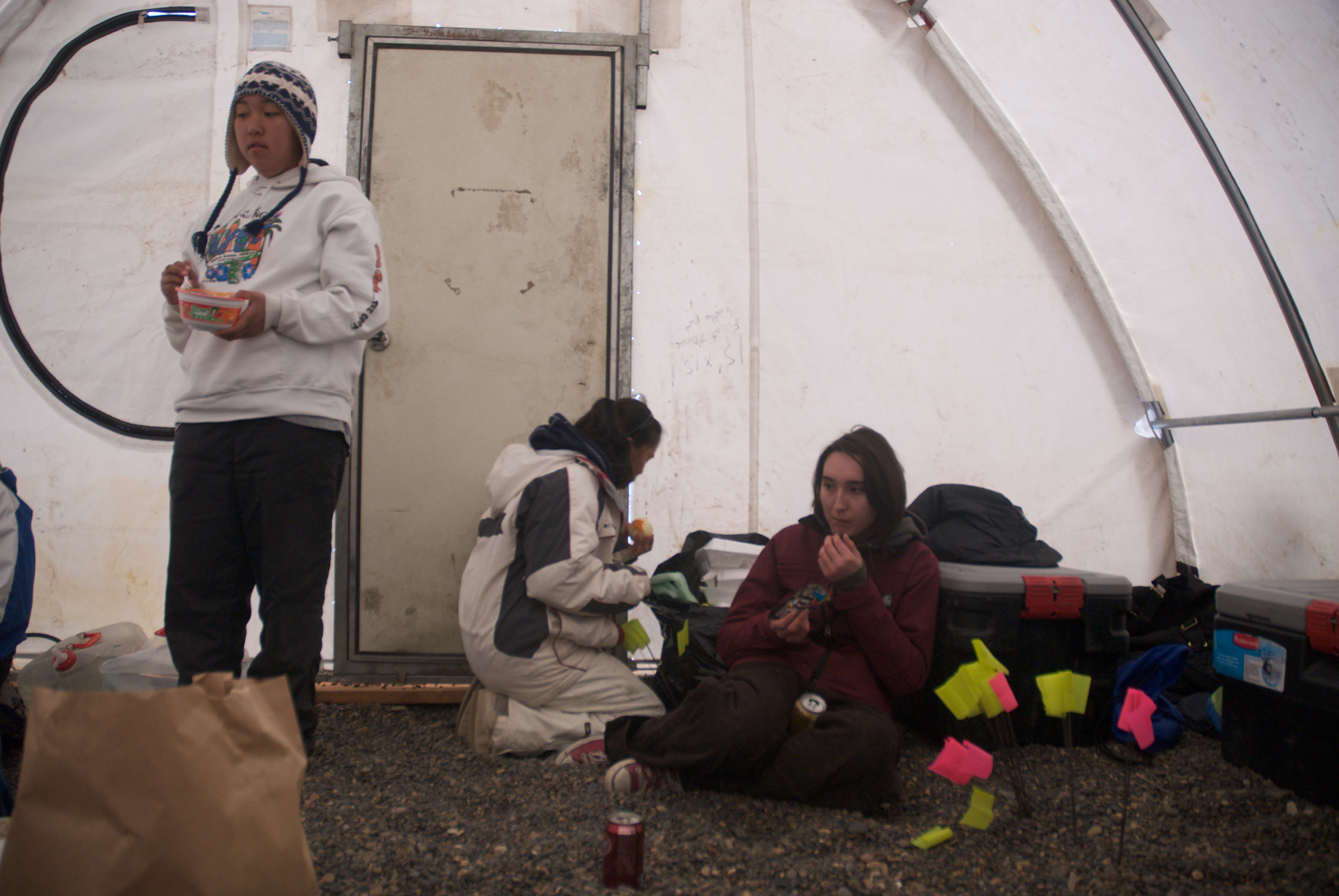
Then it was time for lunch. We have a relatively small crew this year, so the tent felt quite roomy.
Laura, Flora and Trina get their lunches ready.Trina, Nora & Victoria have lunch in our spacious Weatherport.
We took the usual hour for lunch (Rochelle actually caught a nap), and then we went back at it. It started raining, and kept it up until just before clean-up time. Everyone was well dressed, and since the wind was WSW, it wasn’t too cold. The NWS had called for rain or snow, and we’d all be hoping for snow if anything, since it is less wet AND makes for better pictures.
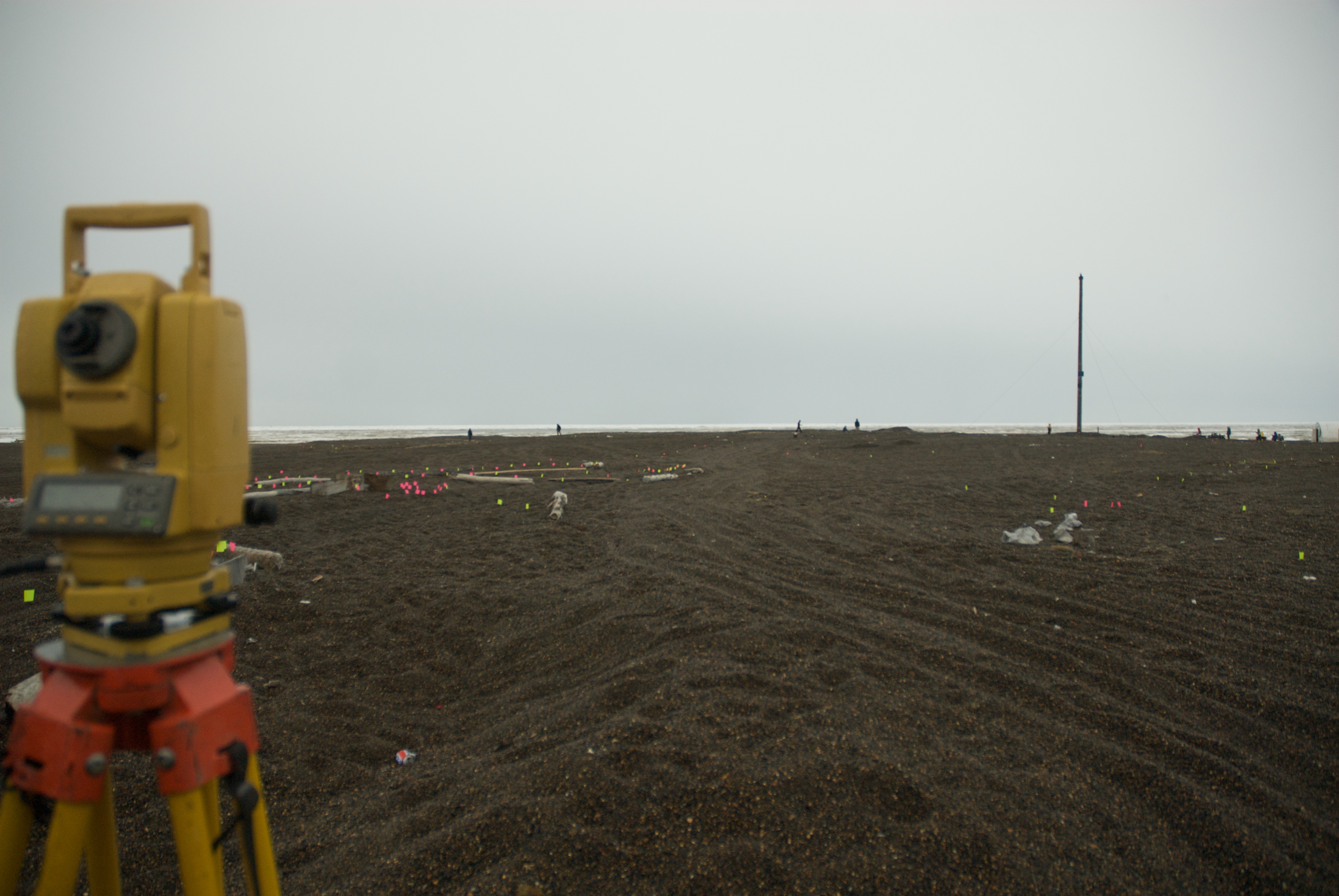
Flora and I set up the transit to shoot in the locations of the burial and some artifacts near it. We are moving from the primary datum we have used for many years, because erosion is approaching and we will lose it in the near future. Fortunately, the work we had done last summer setting up paid off and everything went smoothly. We need to mark a couple of the additional datum points tomorrow so they are easier to find.
View from transit station over the area we will be working in this season.
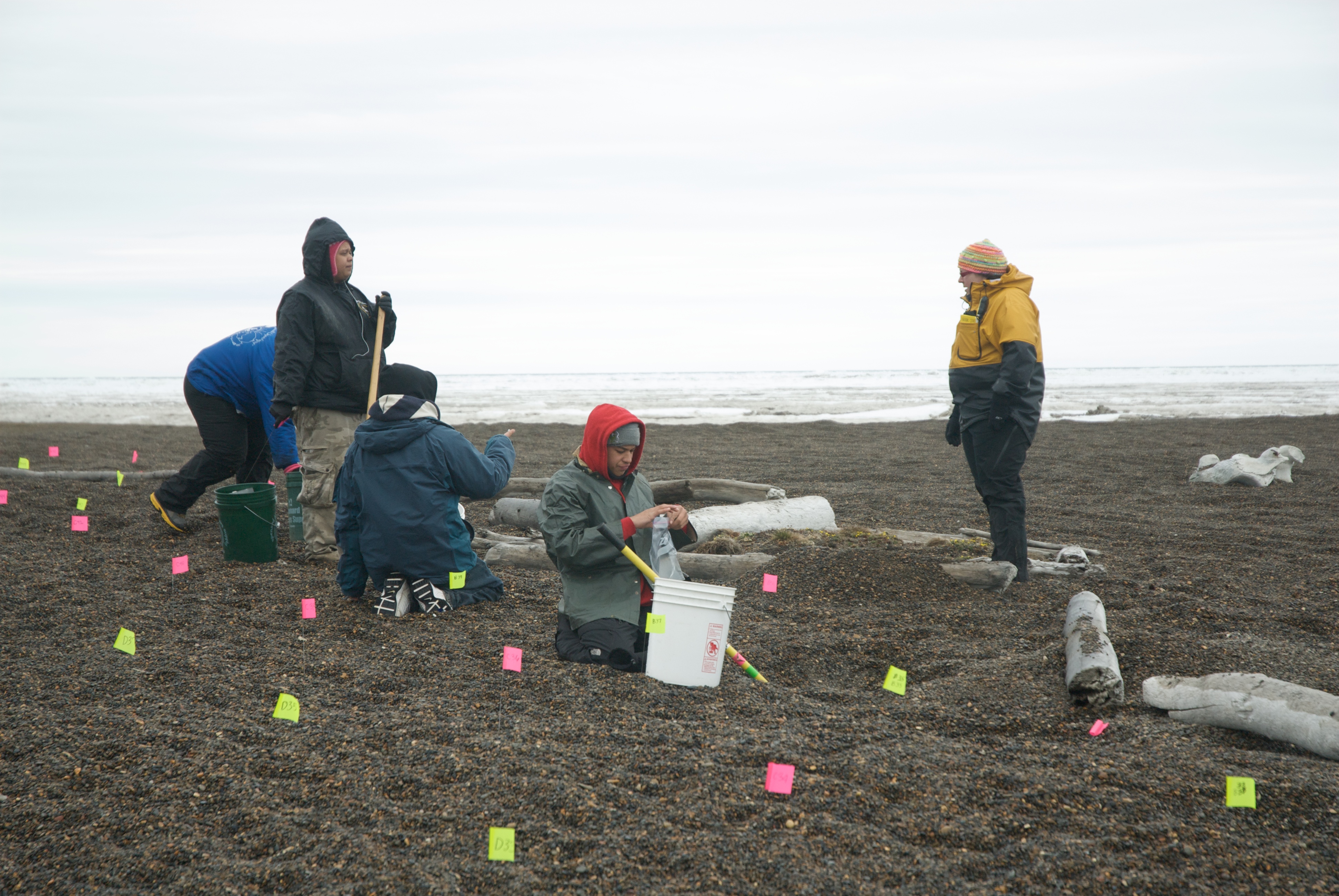
The rest of the crew laid out lines of shovel test pits, and soon Nuvuk was festooned with lines of bright pin flags. We had to dig some of the STPs (shovel test pits) quickly, as they fell on the trail, and we needed to clear that area so people don’t start diverting into untested areas.
Part of crew hard at work among the pin flags.
Flora shot in the STPs, and Brody backfilled about 20 by himself. Then we packed up, rather quickly for the first day, and headed back in. We didn’t see any bears all day. A couple of hours later, all data is downloaded and backed up, everything is on a charger that needs to be, my houseguest and husband have been fed dinner, and I’m going to bed.
You never see Indiana Jones doing labwork. Of course, you never see him taking notes, either, so perhaps one should not take the good Dr. Jones as a guide to good archaeological practice.
In fact, for projects which involve actual excavation of a site (presumably thereby giving rise to a collection of artifacts and other sorts of physical data such as C14 samples and faunal remains), far more time will be spent in the lab than was spent in the field. Labwork is a necessary and important part of archaeology. After all the time and energy spent in the field finding, recording and excavating things, it would be a real pity to just let them deteriorate for lack of cleaning and care, or get mixed up and lose their proveniences because they weren’t properly marked. Then things need to be cataloged, with field IDs checked and expanded on, and the data needs to get into a database so that more detailed analysis can happen without having to root through the entire collection to find things. No labwork = chaos.
The thing is that many of the activities which have to be done in the lab just aren’t that exciting :-(. For example, cleaning things is not on most peoples’ Top 10 Things to Do list. We actually had almost everything cleaned from previous seasons, so there hasn’t been any of that yet. When it happens, it often involves very slow and fiddly removal of gravel, dirt and roots by the gentlest means possible. Sometimes artifacts are so delicate that complete cleaning can’t be done at once, or sometimes at all without the help of a conservator (of whom there are only 2 in Alaska, both at museums).
Our first big task was marking & cataloging, which generally happens after the cleaning. This is really important, and important to get right.
Ideally, all items collected at a site are put into containers (usually Ziploc bags of some sort) or tagged (if they are too big to go in a container) with information as to site of origin, location of find, level and excavation unit they were found in, date found, and who collected them clearly written on the bag or label. The idea is to assign each item (or group of small items like flakes or fish scales) a unique catalog number. The information about that item goes into the catalog, and the item is marked with the catalog number. These days, the catalog is usually a database on a PC, which is a huge improvement on the index cards that were in use when I started, or even the mainframe-based databases which came in shortly after that.
That way, if later an archaeologist decides they need to look at all the harpoon heads, say, from a site (or even many sites), they can be retrieved, and spread out in the lab, grouped and regrouped endlessly, and still not get mixed up or lose associated information. When the analysis is done, everything can get back where it belongs. New information from the analysis can be added to the catalog.
People used to just mark on artifacts with ink, often with a layer of clear nail polish or White-Out as a base coat, and a clear nail polish cover coat, but that wasn’t stable or reversible, and the idea today is that nothing should be done to an artifact that can’t be reversed. We have used Paraloid B-72 dissolved in acetone as base and cover, with the catalog number written in India ink or white ink with a quill pen for years. However, there are not a lot of people who can write a hand that is both tiny and legible. The schools stopped teaching penmanship at all and started kids keyboarding very early, so they don’t really get practice. We went to a system where the catalog numbers are printed on very thin archival paper, which is dunked in the Paraloid and then stuck to the artifact in an unobtrusive (one hopes) spot.
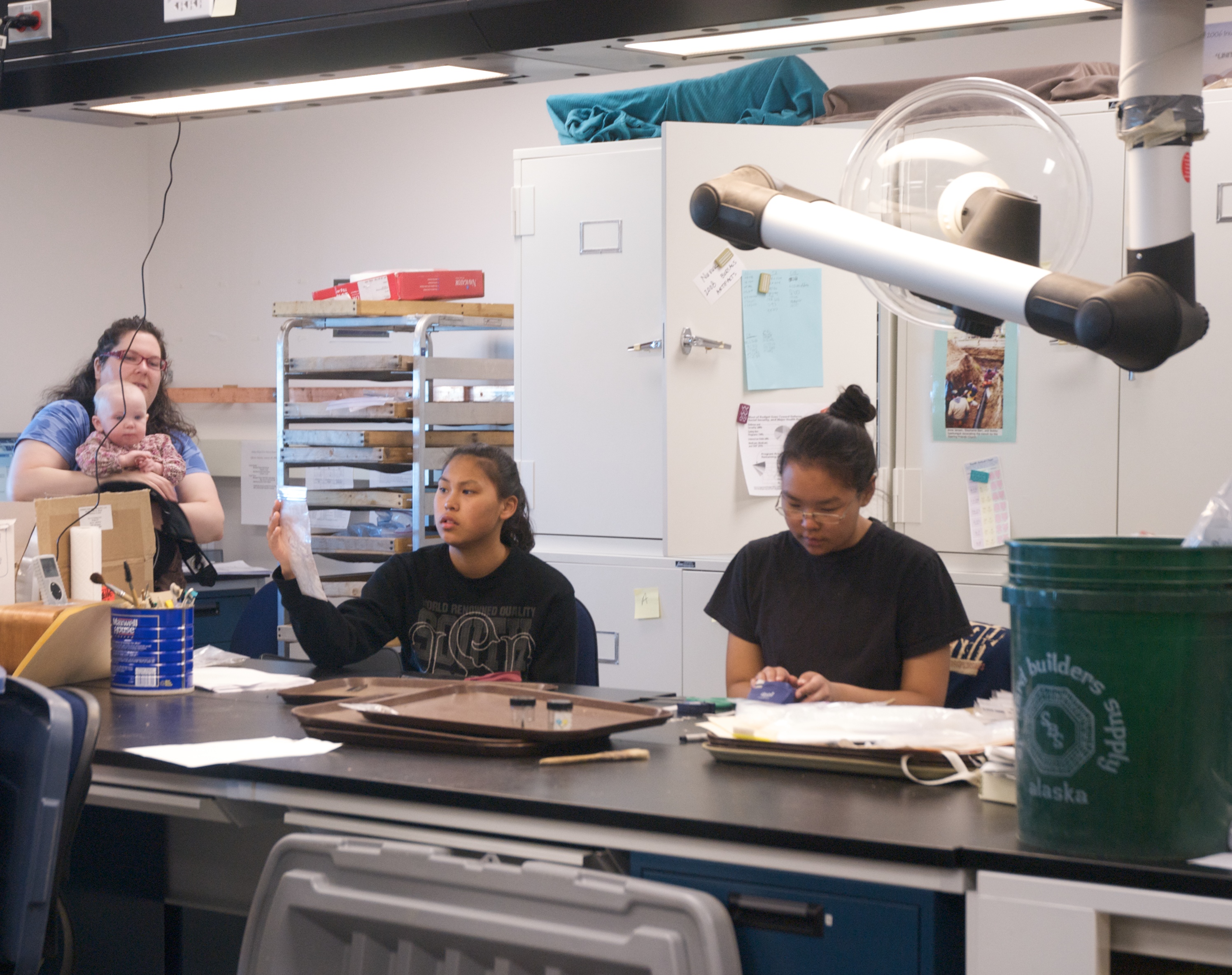
Nora selects artifact to mark, while Flora makes cabinet labels, while Laura & Violet "supervise".
We had some major struggles at first, with the Paraloid bubbling and making everything illegible. We finally realized that the only thing that had changed was a move from a lab in a 1968 building to the new lab in the BARC, which is supposed to be very energy-efficient. It is also extraordinarily dry. One day a woman checking the air flow on the fume hoods measured the relative humidity in the lab, and got 3.8% (not a typo!). I think the Sahara desert is more humid than that! We realized the acetone was evaporating so fast it was making the bubbles. We are now running one house-size and two room-size humidifiers in the lab, and the bubbling problem has gone away. This method is proving very fast, with the only challenge being to get the right label on the right artifact.
However, it isn’t really that exciting, and can get repetitive, which can lead to people getting tired and therefore careless. Like most labs, we try to have people work as a group, although each person is working on their own. It is possible to label and talk at the same time. We’ve got an iPod speaker for tunes, and so far there seems to be enough overlap in musical taste on crew that no-one has had to resort to ear plugs. Like pretty much everyone in archaeology, I’ve spent a lot of time marking and cataloging artifacts, and while time doesn’t usually fly, I can tell you it goes a lot faster when you’re having fun.
Once the artifacts are marked, the catalog info is checked and they are put into cabinets, with the storage location entered into the catalog. In the field, we tend to use quart (“small”) and gallon (“large”) Ziplocs, because they are easy to get, less expensive and too many sizes makes life complex. Most artifacts don’t really need that much room. We are moving the artifacts into the smallest possible archival bags they will fit in, and this is saving a huge amount of space. Particularly nice artifacts, which visitors want to look at, are getting special containers. They get individual beds of ethafoam, inside clear plastic archival boxes with lids. Ron Mancil, a crew member who is currently a MA student at UAF, has museum experience and is very handy as well. He has been applying his skills to making mounts for a bunch of artifacts, so visitors can get a closer look without endangering the artifacts.
Ron hard at work making a mount for a special artifact
It’s true that a lot of what happens in the field isn’t all that exciting either, as you will see in the next post or two. But there’s always the possibility that something really cool will show up in the next shovel test pit (STP) or the next one, or the next one…






 Out of Ice and Time