Actual incremental progress on several fronts!

Now that the storms have passed for the moment, and I can once again get to the office, I’ve actually gotten a few things done.  I managed to take the few comments on the mission statements for the GHEA working groups and finalize them.  That done, I set up, not one, but two (!), working groups.  The first is focused on coastal erosion, and the second on global change effects on the archaeological and paleoecological records.   They are now open for members (a few have already joined).

Monday’s time-sheet approvals were particularly onerous, because a change of user ID in the time-sheet system didn’t work quite right, and not only detached users from approvers until they logged in again on Monday, it also rescinded submitted and approved time-sheets from last week which were done before the update!  Much confusion and a royal pain for us and for the IT/accounting folks, I can assure you.  But we persevered and everyone should get paid on time!  There were a few other accounting and proposal related details to deal with today, but they’re pretty well in hand, and I just need a few more numbers to get the proposal out the door.

That done, I moved on to drafting a summary for newsletters (several paragraphs) of the Polar Archaeological Network meeting in Tromsø, which somewhat coincidentally (since I am the only overlap between the two groups at the moment) was all about global change and threats to the Polar archaeological and paleoecological records.  That’s been circulated and I’ve made several revisions based on comments.  I’ve gotten one more set from Maribeth Murray at UAF, which actually suggests two versions, one for social science audiences and one speaking more to the paleoecology/global change folks, so I should have that ready for final circulation to the attendees tomorrow, and then it should be ready to go to out.  Maribeth and I (and the other meeting attendees) are also doing a poster at the Alaska Anthropological Association annual meeting in Fairbanks next week.  PAN had a preliminary poster, which I am majorly rewriting and putting Alaska-specific images on (since this version is for an Alaska meeting).  I’ve got to get that finished, circulated, and down to Maribeth in Fairbanks so she can get it printed up (since large-format printers are almost as scarce as hen’s teeth in Barrow).

Also needing finishing and polishing is my paper/PowerPoint for the meeting.  I am in a session in honor of Ernest S. “Tiger” Burch Jr., one of the most renowned ethnologists who ever worked in the North, who passed away unexpectedly last September.  He was a brilliant and meticulous researcher, widely admired among Iñupiaq people, particularly those of Kivalina, where he and his wife lived for some time, and an all-around good person.  I was proud to have him as a friend, as was my husband, Glenn Sheehan, and it’s an honor to be asked to be in this session.

I had somehow lost track of when the meeting was, and had rather a jolt today when I opened an email about a side meeting, which mentioned the attached agenda for next week’s meeting!  A mad dash to make travel plans ensued, so I now have a room, a car, a plane ticket and am registered for the meeting.  All told–1.5 hours.  Practice makes perfect (or at least faster).

Heading home

I’m in the Anchorage airport waiting for a plane to fly back to Barrow. I’m coming back from a very interesting meeting in Tromsø, Norway, dealing with threats to the Polar archaeological heritage. More on that later.

I stopped in Anchorage for the weekend to check out a friend’s library for some literature on the NW Arctic and Seward Peninsula for an article I am writing. Found a bunch of good stuff, which he’ll drop off at a copy shop that does a lot of work for lawyers. Way cheaper than Kinko’s, and they can make PDFs, so we’ll both end up with electronic copies, which are pretty nice for the field.

A Meeting in Abisko

I’m at the Abisko Naturvetenskapliga Station (Scientific Research Station) in northern Sweden.  There is a meeting here of scientists and station managers who are involved either directly (or indirectly in the case of non-EU participants) in a project called INTERACT which is about building research & monitoring infrastructure for arctic research.  I’ve come along since my husband is here representing the Barrow Environmental Observatory, and we are both giving papers at a meeting in Munich after this.

It was quite the trip to get here, but the station is very nice, and it looks like it will be quite an interesting meeting.

Papers and articles and PowerPoints, oh my…

Despite the fact that I am still in New York on vacation (except for things like on-line payroll and P-card reviewing and approving, which can’t wait), I’m taking a bit a of a break from reading mysteries and eating Christmas goodies to work on several things I have in progress.  I’m not going to be able to finish any of them, since I don’t have any books here for checking references, and most of the images I want to use are in the Aperture vault  on my computer back in Barrow.  However, I can do outlines, and get a fair bit of the text drafted before I get home, at least for some of them.

In order they are: 1) PowerPoint & accompanying paper on Iñupiat and Cold War Science for a conference in Munich, 2) encyclopedia article on Western Thule 1300-1750AD in North & Northwest Alaska (in 7000 words maximum!), 3)PowerPoint on Alaskan archaeological sites and threats to them from climate change as it has been observed to be occurring for a conference in Tromsø, Norway, 4) article I’m working on with Claire Alix and Owen Mason on Ipiutak at Nuvuk, 5)  encyclopedia article on Barrow sites (Nuvuk, Birnirk and Utqiagvik), 6) paper on ethnographic data on storage of whaling gear, and 7) a paper on whaling gear recovered from archaeological sites which are known to have had whaling taking place.

These all have places they are to go, and times they need to be there.  Nothing concentrates the mind like deadlines, except perhaps the threat of execution…

18th Arctic Conference Part 3-Visit to the University Museum

In the afternoon we took a bus in to the University Museum at Penn for a look at the collections.  William Wierzbowski, Associate Keeper of the American Section, has set things up for the visit.  He had gotten a number of items that had been collected by the late Frederica de Laguna, (BMC ’27: founder of the Bryn Mawr College Anthropology Department) in Alaska out and had arranged them as a temporary “ancestor shrine” for us.

Frederica de Laguna "ancestor shrine" with a number of conference attendees. Rick Davis of Bryn Mawr, who was the host, is in the blue sweater at photo center.

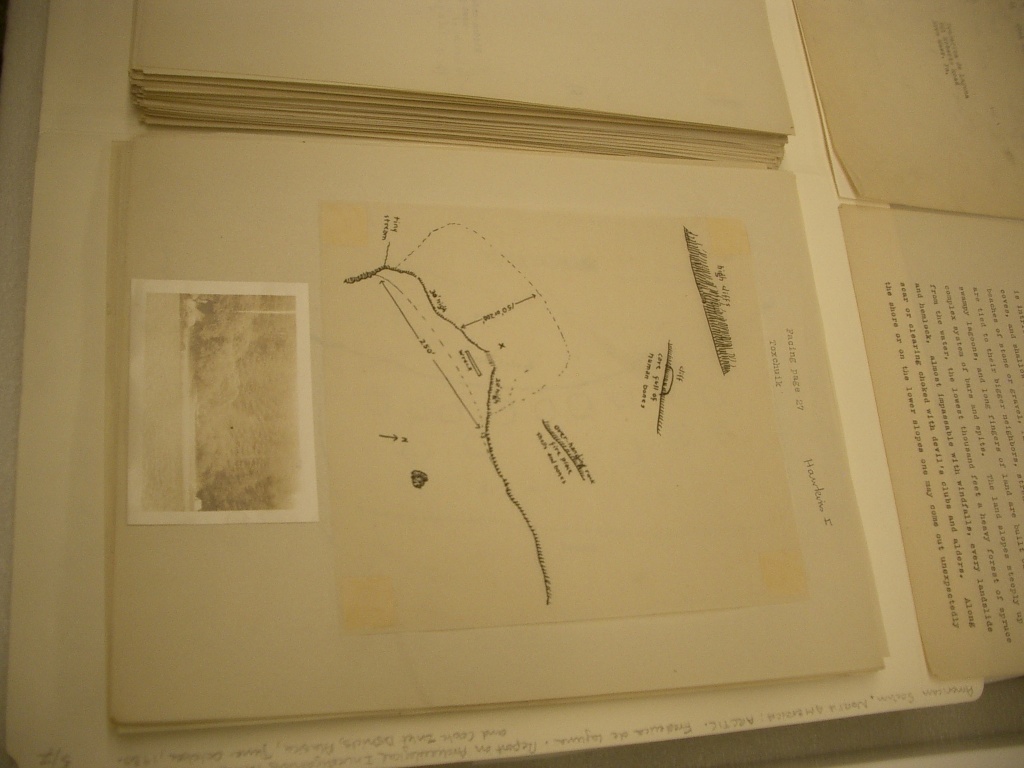
It included maps drawn by Freddy, and fragments of Raven’s Tail weaving, a style which had fallen out of use and was recovered from archaeological fragments like these and a few remaining ethnographic samples.

Hand-drawn map of site location.
Fragment of Raven's Tail weaving.

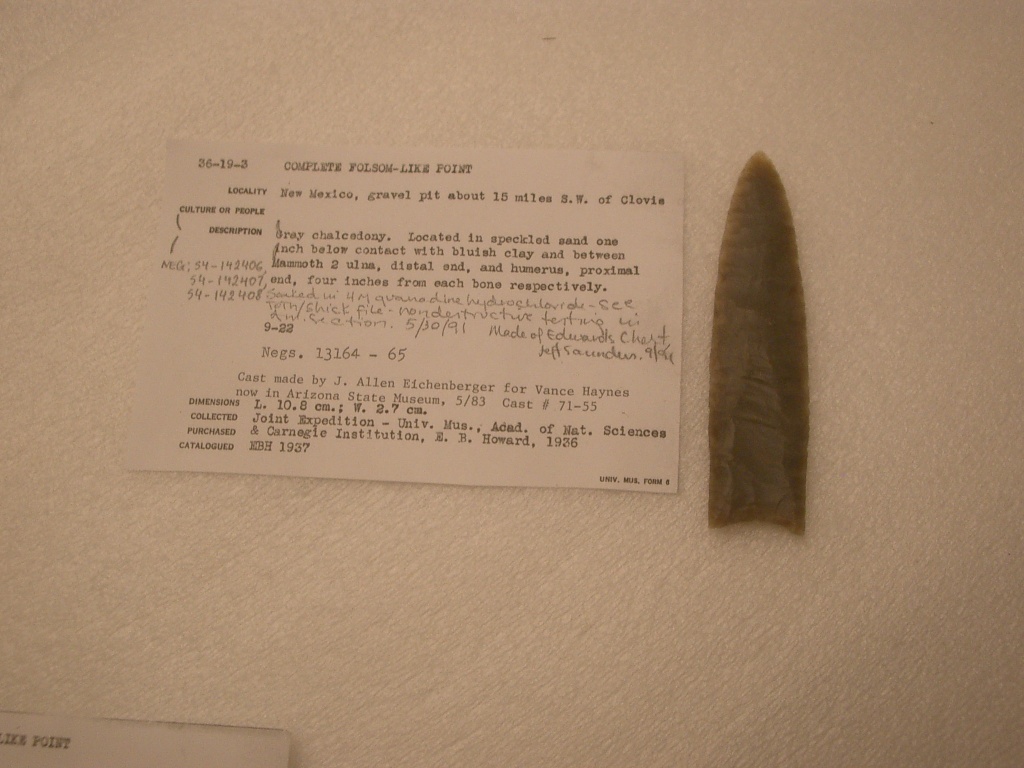
Bill also brought out THE original Clovis Points.  It was really fun to see them “in person” as it were.

Attendees photograph the Clovis points.
Clovis Point with original catalog card.
Close-up of Clovis point.

18th Arctic Conference–Part 2 (Day 1).

Here’s part one on the long-delayed wrap-up of the  18th Arctic Conference.  There were a number of quite interesting papers, as is usually the case.  Since most of this stuff is not yet fully published, it seems worthwhile to put a little update up here.  If anything here sounds interesting, contact the authors.

The first day was mostly earlier material, from Northwest Alaska and the Alaska Range around Denali National Park.  Jeff Rasic gave a paper (coauthored with Bill Hedeman, Ian Buvit and Steve Keuhn) about the Raven’s Bluff site.  This site, about 100 miles north of Kotzebue, not only has fluted points and microblades, but it has a unit (Unit 1) with well-preserved old faunal remains! The 2009 and 2010 work has looked at soils, and there is clearly intact stratigraphy there.  There is an upper ASTt (Arctic Small Tool tradition) component with a date of 2150±40BP, separated from the late Pleistocene materials with a fairly thick sterile layer.  There are 10 C14 dates so far, 9800±60 BP and 10720±50, on the lower component.  Very cool!

John Blong gave a paper on the summer’s work surveying in the uplands of the central Alaska Range, specifically the upper Savage River drainage (Denali NP) and the upper Susitna drainage.  They also found some really old animal bones together with flakes (C14 dates around 10000BP), and excavated at Ewe Creek, where they got cultural material dating to 4500 BP.

Katie Krasinski gave a paper she had done with Gary Haynes on taphonomic analysis of Proboscidean remains.  They had been able to work with fresh African elephant bones and Alaskan mammoth remains to look at how impacts by hammerstones, percussion flaking (this sort of bone can be flaked, as can whalebone) and carnivore chewing modify the bone.  This is important, as groupings of non-intact mammoth (and mastodon in some areas) are often found.  If there are lots of stone tools around, it’s fairly easy to figure out that people butchered them, even if they didn’t kill them in the first place, but otherwise, it’s a lot harder.  This research is aimed at getting data to help figure that out when sites like that are found.  They did gather a fair bit of data.  Biggest surprise: a higher percentage of the animal-gnawed bones had spiral fractures than did the human-modified one.

Brian Wygal talked about survey in Denali NPP.  There has been a several year project to try to get a handle on the prehistory of the park, finishing in 2009.  The talk was a preliminary wrap-up of the project.  He noted that they found the most sites the years they surveyed the fewest acres.  This really points out a problem in Alaska, where the place is so huge and so little has been done.  From the survey results, it also appears that the variations in tool kits which people have been wondering about are more related to seasonal movements and conditions, with microblades (and composite tools in general) perhaps being preferable in colder and snowy conditions.

Heather Smith gave paper on the excavations at the Serpentine Hot Springs site on the Seward Peninsula somewhat north of Nome.  Prior work had found fluted point bases, and 2009 work had located a hearth which yielded a C14 date of around 11,200-11,400BP.  Last summer’s work found more hearth features, which contained a lot of burnt bones and other organics.  Dating is underway.

Lunch was in the Dorothy Vernon Room, a rather interesting room in the modern Louis Kahn dormitory Haffner Hall which includes much of the original Dorothy Vernon Room from the old Deanery.  The afternoon was taken up by a visit to the collections at the University Museum at the University of Pennsylvania.

18th Arctic Conference–Part 1 (the scenic view of Bryn Mawr College).

I’m back from the 18th Arctic Conference in Bryn Mawr.  It was really busy, and the Wi-Fi at Wyndham, where I was staying and had downtime, was amazingly slow, so I didn’t try posting from there.  I’m pretty busy, since I’m only here for a week before we go on a family vacation in Hawaii, so I’m going to break this into small chunks.

We were really lucky to have great weather the whole time.  Apparently the weather has been rather awful this fall in SE Pennsylvania, but last weekend it was perfect.  Bluebird days, still some leaves on the trees, not too hot or muggy.  The campus looked lovely.


Taylor Hall, first building built at Bryn Mawr College, from Thomas Library steps.
Thomas Library

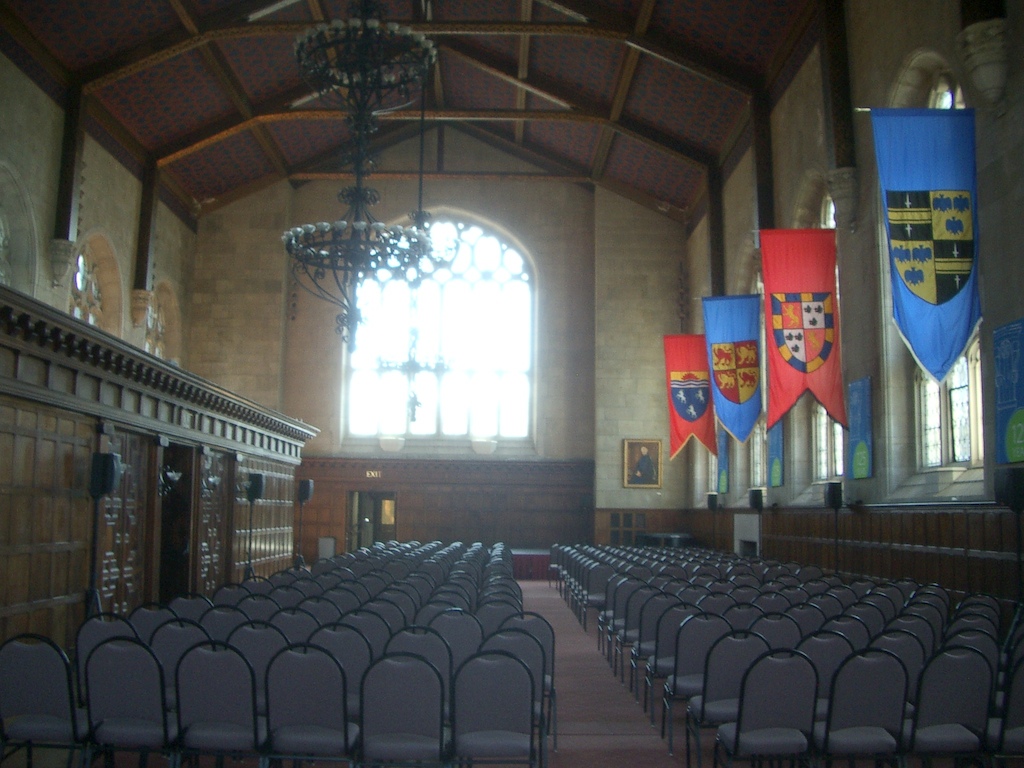
I went inside Thomas, which was the original College library.  It is a bit Hogwarts looking, I suppose.  There used to be a free coffee hour every day in Thomas Great Hall, where just about everyone on campus showed up.  It was very handy.

Thomas Great Hall (apparently set up for some sort of event)
Athena (actually a replica because the original was kidnapped and damaged) surrounded by offerings, holding what appears to be invitations to Lantern Night teas.
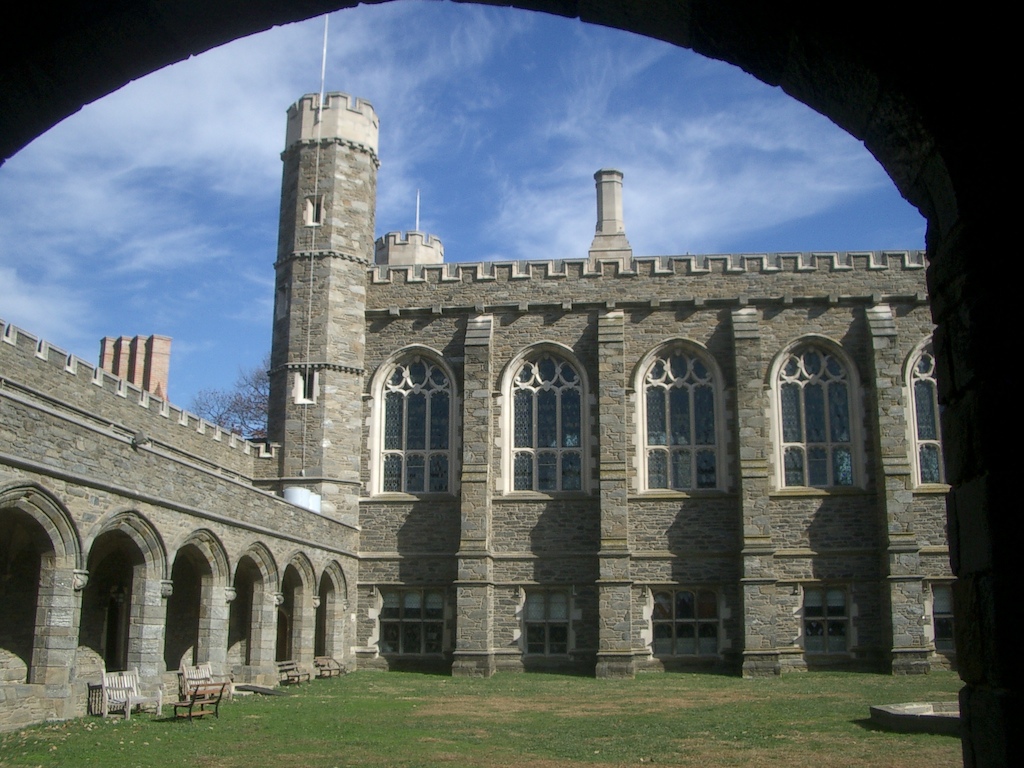
Cloisters of Thomas Library.
Back of Thomas Great Hall from the Cloisters.
Dalton Hall. The "lantern" was a recent addition to hold a staircase that met modern code.

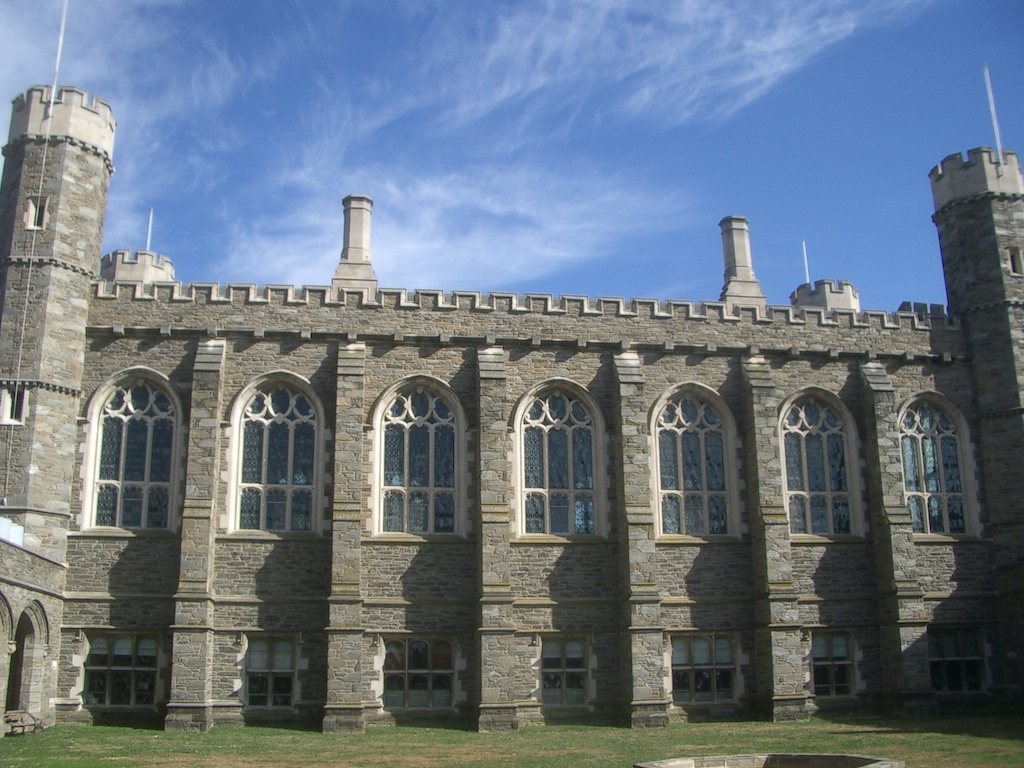
Dalton Hall is where the meeting was held.  It is the home of the Anthropology Department, and other social sciences.  Dalton was built in 1892 as the first science laboratory dedicated to academics.  It underwent a major rehab, which came out really well.  The old building had central stairs, which weren’t up to code, so the “lantern” got stuck on to put the new stairs in.  The labs and lecture spaces are just great, way nicer than when I was doing my AB and my PhD coursework there.


A gorgeous fall day at Bryn Mawr

I’m in Bryn Mawr, PA for the 18th Arctic Conference.  The trip went well, with the biggest problem the 30+ minute taxi from the runway to the terminal here in Philadelphia.  I’m staying in Wyndham, the Bryn Mawr College Alumnae House, replete with antiques, oriental rugs, etc.  Rick Davis pretty much had everything in hand, so I had some free time to check out the 125th Anniversary exhibit in the Rare Book Room at Canaday Library, which was really pretty neat.  A First Folio (Shakespeare), a Nuremberg Chronicle, a Maria Martinez black-on-black pot, Ansel Adams prints, Northwest Coast basketry, Mary Cassatt, Japanese woodblock prints, some lovely Greek pottery (including a plate by the Bryn Mawr Painter!) all in the same small room.

Had a nice dinner with Rick and Rick Knecht, and now off to bed to try & catch up on sleep so I can get up at what my body thinks is 3:45 AM.

Finally starting to catch up

I’ve been insanely busy for the last several weeks.  I do now have a temporary admin assistant, Melinda Nayakik, who has been filing up a storm, which has been really helpful to get a handle on the office situation.  Fortunately, Susie Stine, who has tons of accounting experience and has filled in on UIC Science’s accounting side before also became available.  She’s helping Melinda learn the 2 (!) accounting systems and the paper-flow routines.  Susie has also been really  helpful as we work through moving billing to the main accounting folks.  A good thing, too, since I’ve had the first round of corporate budgets and two CRM reports to take care of.

The budget is in the hands of the higher-ups until the next round, although there are a mass of questions flying back and forth as usual.  One of the CRM reports is just waiting for a nicer background for the main map of this season’s work, assuming it is forthcoming soon, and the other has a couple of references that need to be added.

Other than that, the main thing that is urgent is the presentation for the 18th Arctic Conference in Bryn Mawr.  I leave Tuesday night (since it takes a couple of days to get anywhere that is not in Alaska), so it has to be more or less done by then.  I’ve got an outline, but I need to talk to a couple of whaling captain couples to make sure everything is correct, and I’d like some more pictures of current gear.  I was going to work on this today, and maybe go visit some folks, but I somehow wound up with a stomach bug & couldn’t go out.

I’ve been working on the travel for the Christmas holidays (in upstate NY) and one of the two conferences I’m going to early next year.  My husband & I are both giving papers at a conference in Munich in late January.  He’s going to a meeting at Abisko in Sweden in mid-January, and they’re willing to have me come too, so we’re trying to arrange it as one trip.  Less travel time, and it’ll keep the costs reasonable, I hope.  The organizers are reimbursing a good bit of it, but still, no point going crazy.  I’ve got to go to Tromsø in mid-February, so that travel needs to be figured out next.

Glenn & I may be the only folks at these meetings who actually think there’s a lot of daylight.  Nothing like meeting in the far North in the dead of winter:-).