Back Home Again–Finally

The conference wound up on Saturday with a really interesting circumpolar archaeozoology session, organized by Max Friesen of the University of Toronto.  I’ll do another post about the papers; this one is about coming home.  A bunch of us went out to dinner at a restaurant on a little square up Rue Lacépéde from Rue Monge.

The next day I started home.  My flight was late in the day, so I had a while to hang around Charles De Gaulle (the airport), which resulted in spending money at the duty-free shops on chocolates (for Glenn) and perfume (for me).  The Air France flight had really good food, and was even a bit early into JFK.  Passport control and US customs were the usual slow lines winding around like snakes, but eventually I made my way (by train) to the place where the hotel shuttles stop and got to the room.  A few glitches with the card keys (apparently their machine is on its last legs and only one of 3 worked) and I was able to sleep.

I had to get up quite early Monday, which wasn’t such a chore since I was still on Paris time, since my flight was at 7AM.  While checking in, I discovered that what had appeared as a JFK-ANC flight actually stopped in Salt Lake City.  And that’s where the trouble started.

We arrived in a perfectly good plane, a bit early, and were told that we were going to change planes.  They re-boarded us an hour or so later on the new plane, closed the doors, and discovered that an engine light was on.  They replaced a part, took the jet-way away, tested the engine, put the jet-way back, did something else, took the jet-way away, tested the engine, put the jet-way back, went looking for some other parts, found them, started replacing them, decided that they should deplane us because one of the parts was hard to get at and it would take a while  (they didn’t know that until they started doing the work?  what kind of mechanics are these?),  but we could leave larger luggage on board to speed re-boarding.  They handed us $6 meal vouchers and told us not to leave the boarding area (where there was only one place to get food for 100+ people).  Several hours later, it was clear that I would not be making my connection in ANC to go to Barrow.

When I went up to get re-booked, they were not able to find me a seat from ANC to Barrow until Wednesday.  I had them book it anyway, so I didn’t wind up having to wait even longer.  Eventually, they had us go on the plane five at a time to get the stuff we’d left there, and then sent us to another gate with another plane.  We finally made it to ANC about 4.5 hours late.  A few of us were stuck overnight, but at least the large contingent of senior citizens from the Midwest heading for a cruise ship didn’t miss their sailing.

It took them quite a while working on my ticket, and in the end they took my email and emailed me the itinerary later.  I did wind up standing around so long that when it was time for hotel vouchers, I’d checked the room availability, and was able to get them to put me in the Millennium, which has a decent restaurant and a gift shop that sells T-shirts (which I needed since I didn’t want to do laundry), instead of the Puffin Inn.  I think the problem was that they managed to book me on a Tuesday flight to Fairbanks, with a layover until the Barrow flight arrived, but hadn’t canceled the Wednesday reservation, so the prices weren’t coming out right, and the poor fellow didn’t have a calculator and was having to do all the math by hand.  They handed me more meal vouchers (which didn’t go that far in ANC in the summer) and off I went to catch the shuttle.

The flights on Tuesday went smoothly, Glenn was there to meet the plane, and my bag was one of the first out, so it was only about a 45 minute wait.  We then went over to the library where there was a BASC-sponsored talk going on, to hear the rest of the program, and pick up our daughter and an archaeologist friend, Rick Reanier, who is in Barrow getting ready to do some survey for Shell Oil down the coast.

Naturally, the first couple of days back have been a zoo.  One client has a procedure where they need to get letters estimating how much you are likely to charge them until the end of the fiscal year (September 30) so they can move money around.  The person who does that is going on vacation, so they needed this done ASAP.  So I made those letters, only to have them discover they didn’t have enough money in the projects to do that, and they didn’t have time before the woman left to move the money.  So I had to rewrite the letters to fit their budget!  I really don’t know why they don’t just do it themselves…  That took most of the last 2 days.

In between rewrites, I had a group of Secretary Salazar’s staffers (he’s in Barrow holding a public hearing) tour my lab while touring the building.  Fortunately, they were busy so the tour was brief.  Then I had a regular teleconference with clients, which I got called out of to go and photograph a very large tooth for a local man, Matu.   We think it may be a saber-tooth cat.  Photos have been forwarded to various paleontologists & mammologists, and we await the verdict.
Very neat website about Science and Barrow

Barrow is a pretty interesting place in terms of the sheer amount and variety of science that gets done here, as it has been since the 1st International Polar Year (IPY).  It can be hard keeping track of it even if you live here and are a scientist.  We don’t have a local newspaper reporter, and the radio station can no longer afford a full-time reporter, so there is no local source of science stories for the general public.

Many scientists want to let people know what they are doing, and what they are learning by it, but there are a number of barriers (another post for another day).  One way is blogging.  On bigger hard-science projects, websites and more are possible, since the cost of people to take care of them is really a tiny  portion of the project budget.

A recent project called OASIS really takes this to another level.  Dr. Paul Shepson, the PI, actually built in an author to write about the project, and things grew from there.  Peter Lourie, the author, has written two children’s’ books and has moved on to multimedia.  They’ve made a really neat website, which has video from a number of scientists who work in Barrow.  There’s a lot from various folks on the OASIS project, but also from people who live in Barrow, like Fran Tate of Pepe’s, whaling captain Eugene Brower and even me.  I actually got interviewed twice, because the sound on the first set got messed up, so I had to do it all over again when Peter came up again!

Definitely worth checking out.

Here’s hoping the plane makes it in tonight…

…because Shawn Miller, the physical anthropologist who will be documenting the human remains excavated at Nuvuk this summer, is supposed to be on it. The weather has been rather unfortunate of late, and a number of flights have tried to land, only to be turned back by visibility below minimums, thanks to the fact that the folks who sited the Will Rogers-Wiley Post Memorial Airport seem to have picked the foggiest spot they could find. A lot of folks have gone back and forth between Anchorage or Fairbanks and Barrow a couple of times by now (and you don’t get frequent flier miles for that).

We’ve got the lab all ready, and Laura is getting Shawn’s equipment (various digital measuring devices) out in case he wants to get an early start.  Once he’s done, we can arrange the reburial.

Meanwhile…

While the dental extern was busy in the lab, Laura was there to help her find things, answer questions, and so forth. I was busy with other things.

A couple of Navy archaeologists (yes, the US Navy has archaeologists) were in Barrow last week to look at a tract that the Navy may be transferring to UIC, the Barrow village corporation, to get an idea of what needs to be done to comply with cultural resource protection laws prior to transferring Federal land. Neither of them has any Arctic experience, and they stopped by my office to pick my brain a bit. The next day they were doing a few STPs on an old beach ridge on the tract, and asked if I’d like to join them. It was a warm sunny day, with not much wind, and therefore many mosquitos. I hiked our from my office building to meet them, we checked out the area a bit & I hiked back. Other than all the bugs, it was great.

Navy archaeologists David Grant and Bruce Larson surveying.

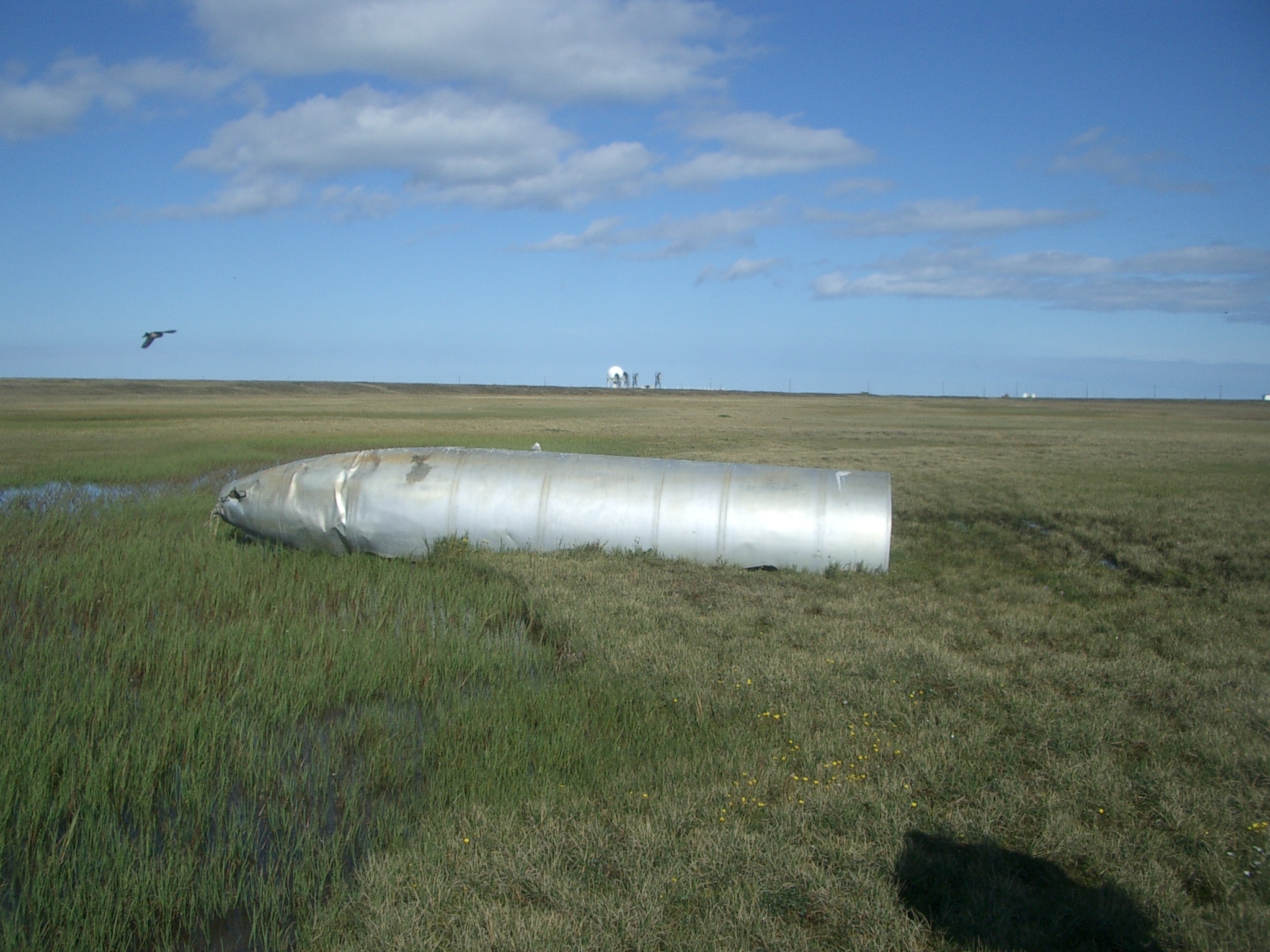
We didn’t find anything cultural that was older than NARL, but we did find a couple very old gravel beaches. We did find some stakes that had probably marked research plots, and a big aluminum object that looked like an aircraft part. It had some cable attached to the front, as if someone had been trying to tow it. Apparently they gave up.  If you happen to recognize this, please let me know and I’ll pass the information on.

Large aluminum mystery object on Navy tract.

The next day I got a call from the City of Barrow. They run the cemeteries, and had been getting reports that a coffin was partially open. They had checked, and indeed a coffin had been frost-heaved and was damaged. They asked if I could come over when they moved the person into a new coffin. We decided to do it the next afternoon, after they got the new coffin built.

Fortunately, the old coffin wasn’t damaged except for a bit of the lid, so we were able to get the dirt off to make it lighter without disturbing the remains. The City crew was able to lift the entire box out and place it in the new larger coffin. It was a tight fit, because the old coffin had been covered with canvas that was nailed on, but that wasn’t clear when they had measured for the new box! Luckily they had left a bit of space, so they were able to pry a bit and get it in. I got the canvas that had frozen in out so it could go along.  I’d mostly been there in case the coffin was fragile and we had to transfer the individual, to make sure that nothing got left, but that wasn’t needed.

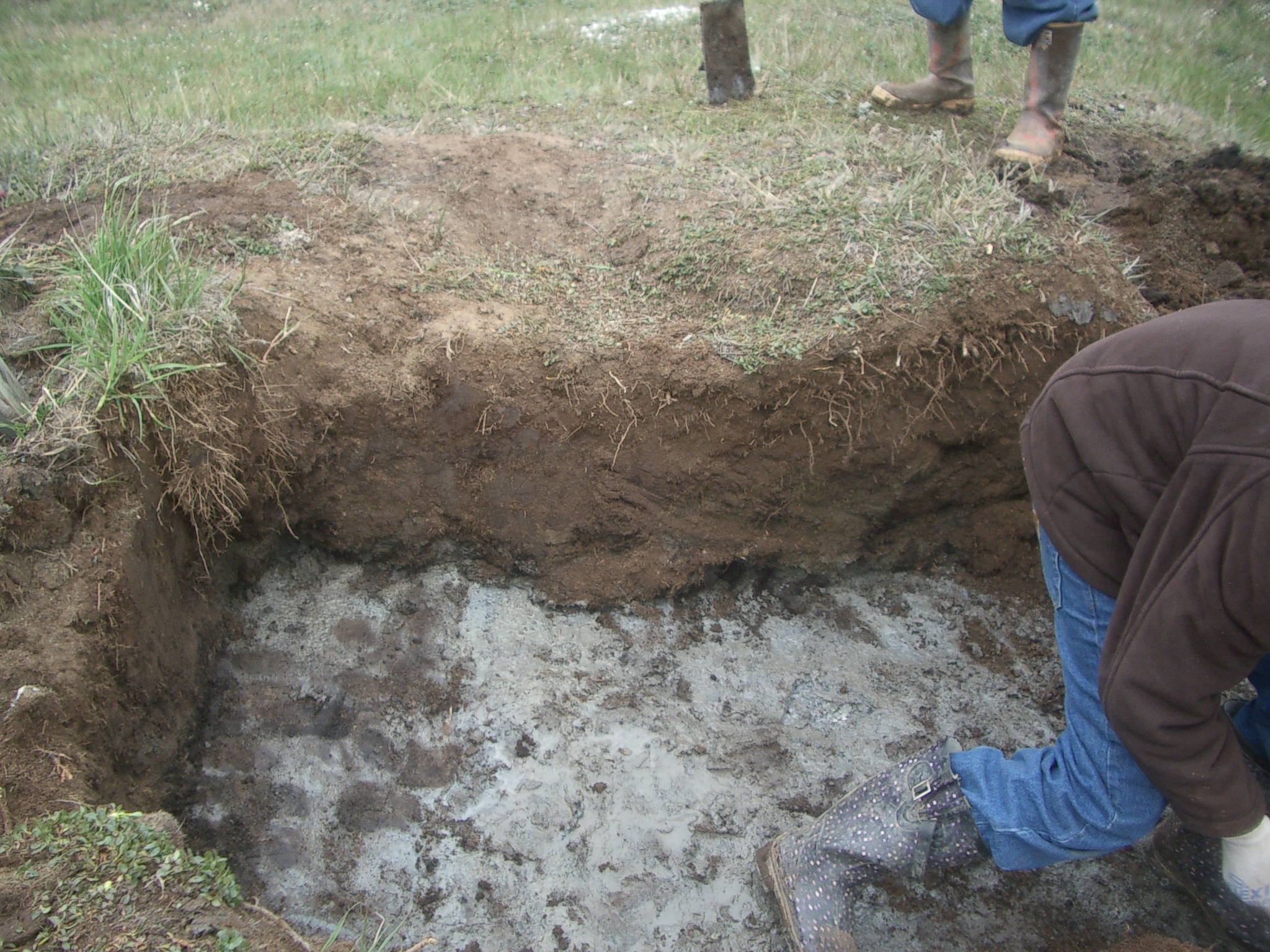
Once the coffin was out of the grave, the idea was to dig it a bit deeper, and then rebury the person. The soil profile was pretty interesting. There was clay (which generally is deposited on the bottom of bodies of still water) very close to the surface, despite the fact that the grave was on a mound. Apparently the permafrost has pushed it up a good bit, although it may have been deposited when sea level was higher than today.

Permanently frozen clay exposed in grave in Barrow cemetery.

The crew did what they could with shovels, but thaw was not that deep, as you can see from the picture above, so they were going to get a compressor and jack hammer, to really get the grave deeper, when I left.  If not, frost heaving would just bring the box up again in a few years.

First Day in the Field!

As usual, things were a bit disorganized getting ready to go to Nuvuk this morning.   However, after rounding up a non-leaking pump, gassing up 5 of the ATVs, buying bungee cords (the many folks who had gotten all the field gear from last year out had somehow not noticed the bungee cords had gone missing), airing up a couple of tires, etc., we set off.

After getting to the site and orienting the newbies, we put all the gear into the proper tents, gave the lesson on how to make up a honey bucket that is unlikely to fail in transit (they have to be backhauled to a proper disposal site), and set off in a line, pin flags in hand, to survey the site.  We located one burial during the survey (exposed by recent vehicular traffic, alas) and spent some time getting driftwood to block off and reroute the trail until we can excavate the person.  We also located a number of features, and a few loose teeth.

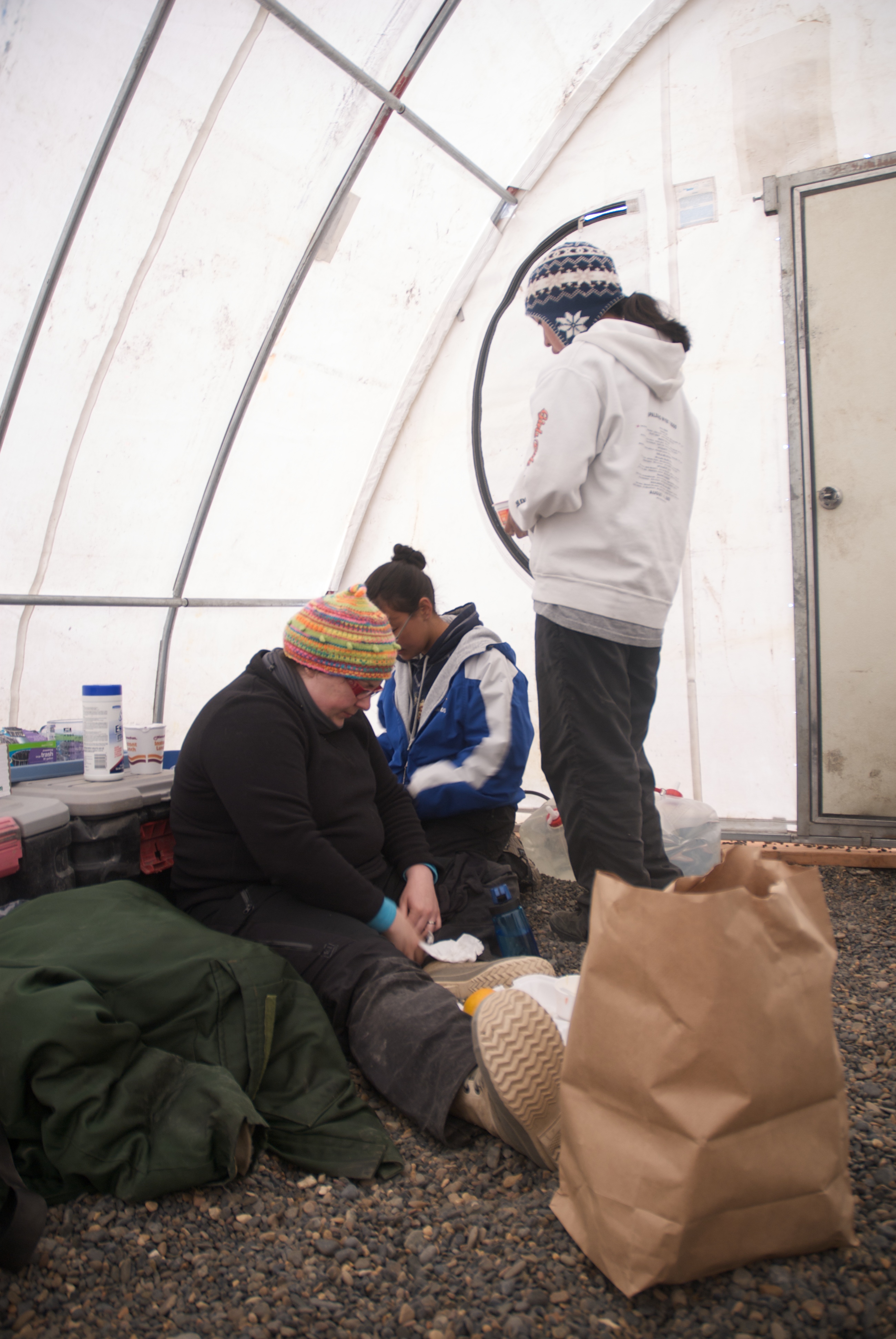
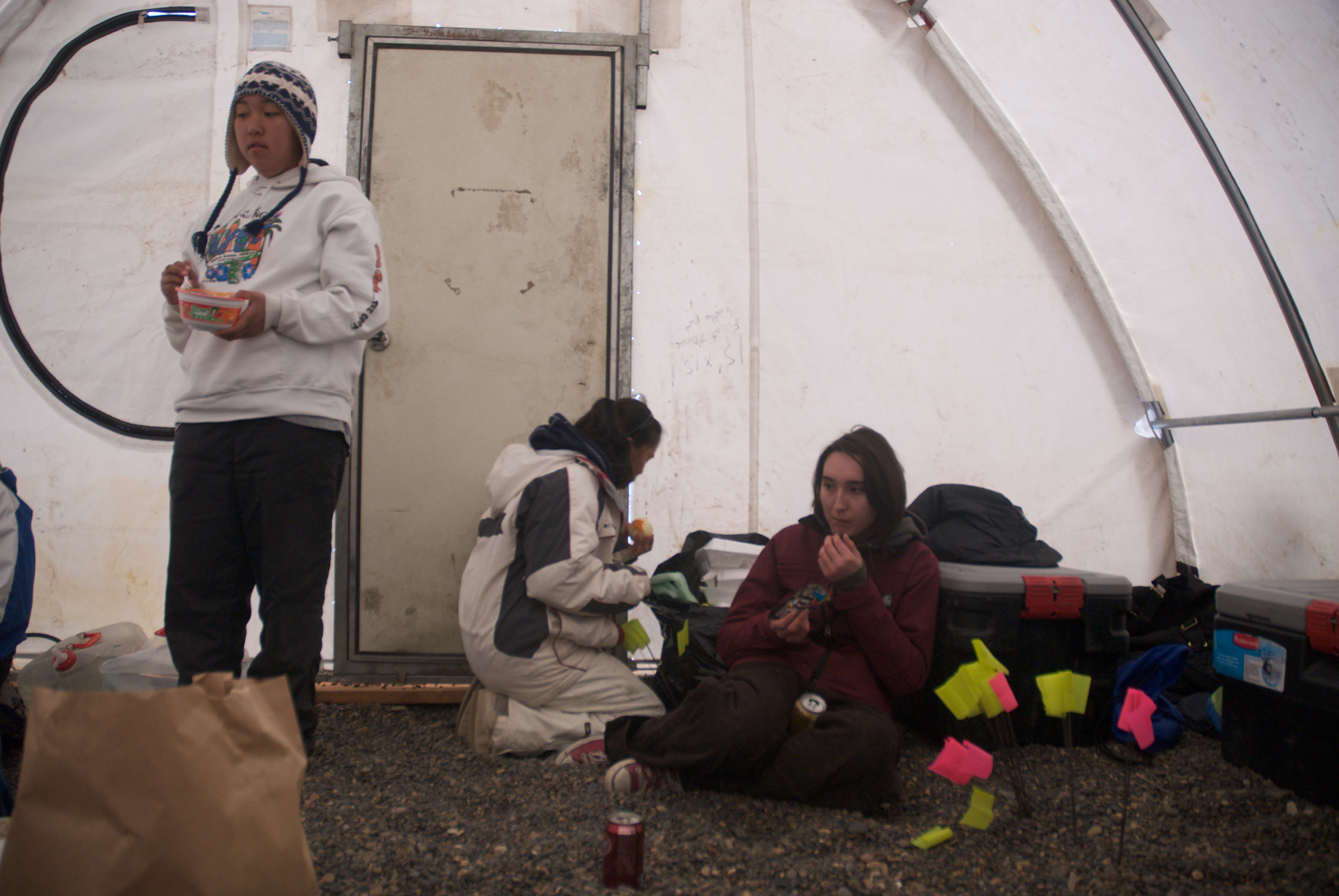
Then it was time for lunch.  We have a relatively small crew this year, so the tent felt quite roomy.

Laura, Flora and Trina get their lunches ready.
Trina, Nora & Victoria have lunch in our spacious Weatherport.

We took the usual hour for lunch (Rochelle actually caught a nap), and then we went back at it.  It started raining, and kept it up until just before clean-up time.  Everyone was well dressed, and since the wind was WSW, it wasn’t too cold.  The NWS had called for rain or snow, and we’d all be hoping for snow if anything, since it is less wet AND makes for better pictures.

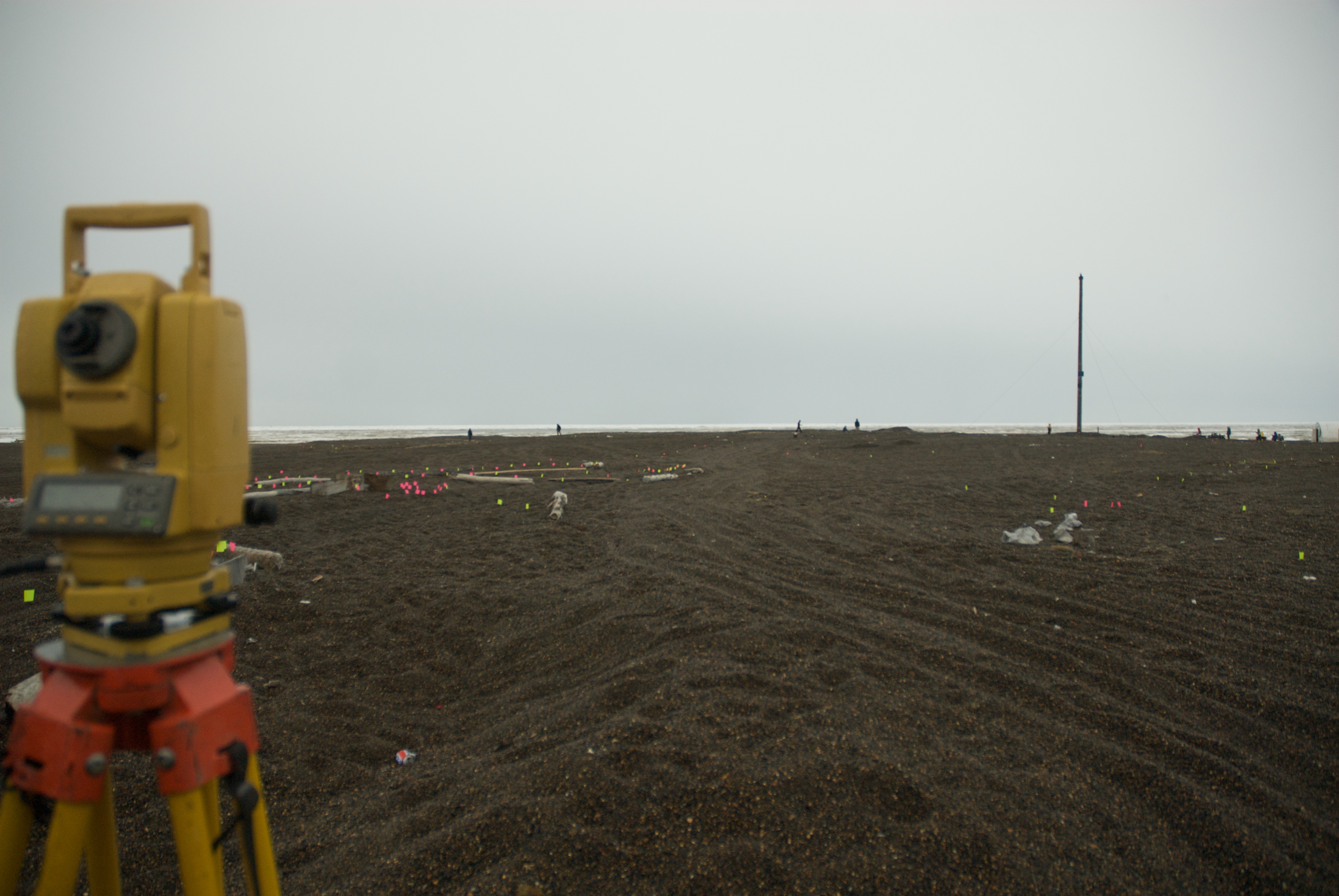
Flora and I set up the transit to shoot in the locations of the burial and some artifacts near it.  We are moving from the primary datum we have used for many years, because erosion is approaching and we will lose it in the near future.  Fortunately, the work we had done last summer setting up paid off and everything went smoothly.  We need to mark a couple of the additional datum points tomorrow so they are easier to find.

View from transit station over the area we will be working in this season.

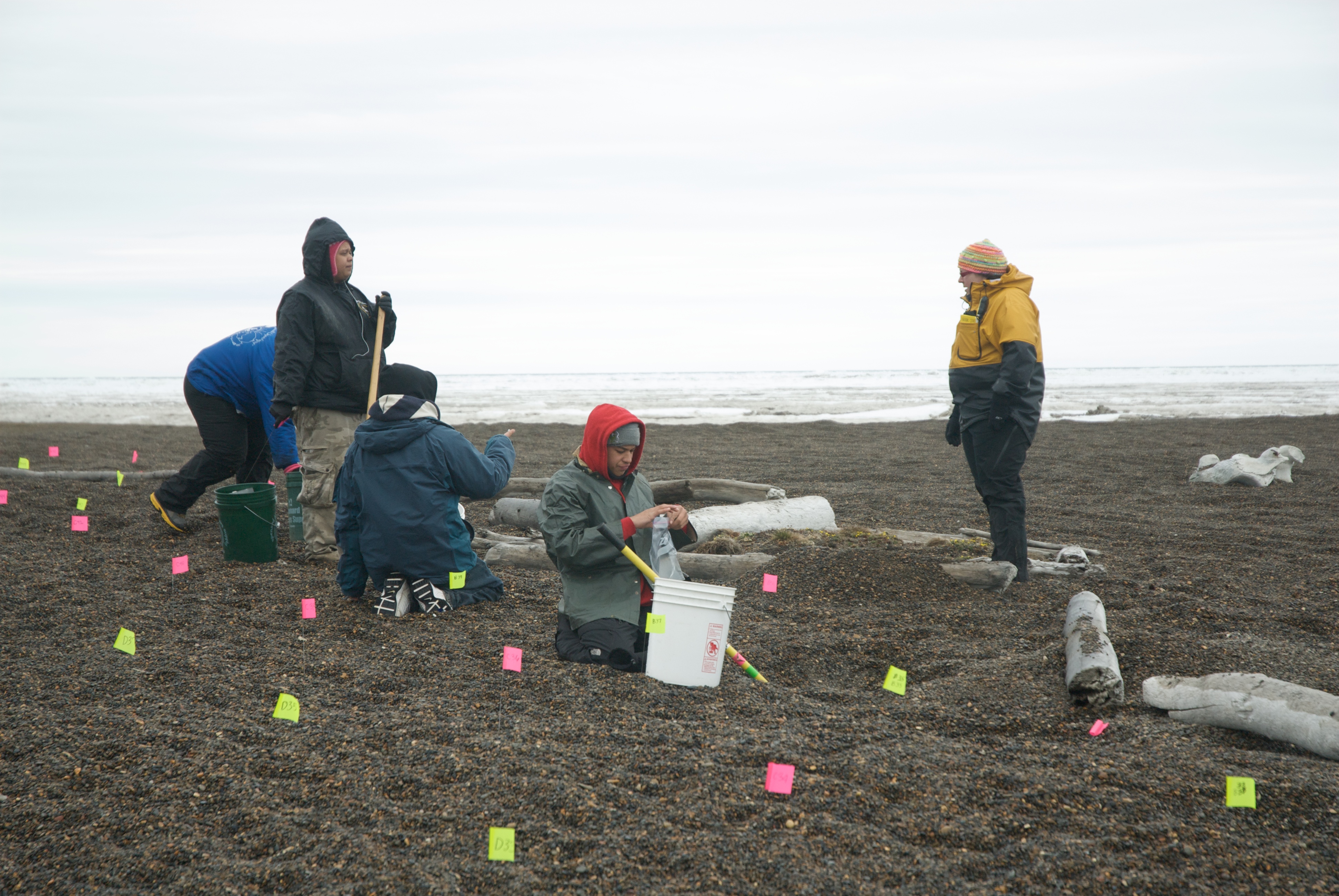
The rest of the crew laid out lines of shovel test pits, and soon Nuvuk was festooned with lines of bright pin flags.  We had to dig some of the STPs (shovel test pits) quickly, as they fell on the trail, and we needed to clear that area so people don’t start diverting into untested areas.

Part of crew hard at work among the pin flags.

Flora shot in the STPs, and Brody backfilled about 20 by himself.  Then we packed up, rather quickly for the first day, and headed back in.  We didn’t see any bears all day.  A couple of hours later, all data is downloaded and backed up, everything is on a charger that needs to be, my houseguest and husband have been fed dinner, and I’m going to bed.

Barrow 4th of July – No fireworks

Barrow really does up the 4th of July.  In part this is because Eben Hopson Day, which celebrates Eben Hopson and the founding of the North Slope Borough, falls on July 2.  This year, it was essentially a 3 1/2 day weekend, with games and activities every day. Not only did people have the 5th off in lieu of the 4th, but most places let people off work early on the 2nd.

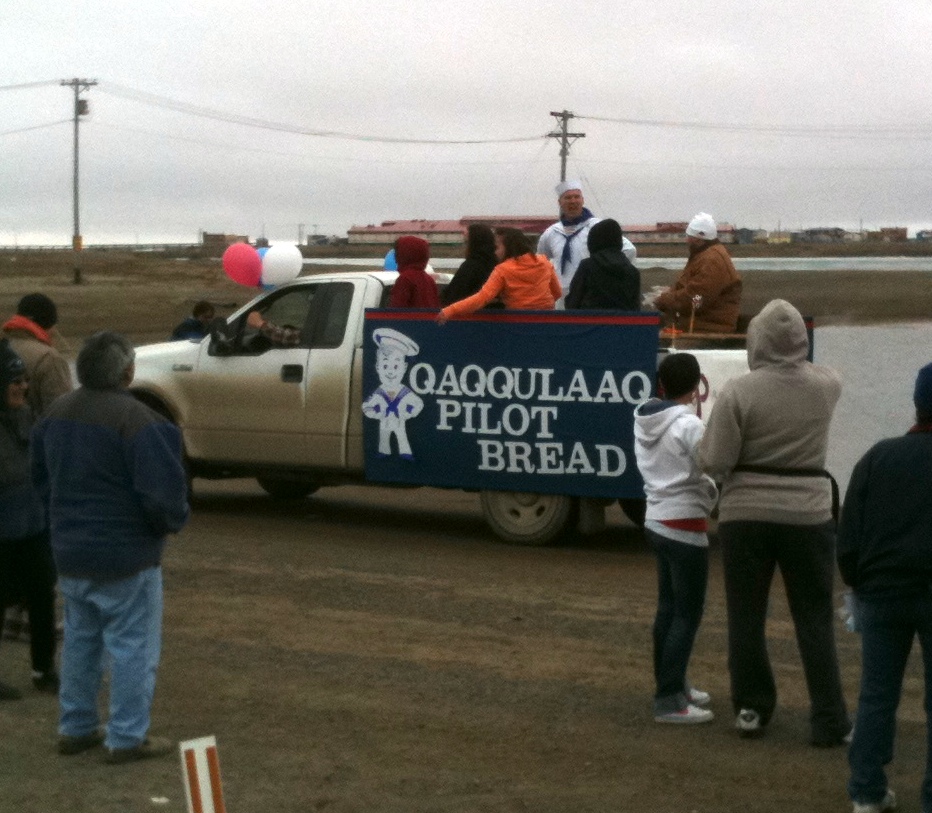
There were all sorts of races and games, a big parade, and the Pretty Baby and Miss Top of the World contests.  The contests (run by age group) usually have money prizes, and are hotly contested.  Lots of local groups fund-raise by selling food, candy, and so forth, and you really don’t need to cook.  This year the Arctic Education Foundation booth had brought up 13 (!) tubs of Baskin-Robbins ice cream, which was a huge hit.  I went 3 days in a row.

One thing it doesn’t include is a fireworks display.  Why not?  Not because people here don’t like fireworks.  The New Year’s Eve display is broadcast not only across the North Slope but on WGN from Chicago.  Long story…  We don’t have 4th of July fireworks because the sun won’t go down until August 2nd, and it’s just too light to appreciate them.  Of course kids have little noise-making ones, snaps & “M-80s” and somebody did try something with colored smoke trails, but it’s not the same.  Most people save their money until New Year’s Eve.

I took a ton of pictures, but not all came out so well (using the iPhone, not the D200), so not all the babies are here :-(.  Some pictures for those who weren’t lucky enough to be here in person…

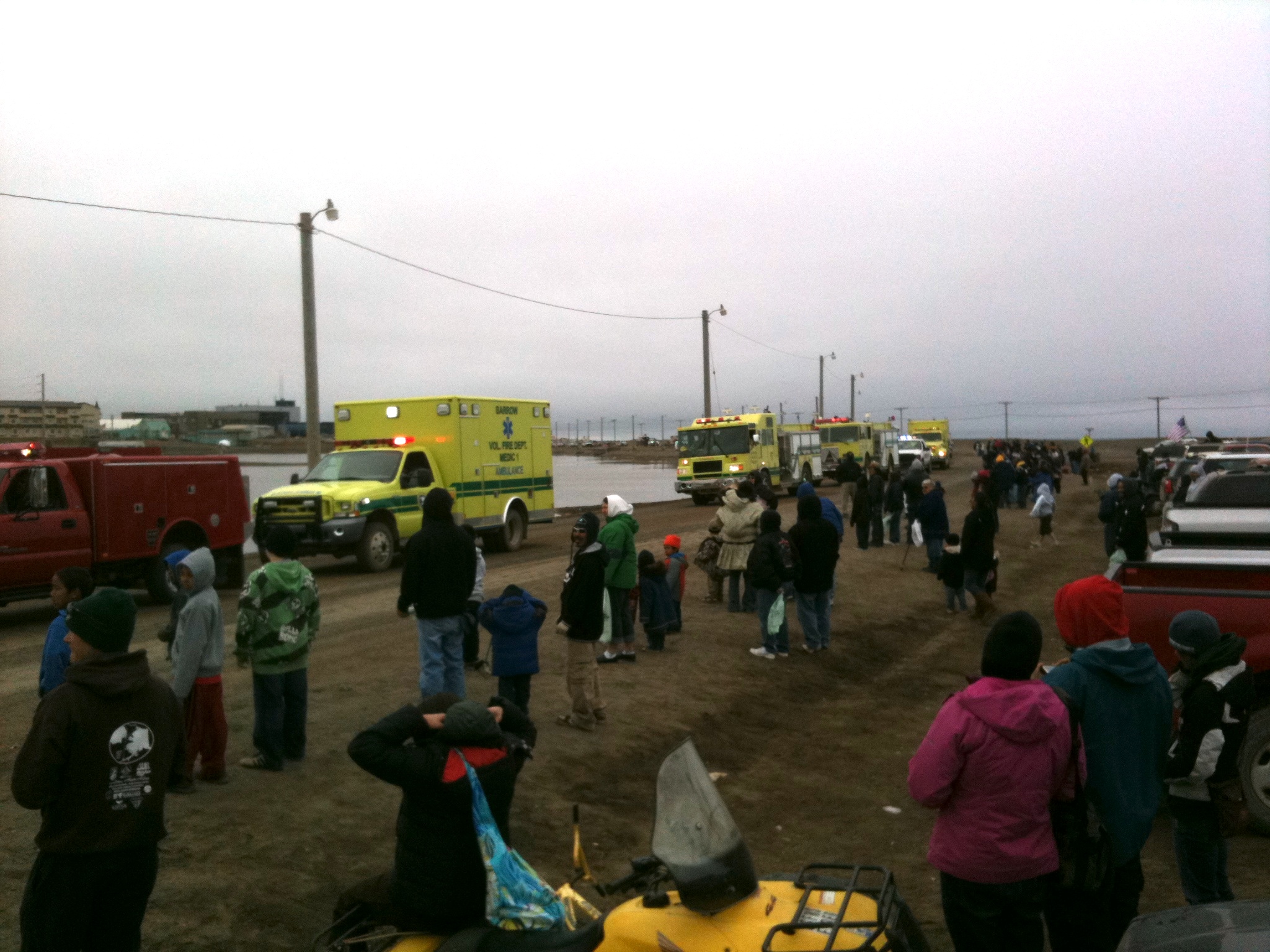
What's a parade without lots of fire apparatus?
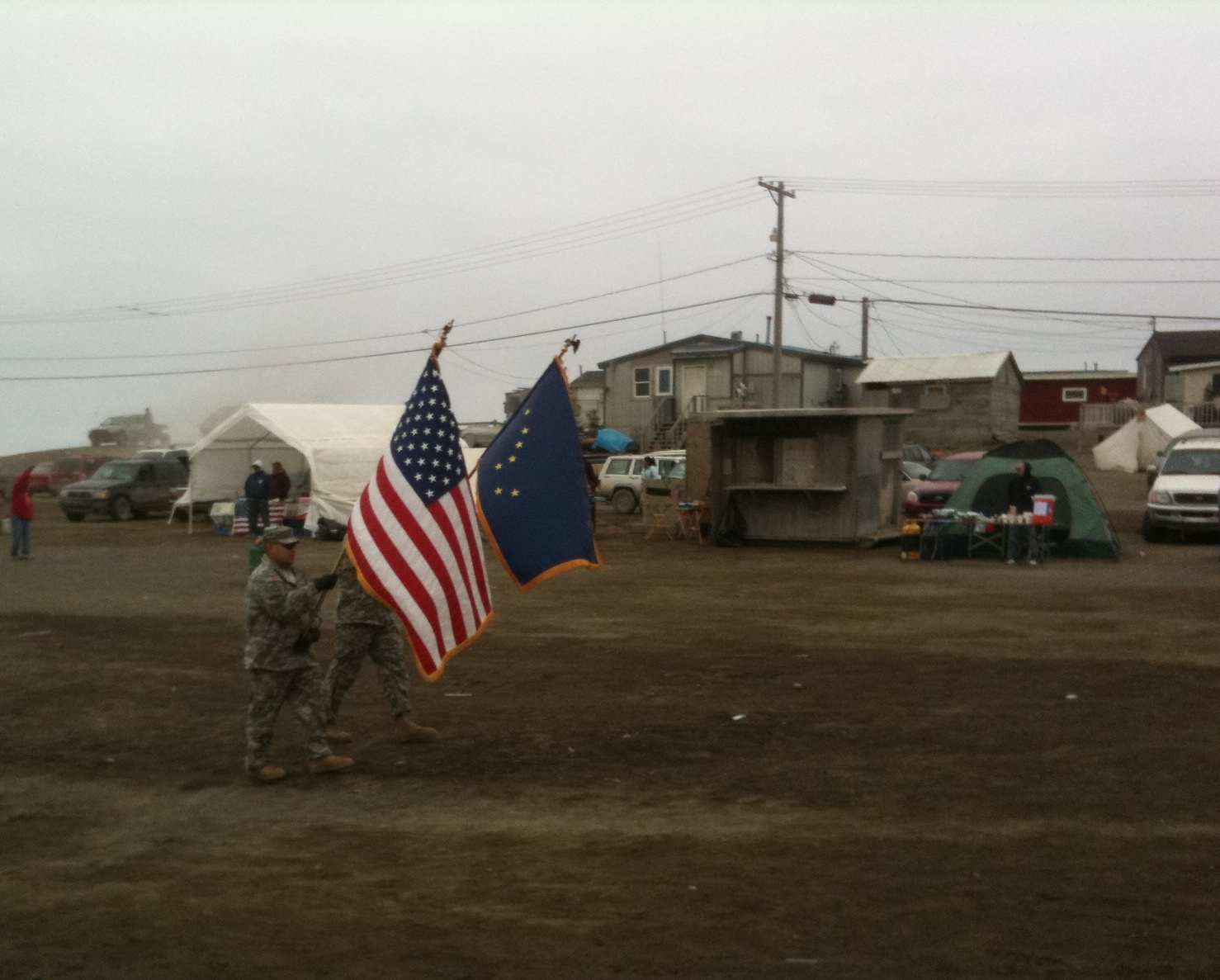
Color guard of local reservists
If you've spent time in Bush Alaska, you'll know why this is the Best. Float. Ever.
Search and Rescue boat. Perry Anasugak, former Nuvuk bear guard, is in the cabin window.
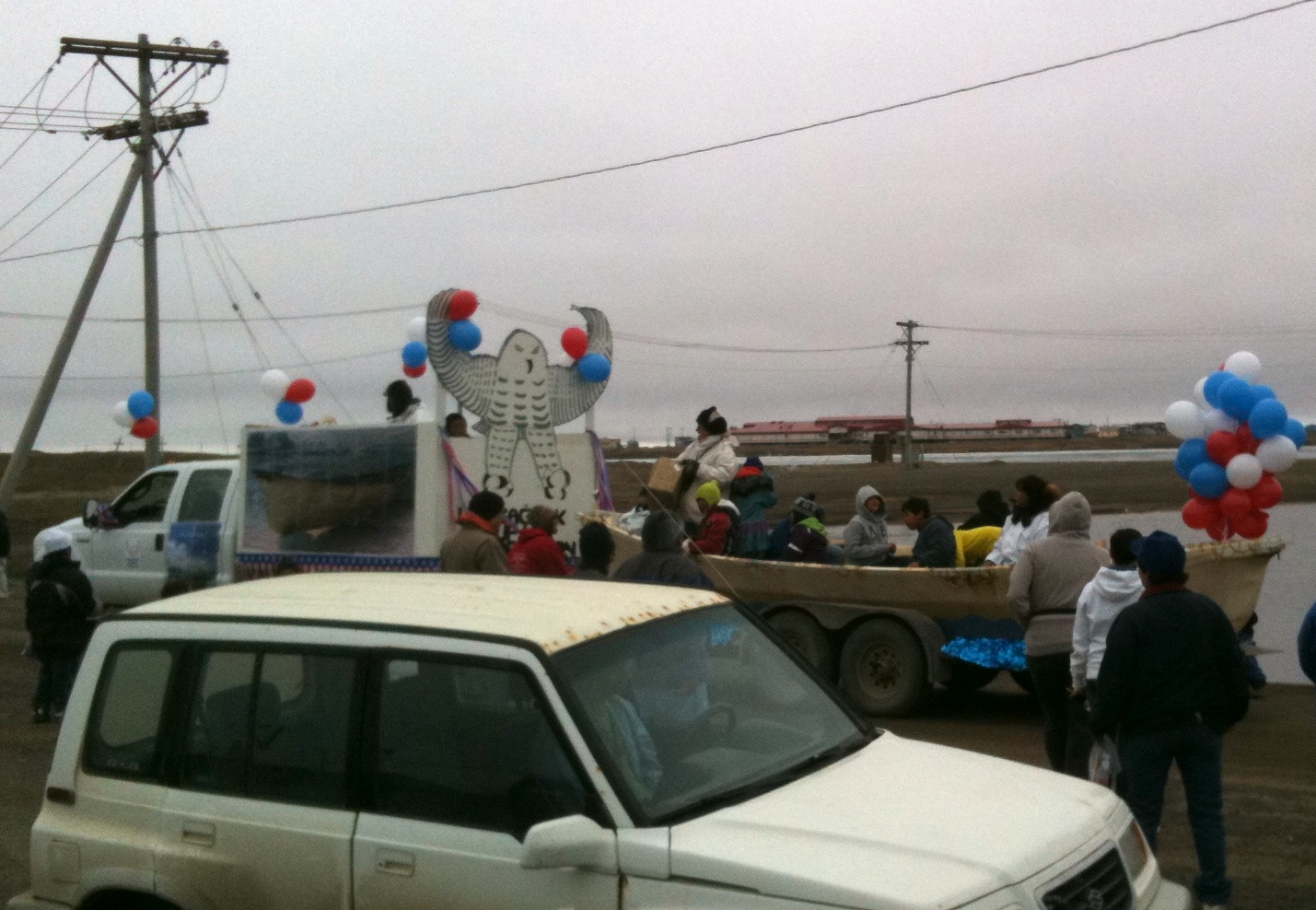
UIC (my employers) float, with real umiaq and surreal ukpik (owl). They can be scary enough at life-size.
Women runners for Clare Okpeaha Memorial Race--2 x around town.
Men runners for Clare Okpeaha Memorial Race--3 x around town.
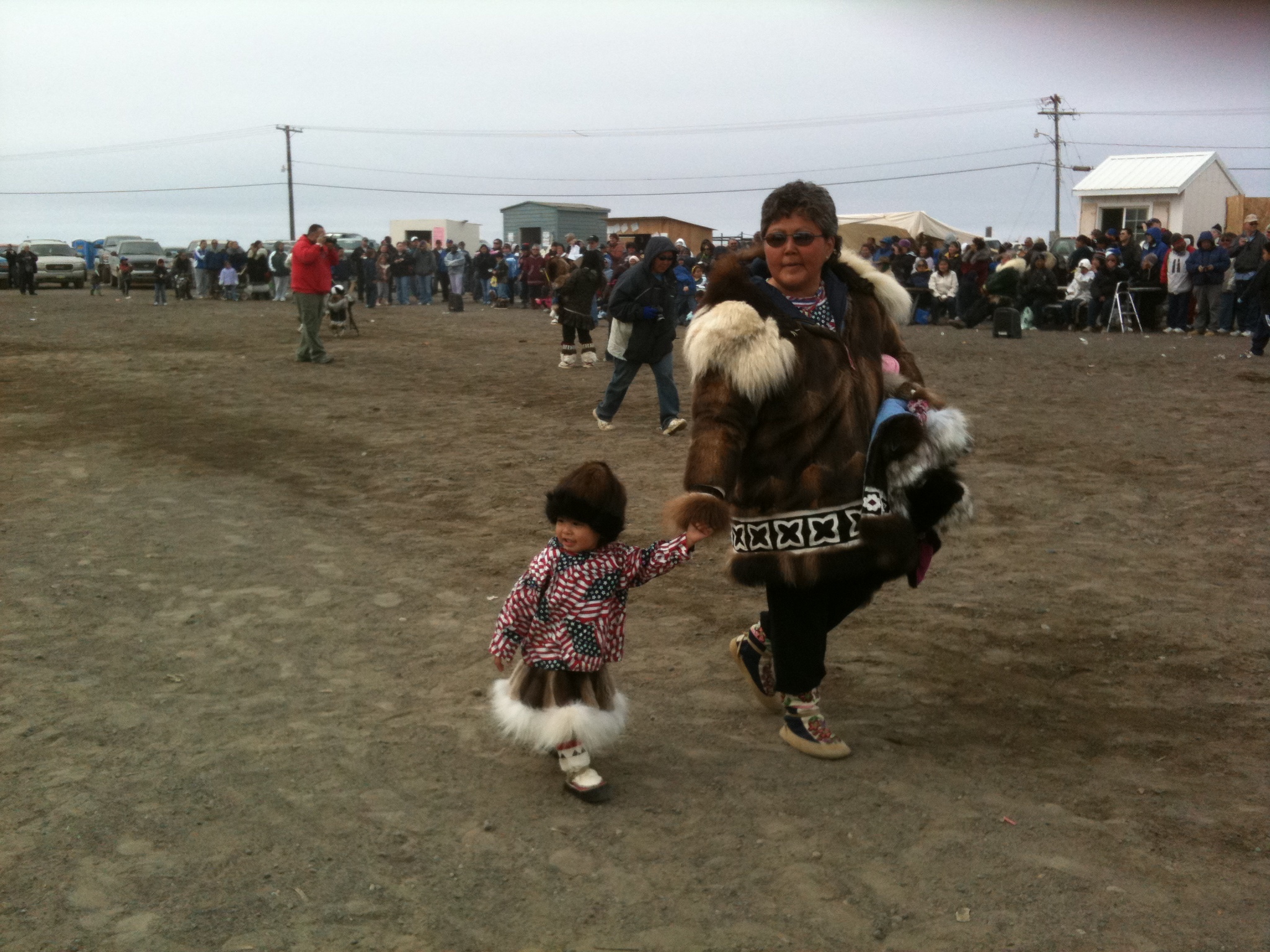
Pretty baby & her Aaka walking around so the crowd can see.
Pretty 4th of July Baby
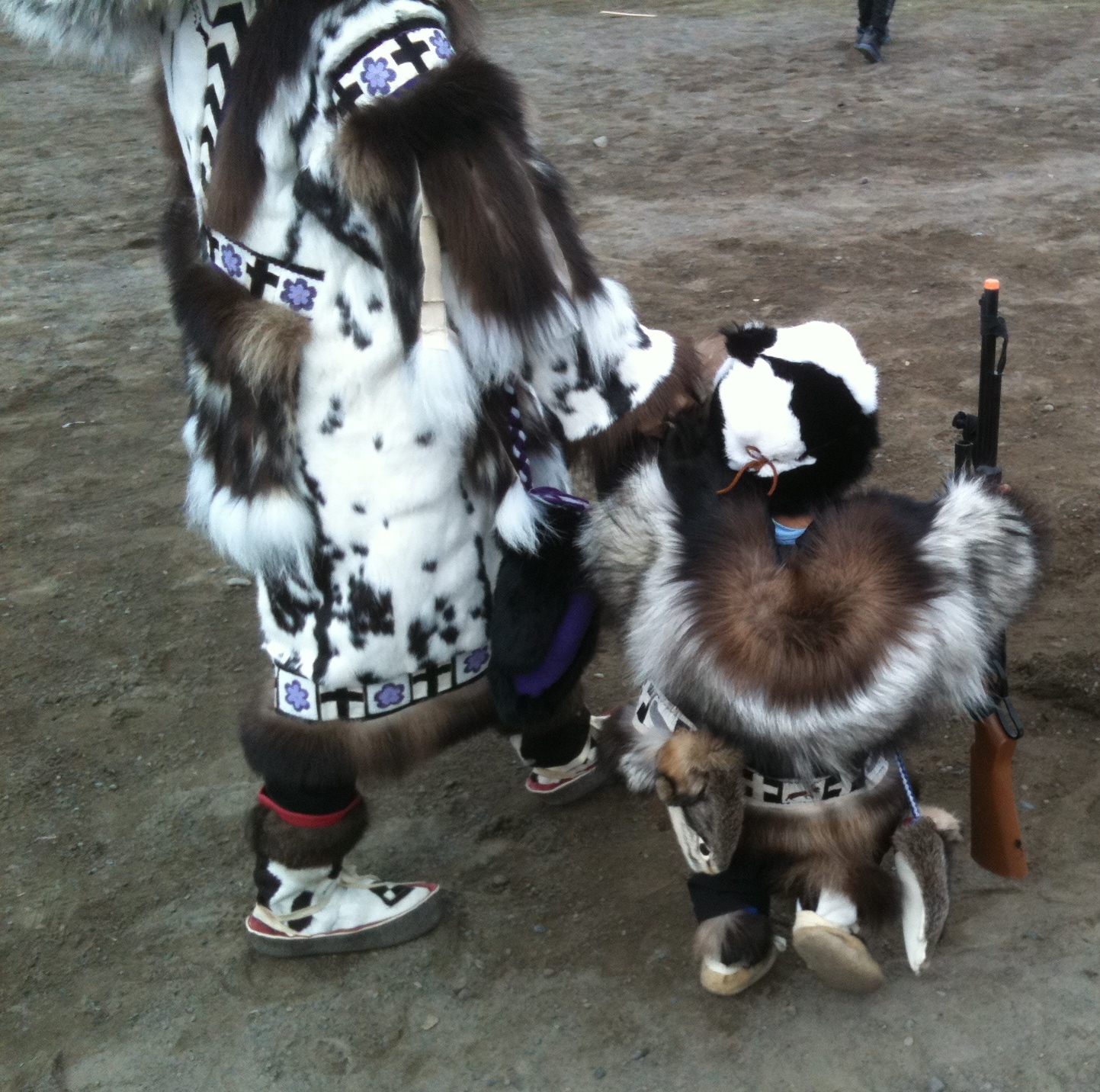
Budding hunter and his mom in beautiful parkas

Oh, yeah, for those on the East Coast, our high today was a pleasant 38 (4.4 C) with light winds :-P.

So you want to do what to the tundra?

Heat it, it turn out.  The Department of Energy has some experiments running in the lower 48 (that’s the Continental US for you non-Alaskans) which involve heating small patches of land to see what the effects of global warming might be.  Better than just wait and see, no doubt, and it would give some guidance about adaptations that might work.  Anyway, they are thinking of trying this on the North Slope.  For the moment, they just want to test the proposed method in a very small area,less 30 m in diameter.  (A meter is just over a yard, about 39 inches, for those who forgot about the metric system when they left school).

Barrow has many wonderful things, including the Barrow Environmental Observatory, which is 7466 acres of land set aside by the Ukpeagvik Inupiat Corporation, the Barrow village corporation (more about that some other time) for scientific research.  It is actually zoned as a Scientific Research District by the North Slope Borough.  That’s where DOE wants to test this.  So, a plot had to be located.  It needed to be near power and a trail.  Craig Tweedie of UTEP, an ecologist, found a spot that seemed fit the bill, which had been disturbed in the past by tracked vehicles called “weasels” which NARL scientists used to use to get around on the tundra.  Now everyone walks in the BEO when the snow is melted, unless matted trail is put down.  The idea with a disturbed site was that it wasn’t much good for other research, so it’d work for testing the warming equipment.

The next question is if there are any cultural resources (archaeological or otherwise) on the site.   Since I work for the company that owns the land, that’s part of my job.  Normally we’d wait until later in the summer when the ground is thawed more and the Nuvuk field season is over, but they’d like to try  to install the equipment soon.  So I went out this afternoon to look at the place for the first time and see what was what.  There were a few pictures, but I guess archaeologists look at things differently.

I had a GPS location for the center point, so I programmed it in, got a 30 m tape and pin flags, and set off.  First I drove to a pull-out on Cakeater Road, parked the truck, and took a half-mile or so hike into the BEO.  There is boardwalk part of the way, and matted trail goes right past the site, although it isn’t very level, since the tundra it is built on is fairly lumpy and shifts a bit over time besides.  However, it’s been such a late melt that a lot of parts of the trail were under water, so I had to do all this in Xtra-Tuffs & rain bibs.  I’ve been coming down with something the last few days, so I really just wanted a nap, and wasn’t exactly looking forward to this little excursion.  Luckily, the sun came out for what seems like the first time in days, and it was actually fun, although I took an amazingly long time to do it.  Then I had to turn around and hike back to the road :-(.  There were lots of birds around, and the buttercups and willows were in full bloom, so  all in all a good day.

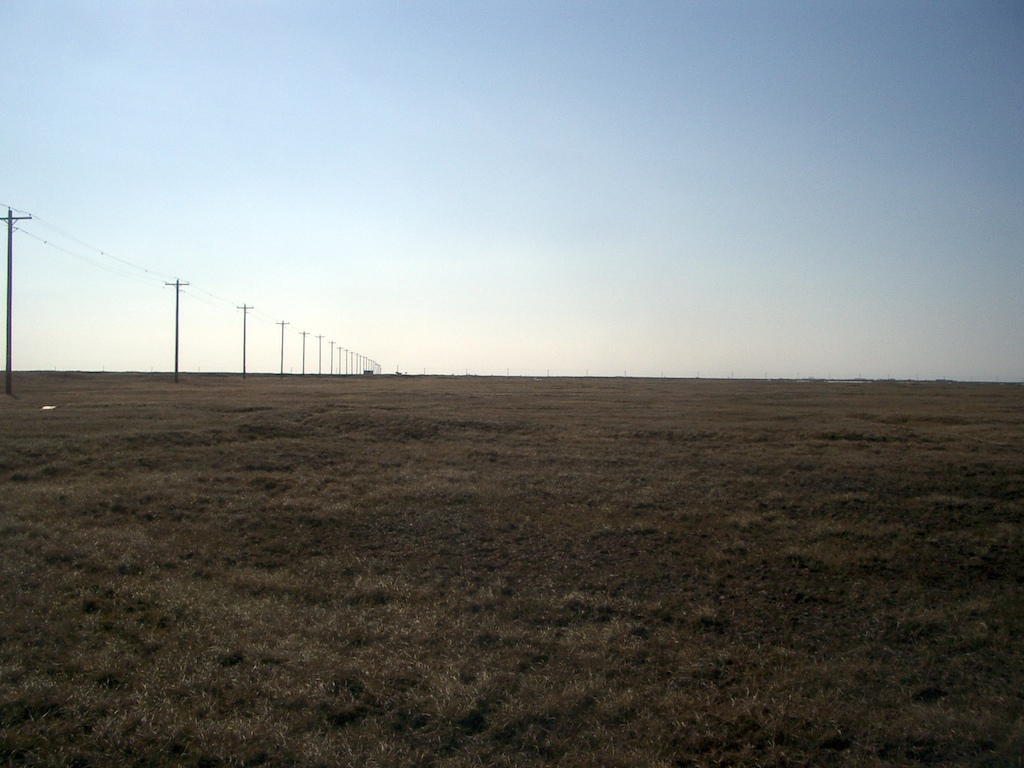
Looking back toward Cakeater Road from the site. My truck is the teeny-tiny thing at the end of the power line.

Once I got there, I put some chaining pins into the center point, and ran out a circle around it with a 25 m radius.  The actual equipment is going to be a hexagon with about a 25 m max dimension, so this gives room for construction and a little wiggle room.  I walked the whole thing in really close transects, much to the annoyance (verging on hysteria) of a shorebird which must have a nest nearby.  Based on this inspection, it looks good for the tundra warming experiment.  The only evidence of human activity on the site was the aforementioned weasel tracks, a crushed 55-gallon drum, and a flattened tin which probably held Blazo once.  The area was pretty damp, and there was higher, drier ground nearby, so it’s unlikely to have any significant pre-NARL activity when we test.

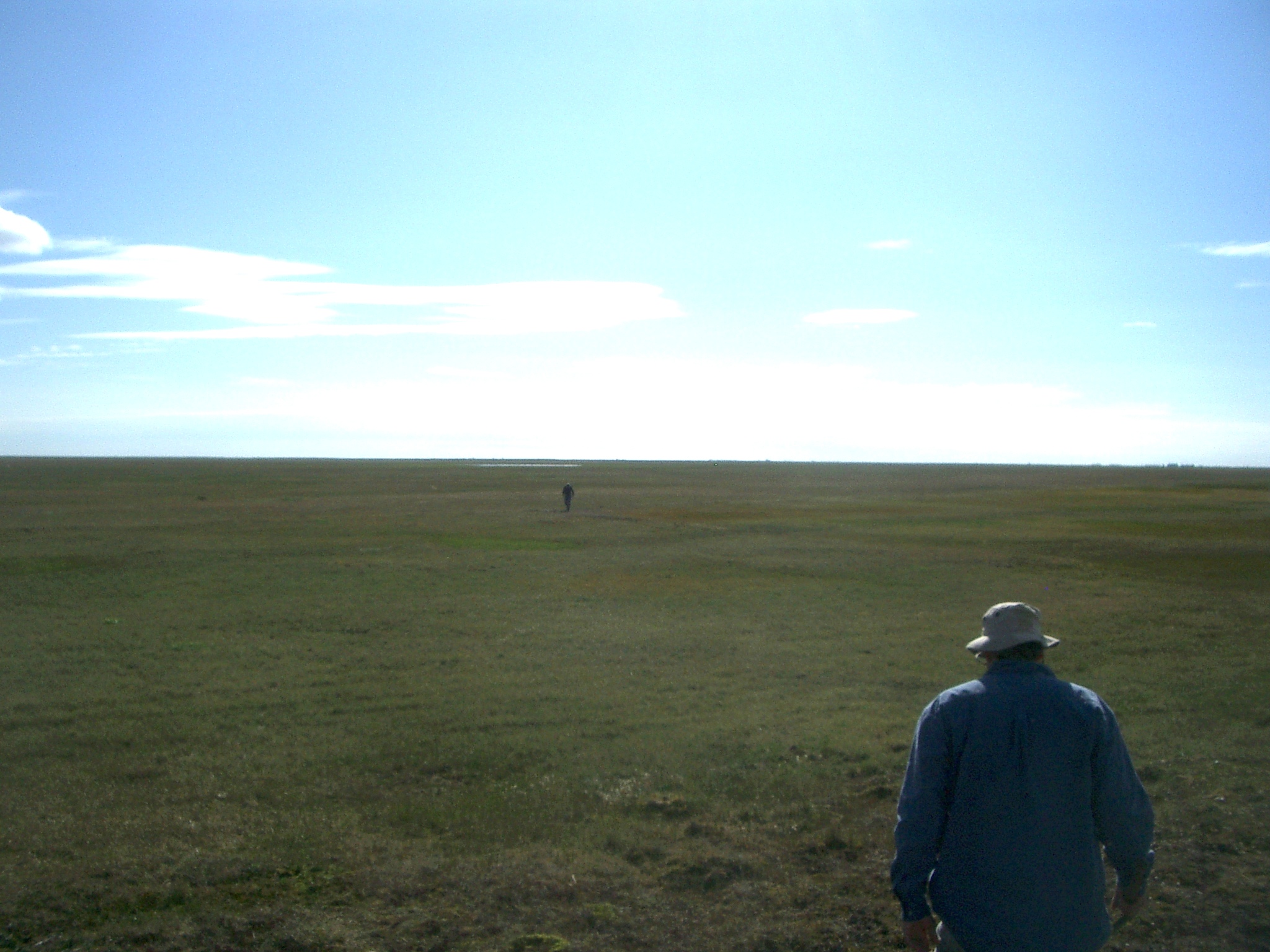
The tundra near Barrow (with my tape stretched out).

Pizza & baklava, and so to bed.

A quick trip to Nuvuk

Monday afternoon I got to take a quick trip to Nuvuk to check on the two tents BASC had put up for us to use doing the field season. The big one is for lunches and gear storage, and the little one is for the honey bucket (the tour van kept showing up at such awkward times…). It was a nice sunny day, not too windy.

On Point Barrow, heading toward Nuvuk
Looking northwest across Point Barrow. The horizon is white because of "ice blink" since the ice pack is still in.

We even got to see a polar bear.  It was sleepy, and just lay there snoozing.  There was a van full of tourists snapping away (just out of frame to the right).

Sleepy bear at Nuvuk.
Blown-up picture of the bear.

Living where you work has its down-side

Unlike most other Arctic archaeologists, I live where I work.  My house is less than 10 miles from the site I am currently working on, and there are other sites closer than that.  In general, that’s a good thing, and I wouldn’t change it for the world, but like so much else in life, it’s not an unmixed blessing.

PROS OF LIVING WHERE YOU WORK

  • Community members can take part in all parts of the project, and can find you to ask questions whenever they want.
  • No long expensive trips to get to the field.
  • Logistics can be arranged before the field season, by talking to people you know or making local phone calls.
  • Gear doesn’t have to be shipped to and from the field, at great expense.
  • If you run out of Ziplocs during the season, you can get more at the grocery store (assuming they haven’t run out, of course.)
  • The artifacts get to the lab every night, after a short trip, and can be treated and stabilized quickly if necessary.
  • The artifacts stay in the community.
  • You get to sleep in your own comfortable bed.
  • You get to cook meals in a real kitchen and go to restaurants, instead of having to eat only things that everyone else will eat too. (Arctic archaeology is hard work, and camp cooking can’t get so far off the beaten track that some folks won’t eat it.)
  • You have access to laundry equipment.
  • You’ve got your professional library handy if something unexpected shows up.
  • You have a good computer and internet access.

CONS OF LIVING WHERE YOU WORK

  • No long expensive trips to get to the field, so people can’t understand why you can’t take a day off during the field season, or don’t want to run out at midnight to see some archaeology they just found.
  • You get to sleep in your own comfortable bed (so you stay warm and can’t eat unlimited amounts of fat and sugar and still lose weight during the field season, so you have to exercise & watch your diet the rest of the year 😦 ).
  • You get to cook meals in a real kitchen (which means you have to cook and clean up, even if you’re exhausted.)
  • You have access to laundry equipment (which means you are expected not to wear the same clothes for 6 weeks, or at least to wash them frequently if you do, so you don’t get out of doing laundry.)
  • You’ve got your professional library handy so you feel like you should be writing professional material in your spare time.
  • You have a good computer and internet access so people expect you to respond to all email just as fast as when you’re not in the field, as well as doing all the work-related tasks you do then (like approving time sheets, etc.).

As you can see, the cons are pretty much personal convenience things, and being here makes the archaeology better and makes it possible to involve local high school students in a way that would be impossible if I didn’t live here.  Aside from the time away from home and school issue (not a minor one with high-stakes testing), no funding agency would pay for a bunch of high school students (& chaperones) to spend weeks somewhere else so they could be part of the lab work.

Right now, I’m trying to get as much “housekeeping” type stuff out-of-the-way, both at work and at home, as I can before the fieldwork starts on July 5.   No way I’m going to get through the to-do before the field list.  Oh well.