I haven’t been posting much lately. Not that I haven’t been writing a lot, but it’s all been papers, reviews, more papers, quarterly reports, monthly reports, bi-monthly reports and so forth. I’ve still got a couple of papers to finish, not to mention homework for an on-line course I’m taking, and of course, that wonderful April ritual of taxes. Then there are a paper and a presentation for the SAAs in Memphis.
The most fun things to write are letters of recommendation for students who have worked on the Nuvuk Project. It is really great to see kids graduating and moving on to college, although we do miss them when they move on. I’ve been working on ways to continue the archaeology program after the Nuvuk grants are done.
The sun is up for about 15 hours a day now, and will be up full-time in just over a month. This is a pretty time of year, and I’ve gotten some nice pictures. Here’s one of the conjunction of Venus, the moon and Jupiter.
A couple of days ago, I looked out the window, and noticed frost flowers hanging on the clothesline, swaying in the breeze! I’ve never seen anything like it.
I’ve been working on talks for the session on the Connected Arctic at next week’s Alaska Anthropological Association meeting in Seattle. My family was in Juneau lobbying, so I had some free time. I’m almost done with the one about the trade networks which moved large quantities of oil, blubber & baleen from the coast to be exchanged for caribou & sheep products from the interior. By volume, this greatly exceeded the amount of metal, jade and similar items that also moved through these networks. For some reason, the skin & oil trade has received less attention from archaeologists, although it has been documented ethnographically. In fact, it seems to have been a necessity for sustained interior occupation. I’ve been trying to make a good visual presentation, which takes a bit of doing. I think it should be done tomorrow.
I would have been done earlier if I hadn’t had to spend some time on sorting out some safety issues. The local phone company is installing a microwave link to carry internet for science, and the best spot is on the BARC, apparently on the tower where the radar is. For some reason, they didn’t think the FOUR signs on the locked door to the tower warning of possible radiation hazards and giving the numbers to contact someone who could make sure the radar was disabled before they went up on the tower meant THEM. The locked gate at the bottom of the tower deck stairway didn’t faze them either. Fortunately the radar was off, so no one got hurt. However, the radar can be activated remotely, so going up on the tower, even if you think you saw the radar was off when you went by the controls, is a really STUPID idea. Since they presumably will need to go up there again to finish the setup and for periodic maintenance, it was necessary to impress on them (management, not just the crew) that they need to call and get an OK every time. The excuse was that they’d talked to the building owner (who I’m sure approved putting stuff up there in concept, but never told them it was OK to ignore warning signs while doing it!) If people would just read and think….
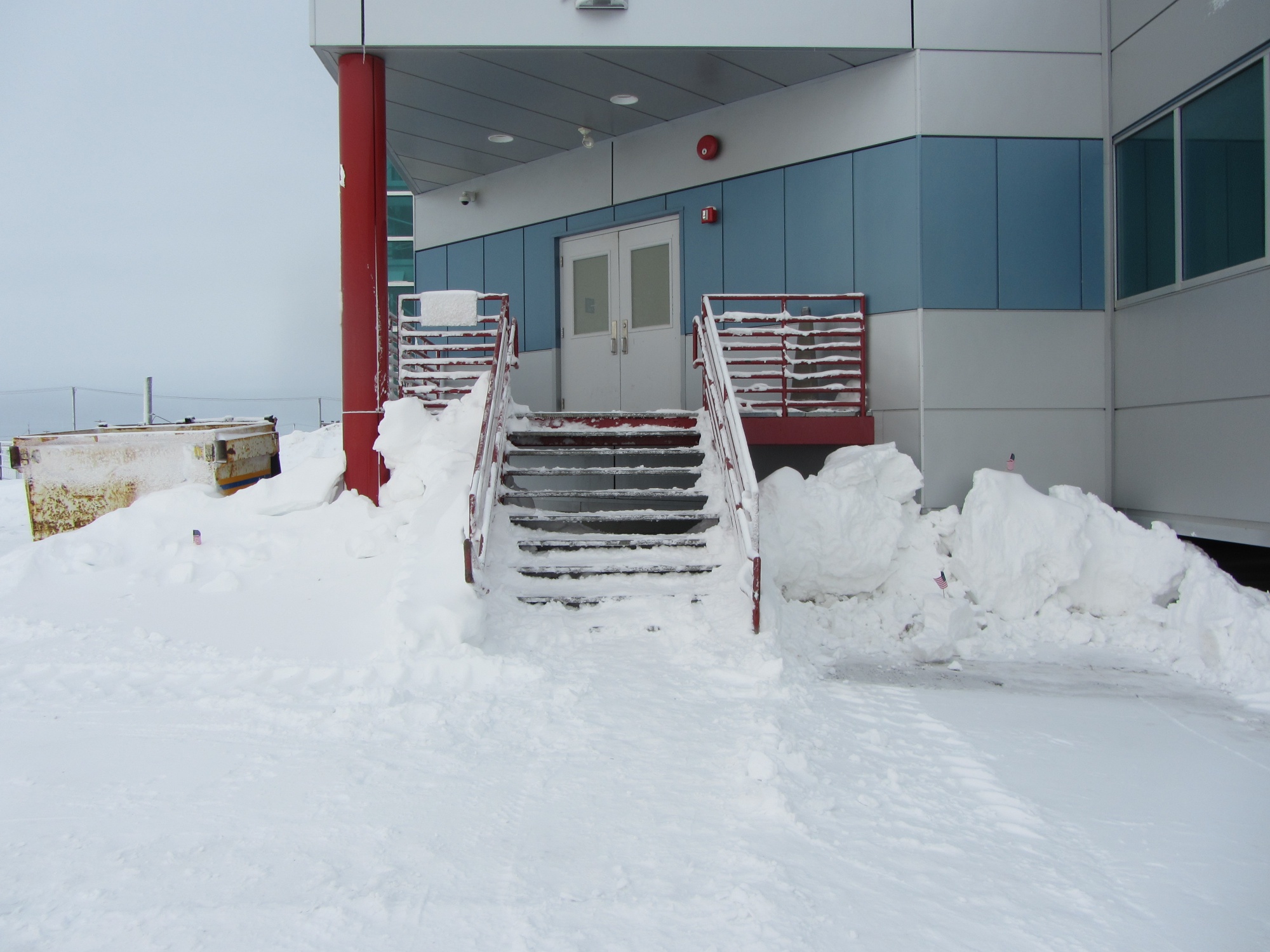
I was walking into the BARC (where I have my office and lab) after lunch the other day, when I came upon this scene:
Flags at the BARC
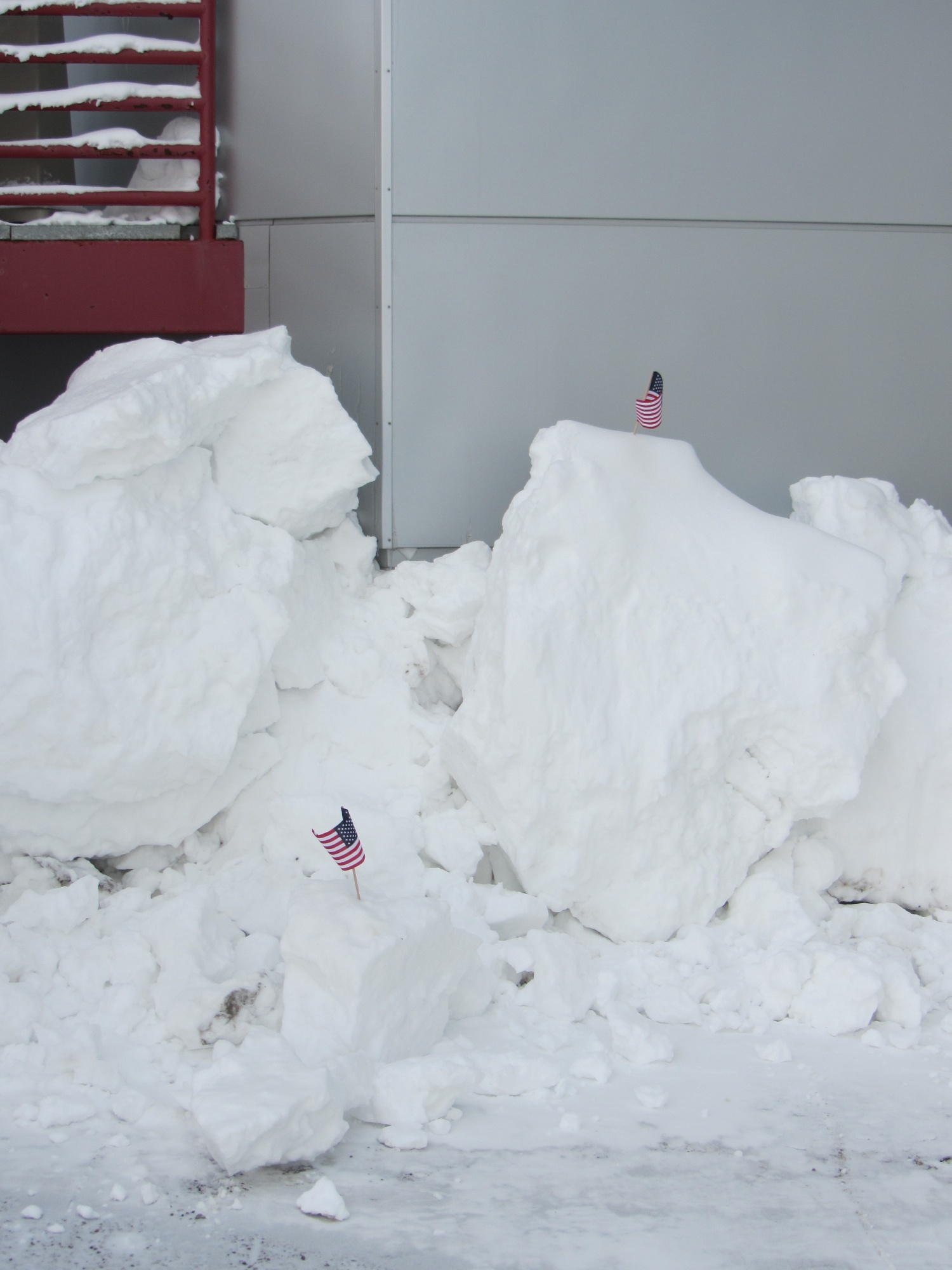
A closer look:
Flags at the BARC II
Who put them there, or why, we do not know. But there they were and are.
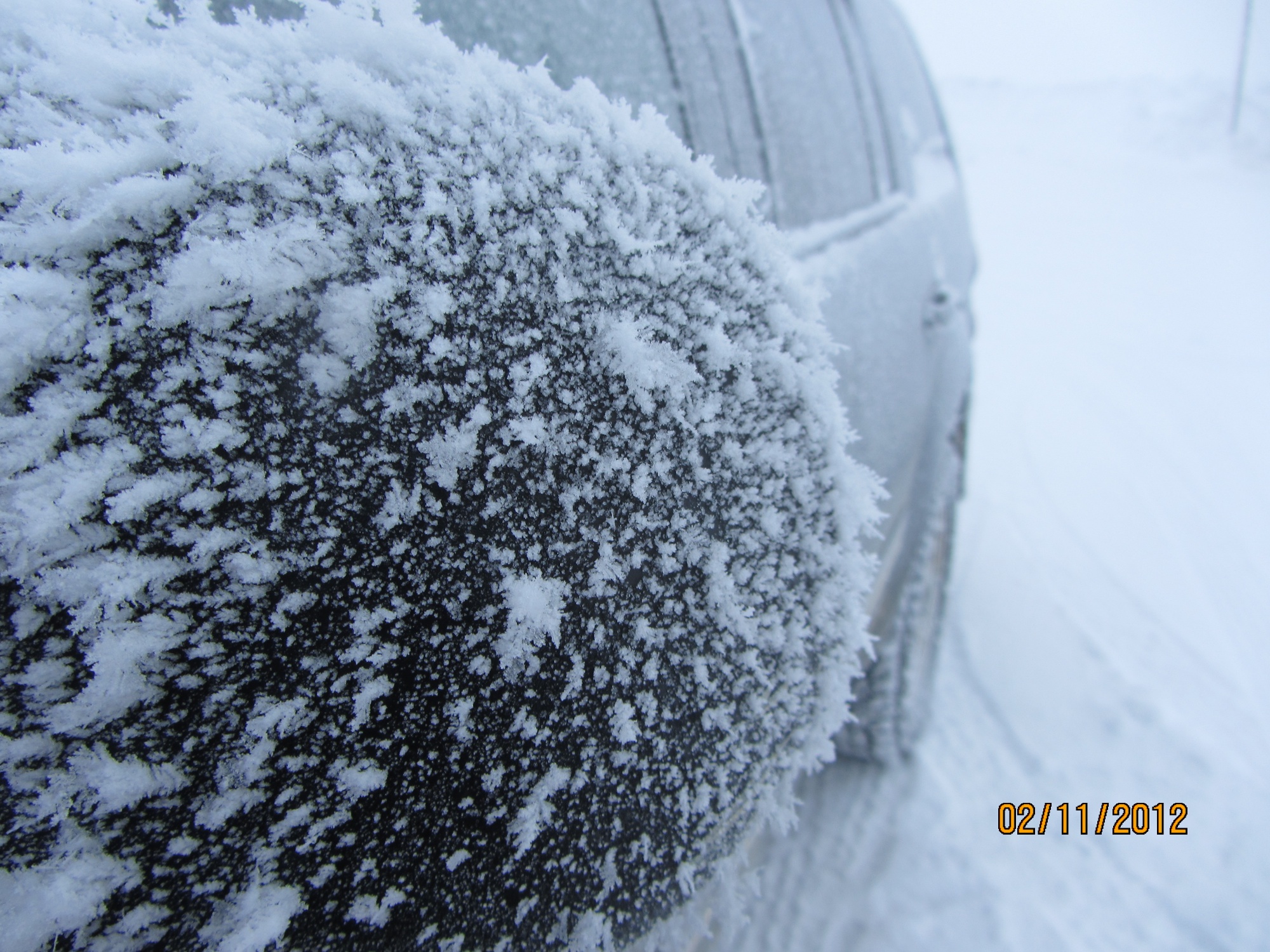
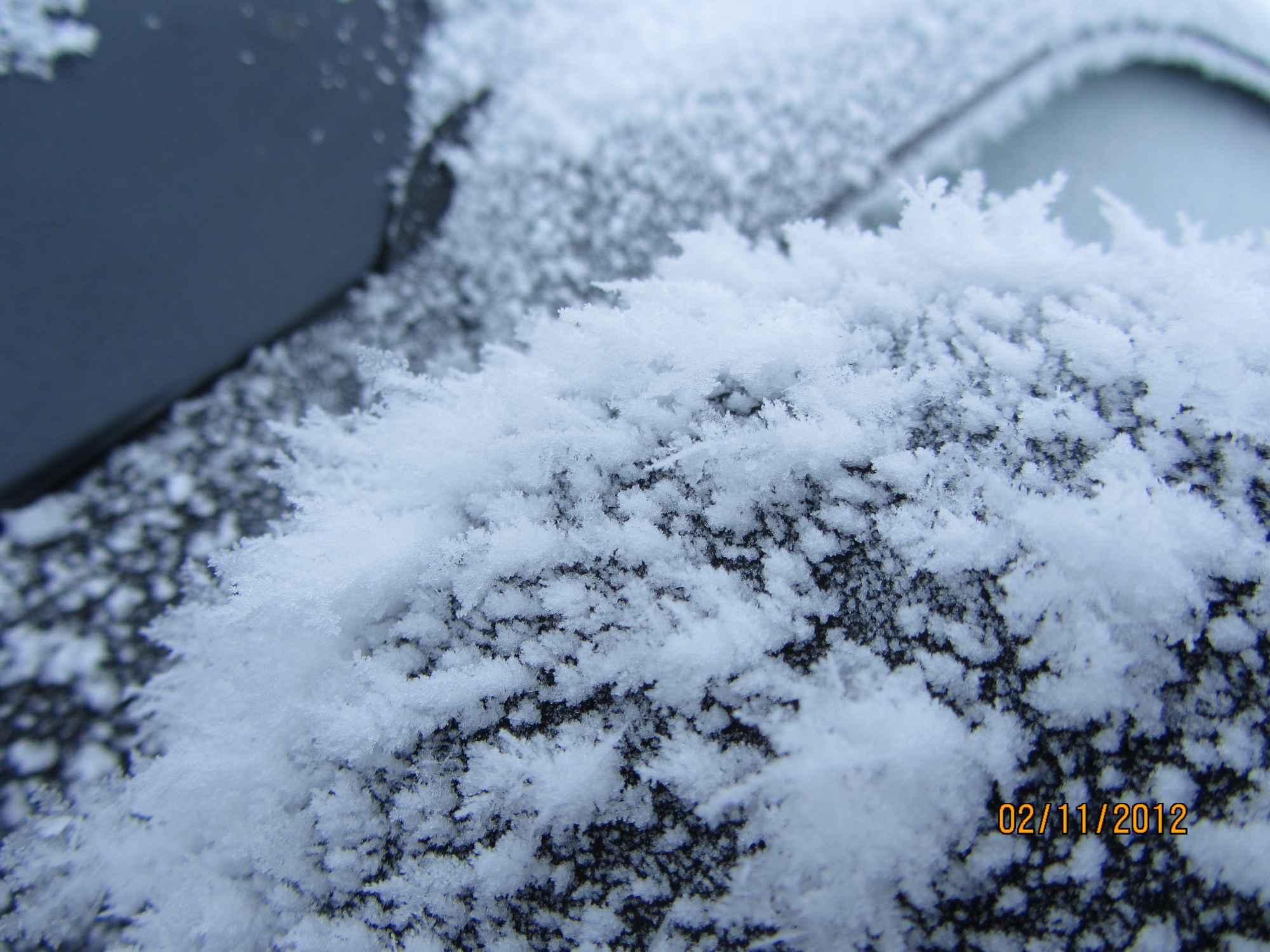
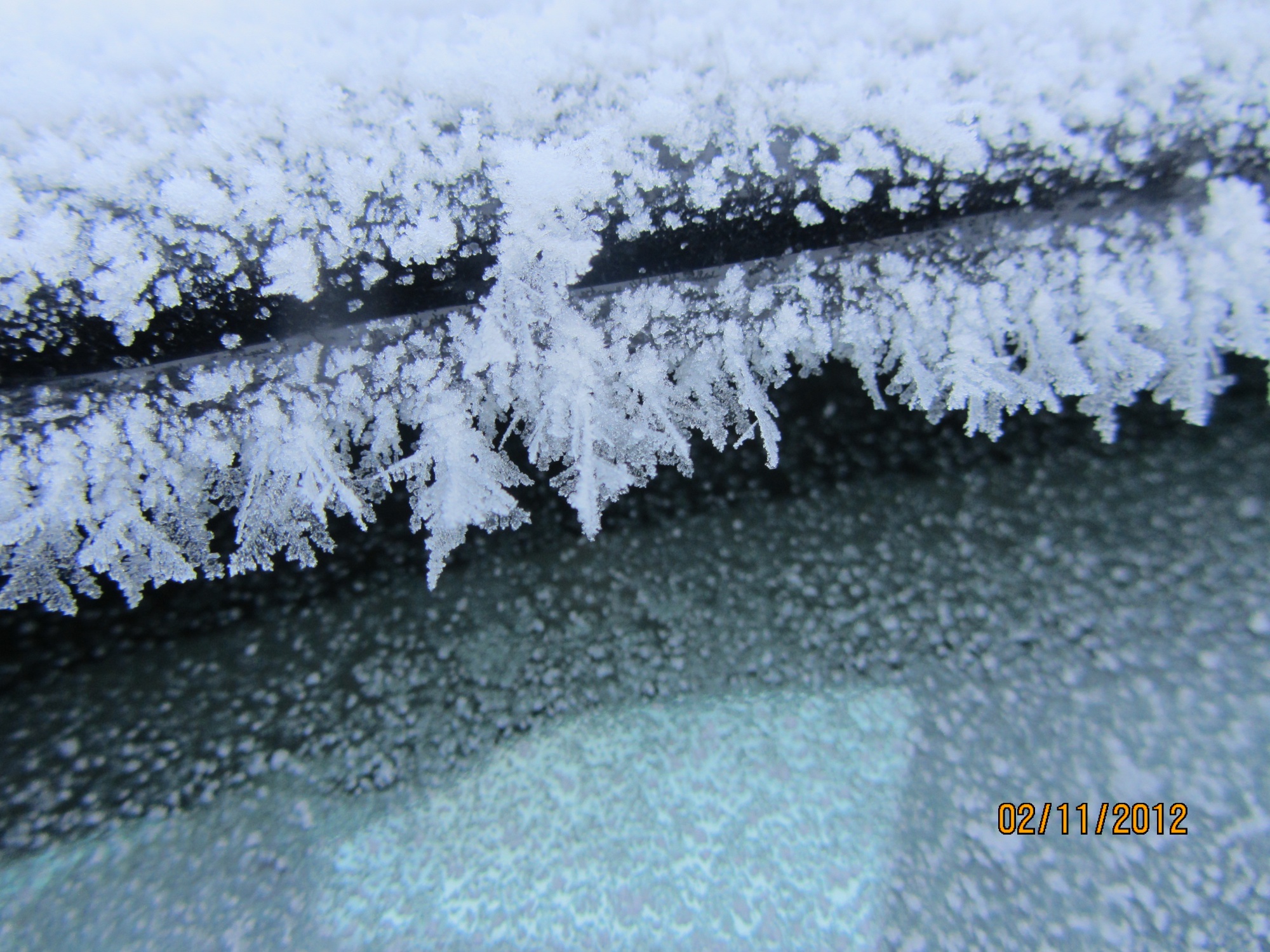
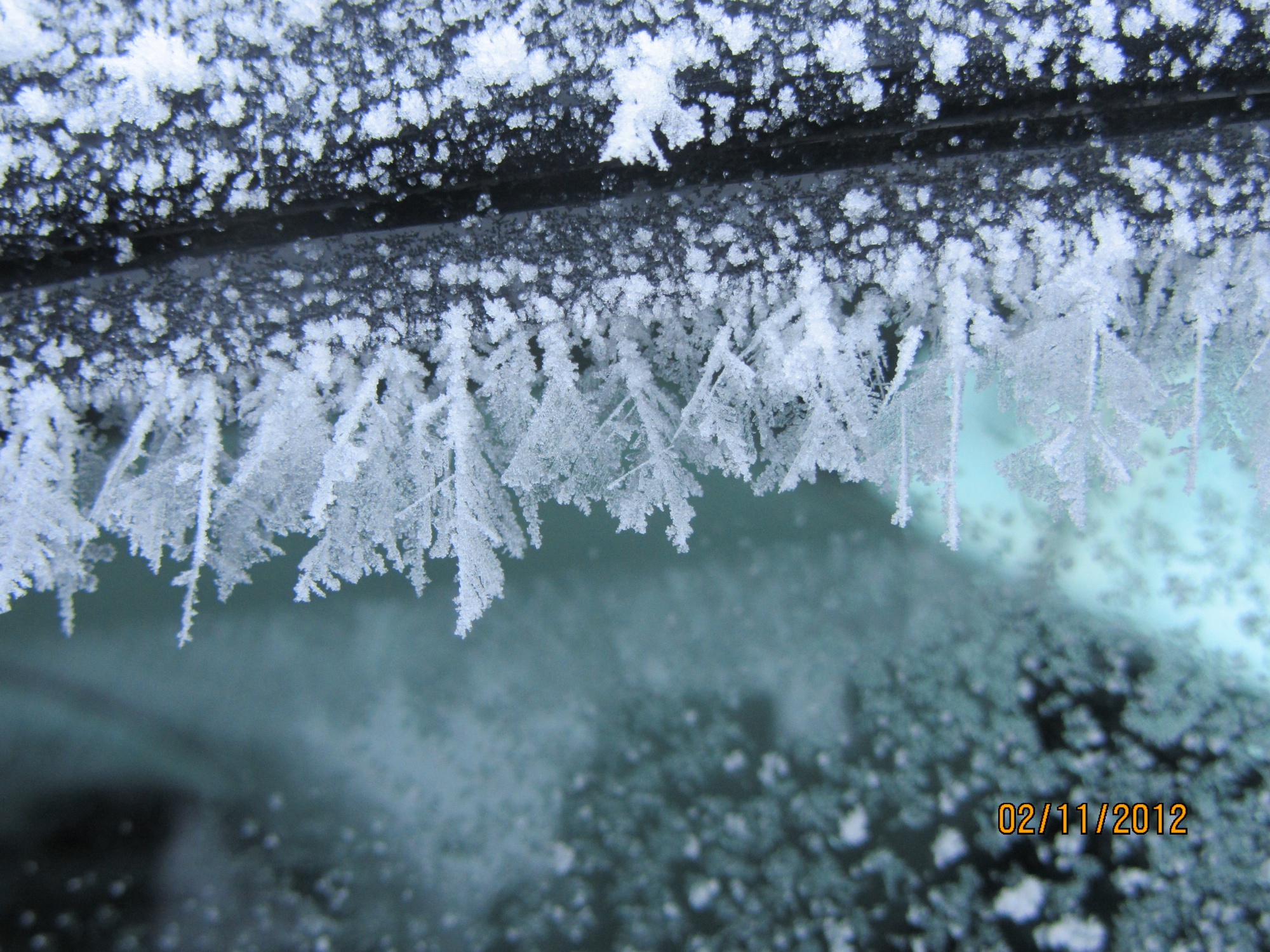
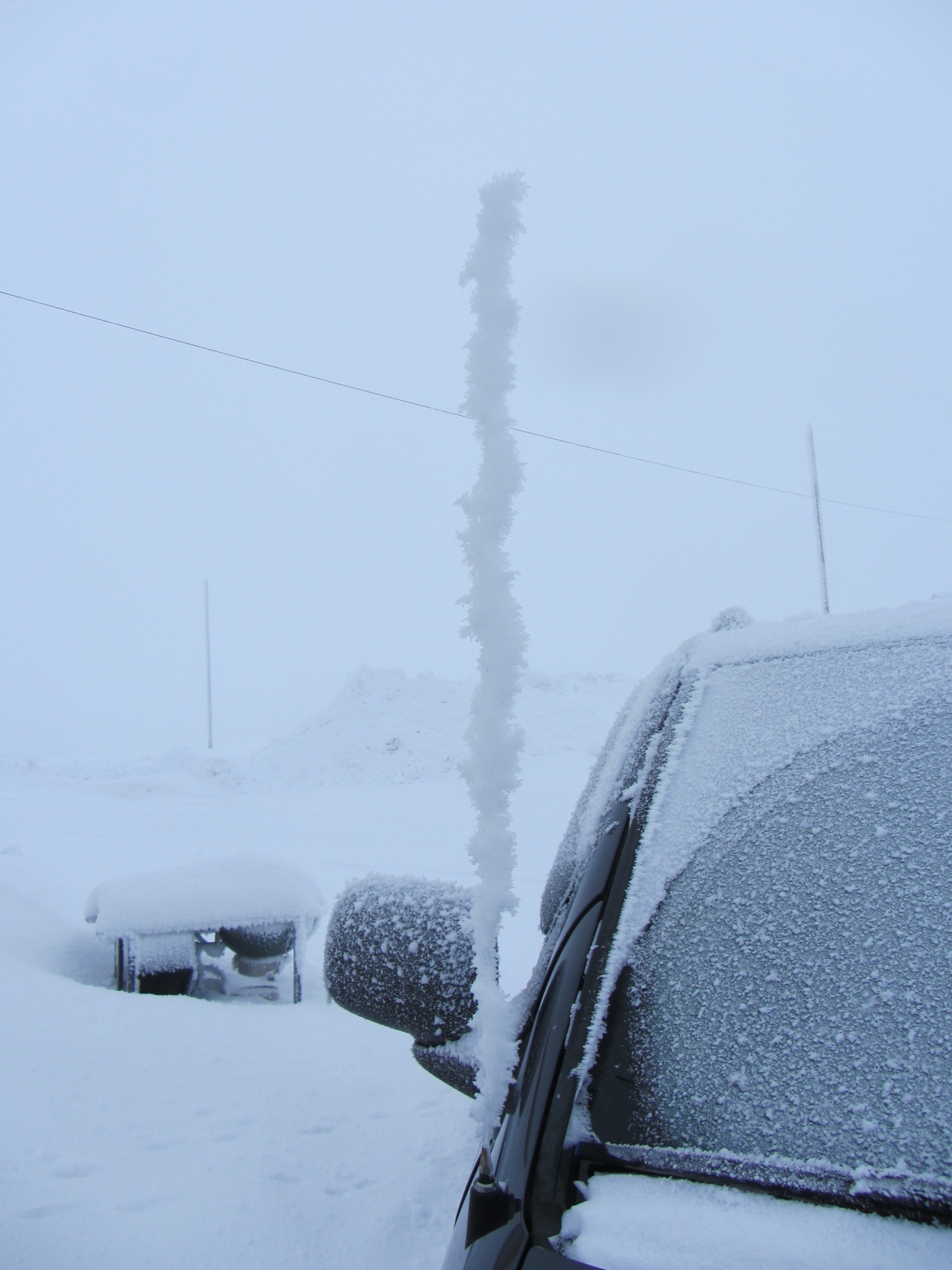
Last night, hoarfrost started building up on things. By this afternoon, my car was covered in it. Hoarfrost can be amazing, with long fern-like feathers growing off of surfaces.
Hoarfrost on the mirror.Mirror close-upFrost feathers IFrost feathers II
The best was the spiral effect the frost that grew on the antenna made.
I’ve noticed I’ve been getting more hits on search terms relating to those whales, probably since the movie “Big Miracle” just was released. So, since I’m kinda busy with the Super Bowl, I thought I’d put up a few links to the real story.
1) Bill Hess’s blog, where he is doing a series on the whole event. Bill took what were probably the first professional pictures of the whales, including some may probably recognize. This features a lot of Bill’s really fine photographs.
2) An article in the Fairbanks New-Miner which has interviews with many of the folks in Barrow who were involved in the original event, including biologist Geoff Carroll.
3) An article in the Anchorage Daily News by Richard Mauer, who covered the original story and hauled out his notes to write this one.
Well, I’ve gotten 3 of the six papers off to the editors, either in final form or waiting for review, and the big one on Late Western Thule (I think that’s what I’m calling it, pending any requests from the editors to change it for consistency in the volume) is coming along. Right now it’s way too long, still missing a couple of topics, and in need of serious cutting & some illustrations. So I don’t feel quite so guilty about writing anything not strictly part of the paper.
That was going to be the start of a good (nay, dare I say great) catchup post. However, it has been very cold in Barrow, the rest of the family is in Juneau, and I have been trying not to use too much water because the trucks that bring it and the trucks that haul the sewage don’t work well below -30°F. Alas, apparently I used so little water that the bathroom sink drain froze up (there is sort of a design flaw in the drain & I don’t think they ran the heat trace (heated wires along pipes to keep them from freezing) far enough), although thankfully the tub & toilet still are working. So I think I have to go try to remedy the situation now :-(.
Just a short post, because I’m home celebrating my birthday (mostly by coughing–the cold has moved to my chest).
The child is completely out of the parka and pantaloons (Murdoch’s term), and Shawn was able to examine the remains. No change in the age estimate.
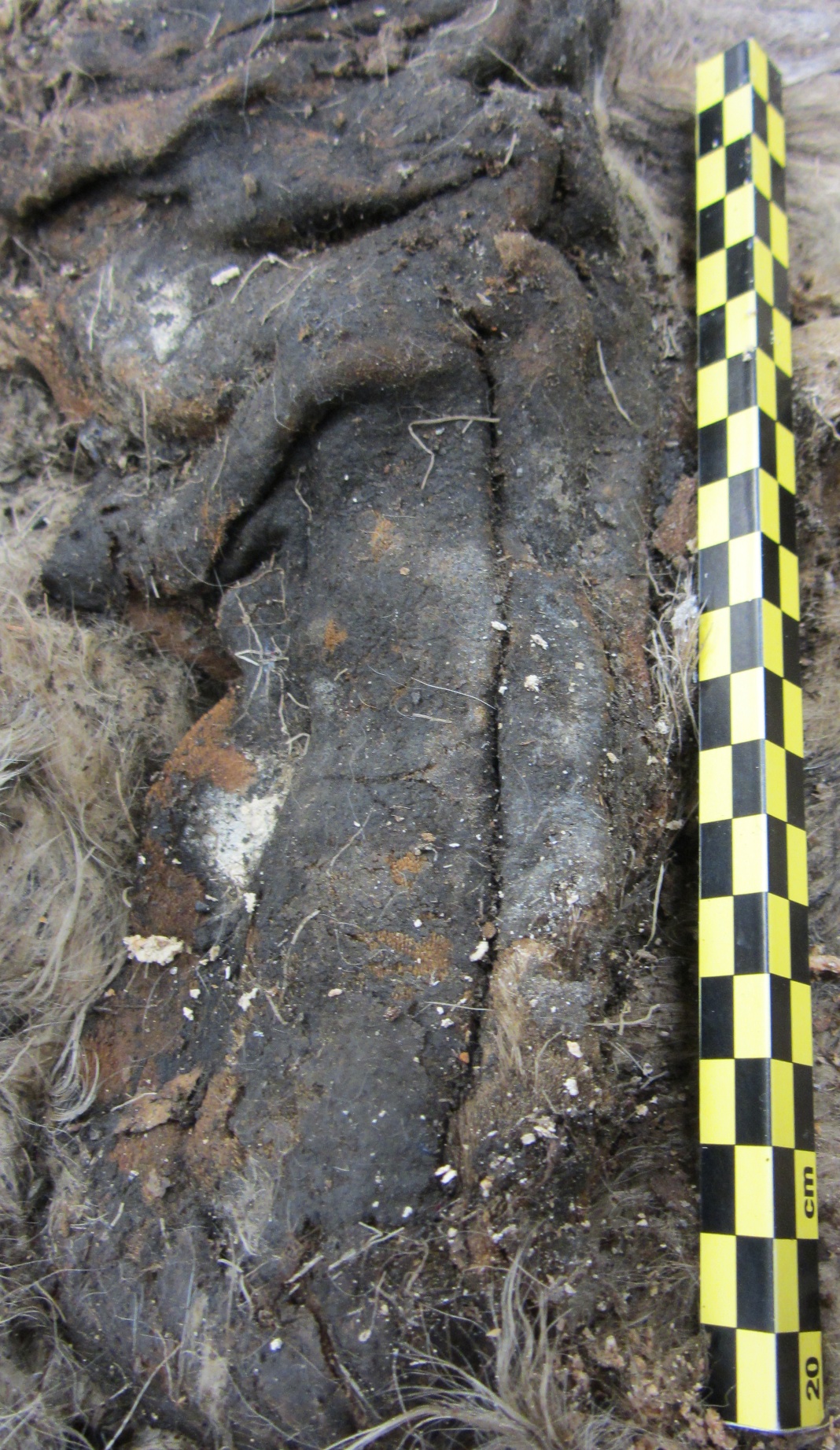
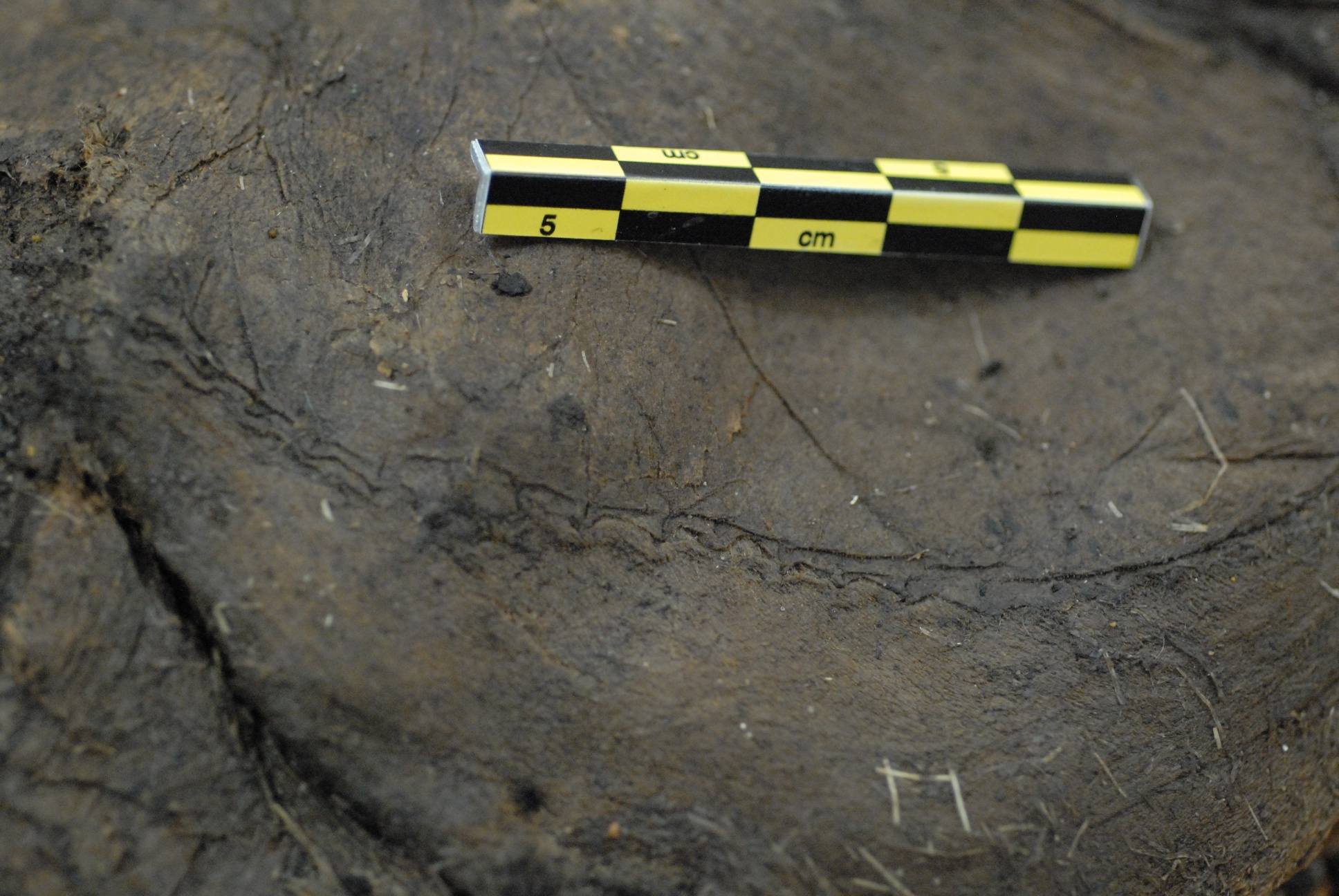
I was able to get some pictures of the boot part of the pantaloons. They look like they may have been made from leg skin (something with shorter finer hair than the main part of a caribou hide), with separate soles.
Sole of the left boot
There was a seam up the middle of the vamp on each boot. The boots seem to have been sewn to the pants, which were of caribou hide.
I’m about halfway done getting the child out of the parka. Fannie Akpik came out to look at the stitches. She agreed with Qaiyaan and me that the stitching on the parka looked like waterproof seams, even though it is clearly caribou, which isn’t normally waterproof. I took some samples to test for presence of marine mammal oil, which might have helped make it water-resistant anyway.
Stitches on the parka
I’m trying to video the whole “excavation” process, both to document it and to serve as a backup to notes & bag labels. I’ve reversed the photostand I have, and put it on a lab bench with the camera mount at the tippy top, overhanging the person on the sheet of plywood. I can just get the camera high enough to get the whole thing in the shot. I use a stepladder to get up and down to work on it. The only problem is that there is no low battery warning, so it just dies, which it did a couple of times yesterday. Today we started setting alarms on our phones to check the camera, so that more or less solved that problem. I haven’t been able to download the card yet. The SD card readers at work are getting touchy, and my Mac at home said it couldn’t read the card. The camera sees files, so maybe I need to hook it up directly.
Lab setup for documentation. Camera at upper right center. The child is under the plastic on the lab bench.
While looking at the wolf, we noticed that some of the pieces were cut with a rounded edge, and Fannie, who is Nuvukmuit (that’s the preferred spelling in their dialect, not Nuvugmiut) herself, thought it could be related to the rounded tail on the atikłuks they make for their dance group today. Later I found another seam where wolf had been sewn to caribou.
Fur side of the wolf. Amazingly well-preserved!Backside of the wolf, showing the stitching. It's a regular whip stitch. The sinew is still preserved.
It’s amazing how nice the stitching is, especially since they were done with a bone needle.
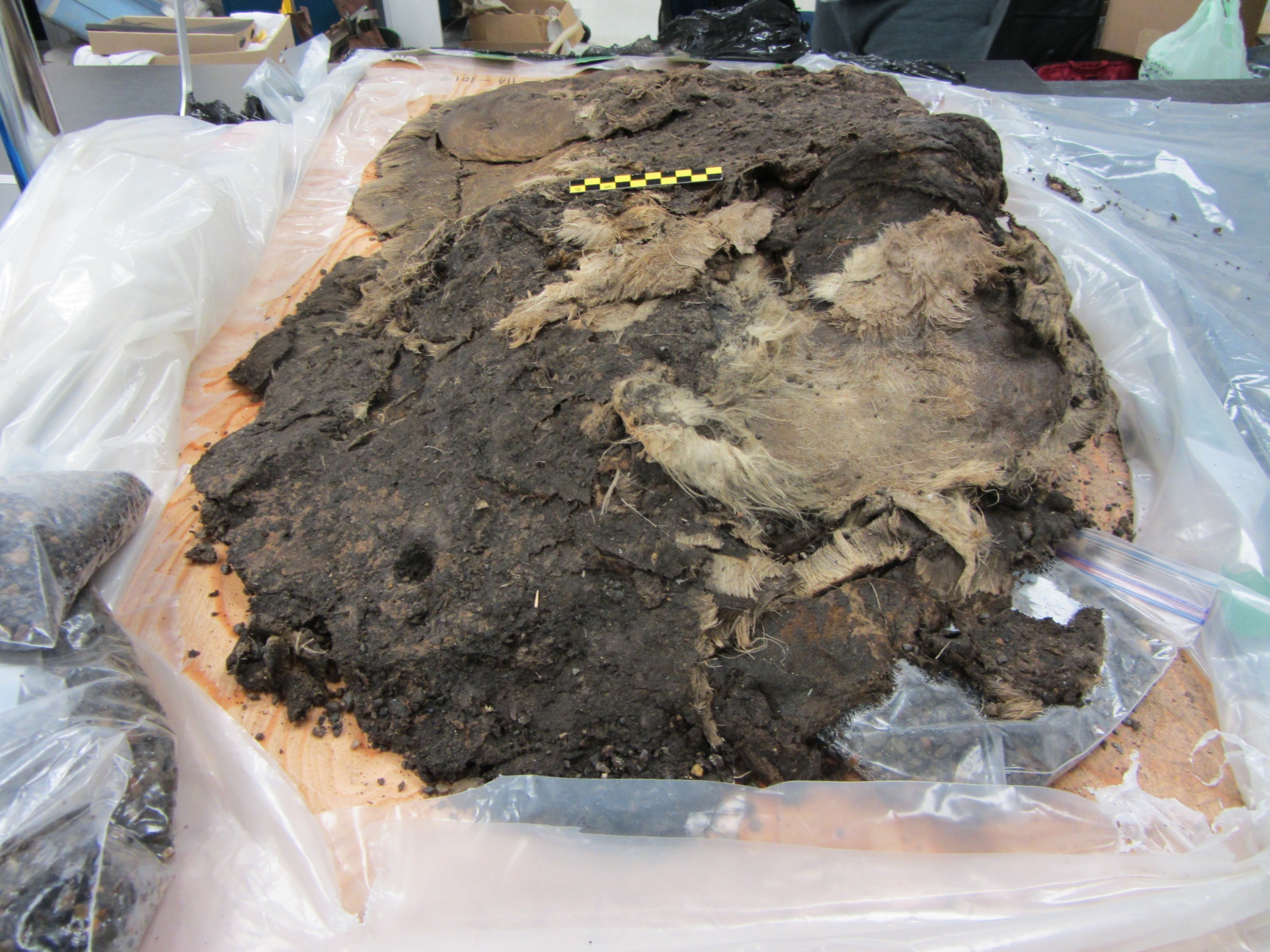
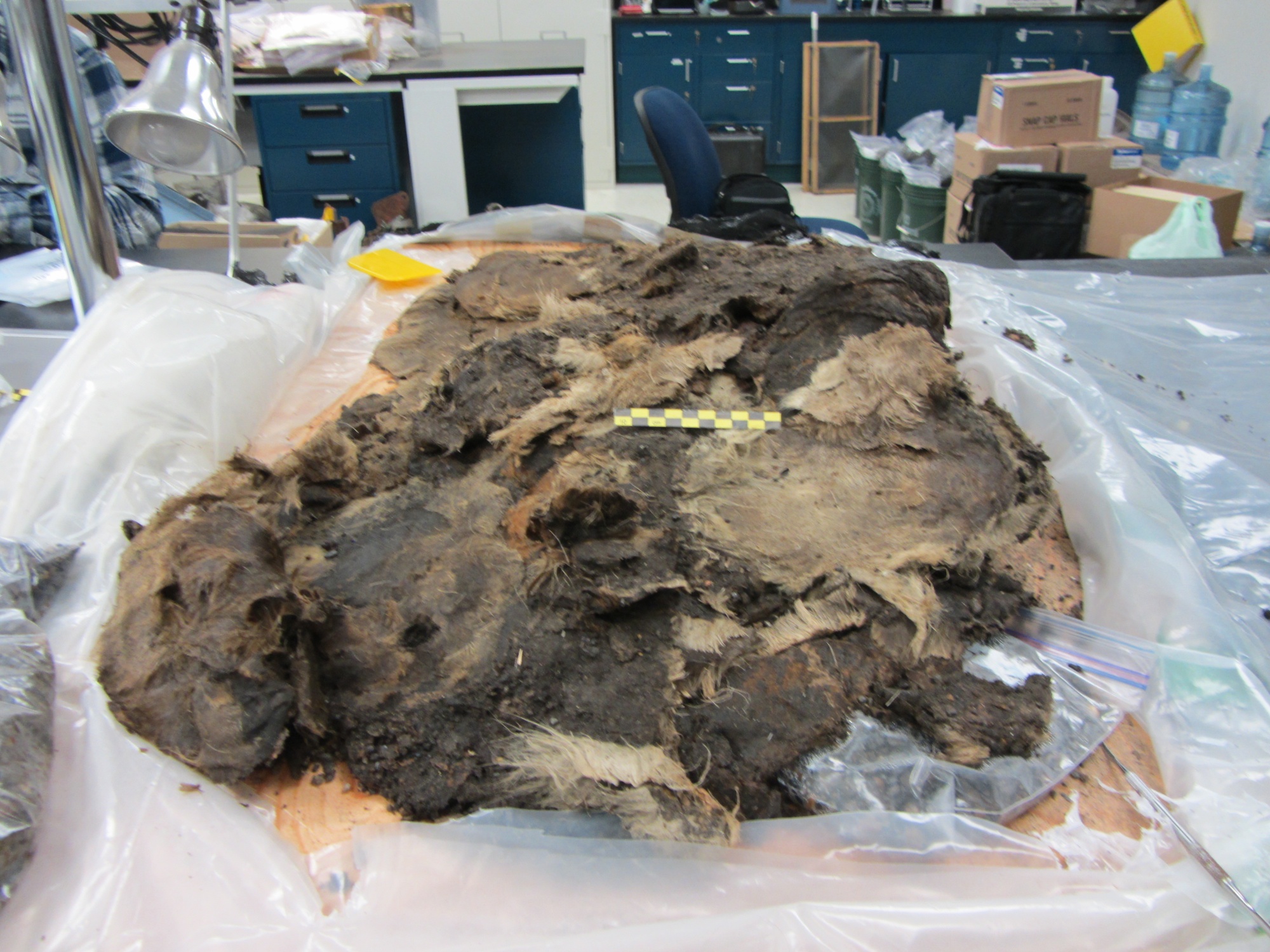
If you remember, last summer we excavated a burial which had some well-reserved fur and hide, including a parka. We put in a freezer (thanks to NSB Wildlife Department and Cyd Hanns in particular), and late last week we brought it to the lab. It took a bit longer to thaw than I thought, so we were only able to start today. Some of the folks I’d hoped could look at the skin sewing since the furs aren’t in great shape and some of the sinew thread (ivalu) has dissolved are out-of-town for the Alaska Federation of Natives (AFN) Annual Meeting and related event, but Shawn is here, and it wouldn’t be right to keep the person around just to study.
So I set up a video camera, and am using two other cameras, one with a macro lens to record stitching and so forth, and another for overall shots. Plus I’m taking a lot of samples, and notes as well.
The bundle of furs before we started.
I got started, with a bit of help from Shawn. He still had one other person to deal with, so I went on without him for a bit. Qaiyaan Harcharek, and Lottie Jones, from the Inupiat History, Language and Culture Commission staff came by. Lottie had to get back to the office, but Qaiyaan, who has a degree in Anthropology, came back and we worked on the person until after 5:30.
The first bit of the caribou hide wrapping unfolded at lower left.
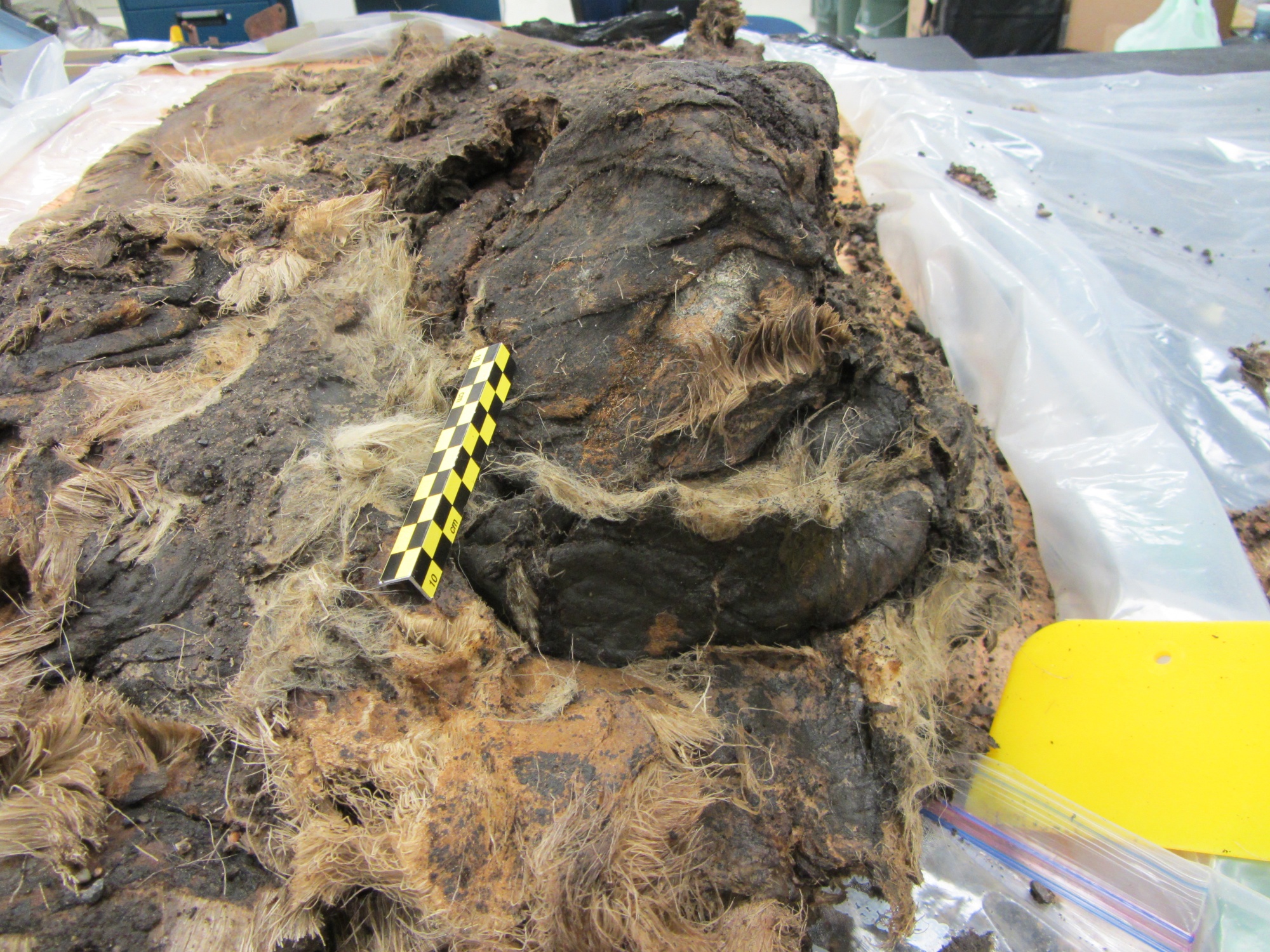
What we were able to figure out so far is that the person was laid on a caribou hide, so of which was wrapped up around the lower legs and over the left side. It’s possible that it may also have been over the right side and decayed so badly it wasn’t recoverable. I’ve got to go back and look at the pictures and notes from the excavation. Once we got part of the hide unwrapped, it was clear there was another kind of hair present. Caribou have long, fairly straight hollow hairs that don’t taper very much. There was a lot of much finer, tapering hair, which had matted down. We were discussing what this might be, and had guessed at maybe wolf when Qaiyaan and Lottie had to head back to town.
Further unfolded, with what turns out to be wolf beside the photo scale.
I kept unfolding layers of furry hide, and all of a sudden, there were long dark guard hairs showing. One more fold, and there was a very well-preserved patch of what is obviously wolf (if you’ve seen wolf skins, anyway). It actually feels very much like my wolf ruff, which was probably running around 5 years ago, even though this one must have been dead for hundreds of years. We don’t have a date yet, but wolf should be good for dating. So that mystery was solved.
Shawn was able to look at the remains of the cranium, which had not been as well-preserved, and the person seems to be a child of 4-6 years or so. We all have kids, and it made us sad to think how this child’s parents must have felt.
We still don’t know what the wolf was. It has stitching, but it seems to just be wrapped around the legs. The child is wearing what appear to be skin-in caribou boots, which may actually go all the way to the waist, sort of like hip-waders. The wolf doesn’t seem to be over-pants, especially as the hair side is in. Maybe we can figure that out tomorrow.
I just got back from the local library, where I went for a talk by Aviâja Egede Lynge on Mental Decolonization in Greenland. Aviâja is a really great speaker, with a graduate degree in social anthropology, who is working on the process of changing the school system to be truly Greenlandic in nature. If you ever get a chance to hear her talk, take it.
The talk was about the lingering effects of the Danish colonization of Greenland. A benign colonization, perhaps, but that brings its own issues. A very complex problem. Much of it is probably the same in any area that has been colonized, other aspects are perhaps specific to this particular case.





 Out of Ice and Time