I had lunch today with Monica Shah. She is one of two conservators (people with specialized training in the preservation of delicate and fragile items, like artifacts) in Alaska. She’s also a fellow Bryn Mawr alumna. Monica has been assisting and advising on the conservation of the wooden artifacts from the Ipiutak feature at Nuvuk, including the only two full-sized Ipiutak sled runners ever recovered. When we started, she was a free-lancer. She went to work for the Anchorage Museum, and they’ve been kind enough to let her continue working on the sled runners.
We went to a new restaurant on 4th Ave., called South. It has good sandwiches and generally HUGE portions. I can recommend the salmon salad, and Monica said the egg salad was tasty if rather sloppy. They have outside tables, but are a bit hampered by a tour company which picks up busloads of tourists right in front of them. Most of the tables were taken up by waiting tourists, most of whom weren’t buying anything. I hope they don’t get run out of business.
The Nuvuk artifacts are getting to the point in treatment where they need to come out of the PEG baths they’ve been in and get looked at by a professional. We figured out that Monica should be able to squeeze in a visit to Barrow in February. With any luck, we may be able to get good pictures of the sled runners in a few more months!
The processing of the large bulk samples is proceeding. It’s slow going, but we are reducing the overall volume. We have found a few things that are noteworthy.
Claire has found some well-preserved wood that she was able to take samples of for species identification and possible tree-ring dating.
We also found one piece of coal with one flat, highly polished side. The rest of it looks like it broke naturally and got smoothed by being rolled in the water, but the one side looks different. It’s a maybe, but a pretty good one, although we’ll probably never know what it was or was going to be…
There are also a variety of marine worms, shells and what we think are marine plants. I just spoke to a friend of mine, “retired” biologist, Dr. Dave Norton, who used to live in Barrow and is fairly familiar with the contents of modern strand lines here. Claire is going to take the oddities we are sorting out down to Fairbanks (where he lives) tomorrow night, and he will look at the specimens and try to connect with the appropriate curators at the UAF Museum of the North. I’m going to Fairbanks (for shotgun refresher qualifications for a non-archaeology project I manage for Sandia National Labs) the week after next, and will go visiting the curators with him, in hopes of getting good IDs.
One of the great things about doing archaeology in the Arctic is that the preservation can be spectacular. Artifacts often froze the winter after they were abandoned, and only thawed when they were excavated. This means we get to find a lot of the bone, wood ivory and leather items that were undoubtedly part of most precontact people’s tool kits. We don’t have to guess at what people were using or extrapolate from a few stone tools that did manage to be preserved; we can see it firsthand.
This is not always an unmixed blessing. Arctic archaeology sometimes suffers from an embarrassment of riches.
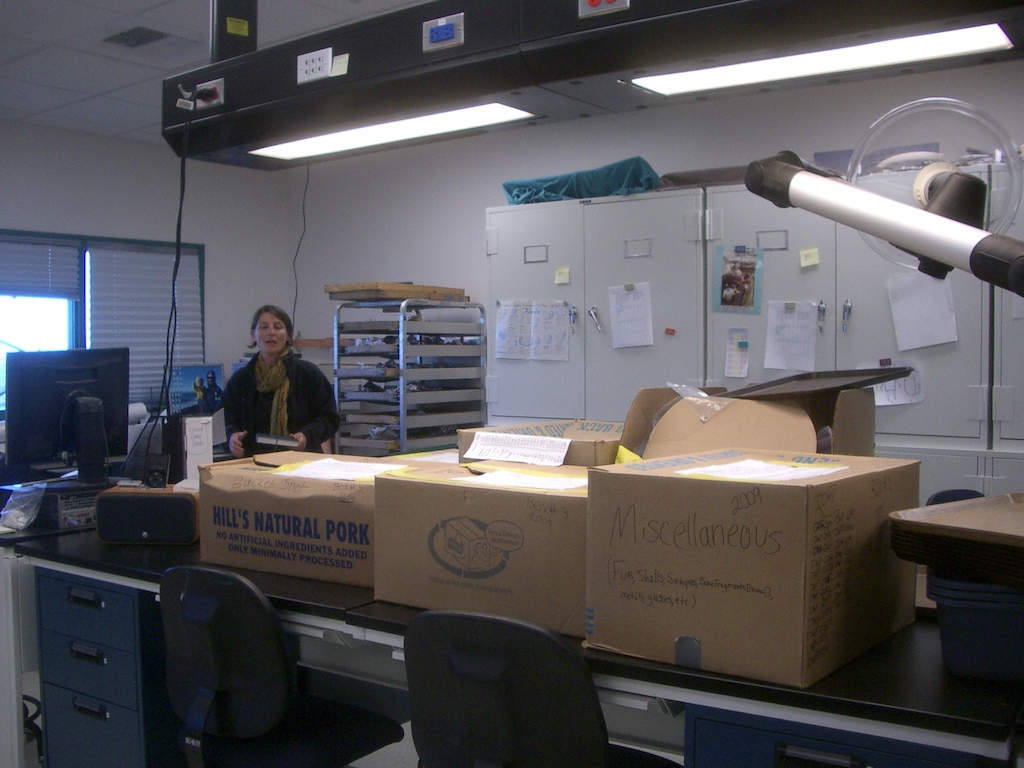
Boxes with wood from the Driftwood Feature (DWF).
In the past, archaeologists generally only saved the artifacts from a site. Animal bones and soil were pretty much ignored, or at best documented in the field (there are a lot of excavated houses in the Arctic where the animal bones are still piled at the edge of the excavation where they were left decades ago). As archaeological science advanced (radiocarbon dating began about 60 years ago) and people began to do more things with faunal (animal) remains and soil samples, people began to collect a lot more, and to bring it back to museums to save, on the assumption that one day someone would be able to do something informative with it. The idea is still a good one in theory, but it is bumping up against various realities. For one thing, in most areas these sorts of things require storage in climate controlled conditions or they will deteriorate and become useless. They are often quite bulky compared to just the artifacts. Most museums simply don’t have any place to put all this stuff! Some of the better-funded places, like the Smithsonian Institution, have built large off-site storage facilities in areas where real estate is a bit less expensive, just to keep all this stuff. But such places require operational funds and new staff, and that costs money too. Most places can’t really afford that. Some institutions have started charging for putting collections there, but there are problems with that as well.
So part of the new reality for archaeology is that we can’t keep everything. The question is how to decide what to keep and what not to keep. In general, the artifacts are kept. No problem there. The issue is how to deal with the other things.
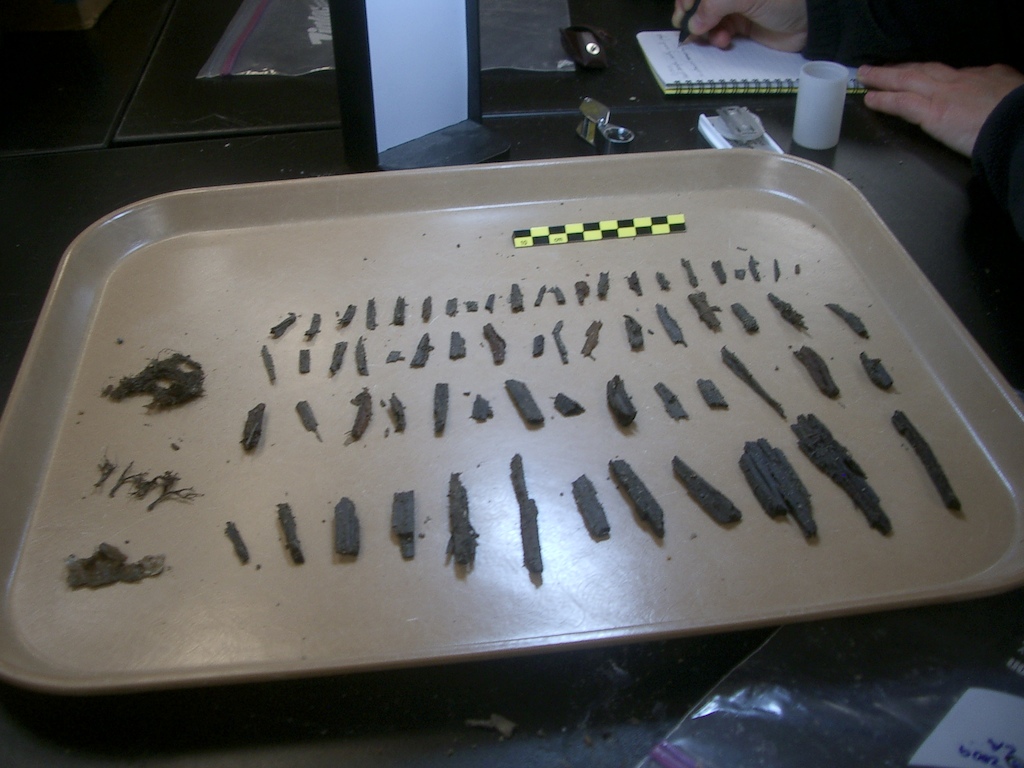
It’s even more complicated for the Nuvuk project. We have had several areas where massive amounts of organic material, with some artifacts and faunal remains mixed in, were encountered. While one might normally choose to excavate this all in the field, in a couple of cases the areas were right at the erosion face, and could literally have vanished overnight. Combine that with a very cold field situation, where mild hypothermia can dull excavators’ thought processes, it didn’t seem like that was the best plan, since it risked data in a variety of ways. I decided to take tightly-provenienced (with very accurate information on where they were from) bulk samples, which can then be processed in the lab, where it is warm and we have good lighting, magnifying lenses and water to wash the dirt and gravel off so we can get a good look at everything. If excavators recognize an artifact in the field, it gets recorded there, but the idea is that we’ll find the less obvious ones in the lab.
Contents of one bucket shot laid out on a tray.A closer look
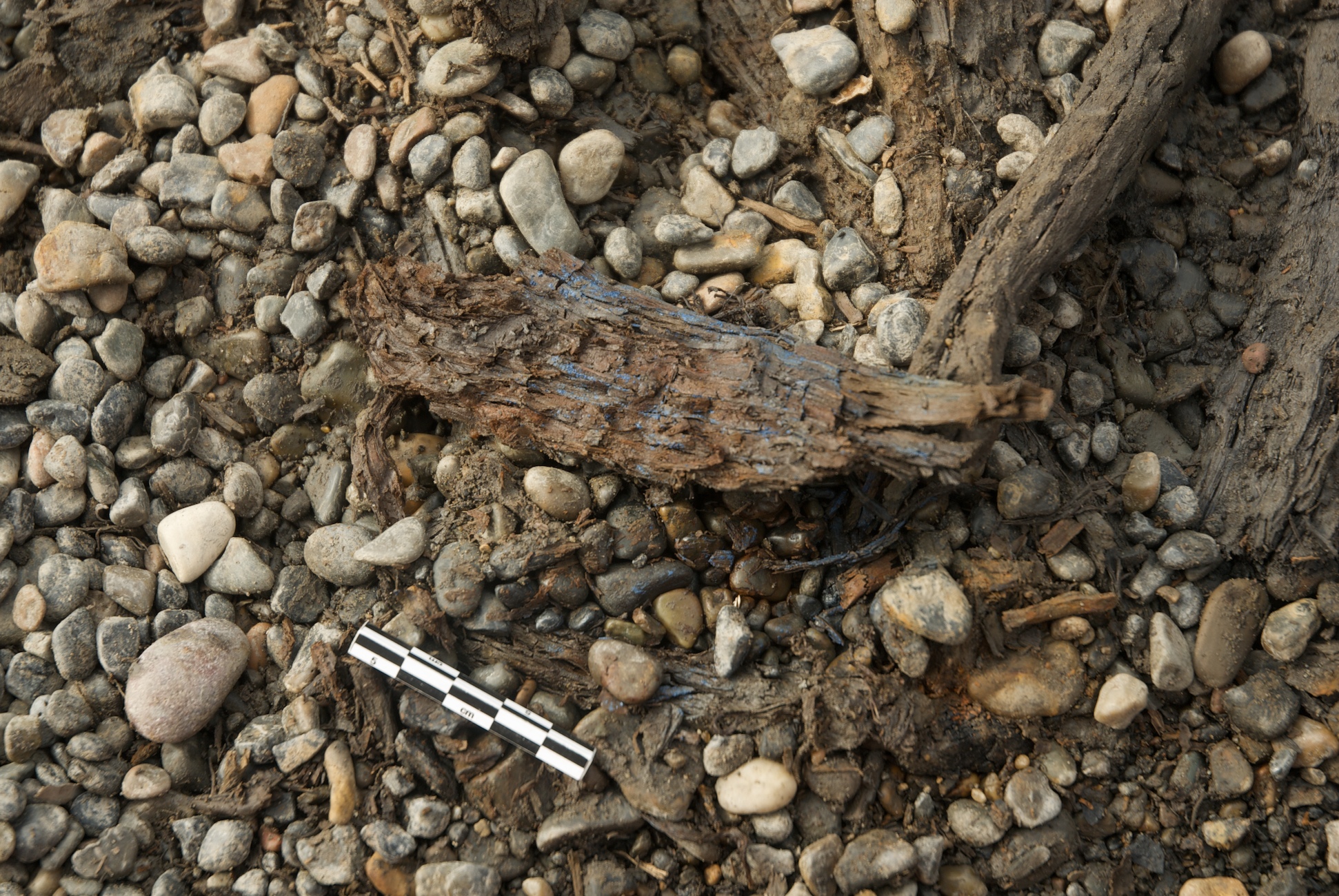
One of the areas with a massive amount of organic material was what we called the Driftwood Feature. This level is about 1 meter (39 inches) below the Thule graves. It was actually permanently frozen, and therefore everything organic was in great shape. It looks like there was an Ipuitak dwelling (maybe there were more that had already eroded–we don’t know) on a ridge near the ocean. Sometime between 300-400 AD there was a huge storm, which washed all sorts of things (driftwood, bark, marine invertebrates, shellfish, peat, etc.) up onto the beach, all the way up to where the people were living. It left what is called a strand-line. It looks like they either left in a hurry and didn’t come back, or didn’t survive, since a number of artifacts were still there. The strand-line continued along what had been the beach ridge, and we wanted to see if there was any evidence of more human activity besides the one dwelling. Because there was so much wood, and a number of the artifacts at the dwelling had been wood, we had a needle in a haystack problem, with the haystack about to fall into the ocean (which it did the next winter). So we bulk sampled.
Close-up of the Ipiutak layer at DWF. We excavated many square meters of this!
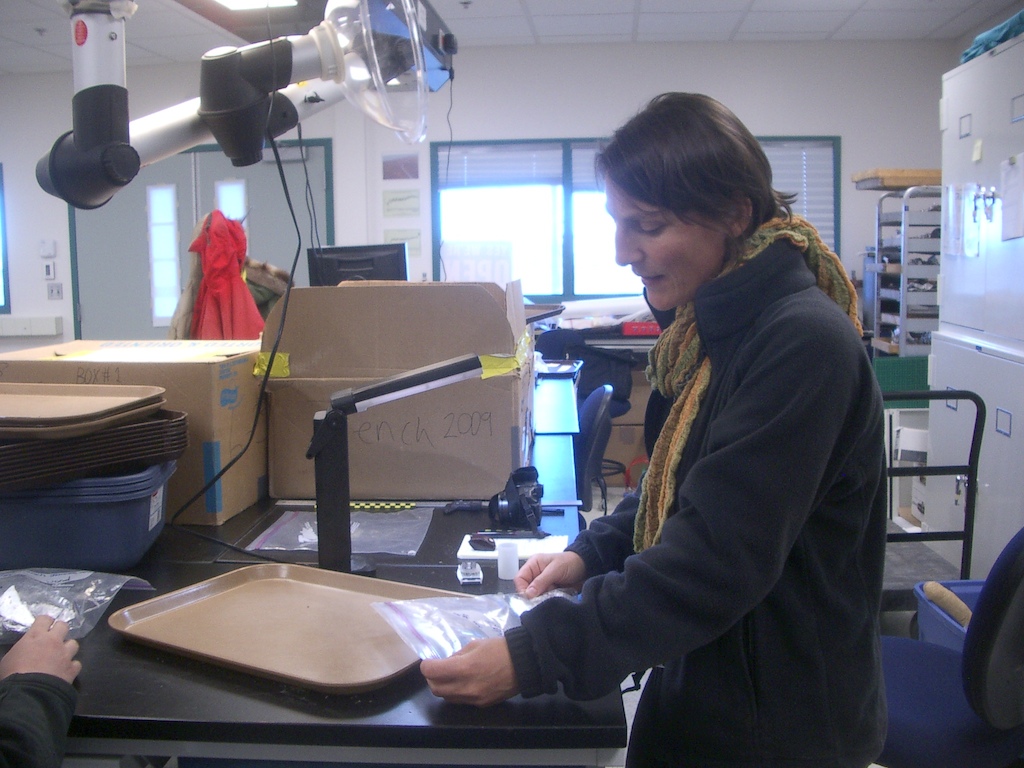
Now we are going through some of the bulk samples. I’ve been very lucky to have Dr. Claire Alix, a French scholar who specializes in Arctic driftwood and its use by humans, involved with the project since the very early days. She was based in Fairbanks, Alaska, for many years, but has recently gotten a teaching and research position at the Sorbonne in Paris. This is wonderful, since Claire is a great person & really deserves it, but it certainly complicates the logistics of her research on this wood!
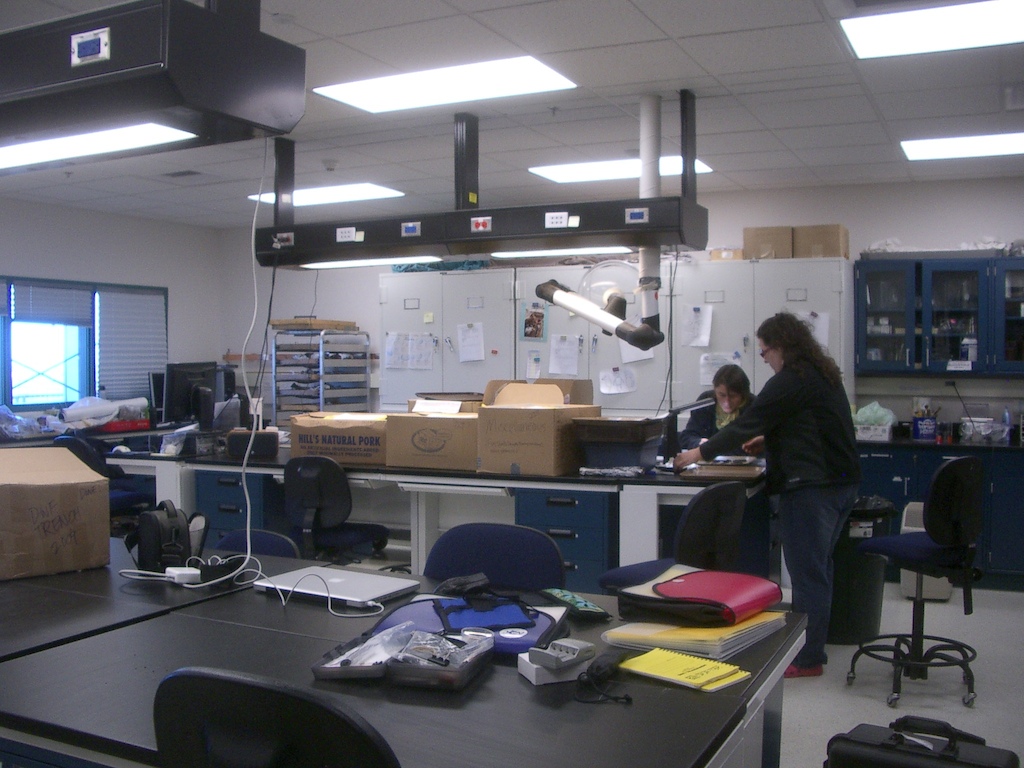
Dr. Claire Alix in the Nuvuk Lab
Claire arrived on this morning’s plane, and is already hard at work going through samples from 2009 which were excavated after she left the field. She is looking for all worked (altered by people) items, picking out things that we can’t yet identify for further examination, and recording amounts & types of wood, bark, and other identifiable organics. The non-worked identified material is then being lab discarded. I’ve got the computer map up and color-coded so Claire can look at it when she needs to, Laura is unwrapping the samples, and I’ll probably end up doing the data entry in the catalog. She leaves again on Wednesday night, and won’t be back in the US until sometime after January, so we’ve got a lot to do, and not much time to do it.
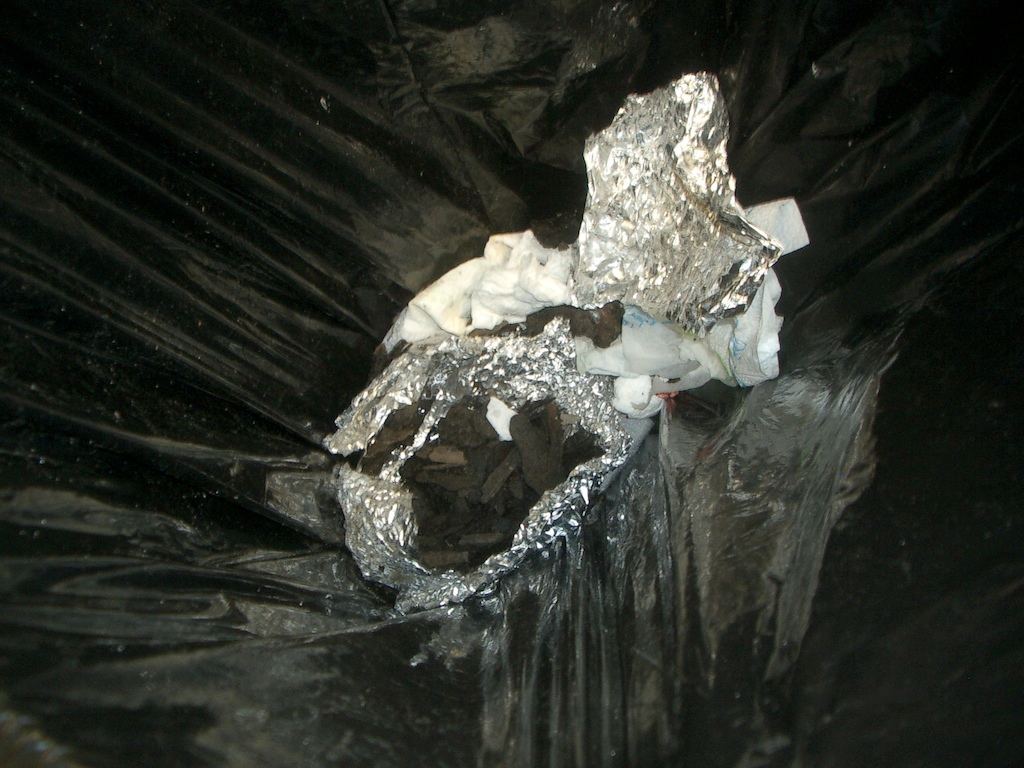
Claire and Laura hard at work.Lab discards--on closer examination they turned out not to be cultural.
Later this fall we are going to start going through soil samples and so forth. We hope to be able to reduce the volume they take up. Some of that will be done by separating the actual sample material of interest from the gravel matrix. Where that isn’t possible (for example with large logs or whalebone) we will have to sub-sample, retaining only a portion of the total sample volume. Otherwise, we’re going to run out of room.
It’s 10: 27 PM and I just got into the office from the field. It was too windy to dig this morning (again!) so we didn’t head out until after lunch. It was still pretty windy and cold (the high was 36 F and the wind didn’t drop below 20 mph until the last couple hours.
We managed to finish one burial today. The students went home at the usual time, and Jenny, Laura, Ron & I (and the bear guards Michael and Richard) stayed out until we were done. It was the grave of a very large man, who had a number of interesting things buried with him. More about that, and pictures in a future post.
The data is downloaded, so I am going home for dinner & bed.
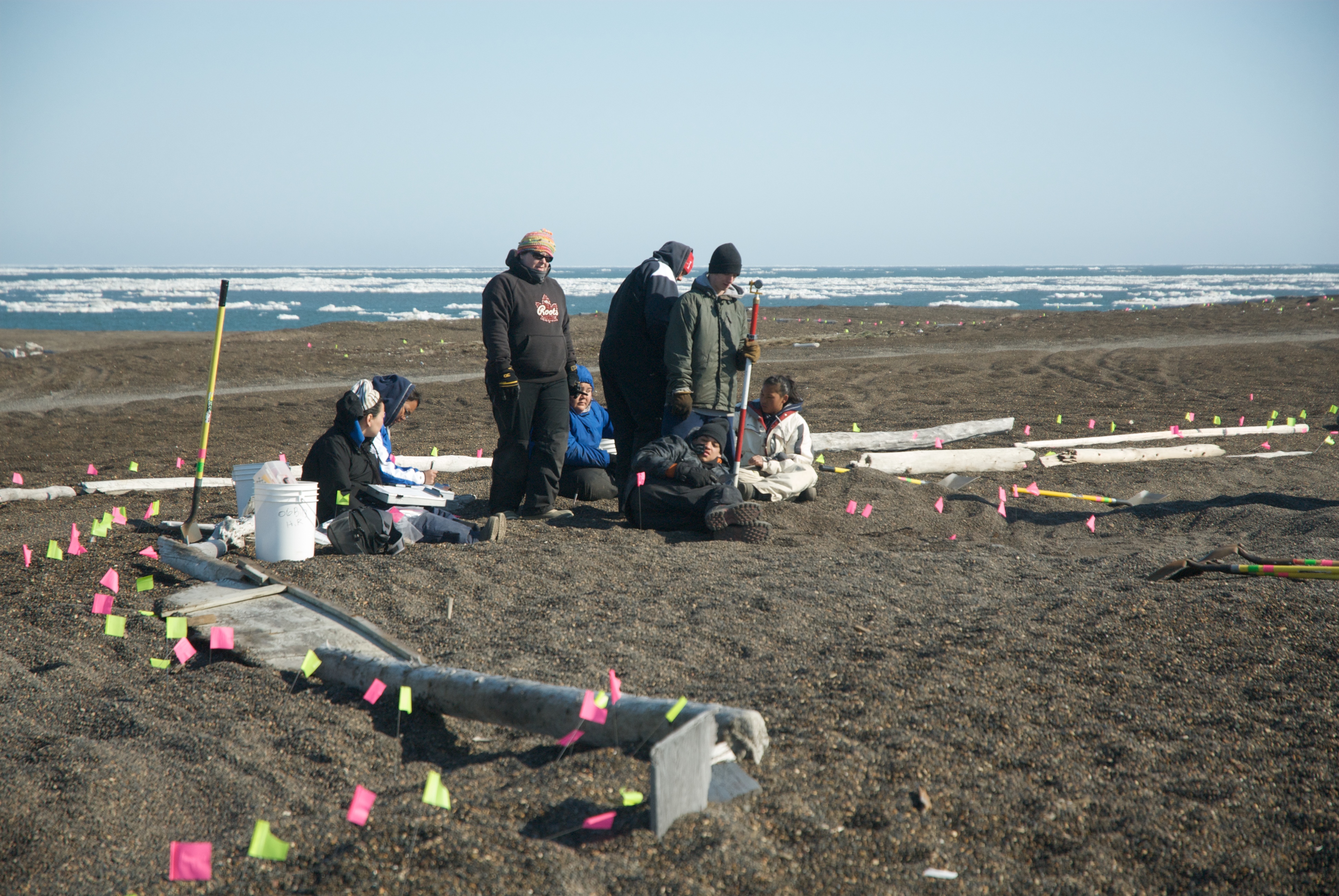
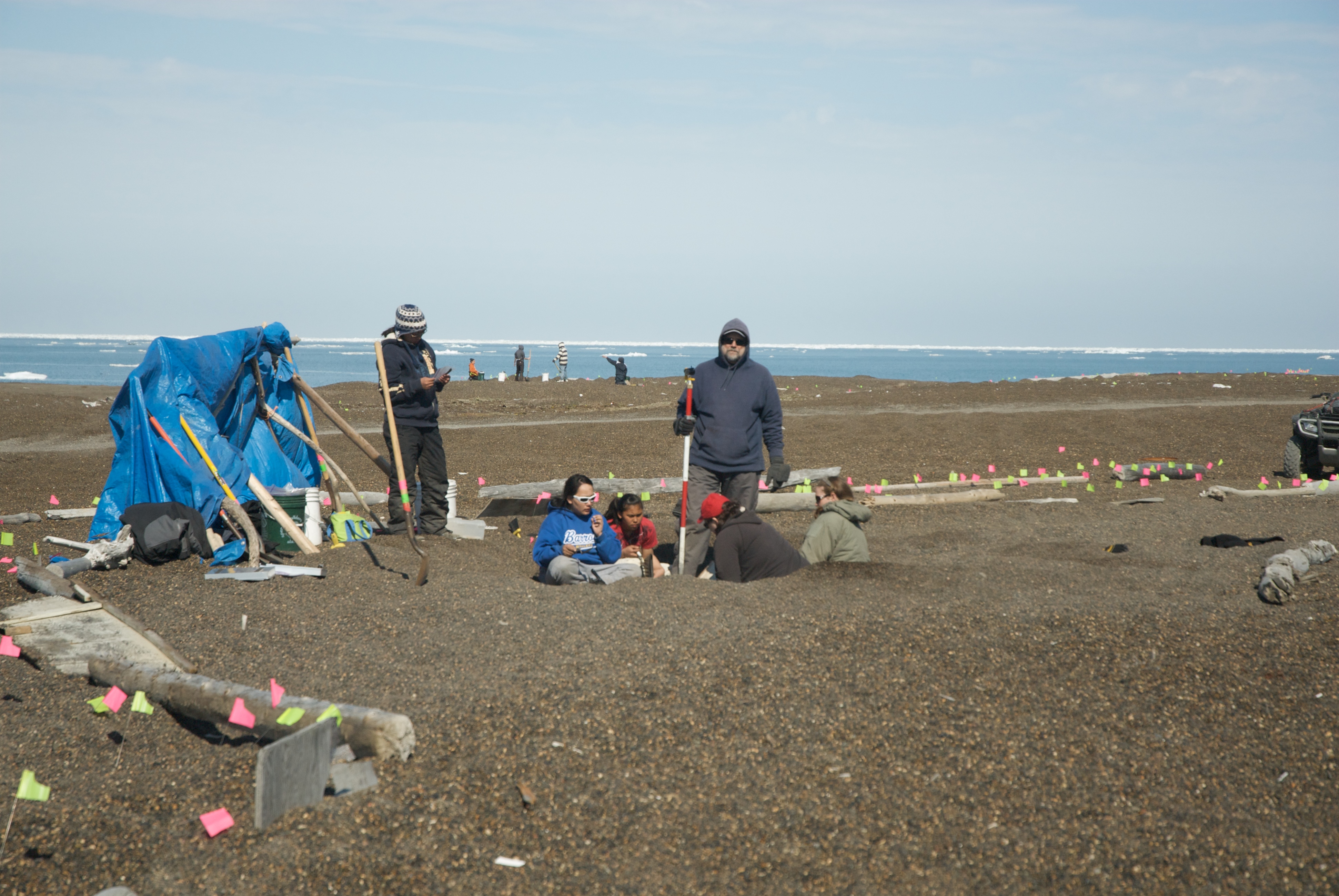
We waited to start burial excavation until Dennis O’Rourke and Jenny Raff, the physical anthropology/ancient DNA folks were here. The weather on July 8 was pretty sunny, although it was very windy in the morning. The burial had been located by a vehicle churning up some human remains and scattering them along the trail for several meters, so we weren’t exactly sure where the burial was located, so we had to remove some of the gravel to find it.
Crew gathers to begin excavation of burial 10A918. Note the sea ice on the ocean.
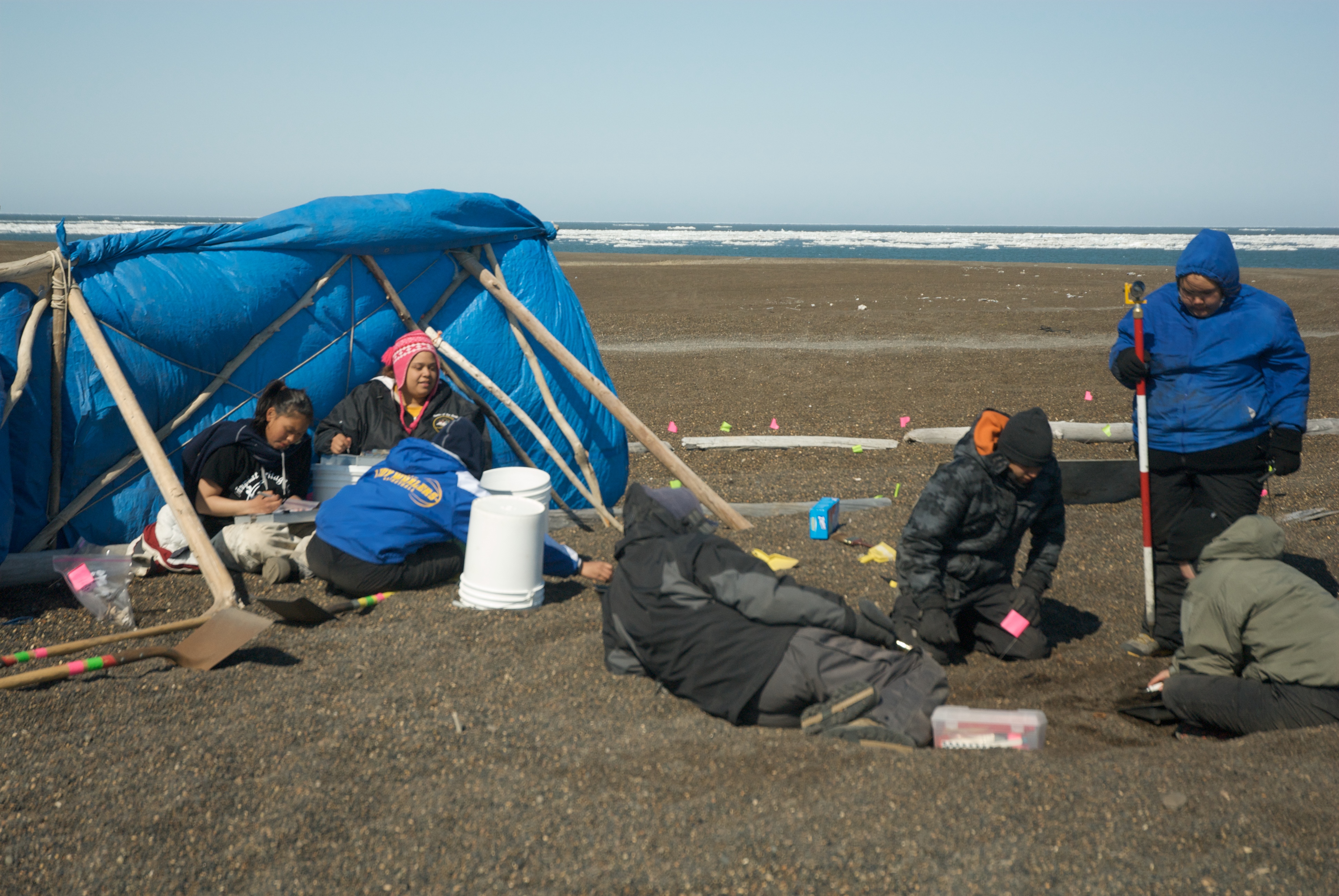
After it was located, a smaller group began the fine excavation. It quickly became clear that the burial was quite scattered, since portions of the skull showed up both north and south of pelvic fragments. At least one of the pelvic fragments seems too small to belong with the others, so there may be two individuals involved.
Beginning excavation.
The rest of the crew moved back to STPs, which over the course of the day located two additional probable burials, as well as a fairly recent and quite large oosik (walrus penis bone). Excavations were interrupted when the honey bucket tent somehow wound up with the door locked. No one was inside, but no one could get in to use it either, so we needed to get that fixed. Fortunately, the cover was just loose enough that Victoria, who is quite slender, was able to wriggle in between the cover and frame (after taking off her jacket) and unlock it from the inside. Crisis averted. Yay Victoria!
Our bear guard Larry Aiken made a good windbreak for the excavators. Unfortunately it just got windier. Eventually the gusts got so strong that an artifact blew away being passed hand to hand, so we stopped work on the burial, tarped it up well, and worked on STPs for the rest of the day. We spent some time watching the sea ice, which was going by faster than I’ve ever seen. One of the bear guards said Volunteer Search and Rescue had somehow measured the speed at 23 mph!
Larry Aiken's excellent windbreak, sheltering the crew.
The next day was also sunny and windy, but not nearly as bad, so we went back to working on the burial. We found a number of vertical faunal (animal bone) fragments in the middle of the burial, around where the chest would have been. The leg bones were more or less in place, so it looked like the disturbance was concentrated on the upper body. We expanded to the south to make sure we recovered all the remains, and found the old ground surface under the gravel. It had remains and some artifacts on it.
Working at 10A918. Dennis O'Rourke holding the stadia rod with reflector to record an artifact. Notice how much ice has gone away.Dennis & Jenny shoveling (for Jenny & Justin)
We were able to find some material suitable for C14 (radiocarbon) dating underneath the bones that hadn’t been disturbed, so that was good. We tarped the burial up for another night.
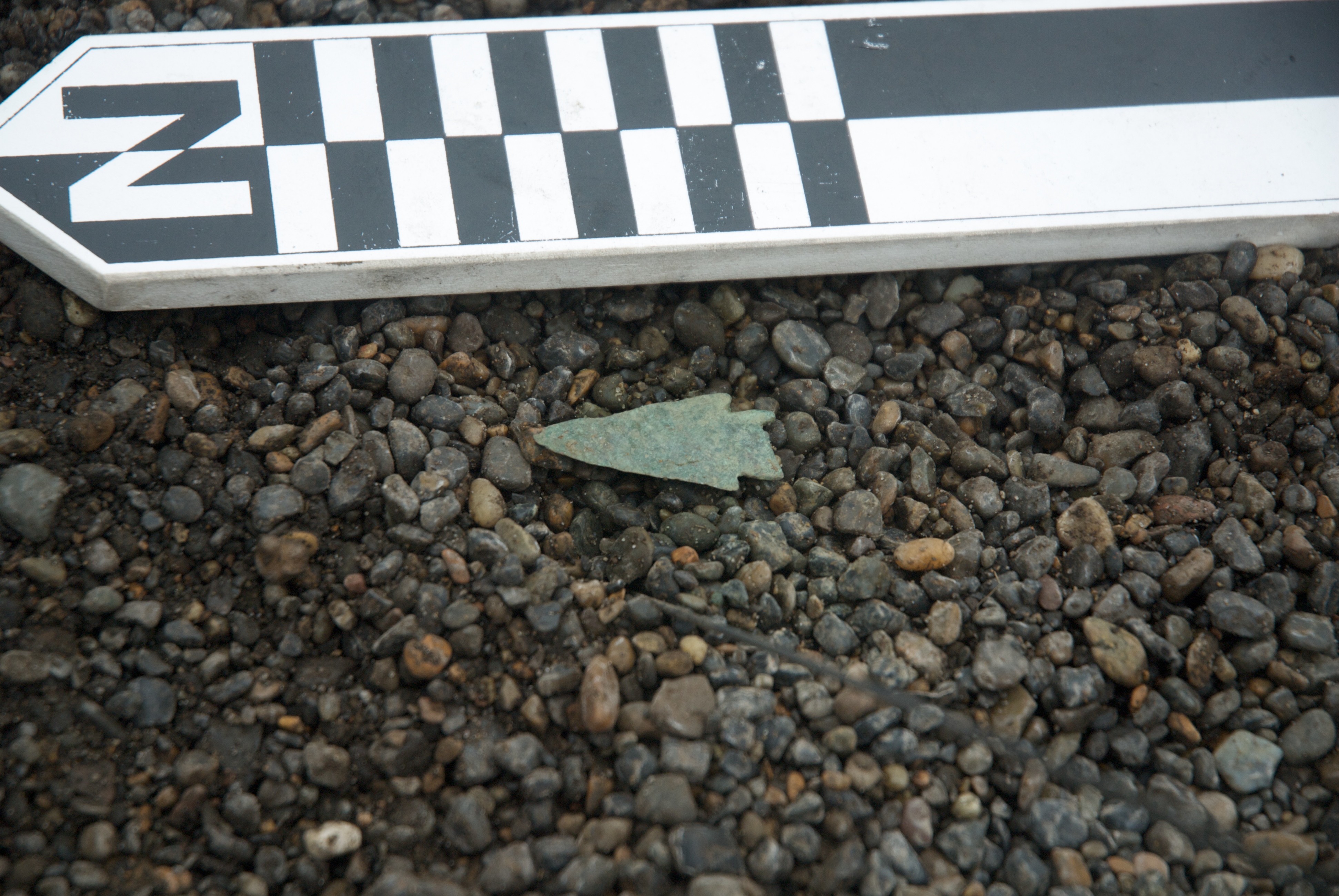
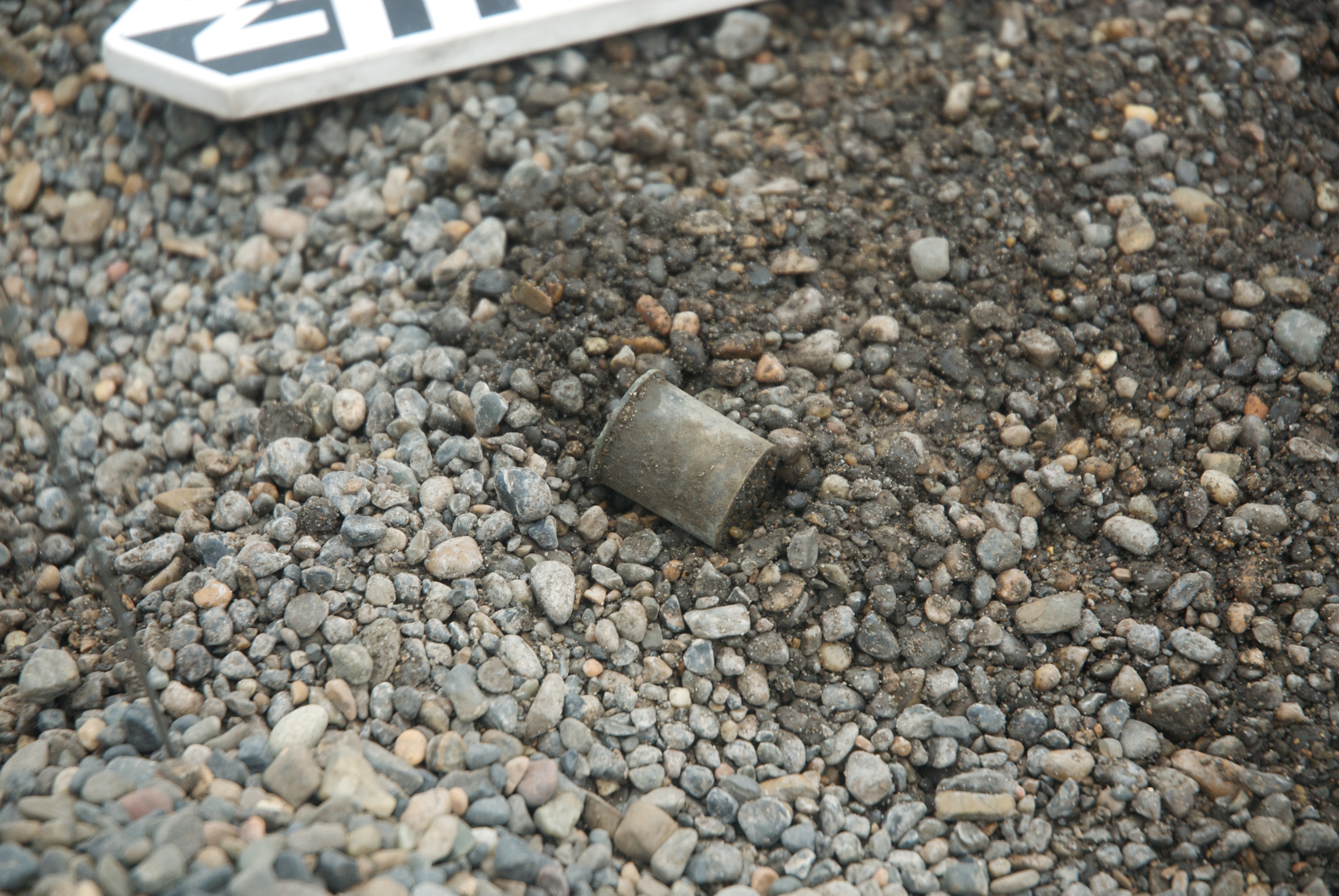
I’ve already mentioned how cold Saturday was, but we managed to finish the burial. We found a couple really neat artifacts, which are pictured below. Speaking of pictures, in case you are wondering, you won’t see any pictures of human remains here (or in any publications or presentations on the site). We do photograph them for documentary purposes, but the community Elders have asked that they not be shown. Like most people, they aren’t enthusiastic about having pictures of the mortal remains of people whom they consider as relatives all over the place. The community has had some bad experiences in the past with this, and I think their position is completely reasonable. It really doesn’t impeded research, and they don’t mind maps or drawings if needed to explain something.
Copper point, probably made from copper sheathing from a ship. It was probably for a sealing harpoon, judging by the size.Older-style cartridge for a whaling shoulder gun. They haven't changed all that much today.
In the end, it looked like the burial had been disturbed twice, once in the late 1800s, when it looks like someone was digging a hole and dug up part of the burial, with remains being scattered on the same surface these artifacts were on, and then a week ago when they were exposed in the trail.
Updated 7/17/10 to fix a picture size problem some folks were reporting.




 Out of Ice and Time