Labwork–A necessary evil?

You never see Indiana Jones doing labwork.  Of course, you never see him taking notes, either, so perhaps one should not take the good Dr. Jones as a guide to good archaeological practice.

In fact, for projects which involve actual excavation of a site (presumably thereby giving rise to a collection of artifacts and other sorts of physical data such as C14 samples and faunal remains), far more time will be spent in the lab than was spent in the field.  Labwork is a necessary and important part of archaeology.  After all the time and energy spent in the field finding, recording and excavating things, it would be a real pity to just let them deteriorate for lack of cleaning and care, or get mixed up and lose their proveniences because they weren’t properly marked.  Then things need to be cataloged, with field IDs checked and expanded on, and the data needs to get into a database so that more detailed analysis can happen without having to root through the entire collection to find things.  No labwork = chaos.

The thing is that many of the activities which have to be done in the lab just aren’t that exciting :-(.  For example, cleaning things is not on most peoples’ Top 10 Things to Do list.  We actually had almost everything cleaned from previous seasons, so there hasn’t been any of that yet.  When it happens, it often involves very slow and fiddly removal of gravel, dirt and roots by the gentlest means possible.  Sometimes artifacts are so delicate that complete cleaning can’t be done at once, or sometimes at all without the help of a conservator (of whom there are only 2 in Alaska, both at museums).

Our first big task was marking & cataloging, which generally happens after the cleaning.  This is really important, and important to get right.

Ideally, all items collected at a site are put into containers (usually Ziploc bags of some sort) or tagged (if they are too big to go in a container) with information as to site of origin, location of find, level and excavation unit they were found in, date found, and who collected them clearly written on the bag or label.  The idea is to assign each item (or group of small items like flakes or fish scales) a unique catalog number.  The information about that item goes into the catalog, and the item is marked with the catalog number.  These days, the catalog is usually a database on a PC, which is a huge improvement on the index cards that were in use when I started, or even the mainframe-based databases which came in shortly after that.

That way, if later an archaeologist decides they need to look at all the harpoon heads, say, from a site (or even many sites), they can be retrieved, and spread out in the lab, grouped and regrouped endlessly, and still not get mixed up or lose associated information.  When the analysis is done, everything can get back where it belongs.  New information from the analysis can be added to the catalog.

People used to just mark on artifacts with ink, often with a layer of clear nail polish or White-Out as a base coat, and a clear nail polish cover coat, but that wasn’t stable or reversible, and the idea today is that nothing should be done to an artifact that can’t be reversed.   We have used Paraloid B-72 dissolved in acetone as base and cover, with the catalog number written in India ink or white ink with a quill pen for years.  However, there are not a lot of people who can write a hand that is both tiny and legible.  The schools stopped teaching penmanship at all and started kids keyboarding very early, so they don’t really get practice.  We went to a system where the catalog numbers are printed on very thin archival paper, which is dunked in the Paraloid and then stuck to the artifact in an unobtrusive (one hopes) spot.
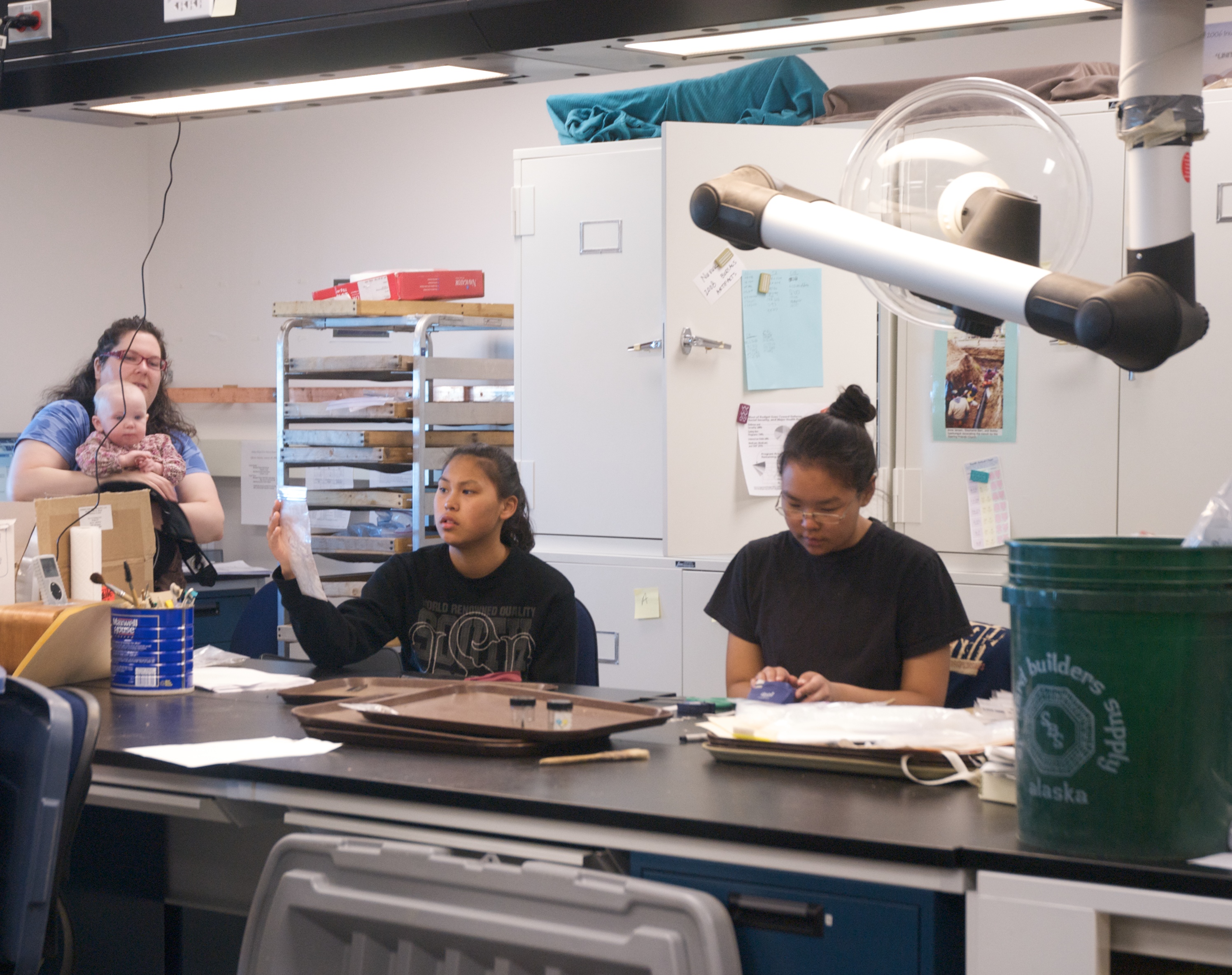
Nora selects artifact to mark, while Flora makes cabinet labels, while Laura & Violet "supervise".

We had some major struggles at first, with the Paraloid bubbling and making everything illegible.  We finally realized that the only thing that had changed was a move from a lab in a 1968 building to the new lab in the BARC, which is supposed to be very energy-efficient.  It is also extraordinarily dry.  One day a woman checking the air flow on the fume hoods measured the relative humidity in the lab, and got 3.8% (not a typo!).  I think the Sahara desert is more humid than that!  We realized the acetone was evaporating so fast it was making the bubbles.  We are now running one house-size and two room-size humidifiers in the lab, and the bubbling problem has gone away.  This method is proving very fast, with the only challenge being to get the right label on the right artifact.

However, it isn’t really that exciting, and can get repetitive, which can lead to people getting tired and therefore careless.  Like most labs, we try to have people work as a group, although each person is working on their own.  It is possible to label and talk at the same time.  We’ve got an iPod speaker for tunes, and so far there seems to be enough overlap in musical taste on crew that no-one has had to resort to ear plugs.  Like pretty much everyone in archaeology, I’ve spent a lot of time marking and cataloging artifacts, and while time doesn’t usually fly, I can tell you it goes a lot faster when you’re having fun.

Once the artifacts are marked, the catalog info is checked and they are put into cabinets, with the storage location entered into the catalog.  In the field, we tend to use quart (“small”) and gallon (“large”) Ziplocs, because they are easy to get, less expensive and too many sizes makes life complex.  Most artifacts don’t really need that much room.  We are moving the artifacts into the smallest possible archival bags they will fit in, and this is saving a huge amount of space.  Particularly nice artifacts, which visitors want to look at, are getting special containers.  They get individual beds of ethafoam, inside clear plastic archival boxes with lids.  Ron Mancil, a crew member who is currently a MA student at UAF, has museum experience and is very handy as well.  He has been applying his skills to making mounts for a bunch of artifacts, so visitors can get a closer look without endangering the artifacts.

Ron hard at work making a mount for a special artifact

It’s true that a lot of what happens in the field isn’t all that exciting either, as you will see in the next post or two.  But there’s always the possibility that something really cool will show up in the next shovel test pit (STP) or the next one, or the next one…

The Gathering Crew

I’ve been working on a major update to the Nuvuk catalog database structure, and the subsequent import and merging of data from 2 Access databases with about 18,000 records or so. Much keyboard & screen time involved, leaving my hands too sore to type more.

Anyway, that’s done, without disaster, and I’m typing again…

The first of the non-Barrow residents arrives on the evening plane. He’s coming up a bit early to help get ready for actual fieldwork. It looks like he may wind up in the hut next door, which will be handy, since we won’t get a truck assigned to the project for a week or so. The physical anthropologists won’t get here for a couple of weeks, since they can’t do a lot (except help dig) until we’re in the field & finding things. They’ve using the time in the lab instead.

Public Meetings & Archaeology

For the 2nd Tuesday evening in a row, I was at a public meeting being held by a NSB Assistant Borough Attorney, who is working on the monumental task of revising Titles 18 and 19 of the North Slope Borough Municipal Code.  These Titles deal with permitting and land use, including issues affecting cultural resources.  She’s certainly trying to do a good job, and the people who came had good input.  Unfortunately, it’s been pretty nice weather both nights, so turnout was light.

Since I’m one of maybe 3 archaeologists resident in Barrow, and the others were otherwise occupied (well, I did bring Glenn along this evening), it seemed like it was pretty much my duty as a concerned citizen to go and make sure the attorney is aware of issues that she might not have thought of.   Many more meetings in all the villages and more drafts and Planning Commission and then NSB Assembly need to pass it before anything really comes out of it, but at least there is some progress.  I certainly hope so, since otherwise I might have finished a piece of needlepoint I’ve been working on for 6 months.  Maybe tomorrow…

I nearly forgot…

…that I had originally gotten a North Slope Borough development permit for the Nuvuk Archaeological Project that expired in September 2009.  At the time I applied, we only had funding for the 3 years, so that seemed reasonable.  We’ve been fortunate to get additional funding, which has let us do at least one extra season.

However, that means that technically we need a new permit (or at least the old one extended/renewed).  I know, it’s not development, but it is a ground-disturbing activity, and that what the NSB calls all permits.  At least they have a permit system that actually covers such things, unlike some places.

Anyway, once I noticed the oversight, I spent the rest of Friday getting all the paperwork and backup together for BASC to take over to the Planning and Permitting Department.  I think everything they need is there, and since it is a renewal, I hope  it won’t be a problem for them.  They do have an extension sort of category.

Choosing the crew

A big part of the past couple weeks has involved choosing the crew for work at Nuvuk.  There are two funding sources for this project.  One is a grant to the North Slope Borough from the Department of Education, through the Education through Cultural and Historical Organizations program (ECHO), and the other is a regular research grant from the Arctic Social Sciences program of the Office of Polar Programs of the National Science Foundation.

The ECHO funds are targeted at K-12 education, so they need to be used for pre-college students and those who teach/supervise them.  We’ve been focusing on high school students for those slots.  For one thing, we run the dig for these students as a job.  That way, even if they don’t find their life’s work in archaeology, they’ll have some spending money for the next school year, and will have learned about interviews, resumes, time-sheets, paychecks and good work habits before they are out on their own.  Students who are less than 15 are very restricted in the hours they can work, even in the summer.  The first year, we hired a couple of students that young, only to find that every time we needed to stay late in the field (usually because something exciting was happening) we’d have to send them home or violate child labor laws.  Essentially, they got punished for being young, which was really no fun for anyone :-(.  After that, we only hired students who were older, and could work some OT, so they wouldn’t need to go home just when things got really exciting.

We’ve been doing interviews with students who haven’t worked before, both to assess motivation and to make sure they understand what they are getting into.  It’s really cold at Nuvuk, even compared to Barrow, and the wind comes right off the ice.  With the field season so short, and the erosion ongoing, we don’t take many weather days.

We’ve also been seeing who is returning, and for how much of the season they are available.  Many of the high school students who want to work at Nuvuk are active in many things, including sports (with summer camps), band, Mayor’s Youth Advisory Council, Model UN, and Rural Alaska Honors Institute.  Most of these involve some travel, so scheduling is complex.  We need to have a good-size crew, but not more than we have 4-wheelers for (allowing for a couple of folks in the lab or sick).  I actually do that in MS Project, just so I can get a clear picture and spot pinch-points more easily.

Anyway, we’ve got all the high school students selected, and have notified most of them, except for the ones who are out of town on family vacations.  We’ve also got one person on tap for the NSF-funded crew, but it looks like we might have room for 1-2 more, since the planned GPR component fell through.  Rhett Herman, a geophysicist from Radford U. in Virginia who has worked with us at Nuvuk in the past, was going to do some geophysical prospecting for burials, which would save us much time & effort.  He had hoped to run a field school, but funding was not available for this summer, so a couple of interested students were going to come up as participants in the dig and help with the GPR on the side.  Rhett’s wife has come down with some unexplained health problems, and he obviously doesn’t want to travel so far while they are unresolved. Looks like -2 for the crew.  So I need to see if I can find suitable replacements.

Care and feeding of the Total Station

You’ve probably seen pictures of archaeological digs with grids made of strings. Much of what we can learn from a site comes not just from what artifacts are found there, but from where particular artifacts are found in relation to each other.  The string grids are there to make it easier to record where each artifact is found (what archaeologists call “provenience”). I rarely use them.

Many years ago, my husband Glenn Sheehan (also an archaeologist) went to a talk at the Engineers’ Club in Philadelphia, where Harold Dibble & Shannon McPherron demonstrated a system to record provenience in 3 dimensions using an electronic total station (used by surveyors) connected to a palmtop computer (back then, an HP 95) to record not only the place each artifact was found, very precisely and with no transcription or data entry errors, but also some information about it. It automatically assigned an individual artifact number. There was even a little thermal printer that made tags to put in the baggie with the artifact! I left determined to get one.

We did, and took the system to places it had never been. Harold and Shannon had developed it for work on French Paleolithic sites, which tend to be very small. We wanted to use it on bigger sites. Fortunately, they kept improving the program, and it’s now really flexible. You can define what data is collected, set up menus, and use it on really huge sites.

Figuring out how to make everything work in the Arctic, where cold kills batteries and you can’t just plug into a wall socket was another adventure. A combination of generators, chargers, adaptors, and gel cell motorcycle batteries solved that problem. I got pretty good at repairing wires on adaptors, since the original stuff couldn’t take cold.  Over the years, the HP95s have been replaced with rugged laptops, and the thermal printers died. We haven’t found a good replacement for printing bag tags, but old-school marking the bags with a Sharpie works fine.

The GTS201D and all its equipment at Nuvuk.

Of course, the whole system depends on the total station. I’ve got 2, a Topcon GTS3B and a Topcon GTS201D, which is supposed to be waterproof. Total stations are surveyors’ instruments, so they are built to be moved around a lot without loosing accuracy, but they do need to be recalibrated on occasion. That time came for the 201D after last season.

Now, the only place in the state of Alaska that this can be done is in Anchorage. The 201D came in a case with really fragile fasteners, which have not held up well, and I haven’t been able to find a replacement, so we actually lash the case closed like a birthday present.   Needless to say, I wasn’t interested in shipping or mailing the total station down to get calibrated. But Laura and her husband Brian were going to Anchorage, and I was going down several weeks later. I called the shop, and they said the work could be done in the time between the trips, so they hand-carried it down and Brian dropped it off. They assured Brian the work would only take a week or so.

I went down for the Alaska Anthropological Association meetings & medical appointments a few weeks later and stopped by to get it, only to find it wasn’t done. What they had forgotten to tell Brian when he dropped it off was that one repair tech was on vacation and the other was out-of-state for two weeks of training, which had backed things up at bit. They couldn’t get it done in time for that trip. A few weeks later, I went to the Society for American Archaeology meetings in St. Louis.  Since you can’t get anywhere in the Lower 48 from Barrow without going through Anchorage, I was able to pick the total station up on the way home!  It’s now safe and sound in the lab, waiting for the fieldwork to start.

Ordering supplies from the Top of the World

The field season will soon be here. For the last couple of months, preparation has been underway.

Laura Thomas, who is the field and lab supervisor for the Nuvuk archaeological Project, has been double-checking the level of various field and lab supplies, and I’ve been ordering them. This is often a bit complicated, since some of the suppliers have never sent anything to Bush Alaska, at least since our last order, from which they don’t seem to have learned much. They either want to ship FedEx or UPS, which tend to be insanely expensive, and quite often are slower than Priority Mail, or they want to use Parcel Post, which can take several months. We try to get all the ordering done well in advance, so that even if my strong suggestions as to practical shipping methods are ignored, we will actually have what we need by the beginning of the field season.

I’m not sure what the deal is with FedEx & UPS. They make you pay way more than in the Lower 48 for Next-Day or Second Day service. It might be worth it if you actually got the service, but the packages are never closer than Anchorage by the “promised” delivery time, and may take a week more to get to Barrow and get delivered, depending on the schedule of the air freight company to which they hand them off. Of course, no refund, since Barrow (and all the rest of Bush Alaska–most of the state) is an exception area. Why they don’t make that clear to shippers beforehand one can only guess.

Anyway, pretty much everything I ordered has finally made it. We’ve got assorted archival-stable plastic zip bags for artifact storage, conservation chemicals of various kinds, Rite-in-the-rain copier paper for field forms by the ream.

Now all we have to do is get things stored and make up the field forms.

Hello world!

I am an Arctic archaeologist.  Most people I meet are fascinated when they find out what I do, and where I do it.    When they find out I live in Barrow, Alaska, they are even more fascinated (or horrified).  From the questions I tend to get asked, it’s pretty clear that most people haven’t had a chance to learn much about archaeology or the Arctic.

Hence, this blog.  Not everyone can live in or even visit the Arctic, or take part in an archaeological project, but maybe I can take you along in a virtual way.  I’m going to try to let you know what it’s like to do this.  Some posts will be about the really nitty-gritty boring details that have to be taken care of so the fun stuff can happen, some will be about days in the field, and some will be about bigger-picture things.   Archaeology is really fun, and I’d like to share it.  I’ll try to put in pictures so you can see where things are happening.

Questions are great.  The summer is a busy time for archaeologists, especially of the Arctic sort, and some places I work have no real internet access, so there may be some gaps in posting or lags in replying now and again, but I’ll pick up again when I can.