Edible Archaeology | diggingthedirt.
Check out the cake slide show at the bottom of the post!

Edible Archaeology | diggingthedirt.
Check out the cake slide show at the bottom of the post!
Once again, I have been spending time choosing the crew for the summer season at Nuvuk. There are a lot of factors that go into the choice, as I explained last year. Once again, I think (hope) I’ve got a good group. Most of the high school students have worked on the project for some time, some for several years. We’ve got one who has been working in the lab for months, and a couple who are totally new. We start orientation on June 13th.
One of the NSF-funded folks was actually on the crew in 2009. Dr. Tom Besom was going to be in Kamchatka this summer, but the project sort of fell through, so he’s coming back to Nuvuk. A good thing, since he is fluent in Spanish (his primary research specialty is Andean mummies) and will be a big help with making sure the Mexican students from the Mexican-American Exchange project who will be joining us get clear explanations and translations. Krysta Terry was also going to return, but her father has a serious health problem, so she can’t take off for the Arctic. Even though we have jet service twice daily and three times on Thursdays and Saturdays, it can take a couple of days to get to most place that aren’t on the West Coast; more than that if the planes are fully booked with tourists or the weather is foggy.
I’ve still got to do the final update of the memo we’ve developed for new crew on what and what not to bring (no flashlights), and send that out. Now the fun of trying to book cheap, yet not horrendous travel for five people to Barrow…
A very handy list of Open Access and other Journals:
List of Archaeology Journals | Doug’s Archaeology.
Thanks, Doug!
Claire Alix, who is probably the world expert on precontact wood use in Alaska, is in Barrow for a 10-day stint of analyzing wood from Nuvuk. She is working on wood from the Driftwood Feature (DWF), because there is so much of it and we need to figure out what needs to be kept.
The DWF was a storm strand line which was washed up onto and mixed with an Ipiutak settlement. Not just any Ipiutak settlement, but the farthest north Ipiutak settlement by about 500 km. The result was a mass of wood, bark and marine invertebrates, with a number of clearly identifiable artifacts included. There was so much wood that we called the level “Wood/Sand/Gravel” because it seemed like there was more wood than matrix. However, some of the smaller pieces of wood and bark were also worked, but it seems that the storm picked up smaller floatable artifacts and mixed them with driftwood. Given the field situation, it was impossible to examine each small piece of wood in detail, so we erred on the side of caution and brought back a lot of things that probably aren’t artifacts, so they could be examined in a nice warm lab.


The DWF was actually frozen, and had been for centuries, so we didn’t just want to bring the wood into a warm lab and let it thaw. That generally leads to wood that looked really well-preserved “exploding.” We have a nice walk-in refrigerator at the Barrow Arctic Research Center (BARC) just down the hall from my lab, so we have been holding the wood there, thawing slowly and keeping it cool to retard mold growth. The large and important artifacts started the conservation process very quickly, but there are boxes of smaller things which need to be inspected to separate the worked wood and bark from the rest. The wood that is just driftwood will be lab discarded, with that being recorded in the catalog so it will be clear in the future that artifacts haven’t been lost. The artifacts will get analyzed and better information will be recorded. This also lets us identify things for the conservator to work on when she next can come to Barrow. Small artifacts are being brought out for gradual drying. Wrapping wood in teflon tape to hold it together during slow drying has worked fairly well, so we’re doing that to move more out of the walk-in
All this is pretty laborious. Claire has to do the analysis and wood IDs, but with her schedule we needed to find a way to speed things up. The initial sorting of bags of wood and the wrapping of the wood are two of the most time-consuming aspects of the process. So, last week Heather Hopson came in to do some data entry and initial sorting, and this week Trina Brower is joining Heather. They are doing the initial sorts, wrapping with Teflon tape & data entry, so Claire can keep looking at wood.
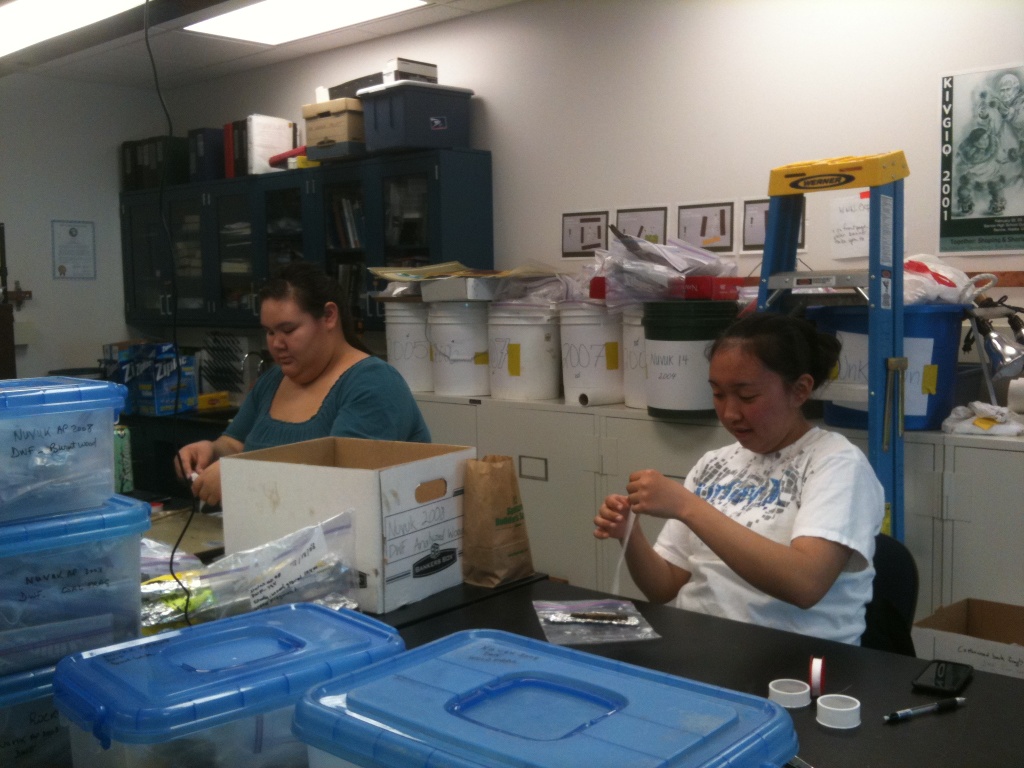
Wrapping the delicate pieces of small wood is definitely fiddly work. It certainly helps having someone to work with & talk to while working.
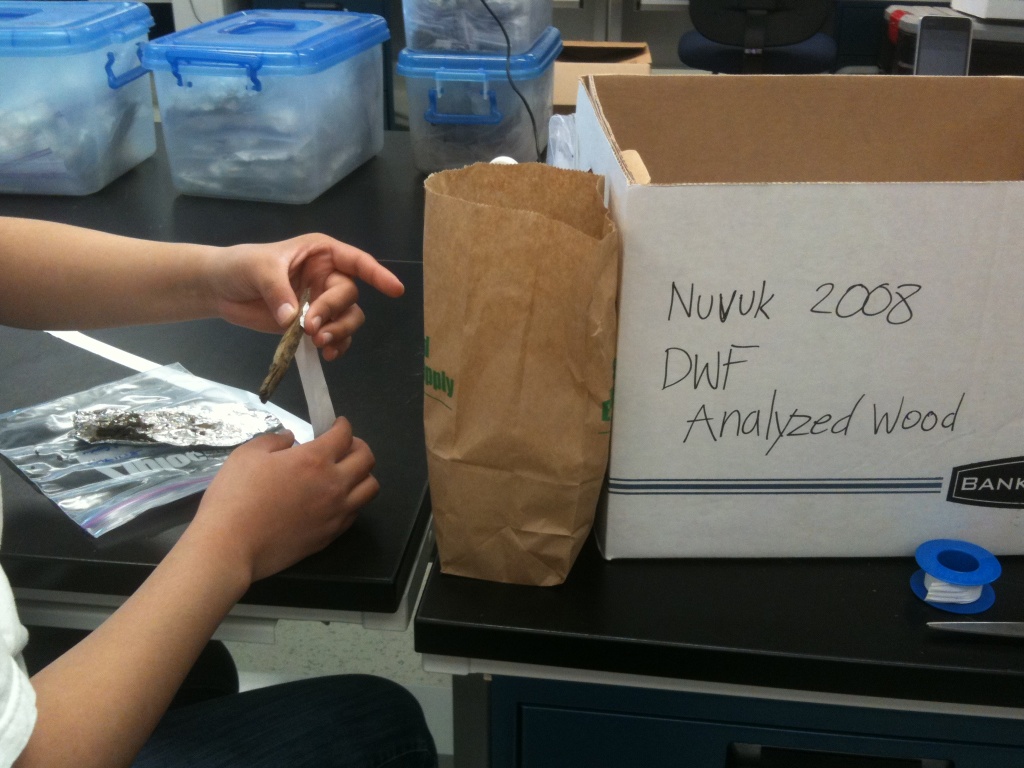
And when all else fails….

I am still plowing through the literature seeking out information on C14 dates. Some of it is really hard to come by, with a date attributed to a house but no information on the sample, either what it was or where it came from. Then I look at the information on the artifacts from that house, turn to the plates (not naming any names here, but there are multiple offenders) to look at the artifacts, and see that the plates say they are from a house nearby. Obviously either the text or the plates are wrong (unless they both are, but I’d rather not go there), so now one is left quite unsure of what was really being dated, and what sorts of artifacts were actually associated with that date. Cross-dating based on artifact assemblages takes another one on the chin.
Another example from today: a date on wood and skin (what kind? caribou, seal, polar bear?) from a burial for which the description seems to indicate that it was only a few baby teeth! It’s one thing to have typos in a dissertation, but in published books that people are expected to pay money for? If people don’t read carefully, and compare about three different places in the book at once, it’s all too easy to accept a date at face value and assume that what is said about what it was found with is correct. Then it gets mentioned elsewhere, and people read it there and pass it on, and so forth.
Such dates do not get high scores for context or association with the event being dated. Actually they get zeros, since those factors are unknown.
All this in aid of a handbook article (well, two articles, since this C14 stuff should make an article as well). On the other hand, a number of people say it should be useful. I’m sure they’re all really glad that I’m doing it and they aren’t. Can’t say I blame them.
Random Acts of Science – Blog – Geotagged Photos or “Hey! Dig here!”.
This is a pretty important point, and something most people probably don’t think about. It might not matter for well-know sites like Pompeii or something, but for a lot of places, it could be a problem. Why take a chance?
The fun with radiocarbon dates continues. I did manage to get a proposal off to a client, make some preparations for the summer field season and take care of the usual admin sorts of things. Otherwise, I was working on the C14 dates.
It was slow going, in part because I read French much more slowly than I do English, and I was working my way through the Blumer compendium of St. Lawrence dates, which requires looking in at least 3 places to figure out how to evaluate the dates. In some cases, one also has to go to other books to look at what the original excavator recorded (or didn’t). Thank goodness for the American Museum of Natural History and their very nice downloadable PDFs (although the link seems troubled at the moment) of their Anthropological Papers. I had a couple of them on my hard drive, which saved me a trip to get the actual books.
Anyway, St. Lawrence is going to be quite a mess. There are a lot of whale and walrus dates, and Dumond has calculated a correction for them by paired dating with terrestrial plants. The only problem is that the whales in St. Lawrence are the same stock as the whales they catch here, and whalebone C14 doesn’t turn over very fast (a couple of decades at least) so they average the ∂C13 over that period. That means that the correction factor for those whales should be the same anywhere in their range. We’ve worked on it here for the Nuvuk graves, and the correction factor that works is much smaller. I’m guessing walrus ingest relatively huge amounts of old carbon and skewed the calculations…
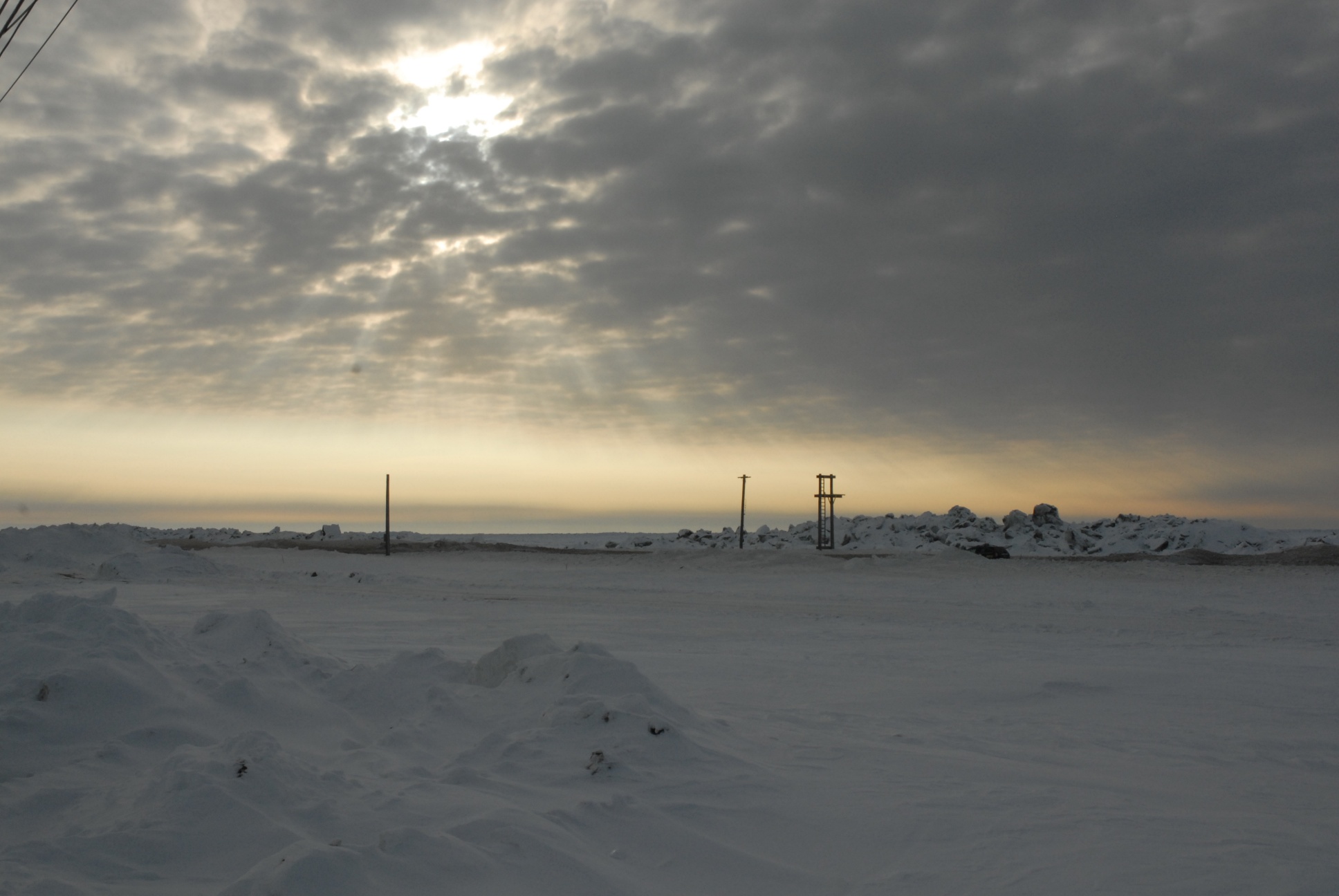
There was a very nice evening sky on the way home.
That’s what I’ve been doing lately. No, not that kind of dating. I’ve been wrestling with how old sites are, combined with the catching up after travel and working on taxes and other forms, it’s kept me busy enough that blogging kept coming in second to sleep.
I got started on this because I agreed to write a chapter for a forthcoming handbook of arctic archaeology dealing with Western Thule to Late Precontact in Northern & Western AK. The northern part was fairly easy, since this is where I have been working for years, and I know the literature inside out, and am responsible for most of the C14 dates in that time frame, as it turns out (a lot of the major sites here were excavated before C14 dating was invented) but I needed to brush up a bit on the more southern parts of the area, I felt. When I started doing that, I realized that terminology was a bit fuzzy (early investigators tended to think the entire sequence had to be present, and to call things, say, “Birnirk” because they thought there must be Birnirk, rather than because there were any diagnostic (types or designs only found in one culture) Birnirk artifacts at the site.
Then it became clear that people were using some artifact types as “index fossils” without being clear that they were really only in use for a limited time period. So if they found such an artifact in a feature, they assumed the feature was used at the same time as all other features with that artifact in them. Fairly recent C14 dating of some such artifacts has shown that some are pretty good to use, and others were being made for hundreds of years, so they aren’t really much help.
There is a pretty good dendrochronological (tree ring) series for the southern part of the area, due to Lou Giddings‘ pioneering work. This has enabled people to date wood, although in some cases the possibility of wood reuse seems not to have been considered thoroughly, and only one log dated in a feature. Then artifacts and artifacts assemblages (groups of artifacts often found together) found in that feature have been dated from the dendro date, and similar assemblages have been assumed to be about the same age.
Add the fact that there are a number of beach ridge complexes in the area (Cape Krusenstern, Cape Espenberg), which develop over time. Once people figured that out, it was a logical (and frequently correct) assumption that maritime-adapted people would choose to live on the ridge closest to the ocean. From there, it was only a short step to deciding that all features on a particular ridge were fairly close in age. In fact, as people have started doing more C!4 dating, and understanding how to interpret the dates better, it’s clear that isn’t the case.
As you can see, it’s not a pretty picture. Add the tendency of earlier researchers to conflate time periods (as they understood they) with archaeological cultures, and things get really confusing. Since this is a handbook, which one assumes is meant to be around for a while (although come to think of it, the Encyclopedia of Marine Mammals, in which I have a co-authored article, is in a 2nd edition less than seven years after the original came out), one would like to write an article that will not be rendered obsolete immediately.
So…. I’ve been going through the literature actually looking at the details of dates given for sites, dendro, C14 or otherwise, and am evaluating them on 9 different criteria to try to winnow out dates that are really reliable to base the chronology on. That doesn’t mean other sites/features won’t be mentioned, but it does mean I’ll avoid putting hard dates on them, or using them as a basis to date yet other sites.
This is not fun. I just hope it’s productive.
As Tripit puts it, I have an “upcoming trip to Fairbanks” for which I very nearly forgot to make travel arrangements. I remembered last week, and got the travel done, leaving only the paper, the poster, and the proposal I had to get done first.
The poster was finished on Friday, and sent off to Maribeth for final additions and printing. She had a touch of flu, but has recovered in time to work out the final edits, and will be getting it printed.
I started serious work on the proposal earlier in the week, and got the final numbers on Friday to plug in. It went off to the contracting officer this morning, and now we will see. Costs keep going up here in the Bush, and it makes it tough all round.
I have the paper (or the PowerPoint for it) almost done. I need to get a picture of Herman Ahsoak’s shed where he keeps his whaling gear (not in the house, behind it, just like folks have for centuries), and improve the map of the whaling captain’s work area at the Peat Locus at Nuvuk tomorrow, and then it’ll be ready.
I’m trying to get packed tonight, so I don’t have to rush after work tomorrow. It looks like a good meeting, although for the second year in a row the Alaska Consortium of Zooarchaeologists (ACZ) workshop and the Alaska Heritage Resource Survey (AHRS) workshop conflict. This is getting a bit old. It should be possible to schedule them both during the meeting without conflicting, but that would apparently require some forethought and consideration on the part of those organizing the AHRS meeting. The ACZ meeting was scheduled way in advance…
 Out of Ice and Time