The burial of a very large man

I mentioned that we started excavating a burial on the 15th of July and didn’t finish until the evening of the 19th, due to some really nasty weather.  It was simply too windy to excavate from Thursday afternoon until Monday the 19th after lunch.  Rain, sleet, and snow are all bothersome, but can be worked around.  Once the wind speeds get over about 30 mph, the chances of small artifacts (or even worse, small skeletal elements) being moved before their position is recorded or even blowing away altogether is real.  Wind speeds at Nuvuk are usually 5-10 mph higher than the official NWS measurements in Barrow.  Last year we had a Kestrel 4000 portable anemometer on site, but Laura’s dog Sir John Franklin ate it, so we have to estimate a bit.

We started work on the burial, called 10A927 on Wednesday, clearing vegetation and the organic soils covering the actual burial.  On the 15th, we began exposing the individual.  The skeleton was quite well-preserved.  It quickly became apparent from the size of the femur (thighbone) that this had been a very large person.  Dennis O’Rourke, the physical anthropologist who has the grant to work on the aDNA from Nuvuk, helps with the excavations each season.  He’s pretty tall (I’m guessing maybe 6’4″) and his opinion was that the burial was of someone who was very close to his height.  That would pretty much have been a giant at the time of European contact, since the tallest man the Ray expedition’s surgeon George Oldmixon measured in 1882-3 was 5’8 3/4″ tall.  There have been several other fairly tall individuals in the ancient graves at Nuvuk, so maybe the average height was depressed at contact because of poor nutrition because Yankee whaling had depleted the whale stocks pretty badly.  We were able to get an aDNA sample, which we take as soon as the ribs begin to show.  Jenny suits up and excavates and collects a previously unexposed rib.  Weather forced us to tarp the burial to protect it until conditions improved.
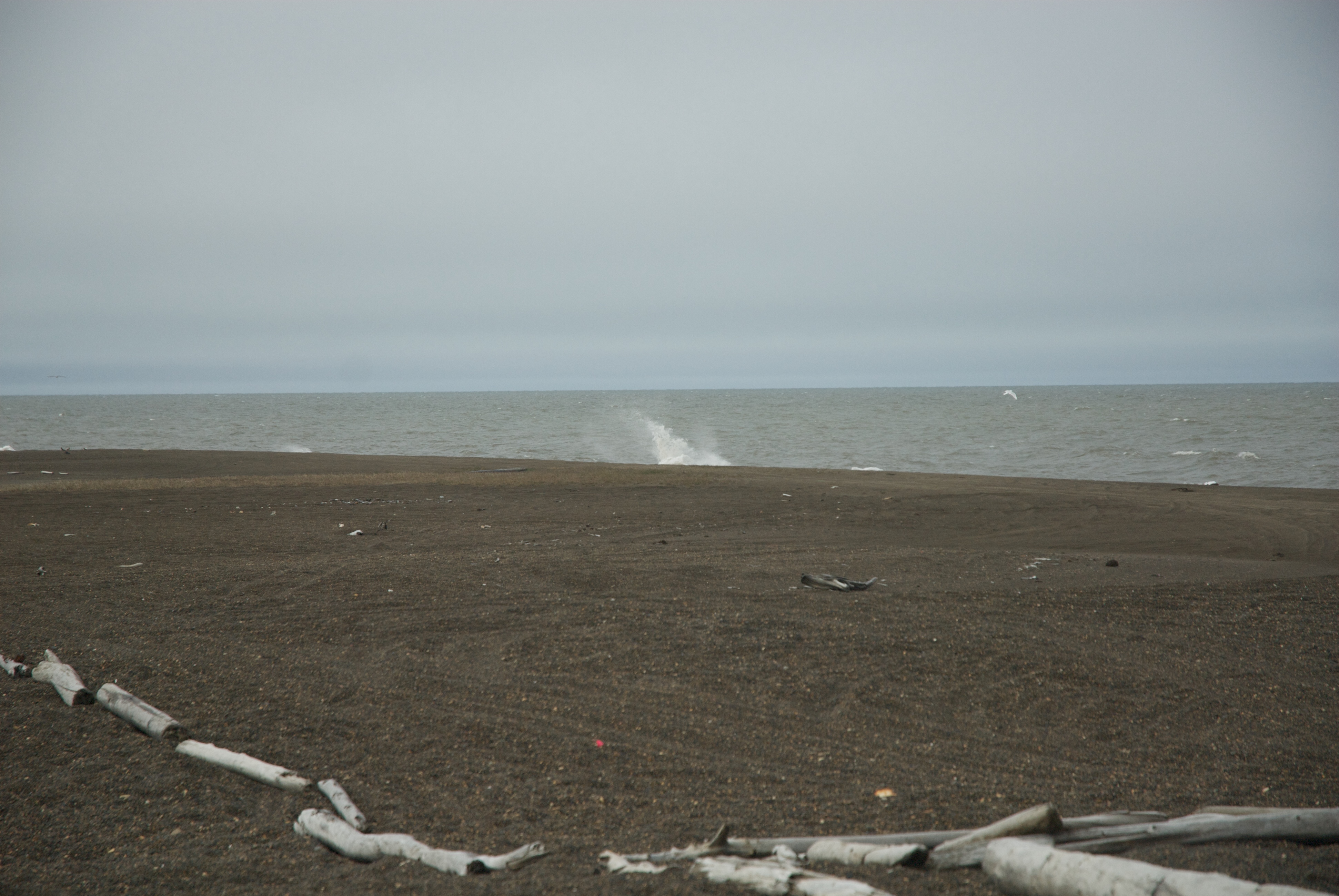
Wave breaking on the Beaufort beach at Nuvuk as the weather improves.

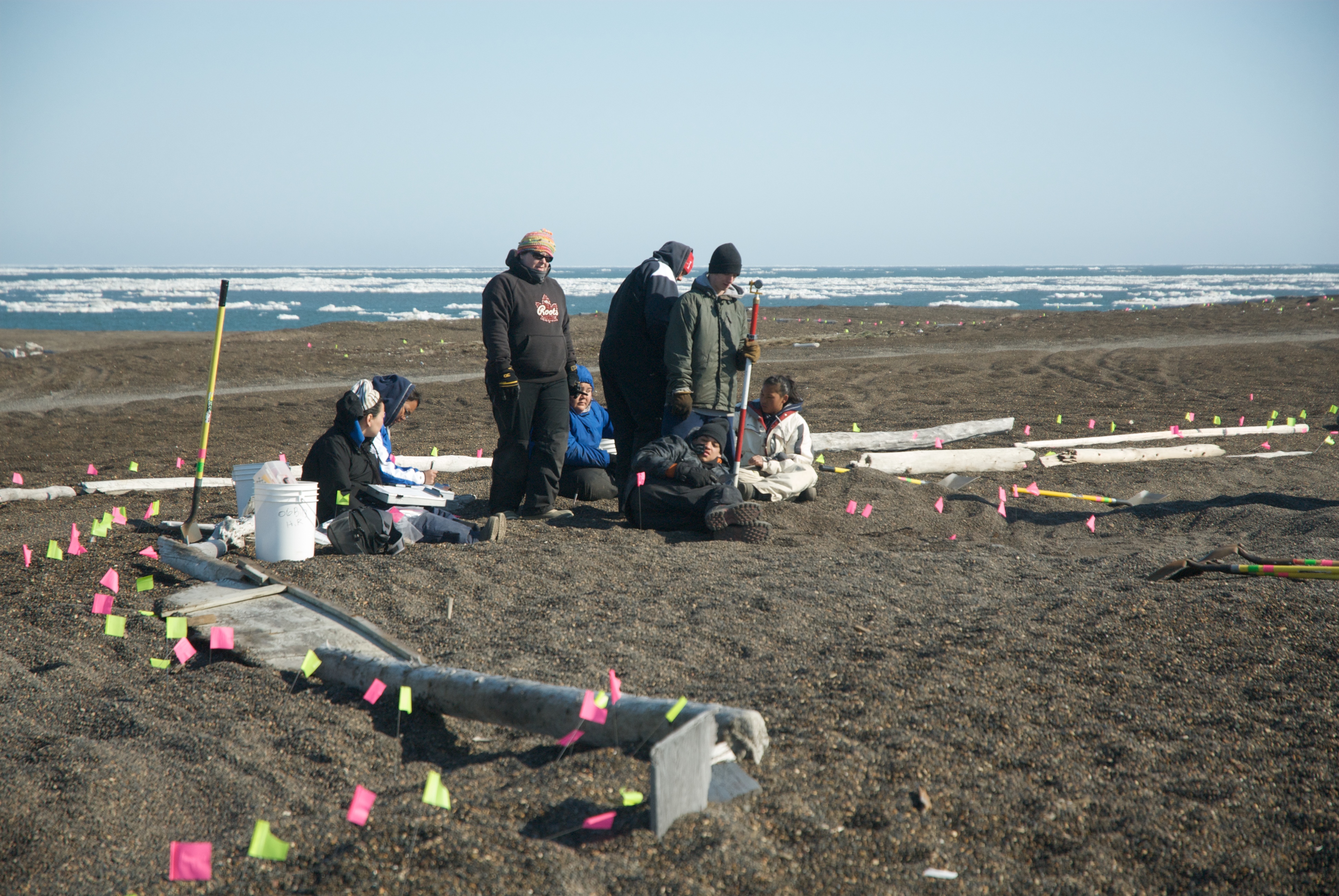
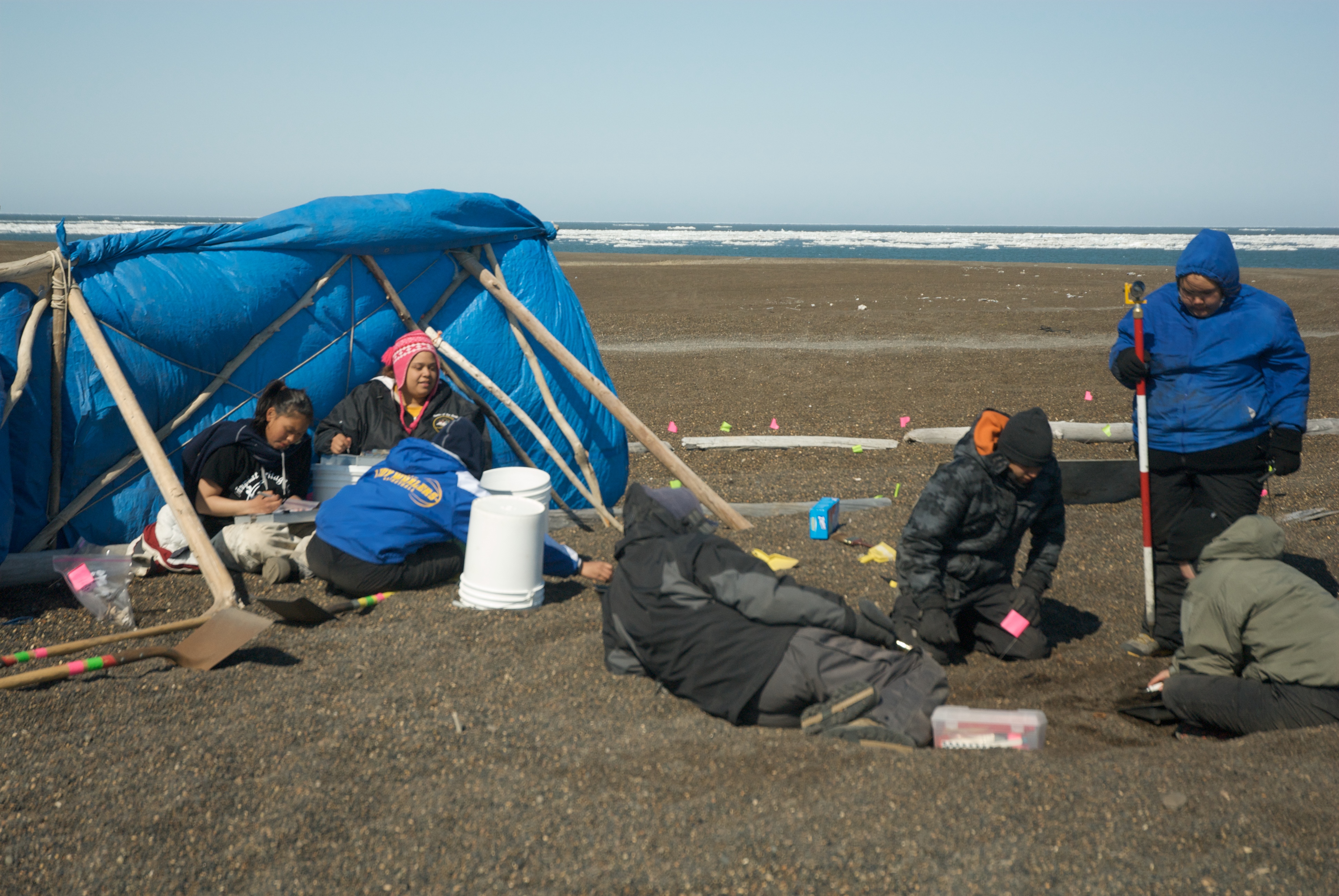
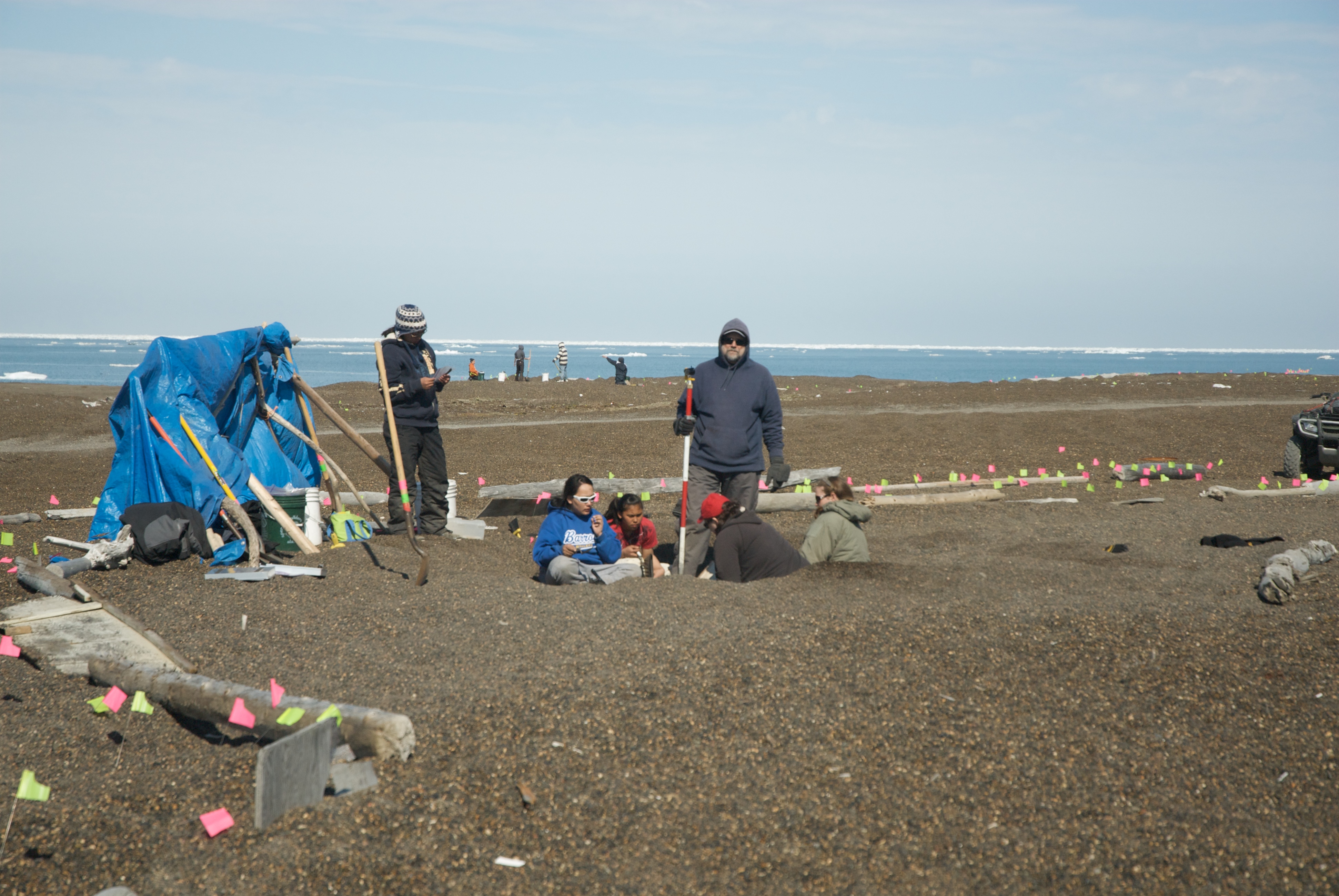
On Monday the 19th, the weather was pretty bad in the morning, but by lunch time it was improving, so we went out.  The passing of the storm had brought the winds around from SW to ENE, so the first order of business was to move the windbreaks on burials 10A927 and 10D75 (which we were excavating simultaneously).   We then began excavating.  10A927 turned out to be a very interesting burial.  The skeleton was nearly complete and well-preserved, and the positioning and grave structure were pretty typical for Nuvuk.  It was very nice to be able to show the students a real-life example.

I can’t show any pictures, as the Barrow Elders do not want them made public, based on past unfortunate experience.  I’ll do my best to describe the burial.  A shallow pit had been dug in the gravel (it’s pretty hard to dig anything else, even with metal shovels, which they didn’t have back then), and surrounded it with a “frame” of wood and/or whalebone.  10A927 had a nice whale rib at the foot, and wood at the sides and head.  The man had been placed on a hide, probably caribou, on his back with his knees bent.  His legs were bent a bit more than usual for Nuvuk, with his feet right by nis pelvis, almost as if the grave had been a bit small.  Perhaps the grave diggers had made the standard grave and he was a little too tall to fit easily.  His face was turned left.  His arms were folded over his chest and stomach.

A number of things had been put in the grave with him.  We found a number of whalebone bola weights (bolas were used for hunting birds), which may actually have been put in as a complete bola.  We also found a lot of the beach cobbles (bigger than the regular gravel and not that common at Nuvuk) that we have come to call “burial rocks” that were placed in some burials.  Most interestingly, he had the top of a human skull , which had apparently been placed on his stomach under his hand, since we found finger bones and a bola weight in it.  The skull appeared to have been on the surface at one point, as it was lighted in color than the skeleton, but it seems to have been placed in the burial deliberately, not found its way in later.  We have had a couple of burials with more than one person in them, and some where a later burial had disturbed an earlier one and ended up with parts of the earlier burial in and around the later one, but nothing like this.

All this was quite complicated to excavate and record.  Since the high school students are all minors, and some are only 15, the easiest way to avoid violating any child labor laws is to make sure they don’t work late.  So they went back to town with one of the bear guards just before 5pm, and the rest of us (Jenny, Laura, Ron & I) stayed out to finish.  It’s kind of unfortunate, since we only work late when something delicate and usually interesting is being excavated, and it seems tough on the students to make them leave just as things get really cool, but since this is a real job for them, we have to be on the safe side and follow all the rules.

We didn’t get done until about 9:15pm.  It wasn’t the greatest weather for all this (never got above 36ºF) but at least the wind dropped for the last couple of hours.
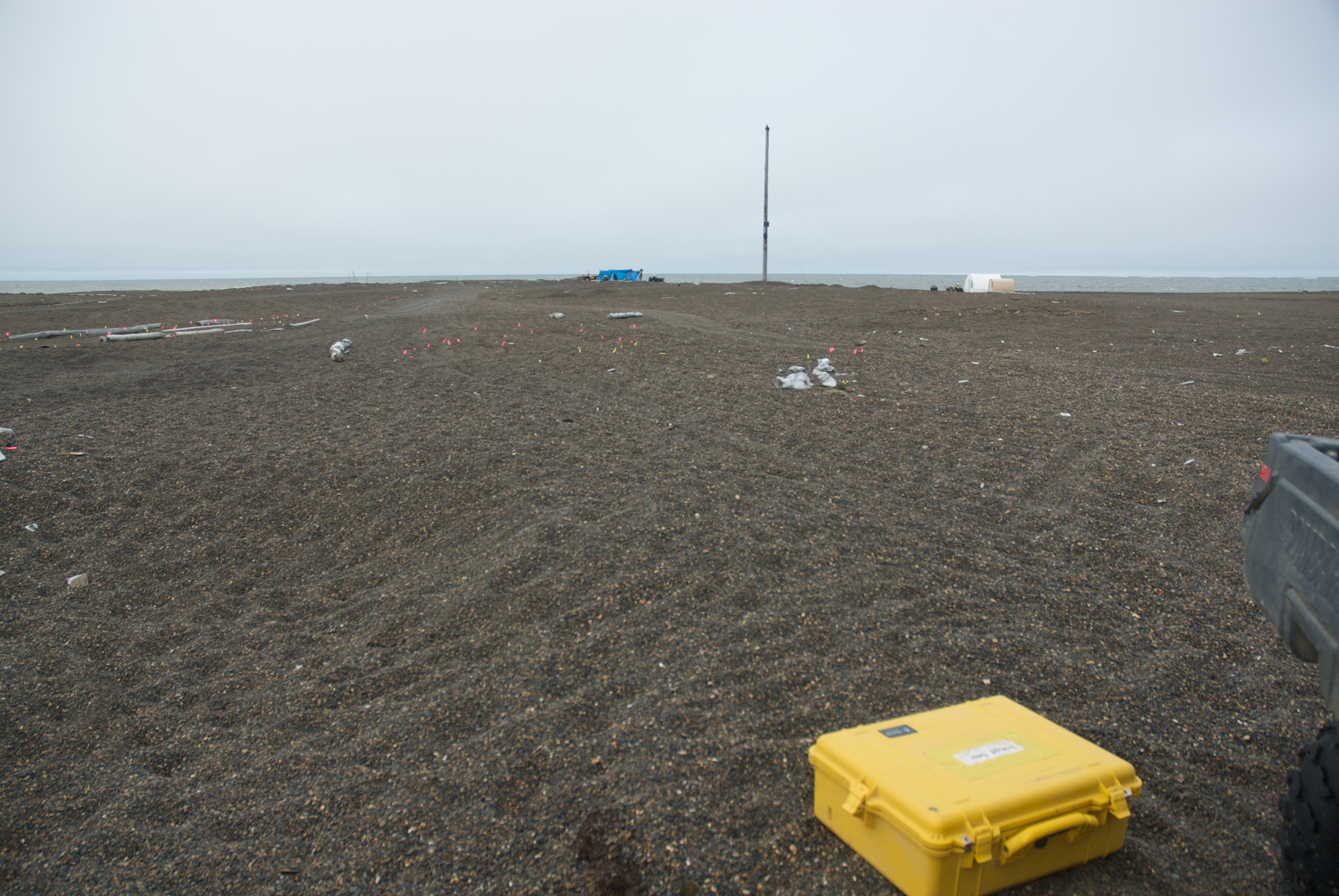
10A927 by the blue tarp, as we pack up at 9:20pm for the ride back to NARL after finishing the excavation.

Neither wind nor snow: Excavating burials under less than ideal conditions, even for Nuvuk

Conditions at Nuvuk are never ideal for excavation of burials, or most other features, really.  The matrix (soil) is mostly loose gravel, so things don’t stay put too well and it is very easy to undercut or otherwise displace things before their position is accurately recorded.  We have learned to take lots of photos, and record things with the transit as they are exposed, and that works fairly well.  This past week was particularly challenging.

We started the week with 3 burials located through shovel testing.  Two of them were very close together, so they could not be excavated at the same time.  It would confuse the EDM data recording program, and the excavators would get in each other’s way.  So we picked two that were separated by a good distance, and got them ready to excavate on Monday.  It was really windy, and one of the burials had a bit of vegetation on top of it.  In the Arctic, vegetation dies back each winter, but the dead stuff doesn’t decay, it just stays there.  Once you start excavating and cut the vegetation loose, it can start blowing around.  Some of the crew wore goggles to excavate.

Dennis, Trina, Trace and Heather excavate the surface levels of a grave in a high wind.

Needless to say, the construction of good windbreaks at both units was a priority.  After that, life was a bit more pleasant for the excavators.  On Tuesday we went to work in earnest.  With excavation at both burials, I was busy on the transit.  Both of my experienced transit operators were excavating, and things had to move so fast that it was not a training day.

Excavation going on at two burials, as seen from the transit. I took the picture during the brief sunny period after the snow squalls were over.

One of the burials seemed to have an intact wood frame around most of it.  Oddly, when we finished the excavation, the lower body seemed to have been undisturbed, but the upper body was mostly missing.  The grave was fairly shallow, and in the past explorers, anthropologists and others are known to have collected surface human remains, especially skulls, for museums.  Most of those individuals have been repatriated and reburied, so it is possible that is what happened to the upper body.  It is also possible that someone dug a hole and scattered the remains unknowingly.  The osteologist will look at any human skeletal elements that have been found on the surface nearby to see if they are part of this individual and reunite the elements before the reburial.  We were able to finish that burial on Tuesday.  Unfortunately, this was not the burial that was close to the other burial, so the excavators had to switch to STPs.

The other burial took longer.  Once we got the vegetation off without anyone wrecking their eyes, we came down on several patches of charcoal, as well as most of the bones of a bird (probably a duck, although I need to look more closely in the lab to be sure).  We spent a good deal of time defining the charcoal, prior to taking C14 samples for possible dating.  In the end, it looked like maybe someone had made a fire and cooked a bird over the grave (probably not knowing it was there).  The charcoal pattern was a bit odd for just a fire, and I think that the grave could have had some wooden framing elements which had been ignited by the fire on top of them, and smoldered into charcoal in place.  So it’s not clear what dating the charcoal will date.

Two of the charcoal patches in the process of being defined.

As we continued excavating, it became clear that the individual’s bones were well-preserved, but were very jumbled.  It appears that they may have been dug up, possibly even at another location, and then reburied in a hole where we found them.  From the soil and the amount of vegetation over the grave, it is clear that this happened quite some time ago, possibly hundreds of years ago, perhaps well before the bonfire.  Because of the jumbling, it took a very long time to document and removed the remains, and we weren’t able to finish until Wednesday morning.

Once we got done with that burial, we immediately started getting ready to excavate the other burial nearby (within about 3 meters).  I programmed a unit into the data recording software, and the crew started to work.  First order of business was a windbreak, since it was still windy.  We also tested several vegetated area we had reached at the end of last season and chosen not to test because they were really high probability burials and we would not have had time to excavate them.  Two were negative, and the third turned out to be positive.  We assigned it a number, set up a windbreak, and went to work on that one as well.  It just kept getting windier.

On Thursday, I didn’t get to the site until after noon, due to the radio show, so the crew worked on STPs and getting one of the burials ready to start shooting in artifacts as soon as I got there.  This burial turned out to have a lot of artifacts, especially the “burial rocks”  which we find in many of the burials, so we didn’t finish.  With the small crew and bad weather on Friday, we will have to finish Monday.

Excavating the first burial of the season

We waited to start burial excavation until Dennis O’Rourke and Jenny Raff, the physical anthropology/ancient DNA folks were here.  The weather on July 8 was pretty sunny, although it was very windy in the morning.  The burial had been located by a vehicle churning up some human remains and scattering them along the trail for several meters, so we weren’t exactly sure where the burial was located, so we had to remove some of the gravel to find it.

Crew gathers to begin excavation of burial 10A918. Note the sea ice on the ocean.

After it was located, a smaller group began the fine excavation.  It quickly became clear that the burial was quite scattered, since portions of the skull showed up both north and south of pelvic fragments.  At least one of the pelvic fragments seems too small to belong with the others, so there may be two individuals involved.

Beginning excavation.

The rest of the crew moved back to STPs, which over the course of the day located two additional probable burials, as well as a fairly recent and quite large oosik (walrus penis bone).  Excavations were interrupted when the honey bucket tent somehow wound up with the door locked.  No one was inside, but no one could get in to use it either, so we needed to get that fixed.  Fortunately, the cover was just loose enough that Victoria, who is quite slender, was able to wriggle in between the cover and frame (after taking off her jacket) and unlock it from the inside.  Crisis averted.  Yay Victoria!

Our bear guard Larry Aiken made a good windbreak for the excavators.  Unfortunately it just got windier.  Eventually the gusts got so strong that an artifact blew away being passed hand to hand, so we stopped work on the burial, tarped it up well, and worked on STPs for the rest of the day.  We spent some time watching the sea ice, which was going by faster than I’ve ever seen.  One of the bear guards said Volunteer Search and Rescue had somehow measured the speed at 23 mph!

Larry Aiken's excellent windbreak, sheltering the crew.

The next day was also sunny and windy, but not nearly as bad, so we went back to working on the burial.  We found a number of vertical faunal (animal bone) fragments in the middle of the burial, around where the chest would have been.  The leg bones were more or less in place, so it looked like the disturbance was concentrated on the upper body.  We expanded to the south to make sure we recovered all the remains, and found the old ground surface under the gravel.  It had remains and some artifacts on it.

Working at 10A918. Dennis O'Rourke holding the stadia rod with reflector to record an artifact. Notice how much ice has gone away.
Dennis & Jenny shoveling (for Jenny & Justin)

We were able to find some material suitable for C14 (radiocarbon) dating underneath the bones that hadn’t been disturbed, so that was good.  We tarped the burial up for another night.

I’ve already mentioned how cold Saturday was, but we managed to finish the burial.  We found a couple really neat artifacts, which are pictured below.  Speaking of pictures, in case you are wondering, you won’t see any pictures of human remains here (or in any publications or presentations on the site).  We do photograph them for documentary purposes, but the community Elders have asked that they not be shown.  Like most people, they aren’t enthusiastic about having pictures of the mortal remains of people whom they consider as relatives all over the place.  The community has had some bad experiences in the past with this, and I think their position is completely reasonable.  It really doesn’t impeded research, and they don’t mind maps or drawings if needed to explain something.

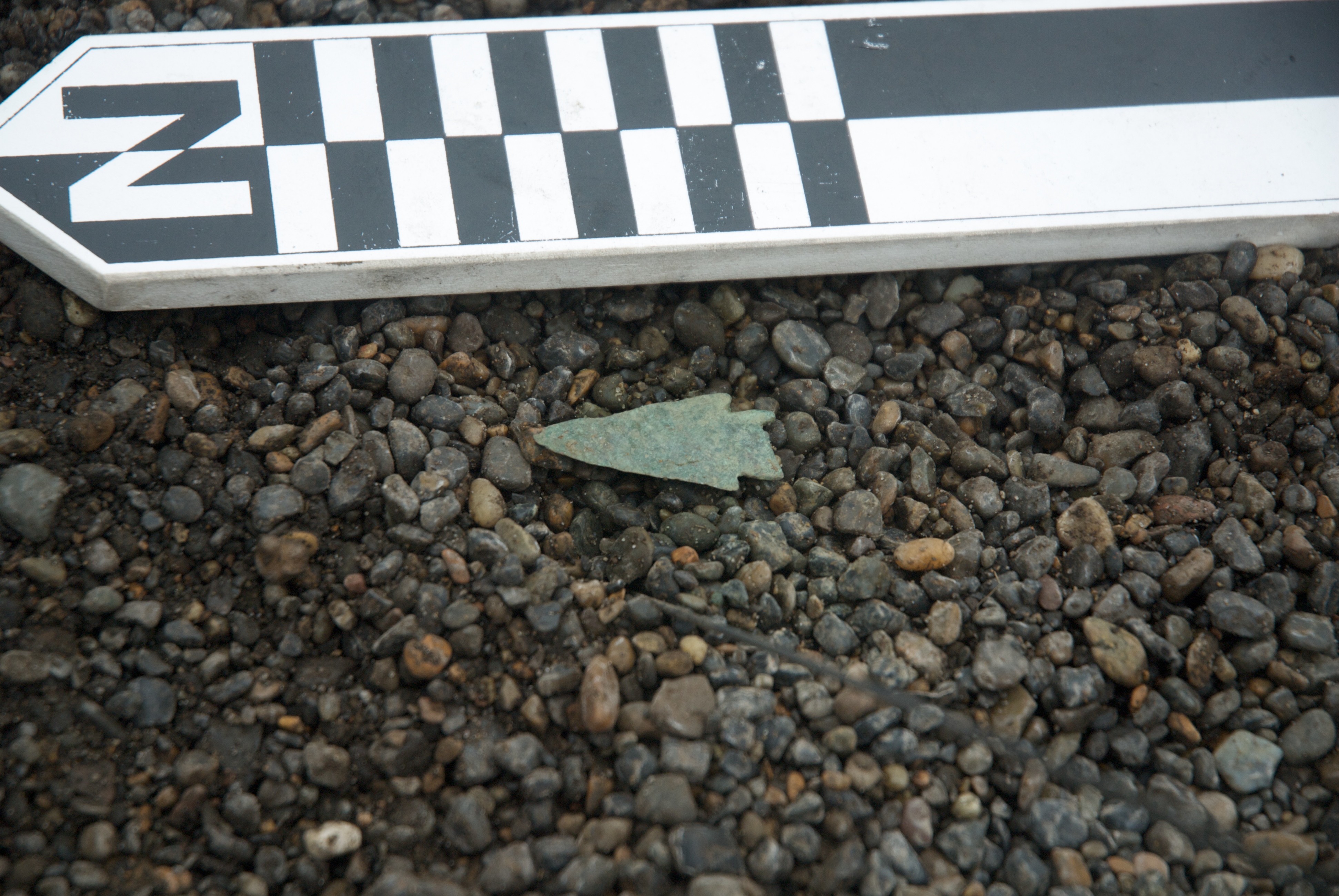
Copper point, probably made from copper sheathing from a ship. It was probably for a sealing harpoon, judging by the size.
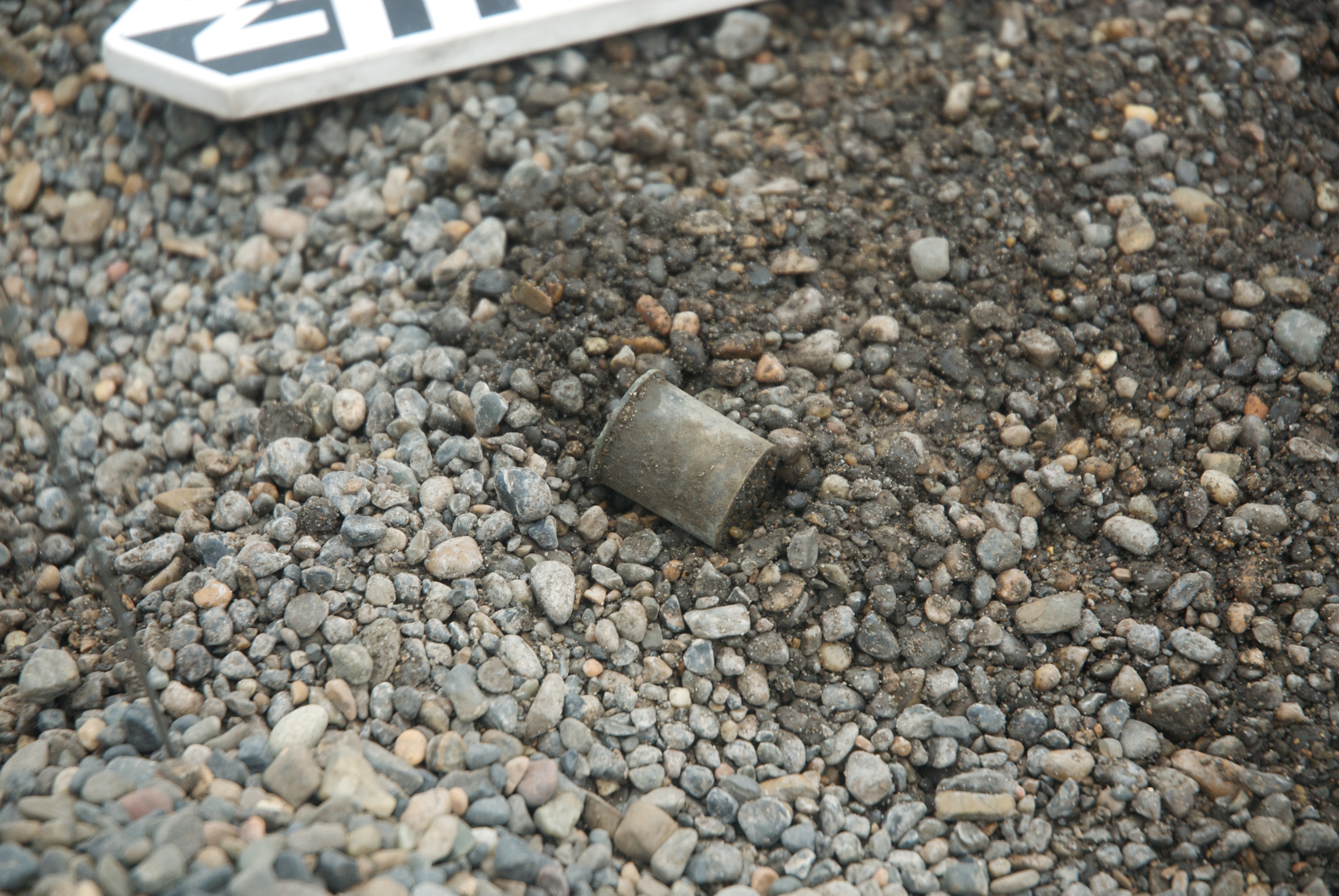
Older-style cartridge for a whaling shoulder gun. They haven't changed all that much today.

In the end, it looked like the burial had been disturbed twice, once in the late 1800s, when it looks like someone was digging a hole and dug up part of the burial, with remains being scattered on the same surface these artifacts were on, and then a week ago when they were exposed in the trail.

Updated 7/17/10 to fix a picture size problem some folks were reporting.

A Cold Day at Nuvuk

It has been a busy week, with all sorts of things to do after the day’s fieldwork was over and the data was downloaded and backed up, including a public meeting (which will need to be rescheduled because the weather was nice and the TV didn’t get it on the announcement roll-around in time), baking dozens of cookies for the community potluck my employer was holding, and dealing with the aftermath of a minor ATV accident involving one of the students (she is fine, but wrenched an already sore shoulder and therefore will be on limited duty next week). We have tomorrow off, so I’ll provide more details and pictures on the fieldwork then.

Just a quick note while I try to get the flash card downloading. The pictures are all shot as hi-res JPEGs and RAW, so it takes forever. I doubt I can stay up long enough to post pictures tonight.

We worked today. Normally we do fieldwork Monday-Friday, because the students are paid by the hour (so they get practical job experience as well as archaeological training) and child labor laws make it complicated to work more than that, especially for the younger students. We had a vacation day on Monday, though, and since it’s a short season and some of the students are trying to earn money we decided to do a 5-day week anyway. In the end, only 5 of them made it to work today. One was out of town, Trina was taking part in a fundraiser for the basketball and volleyball teams, two were sick, one was hurt and we don’t know what happened to the other one. It was wicked cold this morning, so hats off to Rochelle, Trace, Nora, Warren and Victoria. Not only was it cold, it was windy & foggy (yes, at the same time). In fact, it was so foggy we were having trouble with the transit because the lens and/or the reflector kept getting obscured by water drops. And it rained before lunch, and toward the end of the day.

However, as compensation, we finished excavation of the first burial of the season.  It turned out to have been disturbed, probably in the late 1880s, judging by the artifacts scattered along an old ground surface along with some of the individual’s bones.  We found some very cool artifacts (a bit unusual for Nuvuk burial excavations) although they weren’t really in the burial.  Highlights were a copper end-blade (for a harpoon head or possibly arrow), a split blue glass bead, and best of all, the cartridge for a shoulder gun.  The last still seems to have a bit of black powder around the primer area, so we have it in VERY wet conditions, and I will try to clean it tomorrow before there is any chance of the powder drying at all.  Our bear guard, Larry Aiken, who is a whaler, said it was the oldest style, shorter than the ones they use now.

As further compensation, we decided to order our lunches from the fundraiser, so Trina brought 13 lunches to the end of the road to Nuvuk (called my cell before she headed out), and Larry took a trailer back to get them.  So we all had BBQ chicken, potato salad, rice, pancit and a hot dog for lunch, along with the hot beverage of our choice and chips courtesy of Nora!  Even with the big propane cooker going the tent was cold enough to see our breath.  We hung in and finished the burial, and tested the areas where two other single human bones had turned up in a trail.  Neither one had a grave beneath it.  We already have 3 other probable graves, based on subsurface indications in STPs, waiting for us next week.

A quick trip to Nuvuk

Monday afternoon I got to take a quick trip to Nuvuk to check on the two tents BASC had put up for us to use doing the field season. The big one is for lunches and gear storage, and the little one is for the honey bucket (the tour van kept showing up at such awkward times…). It was a nice sunny day, not too windy.

On Point Barrow, heading toward Nuvuk
Looking northwest across Point Barrow. The horizon is white because of "ice blink" since the ice pack is still in.

We even got to see a polar bear.  It was sleepy, and just lay there snoozing.  There was a van full of tourists snapping away (just out of frame to the right).

Sleepy bear at Nuvuk.
Blown-up picture of the bear.

Living where you work has its down-side

Unlike most other Arctic archaeologists, I live where I work.  My house is less than 10 miles from the site I am currently working on, and there are other sites closer than that.  In general, that’s a good thing, and I wouldn’t change it for the world, but like so much else in life, it’s not an unmixed blessing.

PROS OF LIVING WHERE YOU WORK

  • Community members can take part in all parts of the project, and can find you to ask questions whenever they want.
  • No long expensive trips to get to the field.
  • Logistics can be arranged before the field season, by talking to people you know or making local phone calls.
  • Gear doesn’t have to be shipped to and from the field, at great expense.
  • If you run out of Ziplocs during the season, you can get more at the grocery store (assuming they haven’t run out, of course.)
  • The artifacts get to the lab every night, after a short trip, and can be treated and stabilized quickly if necessary.
  • The artifacts stay in the community.
  • You get to sleep in your own comfortable bed.
  • You get to cook meals in a real kitchen and go to restaurants, instead of having to eat only things that everyone else will eat too. (Arctic archaeology is hard work, and camp cooking can’t get so far off the beaten track that some folks won’t eat it.)
  • You have access to laundry equipment.
  • You’ve got your professional library handy if something unexpected shows up.
  • You have a good computer and internet access.

CONS OF LIVING WHERE YOU WORK

  • No long expensive trips to get to the field, so people can’t understand why you can’t take a day off during the field season, or don’t want to run out at midnight to see some archaeology they just found.
  • You get to sleep in your own comfortable bed (so you stay warm and can’t eat unlimited amounts of fat and sugar and still lose weight during the field season, so you have to exercise & watch your diet the rest of the year 😦 ).
  • You get to cook meals in a real kitchen (which means you have to cook and clean up, even if you’re exhausted.)
  • You have access to laundry equipment (which means you are expected not to wear the same clothes for 6 weeks, or at least to wash them frequently if you do, so you don’t get out of doing laundry.)
  • You’ve got your professional library handy so you feel like you should be writing professional material in your spare time.
  • You have a good computer and internet access so people expect you to respond to all email just as fast as when you’re not in the field, as well as doing all the work-related tasks you do then (like approving time sheets, etc.).

As you can see, the cons are pretty much personal convenience things, and being here makes the archaeology better and makes it possible to involve local high school students in a way that would be impossible if I didn’t live here.  Aside from the time away from home and school issue (not a minor one with high-stakes testing), no funding agency would pay for a bunch of high school students (& chaperones) to spend weeks somewhere else so they could be part of the lab work.

Right now, I’m trying to get as much “housekeeping” type stuff out-of-the-way, both at work and at home, as I can before the fieldwork starts on July 5.   No way I’m going to get through the to-do before the field list.  Oh well.

Labwork–A necessary evil?

You never see Indiana Jones doing labwork.  Of course, you never see him taking notes, either, so perhaps one should not take the good Dr. Jones as a guide to good archaeological practice.

In fact, for projects which involve actual excavation of a site (presumably thereby giving rise to a collection of artifacts and other sorts of physical data such as C14 samples and faunal remains), far more time will be spent in the lab than was spent in the field.  Labwork is a necessary and important part of archaeology.  After all the time and energy spent in the field finding, recording and excavating things, it would be a real pity to just let them deteriorate for lack of cleaning and care, or get mixed up and lose their proveniences because they weren’t properly marked.  Then things need to be cataloged, with field IDs checked and expanded on, and the data needs to get into a database so that more detailed analysis can happen without having to root through the entire collection to find things.  No labwork = chaos.

The thing is that many of the activities which have to be done in the lab just aren’t that exciting :-(.  For example, cleaning things is not on most peoples’ Top 10 Things to Do list.  We actually had almost everything cleaned from previous seasons, so there hasn’t been any of that yet.  When it happens, it often involves very slow and fiddly removal of gravel, dirt and roots by the gentlest means possible.  Sometimes artifacts are so delicate that complete cleaning can’t be done at once, or sometimes at all without the help of a conservator (of whom there are only 2 in Alaska, both at museums).

Our first big task was marking & cataloging, which generally happens after the cleaning.  This is really important, and important to get right.

Ideally, all items collected at a site are put into containers (usually Ziploc bags of some sort) or tagged (if they are too big to go in a container) with information as to site of origin, location of find, level and excavation unit they were found in, date found, and who collected them clearly written on the bag or label.  The idea is to assign each item (or group of small items like flakes or fish scales) a unique catalog number.  The information about that item goes into the catalog, and the item is marked with the catalog number.  These days, the catalog is usually a database on a PC, which is a huge improvement on the index cards that were in use when I started, or even the mainframe-based databases which came in shortly after that.

That way, if later an archaeologist decides they need to look at all the harpoon heads, say, from a site (or even many sites), they can be retrieved, and spread out in the lab, grouped and regrouped endlessly, and still not get mixed up or lose associated information.  When the analysis is done, everything can get back where it belongs.  New information from the analysis can be added to the catalog.

People used to just mark on artifacts with ink, often with a layer of clear nail polish or White-Out as a base coat, and a clear nail polish cover coat, but that wasn’t stable or reversible, and the idea today is that nothing should be done to an artifact that can’t be reversed.   We have used Paraloid B-72 dissolved in acetone as base and cover, with the catalog number written in India ink or white ink with a quill pen for years.  However, there are not a lot of people who can write a hand that is both tiny and legible.  The schools stopped teaching penmanship at all and started kids keyboarding very early, so they don’t really get practice.  We went to a system where the catalog numbers are printed on very thin archival paper, which is dunked in the Paraloid and then stuck to the artifact in an unobtrusive (one hopes) spot.

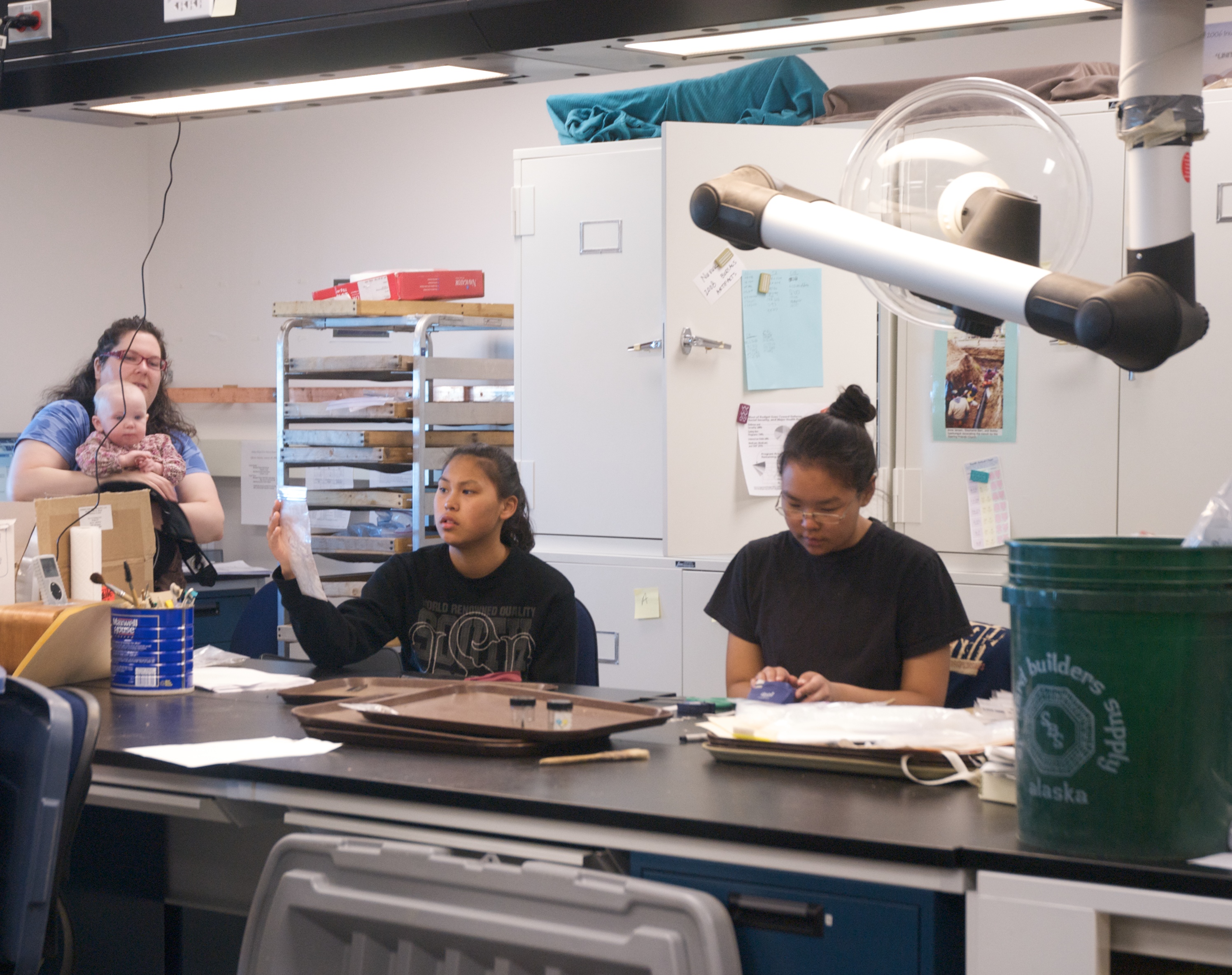
Nora selects artifact to mark, while Flora makes cabinet labels, while Laura & Violet "supervise".

We had some major struggles at first, with the Paraloid bubbling and making everything illegible.  We finally realized that the only thing that had changed was a move from a lab in a 1968 building to the new lab in the BARC, which is supposed to be very energy-efficient.  It is also extraordinarily dry.  One day a woman checking the air flow on the fume hoods measured the relative humidity in the lab, and got 3.8% (not a typo!).  I think the Sahara desert is more humid than that!  We realized the acetone was evaporating so fast it was making the bubbles.  We are now running one house-size and two room-size humidifiers in the lab, and the bubbling problem has gone away.  This method is proving very fast, with the only challenge being to get the right label on the right artifact.

However, it isn’t really that exciting, and can get repetitive, which can lead to people getting tired and therefore careless.  Like most labs, we try to have people work as a group, although each person is working on their own.  It is possible to label and talk at the same time.  We’ve got an iPod speaker for tunes, and so far there seems to be enough overlap in musical taste on crew that no-one has had to resort to ear plugs.  Like pretty much everyone in archaeology, I’ve spent a lot of time marking and cataloging artifacts, and while time doesn’t usually fly, I can tell you it goes a lot faster when you’re having fun.

Once the artifacts are marked, the catalog info is checked and they are put into cabinets, with the storage location entered into the catalog.  In the field, we tend to use quart (“small”) and gallon (“large”) Ziplocs, because they are easy to get, less expensive and too many sizes makes life complex.  Most artifacts don’t really need that much room.  We are moving the artifacts into the smallest possible archival bags they will fit in, and this is saving a huge amount of space.  Particularly nice artifacts, which visitors want to look at, are getting special containers.  They get individual beds of ethafoam, inside clear plastic archival boxes with lids.  Ron Mancil, a crew member who is currently a MA student at UAF, has museum experience and is very handy as well.  He has been applying his skills to making mounts for a bunch of artifacts, so visitors can get a closer look without endangering the artifacts.

Ron hard at work making a mount for a special artifact

It’s true that a lot of what happens in the field isn’t all that exciting either, as you will see in the next post or two.  But there’s always the possibility that something really cool will show up in the next shovel test pit (STP) or the next one, or the next one…

Care and feeding of the Total Station

You’ve probably seen pictures of archaeological digs with grids made of strings. Much of what we can learn from a site comes not just from what artifacts are found there, but from where particular artifacts are found in relation to each other.  The string grids are there to make it easier to record where each artifact is found (what archaeologists call “provenience”). I rarely use them.

Many years ago, my husband Glenn Sheehan (also an archaeologist) went to a talk at the Engineers’ Club in Philadelphia, where Harold Dibble & Shannon McPherron demonstrated a system to record provenience in 3 dimensions using an electronic total station (used by surveyors) connected to a palmtop computer (back then, an HP 95) to record not only the place each artifact was found, very precisely and with no transcription or data entry errors, but also some information about it. It automatically assigned an individual artifact number. There was even a little thermal printer that made tags to put in the baggie with the artifact! I left determined to get one.

We did, and took the system to places it had never been. Harold and Shannon had developed it for work on French Paleolithic sites, which tend to be very small. We wanted to use it on bigger sites. Fortunately, they kept improving the program, and it’s now really flexible. You can define what data is collected, set up menus, and use it on really huge sites.

Figuring out how to make everything work in the Arctic, where cold kills batteries and you can’t just plug into a wall socket was another adventure. A combination of generators, chargers, adaptors, and gel cell motorcycle batteries solved that problem. I got pretty good at repairing wires on adaptors, since the original stuff couldn’t take cold.  Over the years, the HP95s have been replaced with rugged laptops, and the thermal printers died. We haven’t found a good replacement for printing bag tags, but old-school marking the bags with a Sharpie works fine.

The GTS201D and all its equipment at Nuvuk.

Of course, the whole system depends on the total station. I’ve got 2, a Topcon GTS3B and a Topcon GTS201D, which is supposed to be waterproof. Total stations are surveyors’ instruments, so they are built to be moved around a lot without loosing accuracy, but they do need to be recalibrated on occasion. That time came for the 201D after last season.

Now, the only place in the state of Alaska that this can be done is in Anchorage. The 201D came in a case with really fragile fasteners, which have not held up well, and I haven’t been able to find a replacement, so we actually lash the case closed like a birthday present.   Needless to say, I wasn’t interested in shipping or mailing the total station down to get calibrated. But Laura and her husband Brian were going to Anchorage, and I was going down several weeks later. I called the shop, and they said the work could be done in the time between the trips, so they hand-carried it down and Brian dropped it off. They assured Brian the work would only take a week or so.

I went down for the Alaska Anthropological Association meetings & medical appointments a few weeks later and stopped by to get it, only to find it wasn’t done. What they had forgotten to tell Brian when he dropped it off was that one repair tech was on vacation and the other was out-of-state for two weeks of training, which had backed things up at bit. They couldn’t get it done in time for that trip. A few weeks later, I went to the Society for American Archaeology meetings in St. Louis.  Since you can’t get anywhere in the Lower 48 from Barrow without going through Anchorage, I was able to pick the total station up on the way home!  It’s now safe and sound in the lab, waiting for the fieldwork to start.

Hello world!

I am an Arctic archaeologist.  Most people I meet are fascinated when they find out what I do, and where I do it.    When they find out I live in Barrow, Alaska, they are even more fascinated (or horrified).  From the questions I tend to get asked, it’s pretty clear that most people haven’t had a chance to learn much about archaeology or the Arctic.

Hence, this blog.  Not everyone can live in or even visit the Arctic, or take part in an archaeological project, but maybe I can take you along in a virtual way.  I’m going to try to let you know what it’s like to do this.  Some posts will be about the really nitty-gritty boring details that have to be taken care of so the fun stuff can happen, some will be about days in the field, and some will be about bigger-picture things.   Archaeology is really fun, and I’d like to share it.  I’ll try to put in pictures so you can see where things are happening.

Questions are great.  The summer is a busy time for archaeologists, especially of the Arctic sort, and some places I work have no real internet access, so there may be some gaps in posting or lags in replying now and again, but I’ll pick up again when I can.