It’s 10: 27 PM and I just got into the office from the field. It was too windy to dig this morning (again!) so we didn’t head out until after lunch. It was still pretty windy and cold (the high was 36 F and the wind didn’t drop below 20 mph until the last couple hours.
We managed to finish one burial today. The students went home at the usual time, and Jenny, Laura, Ron & I (and the bear guards Michael and Richard) stayed out until we were done. It was the grave of a very large man, who had a number of interesting things buried with him. More about that, and pictures in a future post.
The data is downloaded, so I am going home for dinner & bed.
Conditions at Nuvuk are never ideal for excavation of burials, or most other features, really. The matrix (soil) is mostly loose gravel, so things don’t stay put too well and it is very easy to undercut or otherwise displace things before their position is accurately recorded. We have learned to take lots of photos, and record things with the transit as they are exposed, and that works fairly well. This past week was particularly challenging.
We started the week with 3 burials located through shovel testing. Two of them were very close together, so they could not be excavated at the same time. It would confuse the EDM data recording program, and the excavators would get in each other’s way. So we picked two that were separated by a good distance, and got them ready to excavate on Monday. It was really windy, and one of the burials had a bit of vegetation on top of it. In the Arctic, vegetation dies back each winter, but the dead stuff doesn’t decay, it just stays there. Once you start excavating and cut the vegetation loose, it can start blowing around. Some of the crew wore goggles to excavate.
Dennis, Trina, Trace and Heather excavate the surface levels of a grave in a high wind.
Needless to say, the construction of good windbreaks at both units was a priority. After that, life was a bit more pleasant for the excavators. On Tuesday we went to work in earnest. With excavation at both burials, I was busy on the transit. Both of my experienced transit operators were excavating, and things had to move so fast that it was not a training day.
Excavation going on at two burials, as seen from the transit. I took the picture during the brief sunny period after the snow squalls were over.
One of the burials seemed to have an intact wood frame around most of it. Oddly, when we finished the excavation, the lower body seemed to have been undisturbed, but the upper body was mostly missing. The grave was fairly shallow, and in the past explorers, anthropologists and others are known to have collected surface human remains, especially skulls, for museums. Most of those individuals have been repatriated and reburied, so it is possible that is what happened to the upper body. It is also possible that someone dug a hole and scattered the remains unknowingly. The osteologist will look at any human skeletal elements that have been found on the surface nearby to see if they are part of this individual and reunite the elements before the reburial. We were able to finish that burial on Tuesday. Unfortunately, this was not the burial that was close to the other burial, so the excavators had to switch to STPs.
The other burial took longer. Once we got the vegetation off without anyone wrecking their eyes, we came down on several patches of charcoal, as well as most of the bones of a bird (probably a duck, although I need to look more closely in the lab to be sure). We spent a good deal of time defining the charcoal, prior to taking C14 samples for possible dating. In the end, it looked like maybe someone had made a fire and cooked a bird over the grave (probably not knowing it was there). The charcoal pattern was a bit odd for just a fire, and I think that the grave could have had some wooden framing elements which had been ignited by the fire on top of them, and smoldered into charcoal in place. So it’s not clear what dating the charcoal will date.
Two of the charcoal patches in the process of being defined.
As we continued excavating, it became clear that the individual’s bones were well-preserved, but were very jumbled. It appears that they may have been dug up, possibly even at another location, and then reburied in a hole where we found them. From the soil and the amount of vegetation over the grave, it is clear that this happened quite some time ago, possibly hundreds of years ago, perhaps well before the bonfire. Because of the jumbling, it took a very long time to document and removed the remains, and we weren’t able to finish until Wednesday morning.
Once we got done with that burial, we immediately started getting ready to excavate the other burial nearby (within about 3 meters). I programmed a unit into the data recording software, and the crew started to work. First order of business was a windbreak, since it was still windy. We also tested several vegetated area we had reached at the end of last season and chosen not to test because they were really high probability burials and we would not have had time to excavate them. Two were negative, and the third turned out to be positive. We assigned it a number, set up a windbreak, and went to work on that one as well. It just kept getting windier.
On Thursday, I didn’t get to the site until after noon, due to the radio show, so the crew worked on STPs and getting one of the burials ready to start shooting in artifacts as soon as I got there. This burial turned out to have a lot of artifacts, especially the “burial rocks” which we find in many of the burials, so we didn’t finish. With the small crew and bad weather on Friday, we will have to finish Monday.
It has pretty much been overcast all week. The sun is not visible, although at times the clouds have thinned enough that it was fairly bright. Coupled with constant strong wind, and mixing in fog, rain showers, and a half-day of snow squalls, the weather has been unfortunate, to say the least. Despite all that, we managed to completely excavate two more burials, and start a third, as well as dig a whole bunch of STPs.
On Thursday, I stayed in town in the morning to take part in a call-in radio show on KBRW, the local public (in the best way) radio station, about the graves at Nuvuk, ancient and modern, and the issues about vehicle traffic and erosion, as well as some broader discussion of similar issues in the other North Slope villages. Delbert Rexford, UIC Land Chief, some of whose ancestors lived and are buried at Nuvuk, organized the show, which went in a time slot normally used by the North Slope Borough Health Department. They had a cancellation, so we filled in. We also had Wesley Aiken, a respected local elder, Patuk Glenn, from IHLC (the Inupiat History Language and Culture Commission), Vera Williams from NVB (the Native Village of Barrow–the local tribal government) realty department, and Heather Dingman from the Health Department. It went well, and we got several callers, including one who called to say they appreciated the work the NAP has been doing with the students, which was nice to hear. Thanks to Seismic Isaac Tuckfield for engineering, and letting us run over the time slot a bit.
Once we were done, I headed back home to put on the warm gear, and Dennis O’Rourke (who’d been catching up on manuscripts since no burial excavation that might require sampling was happening when I wasn’t there) and I headed out to Nuvuk. On the way, we ran into Mike and Patsy Aamodt. Mike has a set net near the site, and he and Patsy often stop and see how things are going. One of their nieces, Jackie, worked on the project for several years. Anyway, Mike has finally been getting fish (they’re late here like everywhere else in Alaska this year) and he asked if I would like one. Of course, yes, so he said he’d drop it off in my qanitchat (Arctic entryway, or stoop for those of you from upstate NY). When I got home, there were 3 lovely fresh chum salmon in a bag, so they needed to be taken care of right away.
Friday was still somewhat windy, with fairly serious rain for Barrow. Since the wind had changed direction, we would have had to move the windbreak before we could even start work, and our crew was very small. Flora left for firefighter training in Fairbanks (yeah, Flora!) and a couple of others were out for the day for various reasons, so we decided it was more sensible to do a lab day. That was a good thing, since I was having a minor freezer space crisis at home, and so I invited the non-local project members (AKA the grown-ups) plus Laura (& her husband Bryan and baby Violet) over to eat one of the fish for dinner. Jenny Raff contributed a fine salad, and beverages were provided by Laura & Bryan & Dennis. A fine time was had by all.
Today I went to the BASC Saturday Schoolyard talk, which featured a NOAA LTjg talking about hydrography (actually a very interesting talk) and then added all the week’s transit data to the catalog, updated the lab computer, and spent some time plotting the data and checking IDs for the radiocarbon dates I got in this week. After I finished that, I was going to head home and get the pictures ready to post on the week’s progress int he field. I’ve fallen a bit behind since standing in the cold wind at the transit for much of the day does take it out of you a bit, and then one tends to get really sleepy when one gets back into a warm building. However, I got a call from an archaeologist friend from Anchorage who brought her 17-year-old son to Barrow as a field trip for his Alaska Studies class (very cool), so I met them for dinner at Osaka, the local sushi restaurant (which is quite good). Just got back, as they are heading for Nuvuk on the Aarigaa Tours van tour. I’ll have to get the pictures ready for a descriptive post tomorrow.
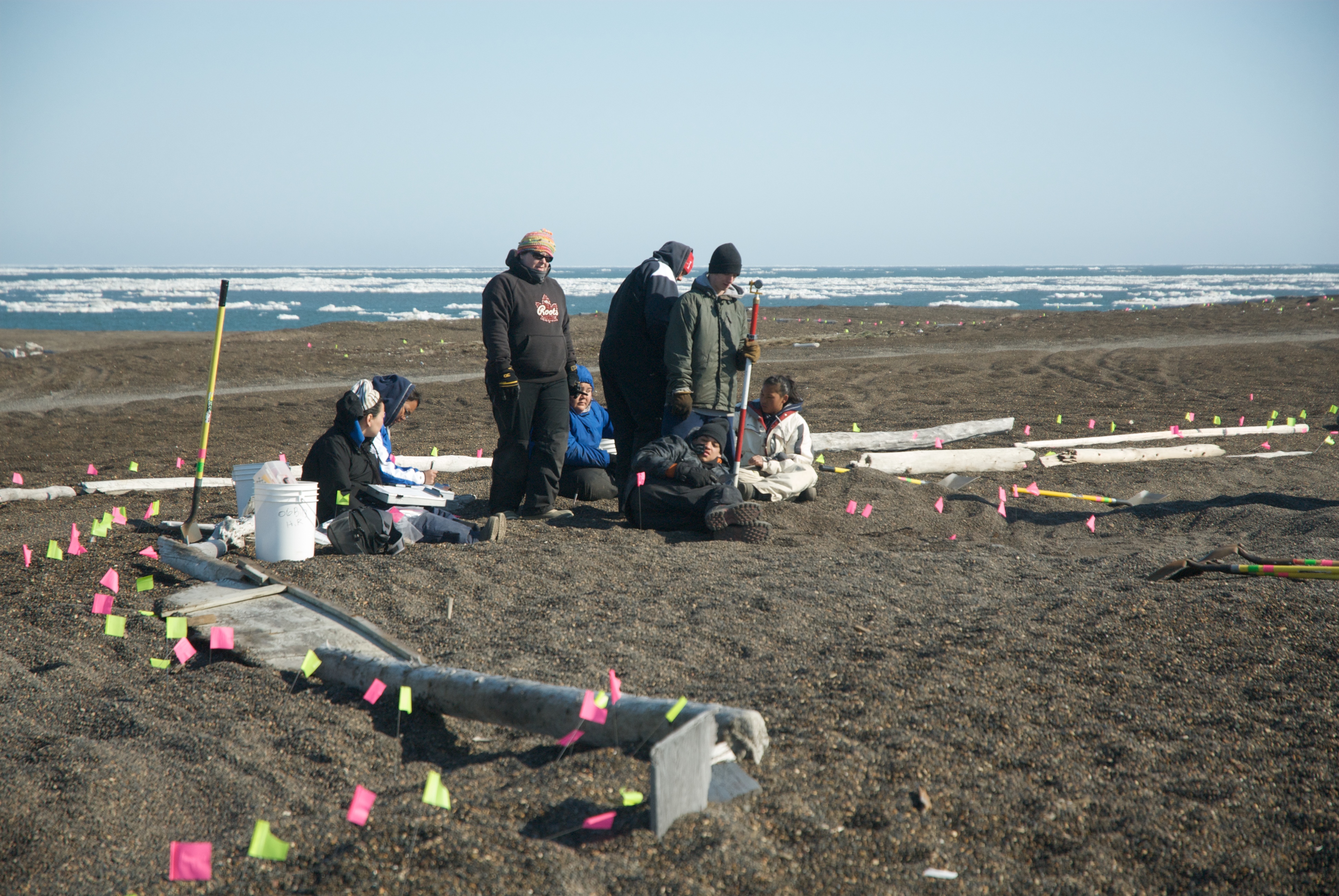
We waited to start burial excavation until Dennis O’Rourke and Jenny Raff, the physical anthropology/ancient DNA folks were here. The weather on July 8 was pretty sunny, although it was very windy in the morning. The burial had been located by a vehicle churning up some human remains and scattering them along the trail for several meters, so we weren’t exactly sure where the burial was located, so we had to remove some of the gravel to find it.
Crew gathers to begin excavation of burial 10A918. Note the sea ice on the ocean.
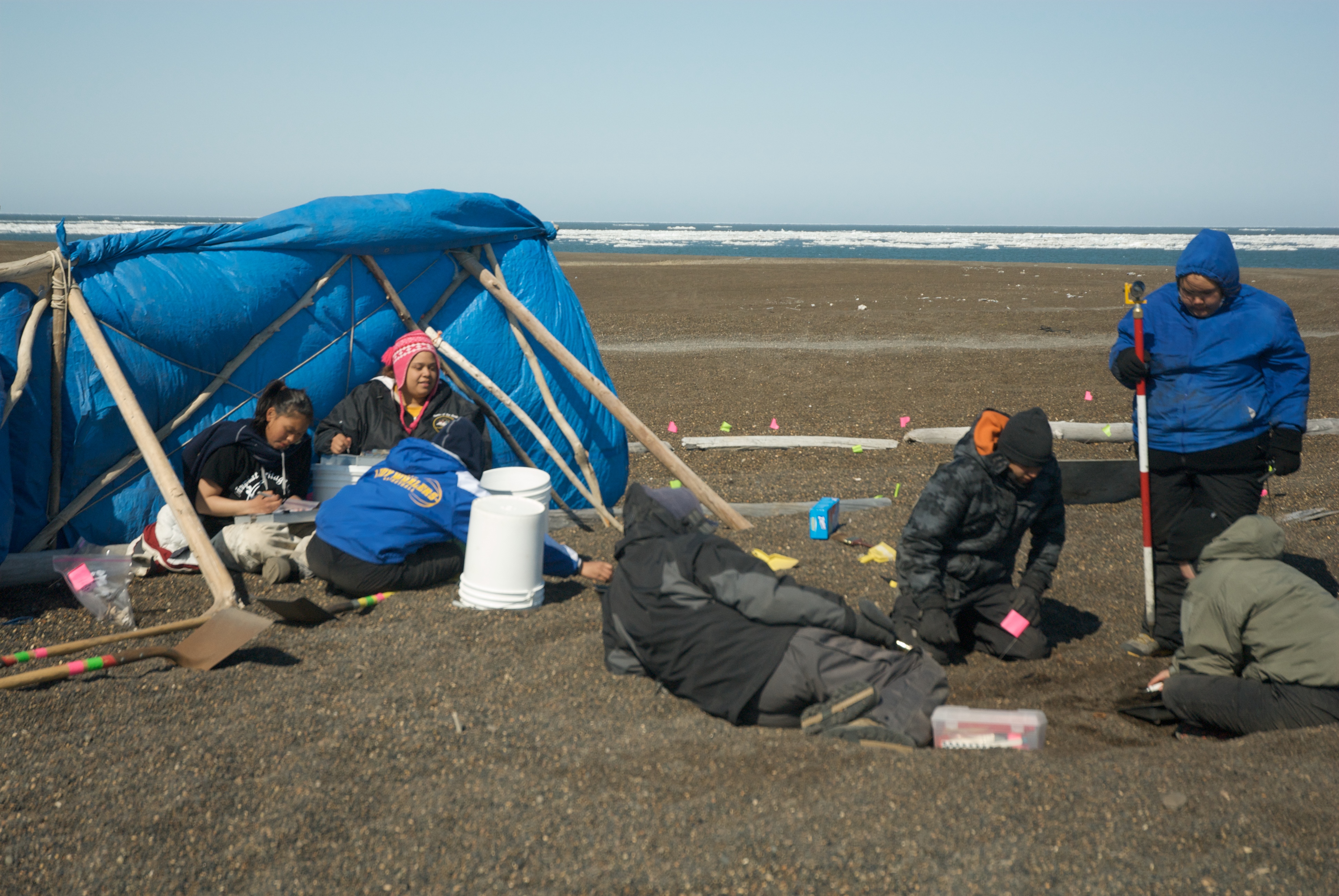
After it was located, a smaller group began the fine excavation. It quickly became clear that the burial was quite scattered, since portions of the skull showed up both north and south of pelvic fragments. At least one of the pelvic fragments seems too small to belong with the others, so there may be two individuals involved.
Beginning excavation.
The rest of the crew moved back to STPs, which over the course of the day located two additional probable burials, as well as a fairly recent and quite large oosik (walrus penis bone). Excavations were interrupted when the honey bucket tent somehow wound up with the door locked. No one was inside, but no one could get in to use it either, so we needed to get that fixed. Fortunately, the cover was just loose enough that Victoria, who is quite slender, was able to wriggle in between the cover and frame (after taking off her jacket) and unlock it from the inside. Crisis averted. Yay Victoria!
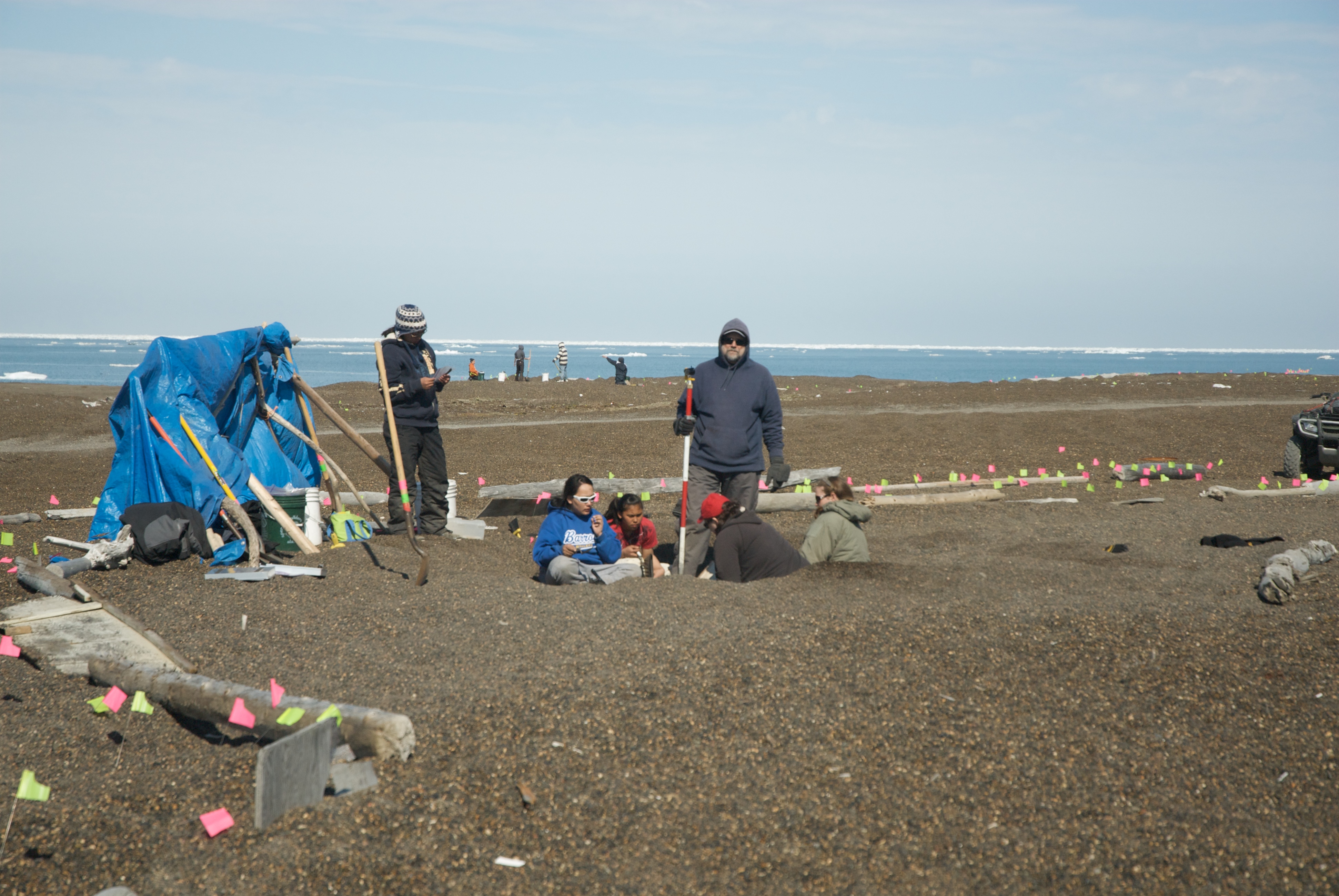
Our bear guard Larry Aiken made a good windbreak for the excavators. Unfortunately it just got windier. Eventually the gusts got so strong that an artifact blew away being passed hand to hand, so we stopped work on the burial, tarped it up well, and worked on STPs for the rest of the day. We spent some time watching the sea ice, which was going by faster than I’ve ever seen. One of the bear guards said Volunteer Search and Rescue had somehow measured the speed at 23 mph!
Larry Aiken's excellent windbreak, sheltering the crew.
The next day was also sunny and windy, but not nearly as bad, so we went back to working on the burial. We found a number of vertical faunal (animal bone) fragments in the middle of the burial, around where the chest would have been. The leg bones were more or less in place, so it looked like the disturbance was concentrated on the upper body. We expanded to the south to make sure we recovered all the remains, and found the old ground surface under the gravel. It had remains and some artifacts on it.
Working at 10A918. Dennis O'Rourke holding the stadia rod with reflector to record an artifact. Notice how much ice has gone away.Dennis & Jenny shoveling (for Jenny & Justin)
We were able to find some material suitable for C14 (radiocarbon) dating underneath the bones that hadn’t been disturbed, so that was good. We tarped the burial up for another night.
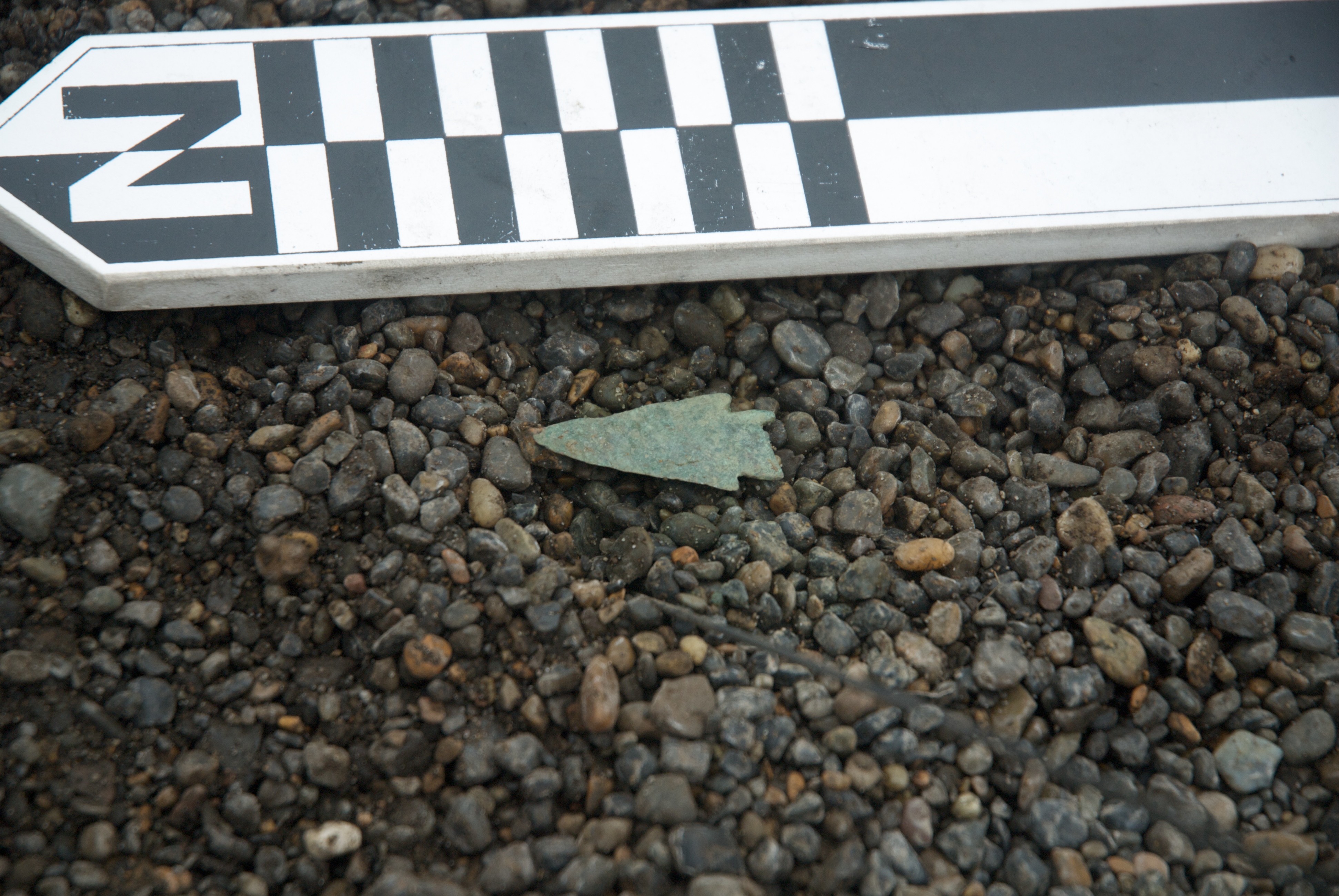
I’ve already mentioned how cold Saturday was, but we managed to finish the burial. We found a couple really neat artifacts, which are pictured below. Speaking of pictures, in case you are wondering, you won’t see any pictures of human remains here (or in any publications or presentations on the site). We do photograph them for documentary purposes, but the community Elders have asked that they not be shown. Like most people, they aren’t enthusiastic about having pictures of the mortal remains of people whom they consider as relatives all over the place. The community has had some bad experiences in the past with this, and I think their position is completely reasonable. It really doesn’t impeded research, and they don’t mind maps or drawings if needed to explain something.
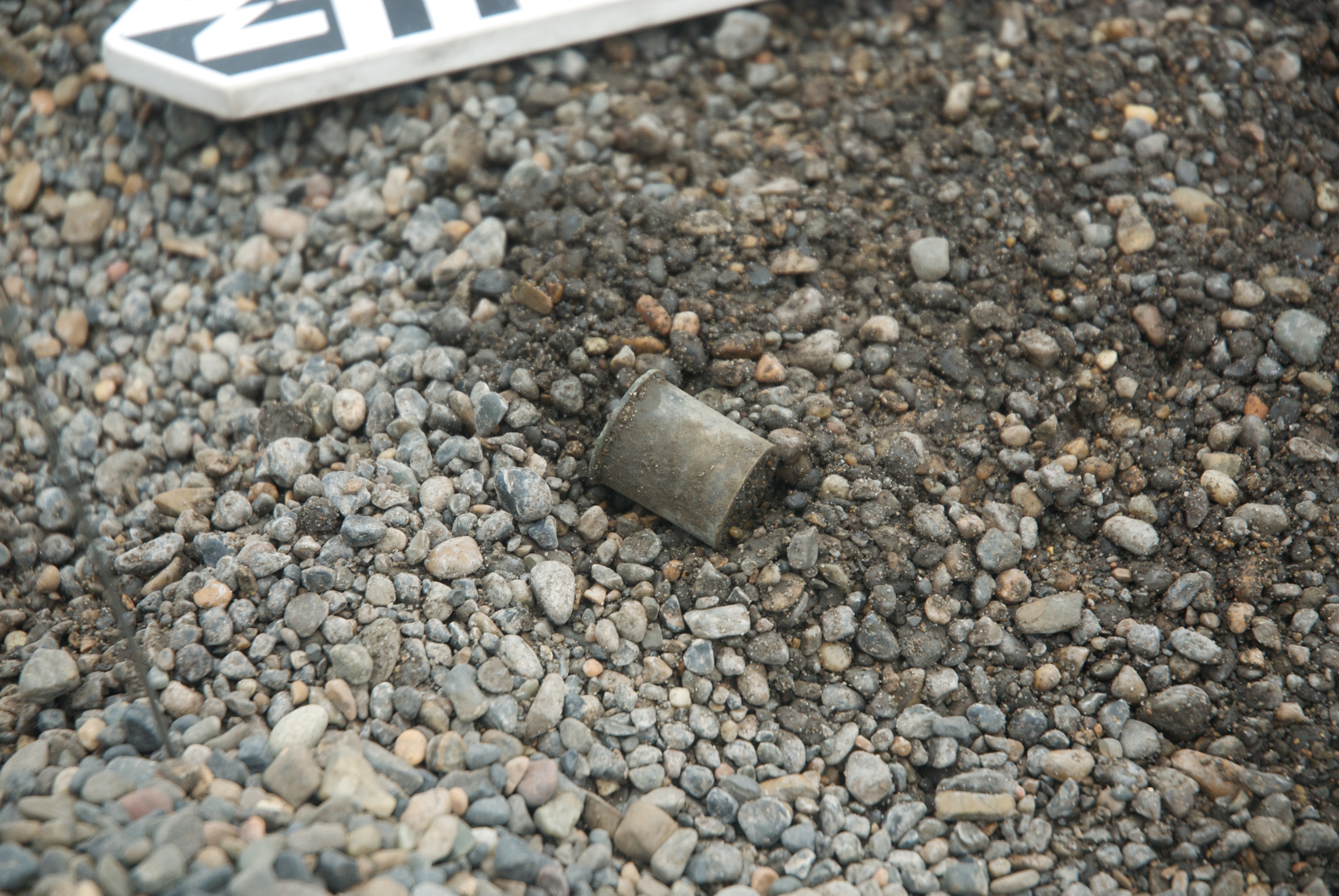
Copper point, probably made from copper sheathing from a ship. It was probably for a sealing harpoon, judging by the size.Older-style cartridge for a whaling shoulder gun. They haven't changed all that much today.
In the end, it looked like the burial had been disturbed twice, once in the late 1800s, when it looks like someone was digging a hole and dug up part of the burial, with remains being scattered on the same surface these artifacts were on, and then a week ago when they were exposed in the trail.
Updated 7/17/10 to fix a picture size problem some folks were reporting.
We had another windy day today. In fact, it was probably even windier than the day the artifact blew away. We didn’t try to excavate or even dig STPs, since odds were that notes, baggies, artifacts and all would have been heading for Canada. We did get two burials ready for excavation when the wind dies down, which should be tomorrow if the National Weather Service knows what they are talking about. One can only hope.
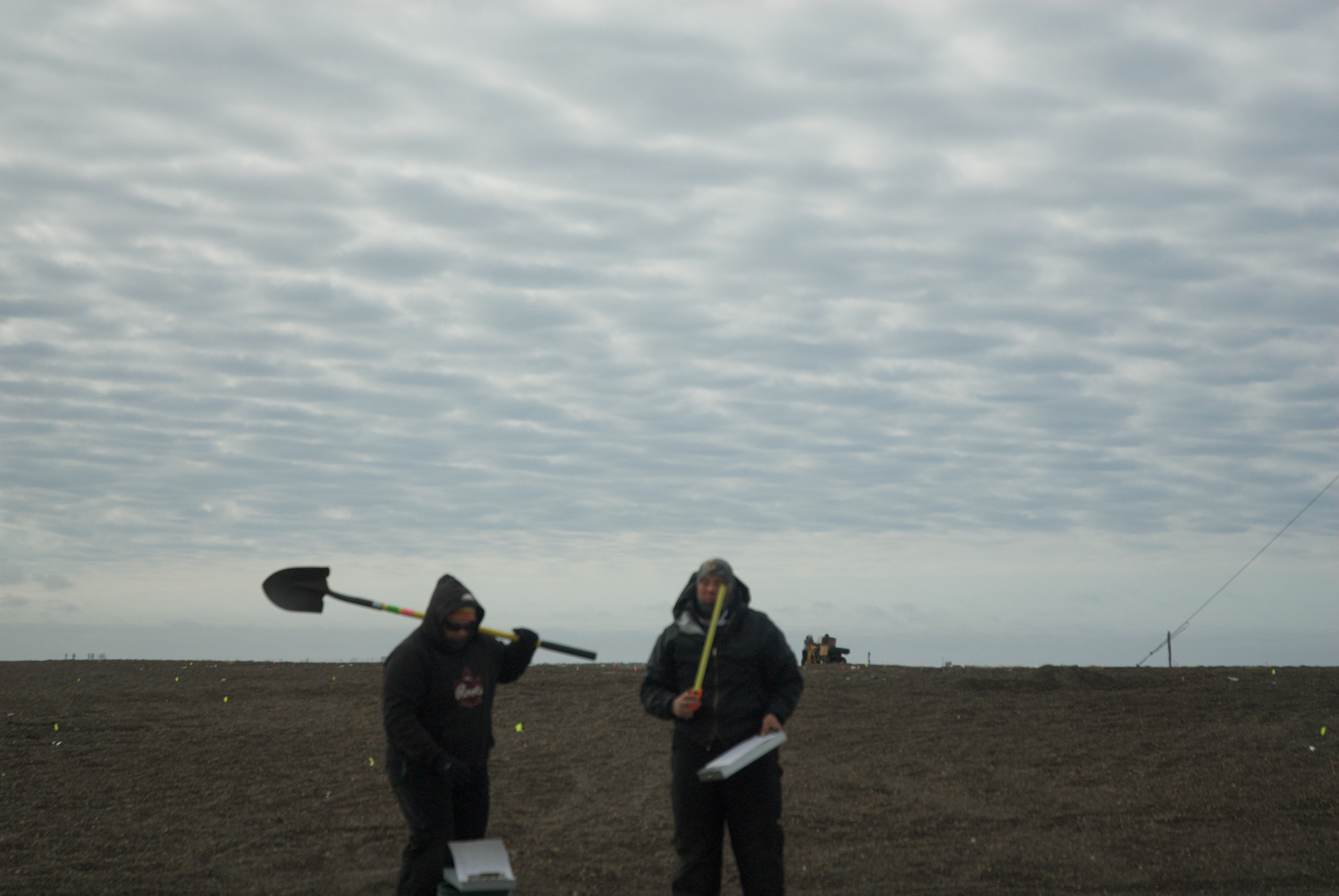
It was so windy that some of the excavators were wearing goggles to remove vegetation, since it was flying into eyes once loosened. The gravel they were removing was flying a good 10-15 meters downwind. Since we were shooting and backfilling all the STPs that were open, that took care of a bunch of them without shoveling! I took some video with my iPhone, but I think I need to get an upgrade and figure out how to use it before I can post it.
We came in after lunch, since we had nothing left we could do in the field.
What an interesting (in the Chinese curse sense) afternoon in the lab!
I went in to the lab to deal with the shoulder gun shell that we found yesterday which had traces of black powder (which is pretty unstable when dry) around the primer hole. In fact, they turned out to be mere traces, and it was easily cleaned and is now drying on a drying rack.
However, in retrieving it from the bucket with yesterday’s finds, I found not one, but two, other items which appeared to contain black powder, and significant amounts at that! One was a shotgun shell head, which had not been fired. Older shells had a paper casing, not the plastic most now have, and that can decay, so we often find the heads alone, filled with gravel. There was a bit of gravel at the mouth of the head, but it had started to fall off in the Ziploc on the way in from the field, to reveal a full load of powder. I was able to soak the shell remnant and get most of the powder out. The primer is still intact, though, so I have it in a bottle of water until we can get it properly disposed of, just to be on the extra safe side.
The other is, I think, some sort of fuse for a fairly large projectile. It was collected as a cartridge casing, but it isn’t. It seems to have had an end blown off, from the way the metal is deformed, but what is left turned out to be packed solidly with some dark substance, nature unknown. Since it was already wet and hadn’t exploded or combusted, I put it into a bottle of water as well, pending disposal.
This just goes to show that when I told one of the students, who was wondering what she should major in when she got to college, that anthropology was great because almost anything you can think of can be related to one of the four fields of anthropology, I really wasn’t lying. I wasn’t thinking of small arms ammunition and explosives when I said it, but there you go.
I also managed to find time to plot all the new transit data. The STPs are falling in just the right place, with no gaps between last year and this year. I also measured the amount of erosion since last year. The bluff edge has receded up to 10 meters at some spots, which is almost exactly average for the ten years I have been mapping the Nuvuk. bluff. In the late 1940s and early 1950s, the erosion at Nuvuk was measured at 4.7 meters per year. The folks that did that got a paper in Arctic out of it. Hmm, I wonder if that would work now?
All the foregoing took a good bit longer than planned, and there were a few things I had to take care of at home, like laundry, so the fieldwork update with pictures will have to wait until tomorrow. Staying up all night when the whole week ahead looks cold is not an option.
The second day in the field was devoted mostly to digging (shovel test pits). It was sort of chilly, and digging is a good way to keep warm. Besides, physical anthropologists Dennis O’Rourke and his post-doc Jenny Raff were due to arrive in Barrow that night (July 7). Since we are collecting small (a rib, generally) samples of the human remains for ancient DNA (aDNA) and stable isotopes and direct dating, and it is best if the samples are collected by one of the physical anthropologists, I decided to wait for them to join us in the field before beginning excavation of the burial we had located the day before.
We set out several more lines of STPs. STPs are common on archaeological surveys, where archaeologists are trying to find sites that may not be obvious when you just walk over them. Digging STPs makes it possible to see if there are artifacts or soil layers created by human activity buried in the ground. STPs are also used on known sites where one wants to find buried features (a term which can cover all sorts of concentrated physical evidence of past human activity–storage pits, hearths, houses, tent sites, turkey traps, reindeer corrals, places where someone sat to make a stone tool, you name it). Usually, they are a relatively minor part of work on a known site, serving mostly to choose where to dig. Often, they are placed on the site in a pattern which is either totally random (as in the locations are picked using a grid and random numbers) or what is called “stratified random” which means the site (or region–this works for survey too) has been divided into different areas (strata) based on something like slope or distance from water or vegetation cover, which each stratum being sampled separately. This avoids the possibility of not testing one stratum at all, which can happen with plain random sampling.
We are not doing random sampling of any sort. Nuvuk is, among other things, an area where people in the past buried their dead. Many of their descendants still live in or visit Barrow regularly. No one likes to think of their relatives, however distant, falling into the ocean due to the erosion of their final resting place. Random sampling is designed to help get a representative sample of whatever is in the ground, not to find all of it. We are trying to find everyone, and excavate them before erosion deposits them in the ocean. To do this we dig a lot of STPs. We had hoped to have some geophysical prospecting gear (GPS, magnetometer and resistivity) here this summer, and test them against the shovel testing in the Nuvuk gravels. If they worked, we’d have to shovel a lot less. Unfortunately, family illness prevented that happening this summer. So what we do is lay out a 50 m tape, place a pin flag every two meters (say on the odd numbers), drag it along and put out more flags and so forth, until we get a line across the entire ridge where the site it (it’s about 116 meter wide). Then we move the tape inland 2 meters, and do it over, except the pin flags would go on the odd numbers.
This spacing is close enough to pretty much guarantee that if there is a grave present some sign will show up in one of the STPs next to it, even if they don’t come right down on it. Actually, we prefer it if they don’t, but since most of the graves don’t show on the surface, it happens.
We have gotten far enough from the bluff that the trail to Plover Point actually crosses the area we are putting STPs in. When we lay out new lines, the first order of business is to dig and document all the STPs in the trail, record their locations with the transit, and backfill them (assuming there is no sign a grave might be there). We don’t want to obstruct the trail, since we’d like to keep traffic on it, rather than driving all over the site.
Digging STPs on the trail to Plover Point.Laura and Warren get ready to document another STP.
All the STPs bore fruit. We located three additional locations, two on the C line and one on the D line, that appear to be burials. There is plenty for us to do this field season already.
It has been a busy week, with all sorts of things to do after the day’s fieldwork was over and the data was downloaded and backed up, including a public meeting (which will need to be rescheduled because the weather was nice and the TV didn’t get it on the announcement roll-around in time), baking dozens of cookies for the community potluck my employer was holding, and dealing with the aftermath of a minor ATV accident involving one of the students (she is fine, but wrenched an already sore shoulder and therefore will be on limited duty next week). We have tomorrow off, so I’ll provide more details and pictures on the fieldwork then.
Just a quick note while I try to get the flash card downloading. The pictures are all shot as hi-res JPEGs and RAW, so it takes forever. I doubt I can stay up long enough to post pictures tonight.
We worked today. Normally we do fieldwork Monday-Friday, because the students are paid by the hour (so they get practical job experience as well as archaeological training) and child labor laws make it complicated to work more than that, especially for the younger students. We had a vacation day on Monday, though, and since it’s a short season and some of the students are trying to earn money we decided to do a 5-day week anyway. In the end, only 5 of them made it to work today. One was out of town, Trina was taking part in a fundraiser for the basketball and volleyball teams, two were sick, one was hurt and we don’t know what happened to the other one. It was wicked cold this morning, so hats off to Rochelle, Trace, Nora, Warren and Victoria. Not only was it cold, it was windy & foggy (yes, at the same time). In fact, it was so foggy we were having trouble with the transit because the lens and/or the reflector kept getting obscured by water drops. And it rained before lunch, and toward the end of the day.
However, as compensation, we finished excavation of the first burial of the season. It turned out to have been disturbed, probably in the late 1880s, judging by the artifacts scattered along an old ground surface along with some of the individual’s bones. We found some very cool artifacts (a bit unusual for Nuvuk burial excavations) although they weren’t really in the burial. Highlights were a copper end-blade (for a harpoon head or possibly arrow), a split blue glass bead, and best of all, the cartridge for a shoulder gun. The last still seems to have a bit of black powder around the primer area, so we have it in VERY wet conditions, and I will try to clean it tomorrow before there is any chance of the powder drying at all. Our bear guard, Larry Aiken, who is a whaler, said it was the oldest style, shorter than the ones they use now.
As further compensation, we decided to order our lunches from the fundraiser, so Trina brought 13 lunches to the end of the road to Nuvuk (called my cell before she headed out), and Larry took a trailer back to get them. So we all had BBQ chicken, potato salad, rice, pancit and a hot dog for lunch, along with the hot beverage of our choice and chips courtesy of Nora! Even with the big propane cooker going the tent was cold enough to see our breath. We hung in and finished the burial, and tested the areas where two other single human bones had turned up in a trail. Neither one had a grave beneath it. We already have 3 other probable graves, based on subsurface indications in STPs, waiting for us next week.
It’s been very busy the last couple of weeks doing all the last-minute things to get ready for the field. As a result, I haven’t been able to keep up with blog posts on everything, so I’ve spent part of the July 4th weekend catching up. That way, I can post catch-ups when I don’t have time to do something from that day (or when the day was so dull no-one would want to hear about it 🙂 ). A bit out of sequence, but that’s life.
Unlike many projects, particularly in the Arctic, where the expenses of getting & keeping people in the field tend to make PI (Principal Investigators–the people in charge of projects) prefer experienced excavators with college backgrounds in archaeology/anthropology, most of our crew is made up of high school students who have never taken a course in archaeology. Obviously, there’s no way to give them (or any other normal human being) that sort of background in the time between hiring them and starting fieldwork. The good thing is, it’s not actually necessary. The skill set that an excavator or basic archaeological laboratory worker needs are actually learned on the job, not in the classroom or from books. Having worked with complete newbies (high school kids, Earthwatch volunteers, college field school students) as well as folks with advanced degrees (some of whom couldn’t have dug their way out of a paper bag if their life had depended on it) has proven this to me beyond the shadow of a doubt.
That said, a bit of background does make it easier to understand why things need to be done a certain way, and therefore to remember to do them, as well as to not go crazy from boredom after the 25th sterile STP in a row. We do have a short reading list we send to college-level & higher folks, but for the high school students that’s not really the best plan. It’s summer, and reading is easy to put off, unless we want to start giving quizzes. Anyway, most high school students haven’t really gotten the knack of learning just by reading, since they almost never have to do that in high school, as far as I can tell (my daughter graduated recently). So I figured some type of exercise would work better. I wanted something fun, that could be done inside (people learn better when they aren’t too uncomfortable, as a general rule).
There are a bunch of books that deal with various exercises people have developed to teach archaeology, so I went through those and found some stuff that looked good. Then I think I remembered my 6th grade teacher, who had developed a teaching method which relied on Milky Way bars (usually hurled from the front of the room to the student’s desk) as rewards for various achievements. It made for a lively classroom, and seemed to motivate kids who usually wouldn’t have cared enough about the subject to exert themselves. Being a good student, I got a lot of Milky Ways, which was ironic, since I didn’t actually like them that much to begin with. So, candy, but a variety of it.
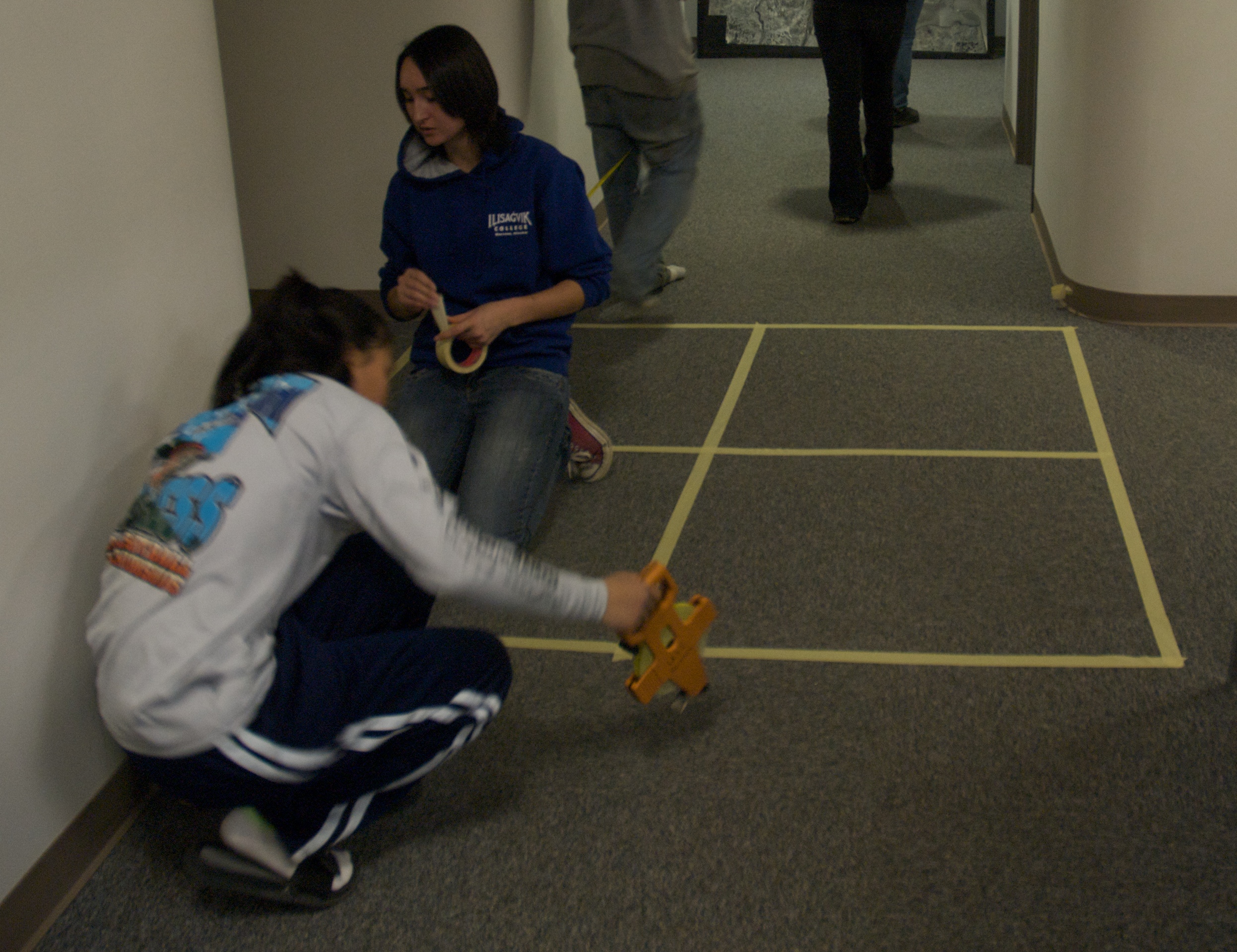
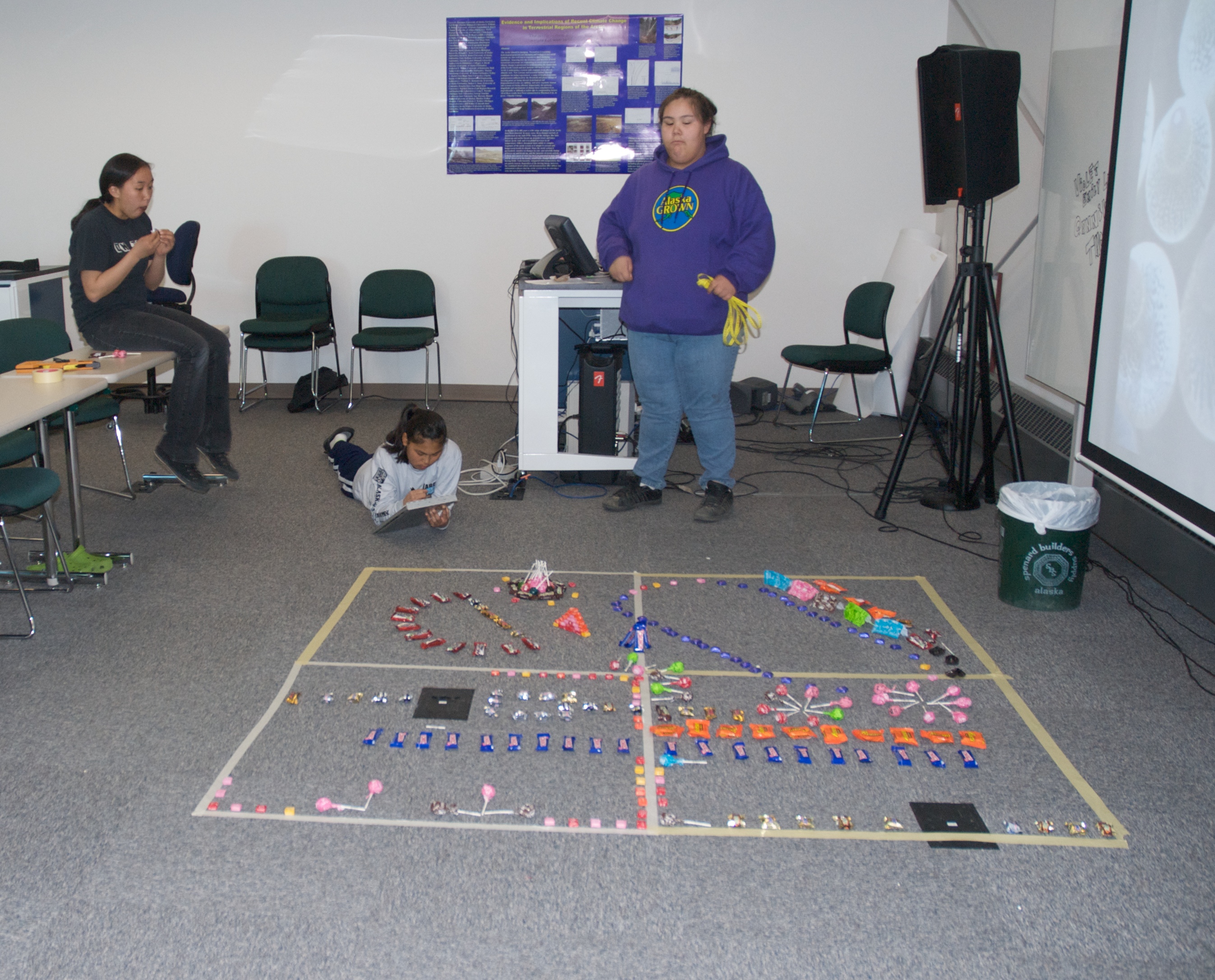
The exercise goes like this. We lay out 2 2m x 2m units with masking tape on the floor (learning how to do units with hand tapes and geometry).
Nora and Victoria lay out a 2 x 2 on the hall floor.
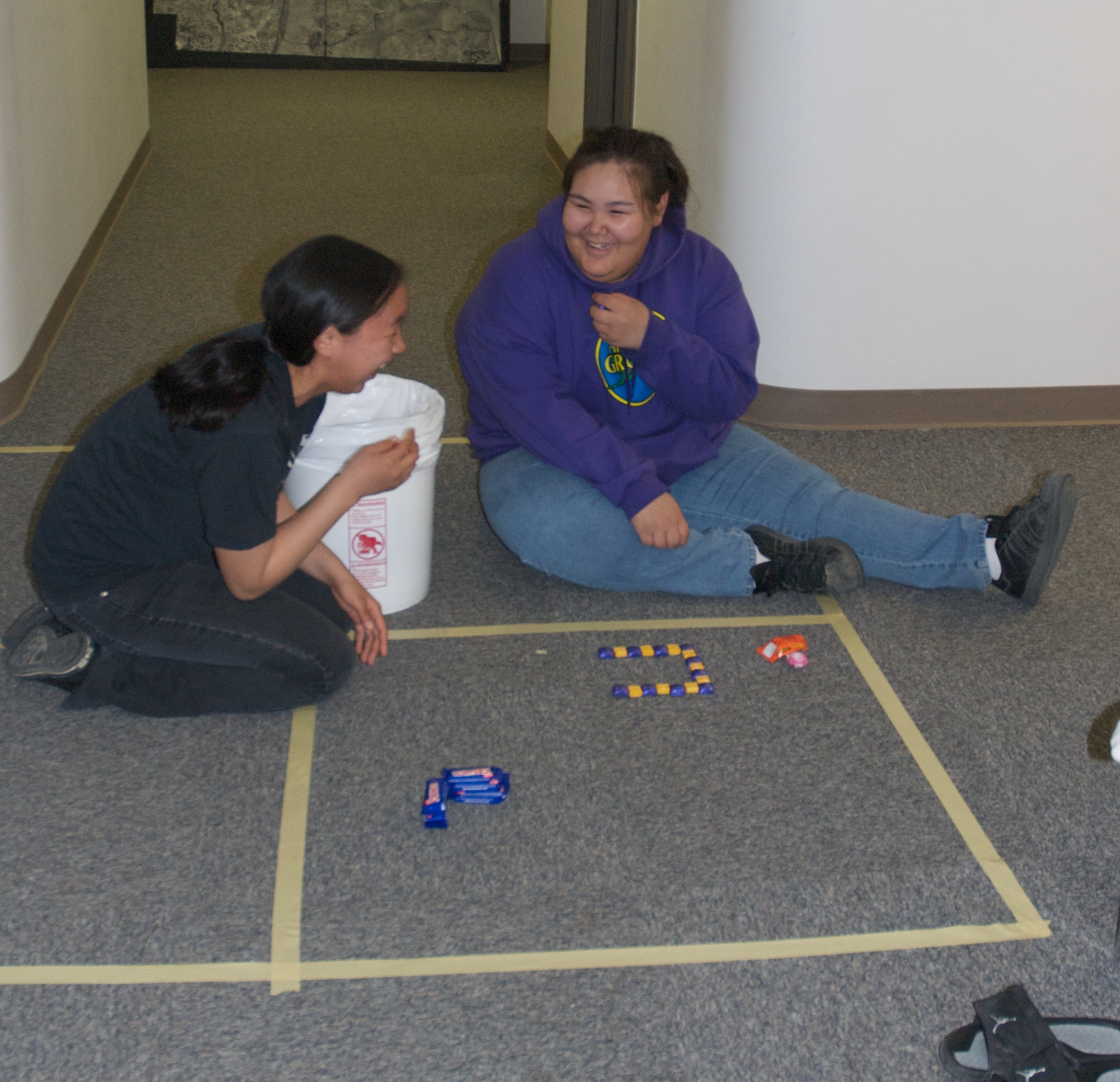
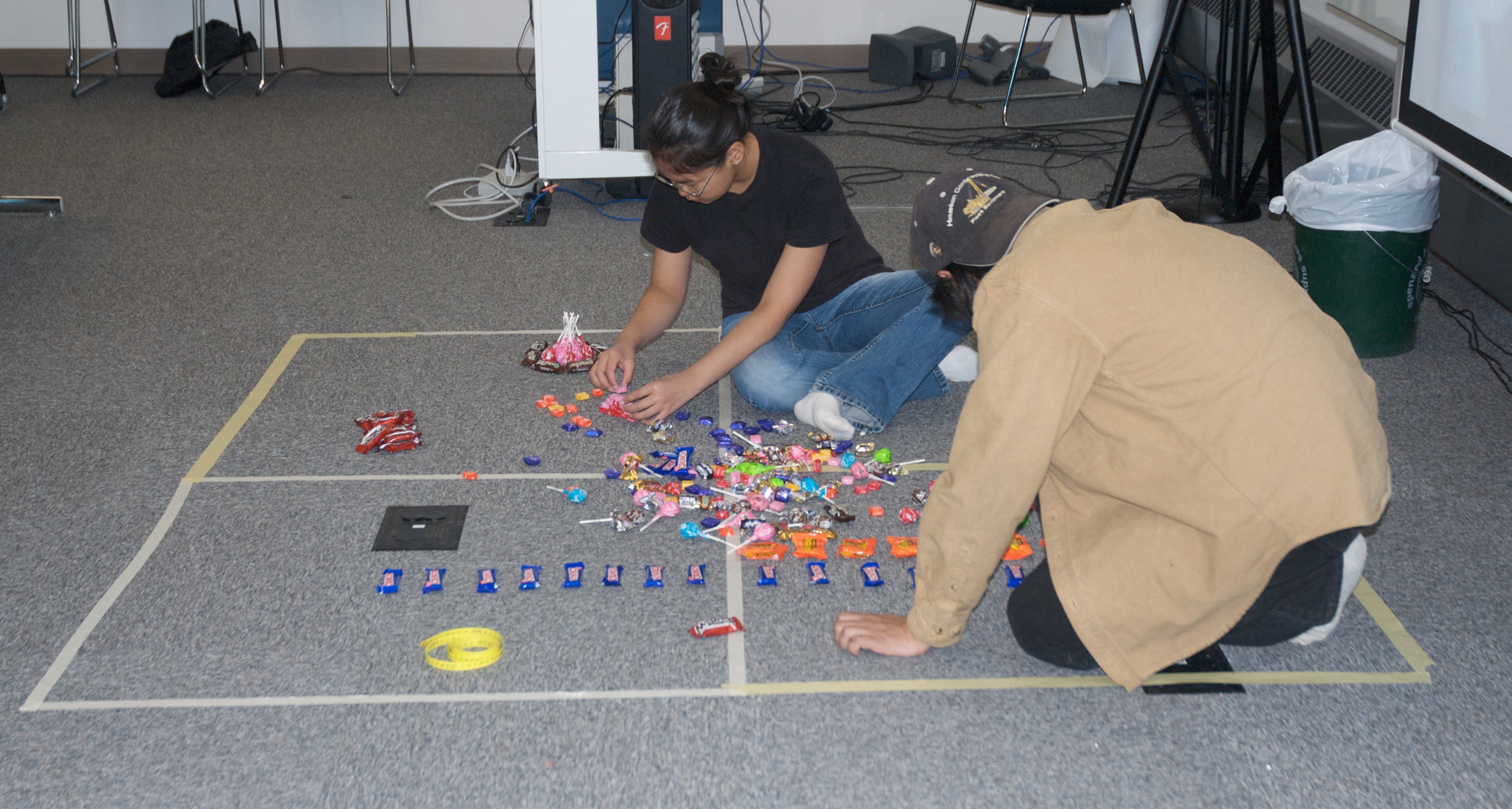
Then, two crew members who already have archaeological experience get to be the “actors,” which involves getting a big bucket with all sort of candy in it, and doing something in and around a 2 x 2. They can talk about it beforehand, and they can do whatever they want, talking or not.
Trina and Heather start making something for the newbies to figure out!Flora and Ron create a site from candy in the conference room.
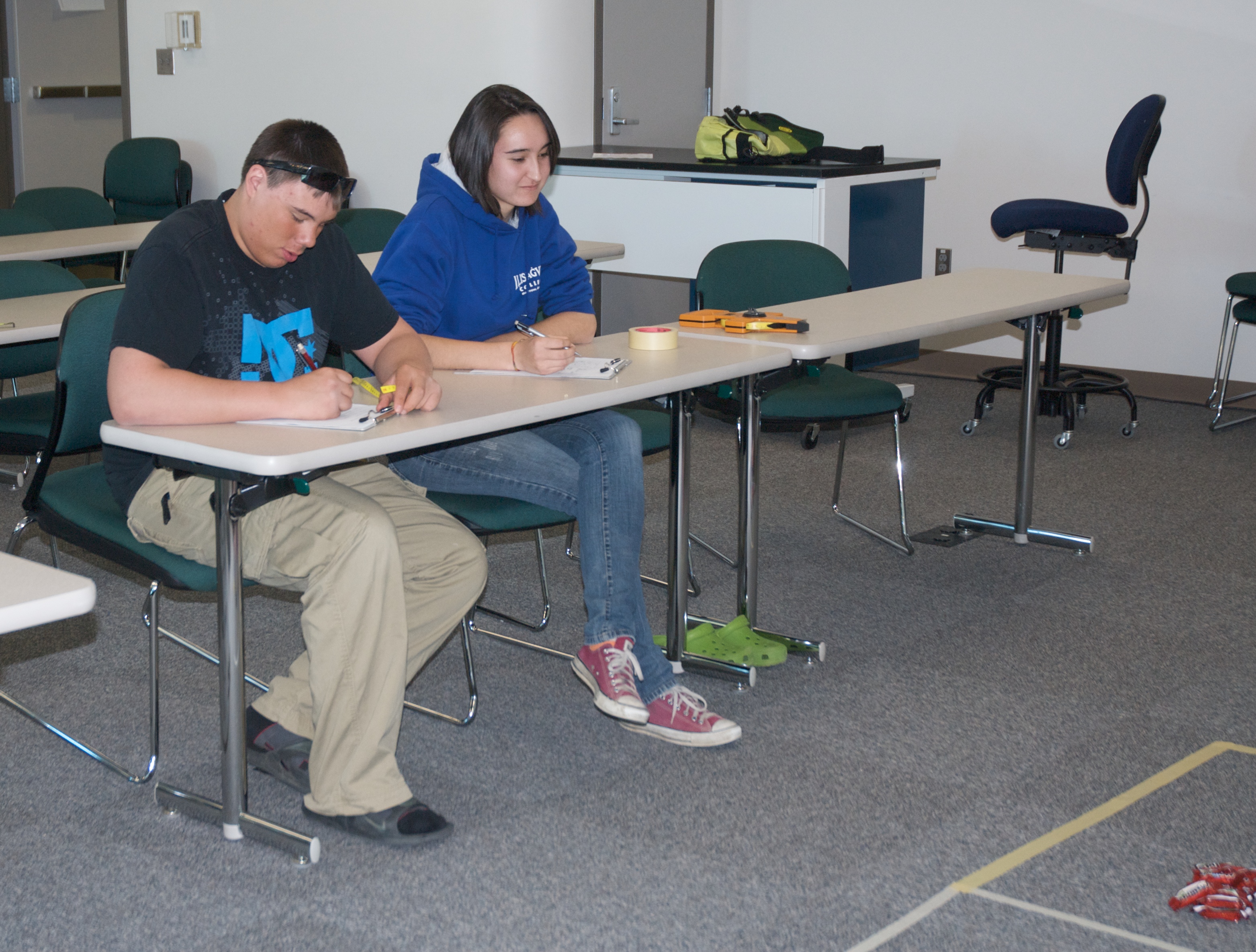
Meanwhile, the newbies are divided into two groups. Each group is assigned to one of the 2 x 2s, where they have to act like ethnographers, recording what they see the “actors” do and say.
Warren and Victoria play ethnographer.Nora carefully records what Heather and Trina are doing.
Then the newbies swap places and practice mapping the site that they didn’t see being made, as an archaeologist would. We give them a bit of information on the kinds of choices (piece plotting, sketching, classifying things by color or type of candy, etc.) that they might need to make and why, what they need on a map (scale, key, North arrow) and let them figure it out. More experienced students help them with the mechanics, which makes a good review for them.
Nora draws a map, while Trina & Heather give advice.Ron gives some pointers on mapping to Victoria and Warren.
After that, we all get together, and I put up a picture of a “site” on-screen (digital technology is great for this!) and the “archaeologists” describe what they saw, and what they think it can tell us about the activities at the site. Then the “ethnographers” add what they saw, and we talk about how it can enhance (or change) the interpretation possible through material culture alone. Finally, the “actors” tell us what was REALLY going on!
The exercise seems to get the general ideas about the possibilities and limits of archaeology and ethnography across to the students fairly quickly, without lots of jargon. It also shows them a lot about the point of recording proveniences accurately, and the difference between doing archaeology and just digging for artifacts. The candy makes it fun. And, we get to have the leftovers for pick-me-ups in the field!






 Out of Ice and Time