The National Weather Service has now canceled the watch, and replaced it with a warning. They’re now calling for winds of 25-30 knots tomorrow, with gusts to 40 knots; waves to 14 feet nearshore and 18 feet offshore, and significant erosion with minor coastal flooding.
It’s snowing and blowing at the moment, and we’ll have to see about the rest once it gets light in 9 hours or so.
I woke up and turned on the radio this morning in time to hear the morning fellow recommend paying attention to the weather. Since most folks here do that anyway, it was obvious that something a bit unusual was coming.
…COASTAL FLOOD WATCH REMAINS IN EFFECT FROM 2 AM AKDT SATURDAY THROUGH LATE SATURDAY NIGHT…
A COASTAL FLOOD WATCH REMAINS IN EFFECT FROM 2 AM AKDT SATURDAY THROUGH LATE SATURDAY NIGHT. LOW PRESSURE 400 MILES NORTH OF BARROW EARLY THIS AFTERNOON WILL STRENGTHEN TONIGHT AS THE LOW MOVES SOUTH. BY SATURDAY MORNING THE LOW IS EXPECTED TO BE ABOUT 250 MILES NORTH OF BARROW. STRONG NORTHWEST WINDS WILL DEVELOP ALONG THE BACKSIDE OF THE LOW. WIND SPEEDS OF AROUND 25 KNOTS ARE EXPECTED IN BARROW LATE TONIGHT THROUGH SATURDAY NIGHT WITH WINDS TO 35 KNOTS OFFSHORE.
THE SEA ICE IS NOW NEAR SEASONAL MINIMUMS AND THERE IS OPEN WATER SEVERAL HUNDRED MILES TO THE NORTHWEST OF BARROW. THIS WILL CAUSE SEAS NEAR SHORE TO BUILD TO 9 TO 13 FEET ON SATURDAY. THE SEAS ARE EXPECTED TO BREAK ALONG OR NEAR SHORE. IN ADDITION TO THE HIGH SEAS A STORM SURGE OF UP TO 2 FEET IS POSSIBLE AROUND THE TIMES OF HIGH TIDE SATURDAY AND SATURDAY NIGHT. SIGNIFICANT BEACH EROSION IS EXPECTED WITH MINOR COASTAL FLOODING POSSIBLE AROUND THE TIMES OF HIGH TIDE. THE AREA AROUND STEVENSON STREET NEAR THE BOAT LAUNCH BY THE CITY PLAYGROUND IS PARTICULARLY VULNERABLE TO FLOODING. OTHER LOW SPOTS ON DOWN THE BEACH WILL ALSO HAVE THE POTENTIAL FOR MINOR FLOODING.
ADDITIONALLY…SIGNIFICANT EROSION TO THE BLUFFS ARE LIKELY AS WELL.
PRECAUTIONARY/PREPAREDNESS ACTIONS
… A COASTAL FLOOD WATCH MEANS THAT CONDITIONS FAVORABLE FOR FLOODING ARE EXPECTED TO DEVELOP. COASTAL RESIDENTS SHOULD BE ALERT FOR LATER STATEMENTS OR WARNINGS…AND TAKE ACTION TO PROTECT PROPERTY. NOW IS THE TIME TO MAKE PREPARATIONS AND MOVE ALL PROPERTY WELL AWAY FROM THE BEACH.
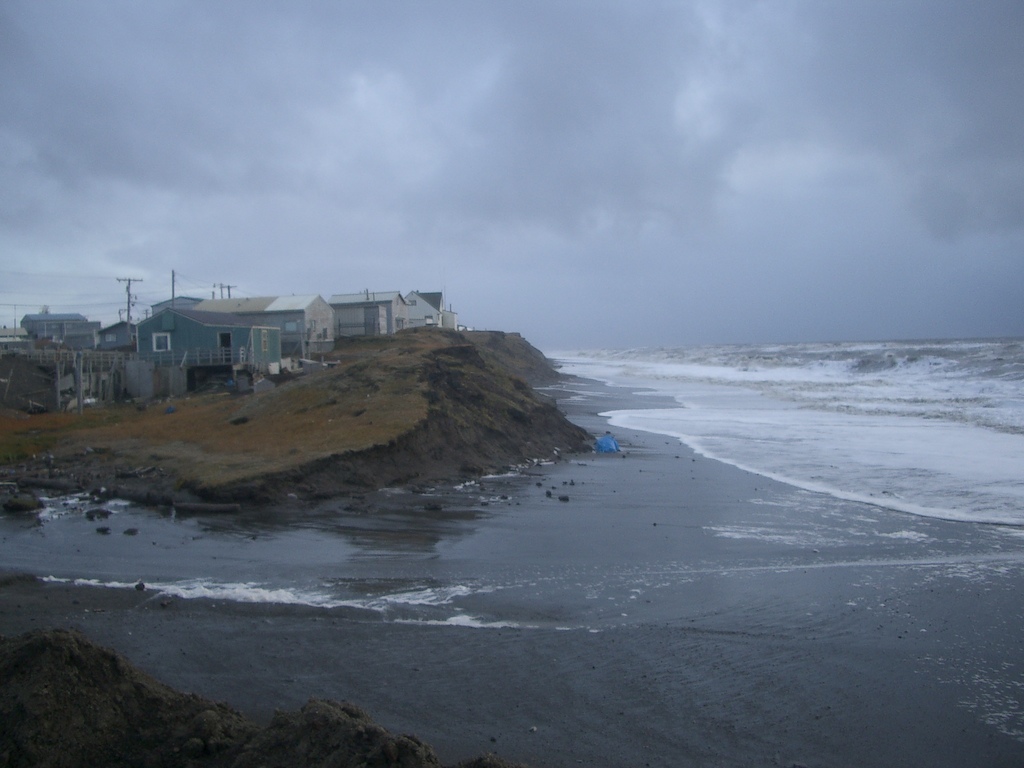
Not what I needed to hear… Turns out it’s the first big fall storm. With the ice so far out, that means lots of room for the wind to put energy into the water, which means big waves and a storm surge. That means beach erosion for sure, and maybe coastal flooding. Our weather forecasts here are a bit less accurate than those most other places, because there are no observing stations where the weather is coming from. It’s sort of like trying to predict weather in Pennsylvania using data from nothing but a weather station in Chicago.
I don’t like fall storms and coastal erosion. Aside from the dangers associated with flooding (the house I live in floated in 1963, and if it does it again we might wind up in a sewage lagoon), erosion is the most immediate threat to coastal archaeological sites. I spend my summers trying to organize things so that we got well ahead of erosion at Nuvuk and now are trying to stay that way.
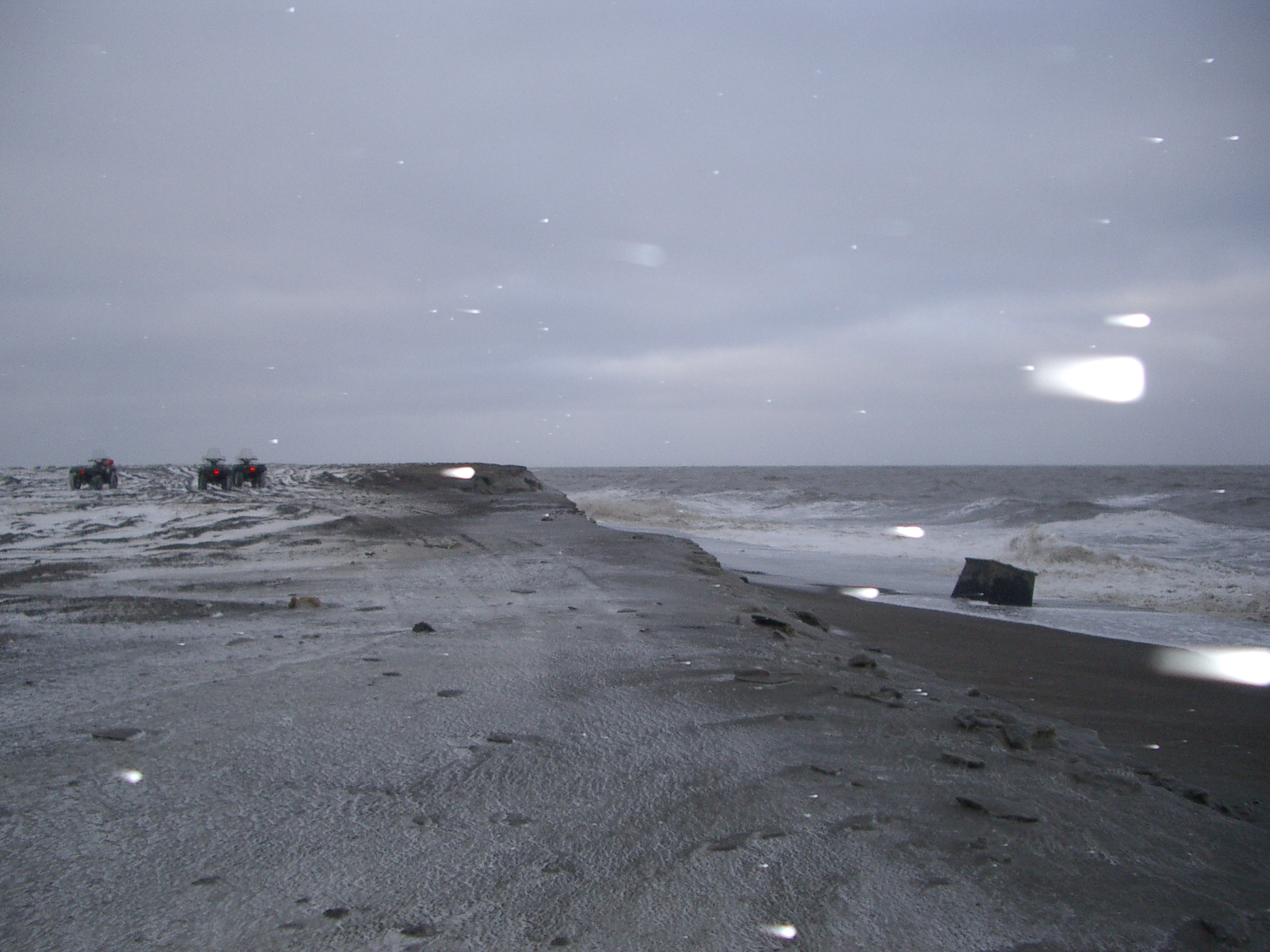
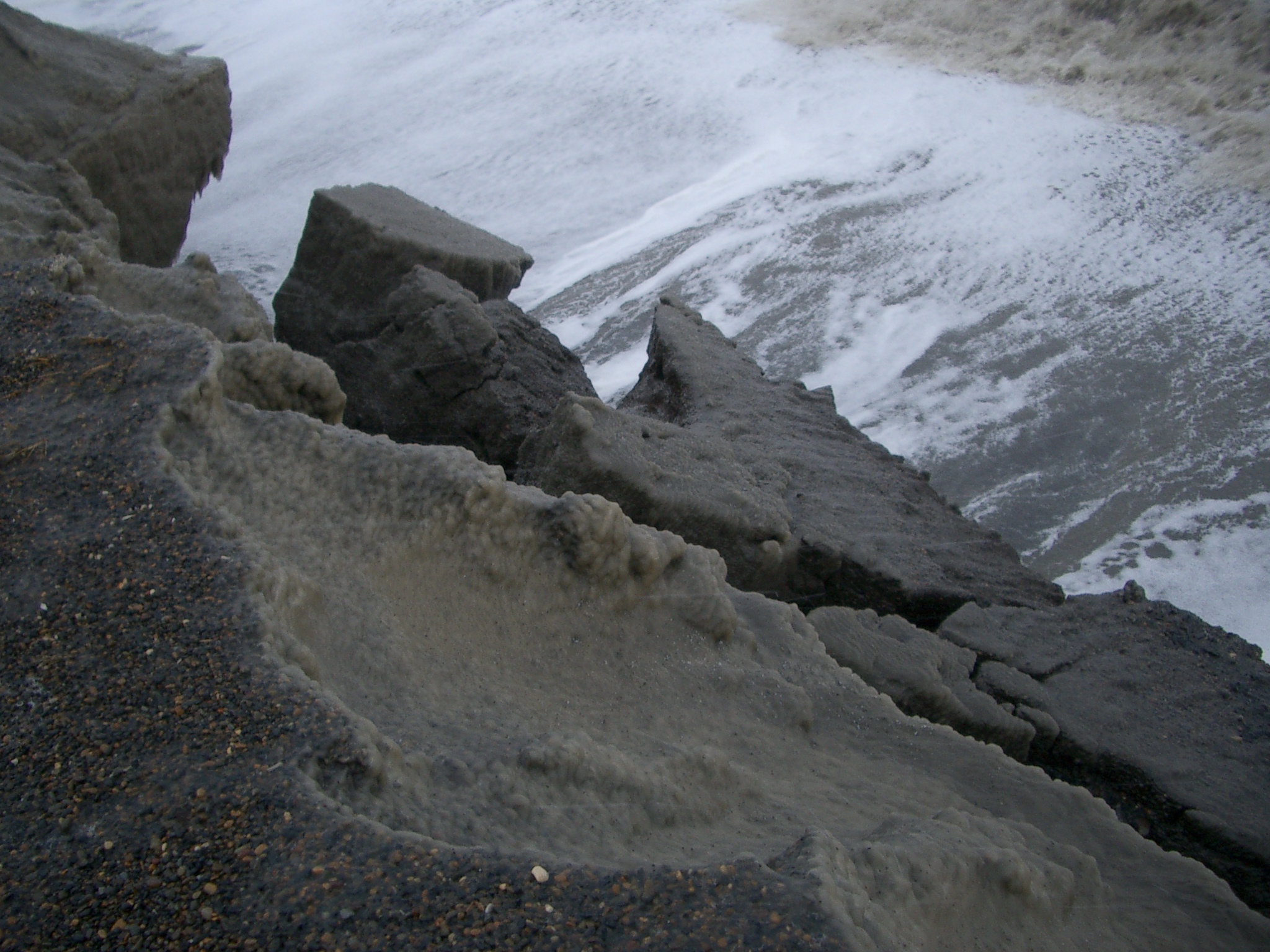
2004 fall storm erodes NuvukNuvuk bluff slumps from effects of surf
The thing is, Nuvuk, where “the houses are all gone under the sea” to borrow T.S. Elliot’s phrase, is just one of many important sites. Utqiagvik, Nunagiak, Ipiutak, Tikigak (Point Hope), and so on down the coast. Most of the sites on the Beaufort coast from Point Barrow east to the Mackenzie River Delta in Canada have already washed away and out of the archaeological record.
I finally made it to Fairbanks and to my hotel. The flight was delayed, and the rental car reservation was missing, but all worked out in the end. In the morning, I’m going to see Dave Norton, who has already gotten to work on the marine inverts, and then off to the museum at UAF.
Today the Saturday Schoolyard talk was about warming permafrost. The speaker was Dr. Vladimir Romanovsky, head of the Permafrost Laboratory at the Geophysical Institute at UAF. He gave a really good talk, explaining what permafrost is (permanently frozen ground, basically), why it matters if it melts, and how permafrost researchers go about taking its temperature (with thermistor (temperature sensor) strings down boreholes, mostly). He then went on to show how permafrost temperatures had changed through time as the atmospheric temperature had changed.
After that, he moved to predictive modeling based on climatic models. Using even a fairly middle-of-the-road climate model, it doesn’t look too good for permafrost in Alaska by the end of the century. He also showed active layer (the soil layer at the top that freezes and thaws every year) modeling done on a similar basis some years ago, and pointed out that over the 10 years since the model was run it had been spot on in its predictions. The active layer is clearly going to be a lot deeper if the predictions hold.
This is not good news for Arctic archaeology. Compared to most of the rest of the world, where archaeologists are left to puzzle out what people were doing from a few stone tools, waste flakes and potsherds, we get really good organic preservation here, which makes it possible to look at questions that can’t be addressed elsewhere for lack of relevant data. The reason the preservation is so good is in large part permafrost, and permanently frozen sites. Last week, when Claire was here, we were getting a lot of well-preserved 1600-1700 year old marine invertebrates from the samples. They exist because the layer was frozen for most, if not all, of that time.
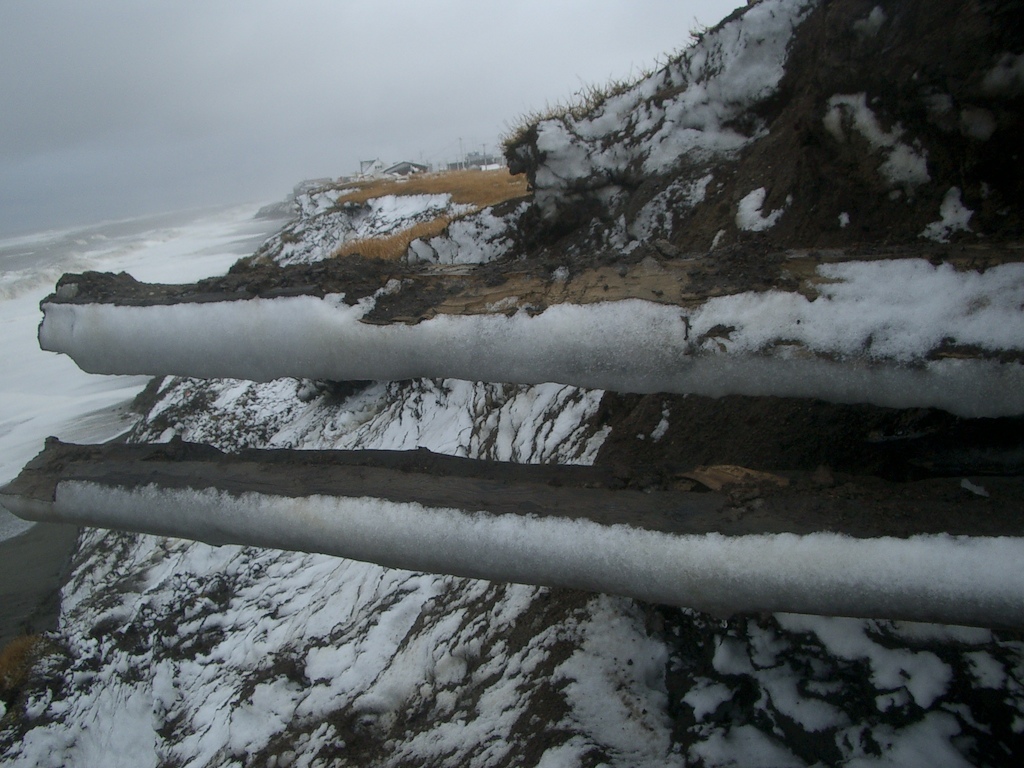
I’m been thinking a lot about site destruction, and how to determine which areas are at highest risk, in order to prioritize field efforts. Perhaps because coastal erosion is the big and immediate threat at Nuvuk (and all the other coastal sites I’ve worked at except for Ipuitak, where the immediate threat was the seawall being built to prevent coastal erosion), I’ve tended to focus on that, as well as eroding river banks for sites along rivers. The melting of exposed ice wedges, which then leads to collapse of the overlying ground is also something I’ve been concerned about. And these are major threats, which can tumble entire houses upside down on the beach for the waves to destroy.
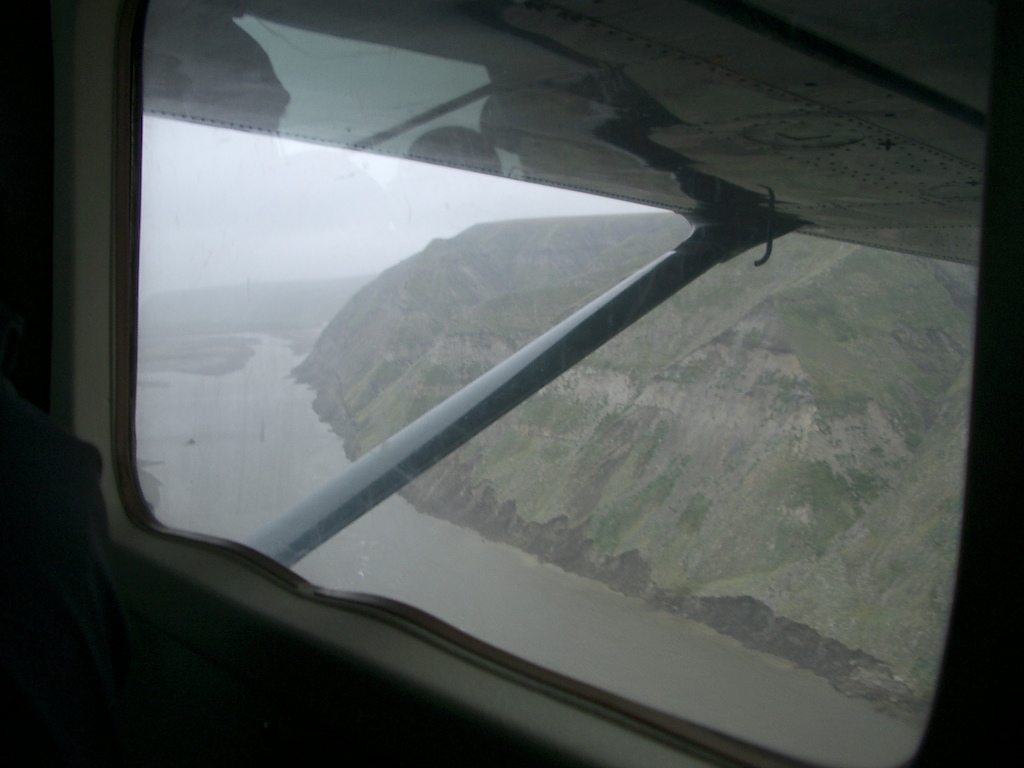
Undercutting by waves caused the gravel to slump from underneath this grave at Nuvuk.Storm-driven surf tears into the mound at Ukkuqsi in Barrow.Tunnel remnants after the storm. The house was to the left, where only thin air can be seen.Ice wedge in bluffs near Barrow. They can be much larger.Slump block on beach at Barrow after a storm.Slumps from thawing ground along a Colville River cut bank.A Colville River cut bank from the air. Notice the earlier slump that has stabilized and even grown over, and the fresh cut at the bottom from the river's current.
I hadn’t thought much at all about the risks to Arctic archaeology from a significant deepening of the active layer, which will mean that artifacts and ecofacts (animal bones, insects, etc.) will freeze and thaw every year (which is hard on things to begin with, often causing rocks and bones to split) and while they are thawed, they will be decaying. Even now, really old sites don’t have much organic preservation. Even sites that are in no danger of eroding are threatened with the gradual invisible loss of a great deal of the information they now contain.
Obviously, if we are going to develop a “threat matrix” for Arctic archaeological sites, this has to be part of it. I talked to Vlad a bit after the talk, and he thought he had students who could be put to work on this problem, perhaps by combining what we know about site locations in Alaska (by no means a complete listing) and the existing models for permafrost change. He also said that one could do active layer modeling for a specific site with a year’s worth of soil and air temperatures, so that’s something we definitely need to get started on.
One of the fun parts of the job is that people find all sorts of things around Barrow. Often, they show them to me, or at least send me pictures. In a lot of cases I can ID them, but I’m not expert on extinct fauna, and the printed/online resources available are not as good as those for modern critters.
I usually send pictures to some folks at UAF (University of Alaska Fairbanks), since they actually have a pretty good collection. Unfortunately their current curator of mammals flatly denies any knowledge (!) of extinct animals, and doesn’t seem inclined to rural residents of the state that pays his salary by taking a peek in the collections to try to make an ID. So I’m broadening the search.
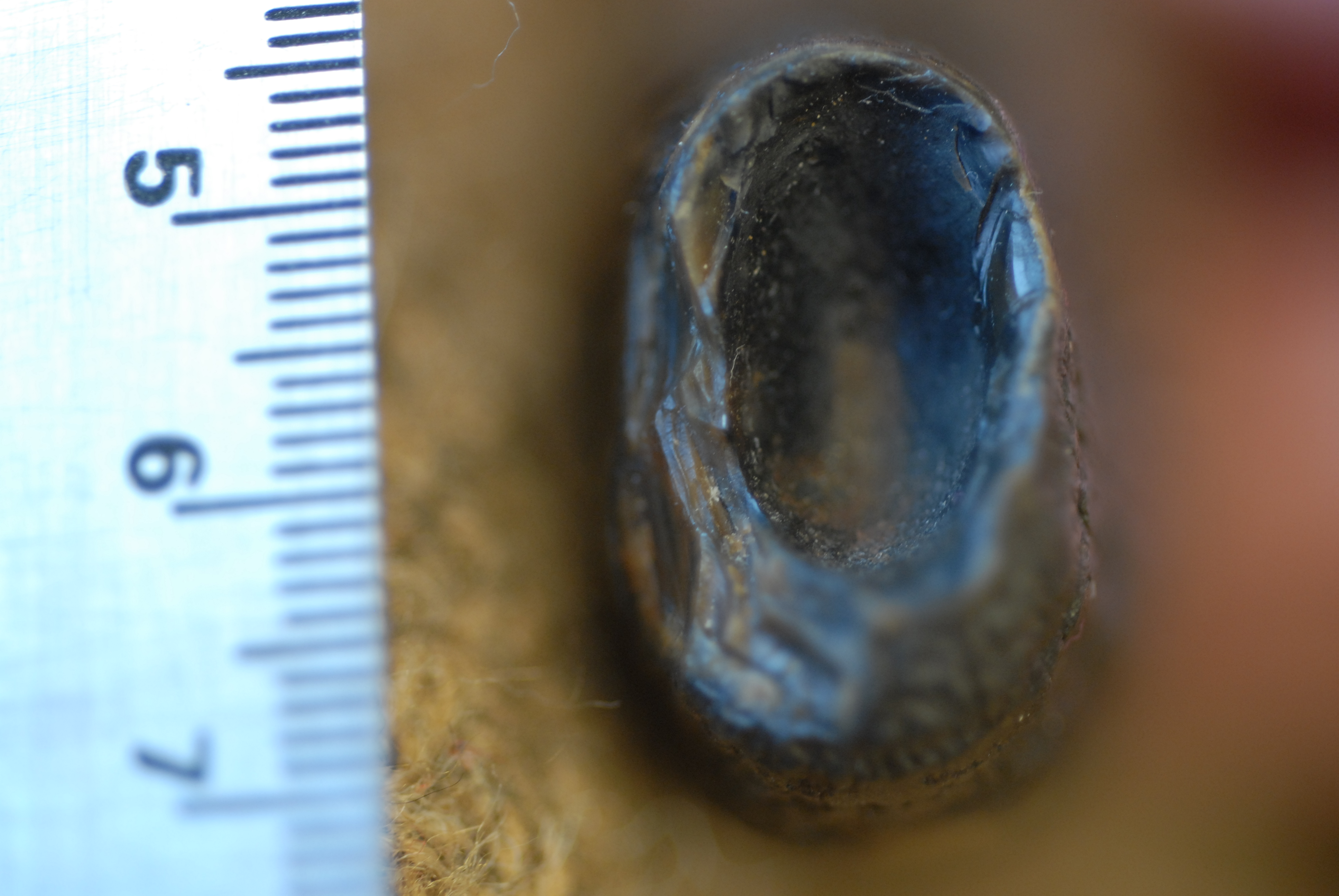
This particular tooth was given to the current owner. Matu believes it was found in a gravel operation near Barrow, AK. He’s really anxious to know what it is. If you have any ideas what it might be from, please let me know. If you have any colleagues who might be able to ID it, we’d appreciate it if you’d give them the URL for this post and ask them to take a look if they have time.
The following pictures aren’t great. I didn’t have a tripod or photo stand, or decent lighting. If you think you know what it might be, but need better pictures (not hard to imagine) or a particular angle, let me know and I’ll see if I can have him bring it to the lab for a better-lit portrait.
Mystery tooth from near Barrow, AK.Root of mystery tooth.Close-up of mystery tooth. Any comments on traces at photo center?
…except that I got back to Barrow to discover that all keys for a crucial filing cabinet have disappeared. I managed to find a place that sells replacements, call them and get them to agree to Express Mail them rather than FedEx them (it’s faster and cheaper to Barrow).
I also had to touch base with folks about yet another ice road route for the work on the Barrow Gas Fields upgrades, so it looks like I will be going flying again.
Then I had to do a quick fact check on an abstract for a poster on the Nuvuk burials for the physical anthropology meetings that I am a co-author on. Nice to see that others are as last-minute with their abstract submissions as I can be!
Besides that, there was the usual Monday time-sheet approving, with a call to the Payroll folks because they still haven’t gotten around to giving us proxy access to input time-sheets for people who are away and can’t do it themselves. Well, my temp admin assistant has it because she was temping in Payroll, but she’s the one who’s out and can’t do it herself….
And all three of the sewage hauling trucks in Barrow are broken. This matters to me because I live at NARL and we do not have piped water and sewage. The water comes to the house in a truck, which pumps it into a tank. Then we use water, and the sewage goes into a holding tank. Another truck comes and takes it away to the sewage treatment plant. That truck is broken. We’re lucky in that our kitchen gray water doesn’t go into the holding tank. We don’t actually know where it goes (under the house? into the NARL gravel pad? into the NARL sewage lagoon?) so we can still wash dishes & hands with no problems. No showers, though, so we can try to postpone the honey bucket use until a truck gets fixed. Crossing my fingers.
I’m in Anchorage at the moment. The unfortunate reason for the trip is to attend the memorial service for an old friend, Stefanie Ludwig. She passed away far too young from multiple myeloma, which sadly was misdiagnosed until it was too late. Get a second opinion, people, if the treatment for the original one isn’t doing any good. Doctors aren’t perfect. Just ask my mom, the retired pathologist.
Stef was a great person. She was the review archaeologist for the Alaska State Historic Preservation Officer (SHPO) for many years, and did that difficult job in a sensible and efficient fashion, with little recognition, probably because she made it seem easier than it was. I’ve worked in a number of states, and interacted with a number of Stef’s counterparts, and she was the best. I don’t say that just because we were friends, either. I really don’t think some of my colleagues with limited experience Outside (of Alaska) appreciate how lucky we were to have her.
Stef and I met when I was a crew chief on the Susitna Hydro Project archaeological surveys. My crew consisted of Stef and a fellow named Chuck. Chuck was a very hard worker, and could dig Tets pits to our one. This may have been because he was working off some anger. We were in a remote camp, and most of us were having our pay direct deposited. So was Chuck. A couple weeks in, he received a letter from his wife informing him that she was divorcing him. He discovered that she was cleaning out the bank accounts, and it took the university bureaucracy some time to stop the direct deposit, so for several weeks the poor guy was working for money he’d never see. He (understandably) was a bit morose and misogynistic in our lunch conversations for a while. He carried the gun for our crew (a personal sidearm) and occasionally when he’d go off into the bushes after being particularly down, we’d wind up worrying if he didn’t return in a reasonable amount of time. Fortunately we never heard a gunshot.
Stef leaves behind her husband, Owen Mason, also a good friend and the geomorphologist on the Nuvuk project, as well as many family members and friends. She’ll be sorely missed, both personally and professionally.
I had lunch today with Monica Shah. She is one of two conservators (people with specialized training in the preservation of delicate and fragile items, like artifacts) in Alaska. She’s also a fellow Bryn Mawr alumna. Monica has been assisting and advising on the conservation of the wooden artifacts from the Ipiutak feature at Nuvuk, including the only two full-sized Ipiutak sled runners ever recovered. When we started, she was a free-lancer. She went to work for the Anchorage Museum, and they’ve been kind enough to let her continue working on the sled runners.
We went to a new restaurant on 4th Ave., called South. It has good sandwiches and generally HUGE portions. I can recommend the salmon salad, and Monica said the egg salad was tasty if rather sloppy. They have outside tables, but are a bit hampered by a tour company which picks up busloads of tourists right in front of them. Most of the tables were taken up by waiting tourists, most of whom weren’t buying anything. I hope they don’t get run out of business.
The Nuvuk artifacts are getting to the point in treatment where they need to come out of the PEG baths they’ve been in and get looked at by a professional. We figured out that Monica should be able to squeeze in a visit to Barrow in February. With any luck, we may be able to get good pictures of the sled runners in a few more months!
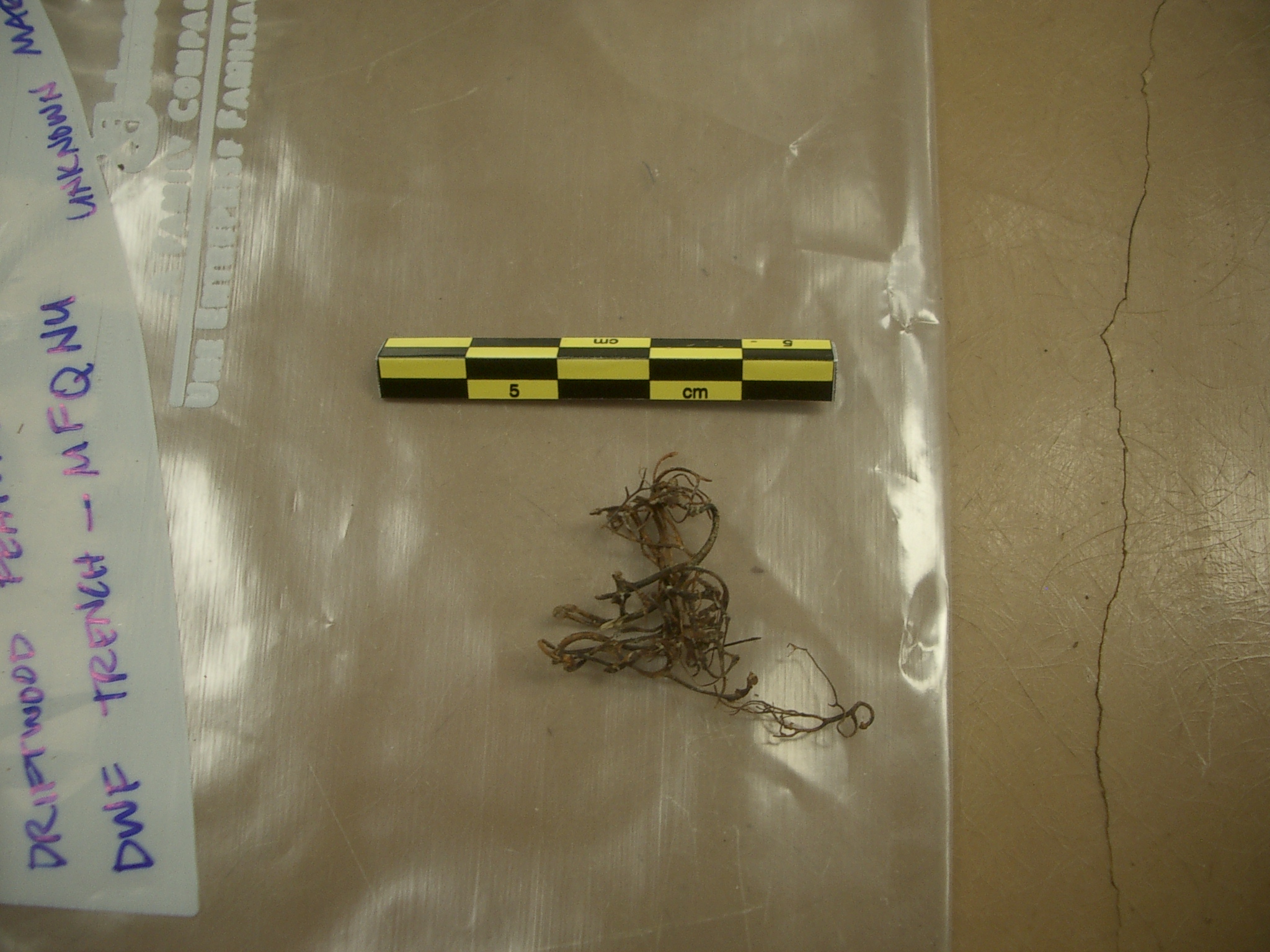
One of the things we collected a lot of from the strand lines was a variety of sea creatures. There are a lot of pieces of what we thought (in the field) was gut, which is a useful raw material. Now that we’ve gotten them into the lab, we think most of it is some sort of marine worms. There are also a variety of other small marine creatures (plants or invertebrates–they have lost their orignal colors) and mollusks.
Marine worm? from 300-400 ADAnother sort of sea creatureSome sort of seaweed?Maybe some type of sponge-like creature?
Obviously, I know a lot more about mammal bones & teeth than these things. So we’ve sorted out a bunch, and Claire will take a couple of each type to Fairbanks, along with the shells. With any luck, we can get some IDs. If we’re really lucky, the species in question will turn out to have fairly narrow habitat requirements, and we’ll know something about what the ocean was like near Barrow when the big storm happened between 300 & 400 AD.
If you happen to recognize any of these, please let me know what you think they are. If you know anyone who might be interested in these creatures, send them my way. The “worms” are very well-preserved, and still flexible. It occurs to me that it might be possible to extract DNA from them (and maybe some of the other creatures as well), which would be a pretty rare opportunity.








 Out of Ice and Time