Meanwhile…

While the dental extern was busy in the lab, Laura was there to help her find things, answer questions, and so forth. I was busy with other things.

A couple of Navy archaeologists (yes, the US Navy has archaeologists) were in Barrow last week to look at a tract that the Navy may be transferring to UIC, the Barrow village corporation, to get an idea of what needs to be done to comply with cultural resource protection laws prior to transferring Federal land. Neither of them has any Arctic experience, and they stopped by my office to pick my brain a bit. The next day they were doing a few STPs on an old beach ridge on the tract, and asked if I’d like to join them. It was a warm sunny day, with not much wind, and therefore many mosquitos. I hiked our from my office building to meet them, we checked out the area a bit & I hiked back. Other than all the bugs, it was great.
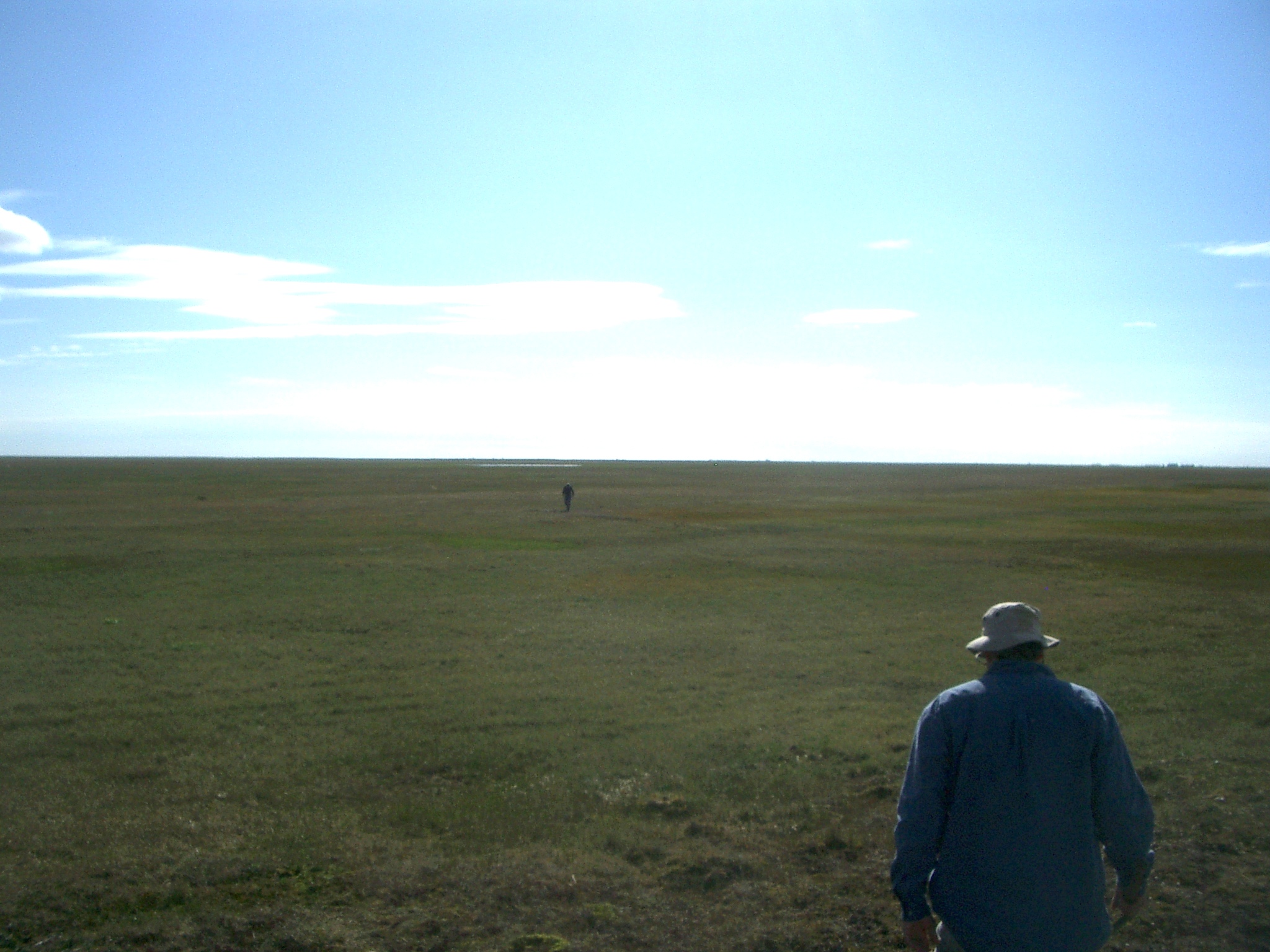
Navy archaeologists David Grant and Bruce Larson surveying.

We didn’t find anything cultural that was older than NARL, but we did find a couple very old gravel beaches. We did find some stakes that had probably marked research plots, and a big aluminum object that looked like an aircraft part. It had some cable attached to the front, as if someone had been trying to tow it. Apparently they gave up.  If you happen to recognize this, please let me know and I’ll pass the information on.
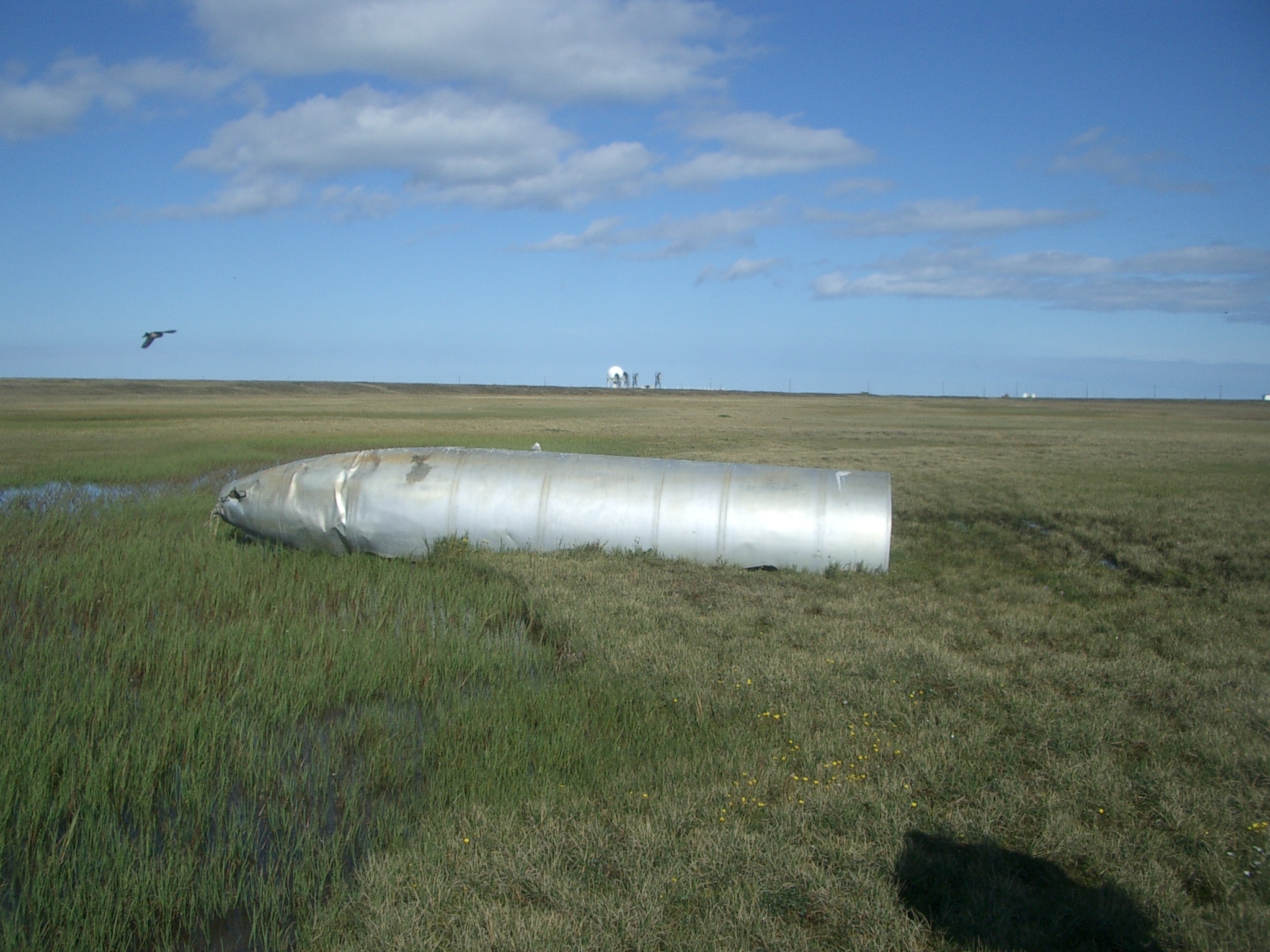
Large aluminum mystery object on Navy tract.

The next day I got a call from the City of Barrow. They run the cemeteries, and had been getting reports that a coffin was partially open. They had checked, and indeed a coffin had been frost-heaved and was damaged. They asked if I could come over when they moved the person into a new coffin. We decided to do it the next afternoon, after they got the new coffin built.

Fortunately, the old coffin wasn’t damaged except for a bit of the lid, so we were able to get the dirt off to make it lighter without disturbing the remains. The City crew was able to lift the entire box out and place it in the new larger coffin. It was a tight fit, because the old coffin had been covered with canvas that was nailed on, but that wasn’t clear when they had measured for the new box! Luckily they had left a bit of space, so they were able to pry a bit and get it in. I got the canvas that had frozen in out so it could go along.  I’d mostly been there in case the coffin was fragile and we had to transfer the individual, to make sure that nothing got left, but that wasn’t needed.

Once the coffin was out of the grave, the idea was to dig it a bit deeper, and then rebury the person. The soil profile was pretty interesting. There was clay (which generally is deposited on the bottom of bodies of still water) very close to the surface, despite the fact that the grave was on a mound. Apparently the permafrost has pushed it up a good bit, although it may have been deposited when sea level was higher than today.
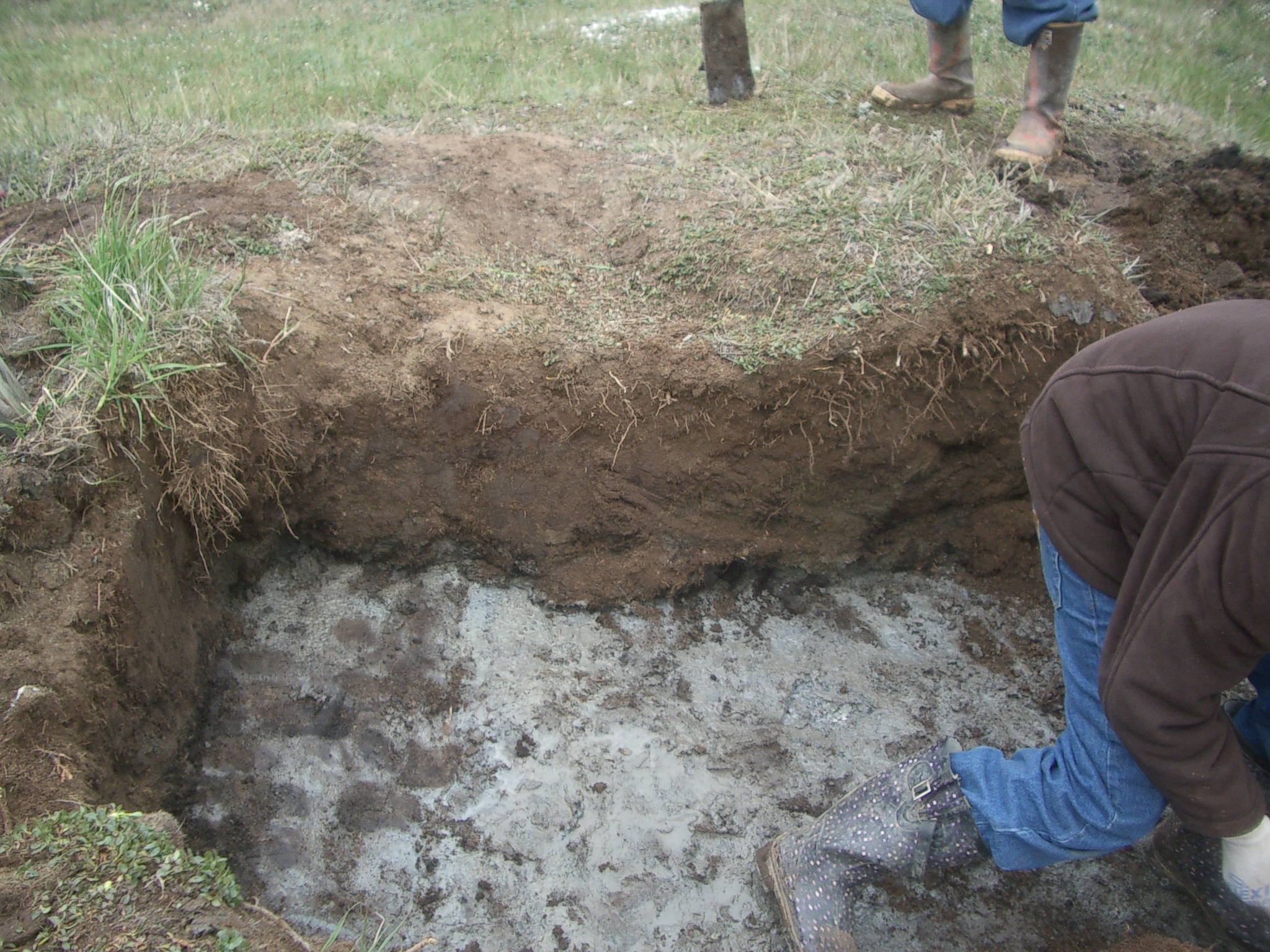
Permanently frozen clay exposed in grave in Barrow cemetery.

The crew did what they could with shovels, but thaw was not that deep, as you can see from the picture above, so they were going to get a compressor and jack hammer, to really get the grave deeper, when I left.  If not, frost heaving would just bring the box up again in a few years.
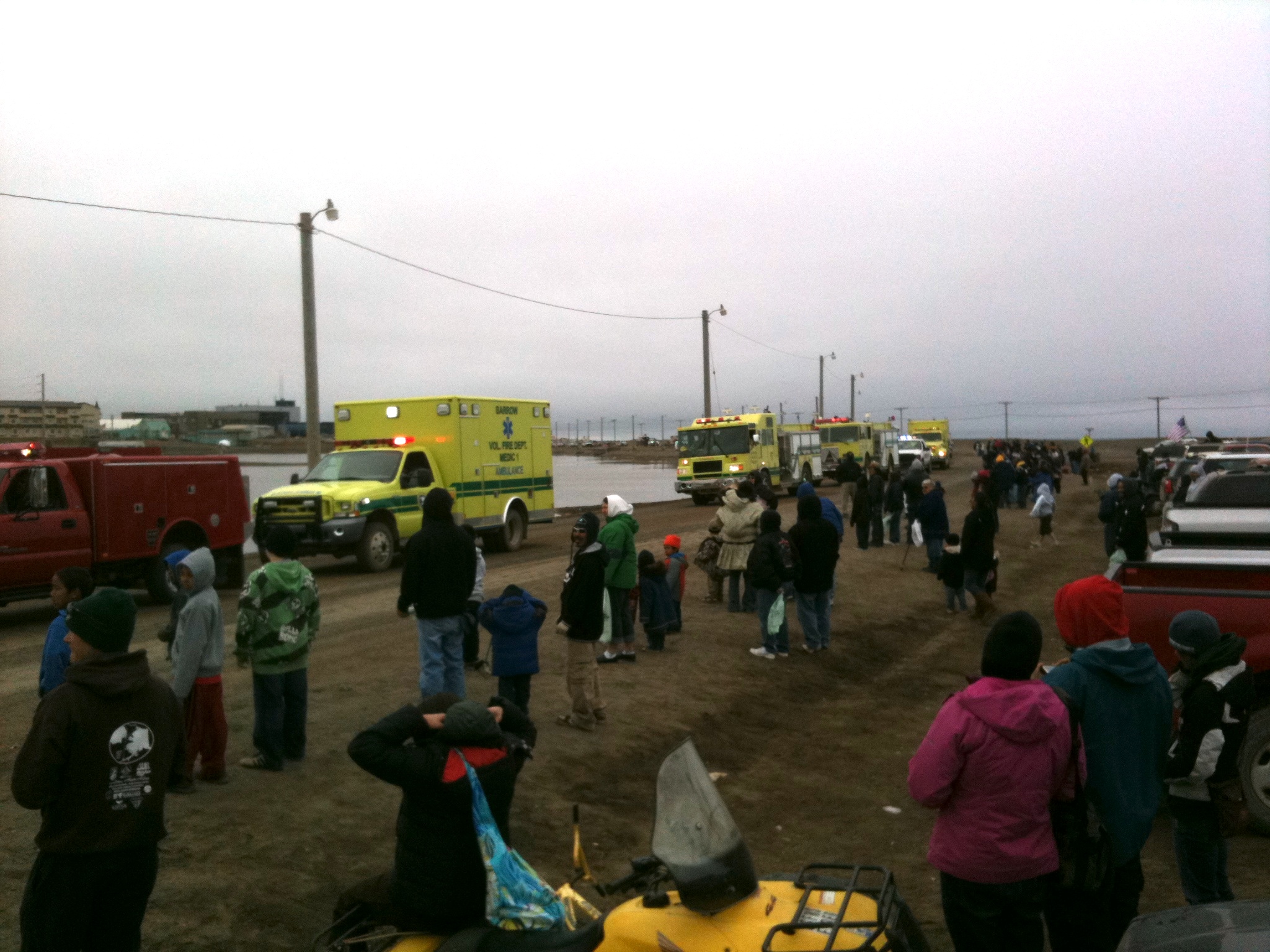
Barrow 4th of July – No fireworks

Barrow really does up the 4th of July.  In part this is because Eben Hopson Day, which celebrates Eben Hopson and the founding of the North Slope Borough, falls on July 2.  This year, it was essentially a 3 1/2 day weekend, with games and activities every day. Not only did people have the 5th off in lieu of the 4th, but most places let people off work early on the 2nd.

There were all sorts of races and games, a big parade, and the Pretty Baby and Miss Top of the World contests.  The contests (run by age group) usually have money prizes, and are hotly contested.  Lots of local groups fund-raise by selling food, candy, and so forth, and you really don’t need to cook.  This year the Arctic Education Foundation booth had brought up 13 (!) tubs of Baskin-Robbins ice cream, which was a huge hit.  I went 3 days in a row.

One thing it doesn’t include is a fireworks display.  Why not?  Not because people here don’t like fireworks.  The New Year’s Eve display is broadcast not only across the North Slope but on WGN from Chicago.  Long story…  We don’t have 4th of July fireworks because the sun won’t go down until August 2nd, and it’s just too light to appreciate them.  Of course kids have little noise-making ones, snaps & “M-80s” and somebody did try something with colored smoke trails, but it’s not the same.  Most people save their money until New Year’s Eve.

I took a ton of pictures, but not all came out so well (using the iPhone, not the D200), so not all the babies are here :-(.  Some pictures for those who weren’t lucky enough to be here in person…

What's a parade without lots of fire apparatus?
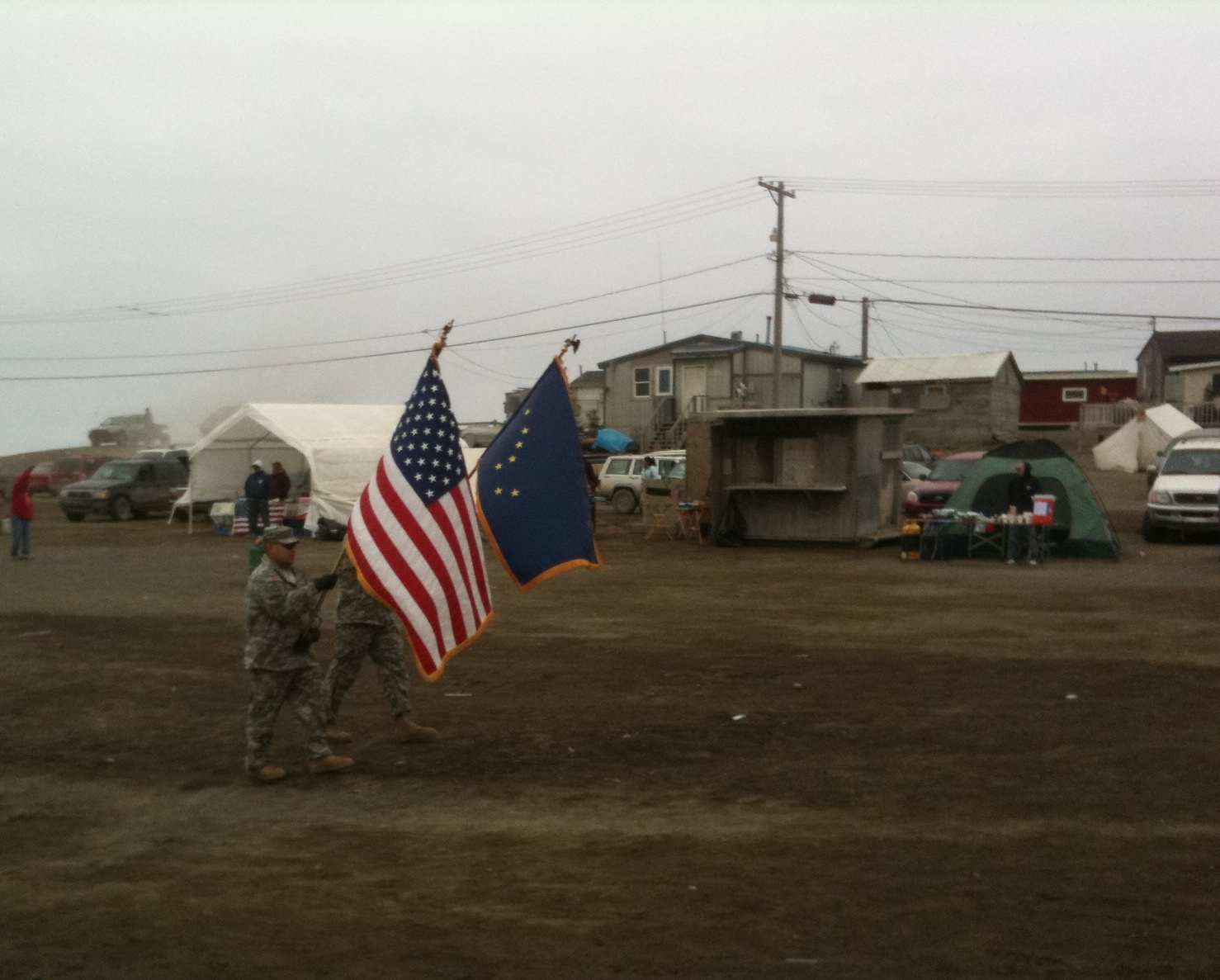
Color guard of local reservists
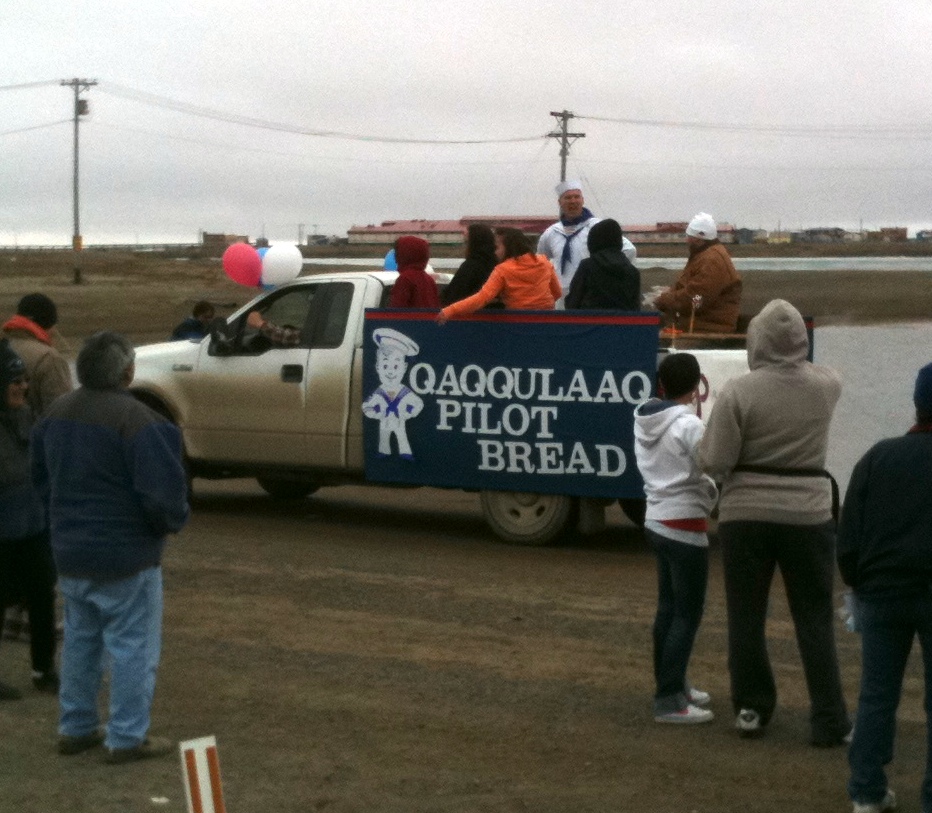
If you've spent time in Bush Alaska, you'll know why this is the Best. Float. Ever.
Search and Rescue boat. Perry Anasugak, former Nuvuk bear guard, is in the cabin window.
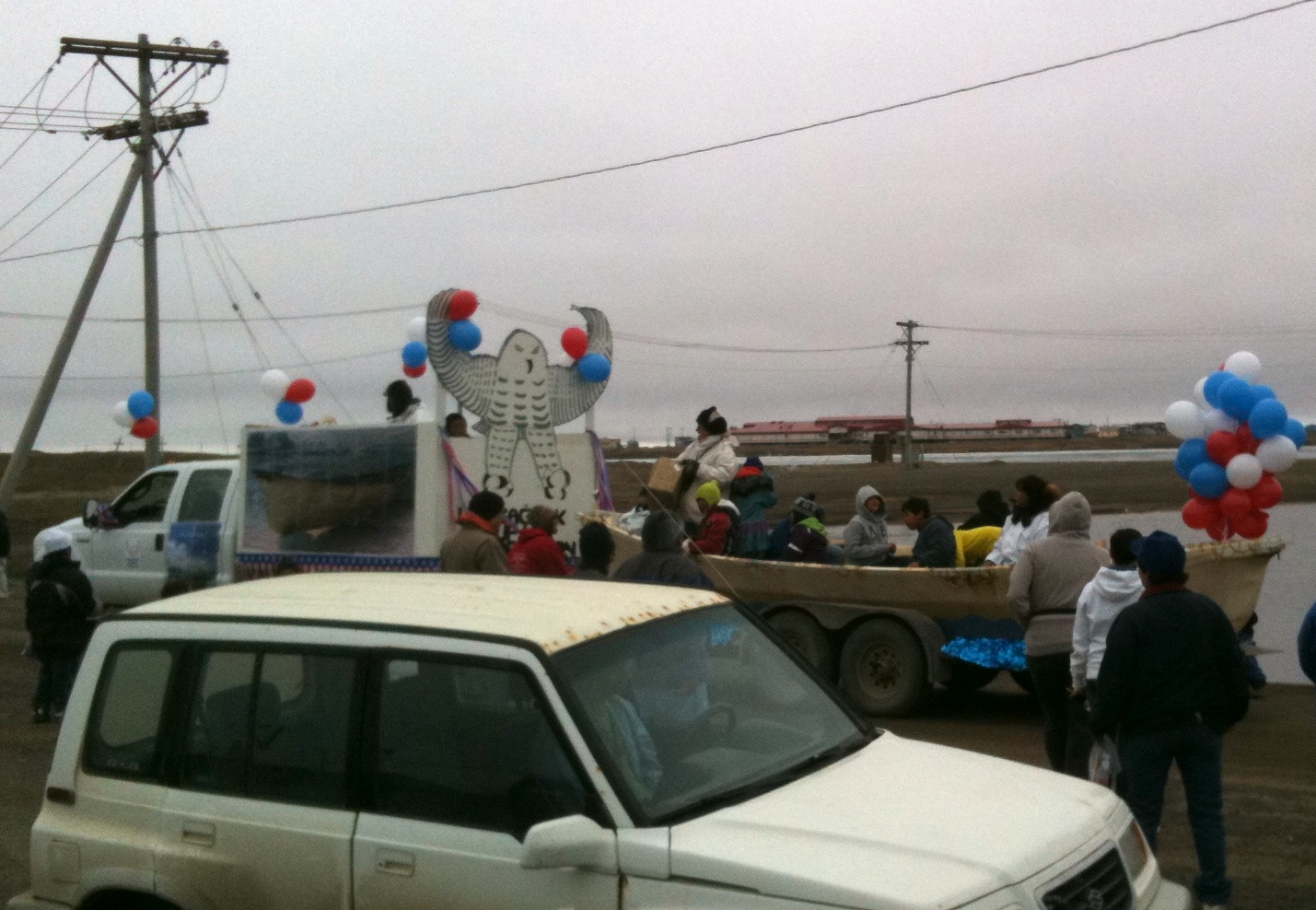
UIC (my employers) float, with real umiaq and surreal ukpik (owl). They can be scary enough at life-size.
Women runners for Clare Okpeaha Memorial Race--2 x around town.
Men runners for Clare Okpeaha Memorial Race--3 x around town.
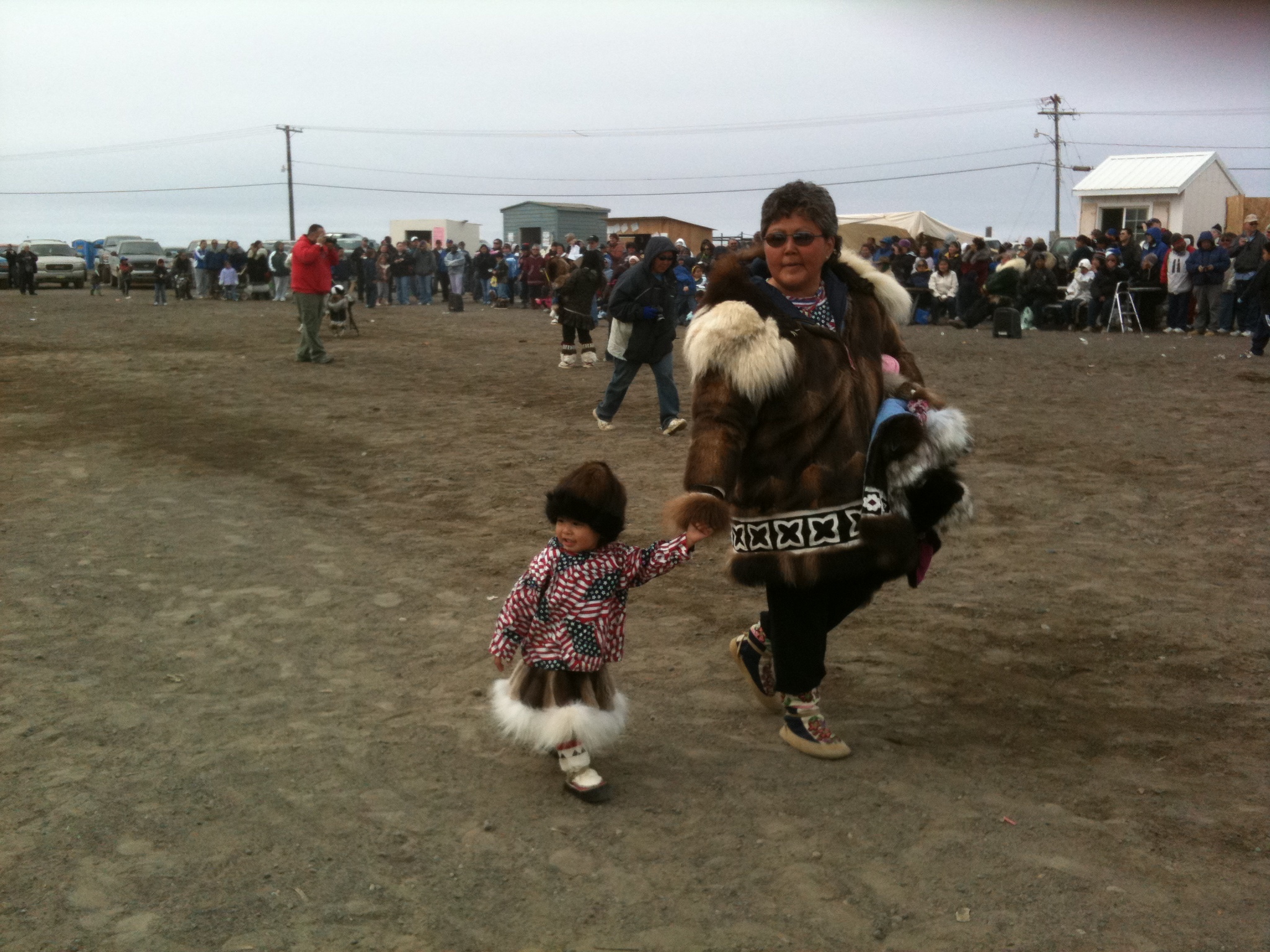
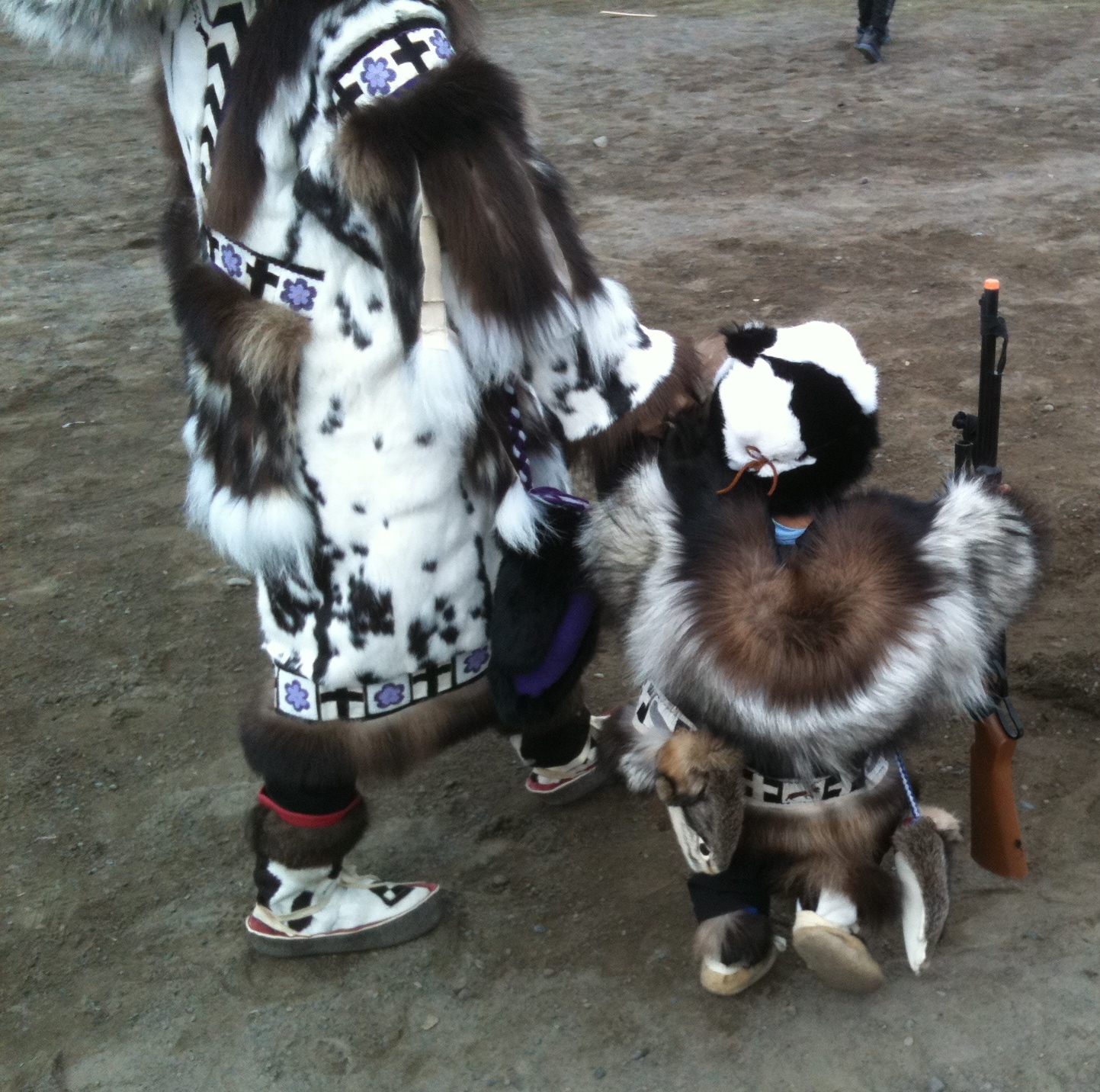
Pretty baby & her Aaka walking around so the crowd can see.
Pretty 4th of July Baby
Budding hunter and his mom in beautiful parkas

Oh, yeah, for those on the East Coast, our high today was a pleasant 38 (4.4 C) with light winds :-P.

So you want to do what to the tundra?

Heat it, it turn out.  The Department of Energy has some experiments running in the lower 48 (that’s the Continental US for you non-Alaskans) which involve heating small patches of land to see what the effects of global warming might be.  Better than just wait and see, no doubt, and it would give some guidance about adaptations that might work.  Anyway, they are thinking of trying this on the North Slope.  For the moment, they just want to test the proposed method in a very small area,less 30 m in diameter.  (A meter is just over a yard, about 39 inches, for those who forgot about the metric system when they left school).

Barrow has many wonderful things, including the Barrow Environmental Observatory, which is 7466 acres of land set aside by the Ukpeagvik Inupiat Corporation, the Barrow village corporation (more about that some other time) for scientific research.  It is actually zoned as a Scientific Research District by the North Slope Borough.  That’s where DOE wants to test this.  So, a plot had to be located.  It needed to be near power and a trail.  Craig Tweedie of UTEP, an ecologist, found a spot that seemed fit the bill, which had been disturbed in the past by tracked vehicles called “weasels” which NARL scientists used to use to get around on the tundra.  Now everyone walks in the BEO when the snow is melted, unless matted trail is put down.  The idea with a disturbed site was that it wasn’t much good for other research, so it’d work for testing the warming equipment.

The next question is if there are any cultural resources (archaeological or otherwise) on the site.   Since I work for the company that owns the land, that’s part of my job.  Normally we’d wait until later in the summer when the ground is thawed more and the Nuvuk field season is over, but they’d like to try  to install the equipment soon.  So I went out this afternoon to look at the place for the first time and see what was what.  There were a few pictures, but I guess archaeologists look at things differently.

I had a GPS location for the center point, so I programmed it in, got a 30 m tape and pin flags, and set off.  First I drove to a pull-out on Cakeater Road, parked the truck, and took a half-mile or so hike into the BEO.  There is boardwalk part of the way, and matted trail goes right past the site, although it isn’t very level, since the tundra it is built on is fairly lumpy and shifts a bit over time besides.  However, it’s been such a late melt that a lot of parts of the trail were under water, so I had to do all this in Xtra-Tuffs & rain bibs.  I’ve been coming down with something the last few days, so I really just wanted a nap, and wasn’t exactly looking forward to this little excursion.  Luckily, the sun came out for what seems like the first time in days, and it was actually fun, although I took an amazingly long time to do it.  Then I had to turn around and hike back to the road :-(.  There were lots of birds around, and the buttercups and willows were in full bloom, so  all in all a good day.

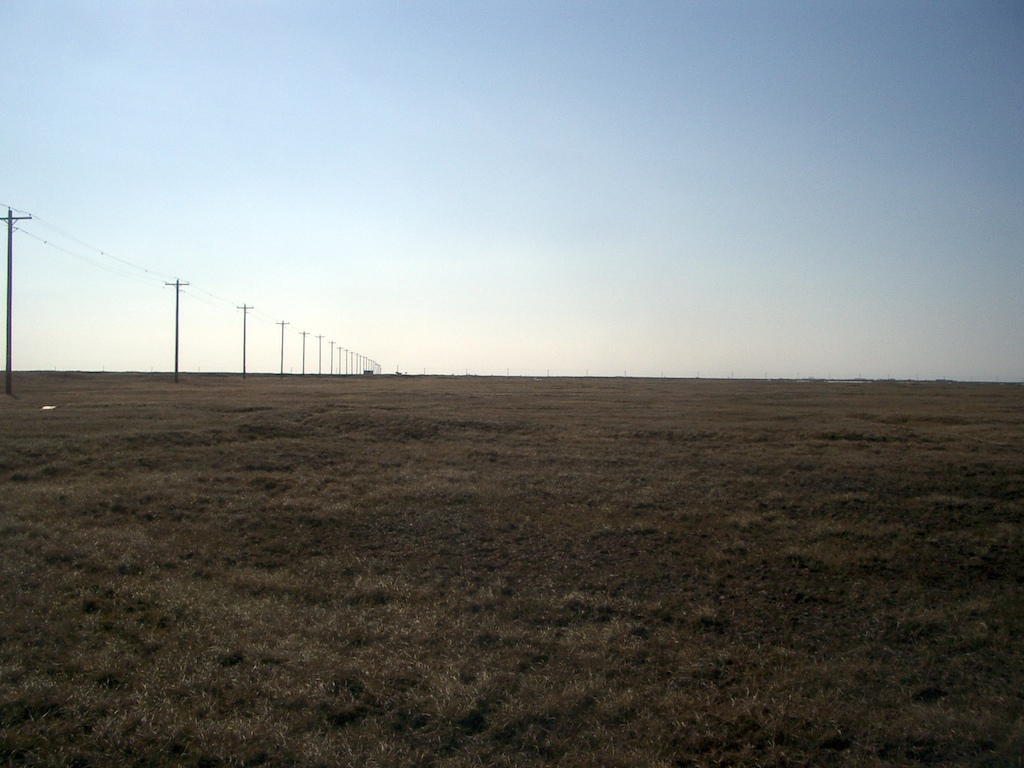
Looking back toward Cakeater Road from the site. My truck is the teeny-tiny thing at the end of the power line.

Once I got there, I put some chaining pins into the center point, and ran out a circle around it with a 25 m radius.  The actual equipment is going to be a hexagon with about a 25 m max dimension, so this gives room for construction and a little wiggle room.  I walked the whole thing in really close transects, much to the annoyance (verging on hysteria) of a shorebird which must have a nest nearby.  Based on this inspection, it looks good for the tundra warming experiment.  The only evidence of human activity on the site was the aforementioned weasel tracks, a crushed 55-gallon drum, and a flattened tin which probably held Blazo once.  The area was pretty damp, and there was higher, drier ground nearby, so it’s unlikely to have any significant pre-NARL activity when we test.

The tundra near Barrow (with my tape stretched out).

Pizza & baklava, and so to bed.

A quick trip to Nuvuk

Monday afternoon I got to take a quick trip to Nuvuk to check on the two tents BASC had put up for us to use doing the field season. The big one is for lunches and gear storage, and the little one is for the honey bucket (the tour van kept showing up at such awkward times…). It was a nice sunny day, not too windy.

On Point Barrow, heading toward Nuvuk
Looking northwest across Point Barrow. The horizon is white because of "ice blink" since the ice pack is still in.

We even got to see a polar bear.  It was sleepy, and just lay there snoozing.  There was a van full of tourists snapping away (just out of frame to the right).

Sleepy bear at Nuvuk.
Blown-up picture of the bear.

Living where you work has its down-side

Unlike most other Arctic archaeologists, I live where I work.  My house is less than 10 miles from the site I am currently working on, and there are other sites closer than that.  In general, that’s a good thing, and I wouldn’t change it for the world, but like so much else in life, it’s not an unmixed blessing.

PROS OF LIVING WHERE YOU WORK

  • Community members can take part in all parts of the project, and can find you to ask questions whenever they want.
  • No long expensive trips to get to the field.
  • Logistics can be arranged before the field season, by talking to people you know or making local phone calls.
  • Gear doesn’t have to be shipped to and from the field, at great expense.
  • If you run out of Ziplocs during the season, you can get more at the grocery store (assuming they haven’t run out, of course.)
  • The artifacts get to the lab every night, after a short trip, and can be treated and stabilized quickly if necessary.
  • The artifacts stay in the community.
  • You get to sleep in your own comfortable bed.
  • You get to cook meals in a real kitchen and go to restaurants, instead of having to eat only things that everyone else will eat too. (Arctic archaeology is hard work, and camp cooking can’t get so far off the beaten track that some folks won’t eat it.)
  • You have access to laundry equipment.
  • You’ve got your professional library handy if something unexpected shows up.
  • You have a good computer and internet access.

CONS OF LIVING WHERE YOU WORK

  • No long expensive trips to get to the field, so people can’t understand why you can’t take a day off during the field season, or don’t want to run out at midnight to see some archaeology they just found.
  • You get to sleep in your own comfortable bed (so you stay warm and can’t eat unlimited amounts of fat and sugar and still lose weight during the field season, so you have to exercise & watch your diet the rest of the year 😦 ).
  • You get to cook meals in a real kitchen (which means you have to cook and clean up, even if you’re exhausted.)
  • You have access to laundry equipment (which means you are expected not to wear the same clothes for 6 weeks, or at least to wash them frequently if you do, so you don’t get out of doing laundry.)
  • You’ve got your professional library handy so you feel like you should be writing professional material in your spare time.
  • You have a good computer and internet access so people expect you to respond to all email just as fast as when you’re not in the field, as well as doing all the work-related tasks you do then (like approving time sheets, etc.).

As you can see, the cons are pretty much personal convenience things, and being here makes the archaeology better and makes it possible to involve local high school students in a way that would be impossible if I didn’t live here.  Aside from the time away from home and school issue (not a minor one with high-stakes testing), no funding agency would pay for a bunch of high school students (& chaperones) to spend weeks somewhere else so they could be part of the lab work.

Right now, I’m trying to get as much “housekeeping” type stuff out-of-the-way, both at work and at home, as I can before the fieldwork starts on July 5.   No way I’m going to get through the to-do before the field list.  Oh well.

Public Meetings & Archaeology

For the 2nd Tuesday evening in a row, I was at a public meeting being held by a NSB Assistant Borough Attorney, who is working on the monumental task of revising Titles 18 and 19 of the North Slope Borough Municipal Code.  These Titles deal with permitting and land use, including issues affecting cultural resources.  She’s certainly trying to do a good job, and the people who came had good input.  Unfortunately, it’s been pretty nice weather both nights, so turnout was light.

Since I’m one of maybe 3 archaeologists resident in Barrow, and the others were otherwise occupied (well, I did bring Glenn along this evening), it seemed like it was pretty much my duty as a concerned citizen to go and make sure the attorney is aware of issues that she might not have thought of.   Many more meetings in all the villages and more drafts and Planning Commission and then NSB Assembly need to pass it before anything really comes out of it, but at least there is some progress.  I certainly hope so, since otherwise I might have finished a piece of needlepoint I’ve been working on for 6 months.  Maybe tomorrow…

I nearly forgot…

…that I had originally gotten a North Slope Borough development permit for the Nuvuk Archaeological Project that expired in September 2009.  At the time I applied, we only had funding for the 3 years, so that seemed reasonable.  We’ve been fortunate to get additional funding, which has let us do at least one extra season.

However, that means that technically we need a new permit (or at least the old one extended/renewed).  I know, it’s not development, but it is a ground-disturbing activity, and that what the NSB calls all permits.  At least they have a permit system that actually covers such things, unlike some places.

Anyway, once I noticed the oversight, I spent the rest of Friday getting all the paperwork and backup together for BASC to take over to the Planning and Permitting Department.  I think everything they need is there, and since it is a renewal, I hope  it won’t be a problem for them.  They do have an extension sort of category.

Care and feeding of the Total Station

You’ve probably seen pictures of archaeological digs with grids made of strings. Much of what we can learn from a site comes not just from what artifacts are found there, but from where particular artifacts are found in relation to each other.  The string grids are there to make it easier to record where each artifact is found (what archaeologists call “provenience”). I rarely use them.

Many years ago, my husband Glenn Sheehan (also an archaeologist) went to a talk at the Engineers’ Club in Philadelphia, where Harold Dibble & Shannon McPherron demonstrated a system to record provenience in 3 dimensions using an electronic total station (used by surveyors) connected to a palmtop computer (back then, an HP 95) to record not only the place each artifact was found, very precisely and with no transcription or data entry errors, but also some information about it. It automatically assigned an individual artifact number. There was even a little thermal printer that made tags to put in the baggie with the artifact! I left determined to get one.

We did, and took the system to places it had never been. Harold and Shannon had developed it for work on French Paleolithic sites, which tend to be very small. We wanted to use it on bigger sites. Fortunately, they kept improving the program, and it’s now really flexible. You can define what data is collected, set up menus, and use it on really huge sites.

Figuring out how to make everything work in the Arctic, where cold kills batteries and you can’t just plug into a wall socket was another adventure. A combination of generators, chargers, adaptors, and gel cell motorcycle batteries solved that problem. I got pretty good at repairing wires on adaptors, since the original stuff couldn’t take cold.  Over the years, the HP95s have been replaced with rugged laptops, and the thermal printers died. We haven’t found a good replacement for printing bag tags, but old-school marking the bags with a Sharpie works fine.

The GTS201D and all its equipment at Nuvuk.

Of course, the whole system depends on the total station. I’ve got 2, a Topcon GTS3B and a Topcon GTS201D, which is supposed to be waterproof. Total stations are surveyors’ instruments, so they are built to be moved around a lot without loosing accuracy, but they do need to be recalibrated on occasion. That time came for the 201D after last season.

Now, the only place in the state of Alaska that this can be done is in Anchorage. The 201D came in a case with really fragile fasteners, which have not held up well, and I haven’t been able to find a replacement, so we actually lash the case closed like a birthday present.   Needless to say, I wasn’t interested in shipping or mailing the total station down to get calibrated. But Laura and her husband Brian were going to Anchorage, and I was going down several weeks later. I called the shop, and they said the work could be done in the time between the trips, so they hand-carried it down and Brian dropped it off. They assured Brian the work would only take a week or so.

I went down for the Alaska Anthropological Association meetings & medical appointments a few weeks later and stopped by to get it, only to find it wasn’t done. What they had forgotten to tell Brian when he dropped it off was that one repair tech was on vacation and the other was out-of-state for two weeks of training, which had backed things up at bit. They couldn’t get it done in time for that trip. A few weeks later, I went to the Society for American Archaeology meetings in St. Louis.  Since you can’t get anywhere in the Lower 48 from Barrow without going through Anchorage, I was able to pick the total station up on the way home!  It’s now safe and sound in the lab, waiting for the fieldwork to start.

Ordering supplies from the Top of the World

The field season will soon be here. For the last couple of months, preparation has been underway.

Laura Thomas, who is the field and lab supervisor for the Nuvuk archaeological Project, has been double-checking the level of various field and lab supplies, and I’ve been ordering them. This is often a bit complicated, since some of the suppliers have never sent anything to Bush Alaska, at least since our last order, from which they don’t seem to have learned much. They either want to ship FedEx or UPS, which tend to be insanely expensive, and quite often are slower than Priority Mail, or they want to use Parcel Post, which can take several months. We try to get all the ordering done well in advance, so that even if my strong suggestions as to practical shipping methods are ignored, we will actually have what we need by the beginning of the field season.

I’m not sure what the deal is with FedEx & UPS. They make you pay way more than in the Lower 48 for Next-Day or Second Day service. It might be worth it if you actually got the service, but the packages are never closer than Anchorage by the “promised” delivery time, and may take a week more to get to Barrow and get delivered, depending on the schedule of the air freight company to which they hand them off. Of course, no refund, since Barrow (and all the rest of Bush Alaska–most of the state) is an exception area. Why they don’t make that clear to shippers beforehand one can only guess.

Anyway, pretty much everything I ordered has finally made it. We’ve got assorted archival-stable plastic zip bags for artifact storage, conservation chemicals of various kinds, Rite-in-the-rain copier paper for field forms by the ream.

Now all we have to do is get things stored and make up the field forms.