18th Arctic Conference–Part 5 (Day 2-PM)

At last!  After a fine lunch, we reassembled in Dalton for the afternoon session.  We moved from Alaska to the North Atlantic, and a variety of Norse sites.  Tom McGovern kicked it off with an overview of what had been accomplished during the most recent IPY.  Much of this is due to the work of various NABO members.  He talked about some really neat school outreach programs, including one issuing GPS and camera to students & teachers to record archaeology and in the case of Iceland, place names.  He also highlighted a very interesting initiative to develop

Konrad Smiarowski talked about zooarchaeology associated with the Vatnahverfi Project, part of the Norse Eastern Settlement, Greenland.  The project involved survey and excavation (following NABO common protocols, which make for great inter-site inter-comparability).  He was looking at how the Norse immigrants adapted to a new environment with new (to them) resources.  He had evidence for the adoption of seal hunting, which the Norse seem not to have done elsewhere, despite the presence of seals, as well as hunting of walrus for ivory and birding.  Bones of harp and hooded seals, both of which are migratory, show up even at more inland sites, so it looks like either people are coming to the outer coast to hunt or the seals are being traded inland.  It looks like they were net or drive hunting.  Things seem to have been going on well, but increasing amounts of ice seem to have changed things, driving people to intensify sealing at the same time as it was affecting the local seal populations.  Things ended badly, as we know.

Ramona Harrison gave an interesting paper on the farm Gásir and its hinterlands, including various types of landscape (hayfields, pastures, etc).  She is working on the zooarchaeology as part of a long-term human eco-dynamics in Eyjafjörður, Northeast Iceland.  Unfortunately, my notes on this appear not to have been saved, so I won’t go into more detail, so as not to mis-report anything Ramona said, but it was quite interesting, and reports should be on the NABO website soon, if they’re not there now.

The final paper was given by Seth Brewington on work in the Faroes, particularly at Undir Junkarinsflotti.  It was abandoned in the 1300s due to repeated sand blows, which were a problem at that time in a number of places on the eastern side of the North Atlantic.  The paper dealt with the zooarchaeology, which is quite unique as bone preservation generally seems to be bad in the Faroes, and the idea of keeping bone is still relatively new.  The inhabitants seem to have been eating lots of birds (mostly puffins), even in comparison to other Norse sites, where the bird consumption seems to drop after the earliest settlement period. 

A Meeting in Abisko

I’m at the Abisko Naturvetenskapliga Station (Scientific Research Station) in northern Sweden.  There is a meeting here of scientists and station managers who are involved either directly (or indirectly in the case of non-EU participants) in a project called INTERACT which is about building research & monitoring infrastructure for arctic research.  I’ve come along since my husband is here representing the Barrow Environmental Observatory, and we are both giving papers at a meeting in Munich after this.

It was quite the trip to get here, but the station is very nice, and it looks like it will be quite an interesting meeting.

Two abstracts submitted!

I still don’t have an admin assistant, and I’m getting stretched pretty thin.  The other day I had to print some checks, and got interrupted by something else before I got the check stock out of the printer.  The first five pages of an interesting white paper by Tom McGovern wound up on check stock.  I didn’t even notice until I got home and started to read the thing…  So there were some checks to void.

But I did manage to do a good bit of work yesterday on the maps for the ice road corridor for the Barrow Gas field project.  Still not report ready, but I was able to talk with the woman who is the main GIS person for the project, and mark up a map so she could constrict the cleared corridor a bit where it got close to some possible hunting stand locations.  It’s still plenty wide, although apparently the engineers were worried that if they can’t go exactly there, they’ll have to go through lots of polygonized ground, which is more expensive to build ice roads on.  The thing is the well pad the ice road is going to is on polygonized ground, and surrounded by lots more of it, so I don’t think they’re going to avoid much that way.  I can always test it next summer if they really want to go just there.

Today I managed to get two different abstracts for talks in, which is pretty amazing.  One was for the Saturday Schoolyard talk that Trace Hudson, one of the Barrow HS students from this summer, and I are giving on the 16th (gotta get my part done before then…) and the other was for the 18th Arctic Conference, which is being held at Bryn Mawr College this year.  Since I’d been implicated in talking Rick Davis and the BMC Anthro department into hosting this (the fact that I hosted it in Barrow, with 2 HS students for assistance, while writing my dissertation and working full-time so how hard can it be did figure prominently in my arguments), it really was incumbent on me to give a paper.  I’m talking about the material culture of modern whaling (the stuff that a whaling captain and his wife and crew members need to have specifically for whaling) and where those things get used and stored.

So folks, especially East Coast Arctic types, the registration/paper/poster deadline is Friday, October 15.  So get a move on!

Snow and wind, wind and snow

That’s the forecast, and tomorrow more of the same. The wind is supposed to drop a bit, although that was supposed to happen today too. Not so much.

Unfortunately for me, and the two guys who are going to be helping me. I have to stake out the locations for the heating elements for the tundra warming prototype experiment. We are going to have to lug the total station, tripod, computer, batteries, and a whole action packer full of stakes out the boardwalk to the area on the BEO where this thing is supposed to be located. No 4-wheelers are allowed, so we’ll have to use a wheelbarrow to drag it out there. I figure we can leave the stakes & such overnight if we don’t finish, but everything else will have to come back in.

The array is hexagonal, so it’s more complex than just laying out a grid. Actually, it’s sort of two offset grids, except that the boxes are rectangular, not square, so there are a lot of weird angles. In some cases, I’m just going to have to move the transit, rather than accumulate error, since the total station I’m using is only accurate to 5 sec of arc. Anyway, it will make the math simpler, and should probably be faster. I hope.

In praise of second opinions

I’m in Anchorage at the moment. The unfortunate reason for the trip is to attend the memorial service for an old friend, Stefanie Ludwig. She passed away far too young from multiple myeloma, which sadly was misdiagnosed until it was too late. Get a second opinion, people, if the treatment for the original one isn’t doing any good. Doctors aren’t perfect. Just ask my mom, the retired pathologist.

Stef was a great person. She was the review archaeologist for the Alaska State Historic Preservation Officer (SHPO) for many years, and did that difficult job in a sensible and efficient fashion, with little recognition, probably because she made it seem easier than it was. I’ve worked in a number of states, and interacted with a number of Stef’s counterparts, and she was the best. I don’t say that just because we were friends, either. I really don’t think some of my colleagues with limited experience Outside (of Alaska) appreciate how lucky we were to have her.

Stef and I met when I was a crew chief on the Susitna Hydro Project archaeological surveys. My crew consisted of Stef and a fellow named Chuck. Chuck was a very hard worker, and could dig Tets pits to our one. This may have been because he was working off some anger. We were in a remote camp, and most of us were having our pay direct deposited. So was Chuck. A couple weeks in, he received a letter from his wife informing him that she was divorcing him. He discovered that she was cleaning out the bank accounts, and it took the university bureaucracy some time to stop the direct deposit, so for several weeks the poor guy was working for money he’d never see. He (understandably) was a bit morose and misogynistic in our lunch conversations for a while. He carried the gun for our crew (a personal sidearm) and occasionally when he’d go off into the bushes after being particularly down, we’d wind up worrying if he didn’t return in a reasonable amount of time. Fortunately we never heard a gunshot.

Stef leaves behind her husband, Owen Mason, also a good friend and the geomorphologist on the Nuvuk project, as well as many family members and friends. She’ll be sorely missed, both personally and professionally.

Very neat website about Science and Barrow

Barrow is a pretty interesting place in terms of the sheer amount and variety of science that gets done here, as it has been since the 1st International Polar Year (IPY).  It can be hard keeping track of it even if you live here and are a scientist.  We don’t have a local newspaper reporter, and the radio station can no longer afford a full-time reporter, so there is no local source of science stories for the general public.

Many scientists want to let people know what they are doing, and what they are learning by it, but there are a number of barriers (another post for another day).  One way is blogging.  On bigger hard-science projects, websites and more are possible, since the cost of people to take care of them is really a tiny  portion of the project budget.

A recent project called OASIS really takes this to another level.  Dr. Paul Shepson, the PI, actually built in an author to write about the project, and things grew from there.  Peter Lourie, the author, has written two children’s’ books and has moved on to multimedia.  They’ve made a really neat website, which has video from a number of scientists who work in Barrow.  There’s a lot from various folks on the OASIS project, but also from people who live in Barrow, like Fran Tate of Pepe’s, whaling captain Eugene Brower and even me.  I actually got interviewed twice, because the sound on the first set got messed up, so I had to do it all over again when Peter came up again!

Definitely worth checking out.

Moving the datum

Since 2004, we have had a primary site datum NUVUK 1, with two others that were used as control points.  As the bluff continued to erode, it became clear that we would need to abandon the primary datum, so last year local surveyor Chris Stein set three more datums.  This year, the primary datum was no longer a good place to set up, so I switched to setting the total station up at NUVUK 2 (our former primary reference point, and using NUVUK 1 as the reference.

The program we use, called EDM, is a really nice special purpose piece of software, written just for recording archaeological excavations with a total station.  It is really configurable and can make major use of menus, which means no typos and a cleaner field catalog down the road.  It allows you to set up (once you get the instrument over the datum point and level) by putting a reflector on the reference point (another datum for which you have coordinates, telling the program where the instrument is.  It then does the geometry and lets you confirm where the program thinks the instrument is and which way it is facing.  With that information and the angle and distance to any other point, the program does the geometry to figure out where the artifact you are recording is in the site grid.

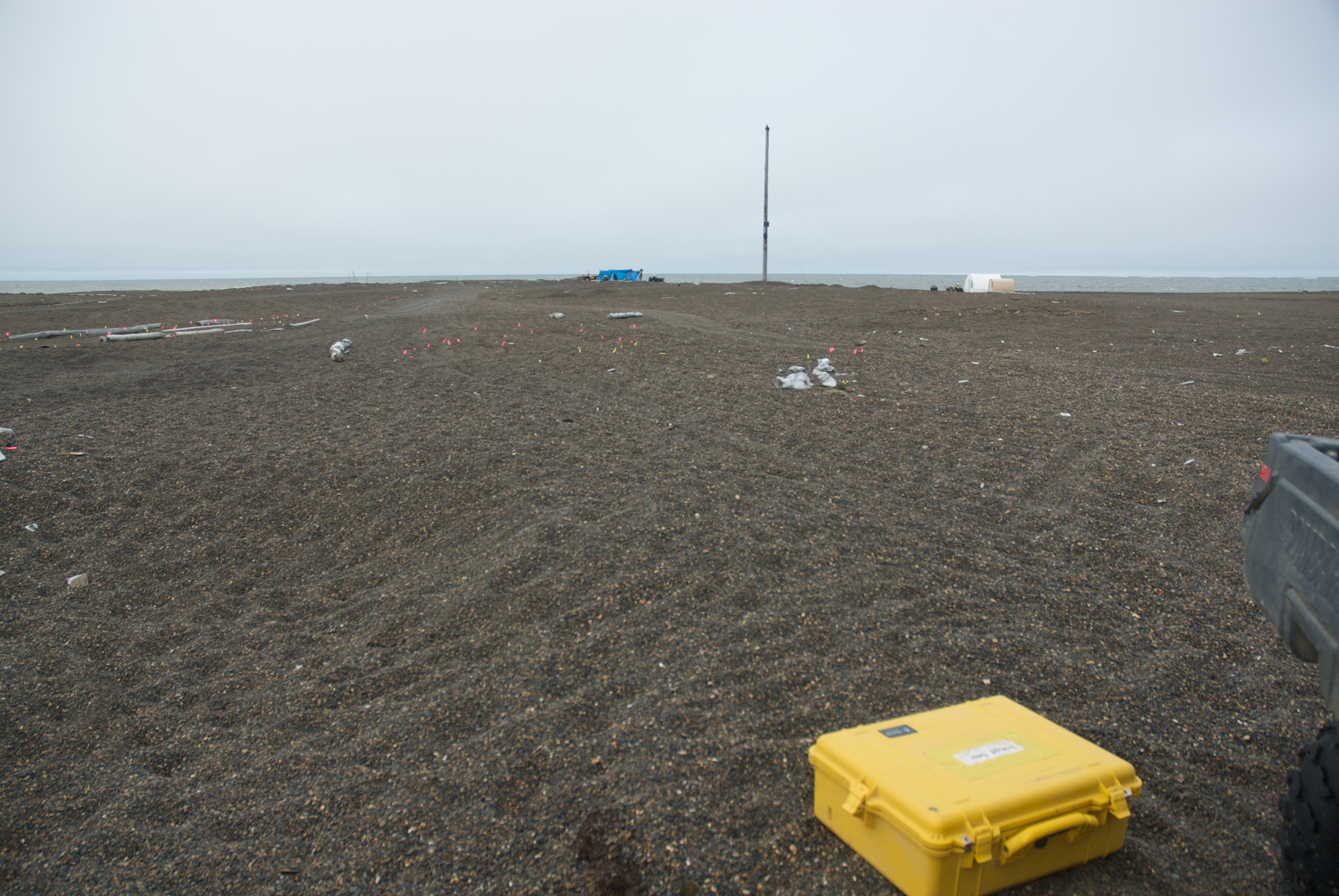
For all this to work, the datums have to be precisely recorded.  On July 20th, we actually had to move NUVUK 1.  When Chris set it, he’d chosen a high point, with vegetation, as a good stable vantage point.  The only problem was that we weren’t sure that it didn’t have a grave under, and the erosion was getting closer.  We had to pull it and see, rather than risk loosing a person to the ocean.  All the other datums were quite far away (a good thing for control points) so we needed something more convenient to where we were excavating for ease in checking the setup, or restarting after battery issues.  I picked a spot below one of the guy wires for the beacon pole, since the wire made it less likely that anyone would disturb it with a vehicle.  We made extra sure of our setup, checked it with NUVUK 4, and tried to yank NUVUK 1.

It didn’t want to come out.  We tried tapping gently with a mallet.  We really didn’t want to be too aggressive, because we weren’t sure if it was in a burial.  In the end, we had to excavate shovel test pits all around to loosen it enough to remove.  Fortunately, there was no burial.

We put the stake into the chosen new location, and shot it in.  For the rest of the season, we checked setups with NUVUK 4 as well as NUVUK 1(A), and it seems to be stable.

While all this was going on, part of the crew was finishing excavation of another burial 10D75.  This burial appeared to be quite disturbed at first, but actually was fairly well-preserved except for the top.  The rest of the crew was STPing.  Rochelle found one burial in an STP, and Trace found another by exposing some aged wood (we call it “burial wood” because the wood in burials just has a certain look to it) while walking.  We recorded and back-filled STPs around the two locations so that we could shift windbreaks there the next day.

Tiana and Kyle recording and backfilling STPs

The burial of a very large man

I mentioned that we started excavating a burial on the 15th of July and didn’t finish until the evening of the 19th, due to some really nasty weather.  It was simply too windy to excavate from Thursday afternoon until Monday the 19th after lunch.  Rain, sleet, and snow are all bothersome, but can be worked around.  Once the wind speeds get over about 30 mph, the chances of small artifacts (or even worse, small skeletal elements) being moved before their position is recorded or even blowing away altogether is real.  Wind speeds at Nuvuk are usually 5-10 mph higher than the official NWS measurements in Barrow.  Last year we had a Kestrel 4000 portable anemometer on site, but Laura’s dog Sir John Franklin ate it, so we have to estimate a bit.

We started work on the burial, called 10A927 on Wednesday, clearing vegetation and the organic soils covering the actual burial.  On the 15th, we began exposing the individual.  The skeleton was quite well-preserved.  It quickly became apparent from the size of the femur (thighbone) that this had been a very large person.  Dennis O’Rourke, the physical anthropologist who has the grant to work on the aDNA from Nuvuk, helps with the excavations each season.  He’s pretty tall (I’m guessing maybe 6’4″) and his opinion was that the burial was of someone who was very close to his height.  That would pretty much have been a giant at the time of European contact, since the tallest man the Ray expedition’s surgeon George Oldmixon measured in 1882-3 was 5’8 3/4″ tall.  There have been several other fairly tall individuals in the ancient graves at Nuvuk, so maybe the average height was depressed at contact because of poor nutrition because Yankee whaling had depleted the whale stocks pretty badly.  We were able to get an aDNA sample, which we take as soon as the ribs begin to show.  Jenny suits up and excavates and collects a previously unexposed rib.  Weather forced us to tarp the burial to protect it until conditions improved.

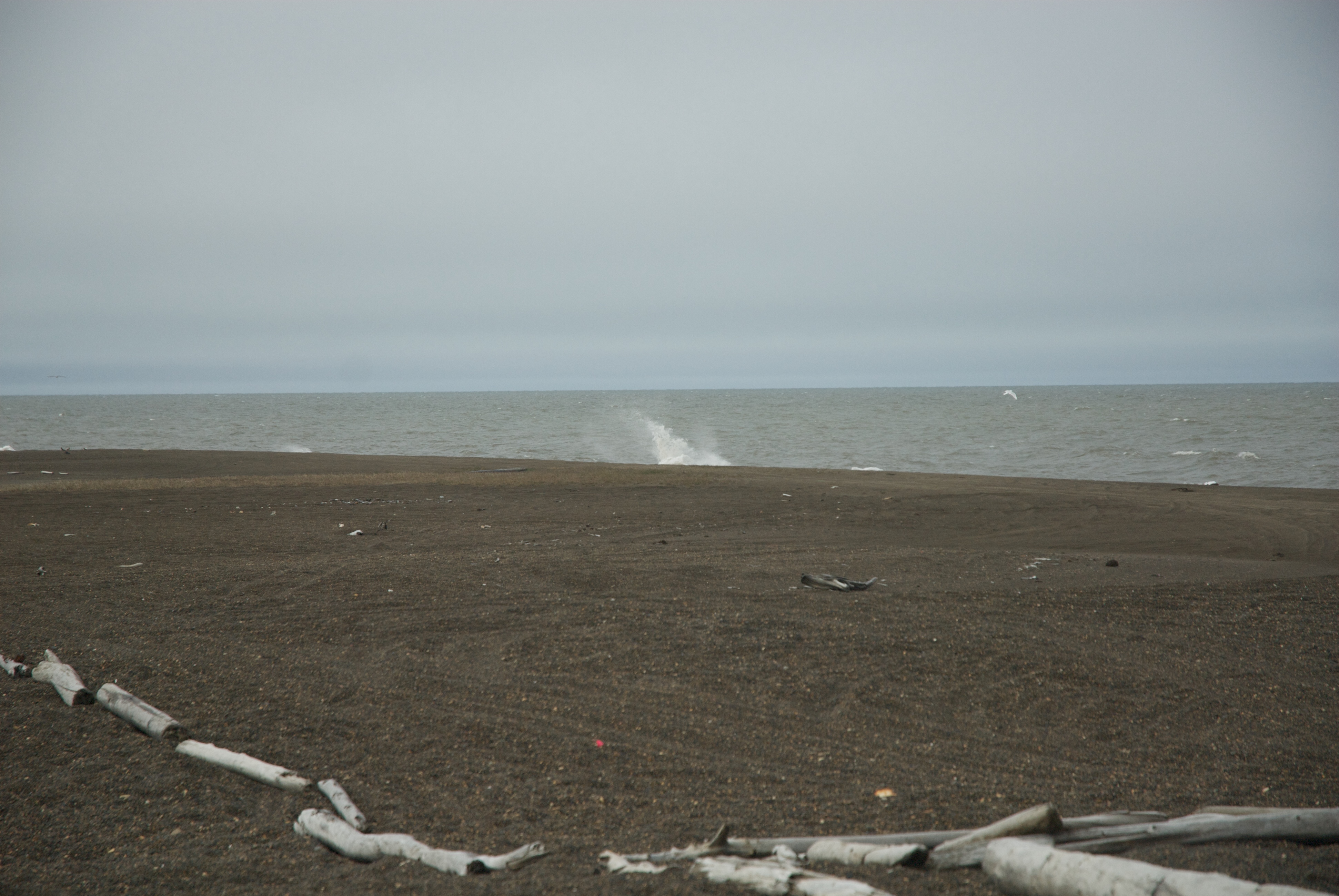
Wave breaking on the Beaufort beach at Nuvuk as the weather improves.

On Monday the 19th, the weather was pretty bad in the morning, but by lunch time it was improving, so we went out.  The passing of the storm had brought the winds around from SW to ENE, so the first order of business was to move the windbreaks on burials 10A927 and 10D75 (which we were excavating simultaneously).   We then began excavating.  10A927 turned out to be a very interesting burial.  The skeleton was nearly complete and well-preserved, and the positioning and grave structure were pretty typical for Nuvuk.  It was very nice to be able to show the students a real-life example.

I can’t show any pictures, as the Barrow Elders do not want them made public, based on past unfortunate experience.  I’ll do my best to describe the burial.  A shallow pit had been dug in the gravel (it’s pretty hard to dig anything else, even with metal shovels, which they didn’t have back then), and surrounded it with a “frame” of wood and/or whalebone.  10A927 had a nice whale rib at the foot, and wood at the sides and head.  The man had been placed on a hide, probably caribou, on his back with his knees bent.  His legs were bent a bit more than usual for Nuvuk, with his feet right by nis pelvis, almost as if the grave had been a bit small.  Perhaps the grave diggers had made the standard grave and he was a little too tall to fit easily.  His face was turned left.  His arms were folded over his chest and stomach.

A number of things had been put in the grave with him.  We found a number of whalebone bola weights (bolas were used for hunting birds), which may actually have been put in as a complete bola.  We also found a lot of the beach cobbles (bigger than the regular gravel and not that common at Nuvuk) that we have come to call “burial rocks” that were placed in some burials.  Most interestingly, he had the top of a human skull , which had apparently been placed on his stomach under his hand, since we found finger bones and a bola weight in it.  The skull appeared to have been on the surface at one point, as it was lighted in color than the skeleton, but it seems to have been placed in the burial deliberately, not found its way in later.  We have had a couple of burials with more than one person in them, and some where a later burial had disturbed an earlier one and ended up with parts of the earlier burial in and around the later one, but nothing like this.

All this was quite complicated to excavate and record.  Since the high school students are all minors, and some are only 15, the easiest way to avoid violating any child labor laws is to make sure they don’t work late.  So they went back to town with one of the bear guards just before 5pm, and the rest of us (Jenny, Laura, Ron & I) stayed out to finish.  It’s kind of unfortunate, since we only work late when something delicate and usually interesting is being excavated, and it seems tough on the students to make them leave just as things get really cool, but since this is a real job for them, we have to be on the safe side and follow all the rules.

We didn’t get done until about 9:15pm.  It wasn’t the greatest weather for all this (never got above 36ºF) but at least the wind dropped for the last couple of hours.

10A927 by the blue tarp, as we pack up at 9:20pm for the ride back to NARL after finishing the excavation.

“Today it’s like heaven!”

Yesterday the weather was very nice, our first real summer day, just in time for a site visit by a number of Barrow Elders with family ties to Nuvuk. A fine time was had by all.

Today the weather started out even better, if possible. It was sunny, with blue sky and blue ocean, and so little wind that we actually had mosquitos. We finished one of the two burials we were working on around lunch, just as it started to cloud up. The other burial was done around 3 pm, and we started shooting in and backfilling STPs. Both burials were quite interesting,and both had harpoon heads as grave goods, which we haven’t had since the first burial.

Laura and the students went in early, since there really wasn’t enough for everyone to do, and Laura had to catch a plane to California for her sister-in-law’s wedding this weekend. Dennis, Jenny, Ron, Richard the bear guard and I stayed out to finish. We had a slight delay due to transit battery issues, and a dry fine mist rolled in. We managed to shoot in everything, including some delicate surface artifacts from portions of the site we haven’t reached yet, which are being collected to avoid damage from traffic. Ron and Richard even backfilled a lot of the remaining STPs! The students are very lucky…

Tomorrow we’ll have part of the crew in the lab, and the rest will go out to finish backfilling and haul gear back to the road, where they will meet Jenny in the project truck, who will haul the gear back to the lab for cleaning and storage. It’s very satisfying (and quite a relief) to actually have accomplished what I wanted & have all the data collected a day AHEAD!!