Wrestling with dating

That’s what I’ve been doing lately.  No, not that kind of dating.  I’ve been wrestling with how old sites are, combined with the catching up after travel and working on taxes and other forms, it’s kept me busy enough that blogging kept coming in second to sleep.

I got started on this because I agreed to write a chapter for a forthcoming handbook of arctic archaeology dealing with Western Thule to Late Precontact in Northern & Western AK.  The northern part was fairly easy, since this is where I have been working for years, and I know the literature inside out, and am responsible for most of the C14 dates in that time frame, as it turns out (a lot of the major sites here were excavated before C14 dating was invented) but I needed to brush up a bit on the more southern parts of the area, I felt.  When I started doing that, I realized that terminology was a bit fuzzy (early investigators tended to think the entire sequence had to be present, and to call things, say, “Birnirk” because they thought there must be Birnirk, rather than because there were any diagnostic (types or designs only found in one culture) Birnirk artifacts at the site.

Then it became clear that people were using some artifact types as “index fossils” without being clear that they were really only in use for a limited time period.  So if they found such an artifact in a feature, they assumed the feature was used at the same time as all other features with that artifact in them.  Fairly recent C14 dating of some such artifacts has shown that some are pretty good to use, and others were being made for hundreds of years, so they aren’t really much help.

There is a pretty good dendrochronological (tree ring) series for the southern part of the area, due to Lou Giddings‘ pioneering work.  This has enabled people to date wood, although in some cases the possibility of wood reuse seems not to have been considered thoroughly, and only one log dated in a feature.  Then artifacts and artifacts assemblages (groups of artifacts often found together) found in that feature have been dated from the dendro date, and similar assemblages have been assumed to be about the same age.

Add the fact that there are a number of beach ridge complexes  in the area (Cape Krusenstern, Cape Espenberg), which develop over time.  Once people figured that out, it was a logical (and frequently correct) assumption that maritime-adapted people would choose to live on the ridge closest to the ocean.  From there, it was only a short step to deciding that all features on a particular ridge were fairly close in age.  In fact, as people have started doing more C!4 dating, and understanding how to interpret the dates better, it’s clear that isn’t the case.

As you can see, it’s not a pretty picture.  Add the tendency of earlier researchers to conflate time periods (as they understood they) with archaeological cultures, and things get really confusing.  Since this is a handbook, which one assumes is meant to be around for a while (although come to think of it, the Encyclopedia of Marine Mammals, in which I have a co-authored article, is in a 2nd edition less than seven years after the original came out), one would like to write an article that will not be rendered obsolete immediately.

So….  I’ve been going through the literature actually looking at the details of dates given for sites, dendro, C14 or otherwise, and am evaluating them on 9 different criteria to try to winnow out dates that are really reliable to base the chronology on.  That doesn’t mean other sites/features won’t be mentioned, but it does mean I’ll avoid putting hard dates on them, or using them as a basis to date yet other sites.

This is not fun.  I just hope it’s productive.
Spring comes in a blaze of glory

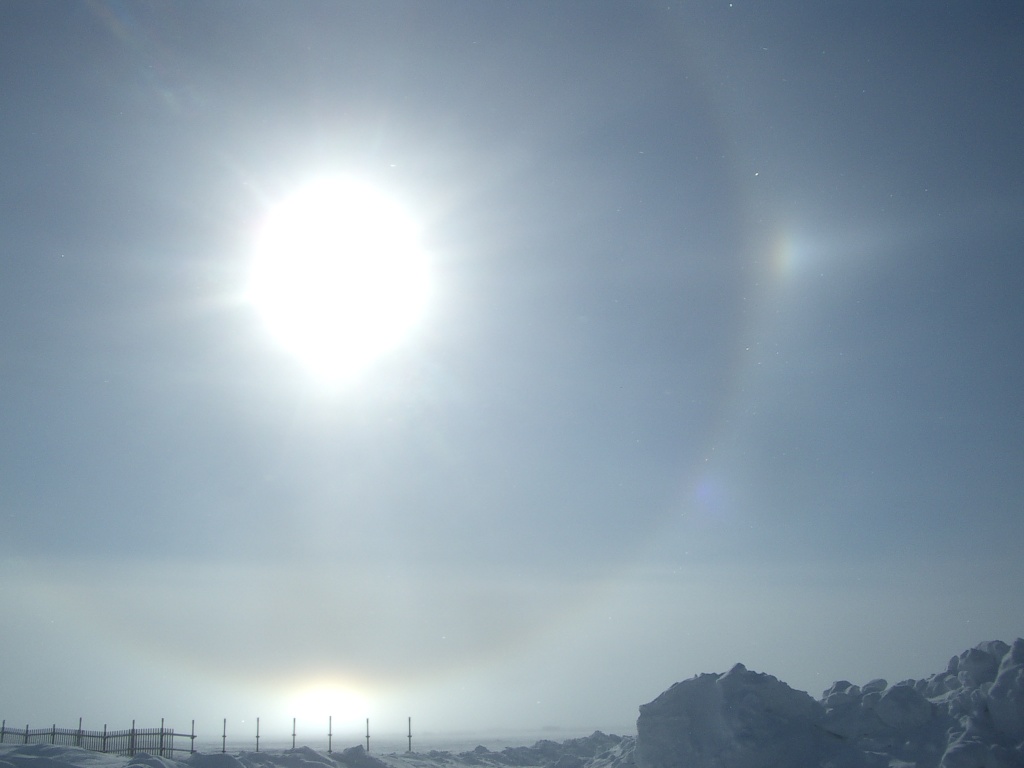
It’s the first day of Piuraagiaqta today.  It’s Barrow’s Spring Festival.  I was sort of stuck in the office working, but it was a gorgeous sunny day, with ice crystals hanging in the air.   I looked up during the afternoon, to see one of the best ice halo displays I have ever seen. I didn’t have a camera with a wide-angle lens, so I could only get part of it in one shot.

Ice halo over Barrow, showing sun with 22º halo, parhelic circle running through the sundog, and the lower tangent arc on the horizon.
Ice halo, showing sun with 22º halo, a parhelic circle through the parhelion (sundog), and an upper tangent arc.

Then my camera battery died.  I didn’t get a good picture of the outer 46º halo.  The whole display looked a lot like the Parry 1820 display.

But just then, as I was turning to go back inside in disappointment, I heard a snow bunting singing!  I couldn’t see him, but he was there, and so I know spring is too.

My “upcoming trip to Fairbanks”–almost ready

As Tripit puts it, I have an “upcoming trip to Fairbanks” for which I very nearly forgot to make travel arrangements.  I remembered last week, and got the travel done, leaving only the paper, the poster, and the proposal I had to get done first.

The poster was finished on Friday, and sent off to Maribeth for final additions and printing.  She had a touch of flu, but has recovered in time to work out the final edits, and will be getting it printed.

I started serious work on the proposal earlier in the week, and got the final numbers on Friday to plug in.  It went off to the contracting officer this morning, and now we will see.  Costs keep going up here in the Bush, and it makes it tough all round.

I have the paper (or the PowerPoint for it) almost done.  I need to get a picture of Herman Ahsoak’s shed where he keeps his whaling gear (not in the house, behind it, just like folks have for centuries), and improve the map of the whaling captain’s work area at the Peat Locus at Nuvuk tomorrow, and then it’ll be ready.

I’m trying to get packed tonight, so I don’t have to rush after work tomorrow.  It looks like a good meeting, although for the second year in a row the Alaska Consortium of Zooarchaeologists (ACZ) workshop and the Alaska Heritage Resource Survey (AHRS) workshop conflict.  This is getting a bit old.  It should be possible to schedule them both during the meeting without conflicting, but that would apparently require some forethought and consideration on the part of those organizing the AHRS meeting.  The ACZ meeting was scheduled way in advance…

Actual incremental progress on several fronts!

Now that the storms have passed for the moment, and I can once again get to the office, I’ve actually gotten a few things done.  I managed to take the few comments on the mission statements for the GHEA working groups and finalize them.  That done, I set up, not one, but two (!), working groups.  The first is focused on coastal erosion, and the second on global change effects on the archaeological and paleoecological records.   They are now open for members (a few have already joined).

Monday’s time-sheet approvals were particularly onerous, because a change of user ID in the time-sheet system didn’t work quite right, and not only detached users from approvers until they logged in again on Monday, it also rescinded submitted and approved time-sheets from last week which were done before the update!  Much confusion and a royal pain for us and for the IT/accounting folks, I can assure you.  But we persevered and everyone should get paid on time!  There were a few other accounting and proposal related details to deal with today, but they’re pretty well in hand, and I just need a few more numbers to get the proposal out the door.

That done, I moved on to drafting a summary for newsletters (several paragraphs) of the Polar Archaeological Network meeting in Tromsø, which somewhat coincidentally (since I am the only overlap between the two groups at the moment) was all about global change and threats to the Polar archaeological and paleoecological records.  That’s been circulated and I’ve made several revisions based on comments.  I’ve gotten one more set from Maribeth Murray at UAF, which actually suggests two versions, one for social science audiences and one speaking more to the paleoecology/global change folks, so I should have that ready for final circulation to the attendees tomorrow, and then it should be ready to go to out.  Maribeth and I (and the other meeting attendees) are also doing a poster at the Alaska Anthropological Association annual meeting in Fairbanks next week.  PAN had a preliminary poster, which I am majorly rewriting and putting Alaska-specific images on (since this version is for an Alaska meeting).  I’ve got to get that finished, circulated, and down to Maribeth in Fairbanks so she can get it printed up (since large-format printers are almost as scarce as hen’s teeth in Barrow).

Also needing finishing and polishing is my paper/PowerPoint for the meeting.  I am in a session in honor of Ernest S. “Tiger” Burch Jr., one of the most renowned ethnologists who ever worked in the North, who passed away unexpectedly last September.  He was a brilliant and meticulous researcher, widely admired among Iñupiaq people, particularly those of Kivalina, where he and his wife lived for some time, and an all-around good person.  I was proud to have him as a friend, as was my husband, Glenn Sheehan, and it’s an honor to be asked to be in this session.

I had somehow lost track of when the meeting was, and had rather a jolt today when I opened an email about a side meeting, which mentioned the attached agenda for next week’s meeting!  A mad dash to make travel plans ensued, so I now have a room, a car, a plane ticket and am registered for the meeting.  All told–1.5 hours.  Practice makes perfect (or at least faster).

Some serious blizzards

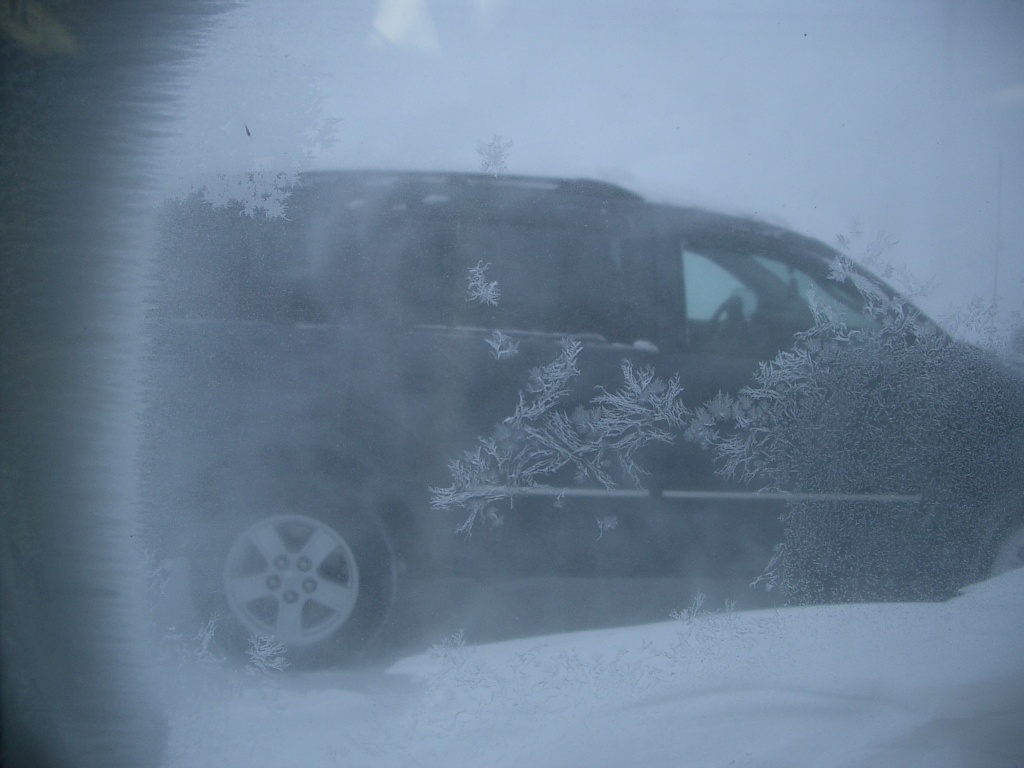
For the past week, the weather has been fairly unfortunate here in Barrow.  We had a snow day on Wednesday.  It was a total whiteout,with so much snow blowing around that I could barely see my car out the front door, let alone the
house next door.  The UICS staff discussed it and decided to hold off until after daylight to go to work (so we could at least have a chance to see drifts).  By that time, UIC and everybody else had closed for the day.

View out the front window during Wednesday's blizzard. Notice the snow streaks and the frost flowers.

The weather improved Wednesday night, but no loaders had been heard at NARL by the next morning.  I called into the regular teleconference with one of our clients, and then headed for the BARC.  Good choice.  The drift across the drive was huge.  I headed back to my house for snowshoes.

Fortunately, the ARM project has a telehandler with a bucket.  They also have a contractor who is trying to finish an upgrade to the BARC instrument platform and is a bit behind schedule.  Once the telehandler was dug out and the area around the ARM duplex was clear, Walter brought the telehandler over to the BARC drive.  One and a half hours later, he had a single lane through the drift and place for me to park, so I went in.  Susie, who’s filling in as the UICS temporary admin assistant, came out in a cab.

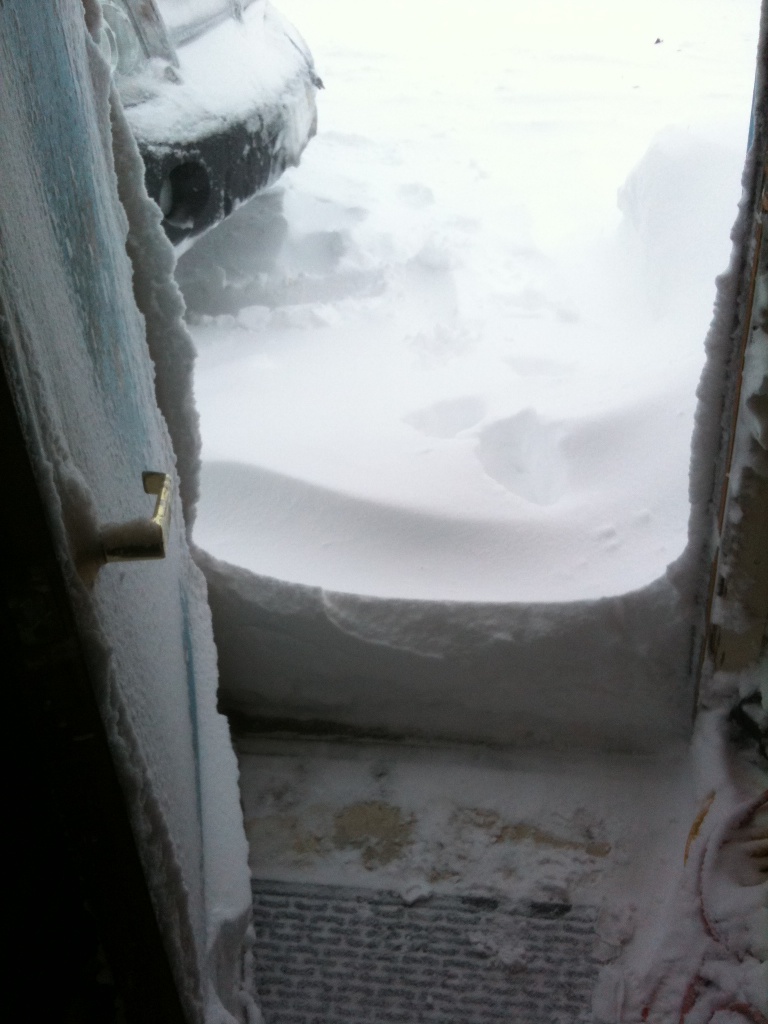
The wind was already rising and the barometer dropping again.  I went home at for a quick lunch, and there was already a drift at my door.

Drift at the door at lunchtime on Thursday.

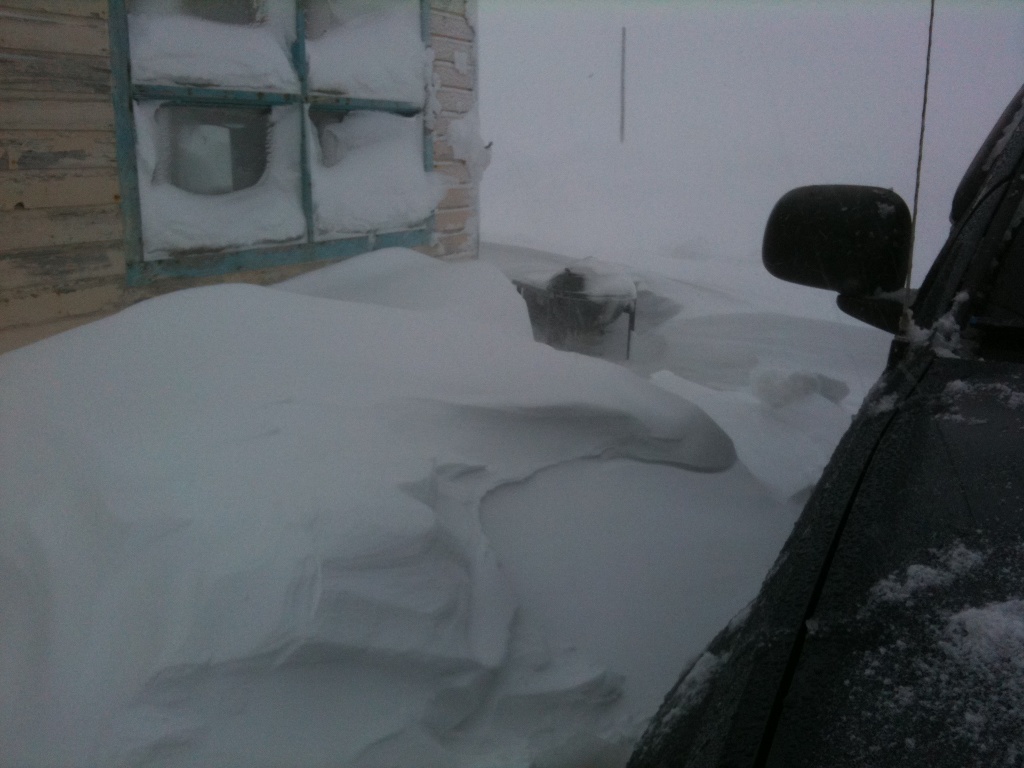
The snow was sculpted in very interesting ways, which had gotten more elaborate while the car was out of the way.

Drift at the front of my house, lunchtime on Thursday. The grill is almost completely exposed.

I went back to work, but by 3 PM it was getting really nasty with low visibility.  I told everyone it was time to head home, since the road from NARL was going to get bad (and Susie and I would be spending some time at the BARC with the contractor if we didn’t get out ASAP).  Shortly after that, they closed pretty much everything in town for the day.

We were closed for everything all day today (Friday), too.  I managed to get a few things done and written from home.  We’ve canceled lab for tomorrow, since the loader has only been working enough to get a path for the water and sewer trucks to get the residential huts, and the BARC is undoubtedly behind a huge drift again.  We haven’t actually gotten water or sewer trucks, mind you, but they can at least come tomorrow.

My husband’s weather day was interrupted by the news that something had blown in in the BASC Bldg. 360 server room.  He went over on foot (falling into snowdrifts that he couldn’t see without glasses) and eventually got a repair crew organized to come secure the room so snow didn’t keep blowing in and wreck the servers.  They had to turn off an air conditioner, but that didn’t seem to be a real problem, given all the cold air that was coming in everywhere.

The wind is finally going around to the north, with temperatures dropping, and even a little bit of sunset sky showing!  It’ll be a chore to get to work on Monday, no doubt, but that is the Arctic.  The entire North Slope was under blizzard warning for a couple days.  That was a huge storm, apparently bigger than any they’re recorded for a decade or more.

Now that I’m home…

I was lucky enough to get an upgrade from Alaska Airlines, so at least I wasn’t bent up like a pretzel all the way to Barrow.  They weren’t any too quick about getting the baggage out, and no-one was to be found to issue the Baggage Service Guarantee vouchers after the 20 minutes had passed, so we took my bag when it showed up (after about 1/2 hour) and went home.

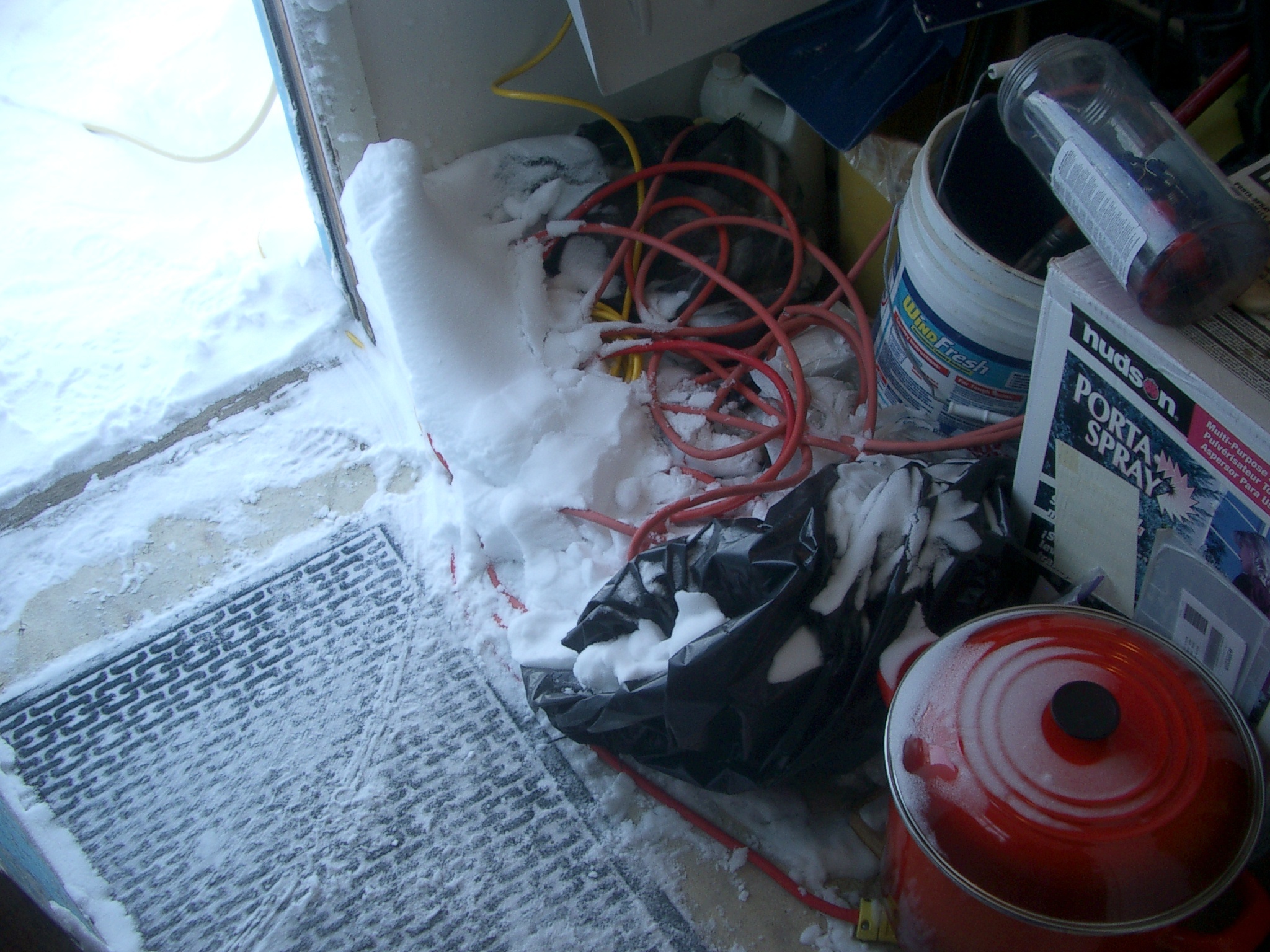
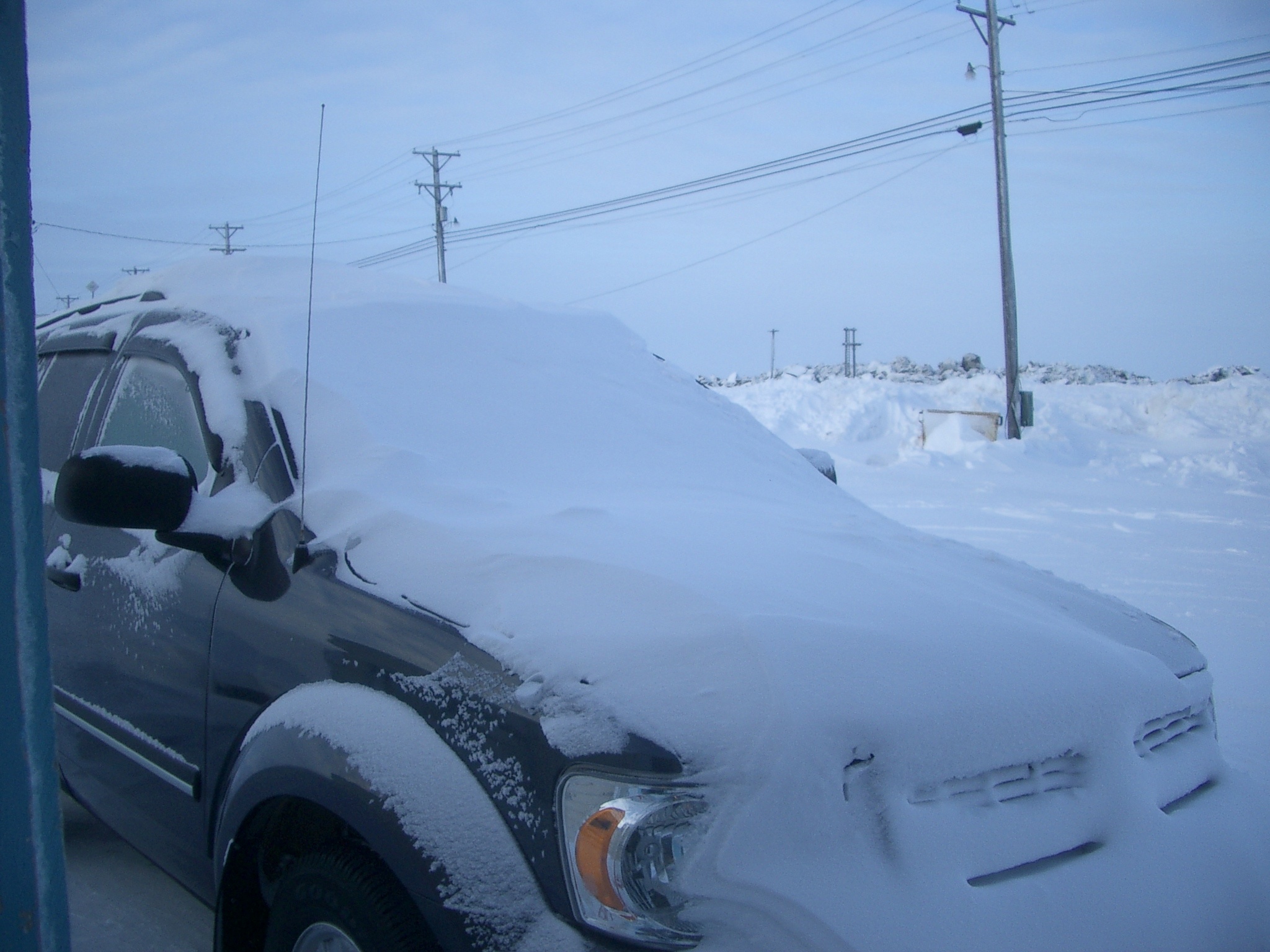
Luckily, today was a holiday so I could sleep late.  Once up, there was the usual post-travel laundry pile to start on.  Once that was underway, I had to dig out my car.  There had been a blizzard in Barrow on Friday, which had blown snow into our arctic entryway, among other places.

Snow in the arctic entryway.

It had also blown all over my vehicle, which required significant digging out.  Apparently the blowing or subsequent plowing had somehow packed snow around my left rear mudflap, since that shattered when I pulled out (only went forward) although I didn’t discover that until I got home.

View out the front door, showing snowed-in car, and ivu (ice push) on the beach in the background.

The wind had apparently also caused some pretty significant ice push from the Chukchi Sea onto the beach.  You can see it in the background of the photo above.  The ice is black in places because it was frozen to the bottom.  The ice is very thin for this time of year.  In some places it is probably 20 or more feet tall.

Once I got to work I caught up on emails, drafted a “mission statement” for a working group on coastal erosion I am helping to organize (contact me if you are interested–it’s global, not just Arctic in focus), worked on an encyclopedia article a bit, and took care of things like time-sheet approvals which can be a time suck, but are fairly important (we all like getting paid!).

18th Arctic Conference–Part 5 (Day 2-PM)

At last!  After a fine lunch, we reassembled in Dalton for the afternoon session.  We moved from Alaska to the North Atlantic, and a variety of Norse sites.  Tom McGovern kicked it off with an overview of what had been accomplished during the most recent IPY.  Much of this is due to the work of various NABO members.  He talked about some really neat school outreach programs, including one issuing GPS and camera to students & teachers to record archaeology and in the case of Iceland, place names.  He also highlighted a very interesting initiative to develop

Konrad Smiarowski talked about zooarchaeology associated with the Vatnahverfi Project, part of the Norse Eastern Settlement, Greenland.  The project involved survey and excavation (following NABO common protocols, which make for great inter-site inter-comparability).  He was looking at how the Norse immigrants adapted to a new environment with new (to them) resources.  He had evidence for the adoption of seal hunting, which the Norse seem not to have done elsewhere, despite the presence of seals, as well as hunting of walrus for ivory and birding.  Bones of harp and hooded seals, both of which are migratory, show up even at more inland sites, so it looks like either people are coming to the outer coast to hunt or the seals are being traded inland.  It looks like they were net or drive hunting.  Things seem to have been going on well, but increasing amounts of ice seem to have changed things, driving people to intensify sealing at the same time as it was affecting the local seal populations.  Things ended badly, as we know.

Ramona Harrison gave an interesting paper on the farm Gásir and its hinterlands, including various types of landscape (hayfields, pastures, etc).  She is working on the zooarchaeology as part of a long-term human eco-dynamics in Eyjafjörður, Northeast Iceland.  Unfortunately, my notes on this appear not to have been saved, so I won’t go into more detail, so as not to mis-report anything Ramona said, but it was quite interesting, and reports should be on the NABO website soon, if they’re not there now.

The final paper was given by Seth Brewington on work in the Faroes, particularly at Undir Junkarinsflotti.  It was abandoned in the 1300s due to repeated sand blows, which were a problem at that time in a number of places on the eastern side of the North Atlantic.  The paper dealt with the zooarchaeology, which is quite unique as bone preservation generally seems to be bad in the Faroes, and the idea of keeping bone is still relatively new.  The inhabitants seem to have been eating lots of birds (mostly puffins), even in comparison to other Norse sites, where the bird consumption seems to drop after the earliest settlement period. 

18th Arctic conference–Part 4 (Day 2-AM)

This penultimate chapter is a bit belated, to say the least, due to holidays, much travel and associated presentations, and proposal preparation.  However, there were some very interesting papers on the final day as well, and I decided I needed to get this written before yet another conference happened.  And I needed a break from final tweaking of the PowerPoint for said conference.

The first paper was by Molly Odell, on economic change at  Mitksqaaq Angayuk between 3400-100BP.  The site, on Kodiak, seems to have had discontinuous occupations from Early Katchemak to the Russian occupation.  Molly focused on the fauna from a midden associated with an Alutiiq house.  The house seemed to have been occupied primarily by men, based on the artifacts.  The midden showed a change from a pre-contact mixed fishery (primarily cod but with significant amounts of salmon and small amounts of other locally available fish) to a fishery focused almost entirely on cod in the historic period.  Molly interprets this as a shift from a winter settlement to a cod-fishing camp, presumably staffed by men.

Jennifer Raff gave a paper on mitochondrial aDNA (ancient DNA) from the Lower Alaska Peninsula & Eastern Aleutians.  This is interesting, as there are disagreements about how/when various cultures in that area appeared, and whether or not they represent in situ (in place) developments or population replacements.  This work may help settle some of those questions.  Not to spoil any surprises, as this paper is being published, but both haplotypes A & D are well represented, and there is B from one site!

Rick Knecht, a fellow Bryn Mawr College PhD, gave a “just out of the field” talk about excavations at Nunalleq, a Yup’ik site in the Yukon-Kuskokwim delta.  The Yup’ik culture is quite well-known ethnographically, but almost no archaeology has been done in the area.  Nunalleq, for which there is a date of 1300BP (not sure if that’s calibrated or what it’s on or associated with) has extraordinary organic preservation at the moment, but is suffering erosion, which is accelerating due to permafrost melting and sea level rise.  The local community actually contacted the archaeologists in concern.  The 2010 season excavated a house, with lots of organic artifacts (rye grass matting, for example) present on the floor.  They think it might have been a men’s house, which are known for the Yup’ik from the ethnographic record, based on the low numbers of women’s artifacts recovered.  There was a burnt side room, with a large number of arrowheads present, which is possibly a result of conflict.  More work is planned.

Chistyann Darwent followed with a report on the 2010 work at Cape Espenberg, a beach ridge complex which is located near Kotzebue in the Bering Land Bridge National Preserve.  This project has been doing survey there for a couple of years and has surveyed and mapped extensively, especially the more recent periods.  They have actually been able to excavate several houses (one on each of the 3 Thule-age ridges) to a considerable extent.  One thing they discovered was that the surface mapping did not necessarily give a good picture of what was under the ground in terms of houses, side rooms and so forth.  One of the houses seems to have burned, although why is not yet clear.  They excavated an outdoor ceramic manufacturing area (inadvertently–it looked like part of the house from the surface).  The houses on the oldest and middle Thule ridges had Thule 2 harpoon heads associated with them, suggesting that they were fairly early.  The also found a copper eyed needle, slat armor.  The tunnel floor was lined with baleen.  The youngest house was of a type that was familiar to the project’s elder consultant, who had been in the US Army during the Korean War, since he’d grown up in a similar house.  It had lots of evidence for fishing.  The dates were a bit later than prior testing had led them to expect, the oldest around 1260-1400BP, the middle 1450-1650BP.

Justin Tackney gave a paper on mDNA (mitochondrial DNA) from Nuvuk, as well as presenting the new direct dates that Joan Coltrane has for the human remains. The results show a number of haplogroups hypothesized to be founders to modern Inuit populations all in one area, which is new.  In general, this supports a Thule expansion from North Alaska.

I got the slot before lunch, and gave a paper looking at the material culture of modern Iñupiat whaling.  I am using this as a way to approach what sort of evidence might be expected in archaeological sites of whalers, and where that evidence might be found.  Essentially, the modern case has a number of artifacts that are needed for whaling and nothing else, most of which have pre-contact equivalents.  The interesting thing is that they are generally not stored in the house, which implies that excavations focused on houses may not be able to address presence/absence whaling too well.

Exhibition Features Objects Collected by Arctic Anthropologist Frederica de Laguna | Bryn Mawr Now

Exhibition Features Objects Collected by Arctic Anthropologist Frederica de Laguna | Bryn Mawr Now.