STPs and more STPs!

The second day in the field was devoted mostly to digging (shovel test pits).  It was sort of chilly, and digging is a good way to keep warm.  Besides, physical anthropologists Dennis O’Rourke and his post-doc Jenny Raff were due to arrive in Barrow that night (July 7).  Since we are collecting small (a rib, generally) samples of the human remains for ancient DNA (aDNA) and stable isotopes and direct dating, and it is best if the samples are collected by one of the physical anthropologists, I decided to wait for them to join us in the field before beginning excavation of the burial we had located the day before.

We set out several more lines of STPs.  STPs are common on archaeological surveys, where archaeologists are trying to find sites that may not be obvious when you just walk over them.  Digging STPs makes it possible to see if there are artifacts or soil layers created by human activity buried in the ground.  STPs are also used on known sites where one wants to find buried features (a term which can cover all sorts of concentrated physical evidence of past human activity–storage pits, hearths, houses, tent sites, turkey traps, reindeer corrals, places where someone sat to make a stone tool, you name it).  Usually, they are a relatively minor part of work on a known site, serving mostly to choose where to dig.  Often, they are placed on the site in a pattern which is either totally random (as in the locations are picked using a grid and random numbers) or what is called “stratified random” which means the site (or region–this works for survey too) has been divided into different areas (strata) based on something like slope or distance from water or vegetation cover, which each stratum being sampled separately.  This avoids the possibility of not testing one stratum at all, which can happen with plain random sampling.

We are not doing random sampling of any sort.  Nuvuk is, among other things, an area where people in the past buried their dead.  Many of their descendants still live in or visit Barrow regularly.  No one likes to think of their relatives, however distant, falling into the ocean due to the erosion of their final resting place.  Random sampling is designed to help get a representative sample of whatever is in the ground, not to find all of it.  We are trying to find everyone, and excavate them before erosion deposits them in the ocean. To do this we dig a lot of STPs.  We had hoped to have some geophysical prospecting gear (GPS, magnetometer and resistivity) here this summer, and test them against the shovel testing in the Nuvuk gravels.   If they worked, we’d have to shovel a lot less.  Unfortunately, family illness prevented that happening this summer.  So what we do is lay out a 50 m tape, place a pin flag every two meters (say on the odd numbers), drag it along and put out more flags and so forth, until we get a line across the entire ridge where the site it (it’s about 116 meter wide).  Then we move the tape inland 2 meters, and do it over, except the pin flags would go on the odd numbers.

This spacing is close enough to pretty much guarantee that if there is a grave present some sign will show up in one of the STPs next to it, even if they don’t come right down on it.  Actually, we prefer it if they don’t, but since most of the graves don’t show on the surface, it happens.

We have gotten far enough from the bluff that the trail to Plover Point actually crosses the area we are putting STPs in.  When we lay out new lines, the first order of business is to dig and document all the STPs in the trail, record their locations with the transit, and backfill them (assuming there is no sign a grave might be there).  We don’t want to obstruct the trail, since we’d like to keep traffic on it, rather than driving all over the site.

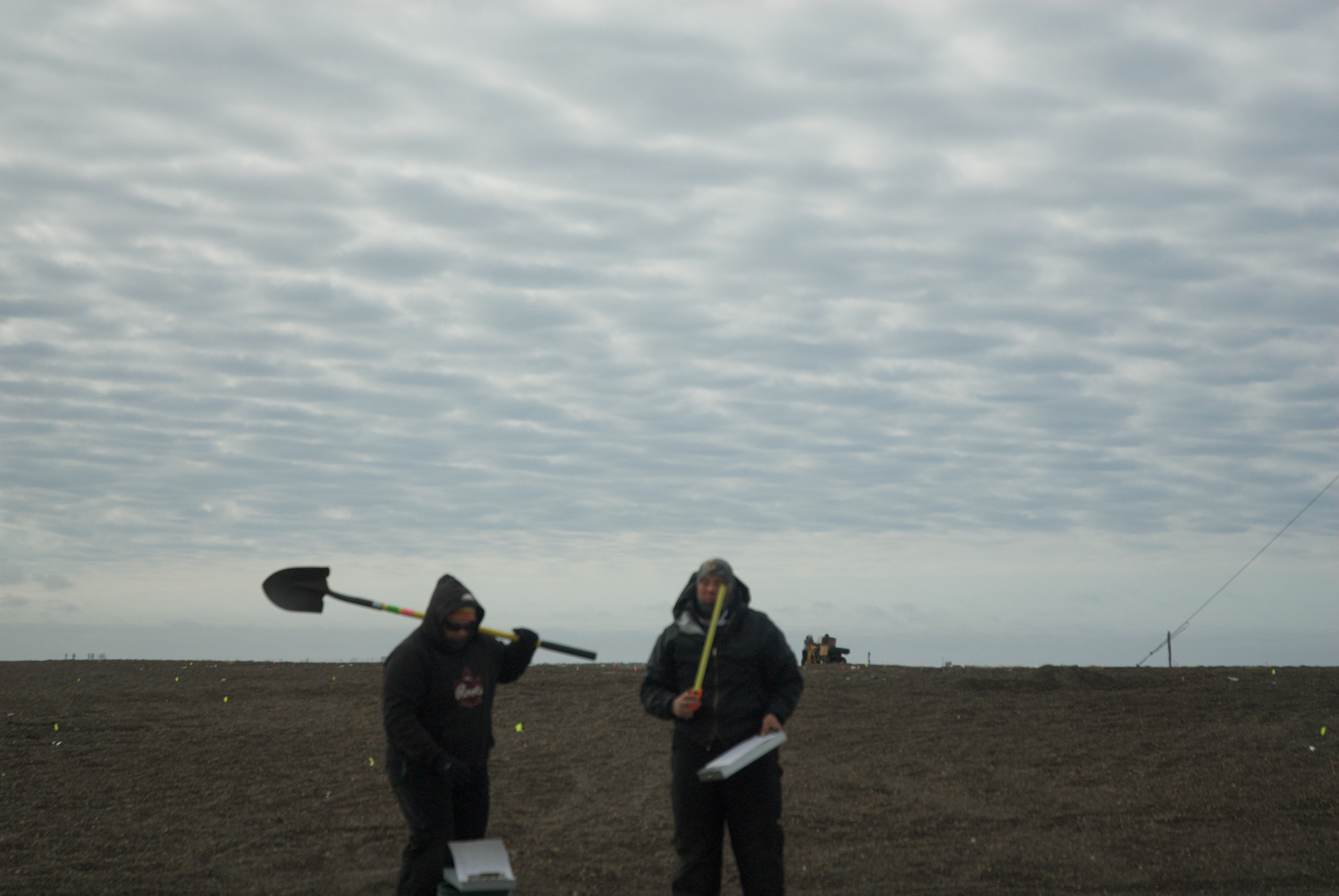
Digging STPs on the trail to Plover Point.
Laura and Warren get ready to document another STP.

All the STPs bore fruit.  We located three additional locations, two on the C line and one on the D line, that appear to be burials.  There is plenty for us to do this field season already.
A Cold Day at Nuvuk

It has been a busy week, with all sorts of things to do after the day’s fieldwork was over and the data was downloaded and backed up, including a public meeting (which will need to be rescheduled because the weather was nice and the TV didn’t get it on the announcement roll-around in time), baking dozens of cookies for the community potluck my employer was holding, and dealing with the aftermath of a minor ATV accident involving one of the students (she is fine, but wrenched an already sore shoulder and therefore will be on limited duty next week). We have tomorrow off, so I’ll provide more details and pictures on the fieldwork then.

Just a quick note while I try to get the flash card downloading. The pictures are all shot as hi-res JPEGs and RAW, so it takes forever. I doubt I can stay up long enough to post pictures tonight.

We worked today. Normally we do fieldwork Monday-Friday, because the students are paid by the hour (so they get practical job experience as well as archaeological training) and child labor laws make it complicated to work more than that, especially for the younger students. We had a vacation day on Monday, though, and since it’s a short season and some of the students are trying to earn money we decided to do a 5-day week anyway. In the end, only 5 of them made it to work today. One was out of town, Trina was taking part in a fundraiser for the basketball and volleyball teams, two were sick, one was hurt and we don’t know what happened to the other one. It was wicked cold this morning, so hats off to Rochelle, Trace, Nora, Warren and Victoria. Not only was it cold, it was windy & foggy (yes, at the same time). In fact, it was so foggy we were having trouble with the transit because the lens and/or the reflector kept getting obscured by water drops. And it rained before lunch, and toward the end of the day.

However, as compensation, we finished excavation of the first burial of the season.  It turned out to have been disturbed, probably in the late 1880s, judging by the artifacts scattered along an old ground surface along with some of the individual’s bones.  We found some very cool artifacts (a bit unusual for Nuvuk burial excavations) although they weren’t really in the burial.  Highlights were a copper end-blade (for a harpoon head or possibly arrow), a split blue glass bead, and best of all, the cartridge for a shoulder gun.  The last still seems to have a bit of black powder around the primer area, so we have it in VERY wet conditions, and I will try to clean it tomorrow before there is any chance of the powder drying at all.  Our bear guard, Larry Aiken, who is a whaler, said it was the oldest style, shorter than the ones they use now.

As further compensation, we decided to order our lunches from the fundraiser, so Trina brought 13 lunches to the end of the road to Nuvuk (called my cell before she headed out), and Larry took a trailer back to get them.  So we all had BBQ chicken, potato salad, rice, pancit and a hot dog for lunch, along with the hot beverage of our choice and chips courtesy of Nora!  Even with the big propane cooker going the tent was cold enough to see our breath.  We hung in and finished the burial, and tested the areas where two other single human bones had turned up in a trail.  Neither one had a grave beneath it.  We already have 3 other probable graves, based on subsurface indications in STPs, waiting for us next week.

Learning Archaeology & Eating Candy

It’s been very busy the last couple of weeks doing all the last-minute things to get ready for the field.  As a result, I haven’t been able to keep up with blog posts on everything, so I’ve spent part of the July 4th weekend catching up.  That way, I can post catch-ups when I don’t have time to do something from that day (or when the day was so dull no-one would want to hear about it 🙂 ).  A bit out of sequence, but that’s life.

Unlike many projects, particularly in the Arctic, where the expenses of getting & keeping people in the field tend to make PI (Principal Investigators–the people in charge of projects) prefer experienced excavators with college backgrounds in archaeology/anthropology, most of our crew is made up of high school students who have never taken a course in archaeology.  Obviously, there’s no way to give them (or any other normal human being) that sort of background in the time between hiring them and starting fieldwork.  The good thing is, it’s not actually necessary.  The skill set that an excavator or basic archaeological laboratory worker needs are actually learned on the job, not in the classroom or from books.  Having worked with complete newbies (high school kids, Earthwatch volunteers, college field school students) as well as folks with advanced degrees (some of whom couldn’t have dug their way out of a paper bag if their life had depended on it) has proven this to me beyond the shadow of a doubt.

That said, a bit of background does make it easier to understand why things need to be done a certain way, and therefore to remember to do them, as well as to not go crazy from boredom after the 25th sterile STP in a row.  We do have a short reading list we send to college-level & higher folks, but for the high school students that’s not really the best plan.  It’s summer, and reading is easy to put off, unless we want to start giving quizzes.  Anyway, most high school students haven’t really gotten the knack of learning just by reading, since they almost never have to do that in high school, as far as I can tell (my daughter graduated recently).  So I figured some type of exercise would work better.   I wanted something fun, that could be done inside (people learn better when they aren’t too uncomfortable, as a general rule).

There are a bunch of books that deal with various exercises people have developed to teach archaeology, so I went through those and found some stuff that looked good.  Then I think I remembered my 6th grade teacher, who had developed a teaching method which relied on Milky Way bars (usually hurled from the front of the room to the student’s desk) as rewards for various achievements.  It made for a lively classroom, and seemed to motivate kids who usually wouldn’t have cared enough about the subject to exert themselves.  Being a good student, I got a lot of Milky Ways, which was ironic, since I didn’t actually like them that much to begin with.  So, candy, but a variety of it.

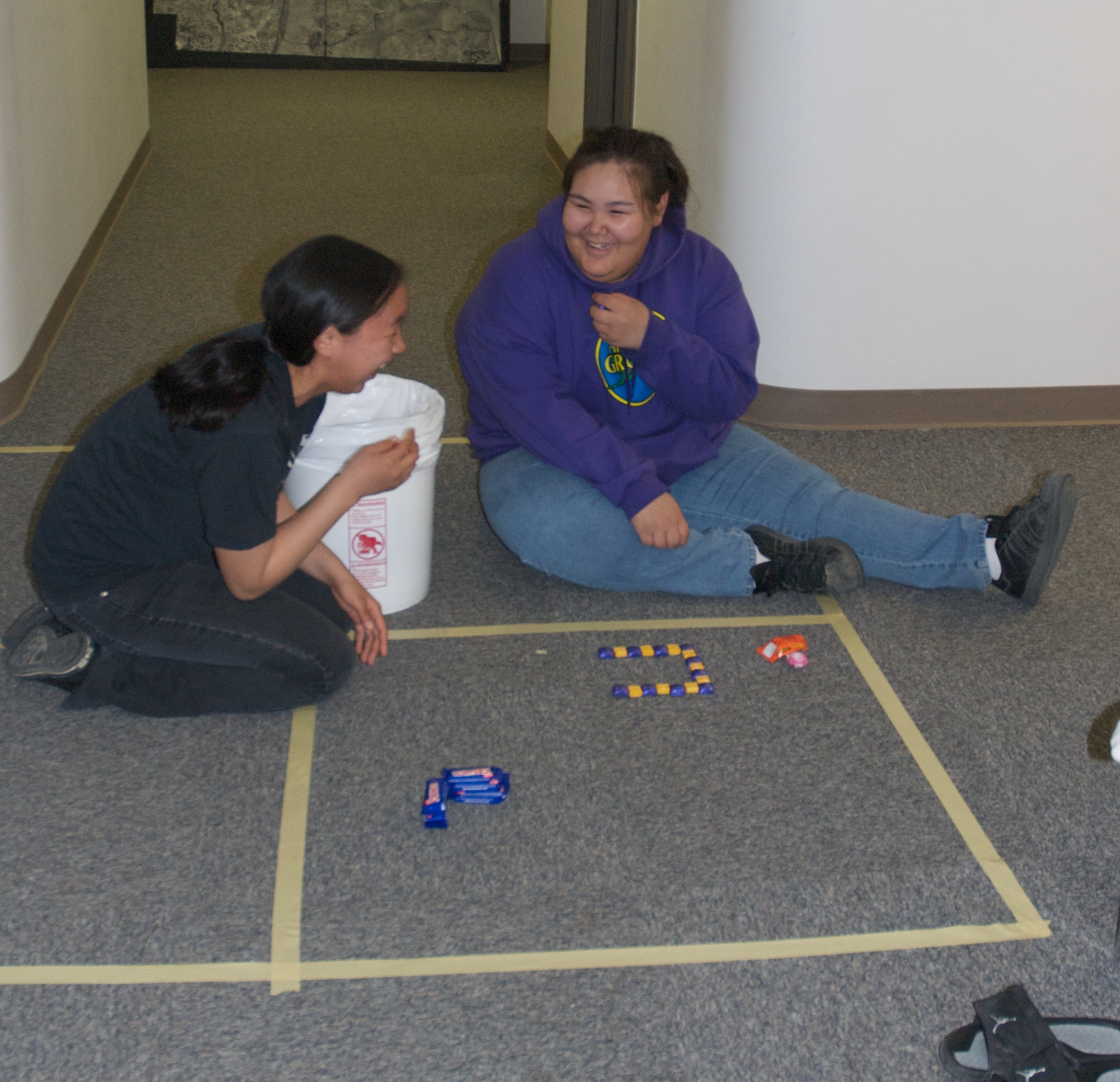
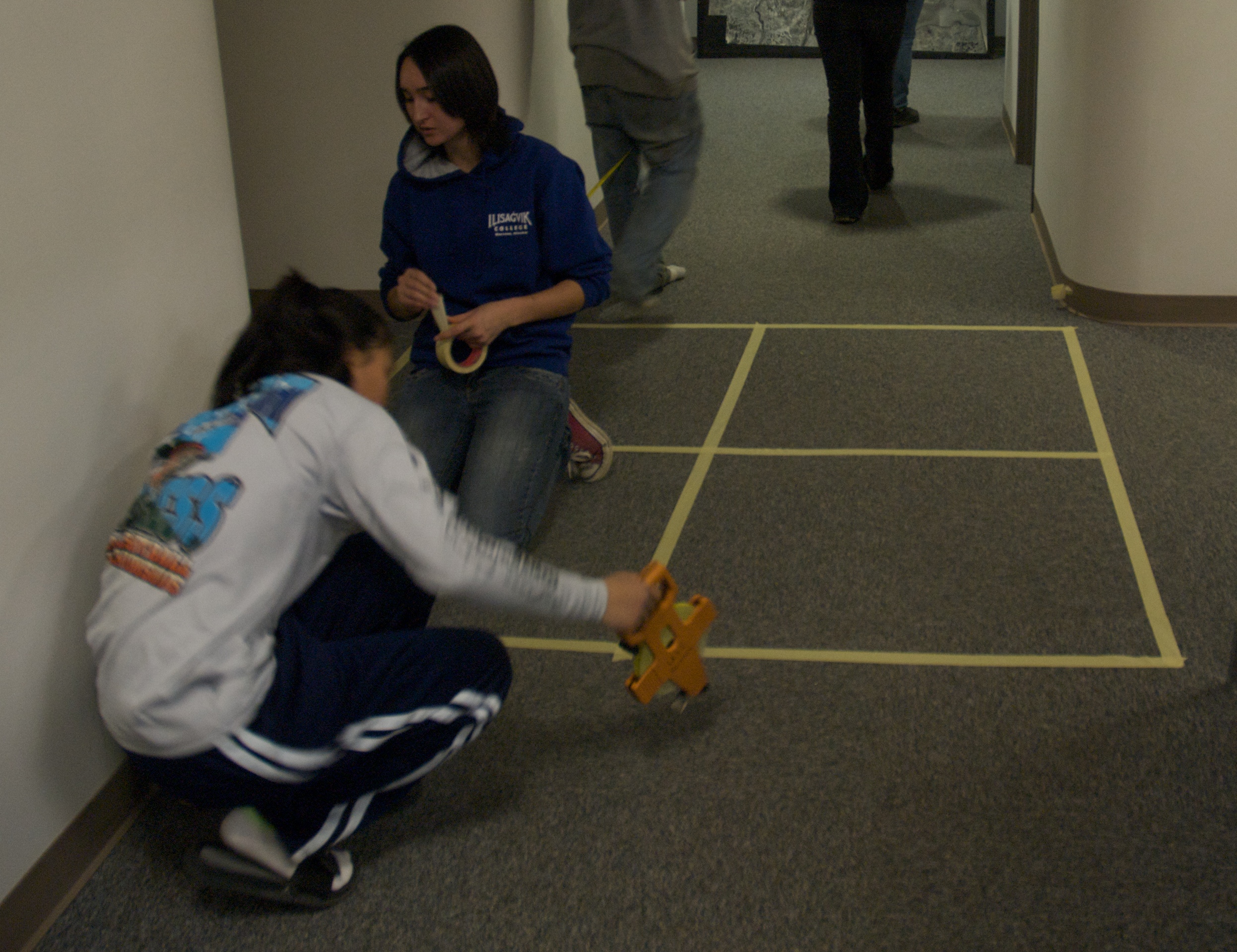
The exercise goes like this.  We lay out 2 2m x 2m units with masking tape on the floor (learning how to do units with hand tapes and geometry).

Nora and Victoria lay out a 2 x 2 on the hall floor.

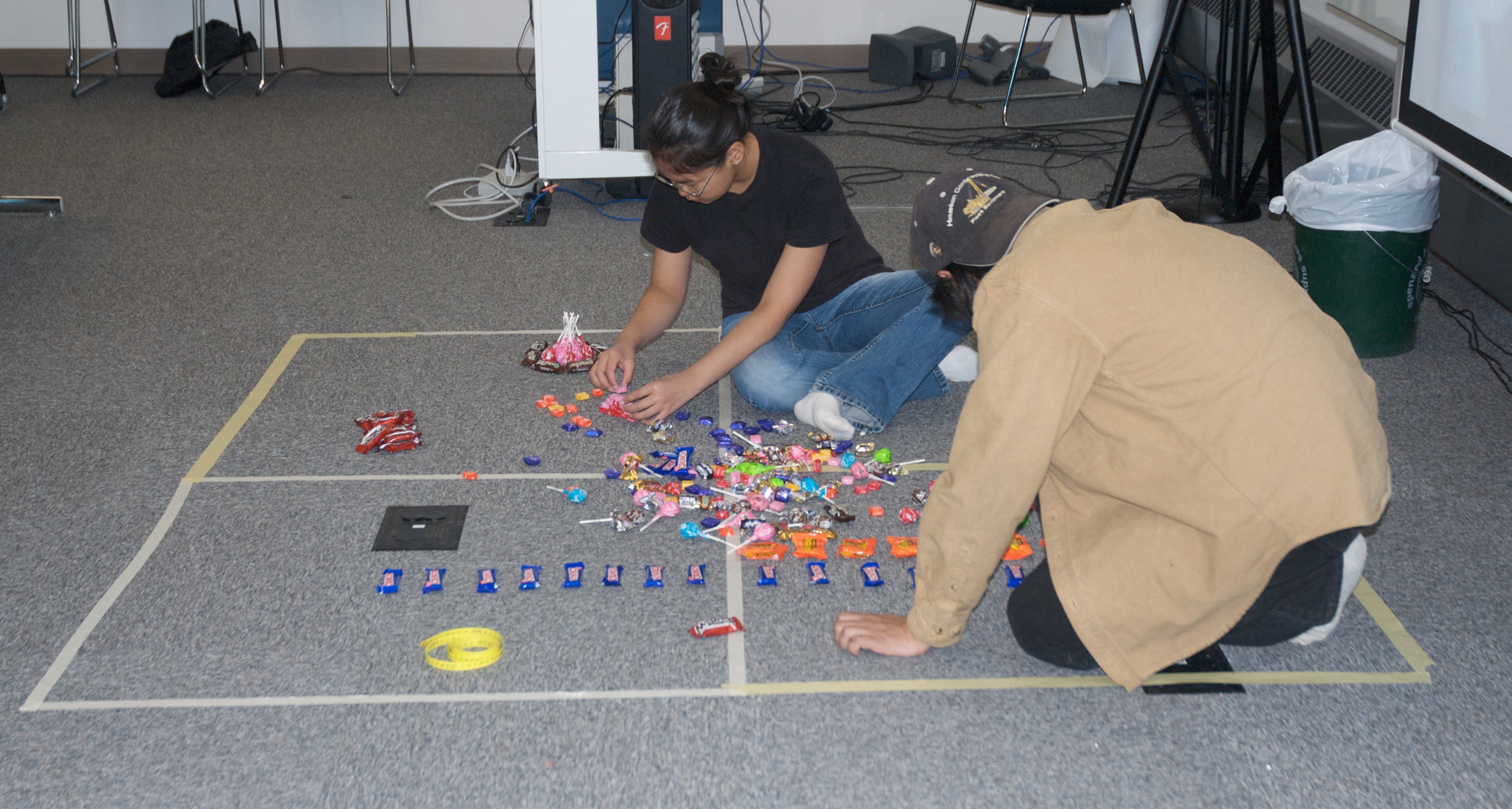
Then, two crew members who already have archaeological experience get to be the “actors,” which involves getting a big bucket with all sort of candy in it, and doing something in and around a 2 x 2.  They can talk about it beforehand, and they can do whatever they want, talking or not.

Trina and Heather start making something for the newbies to figure out!
Flora and Ron create a site from candy in the conference room.

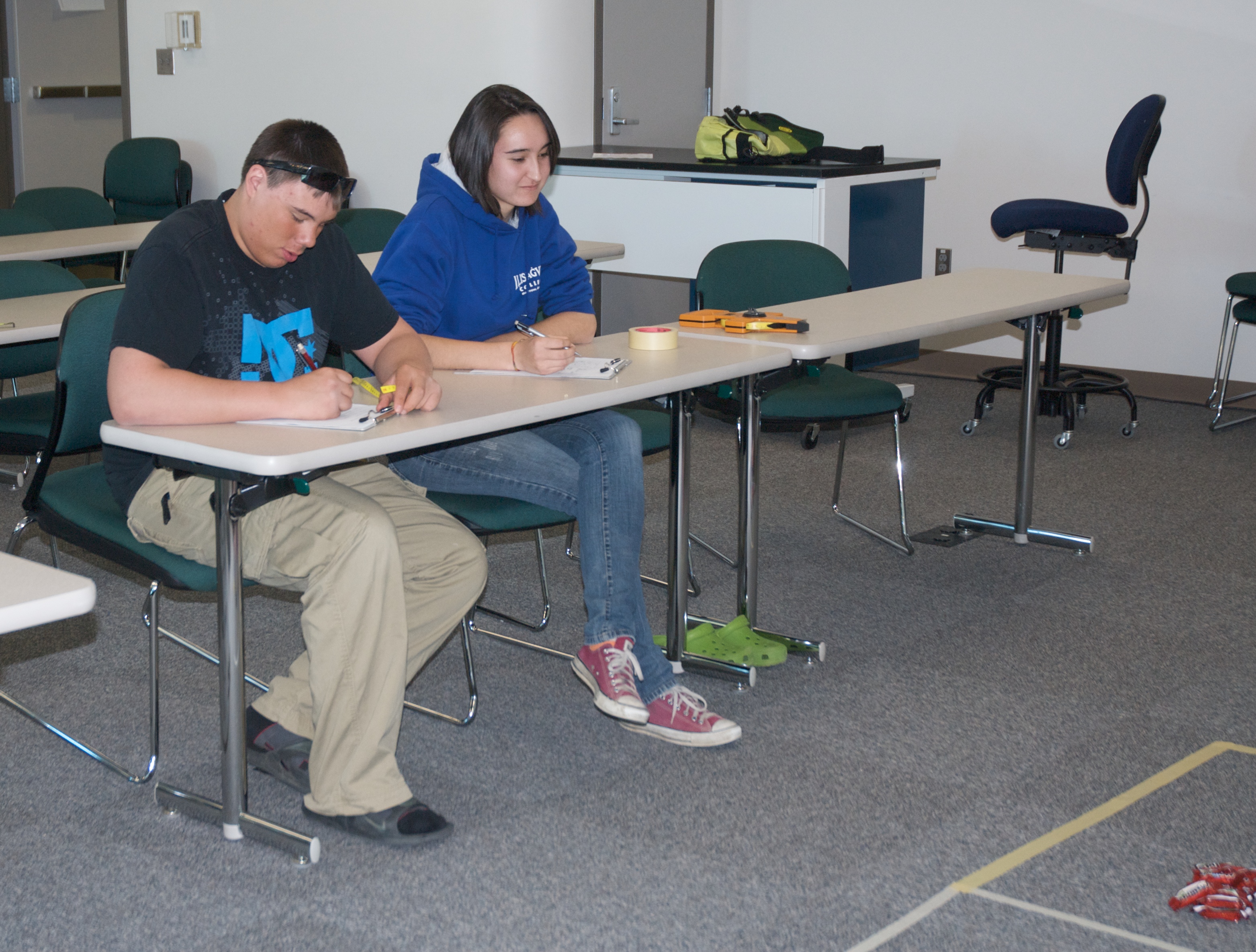
Meanwhile, the newbies are divided into two groups.  Each group is assigned to one of the 2 x 2s, where they have to act like ethnographers, recording what they see the “actors” do and say.

Warren and Victoria play ethnographer.
Nora carefully records what Heather and Trina are doing.

Then the newbies swap places and practice mapping the site that they didn’t see being made, as an archaeologist would.  We give them a bit of information on the kinds of choices (piece plotting, sketching, classifying things by color or type of candy, etc.) that they might need to make and why, what they need on a map (scale, key, North arrow) and let them figure it out.  More experienced students help them with the mechanics, which makes a good review for them.

Nora draws a map, while Trina & Heather give advice.
Ron gives some pointers on mapping to Victoria and Warren.

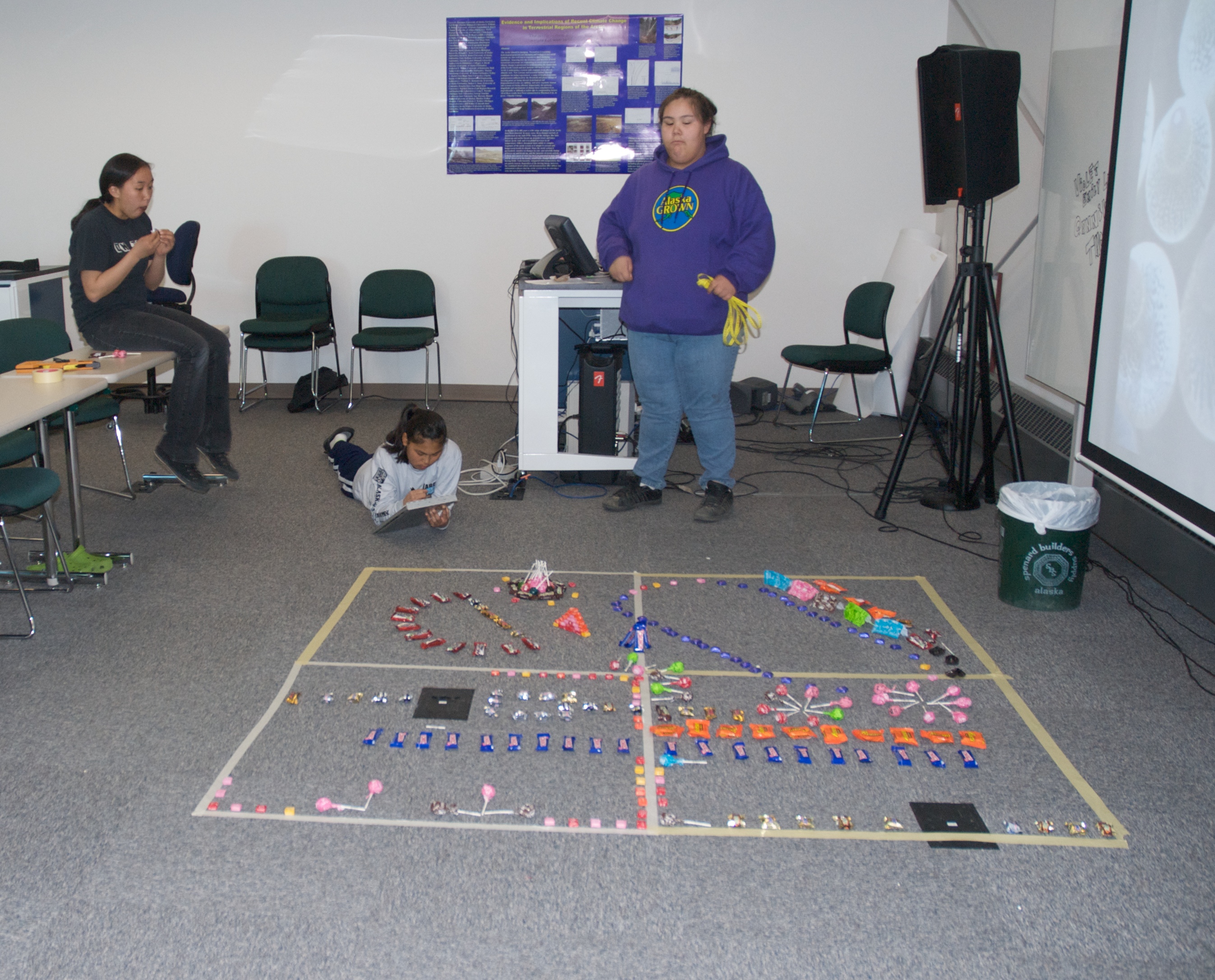
After that, we all get together, and I put up a picture of a “site” on-screen (digital technology is great for this!) and the “archaeologists” describe what they saw, and what they think it can tell us about the activities at the site.  Then the “ethnographers” add what they saw, and we talk about how it can enhance (or change) the interpretation possible through material culture alone.  Finally, the “actors” tell us what was REALLY going on!

The exercise seems to get the general ideas about the possibilities and limits of archaeology and ethnography across to the students fairly quickly, without lots of jargon.  It also shows them a lot about the point of recording proveniences accurately, and the difference between doing archaeology and just digging for artifacts.  The candy makes it fun.  And, we get to have the leftovers for pick-me-ups in the field!

First Day in the Field!

As usual, things were a bit disorganized getting ready to go to Nuvuk this morning.   However, after rounding up a non-leaking pump, gassing up 5 of the ATVs, buying bungee cords (the many folks who had gotten all the field gear from last year out had somehow not noticed the bungee cords had gone missing), airing up a couple of tires, etc., we set off.

After getting to the site and orienting the newbies, we put all the gear into the proper tents, gave the lesson on how to make up a honey bucket that is unlikely to fail in transit (they have to be backhauled to a proper disposal site), and set off in a line, pin flags in hand, to survey the site.  We located one burial during the survey (exposed by recent vehicular traffic, alas) and spent some time getting driftwood to block off and reroute the trail until we can excavate the person.  We also located a number of features, and a few loose teeth.

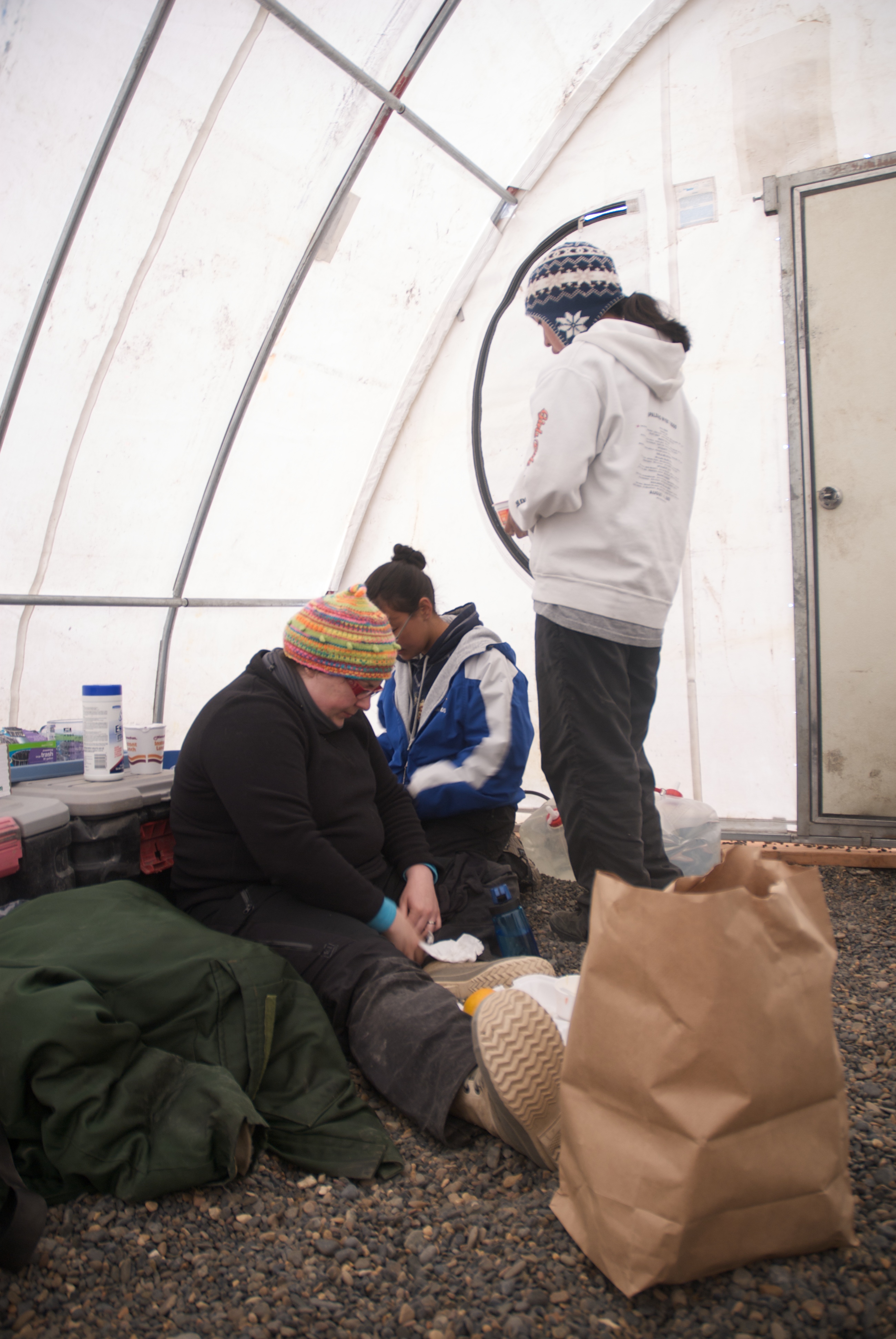
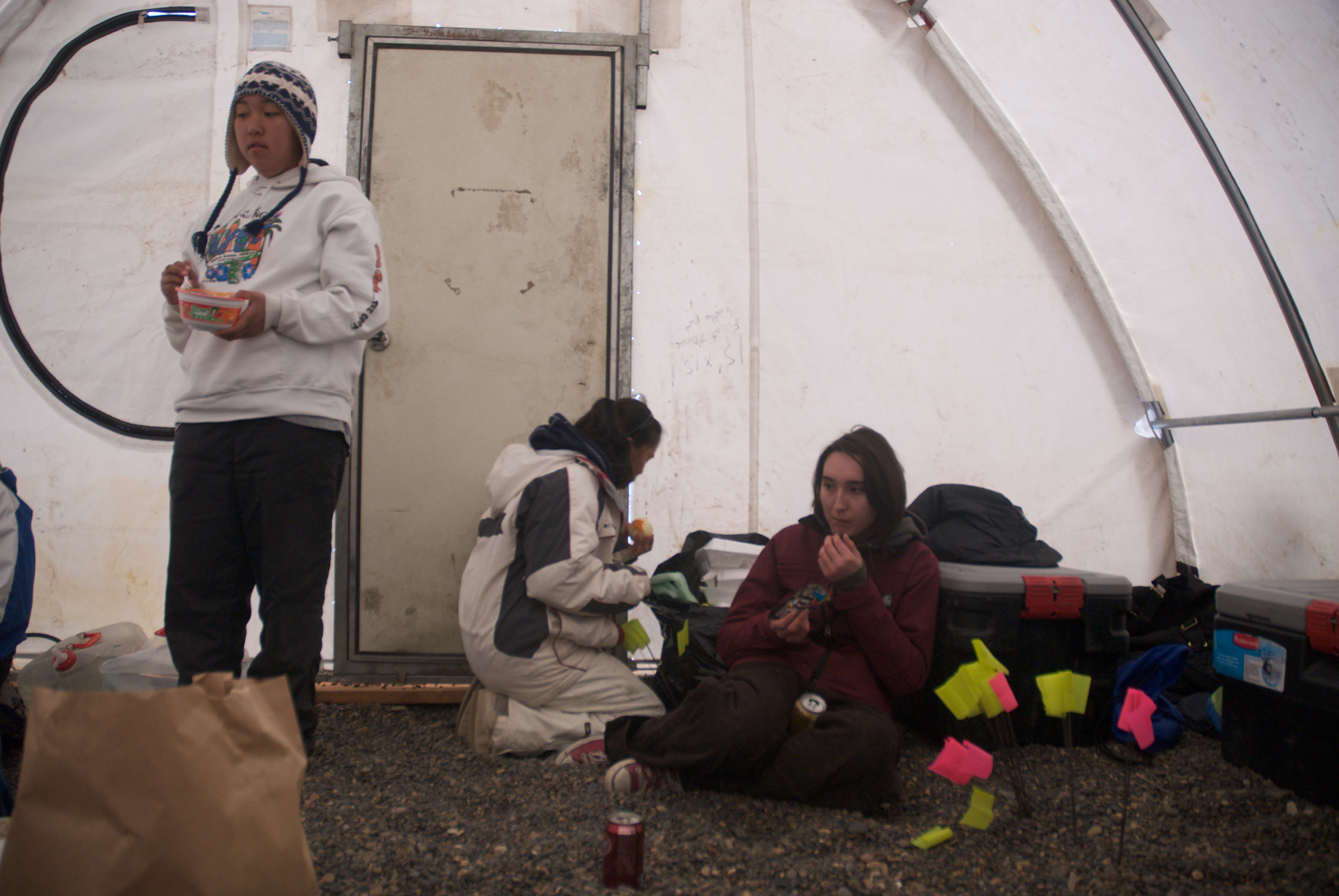
Then it was time for lunch.  We have a relatively small crew this year, so the tent felt quite roomy.

Laura, Flora and Trina get their lunches ready.
Trina, Nora & Victoria have lunch in our spacious Weatherport.

We took the usual hour for lunch (Rochelle actually caught a nap), and then we went back at it.  It started raining, and kept it up until just before clean-up time.  Everyone was well dressed, and since the wind was WSW, it wasn’t too cold.  The NWS had called for rain or snow, and we’d all be hoping for snow if anything, since it is less wet AND makes for better pictures.

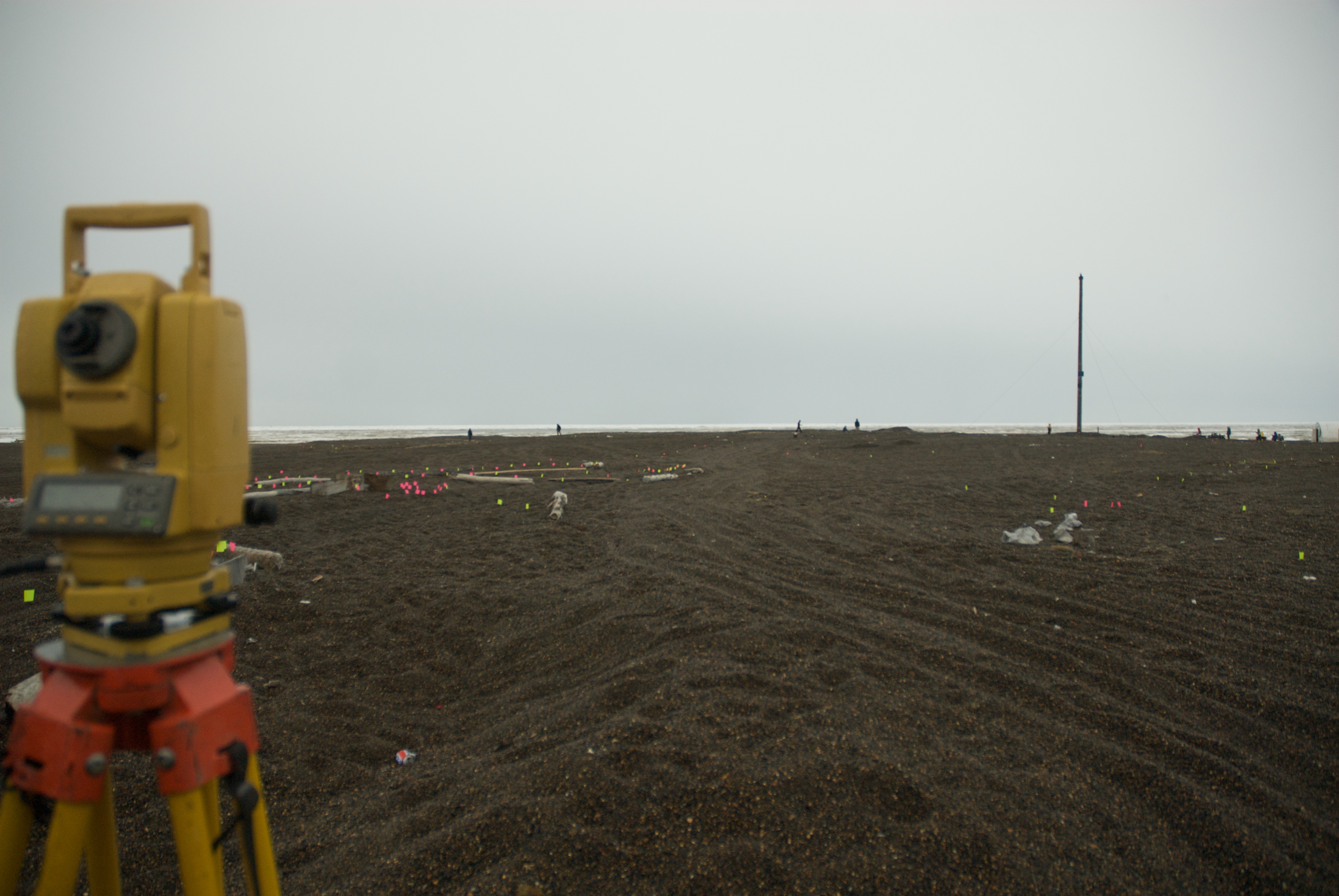
Flora and I set up the transit to shoot in the locations of the burial and some artifacts near it.  We are moving from the primary datum we have used for many years, because erosion is approaching and we will lose it in the near future.  Fortunately, the work we had done last summer setting up paid off and everything went smoothly.  We need to mark a couple of the additional datum points tomorrow so they are easier to find.

View from transit station over the area we will be working in this season.

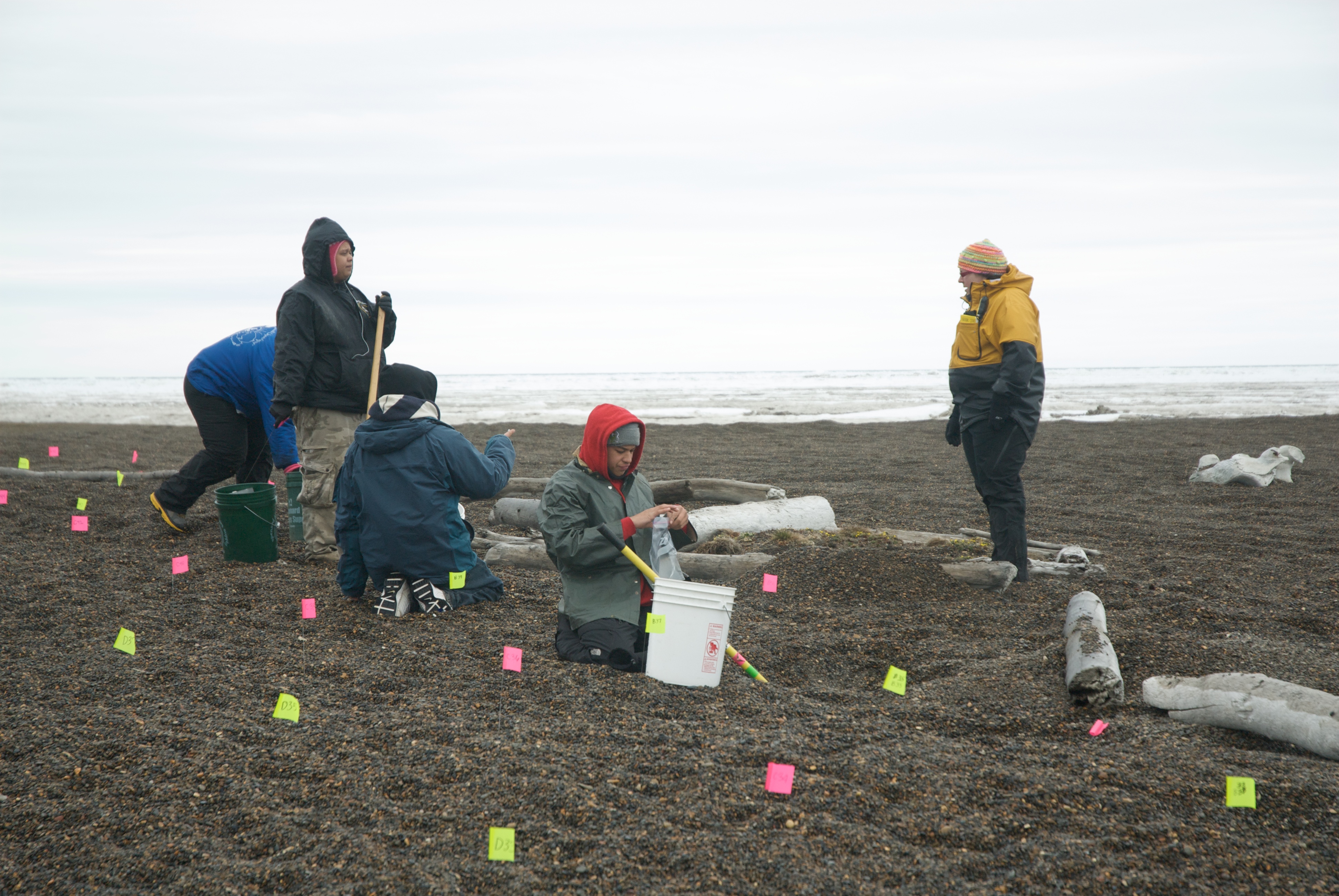
The rest of the crew laid out lines of shovel test pits, and soon Nuvuk was festooned with lines of bright pin flags.  We had to dig some of the STPs (shovel test pits) quickly, as they fell on the trail, and we needed to clear that area so people don’t start diverting into untested areas.

Part of crew hard at work among the pin flags.

Flora shot in the STPs, and Brody backfilled about 20 by himself.  Then we packed up, rather quickly for the first day, and headed back in.  We didn’t see any bears all day.  A couple of hours later, all data is downloaded and backed up, everything is on a charger that needs to be, my houseguest and husband have been fed dinner, and I’m going to bed.

So you want to do what to the tundra?

Heat it, it turn out.  The Department of Energy has some experiments running in the lower 48 (that’s the Continental US for you non-Alaskans) which involve heating small patches of land to see what the effects of global warming might be.  Better than just wait and see, no doubt, and it would give some guidance about adaptations that might work.  Anyway, they are thinking of trying this on the North Slope.  For the moment, they just want to test the proposed method in a very small area,less 30 m in diameter.  (A meter is just over a yard, about 39 inches, for those who forgot about the metric system when they left school).

Barrow has many wonderful things, including the Barrow Environmental Observatory, which is 7466 acres of land set aside by the Ukpeagvik Inupiat Corporation, the Barrow village corporation (more about that some other time) for scientific research.  It is actually zoned as a Scientific Research District by the North Slope Borough.  That’s where DOE wants to test this.  So, a plot had to be located.  It needed to be near power and a trail.  Craig Tweedie of UTEP, an ecologist, found a spot that seemed fit the bill, which had been disturbed in the past by tracked vehicles called “weasels” which NARL scientists used to use to get around on the tundra.  Now everyone walks in the BEO when the snow is melted, unless matted trail is put down.  The idea with a disturbed site was that it wasn’t much good for other research, so it’d work for testing the warming equipment.

The next question is if there are any cultural resources (archaeological or otherwise) on the site.   Since I work for the company that owns the land, that’s part of my job.  Normally we’d wait until later in the summer when the ground is thawed more and the Nuvuk field season is over, but they’d like to try  to install the equipment soon.  So I went out this afternoon to look at the place for the first time and see what was what.  There were a few pictures, but I guess archaeologists look at things differently.

I had a GPS location for the center point, so I programmed it in, got a 30 m tape and pin flags, and set off.  First I drove to a pull-out on Cakeater Road, parked the truck, and took a half-mile or so hike into the BEO.  There is boardwalk part of the way, and matted trail goes right past the site, although it isn’t very level, since the tundra it is built on is fairly lumpy and shifts a bit over time besides.  However, it’s been such a late melt that a lot of parts of the trail were under water, so I had to do all this in Xtra-Tuffs & rain bibs.  I’ve been coming down with something the last few days, so I really just wanted a nap, and wasn’t exactly looking forward to this little excursion.  Luckily, the sun came out for what seems like the first time in days, and it was actually fun, although I took an amazingly long time to do it.  Then I had to turn around and hike back to the road :-(.  There were lots of birds around, and the buttercups and willows were in full bloom, so  all in all a good day.

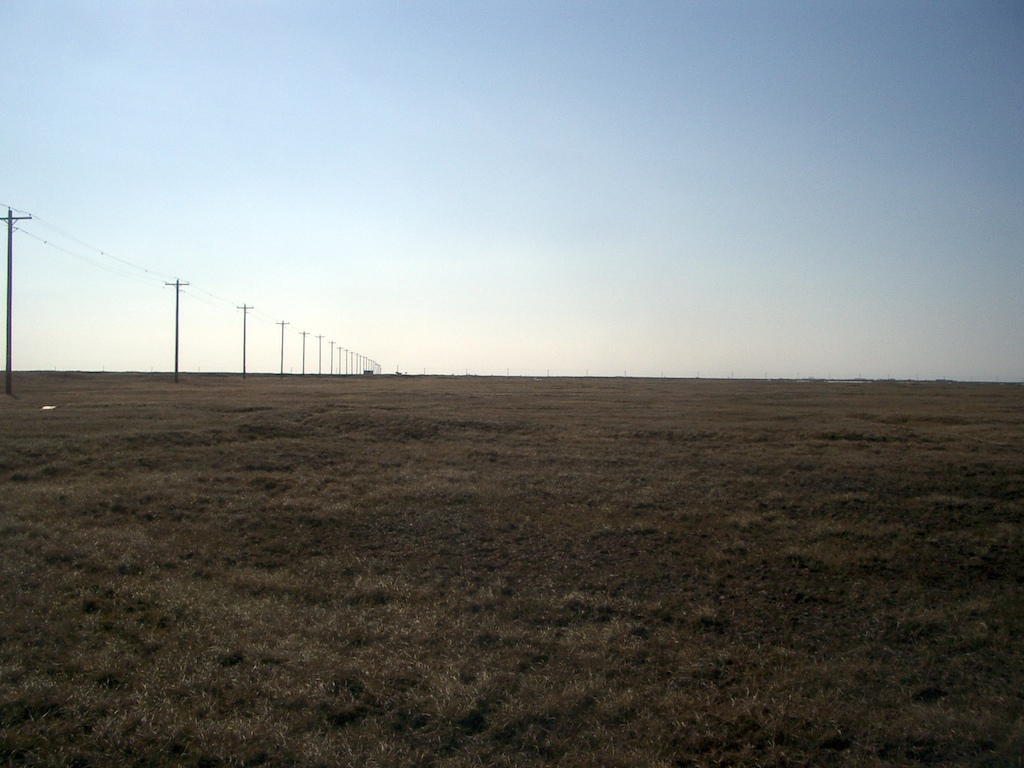
Looking back toward Cakeater Road from the site. My truck is the teeny-tiny thing at the end of the power line.

Once I got there, I put some chaining pins into the center point, and ran out a circle around it with a 25 m radius.  The actual equipment is going to be a hexagon with about a 25 m max dimension, so this gives room for construction and a little wiggle room.  I walked the whole thing in really close transects, much to the annoyance (verging on hysteria) of a shorebird which must have a nest nearby.  Based on this inspection, it looks good for the tundra warming experiment.  The only evidence of human activity on the site was the aforementioned weasel tracks, a crushed 55-gallon drum, and a flattened tin which probably held Blazo once.  The area was pretty damp, and there was higher, drier ground nearby, so it’s unlikely to have any significant pre-NARL activity when we test.

The tundra near Barrow (with my tape stretched out).

Pizza & baklava, and so to bed.

Living where you work has its down-side

Unlike most other Arctic archaeologists, I live where I work.  My house is less than 10 miles from the site I am currently working on, and there are other sites closer than that.  In general, that’s a good thing, and I wouldn’t change it for the world, but like so much else in life, it’s not an unmixed blessing.

PROS OF LIVING WHERE YOU WORK

  • Community members can take part in all parts of the project, and can find you to ask questions whenever they want.
  • No long expensive trips to get to the field.
  • Logistics can be arranged before the field season, by talking to people you know or making local phone calls.
  • Gear doesn’t have to be shipped to and from the field, at great expense.
  • If you run out of Ziplocs during the season, you can get more at the grocery store (assuming they haven’t run out, of course.)
  • The artifacts get to the lab every night, after a short trip, and can be treated and stabilized quickly if necessary.
  • The artifacts stay in the community.
  • You get to sleep in your own comfortable bed.
  • You get to cook meals in a real kitchen and go to restaurants, instead of having to eat only things that everyone else will eat too. (Arctic archaeology is hard work, and camp cooking can’t get so far off the beaten track that some folks won’t eat it.)
  • You have access to laundry equipment.
  • You’ve got your professional library handy if something unexpected shows up.
  • You have a good computer and internet access.

CONS OF LIVING WHERE YOU WORK

  • No long expensive trips to get to the field, so people can’t understand why you can’t take a day off during the field season, or don’t want to run out at midnight to see some archaeology they just found.
  • You get to sleep in your own comfortable bed (so you stay warm and can’t eat unlimited amounts of fat and sugar and still lose weight during the field season, so you have to exercise & watch your diet the rest of the year 😦 ).
  • You get to cook meals in a real kitchen (which means you have to cook and clean up, even if you’re exhausted.)
  • You have access to laundry equipment (which means you are expected not to wear the same clothes for 6 weeks, or at least to wash them frequently if you do, so you don’t get out of doing laundry.)
  • You’ve got your professional library handy so you feel like you should be writing professional material in your spare time.
  • You have a good computer and internet access so people expect you to respond to all email just as fast as when you’re not in the field, as well as doing all the work-related tasks you do then (like approving time sheets, etc.).

As you can see, the cons are pretty much personal convenience things, and being here makes the archaeology better and makes it possible to involve local high school students in a way that would be impossible if I didn’t live here.  Aside from the time away from home and school issue (not a minor one with high-stakes testing), no funding agency would pay for a bunch of high school students (& chaperones) to spend weeks somewhere else so they could be part of the lab work.

Right now, I’m trying to get as much “housekeeping” type stuff out-of-the-way, both at work and at home, as I can before the fieldwork starts on July 5.   No way I’m going to get through the to-do before the field list.  Oh well.

Labwork–A necessary evil?

You never see Indiana Jones doing labwork.  Of course, you never see him taking notes, either, so perhaps one should not take the good Dr. Jones as a guide to good archaeological practice.

In fact, for projects which involve actual excavation of a site (presumably thereby giving rise to a collection of artifacts and other sorts of physical data such as C14 samples and faunal remains), far more time will be spent in the lab than was spent in the field.  Labwork is a necessary and important part of archaeology.  After all the time and energy spent in the field finding, recording and excavating things, it would be a real pity to just let them deteriorate for lack of cleaning and care, or get mixed up and lose their proveniences because they weren’t properly marked.  Then things need to be cataloged, with field IDs checked and expanded on, and the data needs to get into a database so that more detailed analysis can happen without having to root through the entire collection to find things.  No labwork = chaos.

The thing is that many of the activities which have to be done in the lab just aren’t that exciting :-(.  For example, cleaning things is not on most peoples’ Top 10 Things to Do list.  We actually had almost everything cleaned from previous seasons, so there hasn’t been any of that yet.  When it happens, it often involves very slow and fiddly removal of gravel, dirt and roots by the gentlest means possible.  Sometimes artifacts are so delicate that complete cleaning can’t be done at once, or sometimes at all without the help of a conservator (of whom there are only 2 in Alaska, both at museums).

Our first big task was marking & cataloging, which generally happens after the cleaning.  This is really important, and important to get right.

Ideally, all items collected at a site are put into containers (usually Ziploc bags of some sort) or tagged (if they are too big to go in a container) with information as to site of origin, location of find, level and excavation unit they were found in, date found, and who collected them clearly written on the bag or label.  The idea is to assign each item (or group of small items like flakes or fish scales) a unique catalog number.  The information about that item goes into the catalog, and the item is marked with the catalog number.  These days, the catalog is usually a database on a PC, which is a huge improvement on the index cards that were in use when I started, or even the mainframe-based databases which came in shortly after that.

That way, if later an archaeologist decides they need to look at all the harpoon heads, say, from a site (or even many sites), they can be retrieved, and spread out in the lab, grouped and regrouped endlessly, and still not get mixed up or lose associated information.  When the analysis is done, everything can get back where it belongs.  New information from the analysis can be added to the catalog.

People used to just mark on artifacts with ink, often with a layer of clear nail polish or White-Out as a base coat, and a clear nail polish cover coat, but that wasn’t stable or reversible, and the idea today is that nothing should be done to an artifact that can’t be reversed.   We have used Paraloid B-72 dissolved in acetone as base and cover, with the catalog number written in India ink or white ink with a quill pen for years.  However, there are not a lot of people who can write a hand that is both tiny and legible.  The schools stopped teaching penmanship at all and started kids keyboarding very early, so they don’t really get practice.  We went to a system where the catalog numbers are printed on very thin archival paper, which is dunked in the Paraloid and then stuck to the artifact in an unobtrusive (one hopes) spot.

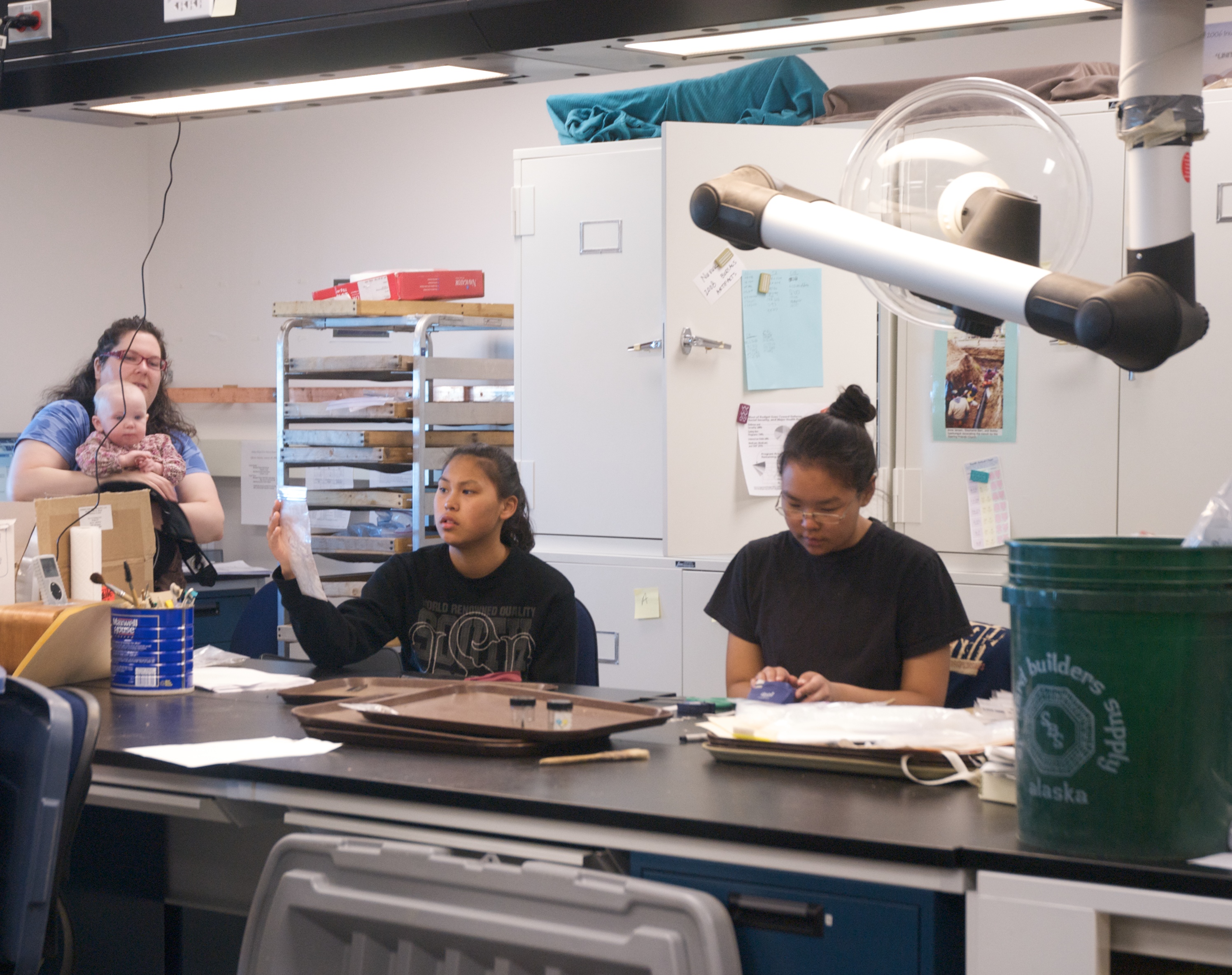
Nora selects artifact to mark, while Flora makes cabinet labels, while Laura & Violet "supervise".

We had some major struggles at first, with the Paraloid bubbling and making everything illegible.  We finally realized that the only thing that had changed was a move from a lab in a 1968 building to the new lab in the BARC, which is supposed to be very energy-efficient.  It is also extraordinarily dry.  One day a woman checking the air flow on the fume hoods measured the relative humidity in the lab, and got 3.8% (not a typo!).  I think the Sahara desert is more humid than that!  We realized the acetone was evaporating so fast it was making the bubbles.  We are now running one house-size and two room-size humidifiers in the lab, and the bubbling problem has gone away.  This method is proving very fast, with the only challenge being to get the right label on the right artifact.

However, it isn’t really that exciting, and can get repetitive, which can lead to people getting tired and therefore careless.  Like most labs, we try to have people work as a group, although each person is working on their own.  It is possible to label and talk at the same time.  We’ve got an iPod speaker for tunes, and so far there seems to be enough overlap in musical taste on crew that no-one has had to resort to ear plugs.  Like pretty much everyone in archaeology, I’ve spent a lot of time marking and cataloging artifacts, and while time doesn’t usually fly, I can tell you it goes a lot faster when you’re having fun.

Once the artifacts are marked, the catalog info is checked and they are put into cabinets, with the storage location entered into the catalog.  In the field, we tend to use quart (“small”) and gallon (“large”) Ziplocs, because they are easy to get, less expensive and too many sizes makes life complex.  Most artifacts don’t really need that much room.  We are moving the artifacts into the smallest possible archival bags they will fit in, and this is saving a huge amount of space.  Particularly nice artifacts, which visitors want to look at, are getting special containers.  They get individual beds of ethafoam, inside clear plastic archival boxes with lids.  Ron Mancil, a crew member who is currently a MA student at UAF, has museum experience and is very handy as well.  He has been applying his skills to making mounts for a bunch of artifacts, so visitors can get a closer look without endangering the artifacts.

Ron hard at work making a mount for a special artifact

It’s true that a lot of what happens in the field isn’t all that exciting either, as you will see in the next post or two.  But there’s always the possibility that something really cool will show up in the next shovel test pit (STP) or the next one, or the next one…

Public Meetings & Archaeology

For the 2nd Tuesday evening in a row, I was at a public meeting being held by a NSB Assistant Borough Attorney, who is working on the monumental task of revising Titles 18 and 19 of the North Slope Borough Municipal Code.  These Titles deal with permitting and land use, including issues affecting cultural resources.  She’s certainly trying to do a good job, and the people who came had good input.  Unfortunately, it’s been pretty nice weather both nights, so turnout was light.

Since I’m one of maybe 3 archaeologists resident in Barrow, and the others were otherwise occupied (well, I did bring Glenn along this evening), it seemed like it was pretty much my duty as a concerned citizen to go and make sure the attorney is aware of issues that she might not have thought of.   Many more meetings in all the villages and more drafts and Planning Commission and then NSB Assembly need to pass it before anything really comes out of it, but at least there is some progress.  I certainly hope so, since otherwise I might have finished a piece of needlepoint I’ve been working on for 6 months.  Maybe tomorrow…

I nearly forgot…

…that I had originally gotten a North Slope Borough development permit for the Nuvuk Archaeological Project that expired in September 2009.  At the time I applied, we only had funding for the 3 years, so that seemed reasonable.  We’ve been fortunate to get additional funding, which has let us do at least one extra season.

However, that means that technically we need a new permit (or at least the old one extended/renewed).  I know, it’s not development, but it is a ground-disturbing activity, and that what the NSB calls all permits.  At least they have a permit system that actually covers such things, unlike some places.

Anyway, once I noticed the oversight, I spent the rest of Friday getting all the paperwork and backup together for BASC to take over to the Planning and Permitting Department.  I think everything they need is there, and since it is a renewal, I hope  it won’t be a problem for them.  They do have an extension sort of category.