Back to the Drawing Board

I’m trying to figure out a way to do at least a little fieldwork at Walakpa this summer.  I’ve got a proposal in for major fieldwork (3 field seasons) but decisions aren’t made yet, and even if it is successful, fieldwork couldn’t start until next summer.  That’ll be great, but there is a remote possibility that we could have another storm as big as the one that took over 11 meters of the deeply stratified deposits last Labor Day weekend.

Sites like Walakpa, with deep, frozen layers with good organic preservation can be seen as a special type of Distributed Long-term Ecological Observing Network of the Past.  In addition to the artifacts and structures left by past humans, these sites contain residues of human subsistence activities, in the form of stratified layers, often several meters deep and spanning millennia, of the remains of animals and plants gathered from the surrounding area. These remains are samples from past ecosystems that cannot be replicated, absent the invention of a working time machine.  A column sample from such a site is similar to an ice cores or a lake or bog core, with the addition of samples from a wider area.  It can tell us all sorts of things about the environment through time when analyzed with the right methods.  Information about how environmental change affected important subsistence species would be incredibly useful for those attempting to manage such species in today’s changing environment, and thus important to the food security of Northern residents.

Unlike ice cores, there is no elaborate infrastructure set up to collect and preserve such samples.  We really want to get a column sample from top to bottom of the site, just in case the worst happens.  It will only take a small crew, and maybe a week or so, since the bluff should be thawing in from the side as well as from the top, making excavation faster.

It looked like maybe it would be possible for the North Slope Borough Department of Iñupiat History, Language and Culture to run a camp there, which would have let students be involved.  I was writing a grant application to try for support for food, fuel and transportation to the site for that camp.  On Friday, we learned there was a conflict, so now I am trying to figure out another approach.  It is looking like it may need to be a volunteer effort, since most quick turn around funding sources don’t pay salary :-(.

If anyone has any ideas, or might be willing to volunteer to help out (digging, loaning camping gear, moving stuff to or from the site, camp cook, basic lab work afterwards), or would be interested in analyzing data from the site, please let me know.  This site is really important both a a part of Iñupiat  Heritage and a source of long-term environemtal data.
Back in Barrow

And just in time, too, since Fairbanks went into the high 80s on Saturday!  I had to get up around 3:30 AM to catch a flight to Anchorage to catch the flight to Barrow (definitely the long way home).  It was amazing flying into Deadhorse.  Water everywhere, and the Dalton Highway and some other roads gone in spots.  A whole lot of the snow in Barrow had melted too, but amazingly the roads are OK.  The Tundra Garden is emerging from under its snow cover, and flocks of redpolls have showed up to join the snow buntings.  I didn’t get much done the rest of the day except resting and a little mindless spring cleaning.

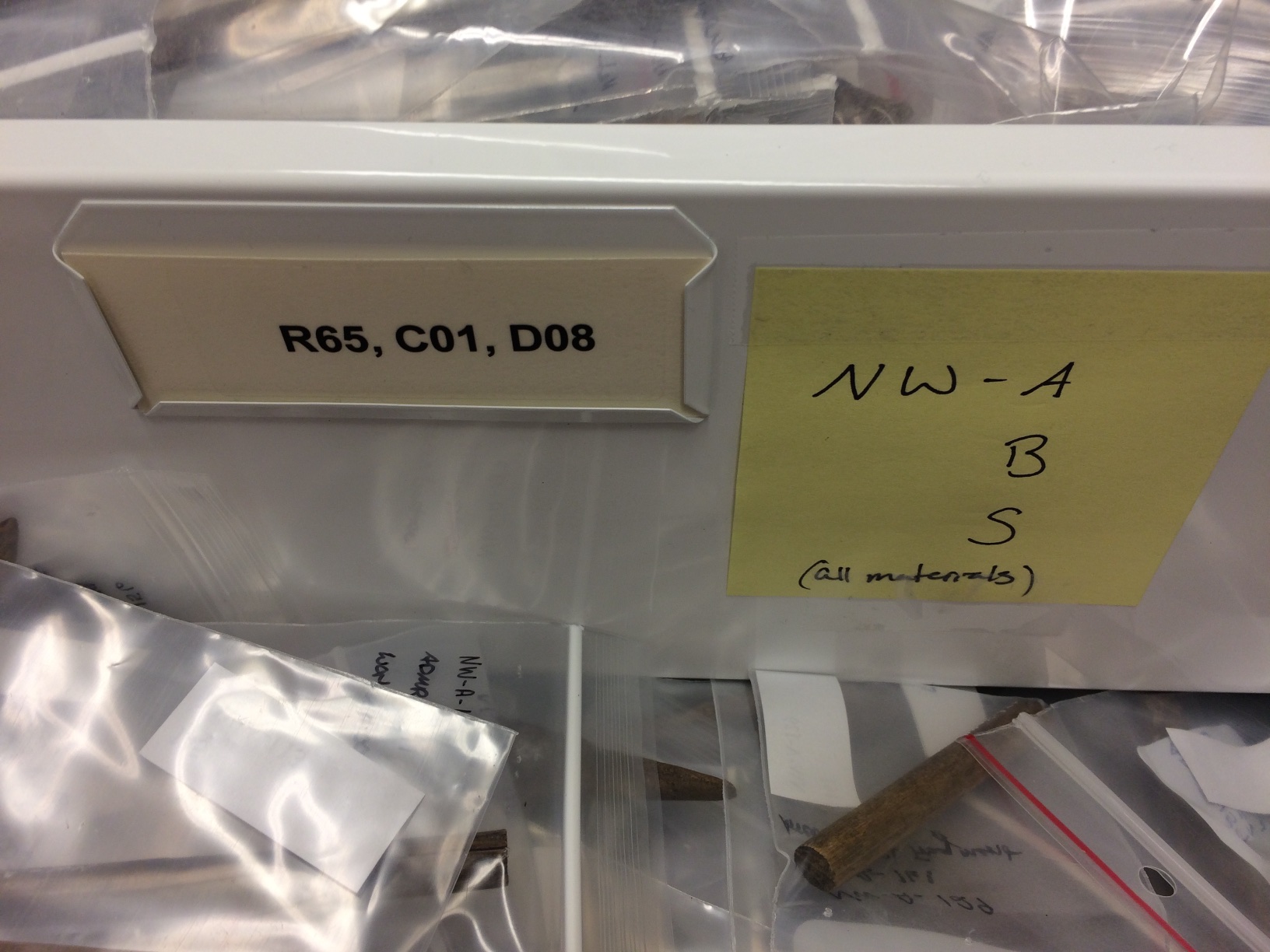
We looked through a huge number of drawers.  The older collections have little or no faunal material saved, so we needed to find worked bones, or in a pinch, artifacts  (preferably broken and non-diagnostic types with many examples) that were definitely made out of walrus bone.  That info wasn’t usually in the catalogs, so we just had to look. Some of the drawers were really full.

Drawers at the University of Alaska Museum

In the end, we have several hundred possible samples (plus associated caribou or wood samples for paired radiocarbon dates since marine mammals like walrus don’t give accurate C14 dates without a correction factor).  Now I need to figure out which may be from the same context, so we can look at them as a group and try to eliminate duplicates.

I’ve finished most of the bookkeeping paperwork that goes with any research trip, and will do the rest on Tuesday at work.  I hear there are a number of applications out for the internships, so I’ll be working on getting interviews done and hiring people as soon as possible.

In Fairbanks, looking for walrus

After a rather long, drawn-out saga, everything is in place and I can draw on funds so I can work on the WALRUS project.  The delays have been really frustrating for everyone involved.   Once I get the interns on board in Barrow, we’ll get back to going through the faunal material we have there for walrus samples.

We are trying to get samples from a wide range of sites.  Since the sampling is destructive, we don’t want to use artifacts if that can be avoided.  Ideally we want  unmodified walrus parts, bone or tooth, or if we can’t get enough of them, manufacturing discards.  As a fallback, we may wind up sampling things like shovels or bola weights, assuming we can get the museum’s permission, since they are common types of artifacts, and not diagnostic (or something that is likely to be displayed).  We currently can’t use tusk parts, since there have been no modern studies to compare their chemistry to that of bones and teeth, so interpretation of results would be problematic. (If any carvers would be able to contribute some scraps from tusks along with a sample of bone and/or a tooth from the same animal, it would be a really big help).  We are also looking for caribou or some terrestrial plant material from the same place in the site for radiocarbon dating, since marine mammals incorporate old carbon and the dates are hard to interpret.

More recent archaeological projects tend to have excavated faunal material in the same way as everything else, with decent stratigraphic control, and also tend to have brought it back from the field.  However, in the early days, that was not often  the case.  Even if material was brought back, it often wasn’t cataloged in any detail, so reports are almost no help in figuring out if there is any walrus to be had in archaeological collections.  A bit of walrus shows up in catalogs, but most of it is in the form of artifacts.  A lot of walrus artifacts (particularly bone, since ivory was clearly an item of trade) suggests that the inhabitants of a site were hunting walrus, so the potential for walrus parts to exist in the collection is there.

Many of the classic sites on the coast of  Alaska have strong indications that walrus were being caught by the people who lived there, but they were excavated decades ago, and finding suitable samples in the collections was not something that could just be done by getting someone to pull a particular bag or catalog number.  It pretty much requires looking through mixed lots of artifacts and bags of bones.  So I’m in Fairbanks doing just that.

We are mostly working in the museum, but it is closed on the weekend, so we got  permission to bring a collection of faunal material to the PI (Nicole Misarti)’s lab, and we went through it yesterday.  It took some doing, but we got though it, and should have plenty of samples.  It was an adventure.  We had 24 boxes, most of them full of bags like this:

Nicole holds a bag from which the bones on the tray burst forth when she took it out of the outer bag.
Nicole holds a bag from which the bones on the tray burst forth (like a scene from Alien) when she took it out of the outer bag.  Sadly, these were almost all ringed seal parts.  Other bags from that box are on the right.

Not all of the bags were correctly labeled, or at least the labels often didn’t specify species, just element, so we had to look.

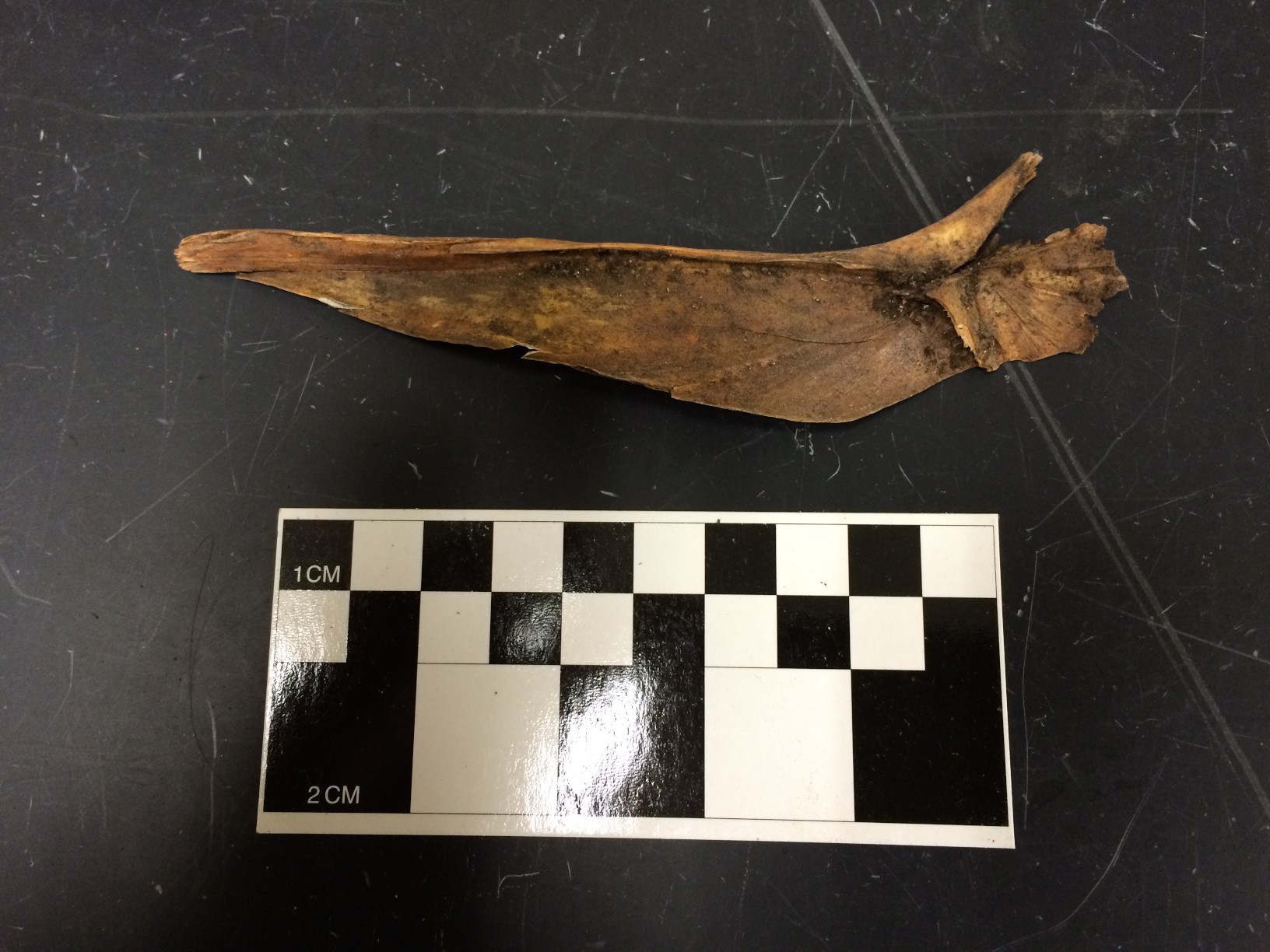
We found a few other interesting things in the process, including this really large fish bone from Point Hope.

Really big fish bone.
The other side of the really big fish bone.

I’m pretty sure it’s some sort of cod (Gadid) but exactly what sort?  It’s really big.  If I have time, I’ll talk to the curator of fish, but the mission is walrus samples at the moment.

Summer archaeology internships

It took a while to get everything in place, but we are ready to start taking applications for summer internships in archaeology through Ilisaġvik College! They will involve learning about laboratory work and participating in some interesting and important research on walrus in the past.   It will help prepare you to participate in some fieldwork that we hope to have coming up this summer and/or next, and you can also earn college credit.

I’ll be in Fairbanks working at the University of Alaska Museum on selecting samples from the collections there for the next two weeks.  In the meantime, you can get an application packet from Susie Stine (852-0921).  I’ll be interviewing the week of May 25 (not on Memorial Day) so get your applications in.

This is probably best for people who live in Barrow, since there is no housing with this internship.