The slog continues…

I am still plowing through the literature seeking out information on C14 dates.  Some of it is really hard to come by, with a date attributed to a house but no  information on the sample, either what it was or where it came from.  Then I look at the information on the artifacts from that house, turn to the plates (not naming any names here, but there are multiple offenders) to look at the artifacts, and see that the plates say they are from a house nearby.  Obviously either the text or the plates are wrong (unless they both are, but I’d rather not go there), so now one is left quite unsure of what was really being dated, and what sorts of artifacts were actually associated with that date.  Cross-dating based on artifact assemblages takes another one on the chin.

Another example from today: a date on wood and skin (what kind? caribou, seal, polar bear?) from a burial for which the description seems to indicate that it was only a few baby teeth!  It’s one thing to have typos in a dissertation, but in published books that people are expected to pay money for?  If people don’t read carefully, and compare about three different places in the book at once, it’s all too easy to accept a date at face value and assume that what is said about what it was found with is correct.  Then it gets mentioned elsewhere, and people read it there and pass it on, and so forth.

Such dates do not get high scores for context or association with the event being dated.  Actually they get zeros, since those factors are unknown.

All this in aid of a handbook article (well, two articles, since this C14 stuff should make an article as well).  On the other hand, a number of people say it should be useful.  I’m sure they’re all really glad that I’m doing it and they aren’t.  Can’t say I blame them.

Random Acts of Science – Blog – Geotagged Photos or “Hey! Dig here!”

Random Acts of Science – Blog – Geotagged Photos or “Hey! Dig here!”.

This is a pretty important point, and something most people probably don’t think about.  It might not matter for well-know sites like Pompeii or something, but for a lot of places, it could be a problem.  Why take a chance?

Occam’s Razor is going to be coming in handy

The fun with radiocarbon dates continues.  I did manage to get a proposal off to a client, make some preparations for the summer field season and take care of the usual admin sorts of things.  Otherwise, I was working on the C14 dates.

It was slow going, in part because I read French much more slowly than I do English, and I was working my way through the Blumer compendium of St. Lawrence dates, which requires looking in at least 3 places to figure out how to evaluate the dates.  In some cases, one also has to go to other books to look at what the original excavator recorded (or didn’t).  Thank goodness for the American Museum of Natural History and their very nice downloadable PDFs (although the link seems troubled at the moment) of their Anthropological Papers.  I had a couple of them on my hard drive, which saved me a trip to get the actual books.

Anyway, St. Lawrence is going to be quite a mess.  There are a lot of whale and walrus dates, and Dumond  has calculated a correction for them by paired dating with terrestrial plants.  The only problem is that the whales in St. Lawrence are the same stock as the whales they catch here, and whalebone C14 doesn’t turn over very fast (a couple of decades at least) so they average the ∂C13 over that period.  That means that the correction factor for those whales should be the same anywhere in their range.  We’ve worked on it here for the Nuvuk graves, and the correction factor that works is much smaller.  I’m guessing walrus ingest relatively huge amounts of old carbon and skewed the calculations…

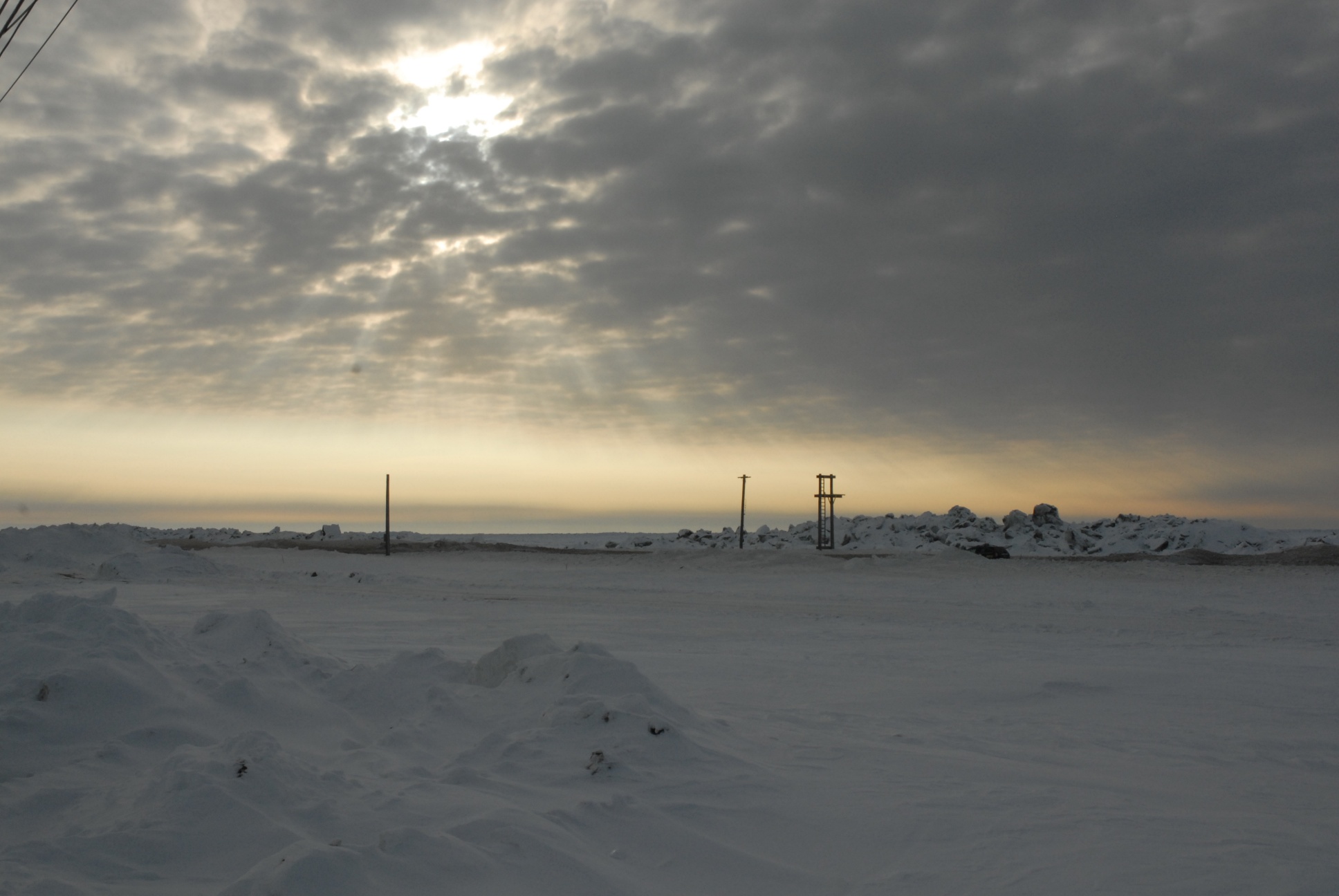
There was a very nice evening sky on the way home.

Sky from NARL. It was actually brighter, but this exposure shows the colors best.

Wrestling with dating

That’s what I’ve been doing lately.  No, not that kind of dating.  I’ve been wrestling with how old sites are, combined with the catching up after travel and working on taxes and other forms, it’s kept me busy enough that blogging kept coming in second to sleep.

I got started on this because I agreed to write a chapter for a forthcoming handbook of arctic archaeology dealing with Western Thule to Late Precontact in Northern & Western AK.  The northern part was fairly easy, since this is where I have been working for years, and I know the literature inside out, and am responsible for most of the C14 dates in that time frame, as it turns out (a lot of the major sites here were excavated before C14 dating was invented) but I needed to brush up a bit on the more southern parts of the area, I felt.  When I started doing that, I realized that terminology was a bit fuzzy (early investigators tended to think the entire sequence had to be present, and to call things, say, “Birnirk” because they thought there must be Birnirk, rather than because there were any diagnostic (types or designs only found in one culture) Birnirk artifacts at the site.

Then it became clear that people were using some artifact types as “index fossils” without being clear that they were really only in use for a limited time period.  So if they found such an artifact in a feature, they assumed the feature was used at the same time as all other features with that artifact in them.  Fairly recent C14 dating of some such artifacts has shown that some are pretty good to use, and others were being made for hundreds of years, so they aren’t really much help.

There is a pretty good dendrochronological (tree ring) series for the southern part of the area, due to Lou Giddings‘ pioneering work.  This has enabled people to date wood, although in some cases the possibility of wood reuse seems not to have been considered thoroughly, and only one log dated in a feature.  Then artifacts and artifacts assemblages (groups of artifacts often found together) found in that feature have been dated from the dendro date, and similar assemblages have been assumed to be about the same age.

Add the fact that there are a number of beach ridge complexes  in the area (Cape Krusenstern, Cape Espenberg), which develop over time.  Once people figured that out, it was a logical (and frequently correct) assumption that maritime-adapted people would choose to live on the ridge closest to the ocean.  From there, it was only a short step to deciding that all features on a particular ridge were fairly close in age.  In fact, as people have started doing more C!4 dating, and understanding how to interpret the dates better, it’s clear that isn’t the case.

As you can see, it’s not a pretty picture.  Add the tendency of earlier researchers to conflate time periods (as they understood they) with archaeological cultures, and things get really confusing.  Since this is a handbook, which one assumes is meant to be around for a while (although come to think of it, the Encyclopedia of Marine Mammals, in which I have a co-authored article, is in a 2nd edition less than seven years after the original came out), one would like to write an article that will not be rendered obsolete immediately.

So….  I’ve been going through the literature actually looking at the details of dates given for sites, dendro, C14 or otherwise, and am evaluating them on 9 different criteria to try to winnow out dates that are really reliable to base the chronology on.  That doesn’t mean other sites/features won’t be mentioned, but it does mean I’ll avoid putting hard dates on them, or using them as a basis to date yet other sites.

This is not fun.  I just hope it’s productive.

Spring comes in a blaze of glory

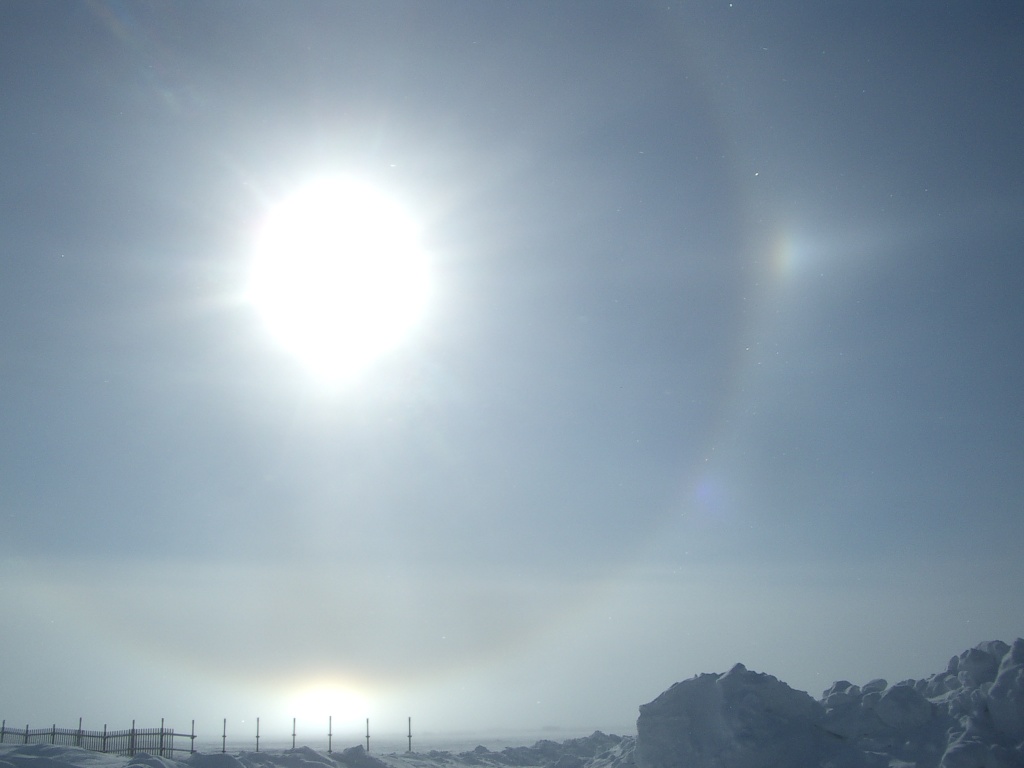
It’s the first day of Piuraagiaqta today.  It’s Barrow’s Spring Festival.  I was sort of stuck in the office working, but it was a gorgeous sunny day, with ice crystals hanging in the air.   I looked up during the afternoon, to see one of the best ice halo displays I have ever seen. I didn’t have a camera with a wide-angle lens, so I could only get part of it in one shot.

Ice halo over Barrow, showing sun with 22º halo, parhelic circle running through the sundog, and the lower tangent arc on the horizon.
Ice halo, showing sun with 22º halo, a parhelic circle through the parhelion (sundog), and an upper tangent arc.

Then my camera battery died.  I didn’t get a good picture of the outer 46º halo.  The whole display looked a lot like the Parry 1820 display.

But just then, as I was turning to go back inside in disappointment, I heard a snow bunting singing!  I couldn’t see him, but he was there, and so I know spring is too.